
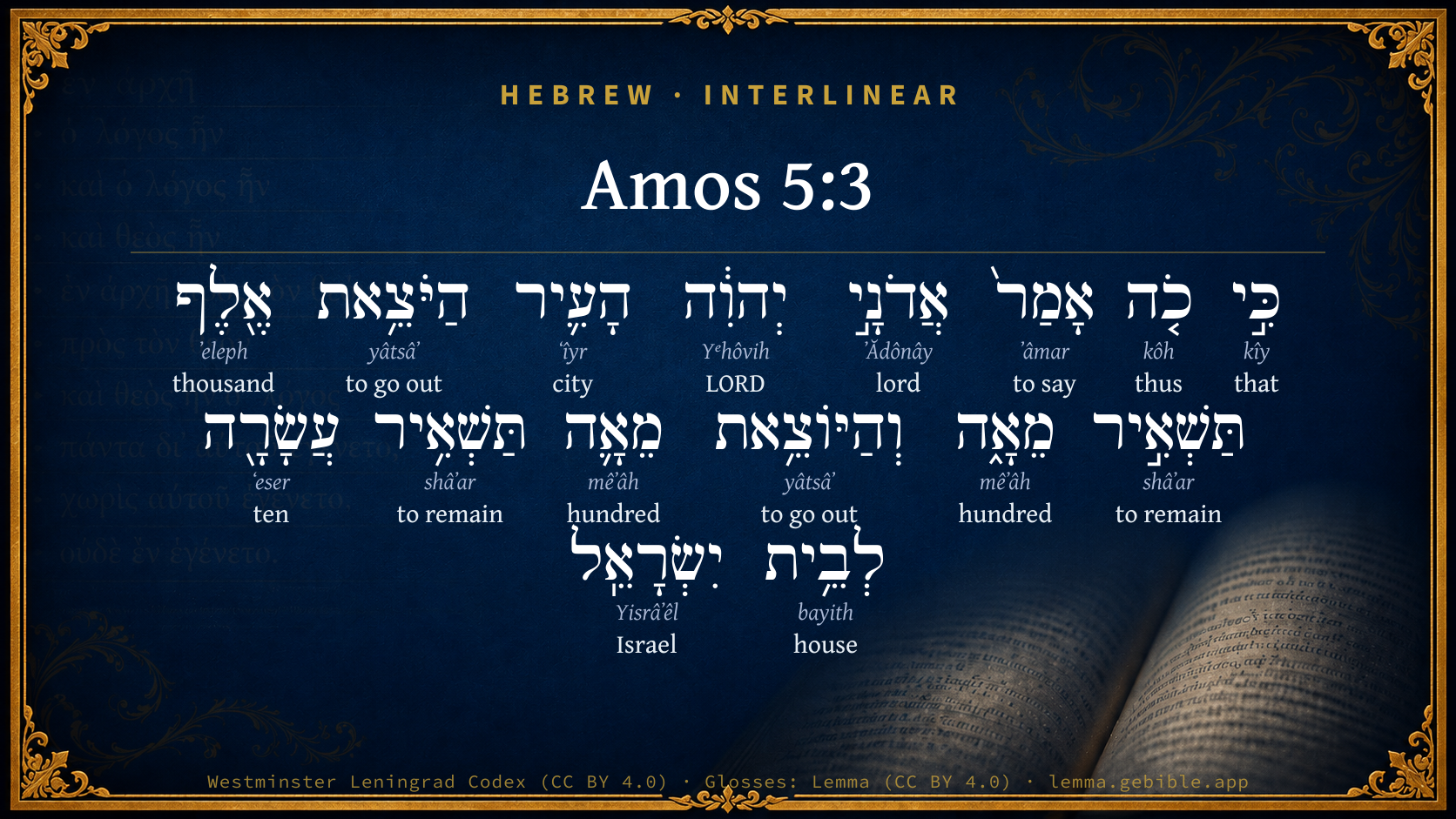
Amos 5:3

Hebrew (Westminster Leningrad Codex) Amos 5:3 appears in the Hebrew Old Testament. The text above is from the Westminster Leningrad Codex. Each word links to its Strong’s number, a concise gloss, and parsing drawn from the Open Scriptures Hebrew Bible morphology. Click any word for its full Brown-Driver-Briggs (BDB) entry.
Download image
Cite this verse

Amos 5:3 (World English Bible). Public Domain. Lemma interlinear Bible study tool, https://lemma.gebible.app/v/amos/5/3.

Show BibTeX & RIS
BibTeX
RIS
English Translation
For thus says the Lord Yahweh: "The city that went forth a thousand shall have a hundred left, And that which went forth one hundred shall have ten left to the house of Israel."
World English Bible · Public Domain
Download a study sheet

One document with this verse’s original text, its word-by-word gloss line, the meaning frame, cross-references with their text, attributed commentary, and full source and license credits — printable, and it pastes into notes with its structure intact.

This verse Autodidact and up

Study sheet (.html) Plain text (.txt)

A passage Seminary Student

Up to 50 verses in one chapter. A passage sheet keeps up to 6 commentary sources and 12 cross-references per verse, in the order this page ranks them, and says so on the sheet whenever that leaves anything out. Ask for a single verse and you get the Autodidact verse sheet above.

Everything on this page stays free to read, with no account — the sheet is a download of what is already on screen, not access to it.

Want to remove ads? Support Godless Engineer
Compare translations 3

The same verse in 3 English versions, stacked beneath the original-language interlinear above. Click any original word for its lexicon entry.

Each is an independent rendering of the whole verse — the interlinear is not word-aligned to these translations.

Highlighted words mark where these versions differ — a whole-verse word diff, not a word-by-word alignment.

  • World English Bible Public Domain
    For thus says the Lord Yahweh: "The city that went forth a thousand shall have a hundred left, And that which went forth one hundred shall have ten left to the house of Israel."
  • King James Version Public Domain
    For thus saith the Lord GOD; The city that went out by a thousand shall leave an hundred, and that which went forth by an hundred shall leave ten, to the house of Israel.
  • unfoldingWord Literal Text CC BY-SA 4.0
    For this is what the Lord Yahweh says: “The city that went out with a thousand will have a hundred left, and the one that went out with a hundred will have ten left belonging to the house of Israel.”

unfoldingWord Literal Text — © unfoldingWord, licensed CC BY-SA 4.0. Word-aligned USFM3 via Door43 (git.door43.org/unfoldingWord/en_ult).

Versions to compare (up to 4)

3 of 4 selected

Show all 18 translations

Every available English version of this verse, each an independent rendering of the whole verse.

  • World English Bible Public Domain
    For thus says the Lord Yahweh: "The city that went forth a thousand shall have a hundred left, And that which went forth one hundred shall have ten left to the house of Israel."
  • Berean Standard Bible Public Domain
    This is what the Lord GOD says: “The city that marches out a thousand strong will only see a hundred return, and the one that marches out a hundred strong will have but ten left in the house of Israel.”
  • Majority Standard Bible Public Domain
    This is what the Lord GOD says: “The city that marches out a thousand strong will have but a hundred left, and the one that marches out a hundred strong will have but ten left in the house of Israel.”
  • King James Version Public Domain
    For thus saith the Lord GOD; The city that went out by a thousand shall leave an hundred, and that which went forth by an hundred shall leave ten, to the house of Israel.
  • American Standard Version (1901) Public Domain
    For thus saith the Lord Jehovah: The city that went forth a thousand shall have a hundred left, and that which went forth a hundred shall have ten left, to the house of Israel.
  • Revised Version (1885) Public Domain
    For thus saith the Lord GOD: The city that went forth a thousand shall have an hundred left, and that which went forth an hundred shall have ten left, to the house of Israel.
  • Geneva Bible (1599) Public Domain
    For thus saith ye Lord God, The citie which went out by a thousand, shall leaue an hundreth: and that which went forth by an hundreth, shall leaue ten to the house of Israel.
  • Douay-Rheims (1899) Public Domain
    For thus saith the Lord God: The city, out of which came forth a thousand, there shall be left in it a hundred: and out of which there came a hundred, there shall be left in it ten, in the house of Israel.
  • Young's Literal Translation Public Domain
    For thus said the Lord Jehovah: The city that is going out a thousand, Doth leave an hundred, And that which is going out an hundred, Doth leave ten to the house of Israel.
  • Literal Standard Version CC BY-SA 4.0
    For thus said Lord YHWH: “The city that is going out one thousand, || Leaves one hundred, || And that which is going out one hundred, || Leaves ten to the house of Israel.”
  • Unlocked Literal Bible CC BY-SA 4.0
    For this is what the Lord Yahweh says: “The city that went out with a thousand will have a hundred left, and the one that went out with a hundred will have ten left belonging to the house of Israel.”
  • unfoldingWord Literal Text CC BY-SA 4.0
    For this is what the Lord Yahweh says: “The city that went out with a thousand will have a hundred left, and the one that went out with a hundred will have ten left belonging to the house of Israel.”
  • Darby Bible Public Domain
    For thus saith the Lord Jehovah: The city that went forth a thousand shall have a hundred left, and that which went forth a hundred shall have ten left, for the house of Israel.
  • World Messianic Bible Public Domain
    For the Lord GOD says: “The city that went out a thousand shall have a hundred left, and that which went out one hundred shall have ten left to the house of Israel.”
  • Webster's Bible Public Domain
    For thus saith the Lord GOD; The city that went out by a thousand shall leave a hundred, and that which went forth by a hundred shall leave ten, to the house of Israel.
  • Free Bible Version CC BY-SA 4.0
    This is what the Lord says: From a city that sends out a thousand soldiers, only a hundred will return; from a city that sends out a hundred soldiers, only ten will return.
  • Bible in Basic English Public Domain
    For these are the words of the Lord God: The town which was able to send out a thousand, will have only a hundred; and that which sent out a hundred, will have only ten, in Israel.
  • JPS Tanakh (1917) Public Domain
    For thus saith the Lord GOD: The city that went forth a thousand shall have a hundred left, and that which went forth a hundred shall have ten left, of the house of Israel.

Literal Standard Version (2020), Covenant Press — licensed CC BY-SA 4.0. Text via the HelloAO Bible API (eBible.org). Unlocked Literal Bible (unfoldingWord) — licensed CC BY-SA 4.0. Text via the HelloAO Bible API (eBible.org). unfoldingWord Literal Text — © unfoldingWord, licensed CC BY-SA 4.0. Word-aligned USFM3 via Door43 (git.door43.org/unfoldingWord/en_ult). Free Bible Version, Dr. Jonathan Gallagher — licensed CC BY-SA 4.0. Text via the HelloAO Bible API (eBible.org).

Word by word

More ways to search: Search by grammar → Find every occurrence → Compare this word →

Practice this passage: Drill this verse → Learn its vocabulary →

תַּשְׁאִ֣יר
shâʼar
H7604
“to remain”
Verb, Hiphil, Imperfect, 3rd Person, Feminine, Singular
Part of Speech
Verb
Stem
Hiphil
Form
Imperfect
Person
3rd Person
Gender
Feminine
Number
Singular
Full BDB Definition

Origin: a primitive root

TWOT: 2307 , 2308

to remain, be left over, be left behind - (Qal) to remain - (Niphal) - to be left over, be left alive, survive - remainder, remnant (participle) - to be left behind - (Hiphil) - to leave over, spare - to leave or keep over - to have left - to leave (as a gift)
  1. כִּ֣י kîy H3588 “that” Conjunction
  2. כֹ֤ה kôh H3541 “thus” Adverb
  3. אָמַר֙ ʼâmar H559 “to say” Verb, Qal, Perfect, 3rd Person, Masculine, Singular
  4. אֲדֹנָ֣י ʼĂdônây H136 “Lord · my” Noun, Common, Masculine, Plural, Construct + Suffix, Personal, 1st Person, Common, Singular
  5. יְהוִ֔ה Yᵉhôvih H3069 “LORD” Noun, Proper
  6. הָעִ֛יר ʻîyr H5892 “the · city” Particle, Definite Article + Noun, Common, Feminine, Singular, Absolute
  7. הַיֹּצֵ֥את yâtsâʼ H3318 “the · going out” Particle, Definite Article + Verb, Qal, Participle Active, Feminine, Singular, Absolute
  8. אֶ֖לֶף ʼeleph H505 “thousand” Adjective, Cardinal number, Both, Singular, Absolute
  9. מֵאָ֑ה mêʼâh H3967 “hundred” Adjective, Cardinal number, Both, Singular, Absolute
  10. וְהַיּוֹצֵ֥את yâtsâʼ H3318 “and · the · going out” Conjunction + Particle, Definite Article + Verb, Qal, Participle Active, Feminine, Singular, Absolute
  11. מֵאָ֛ה mêʼâh H3967 “hundred” Adjective, Cardinal number, Both, Singular, Absolute
  12. תַּשְׁאִ֥יר shâʼar H7604 “to remain” Verb, Hiphil, Imperfect, 3rd Person, Feminine, Singular
  13. עֲשָׂרָ֖ה ʻeser H6235 “ten” Adjective, Cardinal number, Masculine, Singular, Absolute
  14. לְבֵ֥ית bayith H1004 “to/for · house of” Preposition + Noun, Common, Masculine, Singular, Construct
  15. יִשְׂרָאֵֽל Yisrâʼêl H3478 “Israel” Noun, Proper

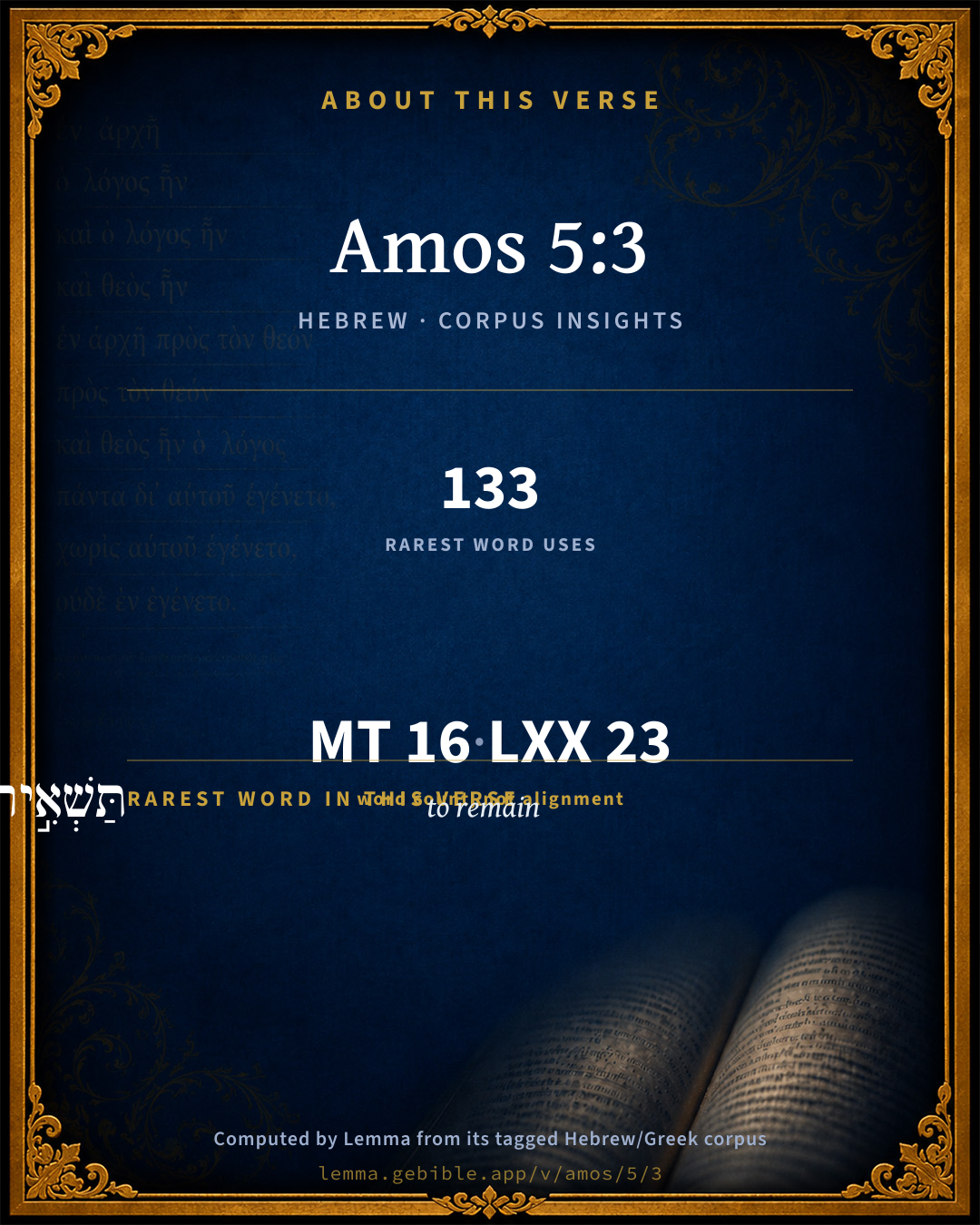
About this verse

These counts appear in no published source. They are computed here, from the morphology-tagged text and Lemma’s own curated glosses. What Lemma adds →

16
words
13
distinct lemmas
Prophets
section

Grammatical profile

  • 5 verbs
  • 5 nouns
  • 4 adjectives
  • 1 conjunction
  • 1 adverb

Verb forms

  • אָמַר֙ Qal · Perfect
  • הַיֹּצֵ֥את Qal · Participle Active
  • תַּשְׁאִ֣יר Hiphil · Imperfect
  • וְהַיּוֹצֵ֥את Qal · Participle Active
  • תַּשְׁאִ֥יר Hiphil · Imperfect

Repetition

Words recur within this verse — often emphatic in Hebrew:

  • הַיֹּצֵ֥את to go out H3318 ×2
  • תַּשְׁאִ֣יר to remain H7604 ×2
  • מֵאָ֑ה hundred H3967 ×2

Hebrew & Septuagint length

In English translation the verse runs 34 words from the Hebrew and 45 from the Septuagint (LXX English) — closely comparable.

A rough comparison of the two English renderings, which tokenize alike — not a word-level alignment.

Word counts can differ between the Hebrew and the Greek without any difference in meaning — e.g. the Hebrew direct-object marker אֵת has no separate Greek word, and Greek often adds the article ὁ.

In the original languages it is 16 Hebrew tokens and 23 Greek tokens — but the two are counted differently (Hebrew bundles its prefixes and suffixes into one token; the Greek is in lemma form), so that isn’t a like-for-like length.

Cross-references

8

Topical passages linked to Amos 5:3 in the Treasury of Scripture Knowledge — connected by theme and wording, ordered by reader-vote popularity; previews shown in the World English Bible.

  • Isaiah 6:13 If there are yet a tenth in it, It also shall in turn be eaten up: As a terebinth, and as an oak, whose stock remains, when they are felled; So the holy seed is its stock."
  • Isaiah 10:22 For though your people, Israel, be as the sand of the sea, [only] a remnant of them shall return: a destruction [is] determined, overflowing with righteousness.
  • Ezekiel 12:16 But I will leave a few men of them from the sword, from the famine, and from the pestilence; that they may declare all their abominations among the nations where they come; and they shall know that I am Yahweh.
  • Romans 9:27 Isaiah cries concerning Israel, "If the number of the children of Israel are as the sand of the sea, It is the remnant who will be saved;
  • Deuteronomy 4:27 Yahweh will scatter you among the peoples, and you shall be left few in number among the nations, where Yahweh shall lead you away.
  • Deuteronomy 28:62 You shall be left few in number, whereas you were as the stars of the sky for multitude; because you didn't listen to the voice of Yahweh your God.
  • Isaiah 1:9 Unless Yahweh of hosts had left to us a very small remnant, We would have been as Sodom; We would have been like Gomorrah.
  • Amos 6:9 It will happen, if there remain ten men in one house, That they shall die.

Cross-references courtesy of OpenBible.info (CC BY 4.0).

Hebrew and Greek witnesses Masoretic Hebrew ↔ Greek Septuagint

The same verse in the two great witnesses to the Old Testament, shown verse-for-verse.

These are two independent witnesses, not word-aligned to each other, and the Septuagint is shown in lemma (dictionary) form.

Hebrew Amos 5:3 Masoretic · Westminster Leningrad Codex

כִּ֣י כֹ֤ה אָמַר֙ אֲדֹנָ֣י יְהוִ֔ה הָעִ֛יר הַיֹּצֵ֥את אֶ֖לֶף תַּשְׁאִ֣יר מֵאָ֑ה וְהַיּוֹצֵ֥את מֵאָ֛ה תַּשְׁאִ֥יר עֲשָׂרָ֖ה לְבֵ֥ית יִשְׂרָאֵֽל

For thus says the Lord Yahweh: "The city that went forth a thousand shall have a hundred left, And that which went forth one hundred shall have ten left to the house of Israel."

World English Bible · Public Domain

Greek LXX Amos 5:3 Septuagint · lemma form

διότι ὅδε λέγω κύριος κύριος ὁ πόλις ἐκ ὅς ἐκπορεύομαι χίλιοι ὑπολείπω ἑκατόν καί ἐκ ὅς ἐκπορεύομαι ἑκατόν ὑπολείπω δέκα ὁ οἶκος ἰσραήλ

Therefore thus says the Lord God; The city out of which there went forth a thousand, in it there shall be left one hundred, and in that out of which there went forth one hundred, there shall be left ten to the house of Israel.

LXX2012 (modern English Septuagint) · Public Domain

On this verse, The Pulpit Commentary discusses the Septuagint’s reading. Read the note in Commentary ↓

Hebrew: Westminster Leningrad Codex (CC BY 4.0). Greek: Septuagint (public domain); English from LXX2012 (modern English Septuagint) (Public Domain). How the Septuagint differs from the Hebrew →

Targum (Aramaic paraphrase)

1

The Targum is the ancient Jewish Aramaic paraphrase of the Hebrew Scriptures — an interpretive translation, not the Hebrew text itself. Onkelos (literal) and Pseudo-Jonathan (expansive) render the Torah, and Jonathan the Prophets. Coverage is partial: where no permissively-licensed English translation exists for a verse, only the Aramaic is shown. This is verse-level text, not a word-by-word alignment to the Hebrew.

  1. Targum Jonathan Prophets (Joshua–Malachi)
    אֲרֵי כִדְנַן אֲמַר יְיָ אֱלֹהִים קַרְתָּא דְיִפְקוּן מִנָהּ אַלְפָא יִשְׁתָּאֲרוּן בָּה מְאָה וּדְיִפְקוּן מִנָה מְאָה יִשְׁתָּאֲרוּן בָּהּ עַד עַסְרָא לְבֵית יִשְׂרָאֵל:

    (no public-domain English translation for this verse)

    Targum Jonathan — Aramaic: “Mikraot Gedolot” (public domain). English: “Sefaria Community Translation” (CC0 1.0 (public-domain dedication)); “London "Chaldee Paraphrase," 1871” (public domain). Text via Sefaria.

Commentary

Notes on Amos 5:3 from classic Christian and Jewish commentators (each source and its license shown beneath its notes). The classic Christian expositions comment on the surrounding passage and are grouped to its opening verse, so a note may address several verses; the Jewish commentaries on the Tanakh (Rashi and others) are per-verse, so they appear only where the commentator wrote on this verse.

Lemma curates 59 commentaries, every one of them public domain or Creative Commons licensed, each selected and text-cleaned for this edition rather than reprinted as found. About our sources →

Trapp's Complete Commentary

John Trapp

Amo 5:3 For thus saith the Lord GOD; The city that went out [by] a thousand shall leave an hundred, and that which went forth [by] an hundred shall leave ten, to the house of Israel.

Ver. 3. The city that went out by a thousand] i.e. That had a thousand inhabitants passing to and fro through the gates, {see Gen 34:24; Gen 23:10, for men love not to be cooped up, or confined to a place, as the Duke of Venice is, but to be travelling and trading} or that can send out a thousand fit to bear arms.

Shall leave an hundred] Here is a woeful decimation, purporting a very great paucity of people; such as was threatened, Deu 28:62, a tenth man only shall be left, if that. Behold the severity of God, and betray not the lives of others by an impenitent continuance in sin. Turn to God, if but for your poor brethren’s sake, that are in danger, or in durance. Hezekiah’s reason to repent is very remarkable, 2Ch 30:9 : "For if ye turn again to the Lord, your brethren and your children shall find compassion before them that lead them captive, so that they shall come again into this land; for the Lord your God is gracious and merciful, and will not turn his face from you, if ye return unto him."

Shall leave ten] Not take ten in a hundred and leave the rest, as the Roman generals used to do in the army, in case of a mutiny. This was fulfilled in that three years’ siege of Samaria, 2Ki 18:10, as afterwards the like occured at Jerusalem, which could hardly be repeopled in Nehemiah’s time, and at this day is but thinly inhabited; there being not a hundred households of Jews to be found there. In our countries, of the abundance of people cometh dearth, which maketh many malcontents to mutter; but in many parts of Turkey, for want of men to till the ground; most of the poor being enforced with victuals and other necessaries to follow their great armies, in their long expeditions; of whom scarce one of ten (saith mine author) ever return home again, there by the way perishing, if not by the enemies’ sword, yet by the wants, intemperateness of the air, or immoderate painstaking.

John Trapp, A Commentary or Exposition upon All the Books of the Old and New Testament (1647–1656) — public domain. Text from a community e-Sword module.

Tyndale Open Study Notes

Tyndale Open Resources

5:3 This verse is a reversal of the promises made in Lev 26:8.

Tyndale Open Study Notes — © Tyndale Open Resources, licensed CC BY-SA 4.0. Text via the HelloAO Bible API.

Geneva Bible (1599)

Geneva Bible translators

Meaning, that the tenth part should scarcely be saved.

Geneva Bible (1599) marginal notes — public domain. Text via Bolls.life.

Jamieson, Fausset & Brown

Robert Jamieson, A. R. Fausset & David Brown

went out by a thousand--that is, "the city from which there used to go out a thousand" equipped for war. "City" is put for "the inhabitants of the city," as in Amo 4:8.

shall leave . . . hundred--shall have only a hundred left, the rest being destroyed by sword and pestilence (Deu 28:62).

Jamieson, Fausset & Brown — Commentary Critical and Explanatory on the Whole Bible (1871) — public domain (CC PDM 1.0). Text via the HelloAO Bible API.

Adam Clarke's Commentary

Verse 3. The city that went out by a thousand] The city that could easily have furnished, on any emergency, a thousand fighting men, can now produce scarcely one hundred-one in ten of the former number; and now of the hundred scarcely ten remain: so reduced was Israel when Shalmaneser besieged and took Samaria, and carried the residue into captivity.

Adam Clarke's Commentary on the Bible (1810–1826) — public domain. Text from a community e-Sword/MySword module.

John Calvin's Commentaries

The Prophet now expresses more clearly what he had before said, — that the kingdom would perish and yet so that the Lord would preserve some remnants. Then as to the body of the people, Israel had fallen; but as to a few remnants they were saved; but they were a small numbers such as the Prophet mentions. We hence see that some hope of mercy was given to God’s chosen people, and that in the meantime destruction was denounced on the whole nation. We have already seen that their wickedness was past hope; it was therefore necessary to announce to them the sentence of final ruin; but it was so done, as not to drive to despair the faithful few, who remained hid among the multitude.

The city then, from which a thousand went forth, shall have a hundred remaining; and the city from which went forth a hundred, shall have ten. Armies were wont formerly to be decimated, when any sedition had been made: but God threatens the Israelites here with a much heavier judgment, that only the tenth part would be saved from ruin. We now then perceive the design of the Prophet. Now this could not alleviate the grief of the people; but the hypocrites were more exasperated, on hearing that few would be saved, and that all hope of deliverance was cut off from them. When, therefore, they saw that God dealt with them with so much severity, envy increased their griefs and more embittered their minds; and this was what the Prophet designed; for it was of no use to apply any solace to the despisers of God: but as God knew that there were some seed remaining among the people, he intended to provide for the miserable, who would have been a hundred times swallowed up with grief, had no mitigation been offered them. The Prophet then directs his discourse to the few, when he says, “In the city from which a thousand had gone forth there will be a hundred; and in that from which a hundred went forth, ten will remain alive.” It now follows —

John Calvin's Commentaries (1540-1563) — public domain. Text from the Calvin Translation Society English edition (1840s-50s) via the Christian Classics Ethereal Library (ccel.org). Calvin's coverage is partial (roughly two-thirds of the Bible); uncommented books and verses are honest gaps, never fabricated. The 19th-century editor's footnotes and remarks are omitted so the notes are faithfully Calvin's own voice.

Ellicott's Commentary for English Readers

(3) Shall leave an hundred.—i.e., shall have an hundred only as a remnant of the thousand who went forth to war. The great cities were to be decimated in the coming struggle with Assyria.

A Bible Commentary for English Readers, edited by Charles John Ellicott (1878–1897) — public domain. Text from a community e-Sword module.

The Cambridge Bible for Schools and Colleges

gen. ed. J. J. S. Perowne

3. The justification of the mournful anticipation of Amo_5:2 : Jehovah has declared that the military strength of the nation will be reduced, by defeat or other causes, to one tenth of what it now is.

The Cambridge Bible for Schools and Colleges (gen. ed. J. J. S. Perowne; Cambridge University Press, 1878–1918) — public domain. Text from a community e-Sword module.

John Gill's Exposition

For thus saith the Lord God,.... This is a reason why there were none to raise her up: since

the city that went out by a thousand shall leave an hundred; that is, the city in which there were a thousand constantly going in and out; or which sent, caused to go out, or furnished, a thousand men upon occasion for war, had only a hundred persons left in it; or there remained but a hundred of the thousand they sent out, the rest being destroyed by one means or another:

and that which went forth by an hundred shall leave ten, to the house of Israel; where there were a hundred persons going out and coming in continually; or which sent out a hundred men to the army to fight their battles had now only ten remaining; to such a small number were they reduced all over the land, so that there were none, or not a number sufficient to raise up Israel to its former state and glory.

John Gill's Exposition of the Whole Bible (1746–1763) — public domain (CC PDM 1.0). Text via the HelloAO Bible API.

Albert Barnes' Notes on the Bible

The city that went out by a thousand - (that is, probably that sent out a thousand fighting men, as the word “went out” is often used for, “went out” to fight,) “shall have” literally, “shall retain, an hundred.” She was to be decimated. Only, the tenth alone was to be reserved alive; the nine-tenths were to be destroyed. And this, alike in larger places and in the small. The city “that went forth an hundred shall retain ten.” Smaller places escape for their obscurity, the larger from their strength and situation. One common doom was to befall all. Out of all that multitude, one tithe alone was to he preserved , “dedicated to God,” that remnant which God always promised to reserve.

Albert Barnes' Notes on the Bible (1834–1885) — public domain. Text from a community e-Sword/MySword module.

Haydock's Catholic Bible Commentary

City, before (Calmet) or after the captivity. It required a long time to fill the cities as they had been. (Haydock) --- When the Assyrians invaded the country, it was greatly reduced. (Calmet)

George Leo Haydock (1774–1849), Haydock's Catholic Family Bible and Commentary, 1859 edition — public domain. Excludes Psalms (Douay-Rheims chapter numbering differs from Protestant) and Deuterocanonical books (Catholic canon only).

Matthew Poole's English Annotations

Thus saith the Lord God: this solemnly attesteth the certainty of the thing.

The city that went out by a thousand, that sent out one thousand soldiers as the quota they were assessed at to help against an invader,

shall leave a hundred; shall lose nine parts of ten, so great shall the slaughter be which the prevailing enemy shall make upon Israel; and here the prophet useth a certain number to express an uncertain; or proverbially, scarce a tenth man shall escape.

That which went forth by a hundred shall leave ten, to the house of Israel; the kingdom of the ten tribes; and this perhaps may refer backward to Jehoahaz’s time, 2Ki 13; to be sure it is fulfilled in the wars of Shalmaneser and the taking Samaria.

Matthew Poole's English Annotations on the Holy Bible (1683–1685) — public domain. Text from a community e-Sword/MySword module.

The Pulpit Commentary

The vindication of the prophet"s lament. The city that went out by a thousand. Septuagint and Vulgate, "from which went forth thousands," or, "a thousand;" i.e. which could send out a thousand warriors to the fight, in such a city only a tenth of the inhabitants shall remain; and this shall happen to small cities as well as great.

The Pulpit Commentary (1880–1919), ed. H.D.M. Spence-Jones & Joseph S. Exell — public domain. Text from a community e-Sword module.

John Wesley's Explanatory Notes

By a thousand - That sent out one thousand soldiers. An hundred - Shall lose nine parts of them.

John Wesley, Explanatory Notes Upon the Whole Bible (1754–1765) — public domain. Text via the GEBible commentary corpus.

unfoldingWord translationNotes

Door43 World Missions Community

The city that went out with a thousand ... the one that went out with a hundred

These phrases refer to any cities that sent out large numbers of soldiers. AT: "Cities that went out with a thousand ... cities that went out with a hundred" (See: Generic Noun Phrases)

The city that went out with a thousand will have a hundred left

The phrases "a thousand" and "a hundred" refer to a thousand soldiers and a hundred soldiers. (See: Assumed Knowledge and Implicit Information)

The city that went out with a thousand

"The city that went out" represents the soldiers of that city going out. It can be stated clearly why they went out. AT: "The city out of which a thousand soldiers went to fight" or "The city that sent out a thousand soldiers to fight" (See: Assumed Knowledge and Implicit Information)

will have a hundred left

"will have a hundred soldiers who have not been killed" or "will have only a hundred soldiers still alive." Here being "left" refers to not being killed by the enemy.

translationWords

Lord Yahweh

house

Israel

unfoldingWord translationNotes — © Distant Shores Media and the Door43 World Missions Community, licensed CC BY-SA 4.0. Source: git.door43.org/Door43/en_tn.

Rashi

Rabbi Shlomo Yitzchaki (Rashi)

that gives forth a thousand Heb. הַיֹּצֵאת, that gives forth a thousand men.

Rashi on the Tanakh — English translations: “The Judaica Press complete Tanach with Rashi, translated by A. J. Rosenberg” (CC BY 4.0); “Pentateuch with Rashi's commentary by M. Rosenbaum and A.M. Silbermann, 1929-1934” (public domain); “The Metsudah Tanach series, Lakewood, N.J” (CC BY 4.0); and “The Book of Joshua, Metsudah Publications, 1997” (CC BY 4.0). Text via Sefaria.

Lesson kit

Teaching starters — assembled from the data on this page, not authored interpretation. Every prompt links to the verse data it draws on. Edit before teaching.

Amos, in the Prophets, opens this verse with 16 words (13 distinct Hebrew lemmas). Its most distinctive word is shâʼar (“to remain”). A historical commentator’s framing appears above. Read the whole chapter for the surrounding context.

Discussion questions

  1. The word shâʼar carries the sense “to remain.” How does it shape the verse?
  2. Isaiah 6:13 shares this passage’s theme. How do the two illuminate each other?
  3. “to go out” occurs 2× in this one verse. What is the effect of the repetition?
  4. These translations render this verse differently; the difference is in the English rendering, not the original. What questions does that raise?
  5. The verb «אָמַר֙» is Qal Perfect. How does its form color the action?
  6. Reading how Trapp's Complete Commentary and Tyndale Open Study Notes read this verse, where do the two commentators agree and where do they part?

Things to notice

Reading settings

Reading text

Shown beneath each verse's original-language words.

Old Testament
Old Testament edition

Read the OT as the Masoretic Hebrew (MT) or the Greek Septuagint (LXX).

English shown for the Greek Septuagint (in the Hebrew ↔ Greek comparison).

Comparing translations? Open the Compare panel on any verse page to stack up to four side by side.