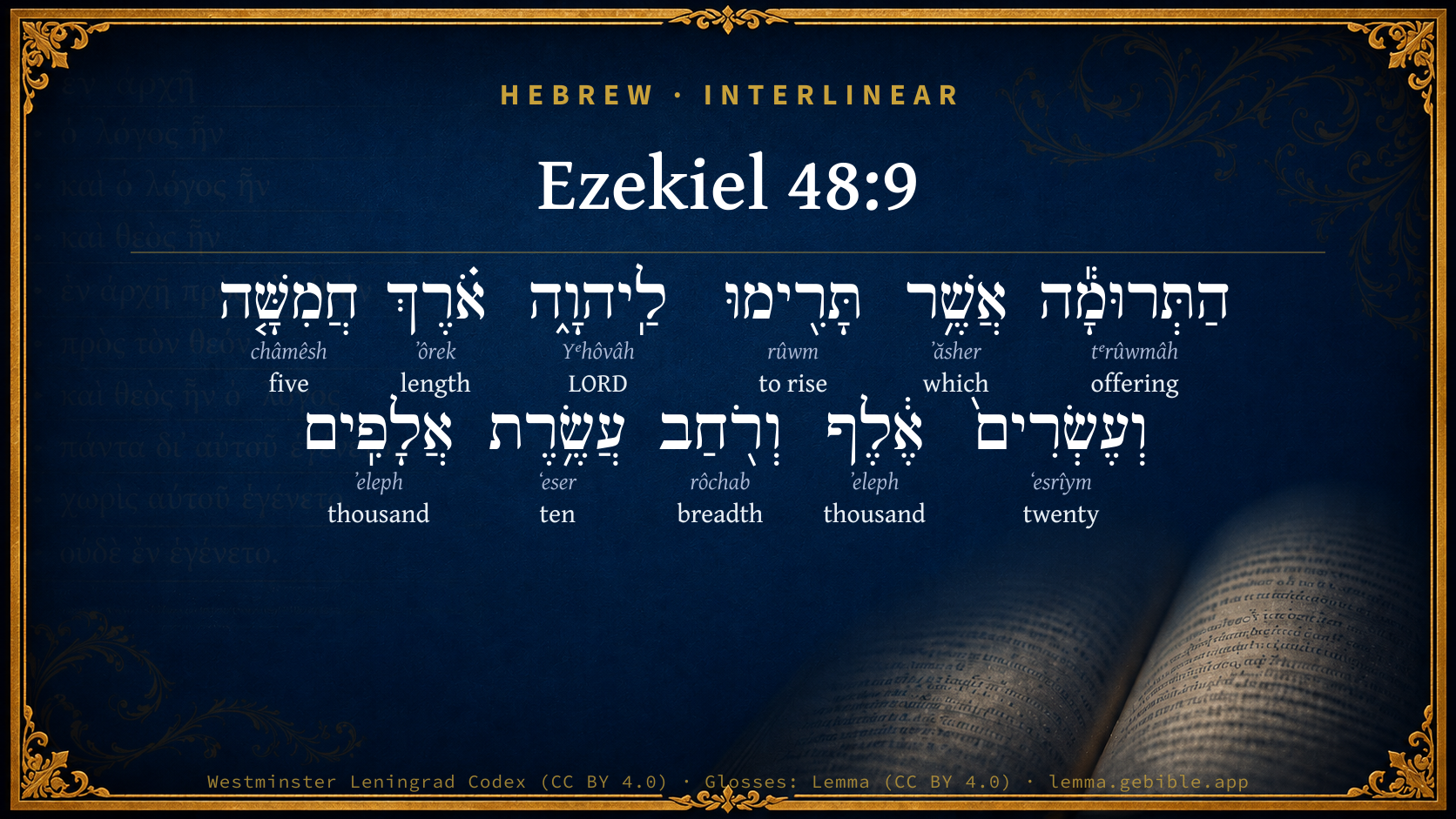
Ezekiel 48:9

Hebrew (Westminster Leningrad Codex) Ezekiel 48:9 appears in the Hebrew Old Testament. The text above is from the Westminster Leningrad Codex. Each word links to its Strong’s number, a concise gloss, and parsing drawn from the Open Scriptures Hebrew Bible morphology. Click any word for its full Brown-Driver-Briggs (BDB) entry.
Download image
Cite this verse

Ezekiel 48:9 (World English Bible). Public Domain. Lemma interlinear Bible study tool, https://lemma.gebible.app/v/ezekiel/48/9.

Show BibTeX & RIS
BibTeX
RIS
English Translation
The offering that you shall offer to Yahweh shall be twenty-five thousand [reeds] in length, and ten thousand in breadth.
World English Bible · Public Domain
Download a study sheet

One document with this verse’s original text, its word-by-word gloss line, the meaning frame, cross-references with their text, attributed commentary, and full source and license credits — printable, and it pastes into notes with its structure intact.

This verse Autodidact and up

Study sheet (.html) Plain text (.txt)

A passage Seminary Student

Up to 50 verses in one chapter. A passage sheet keeps up to 6 commentary sources and 12 cross-references per verse, in the order this page ranks them, and says so on the sheet whenever that leaves anything out. Ask for a single verse and you get the Autodidact verse sheet above.

Everything on this page stays free to read, with no account — the sheet is a download of what is already on screen, not access to it.

Want to remove ads? Support Godless Engineer
Compare translations 3

The same verse in 3 English versions, stacked beneath the original-language interlinear above. Click any original word for its lexicon entry.

Each is an independent rendering of the whole verse — the interlinear is not word-aligned to these translations.

Highlighted words mark where these versions differ — a whole-verse word diff, not a word-by-word alignment.

  • World English Bible Public Domain
    The offering that you shall offer to Yahweh shall be twenty-five thousand [reeds] in length, and ten thousand in breadth.
  • King James Version Public Domain
    The oblation that ye shall offer unto the LORD shall be of five and twenty thousand in length, and of ten thousand in breadth.
  • unfoldingWord Literal Text CC BY-SA 4.0
    This land that you will offer up to Yahweh will be twenty-five thousand cubits in length and ten thousand cubits in width.

unfoldingWord Literal Text — © unfoldingWord, licensed CC BY-SA 4.0. Word-aligned USFM3 via Door43 (git.door43.org/unfoldingWord/en_ult).

Versions to compare (up to 4)

3 of 4 selected

Show all 18 translations

Every available English version of this verse, each an independent rendering of the whole verse.

  • World English Bible Public Domain
    The offering that you shall offer to Yahweh shall be twenty-five thousand [reeds] in length, and ten thousand in breadth.
  • Berean Standard Bible Public Domain
    The special portion you set apart to the LORD shall be 25,000 cubits long and 10,000 cubits wide.
  • Majority Standard Bible Public Domain
    The special portion you set apart to the LORD shall be 25,000 cubits long and 10,000 cubits wide.
  • King James Version Public Domain
    The oblation that ye shall offer unto the LORD shall be of five and twenty thousand in length, and of ten thousand in breadth.
  • American Standard Version (1901) Public Domain
    The oblation that ye shall offer unto Jehovah shall be five and twenty thousand `reeds' in length, and ten thousand in breadth.
  • Revised Version (1885) Public Domain
    The oblation that ye shall offer unto the LORD shall be five and twenty thousand reeds in length, and ten thousand in breadth.
  • Geneva Bible (1599) Public Domain
    The oblation that ye shall offer vnto the Lord, shalbe of fiue and twentie thousande long, and of ten thousand the breadth.
  • Douay-Rheims (1899) Public Domain
    The firstfruits which you shall set apart for the Lord: shall be the length of five and twenty thousand, and the breadth of ten thousand.
  • Young's Literal Translation Public Domain
    The heave-offering that ye lift up to Jehovah `is' five and twenty thousand long, and broad ten thousand.
  • Literal Standard Version CC BY-SA 4.0
    The raised-offering that you lift up to YHWH [is] twenty-five thousand long and ten thousand broad.
  • Unlocked Literal Bible CC BY-SA 4.0
    This land that you will offer up to Yahweh will be twenty-five thousand cubits in length and ten thousand cubits in width.
  • unfoldingWord Literal Text CC BY-SA 4.0
    This land that you will offer up to Yahweh will be twenty-five thousand cubits in length and ten thousand cubits in width.
  • Darby Bible Public Domain
    The heave-offering that ye shall offer unto Jehovah shall be five and twenty thousand in length, and ten thousand in breadth.
  • World Messianic Bible Public Domain
    “The offering that you shall offer to the LORD shall be twenty-five thousand reeds in length, and ten thousand in width.
  • Webster's Bible Public Domain
    The oblation that ye shall offer to the LORD shall be of five and twenty thousand in length, and of ten thousand in breadth.
  • Free Bible Version CC BY-SA 4.0
    The special allocation you make is for the Lord and shall be 25,000 cubits by 10,000 cubits.
  • Bible in Basic English Public Domain
    The offering you will give to the Lord is to be twenty-five thousand long and twenty-five thousand wide.
  • JPS Tanakh (1917) Public Domain
    The offering that ye shall set apart unto the LORD shall be five and twenty thousand reeds in length, and ten thousand in breadth.

Literal Standard Version (2020), Covenant Press — licensed CC BY-SA 4.0. Text via the HelloAO Bible API (eBible.org). Unlocked Literal Bible (unfoldingWord) — licensed CC BY-SA 4.0. Text via the HelloAO Bible API (eBible.org). unfoldingWord Literal Text — © unfoldingWord, licensed CC BY-SA 4.0. Word-aligned USFM3 via Door43 (git.door43.org/unfoldingWord/en_ult). Free Bible Version, Dr. Jonathan Gallagher — licensed CC BY-SA 4.0. Text via the HelloAO Bible API (eBible.org).

Word by word

More ways to search: Search by grammar → Find every occurrence → Compare this word →

Practice this passage: Drill this verse → Learn its vocabulary →

הַתְּרוּמָ֕ה
tᵉrûwmâh
H8641
“the · offering”
Particle, Definite Article + Noun, Common, Feminine, Singular, Absolute
Part of Speech
Particle + Noun
Type
Common
Gender
Feminine
Number
Singular
State
Absolute
Full BDB Definition

Origin: from H7311

TWOT: 2133i

contribution, offering - a heave offering - any offering - an offering to God - an offering (of grain, money, etc) - contribution
  1. אֲשֶׁ֥ר ʼăsher H834 “which” Particle, Relative
  2. תָּרִ֖ימוּ rûwm H7311 “to rise” Verb, Hiphil, Imperfect, 2nd Person, Masculine, Plural
  3. לַֽיהוָ֑ה Yᵉhôvâh H3068 “to/for · LORD” Preposition + Noun, Proper
  4. אֹ֗רֶךְ ʼôrek H753 “length of” Noun, Common, Masculine, Singular, Construct
  5. חֲמִשָּׁ֤ה châmêsh H2568 “five” Adjective, Cardinal number, Masculine, Singular, Absolute
  6. וְעֶשְׂרִים֙ ʻesrîym H6242 “and · twenty” Conjunction + Adjective, Cardinal number, Both, Plural, Absolute
  7. אֶ֔לֶף ʼeleph H505 “thousand” Adjective, Cardinal number, Both, Singular, Absolute
  8. וְרֹ֖חַב rôchab H7341 “and · breadth” Conjunction + Noun, Common, Masculine, Singular, Absolute
  9. עֲשֶׂ֥רֶת ʻeser H6235 “ten” Adjective, Cardinal number, Masculine, Singular, Construct
  10. אֲלָפִֽים ʼeleph H505 “thousand” Adjective, Cardinal number, Both, Plural, Absolute

About this verse

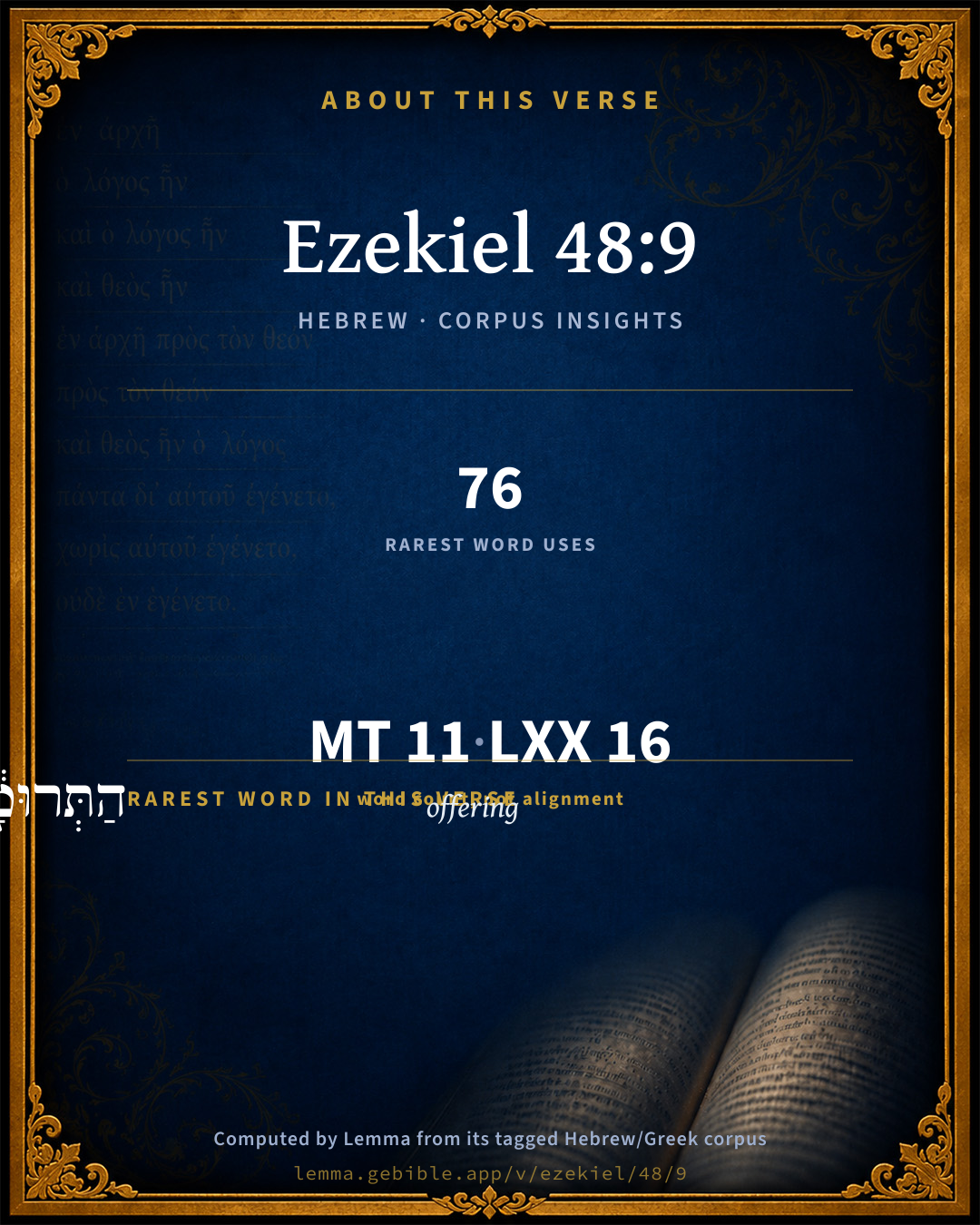
These counts appear in no published source. They are computed here, from the morphology-tagged text and Lemma’s own curated glosses. What Lemma adds →

11
words
10
distinct lemmas
Prophets
section

Grammatical profile

  • 1 verb
  • 4 nouns
  • 5 adjectives
  • 1 particle

Verb forms

  • תָּרִ֖ימוּ Hiphil · Imperfect

Repetition

A word recurs within this verse — often emphatic in Hebrew:

  • אֶ֔לֶף thousand H505 ×2

Hebrew & Septuagint length

In English translation the verse runs 20 words from the Hebrew and 24 from the Septuagint (LXX English) — closely comparable.

A rough comparison of the two English renderings, which tokenize alike — not a word-level alignment.

Word counts can differ between the Hebrew and the Greek without any difference in meaning — e.g. the Hebrew direct-object marker אֵת has no separate Greek word, and Greek often adds the article ὁ.

In the original languages it is 11 Hebrew tokens and 16 Greek tokens — but the two are counted differently (Hebrew bundles its prefixes and suffixes into one token; the Greek is in lemma form), so that isn’t a like-for-like length.

Hebrew and Greek witnesses Masoretic Hebrew ↔ Greek Septuagint

The same verse in the two great witnesses to the Old Testament, shown verse-for-verse.

These are two independent witnesses, not word-aligned to each other, and the Septuagint is shown in lemma (dictionary) form.

Hebrew Ezekiel 48:9 Masoretic · Westminster Leningrad Codex

הַתְּרוּמָ֕ה אֲשֶׁ֥ר תָּרִ֖ימוּ לַֽיהוָ֑ה אֹ֗רֶךְ חֲמִשָּׁ֤ה וְעֶשְׂרִים֙ אֶ֔לֶף וְרֹ֖חַב עֲשֶׂ֥רֶת אֲלָפִֽים

The offering that you shall offer to Yahweh shall be twenty-five thousand [reeds] in length, and ten thousand in breadth.

World English Bible · Public Domain

Greek LXX Ezekiel 48:9 Septuagint · lemma form

ἀπαρχή ὅς ἀποὁρίζω ὁ κύριος μῆκος πέντε καί εἴκοσι χιλιάς καί εὖρος εἴκοσι καί πέντε χιλιάς

As for the first fruits which they shall offer to the Lord, it shall be in length twenty-five thousand, and in breadth twenty-five thousand.

LXX2012 (modern English Septuagint) · Public Domain

On this verse, The Cambridge Bible for Schools and Colleges discusses the Septuagint’s reading. Read the note in Commentary ↓

Hebrew: Westminster Leningrad Codex (CC BY 4.0). Greek: Septuagint (public domain); English from LXX2012 (modern English Septuagint) (Public Domain). How the Septuagint differs from the Hebrew →

Targum (Aramaic paraphrase)

1

The Targum is the ancient Jewish Aramaic paraphrase of the Hebrew Scriptures — an interpretive translation, not the Hebrew text itself. Onkelos (literal) and Pseudo-Jonathan (expansive) render the Torah, and Jonathan the Prophets. Coverage is partial: where no permissively-licensed English translation exists for a verse, only the Aramaic is shown. This is verse-level text, not a word-by-word alignment to the Hebrew.

  1. Targum Jonathan Prophets (Joshua–Malachi)
    אַפְרְשׁוּתָא דִי תִפְרְשׁוּן קֳדָם יְיָ אוּרְכָּא עַסְרִין וְחַמְשָׁא אַלְפִין וּפּוּתְיָא עַסְרָא אַלְפִין:

    (no public-domain English translation for this verse)

    Targum Jonathan — Aramaic: “Mikraot Gedolot” (public domain). English: “Sefaria Community Translation” (CC0 1.0 (public-domain dedication)); “London "Chaldee Paraphrase," 1871” (public domain). Text via Sefaria.

Commentary

Notes on Ezekiel 48:9 from classic Christian and Jewish commentators (each source and its license shown beneath its notes). The classic Christian expositions comment on the surrounding passage and are grouped to its opening verse, so a note may address several verses; the Jewish commentaries on the Tanakh (Rashi and others) are per-verse, so they appear only where the commentator wrote on this verse.

Lemma curates 59 commentaries, every one of them public domain or Creative Commons licensed, each selected and text-cleaned for this edition rather than reprinted as found. About our sources →

The Cambridge Bible for Schools and Colleges

gen. ed. J. J. S. Perowne

9. ten thousand in breadth] LXX. twenty thousand. This reading assumes that Eze_48:9 refers to the portion assigned to priests and Levites together. So Eze_48:13 end. The length E. to W. is 25,000, because the prince’s domain lies between it and the Jordan on the one side, and between it and the sea on the other.

9–12. The domain assigned to the priests. This is mentioned first, not because it actually borders on Judah—the Levites border on Judah—but because it is most important.

The Cambridge Bible for Schools and Colleges (gen. ed. J. J. S. Perowne; Cambridge University Press, 1878–1918) — public domain. Text from a community e-Sword module.

Trapp's Complete Commentary

John Trapp

Eze 48:9 The oblation that ye shall offer unto the LORD [shall be] of five and twenty thousand in length, and of ten thousand in breadth.

Ver. 9. Unto the Lord.] As distinguishing it from other oblations; here stood the sanctuary.

John Trapp, A Commentary or Exposition upon All the Books of the Old and New Testament (1647–1656) — public domain. Text from a community e-Sword module.

Joseph Benson's Commentary

Eze 48:9-10. The oblation ye shall offer unto the Lord — For his sanctuary and priests: see Eze 45:1 : shall be five and twenty thousand in length — See note on Eze 45:3-4. Toward the north five and twenty thousand in length — The dimensions from east to west are called by the name of breadth here, but of length, Eze 48:8, and so they truly are, as may appear from the description given of the whole in the notes on the xlvth chapter. But Houbigant reads this verse more intelligibly, as follows: “Toward the north the length shall be twenty-five thousand cubits; likewise toward the south the length shall be twenty-five thousand cubits; and the breadth toward the east shall be ten thousand cubits; and toward the west ten thousand cubits,” &c.

Joseph Benson's Commentary on the Old and New Testaments (1811–1818) — public domain. Text from a community e-Sword module.

Tyndale Open Study Notes

Tyndale Open Resources

48:9-14 The holy portion was not quite at the exact center of the land; there were seven tribal strips to the north and only five to the south of it. While it was still not exactly central geographically, the spiritual center had apparently moved a significant distance north from where it used to be in Jerusalem. • The importance of the holy portion set aside for the Lord’s Temple is underlined by the detailed description of its dimensions and makeup, in contrast with the brevity of the descriptions of the tribal allocations. This special portion was devoted to God and was never to be sold or traded or used by others. It was made up of strips that ran from east to west and were allocated to the Levites, the priests, and the city. The area for the ordained priests immediately surrounded the Temple and protected it from anything unholy. It was flanked by an area to the north for the Levites.

Tyndale Open Study Notes — © Tyndale Open Resources, licensed CC BY-SA 4.0. Text via the HelloAO Bible API.

Adam Clarke's Commentary

Verse 9. The oblation] This was a portion of land twenty-five thousand cubits in length, by ten thousand broad; in the centre of which was the temple, which must be destined for the use of the priests, the Levites, and the prince.

Adam Clarke's Commentary on the Bible (1810–1826) — public domain. Text from a community e-Sword/MySword module.

John Gill's Exposition

And this oblation of the land that is offered shall be unto them a thing most holy,.... Be peculiarly theirs, and not converted to any other use; but be accounted most sacred, and not alienable, or made use of by other persons, or to other purposes by the border of the Levites; it should be continued, and reach unto their border; or where that should begin, and their part assigned them, which is next considered.

And this oblation of the land that is offered shall be unto them a thing most holy,.... Be peculiarly theirs, and not converted to any other use; but be accounted most sacred, and not alienable, or made use of by other persons, or to other purposes by the border of the Levites; it should be continued, and reach unto their border; or where that should begin, and their part assigned them, which is next considered.

Ezekiel 48:13

eze 48:13

eze 48:13

eze 48:13And over against the border of the priests,.... Next to their border, close to it, running parallel with it:

the Levites shall have five and twenty thousand in length, and ten thousand in breadth; for accommodations for them; for chambers to lodge in, and other uses; all concerned in the house and worship of God shall be provided for with everything necessary and convenient for them; See Gill on Eze 45:5,

all the length shall be five and twenty thousand, and the breadth ten thousand; all the length of the land, both for the priests and Levites, should be five and twenty thousand reeds, and the breadth of the land for both ten thousand reeds: this is repeated for the certainty of it, and to prevent any mistake about it.

John Gill's Exposition of the Whole Bible (1746–1763) — public domain (CC PDM 1.0). Text via the HelloAO Bible API.

Matthew Poole's English Annotations

This verse is the same with Eze 45:3, which see.

Matthew Poole's English Annotations on the Holy Bible (1683–1685) — public domain. Text from a community e-Sword/MySword module.

The Pulpit Commentary

Vers. 9-12 refer to the priests" portion proper, setting forth

(1) its dimensions, 25, 000 reeds along the north and south boundaries from east to west, and 10, 000 reeds from north to south along the east and west sides, so that it should form an oblong or rectangle of 25, 000 10, 000 reeds 548 square (geographical) miles;

(2) its relation to the sanctuary, which should stand in its midst, in this case should occupy the exact geographical center;

(3) its destination, viz. for the priests that are sanctified of the sons of Zadok better than "that which is sanctified is for the priests," as Ewald and Hitzig propose;

(4) its character, most holy; and

(5) its petition, by the border of the Levites, i.e. with the Levites"portion adjoining it, but whether on the north or the south is not stated, and cannot yet be determined (see on ver. 22).

The Pulpit Commentary (1880–1919), ed. H.D.M. Spence-Jones & Joseph S. Exell — public domain. Text from a community e-Sword module.

Rashi

Rabbi Shlomo Yitzchaki (Rashi)

The offering that you shall separate for the Lord From this portion that was separated alongside Judah on their south, whose length is from the east to the sea and whose width is 25,000 rodsfrom it shall be the offering for the Lord for the Sanctuary and a place for houses for the priests, the length 25, 000 rods from east to west and the width 10,000 north to south.

Rashi on the Tanakh — English translations: “The Judaica Press complete Tanach with Rashi, translated by A. J. Rosenberg” (CC BY 4.0); “Pentateuch with Rashi's commentary by M. Rosenbaum and A.M. Silbermann, 1929-1934” (public domain); “The Metsudah Tanach series, Lakewood, N.J” (CC BY 4.0); and “The Book of Joshua, Metsudah Publications, 1997” (CC BY 4.0). Text via Sefaria.

Lesson kit

Teaching starters — assembled from the data on this page, not authored interpretation. Every prompt links to the verse data it draws on. Edit before teaching.

Ezekiel, in the Prophets, opens this verse with 11 words (10 distinct Hebrew lemmas). Its most distinctive word is tᵉrûwmâh (“offering”). A historical commentator’s framing appears above. Read the whole chapter for the surrounding context.

Discussion questions

  1. The word tᵉrûwmâh carries the sense “offering.” How does it shape the verse?
  2. “thousand” occurs 2× in this one verse. What is the effect of the repetition?
  3. These translations render this verse differently. What is at stake in choosing one wording over another?
  4. The verb «תָּרִ֖ימוּ» is Hiphil Imperfect. How does its form color the action?
  5. Reading how The Cambridge Bible for Schools and Colleges and Trapp's Complete Commentary read this verse, where do the two commentators agree and where do they part?

Things to notice

Reading settings

Reading text

Shown beneath each verse's original-language words.

Old Testament
Old Testament edition

Read the OT as the Masoretic Hebrew (MT) or the Greek Septuagint (LXX).

English shown for the Greek Septuagint (in the Hebrew ↔ Greek comparison).

Comparing translations? Open the Compare panel on any verse page to stack up to four side by side.