
Judges 16:27

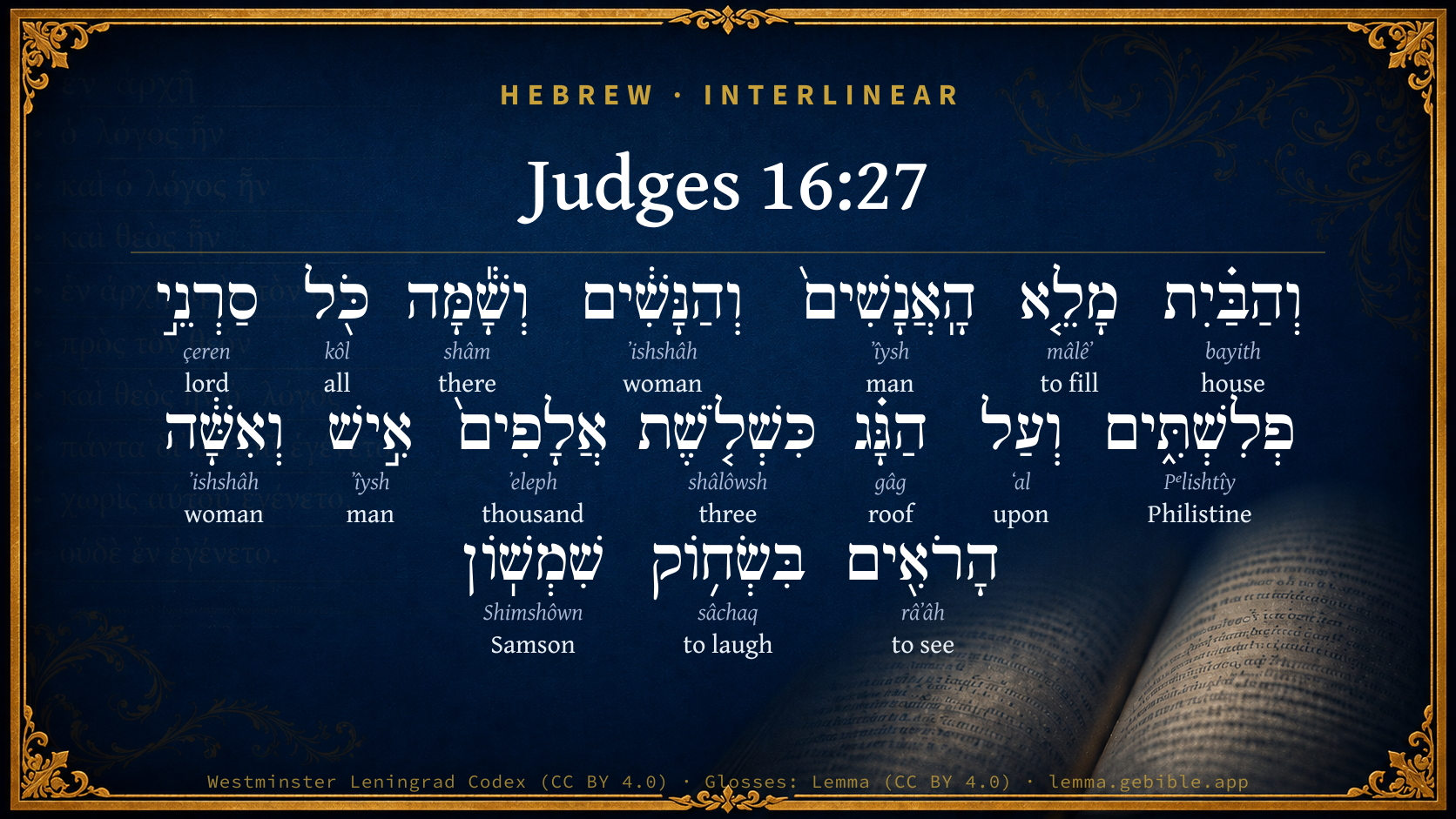
Hebrew (Westminster Leningrad Codex) Judges 16:27 appears in the Hebrew Old Testament. The text above is from the Westminster Leningrad Codex. Each word links to its Strong’s number, a concise gloss, and parsing drawn from the Open Scriptures Hebrew Bible morphology. Click any word for its full Brown-Driver-Briggs (BDB) entry.
Download image
Cite this verse

Judges 16:27 (World English Bible). Public Domain. Lemma interlinear Bible study tool, https://lemma.gebible.app/v/judges/16/27.

Show BibTeX & RIS
BibTeX
RIS
English Translation
Now the house was full of men and women; and all the lords of the Philistines were there; and there were on the roof about three thousand men and women, who saw while Samson made sport.
World English Bible · Public Domain
Download a study sheet

One document with this verse’s original text, its word-by-word gloss line, the meaning frame, cross-references with their text, attributed commentary, and full source and license credits — printable, and it pastes into notes with its structure intact.

This verse Autodidact and up

Study sheet (.html) Plain text (.txt)

A passage Seminary Student

Up to 50 verses in one chapter. A passage sheet keeps up to 6 commentary sources and 12 cross-references per verse, in the order this page ranks them, and says so on the sheet whenever that leaves anything out. Ask for a single verse and you get the Autodidact verse sheet above.

Everything on this page stays free to read, with no account — the sheet is a download of what is already on screen, not access to it.

Want to remove ads? Support Godless Engineer
Compare translations 3

The same verse in 3 English versions, stacked beneath the original-language interlinear above. Click any original word for its lexicon entry.

Each is an independent rendering of the whole verse — the interlinear is not word-aligned to these translations.

Highlighted words mark where these versions differ — a whole-verse word diff, not a word-by-word alignment.

  • World English Bible Public Domain
    Now the house was full of men and women; and all the lords of the Philistines were there; and there were on the roof about three thousand men and women, who saw while Samson made sport.
  • King James Version Public Domain
    Now the house was full of men and women; and all the lords of the Philistines were there; and there were upon the roof about three thousand men and women, that beheld while Samson made sport.
  • unfoldingWord Literal Text CC BY-SA 4.0
    Now the house was full men and women, and all of the lords of the Philistines there, and on the roof about 3, 000 men and women, watching to laughing of Samson.

unfoldingWord Literal Text — © unfoldingWord, licensed CC BY-SA 4.0. Word-aligned USFM3 via Door43 (git.door43.org/unfoldingWord/en_ult).

Versions to compare (up to 4)

3 of 4 selected

Show all 18 translations

Every available English version of this verse, each an independent rendering of the whole verse.

  • World English Bible Public Domain
    Now the house was full of men and women; and all the lords of the Philistines were there; and there were on the roof about three thousand men and women, who saw while Samson made sport.
  • Berean Standard Bible Public Domain
    Now the temple was full of men and women; all the lords of the Philistines were there, and about three thousand men and women were on the roof watching Samson entertain them.
  • Majority Standard Bible Public Domain
    Now the temple was full of men and women; all the lords of the Philistines were there, and about three thousand men and women were on the roof watching Samson entertain them.
  • King James Version Public Domain
    Now the house was full of men and women; and all the lords of the Philistines were there; and there were upon the roof about three thousand men and women, that beheld while Samson made sport.
  • American Standard Version (1901) Public Domain
    Now the house was full of men and women; and all the lords of the Philistines were there; and there were upon the roof about three thousand men and women, that beheld while Samson made sport.
  • Revised Version (1885) Public Domain
    Now the house was full of men and women; and all the lords of the Philistines were there; and there were upon the roof about three thousand men and women, that beheld while Samson made sport.
  • Geneva Bible (1599) Public Domain
    (Nowe the house was full of men and women, and there were all the princes of the Philistims: also vpon the roofe were about three thousande men and women that behelde while Samson played)
  • Douay-Rheims (1899) Public Domain
    Now the house was full of men and women, and all the princes of the Philistines were there. Moreover about three thousand persons of both sexes from the roof and the higher part of the house, were beholding Samson's play.
  • Young's Literal Translation Public Domain
    And the house hath been full of men and of women, and thither `are' all the princes of the Philistines, and on the roof `are' about three thousand men and women, who are looking on the playing of Samson.
  • Literal Standard Version CC BY-SA 4.0
    And the house has been full of the men and the women, and all the princes of the Philistines [are] there, and about three thousand men and women [are] on the roof, who are watching Samson entertain.
  • Unlocked Literal Bible CC BY-SA 4.0
    Now the house was full of men and women. All the rulers of the Philistines were there. There were on the roof about three thousand men and women, who were looking on while Samson was entertaining them.
  • unfoldingWord Literal Text CC BY-SA 4.0
    Now the house was full men and women, and all of the lords of the Philistines there, and on the roof about 3, 000 men and women, watching to laughing of Samson.
  • Darby Bible Public Domain
    Now the house was full of men and women; all the lords of the Philistines were there, and on the roof there were about three thousand men and women, who looked on while Samson made sport.
  • World Messianic Bible Public Domain
    Now the house was full of men and women; and all the lords of the Philistines were there; and there were on the roof about three thousand men and women, who saw while Samson performed.
  • Webster's Bible Public Domain
    Now the house was full of men and women: and all the lords of the Philistines were there: and there were upon the roof about three thousand men and women, that beheld while Samson made sport.
  • Free Bible Version CC BY-SA 4.0
    The temple was full of people. All the Philistine rulers were there, and on the roof were the ordinary people watching what Samson was doing.
  • Bible in Basic English Public Domain
    Now the house was full of men and women; and all the lords of the Philistines were there; and about three thousand men and women were on the roof, looking on while Samson made sport.
  • JPS Tanakh (1917) Public Domain
    Now the house was full of men and women; and all the lords of the Philistines were there; and there were upon the roof about three thousand men and women, that beheld while Samson made sport.

Literal Standard Version (2020), Covenant Press — licensed CC BY-SA 4.0. Text via the HelloAO Bible API (eBible.org). Unlocked Literal Bible (unfoldingWord) — licensed CC BY-SA 4.0. Text via the HelloAO Bible API (eBible.org). unfoldingWord Literal Text — © unfoldingWord, licensed CC BY-SA 4.0. Word-aligned USFM3 via Door43 (git.door43.org/unfoldingWord/en_ult). Free Bible Version, Dr. Jonathan Gallagher — licensed CC BY-SA 4.0. Text via the HelloAO Bible API (eBible.org).

Word by word

More ways to search: Search by grammar → Find every occurrence → Compare this word →

Practice this passage: Drill this verse → Learn its vocabulary →

סַרְנֵ֣י
çeren
H5633
“lords of”
Noun, Common, Masculine, Plural, Construct
Part of Speech
Noun
Type
Common
Gender
Masculine
Number
Plural
State
Construct
Full BDB Definition

Origin: from an unused root of uncertain meaning

TWOT: 1546 , 1547

lord, ruler, tyrant - axle
  1. וְהַבַּ֗יִת bayith H1004 “and · the · house” Conjunction + Particle, Definite Article + Noun, Common, Masculine, Singular, Absolute
  2. מָלֵ֤א mâlêʼ H4390 “to fill” Verb, Qal, Perfect, 3rd Person, Masculine, Singular
  3. הָֽאֲנָשִׁים֙ ʼîysh H376 “the · men” Particle, Definite Article + Noun, Common, Masculine, Plural, Absolute
  4. וְהַנָּשִׁ֔ים ʼishshâh H802 “and · the · women” Conjunction + Particle, Definite Article + Noun, Common, Feminine, Plural, Absolute
  5. וְשָׁ֕מָּה shâm H8033 “and · there · toward” Conjunction + Adverb + Suffix, Demonstrative
  6. כֹּ֖ל kôl H3605 “all of” Noun, Common, Masculine, Singular, Construct
  7. פְלִשְׁתִּ֑ים Pᵉlishtîy H6430 “Philistines” Noun, Gentilic, Masculine, Plural, Absolute
  8. וְעַל ʻal H5921 “and · upon” Conjunction + Preposition
  9. הַגָּ֗ג gâg H1406 “the · roof” Particle, Definite Article + Noun, Common, Masculine, Singular, Absolute
  10. כִּשְׁלֹ֤שֶׁת shâlôwsh H7969 “like/as · three” Preposition + Adjective, Cardinal number, Masculine, Singular, Construct
  11. אֲלָפִים֙ ʼeleph H505 “thousand” Adjective, Cardinal number, Both, Plural, Absolute
  12. אִ֣ישׁ ʼîysh H376 “man” Noun, Common, Masculine, Singular, Absolute
  13. וְאִשָּׁ֔ה ʼishshâh H802 “and · woman” Conjunction + Noun, Common, Feminine, Singular, Absolute
  14. הָרֹאִ֖ים râʼâh H7200 “the · seeing” Particle, Definite Article + Verb, Qal, Participle Active, Masculine, Plural, Absolute
  15. בִּשְׂח֥וֹק sâchaq H7832 “in/at · to laugh” Preposition + Verb, Qal, Infinitive Construct
  16. שִׁמְשֽׁוֹן Shimshôwn H8123 “Samson” Noun, Proper

About this verse

These counts appear in no published source. They are computed here, from the morphology-tagged text and Lemma’s own curated glosses. What Lemma adds →

17
words
15
distinct lemmas
Historical
section

Notable vocabulary

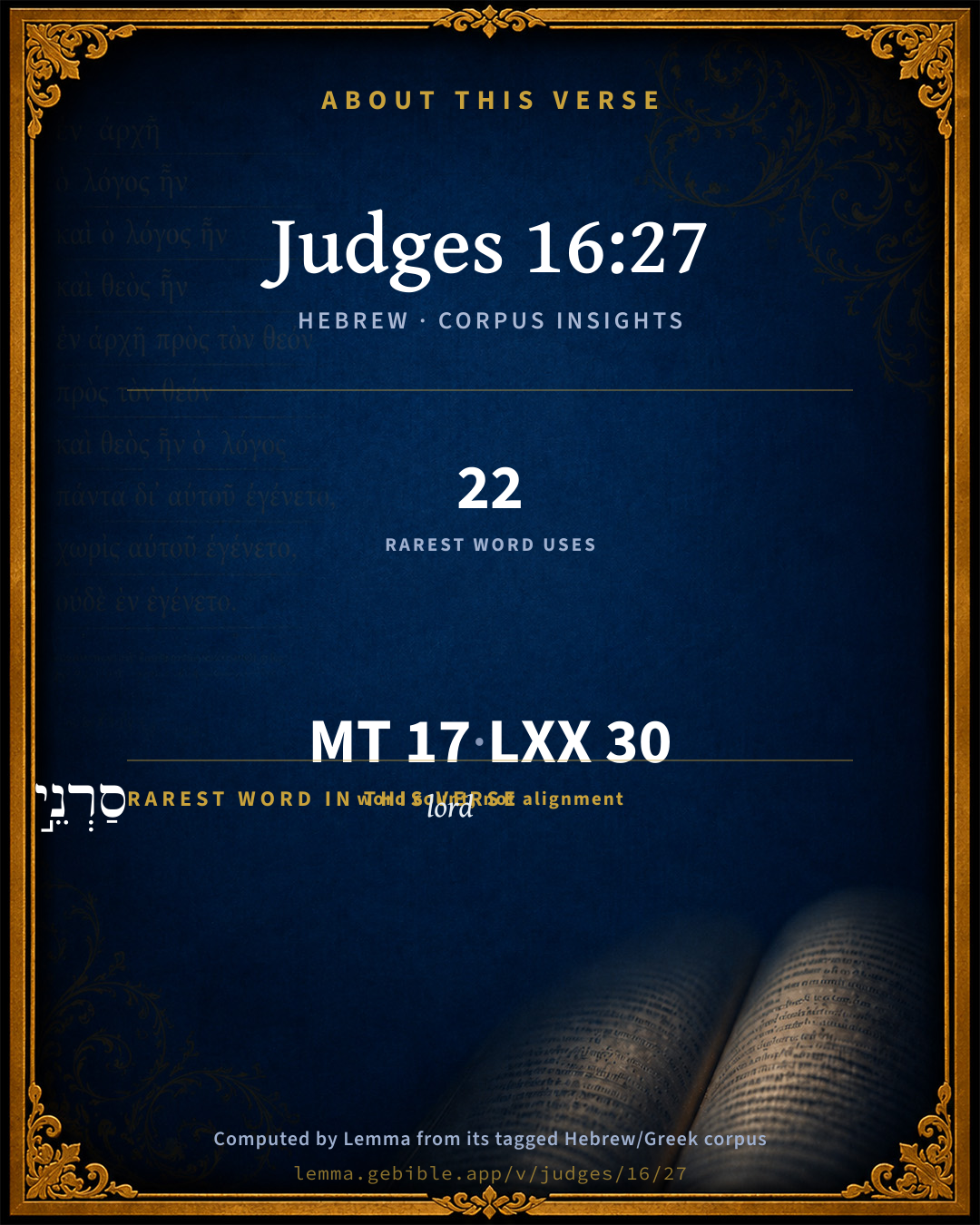
The rarest word here is סַרְנֵ֣י lord H5633 — appearing just 22 times in the whole Hebrew Bible.

Shared distinctive vocabulary

סַרְנֵ֣י lord H5633 occurs in 20 verses of the Hebrew Bible. Also found in:

Grammatical profile

  • 3 verbs
  • 10 nouns
  • 2 adjectives
  • 1 preposition
  • 1 adverb

Verb forms

  • מָלֵ֤א Qal · Perfect
  • הָרֹאִ֖ים Qal · Participle Active
  • בִּשְׂח֥וֹק Qal · Infinitive Construct

Repetition

Words recur within this verse — often emphatic in Hebrew:

  • הָֽאֲנָשִׁים֙ man H376 ×2
  • וְהַנָּשִׁ֔ים woman H802 ×2

Hebrew & Septuagint length

In English translation the verse runs 36 words from the Hebrew and 35 from the Septuagint (LXX English) — closely comparable.

A rough comparison of the two English renderings, which tokenize alike — not a word-level alignment.

Word counts can differ between the Hebrew and the Greek without any difference in meaning — e.g. the Hebrew direct-object marker אֵת has no separate Greek word, and Greek often adds the article ὁ.

In the original languages it is 17 Hebrew tokens and 30 Greek tokens — but the two are counted differently (Hebrew bundles its prefixes and suffixes into one token; the Greek is in lemma form), so that isn’t a like-for-like length.

Cross-references

4

Topical passages linked to Judges 16:27 in the Treasury of Scripture Knowledge — connected by theme and wording, ordered by reader-vote popularity; previews shown in the World English Bible.

  • Deuteronomy 22:8 When you build a new house, then you shall make a battlement for your roof, that you don't bring blood on your house, if any man fall from there.
  • Joshua 2:8 Before they were laid down, she came up to them on the roof;
  • 2 Samuel 11:2 It happened at evening, that David arose from off his bed, and walked on the roof of the king's house: and from the roof he saw a woman bathing; and the woman was very beautiful to look on.
  • Judges 9:51 But there was a strong tower within the city, and there fled all the men and women, and all they of the city, and shut themselves in, and got them up to the roof of the tower.

Cross-references courtesy of OpenBible.info (CC BY 4.0).

Hebrew and Greek witnesses Masoretic Hebrew ↔ Greek Septuagint

The same verse in the two great witnesses to the Old Testament, shown verse-for-verse.

These are two independent witnesses, not word-aligned to each other, and the Septuagint is shown in lemma (dictionary) form.

Hebrew Judges 16:27 Masoretic · Westminster Leningrad Codex

וְהַבַּ֗יִת מָלֵ֤א הָֽאֲנָשִׁים֙ וְהַנָּשִׁ֔ים וְשָׁ֕מָּה כֹּ֖ל סַרְנֵ֣י פְלִשְׁתִּ֑ים וְעַל הַגָּ֗ג כִּשְׁלֹ֤שֶׁת אֲלָפִים֙ אִ֣ישׁ וְאִשָּׁ֔ה הָרֹאִ֖ים בִּשְׂח֥וֹק שִׁמְשֽׁוֹן

Now the house was full of men and women; and all the lords of the Philistines were there; and there were on the roof about three thousand men and women, who saw while Samson made sport.

World English Bible · Public Domain

Greek LXX Judges 16:27 Septuagint · lemma form

καί ὁ οἶκος πλήρης ὁ ἀνήρ καί ὁ γυνή καί ἐκεῖ πᾶς ὁ ἄρχων ὁ ἀλλόφυλος καί ἐπί ὁ δῶμα ὡς ἑπτακόσιοι ἀνήρ καί γυνή ὁ θεωρέω ἐν παιγνία σαμψων

And the house was full of men and women, and there were all the chiefs of the Philistines, and on the roof were about three thousand men and women looking at the sports of Sampson.

LXX2012 (modern English Septuagint) · Public Domain

On this verse, The Cambridge Bible for Schools and Colleges discusses the Septuagint’s reading. Read the note in Commentary ↓

Hebrew: Westminster Leningrad Codex (CC BY 4.0). Greek: Septuagint (public domain); English from LXX2012 (modern English Septuagint) (Public Domain). How the Septuagint differs from the Hebrew →

Targum (Aramaic paraphrase)

1

The Targum is the ancient Jewish Aramaic paraphrase of the Hebrew Scriptures — an interpretive translation, not the Hebrew text itself. Onkelos (literal) and Pseudo-Jonathan (expansive) render the Torah, and Jonathan the Prophets. Coverage is partial: where no permissively-licensed English translation exists for a verse, only the Aramaic is shown. This is verse-level text, not a word-by-word alignment to the Hebrew.

  1. Targum Jonathan Prophets (Joshua–Malachi)
    וּבֵיתָא מָלֵי גַבְרַיָא וּנְשַׁיָא וְתַמָן כָּל טוּרְנֵי פְלִישְׁתָּאֵי וְעַל אִגְרָא כִּתְלָתָא אַלְפִין גַבְרָא וְאִתְּתָא דְחָזָן בְּחוֹכָא דְשִׁמְשׁוֹן:

    (no public-domain English translation for this verse)

    Targum Jonathan — Aramaic: “Mikraot Gedolot” (public domain). English: “Sefaria Community Translation” (CC0 1.0 (public-domain dedication)); “London "Chaldee Paraphrase," 1871” (public domain). Text via Sefaria.

Commentary

Notes on Judges 16:27 from classic Christian and Jewish commentators (each source and its license shown beneath its notes). The classic Christian expositions comment on the surrounding passage and are grouped to its opening verse, so a note may address several verses; the Jewish commentaries on the Tanakh (Rashi and others) are per-verse, so they appear only where the commentator wrote on this verse.

Lemma curates 59 commentaries, every one of them public domain or Creative Commons licensed, each selected and text-cleaned for this edition rather than reprinted as found. About our sources →

Trapp's Complete Commentary

John Trapp

Jdg 16:27 Now the house was full of men and women; and all the lords of the Philistines [were] there; and [there were] upon the roof about three thousand men and women, that beheld while Samson made sport.

Ver. 27. Now the house.] Dagon’s temple: that where they had sinned, there they might suffer. So Ahab’s blood was licked up by dogs in the place where he had slain Naboth. {1Ki 21:19} So Henry III of France was stabbed to death in that very chamber where he had contrived the massacre of Paris.

Was full of men and women.] Assembled they were, by an overruling Providence, that they might be "broken in pieces." {Isa 8:9} So were the Baalites in mount Carmel, {1Ki 18:40} and afterwards in the house of their god, to be slain by Jehu. And so were the refractory Jews besieged and taken by the Romans at the feast of the Passover, when they were met together out of all parts of the land.

John Trapp, A Commentary or Exposition upon All the Books of the Old and New Testament (1647–1656) — public domain. Text from a community e-Sword module.

Joseph Benson's Commentary

Jdg 16:27. There were upon the roof, &c. — The roof was flat, and had windows, through which they might see what was done in the lower parts of the house.

Joseph Benson's Commentary on the Old and New Testaments (1811–1818) — public domain. Text from a community e-Sword module.

Geneva Bible (1599)

Geneva Bible translators

Or, was mocked.

Geneva Bible (1599) marginal notes — public domain. Text via Bolls.life.

Jamieson, Fausset & Brown

Robert Jamieson, A. R. Fausset & David Brown

HIS DEATH. (Jdg 16:26-31)

there were upon the roof about three thousand men and women, that beheld while Samson made sport--This building seems to have been similar to the spacious and open amphitheaters well known among the Romans and still found in many countries of the East. They are built wholly of wood. The standing place for the spectators is a wooden floor resting upon two pillars and rising on an inclined plane, so as to enable all to have a view of the area in the center. In the middle there are two large beams, on which the whole weight of the structure lies, and these beams are supported by two pillars placed almost close to each other, so that when these are unsettled or displaced, the whole pile must tumble to the ground.

Jamieson, Fausset & Brown — Commentary Critical and Explanatory on the Whole Bible (1871) — public domain (CC PDM 1.0). Text via the HelloAO Bible API.

Adam Clarke's Commentary

Verse 27. Now the house was full of men] It was either the prison-house, house of assembly, or a temple of Dagon, raised on pillars, open on all sides, and flat-roofed, so that it could accommodate a multitude of people on the top.

Adam Clarke's Commentary on the Bible (1810–1826) — public domain. Text from a community e-Sword/MySword module.

Ellicott's Commentary for English Readers

(27) The house was full of men and women . . . upon the roof about three thousand men and women.—The words for “men and women” in the first clause are anashim and nashim, and in the second eesh and eeshsha. The more distinguished people were with the lords in the house itself; the common people were on the flat roof.

There were upon the roof.—The temple may have been like a Turkish kiosk, “a spacious hall, of which the roof rested in front upon four columns, two of them standing at the ends, and two close together in the centre. Under this hall the chief Philistines celebrated a sacrificial meal, whilst the people were assembled above upon the top of the roof, which was surrounded by a balustrade” (Faber, Archäol. d. Hebr., quoted by Keil). “His puissant locks,” as Milton says, “sternly shook thunder with ruin upon the heads of those his evil counsellors, but not without great affliction to himself.” In the life of Samson and the incidents of Judges 18 we find the chief illustrations of the character of his tribe as described in Jacob’s blessing Gen_49:16-17). Hence, perhaps, he is called Bedan in 1Sa_12:11, if we follow the improbable gloss of the Targum in making the word there mean a Danite.

A Bible Commentary for English Readers, edited by Charles John Ellicott (1878–1897) — public domain. Text from a community e-Sword module.

The Cambridge Bible for Schools and Colleges

gen. ed. J. J. S. Perowne

27. and all the lords … three thousand men and women] No doubt an insertion to heighten the effect; grammatically full of men and women is carried on by that beheld, shewing that the intervening words are not original. No mention of the people on the roof is made in Jdg_16:30. The LXX. cod. B has 70 for 3000.

The Cambridge Bible for Schools and Colleges (gen. ed. J. J. S. Perowne; Cambridge University Press, 1878–1918) — public domain. Text from a community e-Sword module.

John Gill's Exposition

Now the house was full of men and women,.... Within it, who were gathered together from all parts of the city, and perhaps from other places on this occasion:

and all the lords of the Philistines were there; their five lords, the lords of Gaza, Ashdod, Ashkelon, Gath, and Ekron:

and there were upon the roof three thousand men and women; it being a flat roof, as the houses in Canaan and Phoenicia, and the places adjacent, were; see Deu 22:8 and there might be some openings or windows in several parts of it, through which the people might see who were below them, and were within the house, and what was doing there, and particularly could have a sight of Samson through them as follows:

that beheld while Samson made sport; or was made a sport of; while he was buffeted and used in a ludicrous manner.

John Gill's Exposition of the Whole Bible (1746–1763) — public domain (CC PDM 1.0). Text via the HelloAO Bible API.

Haydock's Catholic Bible Commentary

Play. It is not clear from the text, whether the 3000 were distinct from those who were below. It seems this is the number of all the slain, (Calmet) as Josephus asserts. But the Protestants insert, "the lords of the Philistines were there: and there were upon the roof," &c., which shews that they understand it in the same sense as the Vulgate and the Septuagint which distinguish these outside spectators from those who filled the house, and were in company with the princes. (Haydock)

George Leo Haydock (1774–1849), Haydock's Catholic Family Bible and Commentary, 1859 edition — public domain. Excludes Psalms (Douay-Rheims chapter numbering differs from Protestant) and Deuterocanonical books (Catholic canon only).

Matthew Poole's English Annotations

The roof, after the manner of the times, was flat, and had windows through which they might see what was done in the lower parts of the house.

Matthew Poole's English Annotations on the Holy Bible (1683–1685) — public domain. Text from a community e-Sword/MySword module.

Whedon's Commentary on the Bible

Daniel D. Whedon

27. Upon the roof about three thousand — A roof one hundred and fifty feet square would afford a space of nearly a square yard for each one of these, and probably the roof of this building was still larger than this.

Daniel D. Whedon (gen. ed.), Commentary on the Old and New Testaments (1874–1909) — public domain. Text from a community e-Sword module.

The Pulpit Commentary

Now the house was full, etc. We do not know what was the construction of Philistine temples or houses of amusement; but from the description here given it seems that the interior was ranged like an amphitheatre, with seats for the lords and principal people, and with an open front, so as to command a view of the stage just outside, and that front supported by pillars on which the beams of the roof, both the transverse beam and the longitudinal ones running into it, rested. The roof itself was fiat, and had the weight of 3000 people upon it, throwing a great strain upon the beams which rested upon the pillars. The sudden removal of the pillars would bring the roof down at that end, crowded as it was with the people, and would inevitably drag the whole mass in the same direction one over another, while the swaying of the people would bring the whole roof down upon the heads of those beneath, who would be crushed by the heavy timbers and stones and bodies of men falling upon them.

The Pulpit Commentary (1880–1919), ed. H.D.M. Spence-Jones & Joseph S. Exell — public domain. Text from a community e-Sword module.

John Wesley's Explanatory Notes

The roof - Which was flat, and had window's through which they might see what was done in the lower parts of the house.

John Wesley, Explanatory Notes Upon the Whole Bible (1754–1765) — public domain. Text via the GEBible commentary corpus.

unfoldingWord translationNotes

Door43 World Missions Community

Now

This word is used here to mark a break in the main story while the writer tells background information. (See: Background Information)

three thousand men and women

"3,000 men and women" (See: Numbers)

looking on

"watching"

while Samson was entertaining them

It is unclear what Samson did to entertain them. It seems the Philistines were making him do things that would humiliate him so that they could make fun of him.

translationWords

rule

Philistines

unfoldingWord translationNotes — © Distant Shores Media and the Door43 World Missions Community, licensed CC BY-SA 4.0. Source: git.door43.org/Door43/en_tn.

Lesson kit

Teaching starters — assembled from the data on this page, not authored interpretation. Every prompt links to the verse data it draws on. Edit before teaching.

Judges, in the Historical, opens this verse with 17 words (15 distinct Hebrew lemmas). Its most distinctive word is çeren (“lord”). A historical commentator’s framing appears above. Read the whole chapter for the surrounding context.

Discussion questions

  1. How does “lord” (çeren) shape what this verse is saying?
  2. Joshua 13:3 shares the word «lord» with this verse. How do the two illuminate each other?
  3. “man” occurs 2× in this one verse. What is the effect of the repetition?
  4. The translations on this page render this verse differently — a whole-verse word diff, not a word-by-word alignment. What might account for the different wordings?
  5. The verb «מָלֵ֤א» is Qal Perfect. How does its form color the action?
  6. Reading how Trapp's Complete Commentary and Joseph Benson's Commentary read this verse, where do the two commentators agree and where do they part?

Things to notice

Reading settings

Reading text

Shown beneath each verse's original-language words.

Old Testament
Old Testament edition

Read the OT as the Masoretic Hebrew (MT) or the Greek Septuagint (LXX).

English shown for the Greek Septuagint (in the Hebrew ↔ Greek comparison).

Comparing translations? Open the Compare panel on any verse page to stack up to four side by side.