
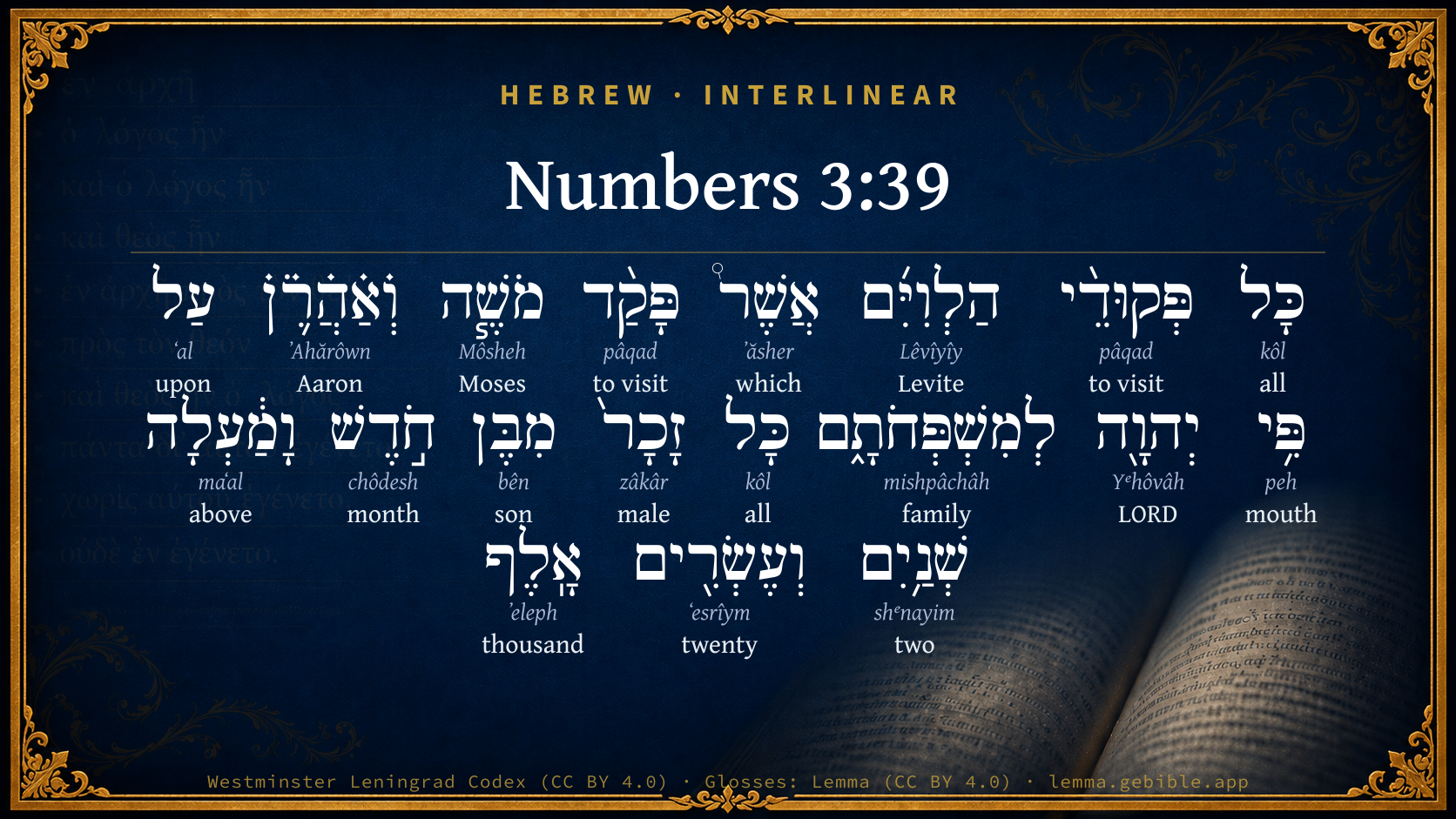
Numbers 3:39

Hebrew (Westminster Leningrad Codex) Numbers 3:39 appears in the Hebrew Old Testament. The text above is from the Westminster Leningrad Codex. Each word links to its Strong’s number, a concise gloss, and parsing drawn from the Open Scriptures Hebrew Bible morphology. Click any word for its full Brown-Driver-Briggs (BDB) entry.
Download image
Cite this verse

Numbers 3:39 (World English Bible). Public Domain. Lemma interlinear Bible study tool, https://lemma.gebible.app/v/numbers/3/39.

Show BibTeX & RIS
BibTeX
RIS
English Translation
All who were numbered of the Levites, whom Moses and Aaron numbered at the commandment of Yahweh, by their families, all the males from a month old and upward, were twenty-two thousand.
World English Bible · Public Domain
Download a study sheet

One document with this verse’s original text, its word-by-word gloss line, the meaning frame, cross-references with their text, attributed commentary, and full source and license credits — printable, and it pastes into notes with its structure intact.

This verse Autodidact and up

Study sheet (.html) Plain text (.txt)

A passage Seminary Student

Up to 50 verses in one chapter. A passage sheet keeps up to 6 commentary sources and 12 cross-references per verse, in the order this page ranks them, and says so on the sheet whenever that leaves anything out. Ask for a single verse and you get the Autodidact verse sheet above.

Everything on this page stays free to read, with no account — the sheet is a download of what is already on screen, not access to it.

Want to remove ads? Support Godless Engineer
Compare translations 3

The same verse in 3 English versions, stacked beneath the original-language interlinear above. Click any original word for its lexicon entry.

Each is an independent rendering of the whole verse — the interlinear is not word-aligned to these translations.

Highlighted words mark where these versions differ — a whole-verse word diff, not a word-by-word alignment.

  • World English Bible Public Domain
    All who were numbered of the Levites, whom Moses and Aaron numbered at the commandment of Yahweh, by their families, all the males from a month old and upward, were twenty-two thousand.
  • King James Version Public Domain
    All that were numbered of the Levites, which Moses and Aaron numbered at the commandment of the LORD, throughout their families, all the males from a month old and upward, were twenty and two thousand.
  • unfoldingWord Literal Text CC BY-SA 4.0
    All the counted ones of the Levites whom Moses and Aaron counted upon the mouth of Yahweh, according to their clans, every male from a son of a month and upward, 22,000.

unfoldingWord Literal Text — © unfoldingWord, licensed CC BY-SA 4.0. Word-aligned USFM3 via Door43 (git.door43.org/unfoldingWord/en_ult).

Versions to compare (up to 4)

3 of 4 selected

Show all 18 translations

Every available English version of this verse, each an independent rendering of the whole verse.

  • World English Bible Public Domain
    All who were numbered of the Levites, whom Moses and Aaron numbered at the commandment of Yahweh, by their families, all the males from a month old and upward, were twenty-two thousand.
  • Berean Standard Bible Public Domain
    The total number of Levites that Moses and Aaron counted by their clans at the LORD’s command, including all the males a month old or more, was 22,000.
  • Majority Standard Bible Public Domain
    The total number of Levites that Moses and Aaron counted by their clans at the LORD’s command, including all the males a month old or more, was 22,000.
  • King James Version Public Domain
    All that were numbered of the Levites, which Moses and Aaron numbered at the commandment of the LORD, throughout their families, all the males from a month old and upward, were twenty and two thousand.
  • American Standard Version (1901) Public Domain
    All that were numbered of the Levites, whom Moses and Aaron numbered at the commandment of Jehovah, by their families, all the males from a month old and upward, were twenty and two thousand.
  • Revised Version (1885) Public Domain
    All that were numbered of the Levites, which Moses and Aaron numbered at the commandment of the LORD, by their families, all the males from a month old and upward, were twenty and two thousand.
  • Geneva Bible (1599) Public Domain
    The wholesumme of ye Leuites, which Moses and Aaron nombred at the commandement of the Lord throughout their families, euen al the males from a moneth olde and aboue, was two and twentie thousand.
  • Douay-Rheims (1899) Public Domain
    All the Levites, that Moses and Aaron numbered according to the precept of the Lord, by their families, of the male kind from one month and upward, were twenty-two thousand.
  • Young's Literal Translation Public Domain
    All those numbered of the Levites whom Moses numbered -- Aaron also -- by the command of Jehovah, by their families, every male from a son of a month and upward, `are' two and twenty thousand.
  • Literal Standard Version CC BY-SA 4.0
    All those numbered of the Levites whom Moses numbered—Aaron also—by the command of YHWH, by their families, every male from a son of a month and upward, [are] twenty-two thousand.
  • Unlocked Literal Bible CC BY-SA 4.0
    Moses and Aaron counted all the males in the clans of Levi who were aged one month old and older, just as Yahweh commanded. They counted twenty-two thousand men.
  • unfoldingWord Literal Text CC BY-SA 4.0
    All the counted ones of the Levites whom Moses and Aaron counted upon the mouth of Yahweh, according to their clans, every male from a son of a month and upward, 22,000.
  • Darby Bible Public Domain
    All that were numbered of the Levites, whom Moses and Aaron numbered at the commandment of Jehovah, according to their families, all the males from a month old and upward, were twenty-two thousand.
  • World Messianic Bible Public Domain
    All who were counted of the Levites, whom Moses and Aaron counted at the commandment of the LORD, by their families, all the males from a month old and upward, were twenty-two thousand.
  • Webster's Bible Public Domain
    All that were numbered of the Levites, whom Moses and Aaron numbered at the commandment of the LORD, throughout their families, all the males from a month old and upward, were twenty and two thousand.
  • Free Bible Version CC BY-SA 4.0
    The sum total of Levites registered by Moses and Aaron as the Lord ordered was 22,000. This included all males aged one month or older.
  • Bible in Basic English Public Domain
    All the Levites numbered by Moses and Aaron at the order of the Lord, all the males of one month old and over numbered in the order of their families, were twenty-two thousand.
  • JPS Tanakh (1917) Public Domain
    All that were numbered of the Levites, whom Moses and Aaron numbered at the commandment of the LORD, by their families, all the males from a month old and upward, were twenty and two thousand.

Literal Standard Version (2020), Covenant Press — licensed CC BY-SA 4.0. Text via the HelloAO Bible API (eBible.org). Unlocked Literal Bible (unfoldingWord) — licensed CC BY-SA 4.0. Text via the HelloAO Bible API (eBible.org). unfoldingWord Literal Text — © unfoldingWord, licensed CC BY-SA 4.0. Word-aligned USFM3 via Door43 (git.door43.org/unfoldingWord/en_ult). Free Bible Version, Dr. Jonathan Gallagher — licensed CC BY-SA 4.0. Text via the HelloAO Bible API (eBible.org).

Word by word

More ways to search: Search by grammar → Find every occurrence → Compare this word →

Practice this passage: Drill this verse → Learn its vocabulary →

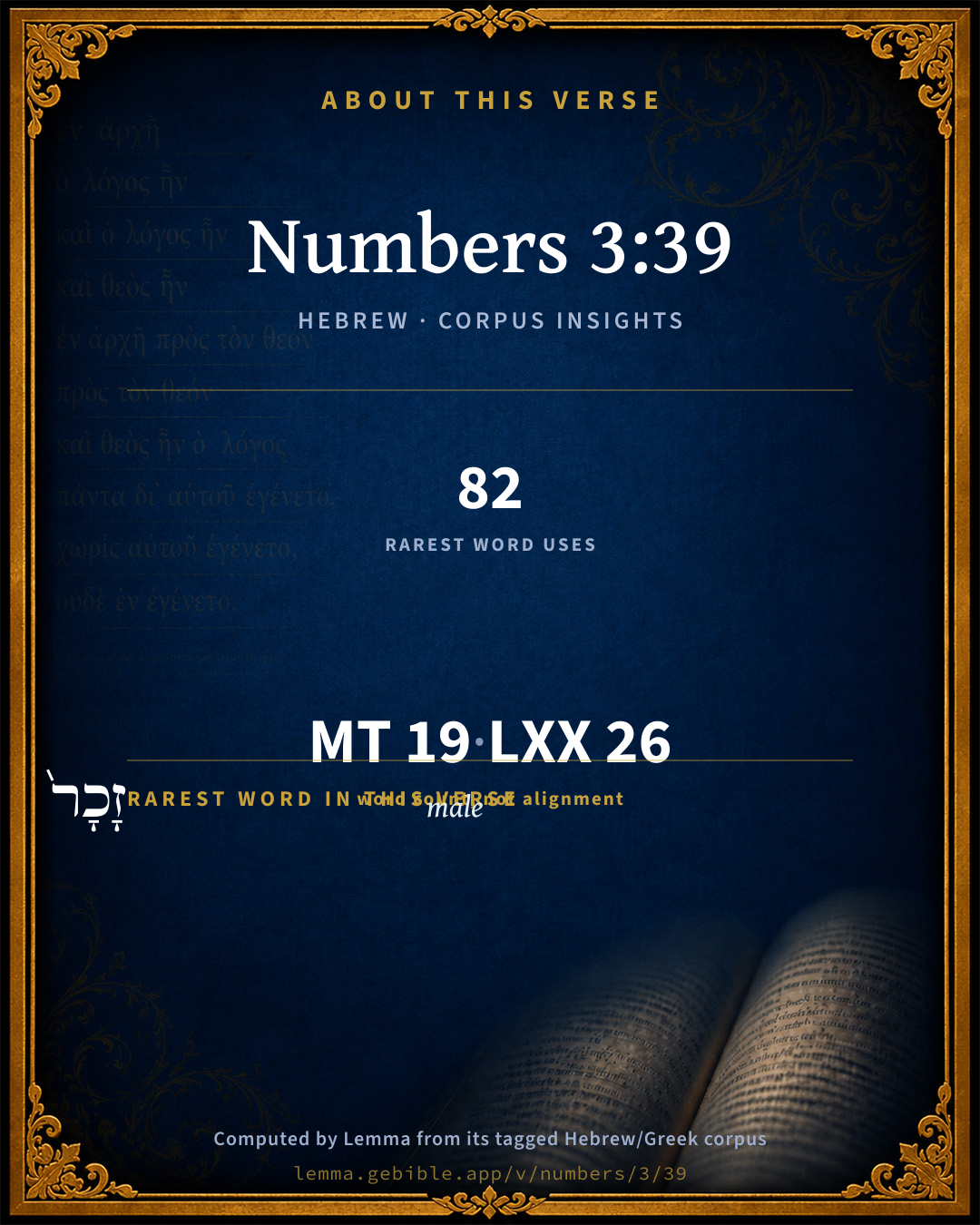
זָכָר֙
zâkâr
H2145
“male”
Adjective, Adjective, Masculine, Singular, Absolute
Part of Speech
Adjective
Type
Adjective
Gender
Masculine
Number
Singular
State
Absolute
Full BDB Definition

Origin: from H2142

TWOT: 551e

male (of humans and animals) (noun masculine) - male (of humans) (adjective)
  1. כָּל kôl H3605 “all of” Noun, Common, Masculine, Singular, Construct
  2. פְּקוּדֵ֨י pâqad H6485 “visited” Verb, Qal, Participle Passive, Masculine, Plural, Construct
  3. הַלְוִיִּ֜ם Lêvîyîy H3881 “the · Levites” Particle, Definite Article + Noun, Gentilic, Masculine, Plural, Absolute
  4. אֲשֶׁר֩ ʼăsher H834 “which” Particle, Relative
  5. פָּקַ֨ד pâqad H6485 “to visit” Verb, Qal, Perfect, 3rd Person, Masculine, Singular
  6. מֹשֶׁ֧ה Môsheh H4872 “Moses” Noun, Proper
  7. וְׄאַׄהֲׄרֹ֛ׄןׄ ʼAhărôwn H175 “and · Aaron” Conjunction + Noun, Proper
  8. עַל ʻal H5921 “upon” Preposition
  9. פִּ֥י peh H6310 “mouth of” Noun, Common, Masculine, Singular, Construct
  10. יְהוָ֖ה Yᵉhôvâh H3068 “LORD” Noun, Proper
  11. לְמִשְׁפְּחֹתָ֑ם mishpâchâh H4940 “to/for · families · their” Preposition + Noun, Common, Feminine, Plural, Construct + Suffix, Personal, 3rd Person, Masculine, Plural
  12. כָּל kôl H3605 “all of” Noun, Common, Masculine, Singular, Construct
  13. מִבֶּן bên H1121 “from · son of” Preposition + Noun, Common, Masculine, Singular, Construct
  14. חֹ֣דֶשׁ chôdesh H2320 “month” Noun, Common, Masculine, Singular, Absolute
  15. וָמַ֔עְלָה maʻal H4605 “and · above · toward” Conjunction + Adverb + Suffix, Demonstrative
  16. שְׁנַ֥יִם shᵉnayim H8147 “two” Adjective, Cardinal number, Masculine, Dual, Absolute
  17. וְעֶשְׂרִ֖ים ʻesrîym H6242 “and · twenty” Conjunction + Adjective, Cardinal number, Both, Plural, Absolute
  18. אָֽלֶף ʼeleph H505 “thousand” Adjective, Cardinal number, Both, Singular, Absolute

About this verse

These counts appear in no published source. They are computed here, from the morphology-tagged text and Lemma’s own curated glosses. What Lemma adds →

19
words
17
distinct lemmas
Pentateuch
section

Grammatical profile

  • 2 verbs
  • 10 nouns
  • 4 adjectives
  • 1 preposition
  • 1 adverb
  • 1 particle

Verb forms

  • פְּקוּדֵ֨י Qal · Participle Passive
  • פָּקַ֨ד Qal · Perfect

Repetition

Words recur within this verse — often emphatic in Hebrew:

  • כָּל all H3605 ×2
  • פְּקוּדֵ֨י to visit H6485 ×2

Hebrew & Septuagint length

In English translation the verse runs 32 words from the Hebrew and 34 from the Septuagint (LXX English) — closely comparable.

A rough comparison of the two English renderings, which tokenize alike — not a word-level alignment.

Word counts can differ between the Hebrew and the Greek without any difference in meaning — e.g. the Hebrew direct-object marker אֵת has no separate Greek word, and Greek often adds the article ὁ.

In the original languages it is 19 Hebrew tokens and 26 Greek tokens — but the two are counted differently (Hebrew bundles its prefixes and suffixes into one token; the Greek is in lemma form), so that isn’t a like-for-like length.

Cross-references

3

Topical passages linked to Numbers 3:39 in the Treasury of Scripture Knowledge — connected by theme and wording, ordered by reader-vote popularity; previews shown in the World English Bible.

  • Numbers 26:62 Those who were numbered of them were twenty-three thousand, every male from a month old and upward: for they were not numbered among the children of Israel, because there was no inheritance given them among the children of Israel.
  • Numbers 4:47–48 from thirty years old and upward even to fifty years old, everyone who entered in to do the work of service, and the work of bearing burdens in the Tent of Meeting,
  • Matthew 7:14 How narrow is the gate, and restricted is the way that leads to life! Few are those who find it.

Cross-references courtesy of OpenBible.info (CC BY 4.0).

Hebrew and Greek witnesses Masoretic Hebrew ↔ Greek Septuagint

The same verse in the two great witnesses to the Old Testament, shown verse-for-verse.

These are two independent witnesses, not word-aligned to each other, and the Septuagint is shown in lemma (dictionary) form.

Hebrew Numbers 3:39 Masoretic · Westminster Leningrad Codex

כָּל פְּקוּדֵ֨י הַלְוִיִּ֜ם אֲשֶׁר֩ פָּקַ֨ד מֹשֶׁ֧ה וְׄאַׄהֲׄרֹ֛ׄןׄ עַל פִּ֥י יְהוָ֖ה לְמִשְׁפְּחֹתָ֑ם כָּל זָכָר֙ מִבֶּן חֹ֣דֶשׁ וָמַ֔עְלָה שְׁנַ֥יִם וְעֶשְׂרִ֖ים אָֽלֶף

All who were numbered of the Levites, whom Moses and Aaron numbered at the commandment of Yahweh, by their families, all the males from a month old and upward, were twenty-two thousand.

World English Bible · Public Domain

Greek LXX Numbers 3:39 Septuagint · lemma form

πᾶς ὁ ἐπίσκεψις ὁ λευίτης ὅς ἐπισκέπτω μωυσῆς καί ἀαρών διά φωνή κύριος κατά δῆμος αὐτός πᾶς ἀρσενικός ἀπό μηνιαῖος καί ἐπάνω δύο καί εἴκοσι χιλιάς

All the numbering of the Levites, whom Moses and Aaron numbered by the word of the Lord, according to their families, every male from a month old and upwards, were two and twenty thousand.

LXX2012 (modern English Septuagint) · Public Domain

Hebrew: Westminster Leningrad Codex (CC BY 4.0). Greek: Septuagint (public domain); English from LXX2012 (modern English Septuagint) (Public Domain). How the Septuagint differs from the Hebrew →

Targum (Aramaic paraphrase)

2

The Targum is the ancient Jewish Aramaic paraphrase of the Hebrew Scriptures — an interpretive translation, not the Hebrew text itself. Onkelos (literal) and Pseudo-Jonathan (expansive) render the Torah, and Jonathan the Prophets. Coverage is partial: where no permissively-licensed English translation exists for a verse, only the Aramaic is shown. This is verse-level text, not a word-by-word alignment to the Hebrew.

  1. Targum Onkelos Torah (Genesis–Deuteronomy)
    כָּל מִנְיָנֵי לֵוָאֵי דִי מְנָא משֶׁה וְאַהֲרֹן עַל מֵימְרָא דַיְיָ לְזַרְעֲיַתְהוֹן כָּל דְכוּרָא מִבַּר יַרְחָא וּלְעֵלָא עַשְׂרִין וּתְרֵין אַלְפִין

    (no public-domain English translation for this verse)

    Targum Onkelos — Aramaic: “Onkelos Genesis” (public domain); “Onkelos Exodus” (public domain); “Onkelos Leviticus” (public domain); “Onkelos Numbers” (public domain); “Onkelos Deuteronomy” (public domain). English: “Sefaria Community Translation” (CC0 1.0 (public-domain dedication)); “J.W. Etheridge. The Targums of Onkelos and Jonathan Ben Uzziel on the Pentateuch. London: Longmans, Green, 1862” (public domain). Text via Sefaria.

  2. Targum Pseudo-Jonathan Torah (Genesis–Deuteronomy)
    כָּל סְכוּמֵי מִנְיָנֵי לֵיוָאֵי דִי מְנָא משֶׁה וְאַהֲרן עַל פּוּם מֵימְרָא דַיְיָ לִגְנִיסַתְהוֹן כָּל דְכוּרָא מִבַּר יַרְחָא וּלְעֵילָא עַשְרִין וּתְרֵין אַלְפִין

    The sum of the Levites whom Mosheh and Aharon numbered by the mouth of the Word of the Lord was twenty-two thousand.

    Targum Pseudo-Jonathan — Aramaic: “Targum Jonathan on Genesis” (public domain); “Targum Jonathan on Exodus” (public domain); “Targum Jonathan on Leviticus” (public domain); “Targum Jonathan on Numbers” (public domain); “Targum Jonathan on Deuteronomy” (public domain). English: “The Targum of Jonathan ben Uzziel, trans. J. W. Etheridge, London, 1862” (public domain). Text via Sefaria.

Commentary

Notes on Numbers 3:39 from classic Christian and Jewish commentators (each source and its license shown beneath its notes). The classic Christian expositions comment on the surrounding passage and are grouped to its opening verse, so a note may address several verses; the Jewish commentaries on the Tanakh (Rashi and others) are per-verse, so they appear only where the commentator wrote on this verse.

Lemma curates 59 commentaries, every one of them public domain or Creative Commons licensed, each selected and text-cleaned for this edition rather than reprinted as found. About our sources →

Joseph Benson's Commentary

Num 3:39. Two and twenty thousand — If the particular numbers mentioned (Num 3:22; Num 3:28; Num 3:34) be put together, they make twenty-two thousand three hundred. But the odd three hundred are omitted here, either according to the use of the Holy Scripture, where in so great numbers small ones are commonly neglected, or because they were the firstborn of the Levites, and therefore belonged to God already, and so could not be given to him again instead of the other firstborn. If this number of firstborn seem small to come from twenty-two thousand Levites, it must be considered, that only such firstborn are here named as were males, and such as continued in their parents’ families, not such as had erected new families of their own. Add to this, that God so ordered things by his wise providence, for divers weighty reasons, that this tribe should be much the least of all the tribes, as is evident by comparing the numbers of the other tribes, from twenty years old, (Numbers 1.,) with the number of this from a month old; and therefore it is not strange if the number of their firstborn be less than in other tribes.

Joseph Benson's Commentary on the Old and New Testaments (1811–1818) — public domain. Text from a community e-Sword module.

Tyndale Open Study Notes

Tyndale Open Resources

3:39 22,000: The numbers listed for each clan (3:22, 28, 34) add up to 22,300. See study note on 3:28.

Tyndale Open Study Notes — © Tyndale Open Resources, licensed CC BY-SA 4.0. Text via the HelloAO Bible API.

Geneva Bible (1599)

Geneva Bible translators

So that the firstborn of the children of Israel were more by 273, as verse 43.

Geneva Bible (1599) marginal notes — public domain. Text via Bolls.life.

Jamieson, Fausset & Brown

Robert Jamieson, A. R. Fausset & David Brown

twenty and two thousand--The result of this census, though made on conditions most advantageous to Levi, proved it to be by far the smallest in Israel. The separate numbers stated in Num 3:22, Num 3:28, Num 3:34, when added together, amount to twenty-two thousand three hundred. The omission of the three hundred is variously accounted for--by some, because they might be first-born who were already devoted to God and could not be counted as substitutes; and by others, because in Scripture style, the sum is reckoned in round numbers. The most probable conjecture is, that as Hebrew letters are employed for figures, one letter was, in the course of transcription, taken for another of like form but smaller value.

Jamieson, Fausset & Brown — Commentary Critical and Explanatory on the Whole Bible (1871) — public domain (CC PDM 1.0). Text via the HelloAO Bible API.

Adam Clarke's Commentary

Verse 39. Which Moses and Aaron numbered] The word ואהרן veaharon, "and Aaron." has a point over each of its letters, probably designed as a mark of spuriousness. The word is wanting in the Samaritan, Syriac, and Coptic; it is wanting also in eight of Dr. Kennicott's MSS., and in four of De Rossi's. Moses alone, as Houbigant observes, is commanded to take the number of the Levites; see Nu 3:5; Nu 3:11; Nu 3:40; Nu 3:44; Nu 3:51.

All the males - were twenty and two thousand.] This total does not agree with the particulars; for the Gershonites were 7,500, the Kohathites 8,600, the Merarites 6,200, total 22,300. Several methods of solving this difficulty have been proposed by learned men; Dr. Kennicott's is the most simple. Formerly the numbers in the Hebrew Bible were expressed by letters, and not by words at full length; and if two nearly similar letters were mistaken for each other, many errors in the numbers must be the consequence. Now it is probable that an error has crept into the number of the Gershonites, Nu 3:22, where, instead of 7,500, we should read 7,200, as ך caph, 500, might have been easily mistaken for ר resh, 200, especially if the down stroke of the caph had been a little shorter than ordinary, which is often the case in MSS. The extra 300 being taken off, the total is just 22,000, as mentioned in the 39th verse.

Adam Clarke's Commentary on the Bible (1810–1826) — public domain. Text from a community e-Sword/MySword module.

Ellicott's Commentary for English Readers

(39) And Aaron . . . —In the Hebrew text the word Aaron has certain marks over it, known as puncta extraordinaria, denoting that it is to be regarded as spurious or doubtful. It is omitted in the Samaritan and Syriac versions and in a few MSS. There appears. however, to be no sufficient reason for its rejection from the text.

Twenty and two thousand.—The total of the three several items—viz., 7,500, 8,600, and 6,200—amounts to 22,300. It appears, however, from Num_3:46 that the total is correctly given as 22,000, inasmuch as the number of the firstborn, 22,273, exceeded that of the Levites by 273. It has been suggested that in Num_3:28 we should read שלש (shalosh), three, for שׁש (shesh), six—i.e., 8,300 instead of 8,600; or, if the numbers were denoted, as it has been commonly supposed, by the letters of the alphabet, it is quite possible that one letter may have been substituted by the scribe for another. Some suppose that the three hundred were themselves firstborn sons, who had been born since the command to sanctify the firstborn, and that it is on this account that they were not included in the census. (See Bishop Wordsworth’s Notes in loc., where the reasons which may be assigned for the extreme paucity of this tribe, as compared with the other tribes, are discussed.) The later census, which also included the children from a month old and upwards, shows but a very small increase in the number of this tribe, the number on that occasion amounting only to 23,000 (Num_26:62).

A Bible Commentary for English Readers, edited by Charles John Ellicott (1878–1897) — public domain. Text from a community e-Sword module.

John Gill's Exposition

And the Lord said unto Moses,.... After he had taken the number of the Levites:

number all the firstborn of the children of Israel, from a month old and upward, and take the number of their names; that they might be compared with the number of the Levites, and the difference between them observed.

John Gill's Exposition of the Whole Bible (1746–1763) — public domain (CC PDM 1.0). Text via the HelloAO Bible API.

Albert Barnes' Notes on the Bible

twenty and two thousand - A number on which the commutation with the firstborn of the twelve tribes depends Num 3:43-46. The actual total of the male Levites is 22,300 (compare Num 3:22, Num 3:28, Num 3:34): and the extra 300 are considered by some to represent those who, being first-born themselves in the tribe of Levi, could not be available to redeem the first-born in other tribes. Others consider the difference due to an error in the Hebrew text.

The tribe of Levi is shown by this census to have been by far the smallest of the tribes.

Albert Barnes' Notes on the Bible (1834–1885) — public domain. Text from a community e-Sword/MySword module.

Haydock's Catholic Bible Commentary

And Aaron; a word omitted in the Samaritan and Syriac, and in the oldest Hebrew manuscript, and marked in the printed copies as dubious. (Kennicott) --- Thousand. If we collect the different sums, we shall find other 300; so that the Levites would be 27 more than the first-born of the other tribes, though Moses says (ver. 43-46) that they were fewer by 273. Some say that the 28th verse has been corrupted, (Calmet) or the 22nd, where we read 500 instead of 200. (Haydock) --- Others observe, that in the 22,000, the first-born of the Levites and the priests of Aaron’s family are not included, and these might amount to 300 men. (Lyranus) --- But Bonfrere rightly observes that this number is too small, as only one is allowed for 74 people. He thinks that the first-born, who were heads of families, are omitted, and those also who were born before the angel destroyed the Egyptians. On this supposition, however, 22,000 will appear too great a number to be produced by the Levites in the space of a year, when some were too young, and others too old, to have children, and others had children already before that event. We may, therefore, either admit the solution of Lyranus, or confess that some fault has crept into the number, though this must be very difficult, since Moses argues in the sequel on the supposition of its certainty. (Calmet) --- St. Jerome hence infers, that these numbers are full of mystery; Origen (hom. 4,) says, that the exact number, 22,000, may signify the perfection which God requires from those whom the takes into his service, as there are just 22 Hebrew letters, and 22 patriarchs, from Adam to Jacob, the father of the Israelites. (Worthington) --- The 22,000 might be accepted by God, instead of so many Israelites; and the 300 other Levites might be due to him on their own account, being the first-born since the Hebrews left Egypt. (Tirinus) (Du Hamel)

George Leo Haydock (1774–1849), Haydock's Catholic Family Bible and Commentary, 1859 edition — public domain. Excludes Psalms (Douay-Rheims chapter numbering differs from Protestant) and Deuterocanonical books (Catholic canon only).

Matthew Poole's English Annotations

Object. But if the particular numbers, mentioned Num 3:22,28,34, be put together, they make exactly 22,300.

Answ. The odd 300 are omitted here, either according to the use of the Holy Scripture, which in so great numbers small sums are commonly neglected, or because they were the first-born of the Levites, and therefore belonged to God already, and so could not be given to him again instead of the other first-born. See Lev 27:26. If this number of first-born seem very small to come from 22,000 Levites, it must be considered, that only such first-born are here named as were males, and such as continued in their parents families, not such as had erected new families of their own. Add to this, that God so ordered things by his wise providence for divers weighty reasons, that this tribe should be much the least of all the tribes, as is evident by comparing the numbers of the other tribes from twenty years old, Num 1, with the number of this from a month old; and therefore it is not strange if the number of their first-born be less than in other tribes. Although if the other tribes had been computed from a month old, as this was, their number of 600,000 had probably been double or treble to that; and consequently the number of their first-born being 22,273 Num 3:43, would have been as unproportionable to their whole sum, as this of 300 first-born Levites seems to their whole number. And some add, that only those first-born are numbered, both in this and in the other tribes, which were born since they came out of Egypt, when God challenged all the first-born to be his.

Matthew Poole's English Annotations on the Holy Bible (1683–1685) — public domain. Text from a community e-Sword/MySword module.

Whedon's Commentary on the Bible

Daniel D. Whedon

39. Twenty and two thousand — Here is bad arithmetic. The sum is three hundred less than the items call for, yet is correct, for it tallies with the total of the firstborn after subtracting the excess, two hundred and seventy-three, (Num_3:46,) who were to be redeemed by money. The rabbies explain the discrepancy by saying that there were three hundred firstborn among the Levites, and that they could not be offset for the same number of firstborn of the other tribes, and so were left out of the total. We adopt this explanation in preference to that of a clerical error of six hundred for three hundred by dropping the letter lamedth in the Hebrew word for three. Michaelis objects to this solution by the rabbies as inadmissible, because “the rule would apply to the particular amounts, as well as to the sum total.” This does not necessarily follow. Baumgarten makes a valuable suggestion when he says that “the silent omission of three hundred firstborn was intended, in this particular instance, to conceal the fact that there were limits to the assumed holiness of Levi, which were manifested in the inability to redeem Israel, in order that the relation between Levi and Israel might not be disturbed.” It speaks well for the scrupulous fidelity of the Jews in guarding their manuscripts that there has been no attempt to interpolate an explanation of this difficulty, or to alter the items to make them conform to the footing. Thus we have a high probability, amounting to a moral certainty, that the Jews, as “librarians for the Christians,” have faithfully transmitted to our hands the uncorrupted word of God.

Daniel D. Whedon (gen. ed.), Commentary on the Old and New Testaments (1874–1909) — public domain. Text from a community e-Sword module.

The Pulpit Commentary

Twenty and two thousand. It is obvious that there is a discrepancy between this total and its three component numbers, which make 22, 300. It is so obvious that it must have been innocent; no one deliberately falsifying or forging would have left so palpable a discrepancy on the face of the narrative. It may, therefore, have arisen from an error in transcription (the alteration of a single letter would suffice); or it may be due to the fact that, for some reason not stated, 300 were struck off the Levitical total for the purpose of this census. Such a reason was found by the Hebrew expositors, and has been accepted by some moderns, in the fact that the Levites were taken and counted instead of the first-born, and that, therefore, their own first-born would have to he excluded. There is nothing to be said against this explanation, except that no trace of it appears in a narrative otherwise very full and minute. The first-born of the Levites may have been just 300 (although the number is singularly small), and they may have been considered ineligible for the purpose of redeeming other first-born; but if so, why did not the sacred writer say so, instead of silently reducing the total of "all that were numbered of the Levites"?

The Pulpit Commentary (1880–1919), ed. H.D.M. Spence-Jones & Joseph S. Exell — public domain. Text from a community e-Sword module.

John Wesley's Explanatory Notes

Two and twenty thousand - If the particular numbers mentioned ver. 22, 28, 34, be put together, they make 22,300. But the odd 300 are omitted here, either according to the use of the holy scripture, where in so great numbers small sums are commonly neglected, or, because they were the first-born of the Levites, and therefore belonged to God already, and so could not be given to him again instead of the other first-born. If this number of first- born seem small to come from 22,000 Levites, it must be considered, that only such first-born are here named as were males, and such as continued in their parents families, not such as had erected new families of their own. Add to this, that God so ordered things by his wise providence for divers weighty reasons, that this tribe should be much the least of all the tribes, as is evident by comparing the numbers of the other tribes, from twenty years old, chap. i, 3-49, with the number of this from a month old; and therefore it is not strange if the number of their first-born be less than in other tribes.

John Wesley, Explanatory Notes Upon the Whole Bible (1754–1765) — public domain. Text via the GEBible commentary corpus.

Rashi

Rabbi Shlomo Yitzchaki (Rashi)

אשר פקד משה ואהרן [ALL THAT WERE NUMBERED OF THE LEVITES] WHOM MOSES AND AARON NUMBERED — There are dots on the word Aaron to indicate that he was not among the number of the Levites (Bekhorot 4a; Sifrei Bamidbar 69:2 on Numbers 9:10).

שנים ועשרים אלף [ALL THE MALES FROM A MONTH OLD AND UPWARDS WERE] TWENTY AND TWO THOUSAND — But in the enumeration of them given above you will find three hundred more — the sons of Gershon 7500 (v. 22). the sons of Kohath 8600 (v. 28), the sons of Merari 6200 (v. 34), making 22,300! Why, then, did Scripture not include them in the sum total together with the others, when they, too, might have redeemed the firstborn of the Israelites (i.e., when each of the 300 might also have served the purpose of replacing a firstborn Israelite, as did the other 22,000; cf. v. 41), and thus the 273 firstborn Israelites who were in excess of the sum total of the Levites as given by Scripture, (the sum total of the firstborn having been 22,273, whilst the Levites, as summed up by Scripture, were only 22,000) would not have required redemption at all (cf. vv. 46—48)!? To this our Rabbis gave the reply in Treatise Bekhorot 5a: those three hundred Levites in question were themselves firstborn, and it was quite sufficient for them to do one thing — that they should free themselves from the necessity of ransom.

Rashi on the Tanakh — English translations: “The Judaica Press complete Tanach with Rashi, translated by A. J. Rosenberg” (CC BY 4.0); “Pentateuch with Rashi's commentary by M. Rosenbaum and A.M. Silbermann, 1929-1934” (public domain); “The Metsudah Tanach series, Lakewood, N.J” (CC BY 4.0); and “The Book of Joshua, Metsudah Publications, 1997” (CC BY 4.0). Text via Sefaria.

Lesson kit

Teaching starters — assembled from the data on this page, not authored interpretation. Every prompt links to the verse data it draws on. Edit before teaching.

Numbers, in the Pentateuch, opens this verse with 19 words (17 distinct Hebrew lemmas). Its most distinctive word is zâkâr (“male”). A historical commentator’s framing appears above. Read the whole chapter for the surrounding context.

Discussion questions

  1. How does “male” (zâkâr) shape what this verse is saying?
  2. How does Numbers 26:62, which shares this passage’s theme, read alongside this verse?
  3. What does the repetition of “all” (2× in this one verse) do in this verse?
  4. These translations render this verse differently; the difference is in the English rendering, not the original. What questions does that raise?
  5. «פְּקוּדֵ֨י» is a Qal Participle Passive verb. How does that grammatical form shape the action described?
  6. Compare how Joseph Benson's Commentary and Tyndale Open Study Notes read this verse. Where do they agree or differ?

Things to notice

Reading settings

Reading text

Shown beneath each verse's original-language words.

Old Testament
Old Testament edition

Read the OT as the Masoretic Hebrew (MT) or the Greek Septuagint (LXX).

English shown for the Greek Septuagint (in the Hebrew ↔ Greek comparison).

Comparing translations? Open the Compare panel on any verse page to stack up to four side by side.