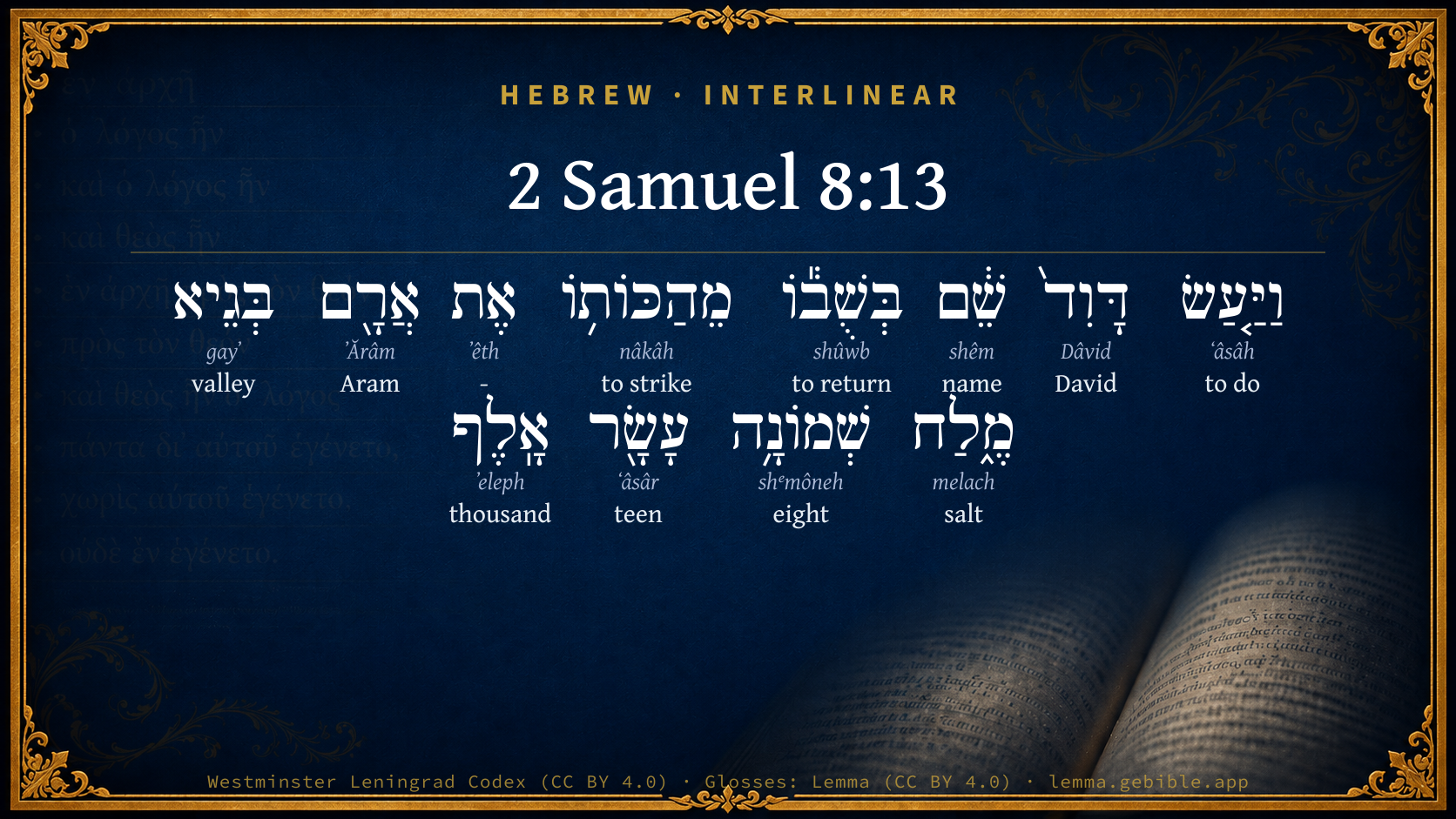
2 Samuel 8:13

Hebrew (Westminster Leningrad Codex) 2 Samuel 8:13 appears in the Hebrew Old Testament. The text above is from the Westminster Leningrad Codex. Each word links to its Strong’s number, a concise gloss, and parsing drawn from the Open Scriptures Hebrew Bible morphology. Click any word for its full Brown-Driver-Briggs (BDB) entry.
Download image
Cite this verse

2 Samuel 8:13 (World English Bible). Public Domain. Lemma interlinear Bible study tool, https://lemma.gebible.app/v/2-samuel/8/13.

Show BibTeX & RIS
BibTeX
RIS
English Translation
David got him a name when he returned from smiting the Syrians in the Valley of Salt, even eighteen thousand men.
World English Bible · Public Domain
Download a study sheet

One document with this verse’s original text, its word-by-word gloss line, the meaning frame, cross-references with their text, attributed commentary, and full source and license credits — printable, and it pastes into notes with its structure intact.

This verse Autodidact and up

Study sheet (.html) Plain text (.txt)

A passage Seminary Student

Up to 50 verses in one chapter. A passage sheet keeps up to 6 commentary sources and 12 cross-references per verse, in the order this page ranks them, and says so on the sheet whenever that leaves anything out. Ask for a single verse and you get the Autodidact verse sheet above.

Everything on this page stays free to read, with no account — the sheet is a download of what is already on screen, not access to it.

Want to remove ads? Support Godless Engineer
Compare translations 3

The same verse in 3 English versions, stacked beneath the original-language interlinear above. Click any original word for its lexicon entry.

Each is an independent rendering of the whole verse — the interlinear is not word-aligned to these translations.

Highlighted words mark where these versions differ — a whole-verse word diff, not a word-by-word alignment.

  • World English Bible Public Domain
    David got him a name when he returned from smiting the Syrians in the Valley of Salt, even eighteen thousand men.
  • King James Version Public Domain
    And David gat him a name when he returned from smiting of the Syrians in the valley of salt, being eighteen thousand men.
  • unfoldingWord Literal Text CC BY-SA 4.0
    And David made a name when he returned from his striking Aram in the Valley of Salt, 18,000.

unfoldingWord Literal Text — © unfoldingWord, licensed CC BY-SA 4.0. Word-aligned USFM3 via Door43 (git.door43.org/unfoldingWord/en_ult).

Versions to compare (up to 4)

3 of 4 selected

Show all 18 translations

Every available English version of this verse, each an independent rendering of the whole verse.

  • World English Bible Public Domain
    David got him a name when he returned from smiting the Syrians in the Valley of Salt, even eighteen thousand men.
  • Berean Standard Bible Public Domain
    And David made a name for himself when he returned from striking down eighteen thousand Edomites in the Valley of Salt.
  • Majority Standard Bible Public Domain
    And David made a name for himself when he returned from striking down eighteen thousand Edomites in the Valley of Salt.
  • King James Version Public Domain
    And David gat him a name when he returned from smiting of the Syrians in the valley of salt, being eighteen thousand men.
  • American Standard Version (1901) Public Domain
    And David gat him a name when he returned from smiting the Syrians in the Valley of Salt, even eighteen thousand men.
  • Revised Version (1885) Public Domain
    And David gat him a name when he returned from smiting of the Syrians in the Valley of Salt, even eighteen thousand men.
  • Geneva Bible (1599) Public Domain
    So Dauid gate a name after that hee returned, and had slayne of the Aramites in the valley of salt eighteene thousand men.
  • Douay-Rheims (1899) Public Domain
    David also made himself a name, when he returned after taking Syria in the valley of the saltpits, killing eighteen thousand:
  • Young's Literal Translation Public Domain
    And David maketh a name in his turning back from his smiting Aram in the valley of Salt -- eighteen thousand;
  • Literal Standard Version CC BY-SA 4.0
    And David makes a name in his turning back from his striking Aram in the Valley of Salt—eighteen thousand;
  • Unlocked Literal Bible CC BY-SA 4.0
    David's name was well known when he returned from conquering the Arameans in the Valley of Salt, with their eighteen thousand men.
  • unfoldingWord Literal Text CC BY-SA 4.0
    And David made a name when he returned from his striking Aram in the Valley of Salt, 18,000.
  • Darby Bible Public Domain
    And David made him a name when he returned, after he had smitten the Syrians in the valley of salt, eighteen thousand [men].
  • World Messianic Bible Public Domain
    David earned a reputation when he returned from striking down eighteen thousand men of the Syrians in the Valley of Salt.
  • Webster's Bible Public Domain
    And David made him a name when he returned from smiting of the Syrians in the valley of Salt, being eighteen thousand men.
  • Free Bible Version CC BY-SA 4.0
    David also made a name for himself when he came back after defeating eighteen thousand Edomites in the Valley of Salt.
  • Bible in Basic English Public Domain
    And David got great honour for himself, when he came back, by the destruction of Edom in the valley of Salt, to the number of eighteen thousand men.
  • JPS Tanakh (1917) Public Domain
    And David got him a name when he returned from smiting the Arameans in the Valley of Salt, even eighteen thousand men.

Literal Standard Version (2020), Covenant Press — licensed CC BY-SA 4.0. Text via the HelloAO Bible API (eBible.org). Unlocked Literal Bible (unfoldingWord) — licensed CC BY-SA 4.0. Text via the HelloAO Bible API (eBible.org). unfoldingWord Literal Text — © unfoldingWord, licensed CC BY-SA 4.0. Word-aligned USFM3 via Door43 (git.door43.org/unfoldingWord/en_ult). Free Bible Version, Dr. Jonathan Gallagher — licensed CC BY-SA 4.0. Text via the HelloAO Bible API (eBible.org).

Word by word

More ways to search: Search by grammar → Find every occurrence → Compare this word →

Practice this passage: Drill this verse → Learn its vocabulary →

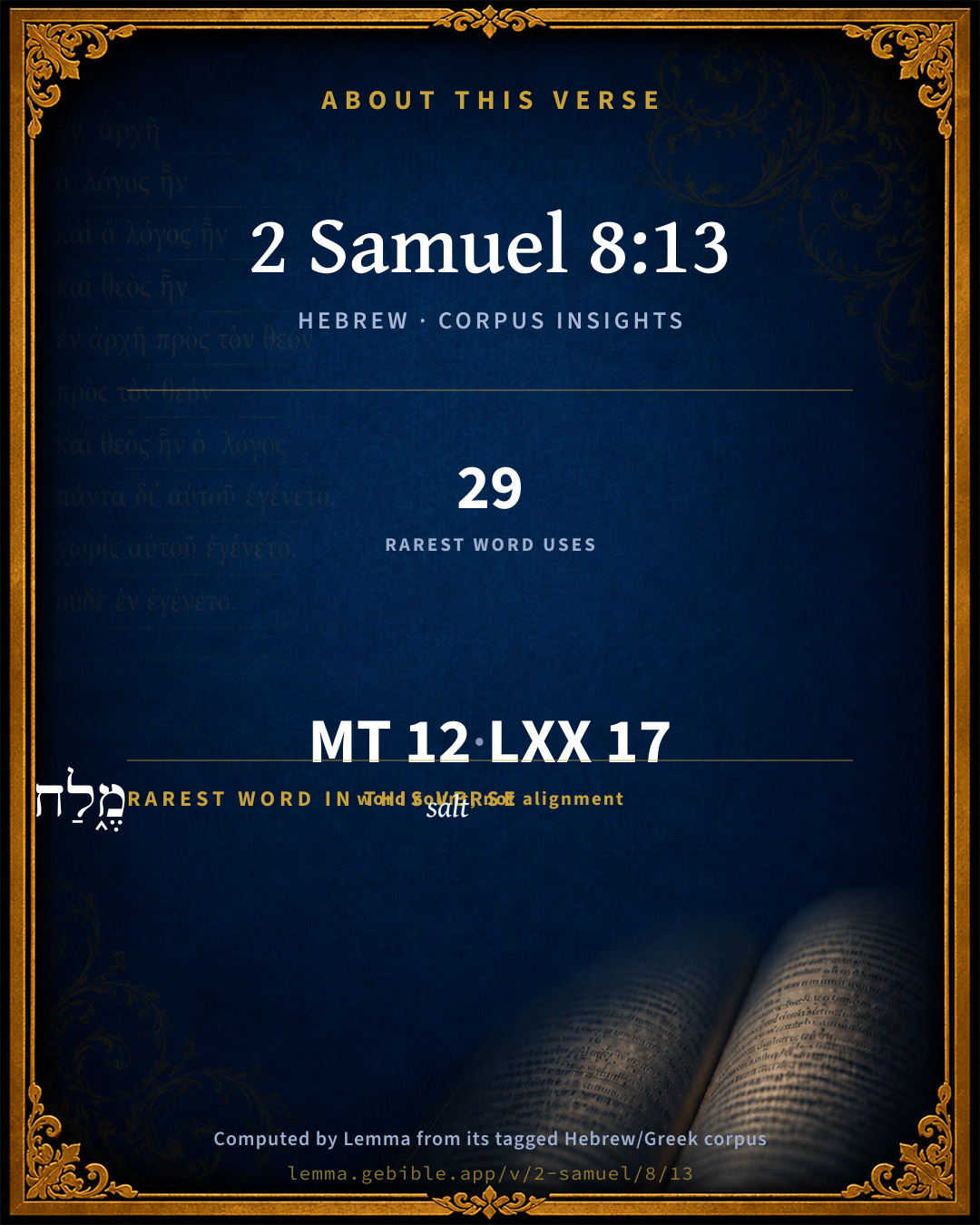
About this verse

These counts appear in no published source. They are computed here, from the morphology-tagged text and Lemma’s own curated glosses. What Lemma adds →

12
words
12
distinct lemmas
Historical
section

Shared distinctive vocabulary

מֶ֑לַח salt H4417 occurs in 26 verses of the Hebrew Bible. Also found in:

Grammatical profile

  • 3 verbs
  • 5 nouns
  • 3 adjectives
  • 1 particle

Verb forms

  • וַיַּ֤עַשׂ Qal · Sequential Imperfect
  • בְּשֻׁב֕וֹ Qal · Infinitive Construct
  • מֵהַכּוֹת֥וֹ Hiphil · Infinitive Construct

Hebrew & Septuagint length

In English translation the verse runs 21 words from the Hebrew and 21 from the Septuagint (LXX English) — the same length.

A rough comparison of the two English renderings, which tokenize alike — not a word-level alignment.

Word counts can differ between the Hebrew and the Greek without any difference in meaning — e.g. the Hebrew direct-object marker אֵת has no separate Greek word, and Greek often adds the article ὁ.

In the original languages it is 12 Hebrew tokens and 17 Greek tokens — but the two are counted differently (Hebrew bundles its prefixes and suffixes into one token; the Greek is in lemma form), so that isn’t a like-for-like length.

Cross-references

5

Topical passages linked to 2 Samuel 8:13 in the Treasury of Scripture Knowledge — connected by theme and wording, ordered by reader-vote popularity; previews shown in the World English Bible.

  • 2 Kings 14:7 He killed of Edom in the Valley of Salt ten thousand, and took Sela by war, and called the name of it Joktheel, to this day.
  • 2 Samuel 7:9 and I have been with you wherever you went, and have cut off all your enemies from before you; and I will make you a great name, like the name of the great ones who are in the earth.
  • 1 Chronicles 18:12 Moreover Abishai the son of Zeruiah struck of the Edomites in the Valley of Salt eighteen thousand.
  • 2 Chronicles 25:11 Amaziah took courage, and led forth his people, and went to the Valley of Salt, and struck of the children of Seir ten thousand.
  • Psalms 60:1 God, you have rejected us. You have broken us down. You have been angry. Restore us, again.

Cross-references courtesy of OpenBible.info (CC BY 4.0).

Hebrew and Greek witnesses Masoretic Hebrew ↔ Greek Septuagint

The same verse in the two great witnesses to the Old Testament, shown verse-for-verse.

These are two independent witnesses, not word-aligned to each other, and the Septuagint is shown in lemma (dictionary) form.

Hebrew 2 Samuel 8:13 Masoretic · Westminster Leningrad Codex

וַיַּ֤עַשׂ דָּוִד֙ שֵׁ֔ם בְּשֻׁב֕וֹ מֵהַכּוֹת֥וֹ אֶת אֲרָ֖ם בְּגֵיא מֶ֑לַח שְׁמוֹנָ֥ה עָשָׂ֖ר אָֽלֶף

David got him a name when he returned from smiting the Syrians in the Valley of Salt, even eighteen thousand men.

World English Bible · Public Domain

Greek LXX 2 Samuel 8:13 Septuagint · lemma form

καί ποιέω δαυίδ ὄνομα καί ἐν ὁ ἀνακάμπτω αὐτός πατάσσω ὁ ιδουμαία ἐν γαιμελε εἰς ὀκτωκαίδεκα χιλίας

And David made himself a name: and when he returned he struck Idumea in Gebelem to the number of eighteen thousand.

LXX2012 (modern English Septuagint) · Public Domain

On this verse, Jamieson, Fausset & Brown discusses the Septuagint’s reading. Read the note in Commentary ↓

Hebrew: Westminster Leningrad Codex (CC BY 4.0). Greek: Septuagint (public domain); English from LXX2012 (modern English Septuagint) (Public Domain). How the Septuagint differs from the Hebrew →

Targum (Aramaic paraphrase)

1

The Targum is the ancient Jewish Aramaic paraphrase of the Hebrew Scriptures — an interpretive translation, not the Hebrew text itself. Onkelos (literal) and Pseudo-Jonathan (expansive) render the Torah, and Jonathan the Prophets. Coverage is partial: where no permissively-licensed English translation exists for a verse, only the Aramaic is shown. This is verse-level text, not a word-by-word alignment to the Hebrew.

  1. Targum Jonathan Prophets (Joshua–Malachi)
    וּכְנַשׁ דָוִד מַשִׁרְיַן כַּד תַּב מִלְמִמְחֵי יַת אֲרָם בְּגֵיא מֶלַח תַּמְנַת עֲסַר אַלְפִין:

    (no public-domain English translation for this verse)

    Targum Jonathan — Aramaic: “Mikraot Gedolot” (public domain). English: “Sefaria Community Translation” (CC0 1.0 (public-domain dedication)); “London "Chaldee Paraphrase," 1871” (public domain). Text via Sefaria.

Commentary

Notes on 2 Samuel 8:13 from classic Christian and Jewish commentators (each source and its license shown beneath its notes). The classic Christian expositions comment on the surrounding passage and are grouped to its opening verse, so a note may address several verses; the Jewish commentaries on the Tanakh (Rashi and others) are per-verse, so they appear only where the commentator wrote on this verse.

Lemma curates 59 commentaries, every one of them public domain or Creative Commons licensed, each selected and text-cleaned for this edition rather than reprinted as found. About our sources →

Trapp's Complete Commentary

John Trapp

2Sa 8:13 And David gat [him] a name when he returned from smiting of the Syrians in the valley of salt, [being] eighteen thousand [men].

Ver. 13. And David gat him a name.] He set him up a triumphal arch or trophy, saith Abulensis and others; he was worthily renowned and reckoned amongst the world’s worthies; he was everywhere cried up for a great warrior and a famous conqueror.

From smiting of the Syrians.] Amongst whom also were very many of the Edomites, who here met with their bane, and lost the library of their country. See 1Ch 18:12 Psa 60:1, title: which psalm David sang at this time, and on this occasion.

John Trapp, A Commentary or Exposition upon All the Books of the Old and New Testament (1647–1656) — public domain. Text from a community e-Sword module.

Tyndale Open Study Notes

Tyndale Open Resources

8:13-14 These two verses highlight three of David’s war policies: (1) inflict heavy damage on the enemy (18,000 casualties); (2) reduce them to vassalage (they became David’s subjects); (3) place army garrisons in the conquered territory to maintain control over them. • Edomites: This name is very similar to Arameans in old Hebrew script. Edomites is more likely, however, because the Valley of Salt (the Dead Sea area) was adjacent to Edomite, not Aramean, territory.

Tyndale Open Study Notes — © Tyndale Open Resources, licensed CC BY-SA 4.0. Text via the HelloAO Bible API.

Geneva Bible (1599)

Geneva Bible translators

Or, in Gemelah.

Geneva Bible (1599) marginal notes — public domain. Text via Bolls.life.

Jamieson, Fausset & Brown

Robert Jamieson, A. R. Fausset & David Brown

David gat him a name when he returned from smiting of the Syrians--Instead of Syrians, the Septuagint version reads "Edomites," which is the true reading, as is evident from Sa2 8:14. This conquest, made by the army of David, was due to the skilful generalship and gallantry of Abishai and Joab. (Ch1 18:12; compare Psa 60:1, title.) The valley was the ravine of salt (the Ghor), adjoining the Salt Mountain, at the southwestern extremity of the Dead Sea, separating the ancient territories of Judah and Edom [ROBINSON].

Jamieson, Fausset & Brown — Commentary Critical and Explanatory on the Whole Bible (1871) — public domain (CC PDM 1.0). Text via the HelloAO Bible API.

Adam Clarke's Commentary

Verse 13. David gat him a name] Became a very celebrated and eminent man. The Targum has it, David collected troops; namely, to recruit his army when he returned from smiting the Syrians. His many battles had no doubt greatly thinned his army.

The valley of salt] Supposed to be a large plain abounding in this mineral, about a league from the city of Palmyra or Tadmor in the wilderness.

Adam Clarke's Commentary on the Bible (1810–1826) — public domain. Text from a community e-Sword/MySword module.

Ellicott's Commentary for English Readers

(13) When he returned from smiting of the Syrians.—Possibly, from the similarity in the original between Syria and Edom (see 2Sa_8:3; 2Sa_8:12), the words “he smote Edom” have dropped out of the text, but this supposition is not necessary. The course of affairs appears to have been as follows:—the war was originally undertaken against the Ammonites (2Sa_10:1-12), who had obtained the aid of the Syrians. In the first campaign their combined armies were defeated (2Sa_10:13-14), and they sought aid from every quarter, from the tribes beyond the Euphrates, on the north (2Sa_10:16), and from the Edomites on the south. David first inflicted a crushing defeat upon the allies near Hamath, and then “returned” to the south, where he again met them in “the valley of salt”—the Arabalt south of the Dead Sea, this latter army being naturally chiefly composed of Edomites, and so called in 1Ch_18:12, and in the title of Psalms 60, but here spoken of as Syrians because the whole confederacy is called by the name of its most powerful member. David himself returned from the southern campaign; but what was done by his general, Abishai, under his orders, is naturally said to have been done by him. Meantime, when this first battle, attended with the slaughter of 18,000 men, had been won by Abishai, Joab, the general-in-chief, being set free by the victories in the north, gained another battle in the same locality, killing 12,000 (Psalms 60, title). The power of Edom was now completely broken, and the whole forces of Israel were mustered under Joab to overrun their country and destroy all its male inhabitants (1Ki_11:15-16), certain of them, however, excepted (1Ki_11:17), and their descendants in after ages were relentless foes of Israel. (Comp. the prophecy of Isaac, Gen_27:40.)

In this summary of David’s reign the historian here turns from his wars and victories over other nations to the internal affairs of his kingdom. Substantially the same list of officers is again given in 2Sa_20:23-26.

A Bible Commentary for English Readers, edited by Charles John Ellicott (1878–1897) — public domain. Text from a community e-Sword module.

The Cambridge Bible for Schools and Colleges

gen. ed. J. J. S. Perowne

13, 14. Conquest of Edom

13. gat him a name] Won renown. Cp. ch. 2Sa_7:9. This, and not “erected a monument,” as some render, is the right meaning.

when he returned from smiting of the Syrians] The text is certainly corrupt. Chr. reads, “And Abishai the son of Zeruiah smote Edom in the valley of salt, (to the number of) eighteen thousand men.” The Sept. has, “And David made a name: and as he returned he smote Edom in Gebelem [a corrupt transliteration of the words meaning valley of salt] to the number of eighteen thousand.” Moreover the Valley of Salt was nowhere in the neighbourhood of Syria, but on the ancient border between Judah and Edom, to the S. of the Dead Sea. It was the scene of Amaziah’s victory over the Edomites (2Ki_14:7). We must therefore either adopt the Sept. reading, or insert after Syrians the words and he smote Edom, which may easily have dropped out, as the second of two similarly ending clauses.

Psalms 60 is referred to this occasion by its title; “Michtam of David. When he fought with Aram of the two rivers [Mesopotamia] and Aram of Zobah, and Joab returned and smote Edom in the Valley of Salt (to the number of) twelve thousand men.” The genuineness of this title is disputed, chiefly on the ground that the Psalm speaks of heavy disasters, of which there is no mention in the history. But we should scarcely expect defeat to be chronicled in such an extremely brief summary as the present, which records only the final results of the war. We may conjecture that while David was occupied with his campaign against the Ammonites and Syrians, Edom seized the opportunity for invading the south of Judah, and succeeded in inflicting serious damage, until David sent back part of his forces under Joab or Abishai, and repulsed their attack, following up his victory by the complete subjugation of Edom. We learn further from 1Ki_11:15-16, that the war was pursued with relentless severity, and signal vengeance taken upon the Edomites. That the successful campaign is here attributed to David, in Chr. to Abishai, in the Psalm and in 1 Kings to Joab, need cause no difficulty. David was concerned in it as king, Joab as general of the army, Abishai probably as commander of the division sent forward in advance. The variations as to the number of slain, here put at 18,000, in the Psalm at 12,000, may be due either to a textual error, or to some difference in the mode of reckoning.

The Cambridge Bible for Schools and Colleges (gen. ed. J. J. S. Perowne; Cambridge University Press, 1878–1918) — public domain. Text from a community e-Sword module.

John Gill's Exposition

And David gat him a name,.... Fame and reputation in the several nations of the world for valour and courage, for the many and signal victories that he obtained; the Jewish writers generally refer this to his humanity in burying the dead bodies of his enemies slain in war, which gained him great esteem among all, and even his very enemies; but nothing of that kind is pointed at here, but his conquests: or "he made himself a name"; erected a triumphal arch (b) in memory of his victories:

when he returned from smiting of the Syrians in the valley of salt,

being eighteen thousand men; in the relation of this fact in different places some difficulties arise, both as to the people smitten, and their numbers, and by whom; in this place they are said to be Syrians, but in Ch1 18:12, and in the title of Psa 60:1, which was composed on account of these victories, they are called Edomites, and said to be of Edom; which may be reconciled by observing, that the Syrians and Edomites were confederates in this war; and that whereas the latter were auxiliaries to the former, the whole body of the army might be called Syrians, of which twenty two thousand were slain that were properly Syrians, and eighteen thousand Edomites, in all forty thousand; which was a very great slaughter: or the sense is, that when he had smitten the twenty two thousand Syrians, and was upon the return, he met with a body of Edomites, who came to the assistance of the Syrians, and he slew eighteen thousand of them; and the Jews say, as Jarchi observes, there were two battles; and if so, this would remove all the difficulties started; as for the numbers slain, here eighteen thousand, and Psa 60:1, twelve thousand, it is reconciled by observing, that Abishai first began the attack upon the Edomites, and slew six thousand of them; and then Joab fell upon them, and slew twelve thousand more, in all eighteen thousand; in Ch1 18:12, this slaughter is ascribed to Abishai, because he began it, even the whole number; and in Psa 60:1, to Joab, the twelve thousand slain by him, who seconded Abishai; and the whole is here attributed to David, because he was king, under whom Abishai and Joab served as generals: and no less difficult is it to ascertain the place where this slaughter was made, called "the valley of salt": it seems by our text that it was in Syria, but in other places as if it was in Edom; see Kg2 14:7; but in Edom itself is no such valley to be found, though there is in Syria; one traveller (c) tells us, that in the way from Aleppo to the banks of Euphrates are many villages, among which is one of note, called Tedith, famous for a synod held here by the Jews, in the year from the creation 3498, of which Ezra was the scribe; when were placed the books of the Old Testament in the order in which they now are; and near this town, he says, is the valley of salt, memorable for the victory here recorded: others say (d) about three or four hours' journey from Aleppo is the valley of salt, near which is a salt spring, whose waters running over the place leave, when dried by the sun, a great quantity of excellent salt; this salt is thrown together in the Gabboul, or salt house; but by others (e) we are informed, that near about an hour's distance from the city of Tadmor, see Kg1 9:18 Ch2 8:3, is to be seen a large valley of salt, affording great quantities thereof; and it is thought that this is more probably the valley of salt mentioned here, than another which lies about four hours from Aleppo, and has sometimes passed for it; and which the above accounts show: but a modern writer (f), in his account of Palmyra, the same with Tadmor, speaks of a great plain, all covered with salt, from whence the whole country round is supplied. This plain is about a league from Palmyra, and extends itself towards the eastern part of Idumea (or Edom) the capital city of which was Bozra; and indeed this valley being both in Syria, and reaching to the borders of Edom, bids fair to be the valley here spoken of.

(b) So Hieron. Trad. Heb. in 2 Reg. fol. 78. D. (c) Cartwright's Preacher's Travels, p. 11. (d) Egmont and Heyman's Travels, vol. 2. p. 347. (e) See Lowthorp's Philosophical Transactions abridged, vol. 3. p. 504. (f) Halifax apud Calmet's Dictionary in the Word "Salt".

John Gill's Exposition of the Whole Bible (1746–1763) — public domain (CC PDM 1.0). Text via the HelloAO Bible API.

Albert Barnes' Notes on the Bible

The Syrians - Read the Edomites, as in marginal references (compare Psa 60:1-12 title), and as the context 2Sa 8:14 requires. For a further account of this war of extermination with Edom, see 1Ki 11:15-16. The war with Edom was of some duration, not without serious reverses and dangers to the Israelites (2Sa 8:2 note). The different accounts probably relate to different parts of the campaign.

Albert Barnes' Notes on the Bible (1834–1885) — public domain. Text from a community e-Sword/MySword module.

Haydock's Catholic Bible Commentary

Name, or triumphal arch. (Rabbins) --- He acquired great fame, chap. xvii. 9., and 1 Machabees v. 57. (Menochius) --- Syria, which is styled Aram in Hebrew. The Septuagint have read Edom, or Idumea, as the two names have often been confounded, on account of the similarity of the letters. The following verse seems favourable to this reading, as well as the title of the Psalm lix; and 1 Paralipomenon xviii. 12, says, Abisai....slew of the Edomites, in the valley of the salt-pits, 18,000. It is probable that David was present. This Idumea was on the east of the Dead Sea, and had Bosra for its capital. The salt-pits might be a great plain, about three miles south of Palmyra or Thadmor, which supplies almost all Syria with salt. (Brun.) (Calmet) --- Othes think that the borders of the most salt lake of Sodom are denoted. (Menochius) See Genesis xiv. 10.

George Leo Haydock (1774–1849), Haydock's Catholic Family Bible and Commentary, 1859 edition — public domain. Excludes Psalms (Douay-Rheims chapter numbering differs from Protestant) and Deuterocanonical books (Catholic canon only).

Matthew Poole's English Annotations

Gat him a name, i.e. much increased his reputation. The Syrians, or Edomites, as they are said to be, 1Ch 18:12. It is likely these two people were confederates, and that divers of the Syrians whom David had defeated in Syria fled to Edom, and there joined with them against their common enemy, and made up together a very great army, (as the number of the men slain in it showeth,) consisting of the veteran soldiers of both countries; although the slaughter here following may seem not to have been of the Syrians, as the words at first reading seem to intimate, but of the Edomites; (it not being probable that the Syrians would come so far from their own country, as to the valley of salt, to fight;) and this verse may be read thus, and that very agreeably to the Hebrew:

And David gat him a name when he returned from smiting of the Syrians, in smiting (which is easily repeated out of the last clause, according to the common usage of Scripture)

in the valley of salt eighteen thousand men, who were Edomites, as is sufficiently implied here in the next verse, and expressed 1Ch 18:12.

The valley of salt; a place in Edom so called, either from its neighbourhood to the Salt Sea, or for some other cause now unknown. Being eighteen thousand men; as it is also 1Ch 18:12, where also they are said to be smitten by Abishai, because he was then a chief commander of the army under David, and, it may be, began the fight; as, for the like reason, they are said to be smitten by Joab, Psa 60:1, where also there are only 12,000 mentioned; which place, if it speak of this battle, the state of it was this: Abishai begins the combat, and kills 6000; after him comes in Joab, and kills 12,000 more, which makes up this 18,000. But why may not that be another history and battle? So the Edomites and Syrians together did first fight with Abishai, and lost 18,000 men, and afterwards recruited their forces and fought with Joab, and lost other 12,000 men. Nor is it strange if two battles were fought in one place; of which there are divers instances in historians.

Matthew Poole's English Annotations on the Holy Bible (1683–1685) — public domain. Text from a community e-Sword/MySword module.

Whedon's Commentary on the Bible

Daniel D. Whedon

13. Gat him a name — Or, made him a monument, for שׁם, name, is sometimes used in this sense. On his return he erected a memorial of his triumphs, and probably also celebrated them with a grand triumphal procession and a splendid exhibition of his spoils.

From smiting of the Syrians in the valley of salt — But the Syrians were not smitten in the valley of salt, for this valley is undoubtedly the great plain to the south of the Dead Sea, which abounds in rock salt and brackish springs and streams. Here, at a later day, Amaziah slew ten thousand Edomites. 2Ki_14:7. The text of this verse is therefore faulty, and to be corrected from the parallel passage in 1Ch_18:12, which says that Abishai, the brother of Joab and a distinguished warrior of David’s army, “slew of the Edomites in the valley of salt eighteen thousand men.” The difference between את אדם, the Edomites, and את ארם, the Syrians, is so slight that a copyist might easily mistake one for the other. Read therefore: From smiting the Edomites in the valley of salt. 1Ki_11:15-16, affords a few more items of this Edomite war. Joab remained there with the host of Israel for six months, until he had smitten every male. So David, Joab, and Abishai are all spoken of as engaged in the conquest of Edom: David, as the royal head of the army and the nation; Joab, as captain or chief general; and Abishai, as having in this war signalized his valour by daring exploits, and leading his division of men into positions which met the chief brunt of the battle. To celebrate these victories David composed Psalms 60.

Daniel D. Whedon (gen. ed.), Commentary on the Old and New Testaments (1874–1909) — public domain. Text from a community e-Sword module.

The Pulpit Commentary

From smiting of the Syrians; Hebrew, of Aram. Here "Edom" is certainly right, (see 1Ch_18:12) unless we accept Keil"s conjecture, and suppose that "he smote Edom" has dropped out of the text, and must be inserted. In the superscription of Psalm we find the wars with Aram-Naharaim (Mesopotamia) and Aram-Zobah coupled with this smiting of Edom in the valley of salt, which lay to the south of the Dead Sea, and was a fatal place to the Edomitos in their war subsequently with Amaziah. (2Ki_14:7) Such a double victory over the Arameans first, and immediately afterwards over Edom, would account for the "name," that is, the reputation, which David gained. The course of events seems to have been as follows. The Edomites, believing that David was engaged in a struggle beyond his powers with the Syrians, took the opportunity to invade Israel. But the campaign in Aram was quickly decided, and David was able to send Abishai with a detachment of his forces to repel the Edomites. On hearing of his approach, they retired before him, and, making a stand in their own territories, were defeated in the valley of salt, with the loss of eighteen thousand men. (1Ch_18:12) In this place the victory is ascribed to David, because it was won by his general acting under his orders. For some unexplained reason, the feelings of the Israelites against Edom were very vindictive, and Joab followed with larger forces, and not only slew twelve thousand in a second battle (Psalm 60, title), but remained six months in the country, ruthlessly putting every male to death. (1Ki_11:15, 1Ki_11:16) From this time the Edomites and Israelites were implacable foes, and in later Jewish literature the Jews gave vent to their intense hatred of the Roman empire by giving it the name of Edom.

Getting a name.

gat him a name," There appears to have been something special in the campaign against the Syrians (or rather Edomites, (1Ch_18:12) and in David"s part therein, which rendered his victory peculiarly signal and memorable. Hence he obtained an honourable "name;" his reputation and fame were greatly increased. A large proportion of the names that men have won have been gained in war. But others more honourable have been obtained by the arts and victories of peace. Most to be valued are those acquired by eminence in goodness and usefulness.

I NAMES WORTH GETTING.

1. A good name a reputation for what is good. Better than a merely great name. Some names, widely known and for centuries, are so much infamy. Better be totally unknown than have a name for ill doing. All may have some reputation, though in a small circle and for a brief period, for sincere piety and Christian excellence; for unselfishness, benevolence, activity in doing good, liberality, self-denial in helping others, meekness, humility, long suffering, patience, and the like. And such a name is more to be desired than riches, (Pro_22:1) infinitely more than a great name which has been obtained by unscrupulous ambition.

2. A good name which arises from and represents reality. A mere name conferred through ignorance or flattery, or assumed and pushed into notice to gratify vanity or secure gain, is utterly worthless, and worse than worthless. So it is with a mere name for wisdom, or learning, or liberality, (Isa_32:5) or public spirit, or philanthropy; worst of all the namewhich a hypocrite sometimes gets for sanctity. How withering the reproach addressed to the Church at Sardis, "Thou hast a name that thou livest, and art dead"! (Rev_3:1)

II THE VALUE OF A GOOD NAME.

1. It is a just source of satisfaction to ourselves, when our own consciousness testifies to its substantial truth. The good opinion of others, especially of the good and discerning, is part of the reward of goodness. It is one of the ways by which God expresses his favourable judgment of us.

2. It sustains and stimulates in the course of conduct from which it has arisen. We are influenced by it to strive more and more to be worthy of it.

3. It is adapted to do good to others. It attracts attention to the excellence it designates, and may lead to imitation. It awakens confidence in those who have won it, which gives force to their instructions or admonitions, and it gives them in other ways greater influence for good. On all these accounts it is a heinous sin to injure or destroy another"s deserved good name by slander.

III HOW IT SHOULD BE SOUGHT. It should scarcely be sought at all. The way to obtain it is, not to seek it, but to practise the virtues from which it arises. To seek it is to set our hearts on the approval of men, which is perilous. Let us labour to be accepted of God, and he will take care of our reputation among men, so far as it is good for us and adapted to honour him and benefit our fellow men. "It is a very small thing to be judged of man"s judgment He that judgeth us is the Lord". (1Co_4:3, 1Co_4:4) At the same time, for the reasons given under division II, we should not needlessly defy or sacrifice the good opinion of others, though we should willingly do so when fidelity to truth and God requires the sacrifice.

In conclusion. The grandest instance of getting a name is that of our Lord and Saviour. By his self-humiliation and self-sacrifice, in love to us and obedience "unto death, even the death of the cross," he obtained "a Name which is above every name," as well in its significance as in its power with God and men. G.W. (Php_2:5-11)

The Pulpit Commentary (1880–1919), ed. H.D.M. Spence-Jones & Joseph S. Exell — public domain. Text from a community e-Sword module.

Keil & Delitzsch

C. F. Keil & F. Delitzsch

"And David made (himself) a name, when he returned from smiting (i.e., from the defeat of) Aram, (and smote Edom) in the valley of Salt, eighteen thousand men." The words enclosed in brackets are wanting in the Masoretic text as it has come down to us, and must have fallen out from a mistake of the copyist, whose eye strayed from את־ארם to את־אדום; for though the text is not "utterly unintelligible" without these words, since the passage might be rendered "after he had smitten Aram in the valley of Salt eighteen thousand men," yet this would be decidedly incorrect, as the Aramaeans were not smitten in the valley of Salt, but partly at Medeba (Ch1 19:7) and Helam (Sa2 10:17), and partly in their own land, which was very far away from the Salt valley. Moreover, the difficulty presented by the text cannot be removed, as Movers supposes, by changing את־ארם (Syria) into את־אדום (Edom), as the expression בּשׁבו ("when he returned") would still be unexplained. The facts were probably these: Whilst David, or rather Israel, was entangled in the war with the Ammonites and Aramaeans, the Edomites seized upon the opportunity, which appeared to them a very favourable one, to invade the land of Israel, and advanced as far as the southern extremity of the Dead Sea. As soon, therefore, as the Aramaeans were defeated and subjugated, and the Israelitish army had returned from this war, David ordered it to march against the Edomites, and defeated them in the valley of Salt. This valley cannot have been any other than the Ghor adjoining the Salt mountain on the south of the Dead Sea, which really separates the ancient territories of Judah and Edom (Robinson, Pal. ii. 483). There Amaziah also smote the Edomites at a later period (Kg2 14:7). We gather more concerning this war of David from the text of the Chronicles (Sa2 8:12) taken in connection with Kg1 11:15-16, and Psa 60:2. According to the Chronicles, it was Abishai the son of Zeruiah who smote the Edomites. This agrees very well not only with the account in Sa2 10:10., to the effect that Abishai commanded a company in the war with the Syrians and Ammonites under the generalship of his brother Joab, but also with the heading to Psa 60:1-12, in which it is stated that Joab returned after the defeat of Aram, and smote the Edomites in the valley of Salt, twelve thousand men; and with Kg1 11:15-16, in which we read that when David was in Edom, Joab, the captain of the host, came up to bury the slain, and smote every male in Edom, and remained six months in Edom with all Israel, till he had cut off every male in Edom. From this casual but yet elaborate notice, we learn that the war with the Edomites was a very obstinate one, and was not terminated all at once. The difference as to the number slain, which is stated to have been 18,000 in the text before us and in the Chronicles, and 12,000 in the heading to Psa 60:1-12, may be explained in a very simple manner, on the supposition that the reckonings made were only approximative, and yielded different results;

(Note: Michaelis adduces a case in point from the Seven Years' War. After the battle of Lissa, eight or twelve thousand men were reported to have been taken prisoners; but when they were all counted, including those who fell into the hands of the conquerors on the second, third, and fourth days of the flight, the number amounted to 22,000.)

and the fact that David is named as the victor in the verse before us, Joab in Psa 60:1-12, and Abishai in the Chronicles, admits of a very easy explanation after what has just been observed. The Chronicles contain the most literal account. Abishai smote the Edomites as commander of the men engaged, Joab as commander-in-chief of the whole army, and David as king and supreme governor, of whom the writer of the Chronicles affirms, "The Lord helped David in all his undertakings." After the defeat of the Edomites, David placed garrisons in the land, and made all Edom subject to himself. Sa2 8:15-18. David's Ministers. - To the account of David's wars and victories there is appended a list of his official attendants, which is introduced with a general remark as to the spirit of his government. As king over all Israel, David continued to execute right and justice.

Keil & Delitzsch — Biblical Commentary on the Old Testament (1861–1891) — public domain (CC PDM 1.0). Text via the HelloAO Bible API. (Old Testament only.)

unfoldingWord translationNotes

Door43 World Missions Community

David's name was well known

Here "name" refers to David's reputation. This can be stated in active form. AT: "David was very famous" (See: Metonymy and Active or Passive)

Valley of Salt

This is the name of a place. Its exact location is unknown. (See: How to Translate Names)

eighteen thousand men

"18,000 men" (See: Numbers)

He placed garrisons throughout all of Edom

"He ordered groups of his soldiers to remain in areas throughout all of Edom"

translationWords

name

know

Edom

Yahweh

unfoldingWord translationNotes — © Distant Shores Media and the Door43 World Missions Community, licensed CC BY-SA 4.0. Source: git.door43.org/Door43/en_tn.

Rashi

Rabbi Shlomo Yitzchaki (Rashi)

Dovid made a name [for himself]. He buried those of Edom whom he had killed and that is a good name for Yisroel that they bury their enemies. As it says in reference to the war of Gog and Mogog, "All the people of the land will bury and this will acquire for them a name." (Yechezkel 39:13) And how do we know that Dovid buried them? Because it says in the Book of kings (I, 11:15), "And it happened when Dovid was in Edom when Yoav, his army general went up to bury the corpses."

Eighteen thousand. [However] in the Book of Tehilim (60:2) it says, "twelve thousand" Hence we must say [in response] that there were two battles.

Rashi on the Tanakh — English translations: “The Judaica Press complete Tanach with Rashi, translated by A. J. Rosenberg” (CC BY 4.0); “Pentateuch with Rashi's commentary by M. Rosenbaum and A.M. Silbermann, 1929-1934” (public domain); “The Metsudah Tanach series, Lakewood, N.J” (CC BY 4.0); and “The Book of Joshua, Metsudah Publications, 1997” (CC BY 4.0). Text via Sefaria.

Lesson kit

Teaching starters — assembled from the data on this page, not authored interpretation. Every prompt links to the verse data it draws on. Edit before teaching.

2 Samuel, in the Historical, opens this verse with 12 words (12 distinct Hebrew lemmas). Its most distinctive word is melach (“salt”). A historical commentator’s framing appears above. Read the whole chapter for the surrounding context.

Discussion questions

  1. How does “salt” (melach) shape what this verse is saying?
  2. How does Genesis 14:3, which shares the word «salt», read alongside this verse?
  3. These translations render this verse differently; the difference is in the English rendering, not the original. What questions does that raise?
  4. «וַיַּ֤עַשׂ» is a Qal Sequential Imperfect verb. How does that grammatical form shape the action described?
  5. Compare how Trapp's Complete Commentary and Tyndale Open Study Notes read this verse. Where do they agree or differ?

Things to notice

Reading settings

Reading text

Shown beneath each verse's original-language words.

Old Testament
Old Testament edition

Read the OT as the Masoretic Hebrew (MT) or the Greek Septuagint (LXX).

English shown for the Greek Septuagint (in the Hebrew ↔ Greek comparison).

Comparing translations? Open the Compare panel on any verse page to stack up to four side by side.