
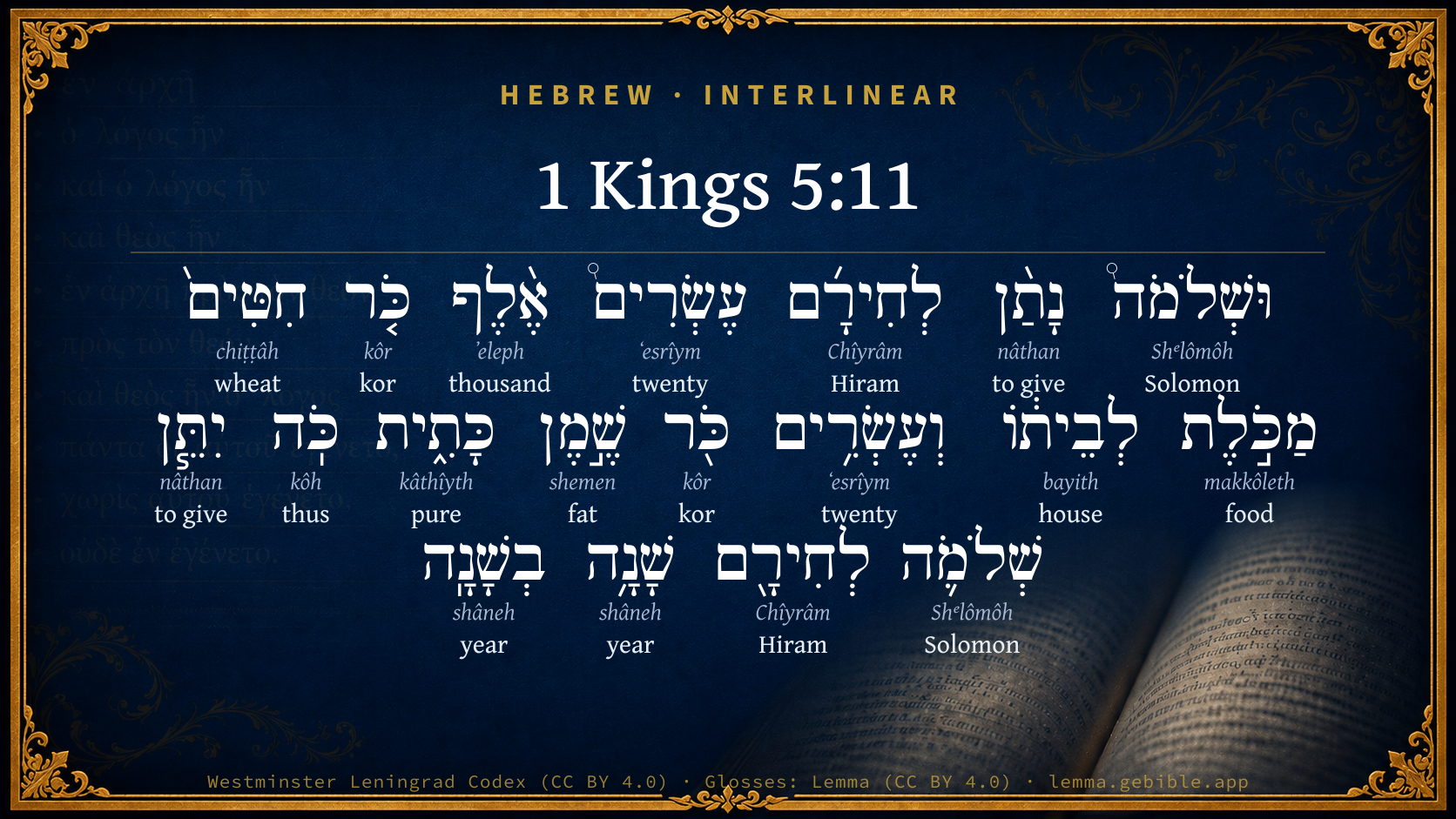
1 Kings 5:11

Hebrew (Westminster Leningrad Codex) 1 Kings 5:11 appears in the Hebrew Old Testament. The text above is from the Westminster Leningrad Codex. Each word links to its Strong’s number, a concise gloss, and parsing drawn from the Open Scriptures Hebrew Bible morphology. Click any word for its full Brown-Driver-Briggs (BDB) entry.
Download image
Cite this verse

1 Kings 5:11 (World English Bible). Public Domain. Lemma interlinear Bible study tool, https://lemma.gebible.app/v/1-kings/5/11.

Show BibTeX & RIS
BibTeX
RIS
English Translation
Solomon gave Hiram twenty thousand measures of wheat for food to his household, and twenty measures of pure oil: thus gave Solomon to Hiram year by year.
World English Bible · Public Domain
Highlights
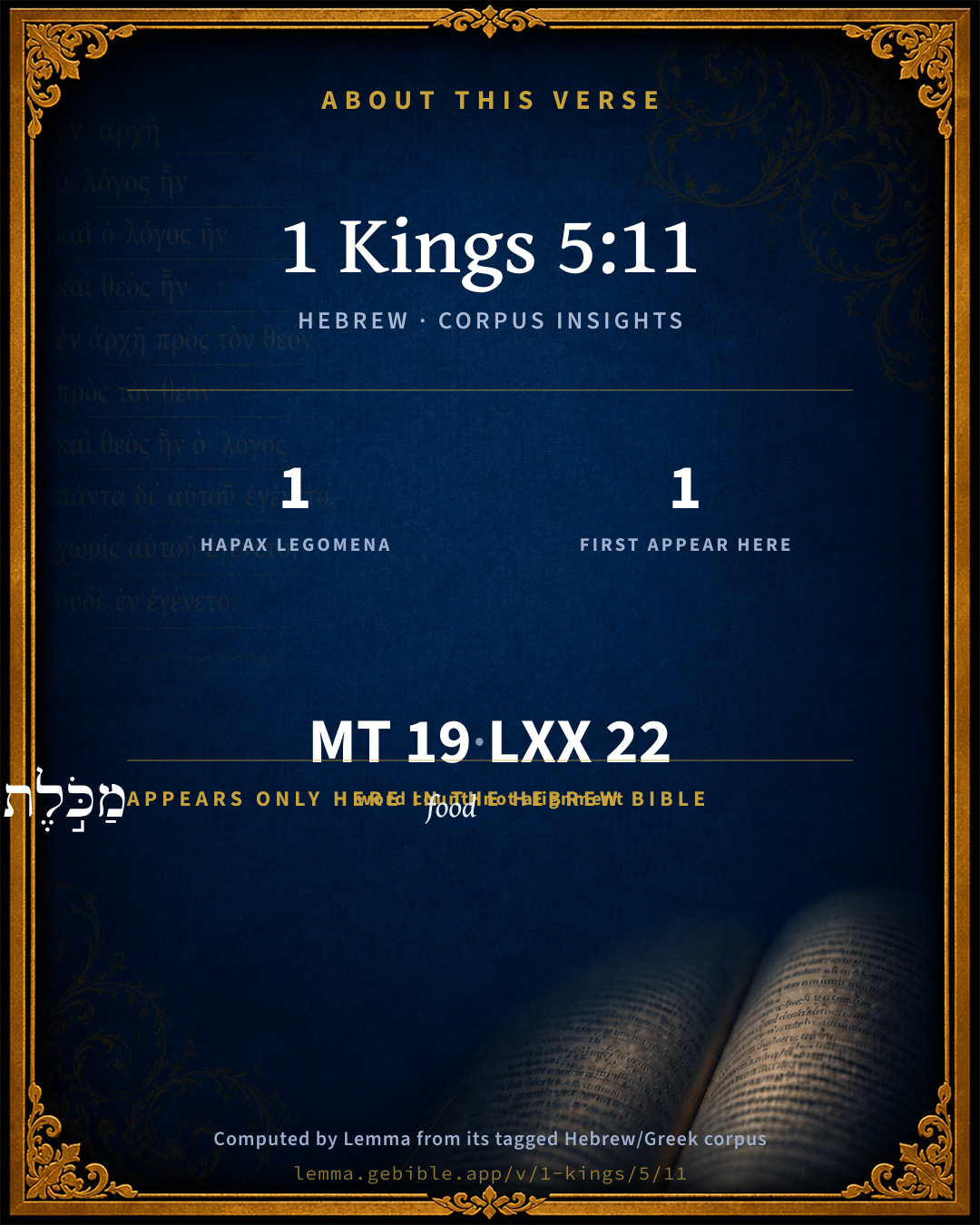
  • 1 hapax legomenon — only here in the Hebrew Bible
  • 1 first appearance in the Hebrew Bible
Full analysis ↓
Download a study sheet

One document with this verse’s original text, its word-by-word gloss line, the meaning frame, cross-references with their text, attributed commentary, and full source and license credits — printable, and it pastes into notes with its structure intact.

This verse Autodidact and up

Study sheet (.html) Plain text (.txt)

A passage Seminary Student

Up to 50 verses in one chapter. A passage sheet keeps up to 6 commentary sources and 12 cross-references per verse, in the order this page ranks them, and says so on the sheet whenever that leaves anything out. Ask for a single verse and you get the Autodidact verse sheet above.

Everything on this page stays free to read, with no account — the sheet is a download of what is already on screen, not access to it.

Want to remove ads? Support Godless Engineer
Compare translations 3

The same verse in 3 English versions, stacked beneath the original-language interlinear above. Click any original word for its lexicon entry.

Each is an independent rendering of the whole verse — the interlinear is not word-aligned to these translations.

Highlighted words mark where these versions differ — a whole-verse word diff, not a word-by-word alignment.

  • World English Bible Public Domain
    Solomon gave Hiram twenty thousand measures of wheat for food to his household, and twenty measures of pure oil: thus gave Solomon to Hiram year by year.
  • King James Version Public Domain
    And Solomon gave Hiram twenty thousand measures of wheat for food to his household, and twenty measures of pure oil: thus gave Solomon to Hiram year by year.
  • unfoldingWord Literal Text CC BY-SA 4.0
    And Solomon gave to Hiram 20,000 cors of wheat food for his house and 20 cors of beaten oil. Thus Solomon would give to Hiram year by year.

unfoldingWord Literal Text — © unfoldingWord, licensed CC BY-SA 4.0. Word-aligned USFM3 via Door43 (git.door43.org/unfoldingWord/en_ult).

Versions to compare (up to 4)

3 of 4 selected

Show all 18 translations

Every available English version of this verse, each an independent rendering of the whole verse.

  • World English Bible Public Domain
    Solomon gave Hiram twenty thousand measures of wheat for food to his household, and twenty measures of pure oil: thus gave Solomon to Hiram year by year.
  • Berean Standard Bible Public Domain
    and year after year Solomon would provide Hiram with 20,000 cors of wheat as food for his household, as well as 20,000 baths of pure olive oil.
  • Majority Standard Bible Public Domain
    and year after year Solomon would provide Hiram with 20,000 cors of wheat as food for his household, as well as 20,000 baths of pure olive oil.
  • King James Version Public Domain
    And Solomon gave Hiram twenty thousand measures of wheat for food to his household, and twenty measures of pure oil: thus gave Solomon to Hiram year by year.
  • American Standard Version (1901) Public Domain
    And Solomon gave Hiram twenty thousand measures of wheat for food to his household, and twenty measures of pure oil: thus gave Solomon to Hiram year by year.
  • Revised Version (1885) Public Domain
    And Solomon gave Hiram twenty thousand measures of wheat for food to his household, and twenty measures of pure oil: thus gave Solomon to Hiram year by year.
  • Geneva Bible (1599) Public Domain
    And Salomon gaue Hiram twentie thousand measures of wheate for foode to his householde, and twentie measures of beaten oyle. Thus much gaue Salomon to Hiram yere by yere.
  • Douay-Rheims (1899) Public Domain
    And Solomon allowed Hiram twenty thousand measures of wheat, for provision for his house, and twenty measures of the purest oil: thus gave Solomon to Hiram every year.
  • Young's Literal Translation Public Domain
    and Solomon hath given to Hiram twenty thousand cors of wheat, food for his house, and twenty cors of beaten oil; thus doth Solomon give to Hiram year by year.
  • Literal Standard Version CC BY-SA 4.0
    and Solomon has given twenty thousand cors of wheat to Hiram, [the] food for his house, and twenty cors of beaten oil; thus Solomon gives to Hiram year by year.
  • Unlocked Literal Bible CC BY-SA 4.0
    Solomon gave Hiram twenty thousand measures of wheat for food to his household and twenty measures of pure oil. Solomon gave this to Hiram year by year.
  • unfoldingWord Literal Text CC BY-SA 4.0
    And Solomon gave to Hiram 20,000 cors of wheat food for his house and 20 cors of beaten oil. Thus Solomon would give to Hiram year by year.
  • Darby Bible Public Domain
    And Solomon gave Hiram twenty thousand measures of wheat as food for his household, and twenty measures of beaten oil: thus gave Solomon to Hiram year by year.
  • World Messianic Bible Public Domain
    Solomon gave Hiram twenty thousand cors of wheat for food to his household, and twenty cors of pure oil. Solomon gave this to Hiram year by year.
  • Webster's Bible Public Domain
    And Solomon gave Hiram twenty thousand measures of wheat for food to his household, and twenty measures of pure oil: thus gave Solomon to Hiram year by year.
  • Free Bible Version CC BY-SA 4.0
    Solomon gave Hiram 20,000 cors of wheat for food and 20,000 cors of olive oil for his household. Solomon provided this to Hiram every year.
  • Bible in Basic English Public Domain
    And Solomon gave Hiram twenty thousand measures of grain, as food for his people, and twenty measures of clear oil; this he did every year.
  • JPS Tanakh (1917) Public Domain
    (5-25) And Solomon gave Hiram twenty thousand measures of wheat for food to his household, and twenty measures of beaten oil; thus gave Solomon to Hiram year by year.

Literal Standard Version (2020), Covenant Press — licensed CC BY-SA 4.0. Text via the HelloAO Bible API (eBible.org). Unlocked Literal Bible (unfoldingWord) — licensed CC BY-SA 4.0. Text via the HelloAO Bible API (eBible.org). unfoldingWord Literal Text — © unfoldingWord, licensed CC BY-SA 4.0. Word-aligned USFM3 via Door43 (git.door43.org/unfoldingWord/en_ult). Free Bible Version, Dr. Jonathan Gallagher — licensed CC BY-SA 4.0. Text via the HelloAO Bible API (eBible.org).

Word by word

More ways to search: Search by grammar → Find every occurrence → Compare this word →

Practice this passage: Drill this verse → Learn its vocabulary →

מַכֹּ֣לֶת
makkôleth
H4361
“food”
Noun, Common, Feminine, Singular, Absolute
Part of Speech
Noun
Type
Common
Gender
Feminine
Number
Singular
State
Absolute
Full BDB Definition

Origin: from H398

TWOT: 85g

food, food stuff
  1. וּשְׁלֹמֹה֩ Shᵉlômôh H8010 “and · Solomon” Conjunction + Noun, Proper
  2. נָתַ֨ן nâthan H5414 “to give” Verb, Qal, Perfect, 3rd Person, Masculine, Singular
  3. לְחִירָ֜ם Chîyrâm H2438 “to/for · Hiram” Preposition + Noun, Proper
  4. עֶשְׂרִים֩ ʻesrîym H6242 “twenty” Adjective, Cardinal number, Both, Plural, Absolute
  5. אֶ֨לֶף ʼeleph H505 “thousand” Adjective, Cardinal number, Both, Singular, Absolute
  6. כֹּ֤ר kôr H3734 “kor of” Noun, Common, Masculine, Singular, Construct
  7. חִטִּים֙ chiṭṭâh H2406 “wheat” Noun, Common, Feminine, Plural, Absolute
  8. לְבֵית֔וֹ bayith H1004 “to/for · house · his” Preposition + Noun, Common, Masculine, Singular, Construct + Suffix, Personal, 3rd Person, Masculine, Singular
  9. וְעֶשְׂרִ֥ים ʻesrîym H6242 “and · twenty” Conjunction + Adjective, Cardinal number, Both, Plural, Absolute
  10. כֹּ֖ר kôr H3734 “kor of” Noun, Common, Masculine, Singular, Construct
  11. שֶׁ֣מֶן shemen H8081 “fat” Noun, Common, Masculine, Singular, Absolute
  12. כָּתִ֑ית kâthîyth H3795 “pure” Adjective, Adjective, Masculine, Singular, Absolute
  13. כֹּֽה kôh H3541 “thus” Adverb
  14. יִתֵּ֧ן nâthan H5414 “to give” Verb, Qal, Imperfect, 3rd Person, Masculine, Singular
  15. שְׁלֹמֹ֛ה Shᵉlômôh H8010 “Solomon” Noun, Proper
  16. לְחִירָ֖ם Chîyrâm H2438 “to/for · Hiram” Preposition + Noun, Proper
  17. שָׁנָ֥ה shâneh H8141 “year” Noun, Common, Feminine, Singular, Absolute
  18. בְשָׁנָֽה shâneh H8141 “in/at · year” Preposition + Noun, Common, Feminine, Singular, Absolute

About this verse

These counts appear in no published source. They are computed here, from the morphology-tagged text and Lemma’s own curated glosses. What Lemma adds →

19
words
13
distinct lemmas
Historical
section

Notable vocabulary

1 hapax legomenon — a word that appears only here in the entire Hebrew Bible:

  • מַכֹּ֣לֶת food H4361

First appearance in Scripture

This word makes its first canonical appearance in the Hebrew Bible here:

  • מַכֹּ֣לֶת food H4361

Shared distinctive vocabulary

כָּתִ֑ית pure H3795 occurs in 5 verses of the Hebrew Bible. Also found in:

Grammatical profile

  • 2 verbs
  • 12 nouns
  • 4 adjectives
  • 1 adverb

Verb forms

  • נָתַ֨ן Qal · Perfect
  • יִתֵּ֧ן Qal · Imperfect

Repetition

Words recur within this verse — often emphatic in Hebrew:

  • וּשְׁלֹמֹה֩ Solomon H8010 ×2
  • נָתַ֨ן to give H5414 ×2
  • לְחִירָ֜ם Hiram H2438 ×2
  • עֶשְׂרִים֩ twenty H6242 ×2
  • כֹּ֤ר kor H3734 ×2
  • שָׁנָ֥ה year H8141 ×2

Hebrew & Septuagint length

In English translation the verse runs 27 words from the Hebrew and 28 from the Septuagint (LXX English) — closely comparable.

A rough comparison of the two English renderings, which tokenize alike — not a word-level alignment.

Word counts can differ between the Hebrew and the Greek without any difference in meaning — e.g. the Hebrew direct-object marker אֵת has no separate Greek word, and Greek often adds the article ὁ.

In the original languages it is 19 Hebrew tokens and 22 Greek tokens — but the two are counted differently (Hebrew bundles its prefixes and suffixes into one token; the Greek is in lemma form), so that isn’t a like-for-like length.

Cross-references

2

Topical passages linked to 1 Kings 5:11 in the Treasury of Scripture Knowledge — connected by theme and wording, ordered by reader-vote popularity; previews shown in the World English Bible.

  • 2 Chronicles 2:10 Behold, I will give to your servants, the cutters who cut timber, twenty thousand measures of beaten wheat, and twenty thousand measures of barley, and twenty thousand baths of wine, and twenty thousand baths of oil.
  • 1 Kings 4:22 Solomon's provision for one day was thirty measures of fine flour, and sixty measures of meal,

Cross-references courtesy of OpenBible.info (CC BY 4.0).

Hebrew and Greek witnesses Masoretic Hebrew ↔ Greek Septuagint

The same verse in the two great witnesses to the Old Testament, shown verse-for-verse.

These are two independent witnesses, not word-aligned to each other, and the Septuagint is shown in lemma (dictionary) form.

Hebrew 1 Kings 5:11 Masoretic · Westminster Leningrad Codex

וּשְׁלֹמֹה֩ נָתַ֨ן לְחִירָ֜ם עֶשְׂרִים֩ אֶ֨לֶף כֹּ֤ר חִטִּים֙ מַכֹּ֣לֶת לְבֵית֔וֹ וְעֶשְׂרִ֥ים כֹּ֖ר שֶׁ֣מֶן כָּתִ֑ית כֹּֽה יִתֵּ֧ן שְׁלֹמֹ֛ה לְחִירָ֖ם שָׁנָ֥ה בְשָׁנָֽה

Solomon gave Hiram twenty thousand measures of wheat for food to his household, and twenty measures of pure oil: thus gave Solomon to Hiram year by year.

World English Bible · Public Domain

Greek LXX 1 Kings 5:11 Septuagint · lemma form

καί σοφίζω ὑπέρ πᾶς ὁ ἄνθρωπος καί σοφίζω ὑπέρ γαιθαν ὁ εζραΐτης καί ὁ αιμαν καί ὁ χαλκαλ καί δαρδα υἱός μαλ

And Solomon gave to Chiram twenty thousand measures of wheat as food for his house, and twenty thousand baths of beaten oil thus Solomon gave to Chiram yearly.

LXX2012 (modern English Septuagint) · Public Domain

On this verse, Adam Clarke's Commentary discusses the Septuagint’s reading. Read the note in Commentary ↓

Hebrew: Westminster Leningrad Codex (CC BY 4.0). Greek: Septuagint (public domain); English from LXX2012 (modern English Septuagint) (Public Domain). How the Septuagint differs from the Hebrew →

Targum (Aramaic paraphrase)

1

The Targum is the ancient Jewish Aramaic paraphrase of the Hebrew Scriptures — an interpretive translation, not the Hebrew text itself. Onkelos (literal) and Pseudo-Jonathan (expansive) render the Torah, and Jonathan the Prophets. Coverage is partial: where no permissively-licensed English translation exists for a verse, only the Aramaic is shown. This is verse-level text, not a word-by-word alignment to the Hebrew.

  1. Targum Jonathan Prophets (Joshua–Malachi)
    וַחֲכָם מִכָּל אֱנָשָׁא מֵאֵיתָן בַּר זָרַח וְהֵימָן וְכַלְכֹּל וְדַרְדַע בְּנֵי מָחוֹל וַהֲוָה שְׁמֵיהּ סַגִי בְכָל עַמְמַיָא סְחוֹר סְחוֹר:

    (no public-domain English translation for this verse)

    Targum Jonathan — Aramaic: “Mikraot Gedolot” (public domain). English: “Sefaria Community Translation” (CC0 1.0 (public-domain dedication)); “London "Chaldee Paraphrase," 1871” (public domain). Text via Sefaria.

Commentary

Notes on 1 Kings 5:11 from classic Christian and Jewish commentators (each source and its license shown beneath its notes). The classic Christian expositions comment on the surrounding passage and are grouped to its opening verse, so a note may address several verses; the Jewish commentaries on the Tanakh (Rashi and others) are per-verse, so they appear only where the commentator wrote on this verse.

Lemma curates 59 commentaries, every one of them public domain or Creative Commons licensed, each selected and text-cleaned for this edition rather than reprinted as found. About our sources →

Trapp's Complete Commentary

John Trapp

1Ki 5:11 And Solomon gave Hiram twenty thousand measures of wheat [for] food to his household, and twenty measures of pure oil: thus gave Solomon to Hiram year by year.

Ver. 11. And Solomon gave Hiram.] Here was fair and faithful dealing on both sides.

“ In cuius subiere locum fraudesque, delique. ”

Twenty thousand measures of wheat, &c.] Besides twenty thousand measures of barley, and twenty thousand baths of oil, ordinary oil for the workmen, {2Ch 2:10} twenty thousand baths of wine also, not here mentioned.

John Trapp, A Commentary or Exposition upon All the Books of the Old and New Testament (1647–1656) — public domain. Text from a community e-Sword module.

Geneva Bible (1599)

Geneva Bible translators

Or, pure.

Hebrew, Kors.

Geneva Bible (1599) marginal notes — public domain. Text via Bolls.life.

Jamieson, Fausset & Brown

Robert Jamieson, A. R. Fausset & David Brown

food to his household--This was an annual supply for the palace, different from that mentioned in Ch2 2:10, which was for the workmen in the forests.

Jamieson, Fausset & Brown — Commentary Critical and Explanatory on the Whole Bible (1871) — public domain (CC PDM 1.0). Text via the HelloAO Bible API.

Adam Clarke's Commentary

Verse 11. And Solomon gave Hiram, c.] The information in this verse of the annual stipend paid to Hiram, is deficient, and must be supplied out of 2Ch 2:10. Here twenty thousand measures of wheat, and twenty measures of pure oil, is all that is promised: there, twenty thousand measures of beaten wheat, twenty thousand measures of barley, twenty thousand baths of wine, and twenty thousand baths of oil, is the stipulation unless we suppose the first to be for Hiram's own family, the latter for his workmen. Instead of twenty measures of oil, the Syriac, Arabic, and Septuagint, have twenty thousand measures, as in Chronicles. In 2 Chron., instead of cors of oil, it is baths. The bath was a measure much less than the cor.

Adam Clarke's Commentary on the Bible (1810–1826) — public domain. Text from a community e-Sword/MySword module.

Ellicott's Commentary for English Readers

(11) Twenty thousand measures of wheat.—This agrees well enough with the calculation in 1Ki_4:22 of ninety measures a day—something over 32,000 a year—for Solomon’s Court, presumably greater than that of Hiram. But the “twenty measures of oil “—even of the pure refined oil—is so insignificant in comparison, that it seems best to adopt the Greek reading here (agreeing with 2Ch_2:10, and with Josephus) of 20,000 baths, or 2,000 cors, of oil.

A Bible Commentary for English Readers, edited by Charles John Ellicott (1878–1897) — public domain. Text from a community e-Sword module.

The Cambridge Bible for Schools and Colleges

gen. ed. J. J. S. Perowne

11. And Solomon gave Hiram] The supply mentioned by the Chronicler (2Ch_2:10) is more than what is here stated. There the payment is 20,000 measures of beaten wheat, 20,000 measures of barley, 20,000 baths of wine and 20,000 baths of oil. Josephus mentions wheat, wine and oil, but says nothing about barley. There appears to be some clerical error in respect of the oil in this verse. The twenty measures (here cor) would only be equal to 200 baths, which seems a small quantity compared with the amount of wheat.

pure oil] Literally ‘beaten.’ It is the word used for describing the specially pure oil provided for the ever burning lamp in the tabernacle (Exo_27:20). It was made by pounding the olives in a mortar, and letting such oil as was thus extracted trickle out. The coarser oil was obtained by the use of the oilpress.

year by year] i.e. During the period in which the work was carried on.

The Cambridge Bible for Schools and Colleges (gen. ed. J. J. S. Perowne; Cambridge University Press, 1878–1918) — public domain. Text from a community e-Sword module.

John Gill's Exposition

And Solomon gave Hiram twenty thousand measures of wheat for food to his household,.... This measure was the Hebrew measure "cor", or "corus", and, according to Bishop Cumberland (e), its contents were 17,477 solid inches; it was equal to ten ephahs, each of which held two gallons and an half, and the cor held seventy five wine gallons five pints, and somewhat more; according to some (f), what it held was equal to six hundred forty eight Roman pounds; so that twenty thousand of them contained 12,960,000 pounds of wheat:

and twenty measures of pure oil; squeezed out of the olives without breaking them; the same kind of measure is here expressed as before, and the quantity answered to 12,960 Roman pounds; another writer (g) reckons a cor to contain 1080 Roman pounds; so that Hiram had every year 21,600 pounds of oil. In Ch2 2:10, it is twenty thousand baths of oil now not to take notice that the measures are different, a bath was but the tenth part of a cor, reference is had to different things; here the writer relates what was given to Hiram for his own family, there what was given to the workmen, where several other things are mentioned besides these:

thus gave Solomon to Hiram year by year: so long as the building lasted, and the workmen were employed; but Abarbinel thinks that he gave it to him as long as he lived, out of his great munificence and liberality.

(e) Scripture Weights and Measures, c. 3. p. 86. (f) Vid. Scheuchzer. Physic. Sacr. p. 517. (g) Van Till in Cantic. Mosis, p. 54.

John Gill's Exposition of the Whole Bible (1746–1763) — public domain (CC PDM 1.0). Text via the HelloAO Bible API.

Albert Barnes' Notes on the Bible

The number of measures of wheat was considerably less than Solomon’s own annual consumption, which exceeded 32,000 cors 1Ki 4:22; but the small amount of twenty cors of oil, which seems at first sight scarcely to match with the 20,000 cors of wheat, will not appear improbable, if we consider that the oil was to be” pure” - literally “beaten” - i. e., oil extracted from the olives by pounding, and not by means of the press.

Year by year - i. e., during all the years that Solomon was engaged in building and was helped by Hiram.

Albert Barnes' Notes on the Bible (1834–1885) — public domain. Text from a community e-Sword/MySword module.

Haydock's Catholic Bible Commentary

Wheat, "ground or beaten." (Hebrew; Paralipomenon) (Haydock) --- By comparing this passage with chap. iv. 22, we may see how much the court of Solomon surpassed that of Hiram. The former consumed 90 measures of flour a day; and 20,000 of wheat sufficed for the Tyrian prince’s family a whole year. --- Twenty. It is supposed by many commentators that thousand is to be supplied from the former sentence; as there seems otherwise to be no proportion between the wheat and the oil. (Piscator, &c.) --- The Septuagint, Syriac, &c., read 20,000. (Calmet) --- The Alexandrian copy has not core, but only beth, (Haydock) or "bath," which is a smaller measure, containing 29 pints and something more, (Calmet) or seven gallons, four pints, English wine measure; where the core, or chomer, consisted of 75 gallons, five pints. (Arbuthnot) (Haydock)

George Leo Haydock (1774–1849), Haydock's Catholic Family Bible and Commentary, 1859 edition — public domain. Excludes Psalms (Douay-Rheims chapter numbering differs from Protestant) and Deuterocanonical books (Catholic canon only).

Matthew Poole's English Annotations

Twenty measures of pure oil, Heb. twenty cors

of pure oil; but in 2Ch 2:10, it is twenty thousand baths of oil; to which is there added twenty thousand measures of barley, and twenty thousand baths of wine. Either therefore, first, He speaks of several things, as was now said on 1Ki 5:9. Or, secondly, He speaks there of what Solomon offered; for it runs thus,

I will give; and here of what Hiram accepted; and accordingly Solomon gave, for it is here said

Solomon gave Hiram. Or, thirdly, The barley, and wine, and twenty thousand baths of common oil, mentioned 2Ch 2, must be added to the twenty thousand measures of wheat, and the twenty measures of pure oil, here expressed, and the whole sum is to be made up from both places; that Book of Chronicles being written to supply and complete the histories of the Books of Samuel and of the Kings.

Thus gave Solomon to Hiram year by year; either, first, For sustenance to the workmen, during the years wherein they were employed in the cutting down and hewing of the timber. Or, secondly, For the yearly support of the king’s house during the said time. And these words being left out in 2Ch 2, may seem to favour their opinion, that these places speak of divers passages, and several recompences, the one given to the king’s house, the other to the labourers, although the argument is not cogent; and this might be omitted there, either because it was sufficiently implied in the nature of the thing, or because it had been plainly expressed here.

Matthew Poole's English Annotations on the Holy Bible (1683–1685) — public domain. Text from a community e-Sword/MySword module.

Whedon's Commentary on the Bible

Daniel D. Whedon

11. Twenty thousand measures of wheat — Or twenty thousand cors, about 222,000 bushels.

Pure oil — Or beaten oil, the purest and finest kind, such as came from the olives by mere pounding and not by pressing. This was for Hiram’s household; but besides this, according to 2Ch_2:10, he furnished Hiram’s servants, the hewers, 20,000 cors of beaten wheat, 20,000 cors of barley, 20,000 baths of wine, and 20,000 baths of oil; the last evidently common oil, not the beaten. Hence there is no discrepancy between these passages, for they refer to different things. The land of Israel abounded in grain and oil, while in this respect Phenicia was poor. Compare Acts 12:26.

Daniel D. Whedon (gen. ed.), Commentary on the Old and New Testaments (1874–1909) — public domain. Text from a community e-Sword module.

The Pulpit Commentary

And Solomon gave Hiram twenty thousand measures Heb. cots. See 1Ki_4:22 of wheat for food tlkm for tlkam to his household Rawlinson remarks that this was much less than Solomon"s own consumption. (1Ki_4:22) But he did not undertake to feed Hiram"s entire court, but merely to make an adequate return for the timber and labour he received. And the consumption of fine flour in Solomon"s household was only about 11, 000 cors per annum and twenty measures of pure oil lit., beaten oil, i.e., such as was obtained by pounding the olives, when not quite ripe, in a mortar. This was both of whiter colour and purer flavour, and also gave a clearer light, than that furnished by the ripe olives in the press. See the authorities quoted in Bahr"s Symbolik, 1. p. 419: thus gave Solomon to Hiram year by year probably so long as the building lasted or timber was furnished. But the agreement may have been for a still longer period.

The Pulpit Commentary (1880–1919), ed. H.D.M. Spence-Jones & Joseph S. Exell — public domain. Text from a community e-Sword module.

John Wesley's Explanatory Notes

Measures - Hebrew. twenty cors pure oil; but in 2Chr ii, 10, it is twenty thousand baths of oil. To which there is added twenty thousand measures of barley, and twenty thousand baths of wine. Either therefore, first, he speaks of several things. Or, secondly, he speaks there of what Solomon offered: for it runs thus, I will give; and here of what Hiram accepted. Or, thirdly, the barley, and wine, and twenty thousand baths of common oil, mentioned 2 Chron. ii, 10, must be added to the twenty thousand measures of wheat, and the twenty measures of pure oil here expressed, and the whole sum is to be made up from both places; that book of Chronicles being written to supply and compleat the histories of the books of Samuel, and of the Kings. Gave Hiram - Either, first, for sustenance to the workmen, during the years wherein they were employed in the cutting down and hewing of timber. Or, for the yearly support of the king's house, during the said time. Thus by the wise disposal of providence, one country has need of another, and is benefited by another, that there may be a mutual correspondence and dependence, to the glory of God our common Parent.

John Wesley, Explanatory Notes Upon the Whole Bible (1754–1765) — public domain. Text via the GEBible commentary corpus.

Kretzmann's Popular Commentary

Paul E. Kretzmann

Arrangements Concerning Material

v. 11. And Solomon gave Hiram twenty thousand measures of wheat, about 260,000 bushels, for food to his household, and twenty measures of pure oil, a little more than 1,600 gallons, this oil being obtained, not by pressing out the fruit, but by bruising the berries and then permitting the juice to run out freely. Thus gave Solomon to Hiram year by year, that was the price agreed upon by them.

v. 12. And the Lord gave Solomon wisdom, as He promised him, not only in concluding this contract in a satisfactory manner, but also in making wise and good provisions for every part of the immense undertaking. And there was peace between Hiram and Solomon; and they two made a league together, this alliance being to the advantage of the work undertaken by Solomon.

v. 13. And King Solomon raised a levy out of all Israel, he drafted a number of Israelites, members of the nation, for this work; and the levy was thirty thousand men.

v. 14. And he sent them to Lebanon, ten thousand a month by courses; a month they were in Lebanon, engaged in felling and transporting cedar-and cypress-trees, and two months at home, attending to the cultivation of their land; and Adoniram, the superintendent of public works, was over the levy.

v. 15. And Solomon had threescore and ten thousand that bare burdens, and fourscore thousand hewers in the mountains, men engaged in stone-cutting, these 150,000 servants being members of the Canaanitish, conquered races,

v. 16. beside the chief of Solomon’s officers, the foremen placed over the workmen, which were over the work, three thousand and three hundred, which ruled over the people that wrought in the work. In the total number of overseers 250 were Israelites, and 300 were foreigners, 2Ch 8:10.

v. 17. And the king commanded, and they brought great stones, costly stones, and hewed stones, immense, splendid stones, without a single flaw, to lay the foundation of the house, these being carefully shaped after being hewn out of the quarry.

v. 18. And Solomon’s builders and Hiram’s builders did hew them, and the stone-squarers, the Giblites, the inhabitants of a Phoenician town in the foothills of the Lebanon. So they prepared timber and stones to build the house, every piece receiving the proper treatment with reference to its place in the great building which was to be erected. The Church of Jesus Christ, the great Temple not made by hands, is an eternal house and kingdom. And all servants of Christ, all believers, have been called to assist in building this Temple, in extending the Church of God throughout all the world.

Paul E. Kretzmann, Popular Commentary of the Bible (1921–1924) — public domain. Text from a community e-Sword module.

Rashi

Rabbi Shlomo Yitzchaki (Rashi)

He was wiser than any man. [To be understood] according to its plain meaning.

Eison the Ezrachite and Heimon, Chalkol and Darda. They were brothers, the sons of Zerach son of Yehudah, as it is stated, “And the children of Zerach were Zimri and Eison [and Heimon and Chalkol and Dora]” (who were Leviyim who played musical instruments).

The sons of Mochol. They knew how to compose psalms which are recited with the accompaniment of dance and song; the Leviyim recited on their platform psalms which were composed in the book of Tehillim, [e.g.,] “An instruction of Eison the Ezrachi,” [and,] “An instruction to Heimon the Ezrachi.” The Midrash Aggadah in the Pesikta [expounds]: “Than all men,” refers to Adam; “Eison Ha’ezrachi,” refers to Avrohom; “Heimon,” refers to Moshe; “Chalkol,” refers to Yoseif; “Darda,” refers to the generation of the wilderness; “Mochol,” who were forgiven for the act of the golden calf.

Rashi on the Tanakh — English translations: “The Judaica Press complete Tanach with Rashi, translated by A. J. Rosenberg” (CC BY 4.0); “Pentateuch with Rashi's commentary by M. Rosenbaum and A.M. Silbermann, 1929-1934” (public domain); “The Metsudah Tanach series, Lakewood, N.J” (CC BY 4.0); and “The Book of Joshua, Metsudah Publications, 1997” (CC BY 4.0). Text via Sefaria.

Lesson kit

Teaching starters — assembled from the data on this page, not authored interpretation. Every prompt links to the verse data it draws on. Edit before teaching.

1 Kings, in the Historical, opens this verse with 19 words (13 distinct Hebrew lemmas). Its most distinctive word is makkôleth (“food”). A historical commentator’s framing appears above. Read the whole chapter for the surrounding context.

Discussion questions

  1. The word makkôleth carries the sense “food.” How does it shape the verse?
  2. This verse holds 1 word here found nowhere else in the Hebrew Bible. What might the rare word draw attention to?
  3. The word “food” first appears here in Scripture. What is being introduced at this debut?
  4. Exodus 27:20 shares the word «pure» with this verse. How do the two illuminate each other?
  5. “Solomon” occurs 2× in this one verse. What is the effect of the repetition?
  6. These translations render this verse differently. What is at stake in choosing one wording over another?
  7. The verb «נָתַ֨ן» is Qal Perfect. How does its form color the action?
  8. Reading how Trapp's Complete Commentary and Geneva Bible (1599) read this verse, where do the two commentators agree and where do they part?

Things to notice

  • 1 word in this verse appears nowhere else in the Hebrew Bible.
  • 1 word makes its first canonical appearance in Scripture here.
  • This verse counts 19 Hebrew ↔ 22 Greek words.
  • These translations choose different wording for 12 words in this verse.
  • “Solomon” occurs 2× in this single verse.

Reading settings

Reading text

Shown beneath each verse's original-language words.

Old Testament
Old Testament edition

Read the OT as the Masoretic Hebrew (MT) or the Greek Septuagint (LXX).

English shown for the Greek Septuagint (in the Hebrew ↔ Greek comparison).

Comparing translations? Open the Compare panel on any verse page to stack up to four side by side.