
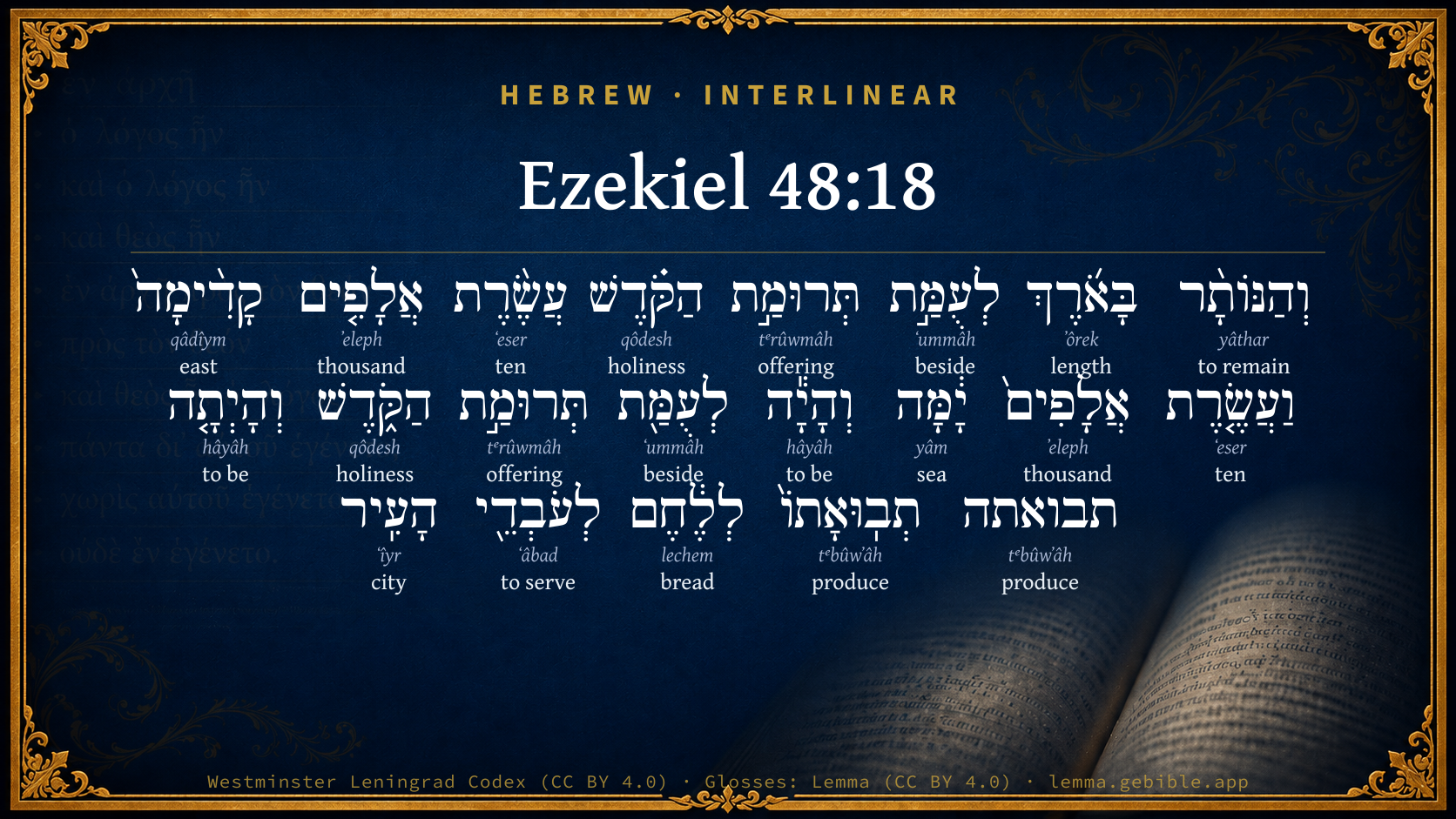
Ezekiel 48:18

Hebrew (Westminster Leningrad Codex) Ezekiel 48:18 appears in the Hebrew Old Testament. The text above is from the Westminster Leningrad Codex. Each word links to its Strong’s number, a concise gloss, and parsing drawn from the Open Scriptures Hebrew Bible morphology. Click any word for its full Brown-Driver-Briggs (BDB) entry.
Download image
Cite this verse

Ezekiel 48:18 (World English Bible). Public Domain. Lemma interlinear Bible study tool, https://lemma.gebible.app/v/ezekiel/48/18.

Show BibTeX & RIS
BibTeX
RIS
English Translation
The remainder in the length, answerable to the holy offering, shall be ten thousand eastward, and ten thousand westward; and it shall be answerable to the holy offering; and the increase of it shall be for food to those who labor in the city.
World English Bible · Public Domain
Download a study sheet

One document with this verse’s original text, its word-by-word gloss line, the meaning frame, cross-references with their text, attributed commentary, and full source and license credits — printable, and it pastes into notes with its structure intact.

This verse Autodidact and up

Study sheet (.html) Plain text (.txt)

A passage Seminary Student

Up to 50 verses in one chapter. A passage sheet keeps up to 6 commentary sources and 12 cross-references per verse, in the order this page ranks them, and says so on the sheet whenever that leaves anything out. Ask for a single verse and you get the Autodidact verse sheet above.

Everything on this page stays free to read, with no account — the sheet is a download of what is already on screen, not access to it.

Want to remove ads? Support Godless Engineer
Compare translations 3

The same verse in 3 English versions, stacked beneath the original-language interlinear above. Click any original word for its lexicon entry.

Each is an independent rendering of the whole verse — the interlinear is not word-aligned to these translations.

Highlighted words mark where these versions differ — a whole-verse word diff, not a word-by-word alignment.

  • World English Bible Public Domain
    The remainder in the length, answerable to the holy offering, shall be ten thousand eastward, and ten thousand westward; and it shall be answerable to the holy offering; and the increase of it shall be for food to those who labor in the city.
  • King James Version Public Domain
    And the residue in length over against the oblation of the holy portion shall be ten thousand eastward, and ten thousand westward: and it shall be over against the oblation of the holy portion; and the increase thereof shall be for food unto them that serve the city.
  • unfoldingWord Literal Text CC BY-SA 4.0
    The remaining area of the holy offering will stretch for ten thousand cubits to the east and ten thousand cubits to the west. It will stretch along the border of the holy offering, and its produce will be food for those working in the city.

unfoldingWord Literal Text — © unfoldingWord, licensed CC BY-SA 4.0. Word-aligned USFM3 via Door43 (git.door43.org/unfoldingWord/en_ult).

Versions to compare (up to 4)

3 of 4 selected

Show all 18 translations

Every available English version of this verse, each an independent rendering of the whole verse.

  • World English Bible Public Domain
    The remainder in the length, answerable to the holy offering, shall be ten thousand eastward, and ten thousand westward; and it shall be answerable to the holy offering; and the increase of it shall be for food to those who labor in the city.
  • Berean Standard Bible Public Domain
    The remainder of the length bordering the holy portion and running adjacent to it will be 10,000 cubits on the east side and 10,000 cubits on the west side. Its produce will supply food for the workers of the city.
  • Majority Standard Bible Public Domain
    The remainder of the length bordering the holy portion and running adjacent to it will be 10,000 cubits on the east side and 10,000 cubits on the west side. Its produce will supply food for the workers of the city.
  • King James Version Public Domain
    And the residue in length over against the oblation of the holy portion shall be ten thousand eastward, and ten thousand westward: and it shall be over against the oblation of the holy portion; and the increase thereof shall be for food unto them that serve the city.
  • American Standard Version (1901) Public Domain
    And the residue in the length, answerable unto the holy oblation, shall be ten thousand eastward, and ten thousand westward; and it shall be answerable unto the holy oblation; and the increase thereof shall be for food unto them that labor in the city.
  • Revised Version (1885) Public Domain
    And the residue in the length, answerable unto the holy oblation, shall be ten thousand eastward, and ten thousand westward: and it shall be answerable unto the holy oblation; and the increase thereof shall be for food unto them that labour in the city.
  • Geneva Bible (1599) Public Domain
    And the residue in length ouer against the oblation of the holy portion shalbe ten thousand Eastwarde, and ten thousand Westwarde: and it shalbe ouer against the oblation of the holy portion, and the encrease thereof shall be for foode vnto them that serue in the citie.
  • Douay-Rheims (1899) Public Domain
    And the residue in length by the firstfruits of the sanctuary, ten thousand toward the east, and ten thousand toward the west, shall be as the firstfruits of the sanctuary: and the fruits thereof shall be for bread to them that serve the city.
  • Young's Literal Translation Public Domain
    `And the residue in length over-against the heave-offering of the holy `portion is' ten thousand eastward, and ten thousand westward, and it hath been over-against the heave-offering of the holy `portion', and its increase hath been for food to the servants of the city,
  • Literal Standard Version CC BY-SA 4.0
    And the remainder in length alongside the raised-offering of the holy [portion is] ten thousand eastward, and ten thousand westward, and it has been alongside the raised-offering of the holy [portion], and its increase has been for food for those serving the city,
  • Unlocked Literal Bible CC BY-SA 4.0
    The remaining area of the holy offering will stretch for ten thousand cubits to the east and ten thousand cubits to the west. It will stretch along the border of the holy offering, and its produce will be food for those working in the city.
  • unfoldingWord Literal Text CC BY-SA 4.0
    The remaining area of the holy offering will stretch for ten thousand cubits to the east and ten thousand cubits to the west. It will stretch along the border of the holy offering, and its produce will be food for those working in the city.
  • Darby Bible Public Domain
    And the residue in length, alongside the holy heave-offering, shall be ten thousand eastward and ten thousand westward: it shall be alongside the holy heave-offering; and the increase thereof shall be for the support of them that serve the city.
  • World Messianic Bible Public Domain
    The remainder of the length, alongside the holy offering, shall be ten thousand eastward and ten thousand westward; and it shall be alongside the holy offering. Its increase shall be for food to those who labor in the city.
  • Webster's Bible Public Domain
    And the residue in length over against the oblation of the holy portion shall be ten thousand eastward, and ten thousand westward: and it shall be over against the oblation of the holy portion; and its increase shall be for food to them that serve the city.
  • Free Bible Version CC BY-SA 4.0
    What remains of the land bordering the holy allocation and running beside it will be 10,000 cubits on both the east side and the west side. The crops it produces will provide food for those who work in the city.
  • Bible in Basic English Public Domain
    And the rest, in measure as long as the holy offering, will be ten thousand to the east and ten thousand to the west: and its produce will be for food for the workers of the town.
  • JPS Tanakh (1917) Public Domain
    And the residue in the length, answerable unto the holy offering, shall be ten thousand eastward, and ten thousand westward; and it shall be answerable unto the holy offering; and the increase thereof shall be for food unto them that serve the city.

Literal Standard Version (2020), Covenant Press — licensed CC BY-SA 4.0. Text via the HelloAO Bible API (eBible.org). Unlocked Literal Bible (unfoldingWord) — licensed CC BY-SA 4.0. Text via the HelloAO Bible API (eBible.org). unfoldingWord Literal Text — © unfoldingWord, licensed CC BY-SA 4.0. Word-aligned USFM3 via Door43 (git.door43.org/unfoldingWord/en_ult). Free Bible Version, Dr. Jonathan Gallagher — licensed CC BY-SA 4.0. Text via the HelloAO Bible API (eBible.org).

Word by word

More ways to search: Search by grammar → Find every occurrence → Compare this word →

Practice this passage: Drill this verse → Learn its vocabulary →

לְעֻמַּ֣ת
ʻummâh
H5980
“to/for · beside of”
Preposition + Noun, Common, Feminine, Singular, Construct
Part of Speech
Preposition + Noun
Type
Common
Gender
Feminine
Number
Singular
State
Construct
Full BDB Definition

Origin: from H6004

TWOT: 1640f

juxtaposition - used only as a preposition - close by, side by side with, alongside of, parallel with - agreeing with, corresponding to, exactly as, close beside - correspondingly to
  1. וְהַנּוֹתָ֨ר yâthar H3498 “and · the · remaining” Conjunction + Particle, Definite Article + Verb, Niphal, Participle Active, Masculine, Singular, Absolute
  2. בָּאֹ֜רֶךְ ʼôrek H753 “in/at the · length” Preposition, Determined + Noun, Common, Masculine, Singular, Absolute
  3. תְּרוּמַ֣ת tᵉrûwmâh H8641 “offering of” Noun, Common, Feminine, Singular, Construct
  4. הַקֹּ֗דֶשׁ qôdesh H6944 “the · holiness” Particle, Definite Article + Noun, Common, Masculine, Singular, Absolute
  5. עֲשֶׂ֨רֶת ʻeser H6235 “ten” Adjective, Cardinal number, Masculine, Singular, Construct
  6. אֲלָפִ֤ים ʼeleph H505 “thousand” Adjective, Cardinal number, Both, Plural, Absolute
  7. קָדִ֨ימָה֙ qâdîym H6921 “east · toward” Noun, Common, Masculine, Singular, Absolute + Suffix, Demonstrative
  8. וַעֲשֶׂ֤רֶת ʻeser H6235 “and · ten” Conjunction + Adjective, Cardinal number, Masculine, Singular, Construct
  9. אֲלָפִים֙ ʼeleph H505 “thousand” Adjective, Cardinal number, Both, Plural, Absolute
  10. יָ֔מָּה yâm H3220 “sea · toward” Noun, Common, Masculine, Singular, Absolute + Suffix, Demonstrative
  11. וְהָיָ֕ה hâyâh H1961 “and · to be” Conjunction + Verb, Qal, Sequential Perfect, 3rd Person, Masculine, Singular
  12. לְעֻמַּ֖ת ʻummâh H5980 “to/for · beside of” Preposition + Noun, Common, Feminine, Singular, Construct
  13. תְּרוּמַ֣ת tᵉrûwmâh H8641 “offering of” Noun, Common, Feminine, Singular, Construct
  14. הַקֹּ֑דֶשׁ qôdesh H6944 “the · holiness” Particle, Definite Article + Noun, Common, Masculine, Singular, Absolute
  15. וְהָיְתָ֤ה hâyâh H1961 “and · to be” Conjunction + Verb, Qal, Sequential Perfect, 3rd Person, Feminine, Singular
  16. תבואתה tᵉbûwʼâh H8393 “produce · her” Noun, Common, Feminine, Singular, Construct + Suffix, Personal, 3rd Person, Feminine, Singular
  17. תְבֽוּאָתוֹ֙ tᵉbûwʼâh H8393 “produce · his” Noun, Common, Feminine, Singular, Construct + Suffix, Personal, 3rd Person, Masculine, Singular
  18. לְלֶ֔חֶם lechem H3899 “to/for · bread” Preposition + Noun, Common, Both, Singular, Absolute
  19. לְעֹבְדֵ֖י ʻâbad H5647 “to/for · serving” Preposition + Verb, Qal, Participle Active, Masculine, Plural, Construct
  20. הָעִֽיר ʻîyr H5892 “the · city” Particle, Definite Article + Noun, Common, Feminine, Singular, Absolute

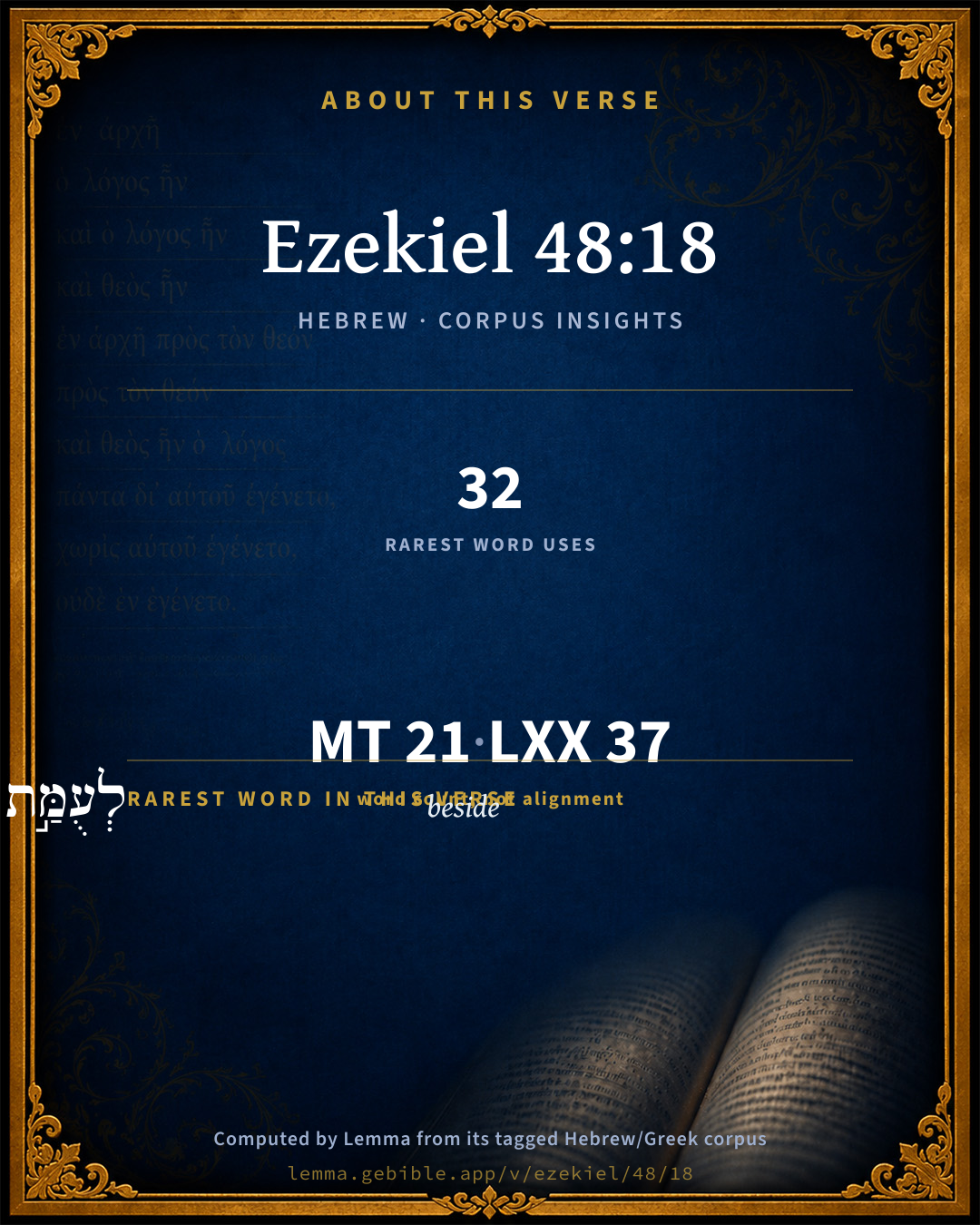
About this verse

These counts appear in no published source. They are computed here, from the morphology-tagged text and Lemma’s own curated glosses. What Lemma adds →

21
words
14
distinct lemmas
Prophets
section

Shared distinctive vocabulary

לְעֻמַּ֣ת beside H5980 occurs in 28 verses of the Hebrew Bible. Also found in:

Grammatical profile

  • 4 verbs
  • 13 nouns
  • 4 adjectives

Verb forms

  • וְהַנּוֹתָ֨ר Niphal · Participle Active
  • וְהָיָ֕ה Qal · Sequential Perfect
  • וְהָיְתָ֤ה Qal · Sequential Perfect
  • לְעֹבְדֵ֖י Qal · Participle Active

Repetition

Words recur within this verse — often emphatic in Hebrew:

  • לְעֻמַּ֣ת beside H5980 ×2
  • תְּרוּמַ֣ת offering H8641 ×2
  • הַקֹּ֗דֶשׁ holiness H6944 ×2
  • עֲשֶׂ֨רֶת ten H6235 ×2
  • אֲלָפִ֤ים thousand H505 ×2
  • וְהָיָ֕ה to be H1961 ×2
  • תבואתה produce H8393 ×2

Hebrew & Septuagint length

In English translation the verse runs 44 words from the Hebrew and 51 from the Septuagint (LXX English) — closely comparable.

A rough comparison of the two English renderings, which tokenize alike — not a word-level alignment.

Word counts can differ between the Hebrew and the Greek without any difference in meaning — e.g. the Hebrew direct-object marker אֵת has no separate Greek word, and Greek often adds the article ὁ.

In the original languages it is 21 Hebrew tokens and 37 Greek tokens — but the two are counted differently (Hebrew bundles its prefixes and suffixes into one token; the Greek is in lemma form), so that isn’t a like-for-like length.

Cross-references

4

Topical passages linked to Ezekiel 48:18 in the Treasury of Scripture Knowledge — connected by theme and wording, ordered by reader-vote popularity; previews shown in the World English Bible.

  • Joshua 9:27 That day Joshua made those wood cutters and drawers of water for the congregation, and for the altar of Yahweh, to this day, in the place which he should choose.
  • Ezra 2:43–58 The Nethinim: the children of Ziha, the children of Hasupha, the children of Tabbaoth,
  • Nehemiah 7:46–62 The Nethinim: the children of Ziha, the children of Hasupha, the children of Tabbaoth,
  • Ezekiel 45:6 You shall appoint the possession of the city five thousand broad, and twenty-five thousand long, side by side with the offering of the holy portion: it shall be for the whole house of Israel.

Cross-references courtesy of OpenBible.info (CC BY 4.0).

Hebrew and Greek witnesses Masoretic Hebrew ↔ Greek Septuagint

The same verse in the two great witnesses to the Old Testament, shown verse-for-verse.

These are two independent witnesses, not word-aligned to each other, and the Septuagint is shown in lemma (dictionary) form.

Hebrew Ezekiel 48:18 Masoretic · Westminster Leningrad Codex

וְהַנּוֹתָ֨ר בָּאֹ֜רֶךְ לְעֻמַּ֣ת תְּרוּמַ֣ת הַקֹּ֗דֶשׁ עֲשֶׂ֨רֶת אֲלָפִ֤ים קָדִ֨ימָה֙ וַעֲשֶׂ֤רֶת אֲלָפִים֙ יָ֔מָּה וְהָיָ֕ה לְעֻמַּ֖ת תְּרוּמַ֣ת הַקֹּ֑דֶשׁ וְהָיְתָ֤ה תבואתה תְבֽוּאָתוֹ֙ לְלֶ֔חֶם לְעֹבְדֵ֖י הָעִֽיר

The remainder in the length, answerable to the holy offering, shall be ten thousand eastward, and ten thousand westward; and it shall be answerable to the holy offering; and the increase of it shall be for food to those who labor in the city.

World English Bible · Public Domain

Greek LXX Ezekiel 48:18 Septuagint · lemma form

καί ὁ περισσός ὁ μῆκος ὁ ἔχω ὁ ἀπαρχή ὁ ἅγιος δέκα χιλιάς πρός ἀνατολή καί δέκα χιλιάς πρός θάλασσα καί εἰμί ὁ ἀπαρχή ὁ ἅγιος καί εἰμί ὁ γένημα αὐτός εἰς ἄρτος ὁ ἐργάζομαι ὁ πόλις

And the remainder of the length that is next to the first fruits of the holy portion shall be ten thousand eastward, and ten thousand westward: and they shall be the first fruits of the sanctuary; and the fruits thereof shall be for bread to them that labor for the city.

LXX2012 (modern English Septuagint) · Public Domain

Hebrew: Westminster Leningrad Codex (CC BY 4.0). Greek: Septuagint (public domain); English from LXX2012 (modern English Septuagint) (Public Domain). How the Septuagint differs from the Hebrew →

Targum (Aramaic paraphrase)

1

The Targum is the ancient Jewish Aramaic paraphrase of the Hebrew Scriptures — an interpretive translation, not the Hebrew text itself. Onkelos (literal) and Pseudo-Jonathan (expansive) render the Torah, and Jonathan the Prophets. Coverage is partial: where no permissively-licensed English translation exists for a verse, only the Aramaic is shown. This is verse-level text, not a word-by-word alignment to the Hebrew.

  1. Targum Jonathan Prophets (Joshua–Malachi)
    וּדְאִשְׁתָּאַר בְּאוּרְכָּא לָקֳבֵיל אַפְרָשׁוּת קוּדְשָׁא עַסְרִין אַלְפִין לְמַדִינְחָא וְעַסְרָא אַלְפִין לְמַעֲרָבָא וִיהֵי לָקֳבֵיל אַפְרָשׁוּת קוּדְשָׁא וּתְהֵי עֲלַלְתֵּיהּ לְמֵיכַל לְדִמְפַלְחִין בְּקַרְתָּא:

    (no public-domain English translation for this verse)

    Targum Jonathan — Aramaic: “Mikraot Gedolot” (public domain). English: “Sefaria Community Translation” (CC0 1.0 (public-domain dedication)); “London "Chaldee Paraphrase," 1871” (public domain). Text via Sefaria.

Commentary

Notes on Ezekiel 48:18 from classic Christian and Jewish commentators (each source and its license shown beneath its notes). The classic Christian expositions comment on the surrounding passage and are grouped to its opening verse, so a note may address several verses; the Jewish commentaries on the Tanakh (Rashi and others) are per-verse, so they appear only where the commentator wrote on this verse.

Lemma curates 59 commentaries, every one of them public domain or Creative Commons licensed, each selected and text-cleaned for this edition rather than reprinted as found. About our sources →

Trapp's Complete Commentary

John Trapp

Eze 48:18 And the residue in length over against the oblation of the holy [portion shall be] ten thousand eastward, and ten thousand westward: and it shall be over against the oblation of the holy [portion]; and the increase thereof shall be for food unto them that serve the city.

Ver. 18. For food to them that serve the city.] To all the citizens, who all are to turn servitors to their fellow brethren that come to the public meetings, to serve one another in love, which they that do shall not lose their reward, but verily they shall be fed.

John Trapp, A Commentary or Exposition upon All the Books of the Old and New Testament (1647–1656) — public domain. Text from a community e-Sword module.

Albert Barnes' Notes on the Bible

Eze 48:18

Then, that serve - i. e., the cultivators or farmers.

Eze 48:19

Of old the city belonged to Benjamin and Judah, and its inhabitants were mainly from these tribes. Now all the tribes are to have equal part in it, and avoid jealousies (compare 2Sa 19:43).

Albert Barnes' Notes on the Bible (1834–1885) — public domain. Text from a community e-Sword/MySword module.

Joseph Benson's Commentary

Eze 48:18-20. And the residue in length over against [or beside] the oblation of the holy portion shall be ten thousand eastward and ten thousand westward — These two dimensions, of ten thousand in length both eastward and westward, remain on each side of the area, which is five thousand cubits square, and set apart for the site of the city. It shall be over against [or beside] the oblation of the holy portion — It shall join to the Levites’ portion, both on the east and west side; and it shall lie parallel with the two portions belonging to the priests and Levites. And the increase thereof shall be for food unto them that serve the city — Perform burdensome offices of public utility, whether of a higher or lower kind. They that serve the city shall serve it out of all the tribes — This service being a burden, it was fit that all the tribes should bear their part in it. All the oblation shall be five and twenty thousand, &c. — That is, twenty-five thousand in length, multiplied by twenty-five thousand in breadth. Ye shall offer the oblation four-square — So the heavenly Jerusalem is described, Rev 21:16, as lying four-square, a square figure being the emblem of perpetuity, strength, and solidity. With the possession of the city — Or the land assigned for the site of the city; which was a square of five thousand cubits, and being added to the portion of the priests and Levites, made their twice ten thousand to be twenty-five thousand in breadth.

Joseph Benson's Commentary on the Old and New Testaments (1811–1818) — public domain. Text from a community e-Sword module.

Ellicott's Commentary for English Readers

(18) Shall be for food.—This piece of land, only four times the size of the city itself, would seem a very insufficient provision for raising all the food required for the labourers of the city. But here, as everywhere, it is to be remembered that the description is ideal

A Bible Commentary for English Readers, edited by Charles John Ellicott (1878–1897) — public domain. Text from a community e-Sword module.

The Cambridge Bible for Schools and Colleges

gen. ed. J. J. S. Perowne

18. As the city with its suburbs was a square of 5000 cubits, there remained of the 25,000 in length assigned to it a portion 10,000 long on the E. and another equally long on the W. In their length these portions lay “over against,” i.e. along, the holy portion of the priests.

that serve the city] The words are very difficult. It is plain that the 10,000 cubits of land E. and W. of the city serve to supply the inhabitants of the city with food. The restored land is a land of husbandmen, and those who dwell in the city live from the city’s domain. Either “serve” or “cultivate,” must be taken in the sense of inhabit and the words be read: for food to them that inhabit the city, 19 and they that inhabit the city &c. though such a usage has no parallel. Or, the word “city” must be taken in a general sense of the city and its domain of land: for food to the tillers of the city, 19 and they that till the city &c.

The Cambridge Bible for Schools and Colleges (gen. ed. J. J. S. Perowne; Cambridge University Press, 1878–1918) — public domain. Text from a community e-Sword module.

John Gill's Exposition

As for the rest of the tribes,.... Not yet mentioned, which lay to the south of the sanctuary, and are as follow:

from the east side to the west side, Benjamin shall have a portion;

the sons of God's right hand, who are as near and dear to him as a man's right hand is to him. Judah and Benjamin are nearest to the holy oblation, sanctuary, city, and prince; the one to the north of them, the other to the south; these tribes being faithful to God, and with his saints, when others departed from him; the Lord takes great notice of his faithful ones, and honours them, Hos 11:12.

John Gill's Exposition of the Whole Bible (1746–1763) — public domain (CC PDM 1.0). Text via the HelloAO Bible API.

Haydock's Catholic Bible Commentary

As the, &c. They shall not be alienated, as some might infer from its being said to be profane, which term is used because it was the habitation of laymen.

George Leo Haydock (1774–1849), Haydock's Catholic Family Bible and Commentary, 1859 edition — public domain. Excludes Psalms (Douay-Rheims chapter numbering differs from Protestant) and Deuterocanonical books (Catholic canon only).

Matthew Poole's English Annotations

The residue in length, which remains on each side of the five thousand cubits square area, will be ten thousand on the east, and ten thousand on the west.

Shall be over against the oblation; lie parallel and even with the south side of the Levites’ portion both on east and west.

The increase thereof; the product, revenues of this land.

For food; the maintenance, both salary and allowances of bread and wine.

Unto them that serve the city; for the city officers, so that they may live by the city, whose life is spent for the city, that the labourer may, as he is worthy of it, receive his wages.

Matthew Poole's English Annotations on the Holy Bible (1683–1685) — public domain. Text from a community e-Sword/MySword module.

The Pulpit Commentary

Vers. 18, 19. The remaining portions of the terumah should be two strips of land, each 10, 000 5000 reeds, one on each side of the city, the increase or produce of which should be for food unto them that serve the city. By "them that serve the city" Hitzig and Smend understand its ordinary inhabitants, since a district may be said to be cultivated through simple residence upon it (compare colere locum). Havernick, after Gesenius, thinks of the workmen who should be employed in building the city, against which may be urged that the city is supposed to be already built. Hengstenberg, with whom Plumptre seems disposed to agree, can only see in the city servers "a militia who take the city in the midst." Keil and Kliefoth find them in the laboring classes, who should not in this future state, as so often in ordinary states among men, be destitute of a possession in land, but should receive an allotment for their maintenance. But an obvious objection to this view is that it hands over the city land exclusively to the laboring classes, forgetting that the "other" classes require support as well as they. Probably the best interpretation is to regard ryih ydebO, "them that serve the city," as standing in antithesis to the other two classes already mentioned the Levites, whose office should be to serve the tabernacle; (see Num_4:24, 26 18:6, in which db is employed to denote the service of the Levites) and the priests, whose special function should be to serve the altar. (see Num_18:7, in which, again, the same verb is used) Thus regarded, "they that serve the city" will mean all engaged in secular pursuits in the city, which approximates to the view of Hitzig; and the prophet"s language will signify that all such should derive their sustenance from the city lands, i.e. should either have direct access to these lands to cultivate them for themselves, or should obtain a share in the produce of these lands for other services rendered to the city. With this accords the further statement that those who served the city should serve it out of all the tribes of Israel; i.e. its inhabitants should not, as formerly, be drawn chiefly from the tribes of Judah and Benjamin, but contain representatives from all the tribes of Israel. (comp. Eze_45:6)

The Pulpit Commentary (1880–1919), ed. H.D.M. Spence-Jones & Joseph S. Exell — public domain. Text from a community e-Sword module.

John Wesley's Explanatory Notes

For food - For the maintenance of the city-officers.

John Wesley, Explanatory Notes Upon the Whole Bible (1754–1765) — public domain. Text via the GEBible commentary corpus.

Rashi

Rabbi Shlomo Yitzchaki (Rashi)

and its grain shall be for food for those who serve the city These are the Gibeonites, who were made wood-cutters and water-drawers (Josh. 9:27). So I heard in the name of Rabbi Menahem of blessed memory.

לְעוֹבדֵי הָעִיר, “as servants” in Old French: to the workers.

Rashi on the Tanakh — English translations: “The Judaica Press complete Tanach with Rashi, translated by A. J. Rosenberg” (CC BY 4.0); “Pentateuch with Rashi's commentary by M. Rosenbaum and A.M. Silbermann, 1929-1934” (public domain); “The Metsudah Tanach series, Lakewood, N.J” (CC BY 4.0); and “The Book of Joshua, Metsudah Publications, 1997” (CC BY 4.0). Text via Sefaria.

Lesson kit

Teaching starters — assembled from the data on this page, not authored interpretation. Every prompt links to the verse data it draws on. Edit before teaching.

Ezekiel, in the Prophets, opens this verse with 21 words (14 distinct Hebrew lemmas). Its most distinctive word is ʻummâh (“beside”). A historical commentator’s framing appears above. Read the whole chapter for the surrounding context.

Discussion questions

  1. What does “beside” (ʻummâh) contribute to the verse as a whole?
  2. Exodus 25:27 shares the word «beside» with this verse. How do the two illuminate each other?
  3. “beside” occurs 2× in this one verse. What is the effect of the repetition?
  4. The translations on this page render this verse differently — a whole-verse word diff, not a word-by-word alignment. What might account for the different wordings?
  5. The verb «וְהַנּוֹתָ֨ר» is Niphal Participle Active. How does its form color the action?
  6. Reading how Trapp's Complete Commentary and Albert Barnes' Notes on the Bible read this verse, where do the two commentators agree and where do they part?

Things to notice

Reading settings

Reading text

Shown beneath each verse's original-language words.

Old Testament
Old Testament edition

Read the OT as the Masoretic Hebrew (MT) or the Greek Septuagint (LXX).

English shown for the Greek Septuagint (in the Hebrew ↔ Greek comparison).

Comparing translations? Open the Compare panel on any verse page to stack up to four side by side.