
Micah 6:7

Hebrew (Westminster Leningrad Codex) Micah 6:7 appears in the Hebrew Old Testament. The text above is from the Westminster Leningrad Codex. Each word links to its Strong’s number, a concise gloss, and parsing drawn from the Open Scriptures Hebrew Bible morphology. Click any word for its full Brown-Driver-Briggs (BDB) entry.
Download image
Cite this verse

Micah 6:7 (World English Bible). Public Domain. Lemma interlinear Bible study tool, https://lemma.gebible.app/v/micah/6/7.

Show BibTeX & RIS
BibTeX
RIS
English Translation
Will Yahweh be pleased with thousands of rams? With tens of thousands of rivers of oil? Shall I give my firstborn for my disobedience? The fruit of my body for the sin of my soul?
World English Bible · Public Domain
Download a study sheet

One document with this verse’s original text, its word-by-word gloss line, the meaning frame, cross-references with their text, attributed commentary, and full source and license credits — printable, and it pastes into notes with its structure intact.

This verse Autodidact and up

Study sheet (.html) Plain text (.txt)

A passage Seminary Student

Up to 50 verses in one chapter. A passage sheet keeps up to 6 commentary sources and 12 cross-references per verse, in the order this page ranks them, and says so on the sheet whenever that leaves anything out. Ask for a single verse and you get the Autodidact verse sheet above.

Everything on this page stays free to read, with no account — the sheet is a download of what is already on screen, not access to it.

Want to remove ads? Support Godless Engineer
Compare translations 3

The same verse in 3 English versions, stacked beneath the original-language interlinear above. Click any original word for its lexicon entry.

Each is an independent rendering of the whole verse — the interlinear is not word-aligned to these translations.

Highlighted words mark where these versions differ — a whole-verse word diff, not a word-by-word alignment.

  • World English Bible Public Domain
    Will Yahweh be pleased with thousands of rams? With tens of thousands of rivers of oil? Shall I give my firstborn for my disobedience? The fruit of my body for the sin of my soul?
  • King James Version Public Domain
    Will the LORD be pleased with thousands of rams, or with ten thousands of rivers of oil? shall I give my firstborn for my transgression, the fruit of my body for the sin of my soul?
  • unfoldingWord Literal Text CC BY-SA 4.0
    Will Yahweh be pleased with thousands of rams, with ten thousands of rivers of oil? Shall I give my firstborn my transgression, the fruit of my belly the sin of my soul?

unfoldingWord Literal Text — © unfoldingWord, licensed CC BY-SA 4.0. Word-aligned USFM3 via Door43 (git.door43.org/unfoldingWord/en_ult).

Versions to compare (up to 4)

3 of 4 selected

Show all 17 translations

Every available English version of this verse, each an independent rendering of the whole verse.

  • World English Bible Public Domain
    Will Yahweh be pleased with thousands of rams? With tens of thousands of rivers of oil? Shall I give my firstborn for my disobedience? The fruit of my body for the sin of my soul?
  • Berean Standard Bible Public Domain
    Would the LORD be pleased with thousands of rams, with ten thousand rivers of oil? Shall I present my firstborn for my transgression, the fruit of my body for the sin of my soul?
  • Majority Standard Bible Public Domain
    Would the LORD be pleased with thousands of rams, with ten thousand rivers of oil? Shall I present my firstborn for my transgression, the fruit of my body for the sin of my soul?
  • King James Version Public Domain
    Will the LORD be pleased with thousands of rams, or with ten thousands of rivers of oil? shall I give my firstborn for my transgression, the fruit of my body for the sin of my soul?
  • American Standard Version (1901) Public Domain
    will Jehovah be pleased with thousands of rams, `or' with ten thousands of rivers of oil? shall I give my first-born for my transgression, the fruit of my body for the sin of my soul?
  • Revised Version (1885) Public Domain
    will the LORD be pleased with thousands of rams, or with ten thousands of rivers of oil? shall I give my firstborn for my transgression, the fruit of my body for the sin of my soul?
  • Geneva Bible (1599) Public Domain
    Will the Lord be pleased with thousands of rams, or with ten thousand riuers of oyle? shall I giue my first borne for my transgression, euen the fruite of my bodie, for the sinne of my soule?
  • Young's Literal Translation Public Domain
    Is Jehovah pleased with thousands of rams? With myriads of streams of oil? Do I give my first-born `for' my transgression? The fruit of my body `for' the sin of my soul?
  • Literal Standard Version CC BY-SA 4.0
    Is YHWH pleased with thousands of rams? With myriads of streams of oil? Do I give my firstborn [for] my transgression? The fruit of my body [for] the sin of my soul?
  • Unlocked Literal Bible CC BY-SA 4.0
    Will Yahweh be pleased with thousands of rams, or with ten thousand rivers of oil? Should I give my firstborn for my transgression, the fruit of my body for my own sin?
  • unfoldingWord Literal Text CC BY-SA 4.0
    Will Yahweh be pleased with thousands of rams, with ten thousands of rivers of oil? Shall I give my firstborn my transgression, the fruit of my belly the sin of my soul?
  • Darby Bible Public Domain
    Will Jehovah take pleasure in thousands of rams, in ten thousands of rivers of oil? Shall I give my firstborn for my transgression, the fruit of my body for the sin of my soul?
  • World Messianic Bible Public Domain
    Will the LORD be pleased with thousands of rams? With tens of thousands of rivers of oil? Shall I give my firstborn for my disobedience? The fruit of my body for the sin of my soul?
  • Webster's Bible Public Domain
    Will the LORD be pleased with thousands of rams, or with ten thousands of rivers of oil? shall I give my first-born for my transgression, the fruit of my body for the sin of my soul?
  • Free Bible Version CC BY-SA 4.0
    Will the Lord be pleased with thousands of rams, or ten thousand rivers of olive oil? Shall I sacrifice my firstborn child for my rebellion, my own flesh and blood for the sins I have committed?
  • Bible in Basic English Public Domain
    Will the Lord be pleased with thousands of sheep or with ten thousand rivers of oil? am I to give my first child for my wrongdoing, the fruit of my body for the sin of my soul?
  • JPS Tanakh (1917) Public Domain
    Will the LORD be pleased with thousands of rams, with ten thousands of rivers of oil? Shall I give my first-born for my transgression, the fruit of my body for the sin of my soul?'

Literal Standard Version (2020), Covenant Press — licensed CC BY-SA 4.0. Text via the HelloAO Bible API (eBible.org). Unlocked Literal Bible (unfoldingWord) — licensed CC BY-SA 4.0. Text via the HelloAO Bible API (eBible.org). unfoldingWord Literal Text — © unfoldingWord, licensed CC BY-SA 4.0. Word-aligned USFM3 via Door43 (git.door43.org/unfoldingWord/en_ult). Free Bible Version, Dr. Jonathan Gallagher — licensed CC BY-SA 4.0. Text via the HelloAO Bible API (eBible.org).

Word by word

More ways to search: Search by grammar → Find every occurrence → Compare this word →

Practice this passage: Drill this verse → Learn its vocabulary →

בְּרִֽבְב֖וֹת
rᵉbâbâh
H7233
“in/at · myriads of”
Preposition + Noun, Common, Feminine, Plural, Construct
Part of Speech
Preposition + Noun
Type
Common
Gender
Feminine
Number
Plural
State
Construct
Full BDB Definition

Origin: from H7231

TWOT: 2099d

multitude, myriad, ten thousand
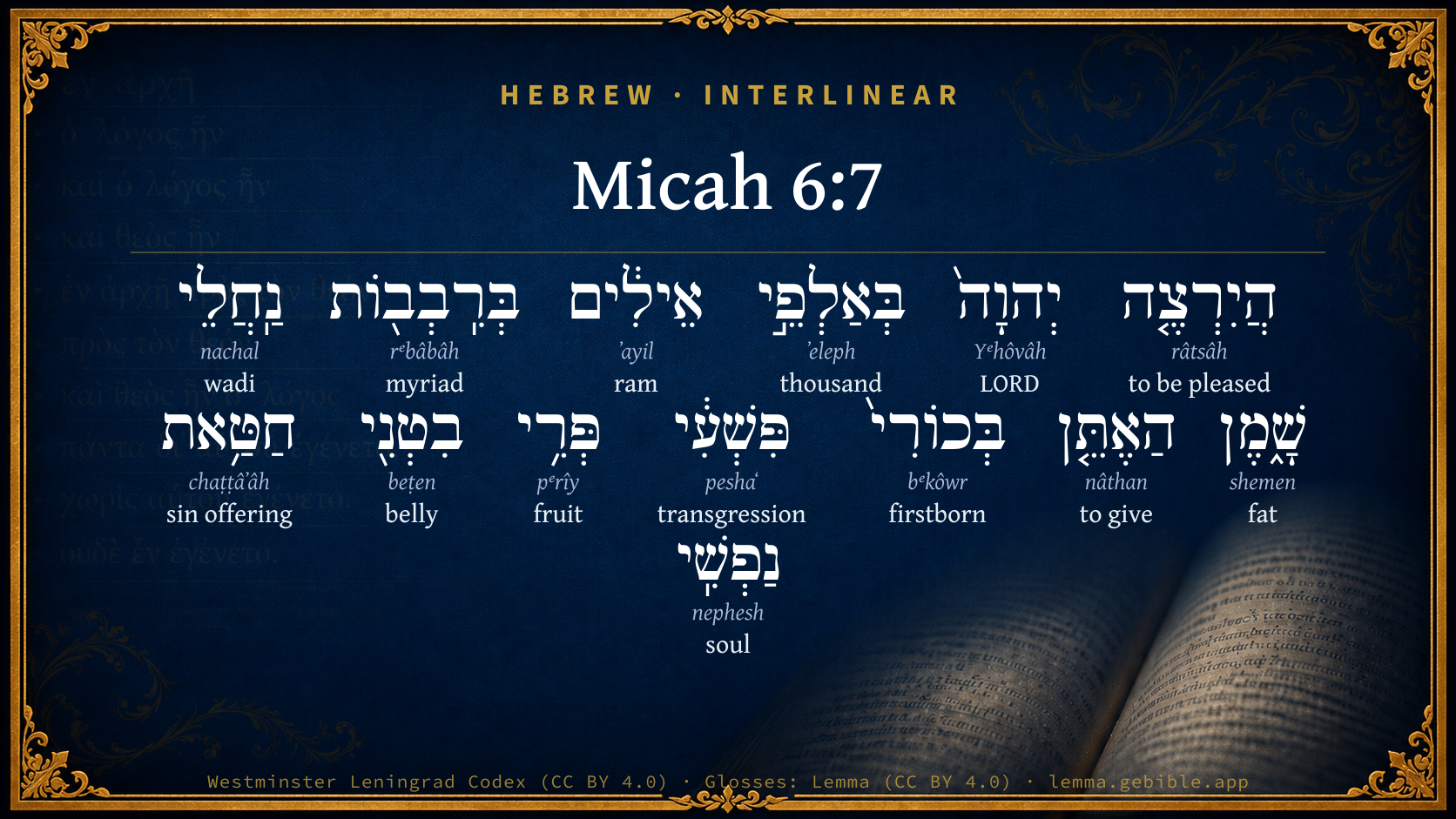
  1. הֲיִרְצֶ֤ה râtsâh H7521 “to be pleased” Particle, Interrogative + Verb, Qal, Imperfect, 3rd Person, Masculine, Singular
  2. יְהוָה֙ Yᵉhôvâh H3068 “LORD” Noun, Proper
  3. בְּאַלְפֵ֣י ʼeleph H505 “in/at · thousand” Preposition + Adjective, Cardinal number, Both, Plural, Construct
  4. אֵילִ֔ים ʼayil H352 “rams” Noun, Common, Masculine, Plural, Absolute
  5. נַֽחֲלֵי nachal H5158 “wadis of” Noun, Common, Masculine, Plural, Construct
  6. שָׁ֑מֶן shemen H8081 “fat” Noun, Common, Masculine, Singular, Absolute
  7. הַאֶתֵּ֤ן nâthan H5414 “to give” Particle, Interrogative + Verb, Qal, Imperfect, 1st Person, Common, Singular
  8. בְּכוֹרִי֙ bᵉkôwr H1060 “firstborn · my” Noun, Common, Masculine, Singular, Construct + Suffix, Personal, 1st Person, Common, Singular
  9. פִּשְׁעִ֔י peshaʻ H6588 “transgression · my” Noun, Common, Masculine, Singular, Construct + Suffix, Personal, 1st Person, Common, Singular
  10. פְּרִ֥י pᵉrîy H6529 “fruit of” Noun, Common, Masculine, Singular, Construct
  11. בִטְנִ֖י beṭen H990 “belly · my” Noun, Common, Feminine, Singular, Construct + Suffix, Personal, 1st Person, Common, Singular
  12. חַטַּ֥את chaṭṭâʼâh H2403 “sin offering of” Noun, Common, Feminine, Singular, Construct
  13. נַפְשִֽׁי nephesh H5315 “soul · my” Noun, Common, Both, Singular, Construct + Suffix, Personal, 1st Person, Common, Singular

About this verse

These counts appear in no published source. They are computed here, from the morphology-tagged text and Lemma’s own curated glosses. What Lemma adds →

14
words
14
distinct lemmas
Prophets
section

Notable vocabulary

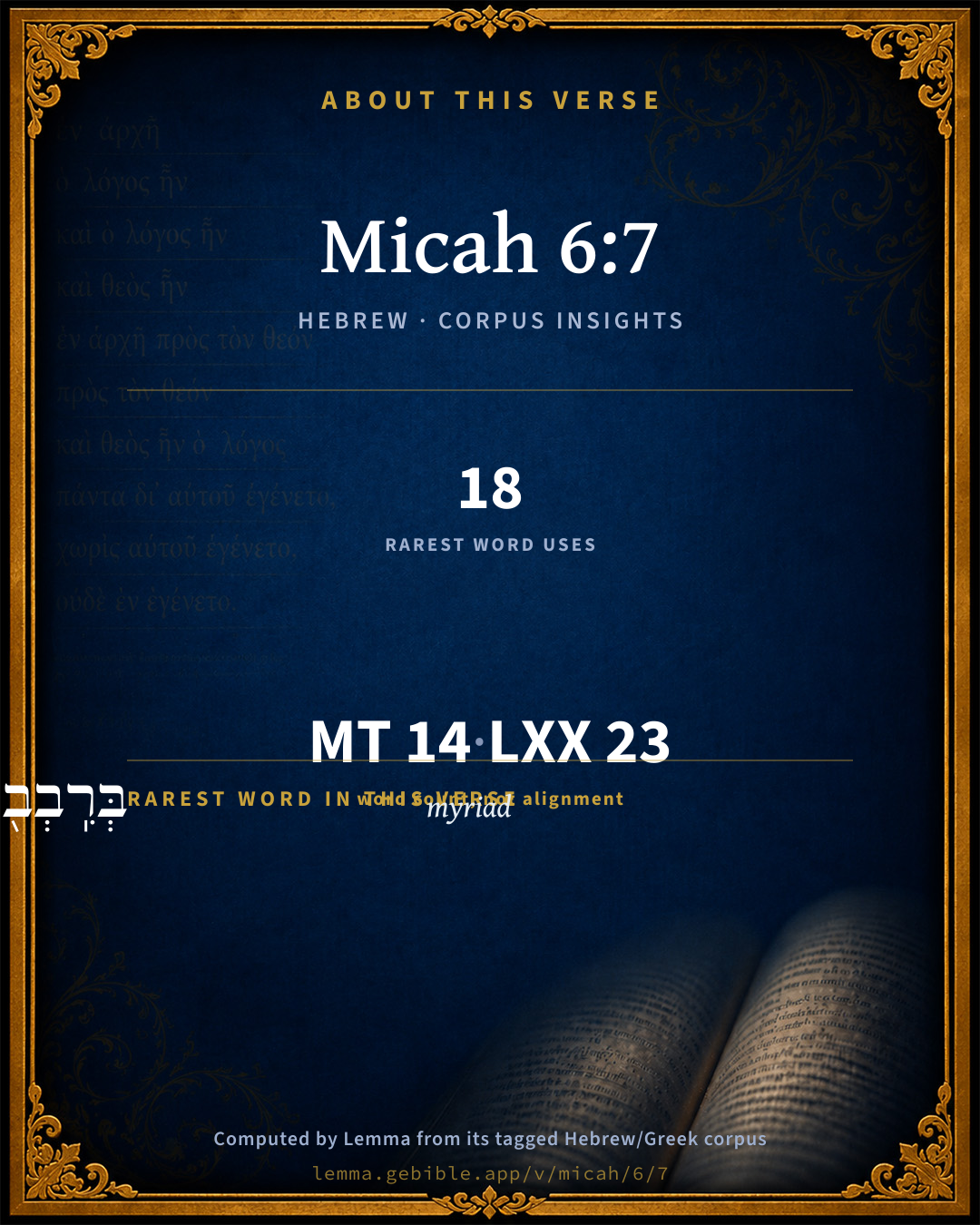
The rarest word here is בְּרִֽבְב֖וֹת myriad H7233 — appearing just 18 times in the whole Hebrew Bible.

Shared distinctive vocabulary

בְּרִֽבְב֖וֹת myriad H7233 occurs in 16 verses of the Hebrew Bible. Also found in:

Grammatical profile

  • 2 verbs
  • 11 nouns
  • 1 adjective

Verb forms

  • הֲיִרְצֶ֤ה Qal · Imperfect
  • הַאֶתֵּ֤ן Qal · Imperfect

Hebrew & Septuagint length

In English translation the verse runs 35 words from the Hebrew and 31 from the Septuagint (LXX English) — closely comparable.

A rough comparison of the two English renderings, which tokenize alike — not a word-level alignment.

Word counts can differ between the Hebrew and the Greek without any difference in meaning — e.g. the Hebrew direct-object marker אֵת has no separate Greek word, and Greek often adds the article ὁ.

In the original languages it is 14 Hebrew tokens and 23 Greek tokens — but the two are counted differently (Hebrew bundles its prefixes and suffixes into one token; the Greek is in lemma form), so that isn’t a like-for-like length.

Cross-references

22

Topical passages linked to Micah 6:7 in the Treasury of Scripture Knowledge — connected by theme and wording, ordered by reader-vote popularity; previews shown in the World English Bible.

  • 2 Kings 16:3 But he walked in the way of the kings of Israel, yes, and made his son to pass through the fire, according to the abominations of the nations, whom Yahweh cast out from before the children of Israel.
  • 1 Samuel 15:22 Samuel said, Has Yahweh as great delight in burnt offerings and sacrifices, as in obeying the voice of Yahweh? Behold, to obey is better than sacrifice, and to listen than the fat of rams.
  • Psalms 51:16 For you don't delight in sacrifice, or else I would give it. You have no pleasure in burnt offering.
  • Psalms 50:9 I have no need for a bull from your stall, Nor male goats from your pens.
  • Hosea 6:6 For I desire mercy, and not sacrifice; And the knowledge of God more than burnt offerings.
  • 2 Kings 3:27 Then he took his eldest son who would have reigned in his place, and offered him for a burnt offering on the wall. There was great wrath against Israel: and they departed from him, and returned to their own land.
  • 2 Kings 21:6 He made his son to pass through the fire, and practiced sorcery, and used enchantments, and dealt with those who had familiar spirits, and with wizards: he worked much evil in the sight of Yahweh, to provoke him to anger.
  • 2 Kings 23:10 He defiled Topheth, which is in the valley of the children of Hinnom, that no man might make his son or his daughter to pass through the fire to Molech.
  • Jeremiah 7:31 They have built the high places of Topheth, which is in the valley of the son of Hinnom, to burn their sons and their daughters in the fire; which I didn't command, neither came it into my mind.
  • Leviticus 18:21 "'You shall not give any of your children to sacrifice to Molech; neither shall you profane the name of your God: I am Yahweh.
  • Isaiah 40:16 Lebanon is not sufficient to burn, nor the animals of it sufficient for a burnt offering.
  • Judges 11:31 then it shall be, that whatever comes forth from the doors of my house to meet me, when I return in peace from the children of Ammon, it shall be Yahweh's, and I will offer it up for a burnt offering.
  • Judges 11:39 It happened at the end of two months, that she returned to her father, who did with her according to his vow which he had vowed: and she was a virgin. It was a custom in Israel,
  • Job 29:6 When my steps were washed with butter, And the rock poured out streams of oil for me!
  • Psalms 10:8–13 He lies in wait near the villages. From ambushes, he murders the innocent. His eyes are secretly set against the helpless.
  • Isaiah 1:11–15 "What are the multitude of your sacrifices to me?," says Yahweh. "I have had enough of the burnt offerings of rams, And the fat of fed animals. I don't delight in the blood of bulls, Or of lambs, Or of male goats.
  • Jeremiah 7:21–22 Thus says Yahweh of Hosts, the God of Israel: Add your burnt offerings to your sacrifices, and eat you flesh.
  • Jeremiah 19:5 and have built the high places of Baal, to burn their sons in the fire for burnt offerings to Baal; which I didn't command, nor spoke it, neither came it into my mind:
  • Ezekiel 16:20–21 Moreover you have taken your sons and your daughters, whom you have borne to me, and these have you sacrificed to them to be devoured. Were your prostitution a small matter,
  • Ezekiel 23:37 For they have committed adultery, and blood is in their hands; and with their idols have they committed adultery; and they have also caused their sons, whom they bore to me, to pass through [the fire] to them to be devoured.
  • Amos 5:22 Yes, though you offer me your burnt offerings and meal-offerings, I will not accept them; Neither will I regard the peace offerings of your fat animals.
  • Philemon 1:12 I am sending him back. Therefore receive him, that is, my own heart,

Cross-references courtesy of OpenBible.info (CC BY 4.0).

Hebrew and Greek witnesses Masoretic Hebrew ↔ Greek Septuagint

The same verse in the two great witnesses to the Old Testament, shown verse-for-verse.

These are two independent witnesses, not word-aligned to each other, and the Septuagint is shown in lemma (dictionary) form.

Hebrew Micah 6:7 Masoretic · Westminster Leningrad Codex

הֲיִרְצֶ֤ה יְהוָה֙ בְּאַלְפֵ֣י אֵילִ֔ים בְּרִֽבְב֖וֹת נַֽחֲלֵי שָׁ֑מֶן הַאֶתֵּ֤ן בְּכוֹרִי֙ פִּשְׁעִ֔י פְּרִ֥י בִטְנִ֖י חַטַּ֥את נַפְשִֽׁי

Will Yahweh be pleased with thousands of rams? With tens of thousands of rivers of oil? Shall I give my firstborn for my disobedience? The fruit of my body for the sin of my soul?

World English Bible · Public Domain

Greek LXX Micah 6:7 Septuagint · lemma form

εἰ προςδέχομαι κύριος ἐν χιλιάς κριός ἤ ἐν μυριάς χειμάρρους πίων εἰ δίδωμι πρωτότοκος ἐγώ ἀσέβεια καρπός κοιλία ἐγώ ὑπέρ ἁμαρτία ψυχή ἐγώ

Will the Lord accept thousands of rams, or ten thousands of fat goats? should I give my firstborn for ungodliness, the fruit of my body for the sin of my soul?

LXX2012 (modern English Septuagint) · Public Domain

On this verse, The Pulpit Commentary discusses the Septuagint’s reading. Read the note in Commentary ↓

Hebrew: Westminster Leningrad Codex (CC BY 4.0). Greek: Septuagint (public domain); English from LXX2012 (modern English Septuagint) (Public Domain). How the Septuagint differs from the Hebrew →

Targum (Aramaic paraphrase)

1

The Targum is the ancient Jewish Aramaic paraphrase of the Hebrew Scriptures — an interpretive translation, not the Hebrew text itself. Onkelos (literal) and Pseudo-Jonathan (expansive) render the Torah, and Jonathan the Prophets. Coverage is partial: where no permissively-licensed English translation exists for a verse, only the Aramaic is shown. This is verse-level text, not a word-by-word alignment to the Hebrew.

  1. Targum Jonathan Prophets (Joshua–Malachi)
    הֲיִתְרְעֵי יְיָ בְּאַלְפֵי דִכְרִין בְּרִבְבַת נַחֲלִין דִמְשַׁח הַאֶתֵּן בּוּכְרִי חֲלַף חוֹבִי חִבּוּב מֵעַי חֲלַף חֲטָאֵי נַפְשִׁי:

    (no public-domain English translation for this verse)

    Targum Jonathan — Aramaic: “Mikraot Gedolot” (public domain). English: “Sefaria Community Translation” (CC0 1.0 (public-domain dedication)); “London "Chaldee Paraphrase," 1871” (public domain). Text via Sefaria.

Commentary

Notes on Micah 6:7 from classic Christian and Jewish commentators (each source and its license shown beneath its notes). The classic Christian expositions comment on the surrounding passage and are grouped to its opening verse, so a note may address several verses; the Jewish commentaries on the Tanakh (Rashi and others) are per-verse, so they appear only where the commentator wrote on this verse.

Lemma curates 59 commentaries, every one of them public domain or Creative Commons licensed, each selected and text-cleaned for this edition rather than reprinted as found. About our sources →

Trapp's Complete Commentary

John Trapp

Mic 6:7 Will the LORD be pleased with thousands of rams, [or] with ten thousands of rivers of oil? shall I give my firstborn [for] my transgression, the fruit of my body [for] the sin of my soul?

Ver. 7. Will the Lord be pleased with thousands of rams?] It was taken for a maxim among all nations that no man was to come before God empty handed, nor to serve him of free cost. And although Lycurgus the Lacedaemonian made a law that no man should be at very great charge for a sacrifice, lest he should grow weary of God’s service; yet when the famous carver Phidias advised the Athenians to make the statue of Minerva rather of marble than of ivory, 1. Because more durable (this passed with allowance), 2. Because less chargeable, at the mention hereof, with infinite indignation, they commanded him silence. Pliny tells us of Alexander the Great, that when, as being yet a youth, he cast great store of frankincense upon the altar, and his schoolmaster told him he must not be so liberal till he had subdued the frankincense countries; when once he had conquered Arabia he sent his schoolmaster a shipfull of frankincense, largely exhorting him to worship the gods therewith. Superstition is, for the most part, not liberal only, but prodigal and no wonder, when as good works are by Bellarmine said to be mercatura regni coelestis the price and purchase of heaven. Hence their churches are so stuffed with vowed presents and memories, as at Loretto, and elsewhere, they are fain to hang their cloisters and churchyards with them. What would not men give, what will they not suffer, that they may be saved? I would swim through a sea of brimstone, said one, that I might come to heaven at last. But those that would buy heaven, and do offer, as these here, a bribe for a pardon, shall hear, Thy money perish with thee; and those that seek to be saved by their works Luther fitly calls the devil’s martyrs; they suffer much and take much pains to go to hell, they buy their damnation, as one saith the Pharisees did when they gave Judas those thirty pieces, for which he sold his salvation.

Shall I give my firstborn for my transgression, &c.] The superstitious Jews used, we know, to offer up their children in sacrifice to Moloch, or Saturn, 2Ki 17:15-17; 2Ki 21:5-7; 2Ki 23:10, and that in an apish imitation of Abraham’s offering his son Isaac. To the same Saturn the Phoenicians are said to have sacrificed the best of their sons (Euseb. Praep. Evang. lib. 4). So did the Carthaginians, as Diodorus Siculus testifies. And when as they had for a while left off so to do, and were overcome by Agathocles, they (supposing that the gods were therefore angry with them, because they had not done as formerly) slew two hundred at once, at the altar, of their young nobility, to pacify the offended deity. Of like sort were Anammelech and Adrammelech, the gods of Sepharvaim, unto whom that people "burnt their children in the fire," 2Ki 17:31. And little better were our ancestors, the old Britons, who not only sacrificed their strangers, but their children too, non ad honorem sed ad iniuriam religionis (Cared. Britan.). Here then the prophet seemeth to speak by way of concession, that he may show these questionists how little it would avail them to sacrifice their children, if such a thing were lawful to be done.

John Trapp, A Commentary or Exposition upon All the Books of the Old and New Testament (1647–1656) — public domain. Text from a community e-Sword module.

Geneva Bible (1599)

Geneva Bible translators

There is nothing so dear to man, but the hypocrites will offer it unto God, if they think thereby to avoid his anger: but they will never be brought to mortify their own affections, and to give themselves willingly to serve God as he commandeth.

Geneva Bible (1599) marginal notes — public domain. Text via Bolls.life.

Jamieson, Fausset & Brown

Robert Jamieson, A. R. Fausset & David Brown

rivers of oil--used in sacrifices (Lev 2:1, Lev 2:15). Will God be appeased by my offering so much oil that it shall flow in myriads of torrents?

my first-born-- (Kg2 3:27). As the king of Moab did.

fruit of my body--my children, as an atonement (Psa 132:11). The Jews offered human sacrifices in the valley of Hinnom (Jer 19:5; Jer 32:35; Eze 23:27).

Jamieson, Fausset & Brown — Commentary Critical and Explanatory on the Whole Bible (1871) — public domain (CC PDM 1.0). Text via the HelloAO Bible API.

Adam Clarke's Commentary

Verse 7. Will the Lord be pleased with thousands of rams] These might be procured, though with difficulty; but conscience says neither will these do.

With ten thousands of rivers of oil] This is absurd and impossible; but could even these be procured, could they all make atonement for such guilt, and ingratitude, and rebellion?

Shall I give my first-born for my transgression] This was sinful and wicked; but such offerings had been made by the Phoenicians, and their successors the Carthaginians; and this very custom was copied by the corrupt Israelites. See some cases of such offerings, 2Kg 3:27; Le 20:27.

The fruit of my body for the sin of my soul?] This clause is an explanation of the former. Shall I make the first-born, the best and goodliest of my children, חטאת chattath, a SIN-OFFERING for my soul? And thus the original is used in a multitude of places.

When they had put all these questions to their reason and conscience, they found no satisfaction; their distraction is increased, and despair is about to take place, when Jehovah, the plaintiff, in his mercy interposes:

Adam Clarke's Commentary on the Bible (1810–1826) — public domain. Text from a community e-Sword/MySword module.

Ellicott's Commentary for English Readers

(7) The fruit of my body.—Will God require the sacrifice of such a precious possession, as Isaac was to Abraham, to atone for my wrong-doing? There may possibly be an allusion to human sacrifices, such as Ahaz offered to Molech, or to the act of Mesha, King of Moab, who “took his eldest son, that should have reigned in his stead, and offered him up for a burnt offering upon the wall.”

A Bible Commentary for English Readers, edited by Charles John Ellicott (1878–1897) — public domain. Text from a community e-Sword module.

The Cambridge Bible for Schools and Colleges

gen. ed. J. J. S. Perowne

7. with thousands of rams] With hecatombs, a Greek would have said. The calves are estimated by quality; the rams, by quantity.

rivers of oil] Or, ‘torrents of oil;’ like ‘brooks [torrents] of honey,’ Job_20:17.

my firstborn for my transgression] This is the climax of Israel’s offers; he will not withhold his most precious possession. The valley of Hinnom was for centuries defiled by sacrifices of children to the ‘devouring’ Fire-god, Moloch; a custom derived from ‘the nations whom Jehovah cast out from before the children of Israel’ (2Ki_16:3). The narrative of the substitution of the ram for Isaac (Gen_22:13), and the law of the redemption of the firstborn of man (Exo_13:13), show that, although perhaps permitted ‘for the hardness of men’s hearts’ in earlier times, such human sacrifices were no longer admitted by the prophetic and legal interpreters of the Divine will to Israel. Comp. Lev_18:21; Lev_20:2, 2Ki_16:3; 2Ki_23:10, Isa_57:5, Jer_7:31, Eze_16:20; Eze_20:26

The Cambridge Bible for Schools and Colleges (gen. ed. J. J. S. Perowne; Cambridge University Press, 1878–1918) — public domain. Text from a community e-Sword module.

John Gill's Exposition

Will the Lord be pleased with thousands of rams,.... If single burnt offerings of bullocks and heifers will not do, will rams, and thousands of them, be acceptable to him? if they will, they are at his service, even as many as he pleases; such creatures, as well as oxen, were offered by Balak, Num 23:1;

or with ten thousands of rivers of oil? for meat offerings, as Jarchi, in which oil was used: this is a hyperbolical expression, as Kimchi rightly observes; suggesting that he was willing to be at any expenses, even the most extravagant, if he could but gain his point, and get the God of Israel on his side. Some render it, "ten thousands of fat valleys" (d); abounding with corn, and wine, and oil; the produce of which, had he so many, he could freely part with, could he but obtain his end; see Job 20:17;

shall I give my firstborn for my transgression, the fruit of my body for the sin of my soul? his Son, his firstborn, his own flesh and blood, to make atonement for his sins and transgressions; this betrays the person speaking. The people of Israel, though they were sometimes guilty of this horrid, unnatural, and abominable sin, in the height of their degeneracy and apostasy, as to sacrifice their children to Mo; yet when convinced of their sins, and humbling themselves before God for them, even though but in a hypocritical way, could never be so weak and foolish, so impious and audacious, as to propose that to God, which they knew was so contrary to his will, and so abominable in his sight, Lev 18:21; but this comes well enough from a Heathen prince, with whom it was the, height of his devotion and religion, and the greatest sacrifice he thought he could offer up to God; for there is a climax, a gradation in the words from lesser things to greater; and this is the greatest of all, and what was done among the Heathens, Kg2 17:31; and was afterwards done by a king of Moab, Kg2 3:26.

(d) "in decem millibus vallium pinguium", Munster.

John Gill's Exposition of the Whole Bible (1746–1763) — public domain (CC PDM 1.0). Text via the HelloAO Bible API.

Haydock's Catholic Bible Commentary

Fat. Hebrew, "torrents of oil." --- First-born, like Jephte, or the king of Moab, Judges xi., and 4 Kings iii. 27. Saturn taught the Phœnicians this impiety. (Eusebius, præp. iv. 16.) (Calmet)

George Leo Haydock (1774–1849), Haydock's Catholic Family Bible and Commentary, 1859 edition — public domain. Excludes Psalms (Douay-Rheims chapter numbering differs from Protestant) and Deuterocanonical books (Catholic canon only).

Matthew Poole's English Annotations

Will the Lord be pleased with thousands of rams? the law did direct the offering of rams, single beasts for single sacrifices; if this be too little, they shall be multiplied, we will give many, very many; for the phrase is a hyperbole.

With ten thousands of rivers of oil: oil was required too in their sacrifices, in the meat-offerings of them, but in no great quantities, a log, or hin, i.e. half a pint, or three quarts; but we know such gifts are infinitely short of the Divine goodness bestowed on us; he who is our God is worthy of rivers of oil, multiplied to thousands; had we such store it should be all his. Such-like hyperbole you meet with in Isa 40:15-17.

Shall I give my first-born? this is proposed not as a thing practicable by any rule of reason or religion, but as a proof of their readiness, as Abraham, to offer up their first-born, as he did offer up his Isaac to God. It is much to part with any of our children, but it is more to part with the strength, and glory, and hope of our families; yet, like hypocrites, or like unnatural heathen, this they would do, rather than what would please the Lord.

For my transgression; to appease the anger of the Lord for my sins; would these be expiatories?

The fruit of my body for the sin of my soul? the question is repeated to affect us the more: the words would bear this reading, Shall I give my first-born? This would be my sin. The fruit of my body? These would be the sin of my soul.

Matthew Poole's English Annotations on the Holy Bible (1683–1685) — public domain. Text from a community e-Sword/MySword module.

The Pulpit Commentary

Thousands of rams, as though the quantity enhanced the value, and tended to dispose the Lord to regard the offerer"s thousandfold sinfulness with greater favour. Ten thousands of rivers (torrents , as in Job_20:17) of oil. Oil was used in the daily meal offering, and in that which accompanied every burnt offering. (see Exo_29:40 Lev_7:10-12 Num_15:4, etc.)

The Vulgate has a different reading, In multis millibus hircorum pinguium; so the Septuagint, en muriasi cimarwn arnwn , Alex. ptonwn , "with ten thousands of fat goats," so also the Syriac. The alteration has been introduced probably with some idea of making the parallelism more exact.

Shall I give my firstborn? Micah exactly represents the people"s feeling; they would do anything but what God required; they would make the costliest sacrifice, even, m their exaggerated devotion, holding themselves ready to make a forbidden offering; but they would not attend to the moral requirements of the Law. It is probably by a mere hyperbole that the question in the text is asked. The practice of human sacrifice was founded on the notion that man ought to offer to God his dearest and costliest, and that the acceptability of an offering was proportioned to its preciousness. The Hebrews had learned the custom from their neighbours, e.g. the Phoenicians and Moabites, (comp. 2Ki_3:27) and had for centuries offered their children to Moloch, in defiance of the stern prohibitions of Moses and their prophets. (Lev_18:21 2Ki_16:3 Isa_57:5) They might have learned, from many facts and inferences, that man"s self-surrender was not to be realized by this ritual; the sanctity of human, (Gen_9:6) the substitution of the ram for Isaac, (Gen_22:13) the redemption of the firstborn, (Exo_13:13) all made for this truth. But the heathen idea retained its hold among them, so that the inquiry above is in strict keeping with the circumstances. The fruit of my body; i.e. the rest of my children. (Deu_28:4)

The Pulpit Commentary (1880–1919), ed. H.D.M. Spence-Jones & Joseph S. Exell — public domain. Text from a community e-Sword module.

John Wesley's Explanatory Notes

Thousands - Ever so many. Ten thousands of rivers - Were it possible to give them.

John Wesley, Explanatory Notes Upon the Whole Bible (1754–1765) — public domain. Text via the GEBible commentary corpus.

Rashi

Rabbi Shlomo Yitzchaki (Rashi)

streams of oil—for meal offerings.

Shall I give my firstborn?—as a sacrifice for my transgression.

Rashi on the Tanakh — English translations: “The Judaica Press complete Tanach with Rashi, translated by A. J. Rosenberg” (CC BY 4.0); “Pentateuch with Rashi's commentary by M. Rosenbaum and A.M. Silbermann, 1929-1934” (public domain); “The Metsudah Tanach series, Lakewood, N.J” (CC BY 4.0); and “The Book of Joshua, Metsudah Publications, 1997” (CC BY 4.0). Text via Sefaria.

Lesson kit

Teaching starters — assembled from the data on this page, not authored interpretation. Every prompt links to the verse data it draws on. Edit before teaching.

Micah, in the Prophets, opens this verse with 14 words (14 distinct Hebrew lemmas). Its most distinctive word is rᵉbâbâh (“myriad”). A historical commentator’s framing appears above. Read the whole chapter for the surrounding context.

Discussion questions

  1. How does “myriad” (rᵉbâbâh) shape what this verse is saying?
  2. How does Genesis 24:60, which shares the word «myriad», read alongside this verse?
  3. These translations render this verse differently. What is at stake in choosing one wording over another?
  4. «הֲיִרְצֶ֤ה» is a Qal Imperfect verb. How does that grammatical form shape the action described?
  5. Compare how Trapp's Complete Commentary and Geneva Bible (1599) read this verse. Where do they agree or differ?

Things to notice

Reading settings

Reading text

Shown beneath each verse's original-language words.

Old Testament
Old Testament edition

Read the OT as the Masoretic Hebrew (MT) or the Greek Septuagint (LXX).

English shown for the Greek Septuagint (in the Hebrew ↔ Greek comparison).

Comparing translations? Open the Compare panel on any verse page to stack up to four side by side.