1 Samuel 18:7

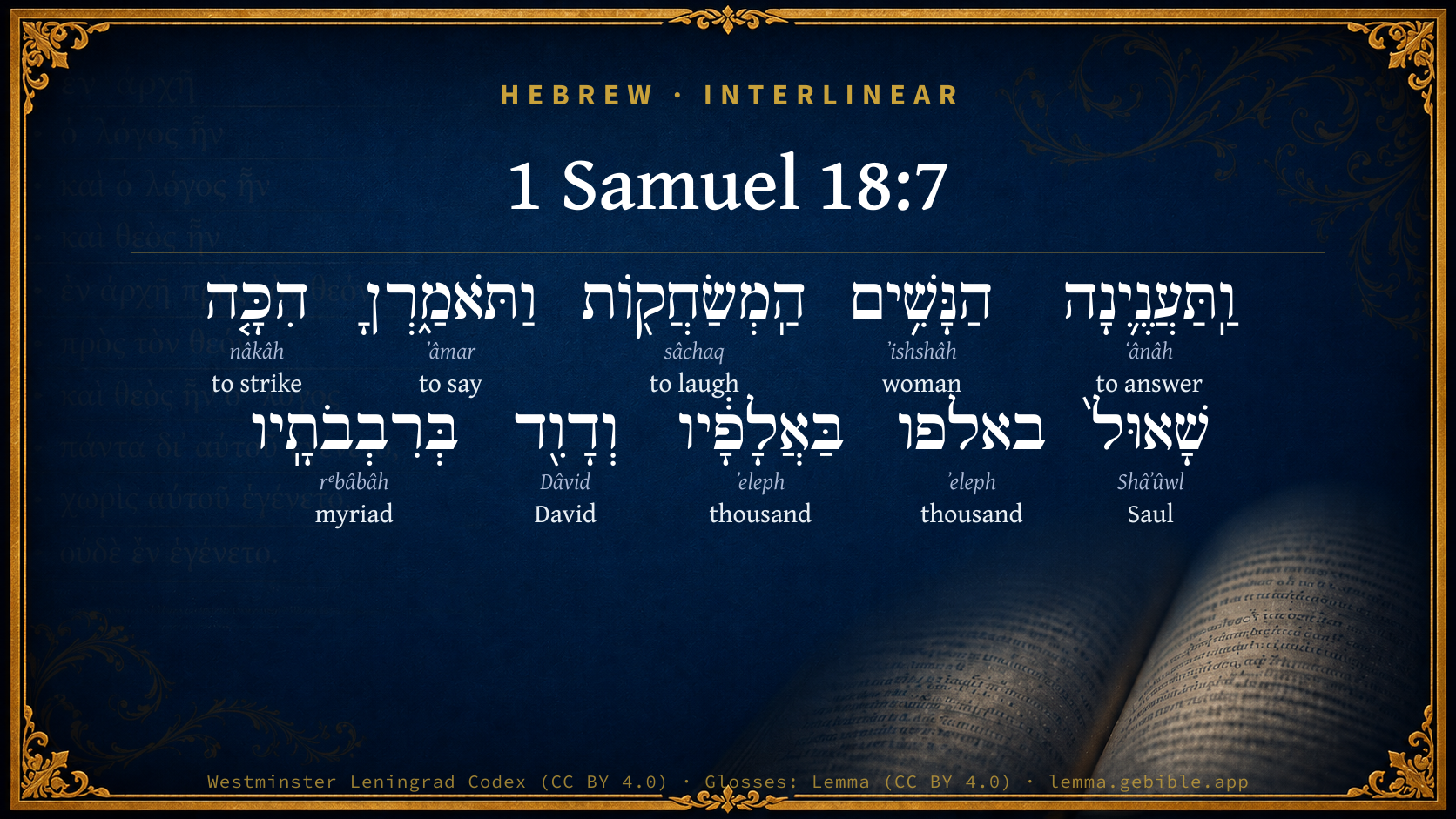
Hebrew (Westminster Leningrad Codex) 1 Samuel 18:7 appears in the Hebrew Old Testament. The text above is from the Westminster Leningrad Codex. Each word links to its Strong’s number, a concise gloss, and parsing drawn from the Open Scriptures Hebrew Bible morphology. Click any word for its full Brown-Driver-Briggs (BDB) entry.
Download image
Cite this verse

1 Samuel 18:7 (World English Bible). Public Domain. Lemma interlinear Bible study tool, https://lemma.gebible.app/v/1-samuel/18/7.

Show BibTeX & RIS
BibTeX
RIS
English Translation
The women sang one to another as they played, and said, Saul has slain his thousands, David his ten thousands.
World English Bible · Public Domain
Download a study sheet

One document with this verse’s original text, its word-by-word gloss line, the meaning frame, cross-references with their text, attributed commentary, and full source and license credits — printable, and it pastes into notes with its structure intact.

This verse Autodidact and up

Study sheet (.html) Plain text (.txt)

A passage Seminary Student

Up to 50 verses in one chapter. A passage sheet keeps up to 6 commentary sources and 12 cross-references per verse, in the order this page ranks them, and says so on the sheet whenever that leaves anything out. Ask for a single verse and you get the Autodidact verse sheet above.

Everything on this page stays free to read, with no account — the sheet is a download of what is already on screen, not access to it.

Want to remove ads? Support Godless Engineer
Compare translations 3

The same verse in 3 English versions, stacked beneath the original-language interlinear above. Click any original word for its lexicon entry.

Each is an independent rendering of the whole verse — the interlinear is not word-aligned to these translations.

Highlighted words mark where these versions differ — a whole-verse word diff, not a word-by-word alignment.

  • World English Bible Public Domain
    The women sang one to another as they played, and said, Saul has slain his thousands, David his ten thousands.
  • King James Version Public Domain
    And the women answered one another as they played, and said, Saul hath slain his thousands, and David his ten thousands.
  • unfoldingWord Literal Text CC BY-SA 4.0
    And the women celebrating sang and said, “Saul has struck his thousands, and David his myriads.”

unfoldingWord Literal Text — © unfoldingWord, licensed CC BY-SA 4.0. Word-aligned USFM3 via Door43 (git.door43.org/unfoldingWord/en_ult).

Versions to compare (up to 4)

3 of 4 selected

Show all 18 translations

Every available English version of this verse, each an independent rendering of the whole verse.

  • World English Bible Public Domain
    The women sang one to another as they played, and said, Saul has slain his thousands, David his ten thousands.
  • Berean Standard Bible Public Domain
    And as the women danced, they sang out: “Saul has slain his thousands, and David his tens of thousands.”
  • Majority Standard Bible Public Domain
    And as the women danced, they sang out: “Saul has slain his thousands, and David his tens of thousands.”
  • King James Version Public Domain
    And the women answered one another as they played, and said, Saul hath slain his thousands, and David his ten thousands.
  • American Standard Version (1901) Public Domain
    And the women sang one to another as they played, and said, Saul hath slain his thousands, And David his ten thousands.
  • Revised Version (1885) Public Domain
    And the women sang one to another in their play, and said, Saul hath slain his thousands, and David his ten thousands.
  • Geneva Bible (1599) Public Domain
    And the women sang by course in their play, and sayd, Saul hath slayne his thousand, and Dauid his ten thousand.
  • Douay-Rheims (1899) Public Domain
    And the women sung as they played, and they said: I Saul slew his thousands, and David his ten thousands.
  • Young's Literal Translation Public Domain
    and the women answer -- those playing, and say, `Saul hath smitten among his thousands, And David among his myriads.'
  • Literal Standard Version CC BY-SA 4.0
    and the women answer—those playing, and say, “Saul has struck among his thousands, || And David among his myriads.”
  • Unlocked Literal Bible CC BY-SA 4.0
    The women sang one to another as they played. They sang: “Saul has killed his thousands, and David his ten thousands.”
  • unfoldingWord Literal Text CC BY-SA 4.0
    And the women celebrating sang and said, “Saul has struck his thousands, and David his myriads.”
  • Darby Bible Public Domain
    And the women answered [one another] as they played, and said, Saul hath smitten his thousands, And David his ten thousands.
  • World Messianic Bible Public Domain
    The women sang to one another as they played, and said, “Saul has slain his thousands, and David his ten thousands.”
  • Webster's Bible Public Domain
    And the women answered one another as they played, and said, Saul hath slain his thousands, and David his ten thousands.
  • Free Bible Version CC BY-SA 4.0
    As they danced the women sang, “Saul has killed his thousands, and David his tens of thousands.”
  • Bible in Basic English Public Domain
    And the women, answering one another in their song, said, Saul has put to death his thousands and David his tens of thousands.
  • JPS Tanakh (1917) Public Domain
    And the women sang one to another in their play, and said: Saul hath slain his thousands, and David his ten thousands.

Literal Standard Version (2020), Covenant Press — licensed CC BY-SA 4.0. Text via the HelloAO Bible API (eBible.org). Unlocked Literal Bible (unfoldingWord) — licensed CC BY-SA 4.0. Text via the HelloAO Bible API (eBible.org). unfoldingWord Literal Text — © unfoldingWord, licensed CC BY-SA 4.0. Word-aligned USFM3 via Door43 (git.door43.org/unfoldingWord/en_ult). Free Bible Version, Dr. Jonathan Gallagher — licensed CC BY-SA 4.0. Text via the HelloAO Bible API (eBible.org).

Word by word

More ways to search: Search by grammar → Find every occurrence → Compare this word →

Practice this passage: Drill this verse → Learn its vocabulary →

בְּרִבְבֹתָֽיו
rᵉbâbâh
H7233
“in/at · myriads · his”
Preposition + Noun, Common, Feminine, Plural, Construct + Suffix, Personal, 3rd Person, Masculine, Singular
Part of Speech
Preposition + Noun
Type
Common
Gender
Feminine
Number
Plural
State
Construct
Full BDB Definition

Origin: from H7231

TWOT: 2099d

multitude, myriad, ten thousand
  1. וַֽתַּעֲנֶ֛ינָה ʻânâh H6030 “and · to answer” Conjunction + Verb, Qal, Sequential Imperfect, 3rd Person, Feminine, Plural
  2. הַנָּשִׁ֥ים ʼishshâh H802 “the · women” Particle, Definite Article + Noun, Common, Feminine, Plural, Absolute
  3. הַֽמְשַׂחֲק֖וֹת sâchaq H7832 “the · laughing” Particle, Definite Article + Verb, Piel, Participle Active, Feminine, Plural, Absolute
  4. וַתֹּאמַ֑רְןָ ʼâmar H559 “and · to say” Conjunction + Verb, Qal, Sequential Imperfect, 3rd Person, Feminine, Plural
  5. הִכָּ֤ה nâkâh H5221 “to strike” Verb, Hiphil, Perfect, 3rd Person, Masculine, Singular
  6. שָׁאוּל֙ Shâʼûwl H7586 “Saul” Noun, Proper
  7. באלפו ʼeleph H505 “in/at · thousand · his” Preposition + Adjective, Cardinal number, Both, Plural, Construct + Suffix, Personal, 3rd Person, Masculine, Singular
  8. בַּאֲלָפָ֔יו ʼeleph H505 “in/at · thousand · his” Preposition + Adjective, Cardinal number, Both, Plural, Construct + Suffix, Personal, 3rd Person, Masculine, Singular
  9. וְדָוִ֖ד Dâvid H1732 “and · David” Conjunction + Noun, Proper

About this verse

These counts appear in no published source. They are computed here, from the morphology-tagged text and Lemma’s own curated glosses. What Lemma adds →

10
words
9
distinct lemmas
Historical
section

Notable vocabulary

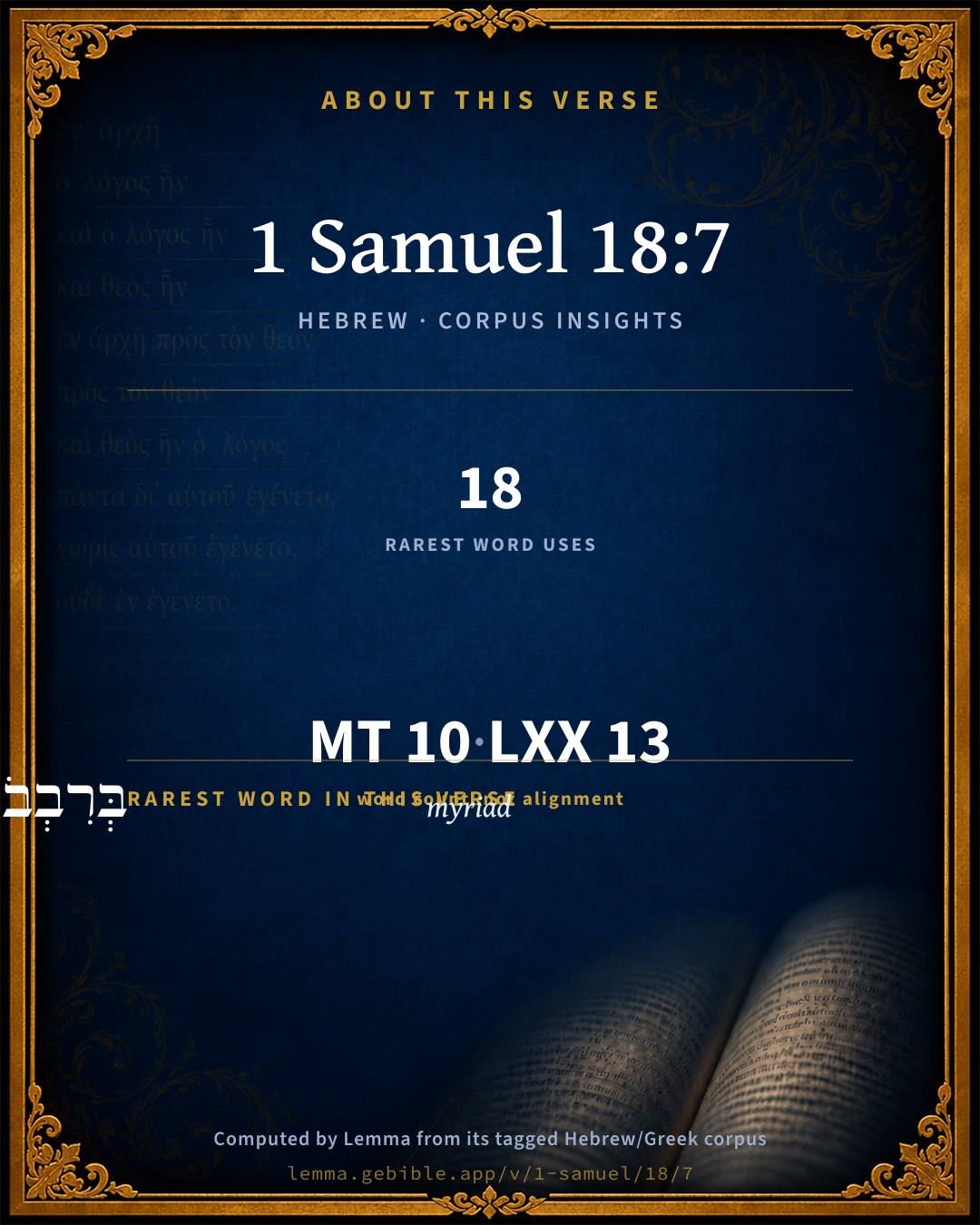
The rarest word here is בְּרִבְבֹתָֽיו myriad H7233 — appearing just 18 times in the whole Hebrew Bible.

Shared distinctive vocabulary

בְּרִבְבֹתָֽיו myriad H7233 occurs in 16 verses of the Hebrew Bible. Also found in:

Grammatical profile

  • 4 verbs
  • 4 nouns
  • 2 adjectives

Verb forms

  • וַֽתַּעֲנֶ֛ינָה Qal · Sequential Imperfect
  • הַֽמְשַׂחֲק֖וֹת Piel · Participle Active
  • וַתֹּאמַ֑רְןָ Qal · Sequential Imperfect
  • הִכָּ֤ה Hiphil · Perfect

Repetition

A word recurs within this verse — often emphatic in Hebrew:

  • באלפו thousand H505 ×2

Hebrew & Septuagint length

In English translation the verse runs 20 words from the Hebrew and 18 from the Septuagint (LXX English) — closely comparable.

A rough comparison of the two English renderings, which tokenize alike — not a word-level alignment.

Word counts can differ between the Hebrew and the Greek without any difference in meaning — e.g. the Hebrew direct-object marker אֵת has no separate Greek word, and Greek often adds the article ὁ.

In the original languages it is 10 Hebrew tokens and 13 Greek tokens — but the two are counted differently (Hebrew bundles its prefixes and suffixes into one token; the Greek is in lemma form), so that isn’t a like-for-like length.

Cross-references

4

Topical passages linked to 1 Samuel 18:7 in the Treasury of Scripture Knowledge — connected by theme and wording, ordered by reader-vote popularity; previews shown in the World English Bible.

  • 1 Samuel 21:11 The servants of Achish said to him, "Isn't this David the king of the land? Didn't they sing one to another about him in dances, saying, 'Saul has slain his thousands, David his ten thousands?'"
  • Exodus 15:21 Miriam answered them, "Sing to Yahweh, for he has triumphed gloriously: The horse and his rider he has thrown into the sea."
  • 1 Samuel 29:5 Is not this David, of whom they sang one to another in dances, saying, Saul has slain his thousands, David his ten thousands?
  • Psalms 24:7–8 Lift up your heads, you gates; Be lifted up, you everlasting doors: The King of glory will come in.

Cross-references courtesy of OpenBible.info (CC BY 4.0).

Hebrew and Greek witnesses Masoretic Hebrew ↔ Greek Septuagint

The same verse in the two great witnesses to the Old Testament, shown verse-for-verse.

These are two independent witnesses, not word-aligned to each other, and the Septuagint is shown in lemma (dictionary) form.

Hebrew 1 Samuel 18:7 Masoretic · Westminster Leningrad Codex

וַֽתַּעֲנֶ֛ינָה הַנָּשִׁ֥ים הַֽמְשַׂחֲק֖וֹת וַתֹּאמַ֑רְןָ הִכָּ֤ה שָׁאוּל֙ באלפו בַּאֲלָפָ֔יו וְדָוִ֖ד בְּרִבְבֹתָֽיו

The women sang one to another as they played, and said, Saul has slain his thousands, David his ten thousands.

World English Bible · Public Domain

Greek LXX 1 Samuel 18:7 Septuagint · lemma form

καί εἰμί δαυίδ ἐν πᾶς ὁ ὁδός αὐτός συνἵημι καί κύριος μετά αὐτός

And the women began the strain, and said, Saul has struck his thousands, and David his ten thousands.

LXX2012 (modern English Septuagint) · Public Domain

Hebrew: Westminster Leningrad Codex (CC BY 4.0). Greek: Septuagint (public domain); English from LXX2012 (modern English Septuagint) (Public Domain). How the Septuagint differs from the Hebrew →

Targum (Aramaic paraphrase)

1

The Targum is the ancient Jewish Aramaic paraphrase of the Hebrew Scriptures — an interpretive translation, not the Hebrew text itself. Onkelos (literal) and Pseudo-Jonathan (expansive) render the Torah, and Jonathan the Prophets. Coverage is partial: where no permissively-licensed English translation exists for a verse, only the Aramaic is shown. This is verse-level text, not a word-by-word alignment to the Hebrew.

  1. Targum Jonathan Prophets (Joshua–Malachi)
    וַאֲתִיבָא נְשַׁיָא דִמְשַׁבְּחָן וַאֲמַרָא קְטַל שָׁאוּל בְּאַלְפִין וְדָוִד בְּרִיבְוָן:

    (no public-domain English translation for this verse)

    Targum Jonathan — Aramaic: “Mikraot Gedolot” (public domain). English: “Sefaria Community Translation” (CC0 1.0 (public-domain dedication)); “London "Chaldee Paraphrase," 1871” (public domain). Text via Sefaria.

Commentary

Notes on 1 Samuel 18:7 from classic Christian and Jewish commentators (each source and its license shown beneath its notes). The classic Christian expositions comment on the surrounding passage and are grouped to its opening verse, so a note may address several verses; the Jewish commentaries on the Tanakh (Rashi and others) are per-verse, so they appear only where the commentator wrote on this verse.

Lemma curates 59 commentaries, every one of them public domain or Creative Commons licensed, each selected and text-cleaned for this edition rather than reprinted as found. About our sources →

Trapp's Complete Commentary

John Trapp

1Sa 18:7 And the women answered [one another] as they played, and said, Saul hath slain his thousands, and David his ten thousands.

Ver. 7. Saul hath slain his thousands, &c., ] q.d., Saul is to be commended, but David ten times more. This praise of the women given to David flew far and near, {1Sa 21:11; 1Sa 29:5} and was the rise of all his following troubles: likeas in the gospel, he whom our Saviour cured, - and in addition charged him to say nothing, - when he divulged the miracle, though of a good intent, caused a persecution by the spiteful Pharisees.

John Trapp, A Commentary or Exposition upon All the Books of the Old and New Testament (1647–1656) — public domain. Text from a community e-Sword module.

Tyndale Open Study Notes

Tyndale Open Resources

18:7 thousands . . . ten thousands: This dramatic increase in number between two lines of Hebrew poetry was a way of intensifying the statement (cp. Deut 32:30; Ps 91:7). Because of his great military victories, David was beginning to eclipse Saul (1 Sam 18:16, 30; 21:11).

Tyndale Open Study Notes — © Tyndale Open Resources, licensed CC BY-SA 4.0. Text via the HelloAO Bible API.

Geneva Bible (1599)

Geneva Bible translators

Hebrew, answered, playing.

Geneva Bible (1599) marginal notes — public domain. Text via Bolls.life.

Adam Clarke's Commentary

Verse 7. Saul hath slain his thousands] As it cannot literally be true that Saul had slain thousands, and David ten thousands; it would be well to translate the passage thus: Saul hath smitten or fought against thousands; David against tens of thousands. "Though Saul has been victorious in all his battles; yet he has not had such great odds against him as David has had; Saul, indeed, has been opposed by thousands; David, by ten thousands." We may here remark that the Philistines had drawn out their whole forces at this time: and when Goliath was slain, they were totally discomfited by the Israelites, led on chiefly by David.

Adam Clarke's Commentary on the Bible (1810–1826) — public domain. Text from a community e-Sword/MySword module.

Ellicott's Commentary for English Readers

(7) Saul hath slain his thousands, and David his ten thousands.—These words, which sing of the early glory of David in battle, are quoted again in 1Sa_29:5. They were, no doubt, the favourite refrain of an old national or folk-song.

A Bible Commentary for English Readers, edited by Charles John Ellicott (1878–1897) — public domain. Text from a community e-Sword module.

The Cambridge Bible for Schools and Colleges

gen. ed. J. J. S. Perowne

7. answered one another] The women who “played”—i.e. danced and gesticulated—sang in antiphonal chorus (Exo_15:21) the refrain of a popular song, which evidently became widely current, as it was well known even among the Philistines (1Sa_21:11, 1Sa_29:5).

David his ten thousands] For the Philistine champion was a host in himself. Comp. the people’s words to David: “thou art worth ten thousand of us” (2Sa_18:3).

The Cambridge Bible for Schools and Colleges (gen. ed. J. J. S. Perowne; Cambridge University Press, 1878–1918) — public domain. Text from a community e-Sword module.

John Gill's Exposition

And the women answered one another as they played,.... They sung vocally to their instruments, and that by turns, one rehearsing one line or verse in the song, and then the other another:

and said, Saul hath slain his thousands, and David his ten thousands; which, if to be referred to the battle in the preceding chapter, as it commonly is, must be understood thus, that though Saul, in pursuit of the Philistines, slew many thousands of them, and David but one, even Goliath; yet the slaying of him was the occasion of slaying ten thousands, and therefore it is ascribed to him: but it seems rather that in some after battles David had been more prosperous and victorious than Saul, and therefore superior commendations are given him by the author of the song the women sung; which, however just it might be to give them, was not wise, since it served to irritate their king, as follows.

John Gill's Exposition of the Whole Bible (1746–1763) — public domain (CC PDM 1.0). Text via the HelloAO Bible API.

Albert Barnes' Notes on the Bible

As they played - Or danced with vocal and instrumental music (see Jdg 16:25 note).

Albert Barnes' Notes on the Bible (1834–1885) — public domain. Text from a community e-Sword/MySword module.

Haydock's Catholic Bible Commentary

Sung. The chorus of their song is given. (Calmet) --- "The women sung, Saul slew his thousands; and the virgins answered, And David," &c. (Josephus) --- The death of Goliath was equivalent to the slaughter of thousands, as he had filled the whole army of Israel with dismay. (Haydock)

George Leo Haydock (1774–1849), Haydock's Catholic Family Bible and Commentary, 1859 edition — public domain. Excludes Psalms (Douay-Rheims chapter numbering differs from Protestant) and Deuterocanonical books (Catholic canon only).

Matthew Poole's English Annotations

Answered one another; singing by parts alternately.

David his ten thousands; so they said, because David killed Goliath, which was the principal cause of all the following slaughter of the Philistines.

Matthew Poole's English Annotations on the Holy Bible (1683–1685) — public domain. Text from a community e-Sword/MySword module.

Whedon's Commentary on the Bible

Daniel D. Whedon

7. Saul hath slain his thousands, and David his ten thousands — A neat poetic parallelism. The enthusiastic throng intimate, in an exultant hour, that David’s triumph is of more importance than all Saul’s victories.

Daniel D. Whedon (gen. ed.), Commentary on the Old and New Testaments (1874–1909) — public domain. Text from a community e-Sword module.

The Pulpit Commentary

The women answered. Ie. they sang alternately. It was this alternate singing which led to the psalms being composed in parallel sentences, and not in metre; and we from the temple service have inherited our method of chanting antiphonally. As they played. The word is ambiguous, and to an English reader would suggest the idea of the women playing upon the musical instruments. It usually refers to merriment, and so Zec_8:5 it is used of the children playing in the streets, but especially it refers to dancing. Thus in 2Sa_2:14 it is used of a war dance ending in a real conflict; and again (2Sa_6:5, 2Sa_6:21; 1Ch_13:8 1Ch_15:29) of David dancing to instruments of music, before the ark. Michal probably would not have despised David for playing an instrument of music during a religious ceremony; it was the posturing of the dance which seemed to her beneath the dignity of a king. So these women danced in alternate choruses to the beating of their tambourines and triangles. In Jud_1:16:25, where, however, it is in a different conjugation, the verb is translated "to make sport." Really Samson was compelled to dance Israel"s national war dance before the Philistines.

The Pulpit Commentary (1880–1919), ed. H.D.M. Spence-Jones & Joseph S. Exell — public domain. Text from a community e-Sword module.

Lesson kit

Teaching starters — assembled from the data on this page, not authored interpretation. Every prompt links to the verse data it draws on. Edit before teaching.

1 Samuel, in the Historical, opens this verse with 10 words (9 distinct Hebrew lemmas). Its most distinctive word is rᵉbâbâh (“myriad”). A historical commentator’s framing appears above. Read the whole chapter for the surrounding context.

Discussion questions

  1. How does “myriad” (rᵉbâbâh) shape what this verse is saying?
  2. Genesis 24:60 shares the word «myriad» with this verse. How do the two illuminate each other?
  3. “thousand” occurs 2× in this one verse. What is the effect of the repetition?
  4. These translations render this verse differently. What is at stake in choosing one wording over another?
  5. The verb «וַֽתַּעֲנֶ֛ינָה» is Qal Sequential Imperfect. How does its form color the action?
  6. Reading how Trapp's Complete Commentary and Tyndale Open Study Notes read this verse, where do the two commentators agree and where do they part?

Things to notice

Reading settings

Reading text

Shown beneath each verse's original-language words.

Old Testament
Old Testament edition

Read the OT as the Masoretic Hebrew (MT) or the Greek Septuagint (LXX).

English shown for the Greek Septuagint (in the Hebrew ↔ Greek comparison).

Comparing translations? Open the Compare panel on any verse page to stack up to four side by side.