2 Samuel 8:5

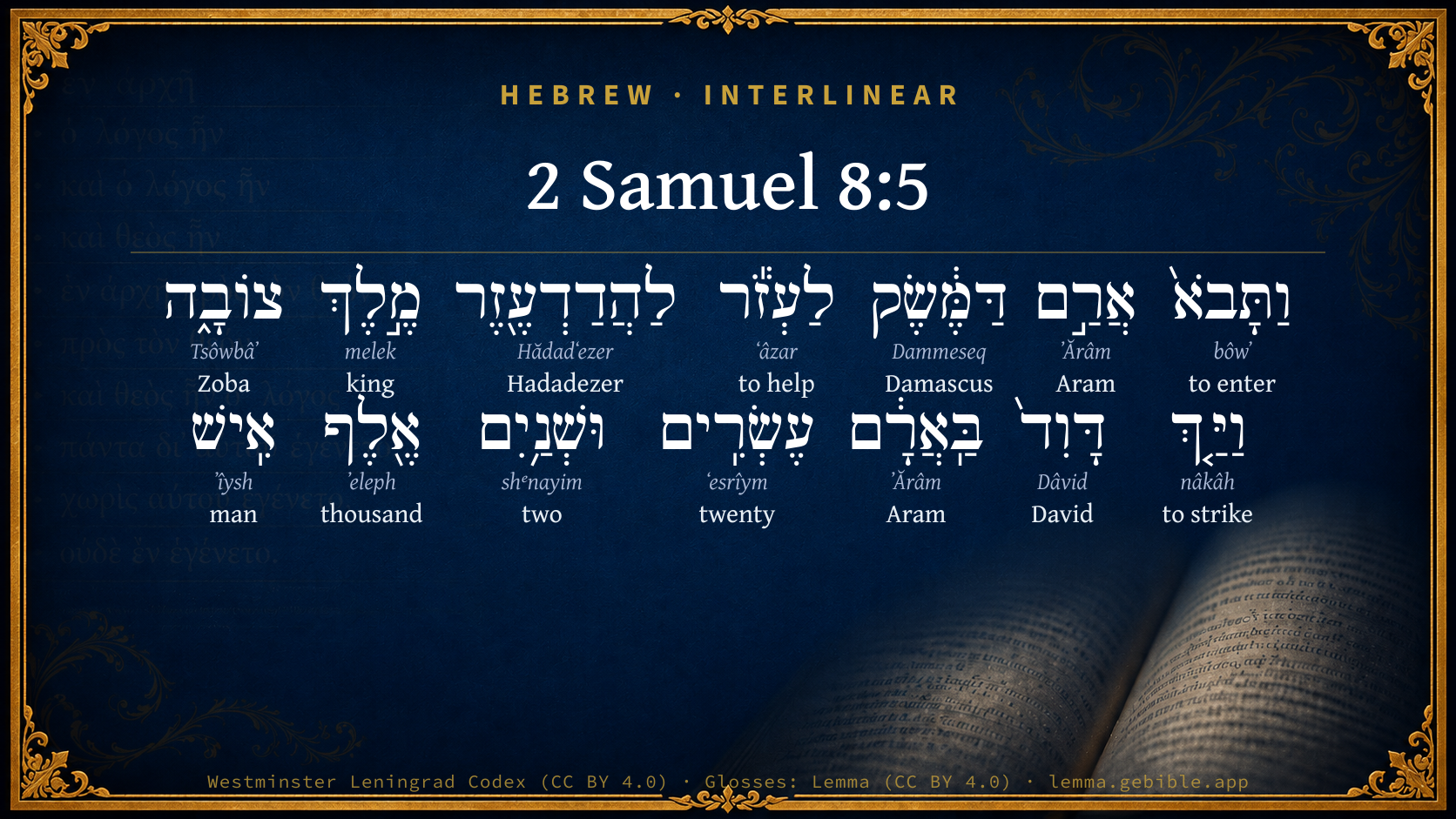
Hebrew (Westminster Leningrad Codex) 2 Samuel 8:5 appears in the Hebrew Old Testament. The text above is from the Westminster Leningrad Codex. Each word links to its Strong’s number, a concise gloss, and parsing drawn from the Open Scriptures Hebrew Bible morphology. Click any word for its full Brown-Driver-Briggs (BDB) entry.
Download image
Cite this verse

2 Samuel 8:5 (World English Bible). Public Domain. Lemma interlinear Bible study tool, https://lemma.gebible.app/v/2-samuel/8/5.

Show BibTeX & RIS
BibTeX
RIS
English Translation
When the Syrians of Damascus came to help Hadadezer king of Zobah, David struck of the Syrians two and twenty thousand men.
World English Bible · Public Domain
Download a study sheet

One document with this verse’s original text, its word-by-word gloss line, the meaning frame, cross-references with their text, attributed commentary, and full source and license credits — printable, and it pastes into notes with its structure intact.

This verse Autodidact and up

Study sheet (.html) Plain text (.txt)

A passage Seminary Student

Up to 50 verses in one chapter. A passage sheet keeps up to 6 commentary sources and 12 cross-references per verse, in the order this page ranks them, and says so on the sheet whenever that leaves anything out. Ask for a single verse and you get the Autodidact verse sheet above.

Everything on this page stays free to read, with no account — the sheet is a download of what is already on screen, not access to it.

Want to remove ads? Support Godless Engineer
Compare translations 3

The same verse in 3 English versions, stacked beneath the original-language interlinear above. Click any original word for its lexicon entry.

Each is an independent rendering of the whole verse — the interlinear is not word-aligned to these translations.

Highlighted words mark where these versions differ — a whole-verse word diff, not a word-by-word alignment.

  • World English Bible Public Domain
    When the Syrians of Damascus came to help Hadadezer king of Zobah, David struck of the Syrians two and twenty thousand men.
  • King James Version Public Domain
    And when the Syrians of Damascus came to succor Hadadezer king of Zobah, David slew of the Syrians two and twenty thousand men.
  • unfoldingWord Literal Text CC BY-SA 4.0
    And Aram of Damascus came to help Hadadezer, the king of Zobah. And David struck 22, 000 men among Aram.

unfoldingWord Literal Text — © unfoldingWord, licensed CC BY-SA 4.0. Word-aligned USFM3 via Door43 (git.door43.org/unfoldingWord/en_ult).

Versions to compare (up to 4)

3 of 4 selected

Show all 18 translations

Every available English version of this verse, each an independent rendering of the whole verse.

  • World English Bible Public Domain
    When the Syrians of Damascus came to help Hadadezer king of Zobah, David struck of the Syrians two and twenty thousand men.
  • Berean Standard Bible Public Domain
    When the Arameans of Damascus came to help King Hadadezer of Zobah, David struck down twenty-two thousand men.
  • Majority Standard Bible Public Domain
    When the Arameans of Damascus came to help King Hadadezer of Zobah, David struck down twenty-two thousand of their men.
  • King James Version Public Domain
    And when the Syrians of Damascus came to succor Hadadezer king of Zobah, David slew of the Syrians two and twenty thousand men.
  • American Standard Version (1901) Public Domain
    And when the Syrians of Damascus came to succor Hadadezer king of Zobah, David smote of the Syrians two and twenty thousand men.
  • Revised Version (1885) Public Domain
    And when the Syrians of Damascus came to succour Hadadezer king of Zobah, David smote of the Syrians two and twenty thousand men.
  • Geneva Bible (1599) Public Domain
    Then came the Aramites of Dammesek to succour Hadadezer king of Zobah, but Dauid slewe of the Aramites two and twenty thousande men.
  • Douay-Rheims (1899) Public Domain
    And the Syrians of Damascus came to succour Adarezer the king of Soba: and David slew of the Syrians two and twenty thousand men.
  • Young's Literal Translation Public Domain
    And Aram of Damascus cometh to give help to Hadadezer king of Zobah, and David smiteth of Aram twenty and two thousand men;
  • Literal Standard Version CC BY-SA 4.0
    And Aram of Damascus comes to give help to Hadadezer king of Zobah, and David strikes twenty-two thousand men of Aram;
  • Unlocked Literal Bible CC BY-SA 4.0
    When the Arameans of Damascus came to help Hadadezer king of Zobah, David killed twenty-two thousand Aramean men.
  • unfoldingWord Literal Text CC BY-SA 4.0
    And Aram of Damascus came to help Hadadezer, the king of Zobah. And David struck 22, 000 men among Aram.
  • Darby Bible Public Domain
    And the Syrians of Damascus came to help Hadadezer king of Zobah, and David smote of the Syrians twenty-two thousand men.
  • World Messianic Bible Public Domain
    When the Syrians of Damascus came to help Hadadezer king of Zobah, David struck twenty two thousand men of the Syrians.
  • Webster's Bible Public Domain
    And when the Syrians of Damascus came to succor Hadadezer king of Zobah, David slew of the Syrians two and twenty thousand men.
  • Free Bible Version CC BY-SA 4.0
    When the Arameans of Damascus came to help King Hadadezer of Zobah, David killed twenty-two thousand of them.
  • Bible in Basic English Public Domain
    And when the Aramaeans of Damascus came to the help of Hadadezer, king of Zobah, David put to the sword twenty-two thousand of the Aramaeans.
  • JPS Tanakh (1917) Public Domain
    And when the Arameans of Damascus came to succour Hadadezer king of Zobah, David smote of the Arameans two and twenty thousand men.

Literal Standard Version (2020), Covenant Press — licensed CC BY-SA 4.0. Text via the HelloAO Bible API (eBible.org). Unlocked Literal Bible (unfoldingWord) — licensed CC BY-SA 4.0. Text via the HelloAO Bible API (eBible.org). unfoldingWord Literal Text — © unfoldingWord, licensed CC BY-SA 4.0. Word-aligned USFM3 via Door43 (git.door43.org/unfoldingWord/en_ult). Free Bible Version, Dr. Jonathan Gallagher — licensed CC BY-SA 4.0. Text via the HelloAO Bible API (eBible.org).

Word by word

More ways to search: Search by grammar → Find every occurrence → Compare this word →

Practice this passage: Drill this verse → Learn its vocabulary →

צוֹבָ֑ה
Tsôwbâʼ
H6678
“Zoba”
Noun, Proper
Part of Speech
Noun
Type
Proper
Full BDB Definition

Origin: from an unused root meaning to station

TWOT: None

Zoba or Zobah = "station" - the name of a portion of Syria which formed a separate kingdom in the times of Saul, David, and Solomon; located northeast of Damascus
  1. וַתָּבֹא֙ bôwʼ H935 “and · to enter” Conjunction + Verb, Qal, Sequential Imperfect, 3rd Person, Feminine, Singular
  2. אֲרַ֣ם ʼĂrâm H758 “Aram” Noun, Proper
  3. דַּמֶּ֔שֶׂק Dammeseq H1834 “Damascus” Noun, Proper
  4. לַעְזֹ֕ר ʻâzar H5826 “to help” Preposition + Verb, Qal, Infinitive Construct
  5. לַהֲדַדְעֶ֖זֶר Hădadʻezer H1909 “to/for · Hadadezer” Preposition + Noun, Proper
  6. מֶ֣לֶךְ melek H4428 “king of” Noun, Common, Masculine, Singular, Construct
  7. וַיַּ֤ךְ nâkâh H5221 “and · to strike” Conjunction + Verb, Hiphil, Sequential Imperfect, 3rd Person, Masculine, Singular
  8. דָּוִד֙ Dâvid H1732 “David” Noun, Proper
  9. בַּֽאֲרָ֔ם ʼĂrâm H758 “in/at · Aram” Preposition + Noun, Proper
  10. עֶשְׂרִֽים ʻesrîym H6242 “twenty” Adjective, Cardinal number, Both, Plural, Absolute
  11. וּשְׁנַ֥יִם shᵉnayim H8147 “and · two” Conjunction + Adjective, Cardinal number, Masculine, Dual, Absolute
  12. אֶ֖לֶף ʼeleph H505 “thousand” Adjective, Cardinal number, Both, Singular, Absolute
  13. אִֽישׁ ʼîysh H376 “man” Noun, Common, Masculine, Singular, Absolute

About this verse

These counts appear in no published source. They are computed here, from the morphology-tagged text and Lemma’s own curated glosses. What Lemma adds →

14
words
13
distinct lemmas
Historical
section

Notable vocabulary

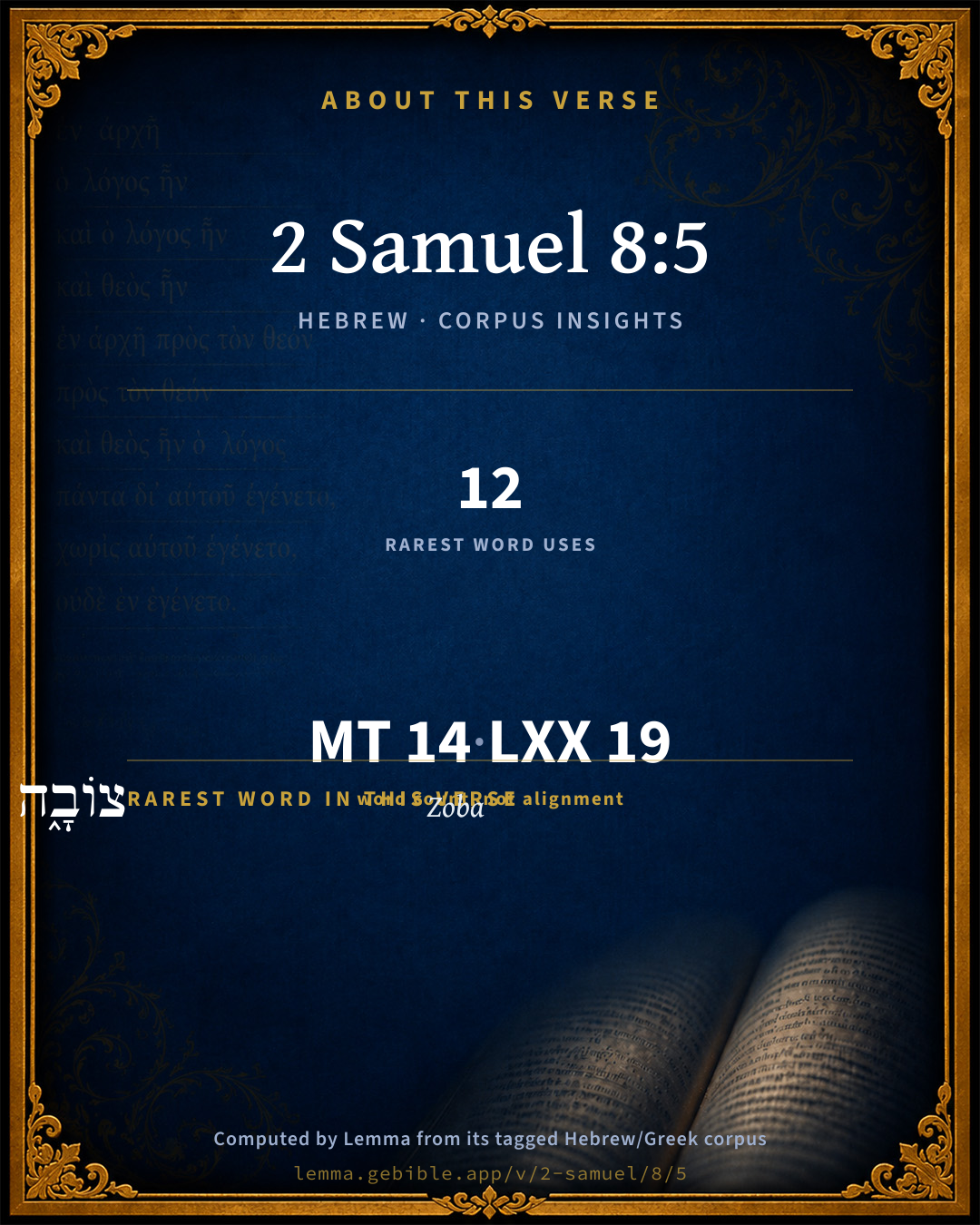
The rarest word here is צוֹבָ֑ה Zoba H6678 — appearing just 12 times in the whole Hebrew Bible.

Shared distinctive vocabulary

צוֹבָ֑ה Zoba H6678 occurs in 12 verses of the Hebrew Bible. Also found in:

Grammatical profile

  • 3 verbs
  • 8 nouns
  • 3 adjectives

Verb forms

  • וַתָּבֹא֙ Qal · Sequential Imperfect
  • לַעְזֹ֕ר Qal · Infinitive Construct
  • וַיַּ֤ךְ Hiphil · Sequential Imperfect

Repetition

A word recurs within this verse — often emphatic in Hebrew:

  • אֲרַ֣ם Aram H758 ×2

Hebrew & Septuagint length

In English translation the verse runs 22 words from the Hebrew and 21 from the Septuagint (LXX English) — closely comparable.

A rough comparison of the two English renderings, which tokenize alike — not a word-level alignment.

Word counts can differ between the Hebrew and the Greek without any difference in meaning — e.g. the Hebrew direct-object marker אֵת has no separate Greek word, and Greek often adds the article ὁ.

In the original languages it is 14 Hebrew tokens and 19 Greek tokens — but the two are counted differently (Hebrew bundles its prefixes and suffixes into one token; the Greek is in lemma form), so that isn’t a like-for-like length.

Cross-references

8

Topical passages linked to 2 Samuel 8:5 in the Treasury of Scripture Knowledge — connected by theme and wording, ordered by reader-vote popularity; previews shown in the World English Bible.

  • 1 Kings 11:23–25 God raised up [another] adversary to him, Rezon the son of Eliada, who had fled from his lord Hadadezer king of Zobah.
  • 2 Samuel 8:3 David struck also Hadadezer the son of Rehob, king of Zobah, as he went to recover his dominion at the River.
  • 1 Chronicles 18:5–6 When the Syrians of Damascus came to help Hadarezer king of Zobah, David struck of the Syrians twenty-two thousand men.
  • Job 9:13 "God will not withdraw his anger; The helpers of Rahab stoop under him.
  • Psalms 83:4–8 "Come," they say, "and let's destroy them as a nation, That the name of Israel may be remembered no more."
  • Isaiah 7:8 For the head of Syria is Damascus, and the head of Damascus is Rezin; and within sixty-five years Ephraim shall be broken in pieces, so that it shall not be a people;
  • Isaiah 8:9–10 Make an uproar, O you peoples, and be broken in pieces! And give ear, all you of far countries: gird yourselves, and be broken in pieces! Gird yourselves, and be broken in pieces!
  • Isaiah 31:3 Now the Egyptians are men, and not God; and their horses flesh, and not spirit: and when Yahweh shall stretch out his hand, both he who helps shall stumble, and he who is helped shall fall, and they all shall be consumed together.

Cross-references courtesy of OpenBible.info (CC BY 4.0).

Hebrew and Greek witnesses Masoretic Hebrew ↔ Greek Septuagint

The same verse in the two great witnesses to the Old Testament, shown verse-for-verse.

These are two independent witnesses, not word-aligned to each other, and the Septuagint is shown in lemma (dictionary) form.

Hebrew 2 Samuel 8:5 Masoretic · Westminster Leningrad Codex

וַתָּבֹא֙ אֲרַ֣ם דַּמֶּ֔שֶׂק לַעְזֹ֕ר לַהֲדַדְעֶ֖זֶר מֶ֣לֶךְ צוֹבָ֑ה וַיַּ֤ךְ דָּוִד֙ בַּֽאֲרָ֔ם עֶשְׂרִֽים וּשְׁנַ֥יִם אֶ֖לֶף אִֽישׁ

When the Syrians of Damascus came to help Hadadezer king of Zobah, David struck of the Syrians two and twenty thousand men.

World English Bible · Public Domain

Greek LXX 2 Samuel 8:5 Septuagint · lemma form

καί παραγίγνομαι συρία δαμασκός βοηθέω ὁ αδρααζαρ βασιλεύς σουβα καί πατάσσω δαυίδ ἐν ὁ σύρος εἴκοσι δύο χιλίας ἀνήρ

And Syria of Damascus comes to help Adraazar king of Suba, and David struck twenty-two thousand men belonging to the Syrian.

LXX2012 (modern English Septuagint) · Public Domain

Hebrew: Westminster Leningrad Codex (CC BY 4.0). Greek: Septuagint (public domain); English from LXX2012 (modern English Septuagint) (Public Domain). How the Septuagint differs from the Hebrew →

Targum (Aramaic paraphrase)

1

The Targum is the ancient Jewish Aramaic paraphrase of the Hebrew Scriptures — an interpretive translation, not the Hebrew text itself. Onkelos (literal) and Pseudo-Jonathan (expansive) render the Torah, and Jonathan the Prophets. Coverage is partial: where no permissively-licensed English translation exists for a verse, only the Aramaic is shown. This is verse-level text, not a word-by-word alignment to the Hebrew.

  1. Targum Jonathan Prophets (Joshua–Malachi)
    וַאֲתוֹ אֱנַשׁ אֲרַם דַמֶשֶׂק לְמִסְעֹד לַהֲדַדְעֶזֶר מַלְכָּא דְצוֹבָה וּמְחָא דָוִד בַּאֲרָם עַשְׂרִין וּתְרֵין אַלְפִין גַבְרָא:

    (no public-domain English translation for this verse)

    Targum Jonathan — Aramaic: “Mikraot Gedolot” (public domain). English: “Sefaria Community Translation” (CC0 1.0 (public-domain dedication)); “London "Chaldee Paraphrase," 1871” (public domain). Text via Sefaria.

Commentary

Notes on 2 Samuel 8:5 from classic Christian and Jewish commentators (each source and its license shown beneath its notes). The classic Christian expositions comment on the surrounding passage and are grouped to its opening verse, so a note may address several verses; the Jewish commentaries on the Tanakh (Rashi and others) are per-verse, so they appear only where the commentator wrote on this verse.

Lemma curates 59 commentaries, every one of them public domain or Creative Commons licensed, each selected and text-cleaned for this edition rather than reprinted as found. About our sources →

Trapp's Complete Commentary

John Trapp

2Sa 8:5 And when the Syrians of Damascus came to succour Hadadezer king of Zobah, David slew of the Syrians two and twenty thousand men.

Ver. 5. And when the Syrians of Damascus came.] Either by the command of Hadadezer, who had subdued them - compare 1Ki 11:23 - or else out of a pragmatical humour, to meddle where they had not to do. See Pro 26:17.

John Trapp, A Commentary or Exposition upon All the Books of the Old and New Testament (1647–1656) — public domain. Text from a community e-Sword module.

Joseph Benson's Commentary

2Sa 8:5-6. The Syrians of Damascus — That is, that were subject to Damascus, the chief city of Syria. Put garrisons in Syria of Damascus — Hebrew, in Aram Damasek. This was that part of Syria which lay between Libanus and Antilibanus. The Syrians brought gifts — By way of tribute, in token of their subjection. The Lord preserved David whithersoever he went — Kept him from all the dangers to which he was exposed in these wars.

Joseph Benson's Commentary on the Old and New Testaments (1811–1818) — public domain. Text from a community e-Sword module.

Tyndale Open Study Notes

Tyndale Open Resources

8:5 Hadadezer’s neighbors, Arameans from Damascus, were of no help to him in repelling David. They would later be more successful against Solomon (1 Kgs 11:23-25) but less successful in their attack of Samaria during the days of King Ahab of Israel (1 Kgs 20).

Tyndale Open Study Notes — © Tyndale Open Resources, licensed CC BY-SA 4.0. Text via the HelloAO Bible API.

Geneva Bible (1599)

Geneva Bible translators

Or, the Syrians.

Or, of Damascus, that is, which dwelt near Damascus.

Geneva Bible (1599) marginal notes — public domain. Text via Bolls.life.

Ellicott's Commentary for English Readers

(5) Syrians of Damascus.—So called from their capital, this being the most powerful branch of the Syrian race.

Two and twenty thousand men.—Josephus (Ant. vii. 5, § 2) quotes from the historian Nicolaus a mention of the defeat of Hadad at this place by David.

A Bible Commentary for English Readers, edited by Charles John Ellicott (1878–1897) — public domain. Text from a community e-Sword module.

The Cambridge Bible for Schools and Colleges

gen. ed. J. J. S. Perowne

5. the Syrians of Damascus] The kingdom of which Damascus was the capital was the most powerful branch of the Aramaeans or Syrians, and played an important part in the history of Israel. It did not long remain subject to them. In Solomon’s reign a certain Rezon established himself at Damascus, and proved a troublesome enemy (1Ki_11:23-25). Benhadad I. was bribed by Asa to break his league with Baasha and invade the Israelite territory (1Ki_15:18), and actually built a Syrian quarter in Samaria (1Ki_20:34). His son and successor Ben-hadad II. besieged Samaria (1Ki_20:1), but was defeated, and compelled to submit to Ahab (1Ki_20:34). But the defeat and death of Ahab at Ramoth-gilead again gave Syria the upper hand (1 Kings 22); and in the reign of Jehoram Samaria was once more besieged by them, and only saved by a miraculous interposition (2Ki_6:24 to 2Ki_7:20). The rising power of Assyria now began to threaten Syria, but in spite of the defeats he suffered from it, the usurper Hazael, succeeding in repulsing the combined forces of Judah and Israel at Ramoth-gilead (2Ki_8:28-29), ravaged the trans-Jordanic territory of Israel (2Ki_10:32-33), captured Gath, and threatened Jerusalem, which only escaped on payment of a heavy ransom (2Ki_12:17-18), and seriously reduced the power of the Northern Kingdom (2Ki_13:3-7). Joash, however, recovered the lost territory (2Ki_13:25), and Jeroboam II. extended his conquests to Damascus (2Ki_14:28). Three quarters of a century later Syria reappears as the ally of Israel against Judah. Rezin, king of Damascus, made a league with Pekah to depose Ahaz and set up a creature of their own in his stead (2Ki_16:5; Isa_7:1-9); but their attempt to take Jerusalem failed, and Ahaz persuaded Tiglath-pileser, king of Assyria, to attack Syria. Rezin was slain and Damascus destroyed (2Ki_16:7-9). Damascus now disappears from the O.T. history; but by the fourth century b. c. it had been rebuilt. and has maintained its prosperity down to the present day. It is situated in a fertile plain watered by the river Barada, which is probably the Abana of Scripture, to the E. of the great mountain chain of the Anti-Libanus, on the edge of the desert. Travellers describe it as “embosomed in a wide forest of fruit trees, intersected and surrounded by sparkling streams, in the midst of an earthly paradise.” This natural beauty and fertility, combined with its importance as a centre of trade, have secured the permanence of its prosperity for nearly 4,000 years. See Robinson’s Biblical Researches, III. 443 ff; Stanley’s Sinai and Palestine, p. 414 ff.

The Cambridge Bible for Schools and Colleges (gen. ed. J. J. S. Perowne; Cambridge University Press, 1878–1918) — public domain. Text from a community e-Sword module.

John Gill's Exposition

And when the Syrians of Damascus came to succour Hadadezer king of Zobah,.... These seem to have had no king at this time, or, if they had, Hadadezer was their king, which is not improbable; and Nicholas of Damascus (o); an Heathen writer, is clear for it, whom he calls Adad, who, he says, reigned over Damascus, and the other Syria without Phoenicia, who made war with David king of Judea, and was routed by him at Euphrates: and he seems to be the first king of Damascus, which he joined to the kingdom of Zobah, and all the kings of Damascus afterwards were called by the same name; though Josephus (p), who also speaks of Adad being king of Damascus and of the Syrians, yet makes him different from this Hadadezer, to whose assistance he says he came:

David slew of the Syrians two and twenty thousand men; that is, of the Syrians of Damascus.

(o) Apud Joseph. ib. (l. 7. c. 5.) sect. 2. (p) Ibid.

John Gill's Exposition of the Whole Bible (1746–1763) — public domain (CC PDM 1.0). Text via the HelloAO Bible API.

Albert Barnes' Notes on the Bible

Syrians of Damascus - The Syrians (Aram), whose capital was Damascus, were the best known and most powerful. Damascus (written Darmesek in marginal references, according to the late Aramean orthography) is first mentioned in Gen 15:2. According to Nicolaus of Damascus, cited by Josephus, the Syrian king’s name was Hadad.

Albert Barnes' Notes on the Bible (1834–1885) — public domain. Text from a community e-Sword/MySword module.

Haydock's Catholic Bible Commentary

Men. As Adarezer had brought upon himself the arms of David, perhaps by attempting to succour the Moabites, as he afterwards did the children of Ammon; (chap. x.) so the king of Damascus was ruined by coming too late to his assistance. This king may be the Adad mentioned by Nicholaus. (B. 4.) (Salien, the year of the world 2993, the 14th year of David.) See ver. 1 and 3.

George Leo Haydock (1774–1849), Haydock's Catholic Family Bible and Commentary, 1859 edition — public domain. Excludes Psalms (Douay-Rheims chapter numbering differs from Protestant) and Deuterocanonical books (Catholic canon only).

Matthew Poole's English Annotations

The Syrians of Damascus, i. e. who were subject to Damascus, the chief city of Syria.

Matthew Poole's English Annotations on the Holy Bible (1683–1685) — public domain. Text from a community e-Sword/MySword module.

Whedon's Commentary on the Bible

Daniel D. Whedon

5. Syrians of Damascus — Damascus was the metropolis of the Syrian empire, (see note on Gen_15:2,) and confederate with Zobah. According to Josephus, the king of Syria who reigned at this time at Damascus was called Hadad.

Daniel D. Whedon (gen. ed.), Commentary on the Old and New Testaments (1874–1909) — public domain. Text from a community e-Sword module.

The Pulpit Commentary

The Syrians of Damascus; Hebrew, Aram-Dammesek; that is, Aram-Damascus. The inhabitants of these regions and of Mesopotamia were descended from Aram, the son of Shem, (Gen_10:22) and bore his name. Thus Zobah is called Aram-Zobah in the title of Psalm 60. As members of a kindred race, and speaking the same language, all the clans of the Aramean family would naturally combine to check the growing power of Israel.

The Pulpit Commentary (1880–1919), ed. H.D.M. Spence-Jones & Joseph S. Exell — public domain. Text from a community e-Sword module.

John Wesley's Explanatory Notes

Of Damascus - That is, who were subject to Damascus, the chief city of Syria.

John Wesley, Explanatory Notes Upon the Whole Bible (1754–1765) — public domain. Text via the GEBible commentary corpus.

Keil & Delitzsch

C. F. Keil & F. Delitzsch

After destroying the main force of Hadadezer, David turned against his ally, against Aram-Damascus, i.e., the Aramaeans, whose capital was Damascus. Dammesek (for which we have Darmesek in the Chronicles according to its Aramaean form), Damascus, a very ancient and still a very important city of Syria, standing upon the Chrysorrhoas (Pharpar), which flows through the centre of it. It is situated in the midst of paradisaical scenery, on the eastern side of the Antilibanus, on the road which unites Western Asia with the interior. David smote 22,000 Syrians of Damascus, placed garrisons in the kingdom, and made it subject and tributary. נציבים are not governors of officers, but military posts, garrisons, as in Sa1 10:5; Sa1 13:3.

Keil & Delitzsch — Biblical Commentary on the Old Testament (1861–1891) — public domain (CC PDM 1.0). Text via the HelloAO Bible API. (Old Testament only.)

unfoldingWord translationNotes

Door43 World Missions Community

David killed

Here David represents his soldiers. AT: "David and his soldiers killed" (See: Synecdoche)

twenty-two thousand Aramean men

"22,000 Aramean men" (See: Numbers)

put garrisons in Aram

"ordered large groups of his soldiers to remain in Aram"

translationWords

Aram

Damascus

David

servant

tribute

Yahweh

unfoldingWord translationNotes — © Distant Shores Media and the Door43 World Missions Community, licensed CC BY-SA 4.0. Source: git.door43.org/Door43/en_tn.

Lesson kit

Teaching starters — assembled from the data on this page, not authored interpretation. Every prompt links to the verse data it draws on. Edit before teaching.

2 Samuel, in the Historical, opens this verse with 14 words (13 distinct Hebrew lemmas). Its most distinctive word is Tsôwbâʼ (“Zoba”). A historical commentator’s framing appears above. Read the whole chapter for the surrounding context.

Discussion questions

  1. The word Tsôwbâʼ carries the sense “Zoba.” How does it shape the verse?
  2. 1 Samuel 14:47 shares the word «Zoba» with this verse. How do the two illuminate each other?
  3. “Aram” occurs 2× in this one verse. What is the effect of the repetition?
  4. The translations on this page render this verse differently — a whole-verse word diff, not a word-by-word alignment. What might account for the different wordings?
  5. The verb «וַתָּבֹא֙» is Qal Sequential Imperfect. How does its form color the action?
  6. Reading how Trapp's Complete Commentary and Joseph Benson's Commentary read this verse, where do the two commentators agree and where do they part?

Things to notice

Reading settings

Reading text

Shown beneath each verse's original-language words.

Old Testament
Old Testament edition

Read the OT as the Masoretic Hebrew (MT) or the Greek Septuagint (LXX).

English shown for the Greek Septuagint (in the Hebrew ↔ Greek comparison).

Comparing translations? Open the Compare panel on any verse page to stack up to four side by side.