Joshua 4:13

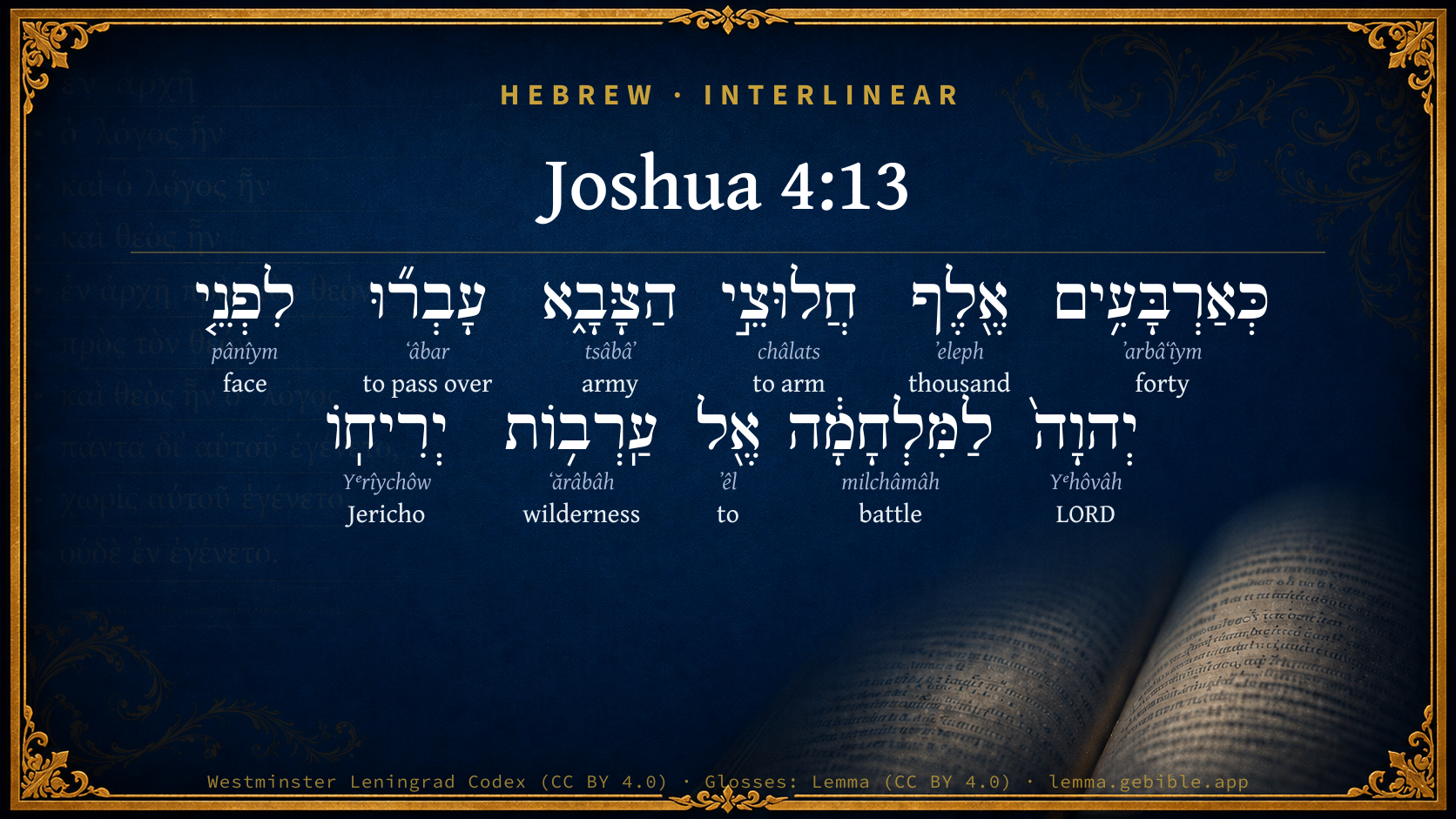
Hebrew (Westminster Leningrad Codex) Joshua 4:13 appears in the Hebrew Old Testament. The text above is from the Westminster Leningrad Codex. Each word links to its Strong’s number, a concise gloss, and parsing drawn from the Open Scriptures Hebrew Bible morphology. Click any word for its full Brown-Driver-Briggs (BDB) entry.
Download image
Cite this verse

Joshua 4:13 (World English Bible). Public Domain. Lemma interlinear Bible study tool, https://lemma.gebible.app/v/joshua/4/13.

Show BibTeX & RIS
BibTeX
RIS
English Translation
about forty thousand ready armed for war passed over before Yahweh to battle, to the plains of Jericho.
World English Bible · Public Domain
Download a study sheet

One document with this verse’s original text, its word-by-word gloss line, the meaning frame, cross-references with their text, attributed commentary, and full source and license credits — printable, and it pastes into notes with its structure intact.

This verse Autodidact and up

Study sheet (.html) Plain text (.txt)

A passage Seminary Student

Up to 50 verses in one chapter. A passage sheet keeps up to 6 commentary sources and 12 cross-references per verse, in the order this page ranks them, and says so on the sheet whenever that leaves anything out. Ask for a single verse and you get the Autodidact verse sheet above.

Everything on this page stays free to read, with no account — the sheet is a download of what is already on screen, not access to it.

Want to remove ads? Support Godless Engineer
Compare translations 3

The same verse in 3 English versions, stacked beneath the original-language interlinear above. Click any original word for its lexicon entry.

Each is an independent rendering of the whole verse — the interlinear is not word-aligned to these translations.

Highlighted words mark where these versions differ — a whole-verse word diff, not a word-by-word alignment.

  • World English Bible Public Domain
    about forty thousand ready armed for war passed over before Yahweh to battle, to the plains of Jericho.
  • King James Version Public Domain
    About forty thousand prepared for war passed over before the LORD unto battle, to the plains of Jericho.
  • unfoldingWord Literal Text CC BY-SA 4.0
    About 40, 000 equipped of the army crossed over to the face of Yahweh to the plains of Jericho for battle.

unfoldingWord Literal Text — © unfoldingWord, licensed CC BY-SA 4.0. Word-aligned USFM3 via Door43 (git.door43.org/unfoldingWord/en_ult).

Versions to compare (up to 4)

3 of 4 selected

Show all 18 translations

Every available English version of this verse, each an independent rendering of the whole verse.

  • World English Bible Public Domain
    about forty thousand ready armed for war passed over before Yahweh to battle, to the plains of Jericho.
  • Berean Standard Bible Public Domain
    About 40,000 troops armed for battle crossed over before the LORD into the plains of Jericho.
  • Majority Standard Bible Public Domain
    About 40,000 troops armed for battle crossed over before the LORD into the plains of Jericho.
  • King James Version Public Domain
    About forty thousand prepared for war passed over before the LORD unto battle, to the plains of Jericho.
  • American Standard Version (1901) Public Domain
    about forty thousand ready armed for war passed over before Jehovah unto battle, to the plains of Jericho.
  • Revised Version (1885) Public Domain
    about forty thousand ready armed for war passed over before the LORD unto battle, to the plains of Jericho.
  • Geneva Bible (1599) Public Domain
    Euen fourty thousand prepared for warre, went before the Lord vnto battel, into ye plaine of Iericho.
  • Douay-Rheims (1899) Public Domain
    And forty thousand fighting men by their troops, and bands, marched through the plains and fields of the city of Jericho.
  • Young's Literal Translation Public Domain
    about forty thousand, armed ones of the host, passed over before Jehovah for battle, unto the plains of Jericho.
  • Literal Standard Version CC BY-SA 4.0
    about forty thousand, armed ones of the host, passed over before YHWH for battle, to the plains of Jericho.
  • Unlocked Literal Bible CC BY-SA 4.0
    About forty thousand men equipped for war passed before Yahweh, for battle on the plains of Jericho.
  • unfoldingWord Literal Text CC BY-SA 4.0
    About 40, 000 equipped of the army crossed over to the face of Yahweh to the plains of Jericho for battle.
  • Darby Bible Public Domain
    About forty thousand armed for military service passed over before Jehovah to the war, unto the plains of Jericho.
  • World Messianic Bible Public Domain
    About forty thousand men, ready and armed for war, passed over before GOD to battle, to the plains of Jericho.
  • Webster's Bible Public Domain
    About forty thousand prepared for war passed over before the LORD to battle, to the plains of Jericho.
  • Free Bible Version CC BY-SA 4.0
    They numbered about 40,000 men, armed and ready for battle, who crossed in the presence of the Lord to the plains of Jericho.
  • Bible in Basic English Public Domain
    About forty thousand armed for war went over before the Lord to the fight, to the lowlands of Jericho.
  • JPS Tanakh (1917) Public Domain
    about forty thousand ready armed for war passed on in the presence of the LORD unto battle, to the plains of Jericho.

Literal Standard Version (2020), Covenant Press — licensed CC BY-SA 4.0. Text via the HelloAO Bible API (eBible.org). Unlocked Literal Bible (unfoldingWord) — licensed CC BY-SA 4.0. Text via the HelloAO Bible API (eBible.org). unfoldingWord Literal Text — © unfoldingWord, licensed CC BY-SA 4.0. Word-aligned USFM3 via Door43 (git.door43.org/unfoldingWord/en_ult). Free Bible Version, Dr. Jonathan Gallagher — licensed CC BY-SA 4.0. Text via the HelloAO Bible API (eBible.org).

Word by word

More ways to search: Search by grammar → Find every occurrence → Compare this word →

Practice this passage: Drill this verse → Learn its vocabulary →

חֲלוּצֵ֣י
châlats
H2502
“armed”
Verb, Qal, Participle Passive, Masculine, Plural, Construct
Part of Speech
Verb
Stem
Qal
Form
Participle Passive
Gender
Masculine
Number
Plural
State
Construct
Full BDB Definition

Origin: a primitive root

TWOT: 667 , 668

to remove, draw out, draw off, take off, withdraw, equip (for war), arm for war, rescue, be rescued - (Qal) equipped (participle) - (Niphal) - to be equipped - to go equipped - to be armed - (Hiphil) - to make strong, brace up - to invigorate - to draw off or out, withdraw - (Qal) - to draw, draw off - to withdraw - (Niphal) - to be delivered - to be saved - (Piel) - to pull out, tear out - to rescue, deliver, set free - to take away, plunder
  1. כְּאַרְבָּעִ֥ים ʼarbâʻîym H705 “like/as · forty” Preposition + Adjective, Cardinal number, Both, Plural, Absolute
  2. אֶ֖לֶף ʼeleph H505 “thousand” Adjective, Cardinal number, Both, Singular, Absolute
  3. הַצָּבָ֑א tsâbâʼ H6635 “the · army” Particle, Definite Article + Noun, Common, Both, Singular, Absolute
  4. עָבְר֞וּ ʻâbar H5674 “to pass over” Verb, Qal, Perfect, 3rd Person, Common, Plural
  5. לִפְנֵ֤י pânîym H6440 “to/for · face(s) of” Preposition + Noun, Common, Both, Plural, Construct
  6. יְהוָה֙ Yᵉhôvâh H3068 “LORD” Noun, Proper
  7. לַמִּלְחָמָ֔ה milchâmâh H4421 “to/for the · battle” Preposition, Determined + Noun, Common, Feminine, Singular, Absolute
  8. אֶ֖ל ʼêl H413 “to” Preposition
  9. עַֽרְב֥וֹת ʻărâbâh H6160 “wildernesses of” Noun, Common, Feminine, Plural, Construct
  10. יְרִיחֽוֹ Yᵉrîychôw H3405 “Jericho” Noun, Proper

About this verse

These counts appear in no published source. They are computed here, from the morphology-tagged text and Lemma’s own curated glosses. What Lemma adds →

11
words
11
distinct lemmas
Historical
section

Shared distinctive vocabulary

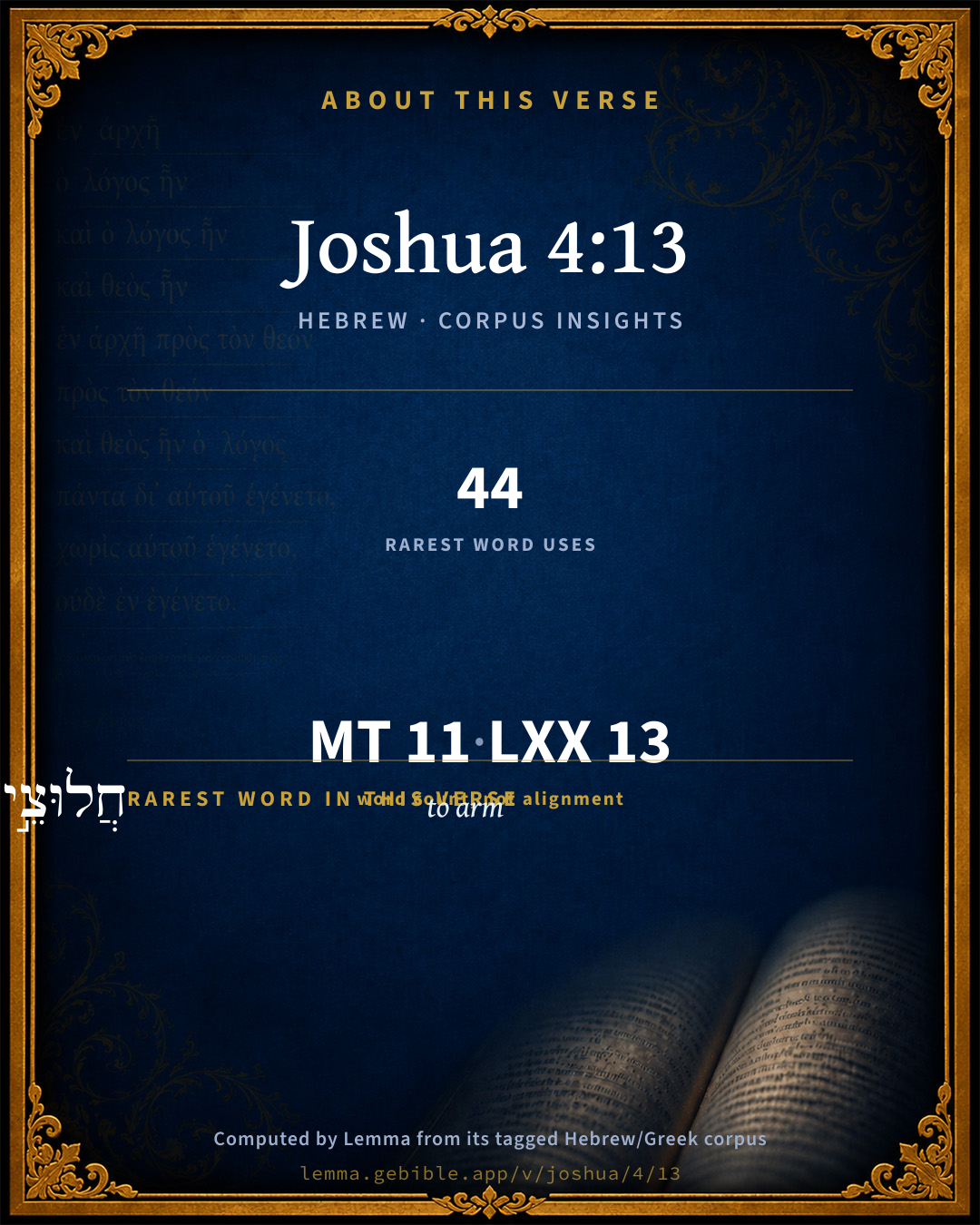
חֲלוּצֵ֣י to arm H2502 occurs in 44 verses of the Hebrew Bible. Also found in:

Grammatical profile

  • 2 verbs
  • 6 nouns
  • 2 adjectives
  • 1 preposition

Verb forms

  • חֲלוּצֵ֣י Qal · Participle Passive
  • עָבְר֞וּ Qal · Perfect

Hebrew & Septuagint length

In English translation the verse runs 18 words from the Hebrew and 17 from the Septuagint (LXX English) — closely comparable.

A rough comparison of the two English renderings, which tokenize alike — not a word-level alignment.

Word counts can differ between the Hebrew and the Greek without any difference in meaning — e.g. the Hebrew direct-object marker אֵת has no separate Greek word, and Greek often adds the article ὁ.

In the original languages it is 11 Hebrew tokens and 13 Greek tokens — but the two are counted differently (Hebrew bundles its prefixes and suffixes into one token; the Greek is in lemma form), so that isn’t a like-for-like length.

Cross-references

5

Topical passages linked to Joshua 4:13 in the Treasury of Scripture Knowledge — connected by theme and wording, ordered by reader-vote popularity; previews shown in the World English Bible.

  • Ephesians 6:11 Put on the whole armor of God, that you may be able to stand against the wiles of the devil.
  • 2 Kings 25:5 But the army of the Chaldeans pursued after the king, and overtook him in the plains of Jericho; and all his army was scattered from him.
  • Jeremiah 39:5 But the army of the Chaldeans pursued after them, and overtook Zedekiah in the plains of Jericho: and when they had taken him, they brought him up to Nebuchadrezzar king of Babylon to Riblah in the land of Hamath; and he gave judgment on him.
  • Jeremiah 52:8 But the army of the Chaldeans pursued after the king, and overtook Zedekiah in the plains of Jericho; and all his army was scattered from him.
  • Joshua 5:10 The children of Israel encamped in Gilgal; and they kept the Passover on the fourteenth day of the month at even in the plains of Jericho.

Cross-references courtesy of OpenBible.info (CC BY 4.0).

Hebrew and Greek witnesses Masoretic Hebrew ↔ Greek Septuagint

The same verse in the two great witnesses to the Old Testament, shown verse-for-verse.

These are two independent witnesses, not word-aligned to each other, and the Septuagint is shown in lemma (dictionary) form.

Hebrew Joshua 4:13 Masoretic · Westminster Leningrad Codex

כְּאַרְבָּעִ֥ים אֶ֖לֶף חֲלוּצֵ֣י הַצָּבָ֑א עָבְר֞וּ לִפְנֵ֤י יְהוָה֙ לַמִּלְחָמָ֔ה אֶ֖ל עַֽרְב֥וֹת יְרִיחֽוֹ

about forty thousand ready armed for war passed over before Yahweh to battle, to the plains of Jericho.

World English Bible · Public Domain

Greek LXX Joshua 4:13 Septuagint · lemma form

τετρακισμύριοι εὔζωνος εἰς μάχη διαβαίνω ἐναντίον κύριος εἰς πόλεμος πρός ὁ ιεριχω πόλις

Forty thousand armed for battle went over before the Lord to war, to the city of Jericho.

LXX2012 (modern English Septuagint) · Public Domain

On this verse, John Gill's Exposition discusses the Septuagint’s reading. Read the note in Commentary ↓

Hebrew: Westminster Leningrad Codex (CC BY 4.0). Greek: Septuagint (public domain); English from LXX2012 (modern English Septuagint) (Public Domain). How the Septuagint differs from the Hebrew →

Targum (Aramaic paraphrase)

1

The Targum is the ancient Jewish Aramaic paraphrase of the Hebrew Scriptures — an interpretive translation, not the Hebrew text itself. Onkelos (literal) and Pseudo-Jonathan (expansive) render the Torah, and Jonathan the Prophets. Coverage is partial: where no permissively-licensed English translation exists for a verse, only the Aramaic is shown. This is verse-level text, not a word-by-word alignment to the Hebrew.

  1. Targum Jonathan Prophets (Joshua–Malachi)
    כְּאַרְבְּעִין אַלְפִין מְזָרְזֵי חֵילָא עֲבָרוּ קֳדָם עַמָא דַייָ לִקְרָבָא לְמֵשְׁרֵי יְרֵיחוֹ:

    (no public-domain English translation for this verse)

    Targum Jonathan — Aramaic: “Mikraot Gedolot” (public domain). English: “Sefaria Community Translation” (CC0 1.0 (public-domain dedication)); “London "Chaldee Paraphrase," 1871” (public domain). Text via Sefaria.

Commentary

Notes on Joshua 4:13 from classic Christian and Jewish commentators (each source and its license shown beneath its notes). The classic Christian expositions comment on the surrounding passage and are grouped to its opening verse, so a note may address several verses; the Jewish commentaries on the Tanakh (Rashi and others) are per-verse, so they appear only where the commentator wrote on this verse.

Lemma curates 59 commentaries, every one of them public domain or Creative Commons licensed, each selected and text-cleaned for this edition rather than reprinted as found. About our sources →

Trapp's Complete Commentary

John Trapp

Jos 4:13 About forty thousand prepared for war passed over before the LORD unto battle, to the plains of Jericho.

Ver. 13. Passed over before the Lord.] As in his sight and presence, approving to him their hearts and practices.

John Trapp, A Commentary or Exposition upon All the Books of the Old and New Testament (1647–1656) — public domain. Text from a community e-Sword module.

Geneva Bible (1599)

Geneva Bible translators

That is, before the Ark.

Geneva Bible (1599) marginal notes — public domain. Text via Bolls.life.

Jamieson, Fausset & Brown

Robert Jamieson, A. R. Fausset & David Brown

to the plains of Jericho--That part of the Arabah or Ghor, on the west, is about seven miles broad from the Jordan to the mountain entrance at Wady-Kelt. Though now desert, this valley was in ancient times richly covered with wood. An immense palm forest, seven miles long, surrounded Jericho.

Jamieson, Fausset & Brown — Commentary Critical and Explanatory on the Whole Bible (1871) — public domain (CC PDM 1.0). Text via the HelloAO Bible API.

Ellicott's Commentary for English Readers

(13) About forty thousand.—The totals of these three tribes at the last census (Numbers 26) were:—Reuben (Num_26:7), 43,730; Gad (Num_26:18), 40,500; Manasseh (Num_26:34), 52,700, or for the exact half, 26, 350. Thus the entire force of the two and a half tribes might amount to 110,580. They therefore left more than half their number to protect their families and their dwellings. This does not seem inconsistent with the spirit of their agreement with Moses, or with the interpretation of that agreement by Joshua and their fellow-Israelites. (See Num_32:16-17; Num_32:24; Num_32:26.) The permission to build cities implies the right to fortify and defend them.

Reuben, Gad, and Simeon formed the second division on the march in the wilderness (Num_10:18-20). Why Reuben and Gad discarded Simeon, and associated themselves with part of Manasseh, is not explained. (See Names on the Gates of Pearl.—Simeon.)

A Bible Commentary for English Readers, edited by Charles John Ellicott (1878–1897) — public domain. Text from a community e-Sword module.

John Gill's Exposition

About forty thousand prepared for war,.... Accoutred with proper armour to defend themselves, and their brethren, and annoy their enemies: this is to be understood of such a number of the above mentioned tribes; otherwise the number of all Israel that went over Jordan, even armed or fighting men, besides women and children, were five hundred thousand or more. Now though the number of men fit for war, of these tribes, were an hundred thirty thousand, who were all, according to the original agreement, under obligation to go with their brethren over Jordan into Canaan's land, and continue with them until it was subdued, and they had rest in it; yet Joshua took no more than about forty thousand of them, who we may suppose were select men, and fit for his purpose; the rest were left to look after their flocks, their families, and their lands: these

passed over before the Lord unto battle; over Jordan, before the ark of the Lord, as that stood in Jordan, bore by the priests there, being ready to engage in battle whenever it was necessary: and they went on with their brethren

to the plains of Jericho; to a place afterwards called Gilgal; see Jos 4:19. The Septuagint version is, to the city Jericho.

John Gill's Exposition of the Whole Bible (1746–1763) — public domain (CC PDM 1.0). Text via the HelloAO Bible API.

Albert Barnes' Notes on the Bible

The plains of Jericho, consisting of the higher terrace of the Jordan valley, are almost seven miles broad. The mountains of Judaea here recede somewhat from the river, and leave a level and fertile space, which, at the time of Joshua’s invasion, was principally occupied by a forest of palms. Hence, the name “city of palms,” Deu 34:3.

Albert Barnes' Notes on the Bible (1834–1885) — public domain. Text from a community e-Sword/MySword module.

Haydock's Catholic Bible Commentary

Bands. Hebrew, "prepared for war passed over, before the Lord, unto battle, to the plains of Jericho." (Haydock) --- These formed the van-guard. --- Plains. Hebrew harboth, which is translated desert, Jeremias lii. 8. A large plain, fit for pasturage, extended from the city to the Jordan, on the east side. (Calmet)

George Leo Haydock (1774–1849), Haydock's Catholic Family Bible and Commentary, 1859 edition — public domain. Excludes Psalms (Douay-Rheims chapter numbering differs from Protestant) and Deuterocanonical books (Catholic canon only).

Matthew Poole's English Annotations

Either,

1. Before the ark, by which they, as well as the rest, passed when they went over Jordan. Or,

2. In the presence of God, who diligently observed whether they would keep their promise and covenant made with their brethren, or not.

Matthew Poole's English Annotations on the Holy Bible (1683–1685) — public domain. Text from a community e-Sword/MySword module.

Whedon's Commentary on the Bible

Daniel D. Whedon

13. Forty thousand — For their entire military strength see Jos_1:14, note.

Plains of Jericho — A part of the Ghor or Arabah near Jericho. The mountains on the west fall back considerably to the south of the entrance into the Wady Kelt, and sweep toward the southwest, and then turn again toward the Dead Sea. The valley on the west of the Jordan is at this point seven miles wide.

Daniel D. Whedon (gen. ed.), Commentary on the Old and New Testaments (1874–1909) — public domain. Text from a community e-Sword module.

The Pulpit Commentary

Prepared for war. euzwnoi , LXX Literally, disencumbered, like the Latin expeditus. Unlike Num_31:5, the Hebrew has the article here. The meaning therefore may be "equipped men of the host," i.e., the light armed and active among them. If we translate thus, it is clear that all their armed men did not go over Jordan. The impedimenta were left behind, under a strong guard. (see notes on Jos_1:14) The plains of Jericho. Here the LXX and Theodotion have thcw polin , Symmachus renders by aoikhton , the Vulgate by cumpestria. The original is twObr literally, the deserts or uncultivated lands. (see note on Jos_3:16) They formed a "low-lying plain about four hours" journey in breadth," at that time largely covered with palm trees and thorny acacias, but apparently not cultivated. Since that time, the palms having disappeared, the plain has become "a very picture of fertility," "covered with luxuriant vegetation". (Bartlett, "From Egypt to Palestine," p. 453. See also note on Jos_3:16) The valley narrows to a gorge at Jericho, through which the Kelt, according to Robinson the ancient Cherith, flows, the source of all the verdure which once bloomed around the city. The gorge of the Kelt Canon Tristram describes as "tremendous," but he believes the Cherith to have been eastward of Jordan, following Mr. Grove, who is here disposed to accept the. tradition of Eusebius and Jerome.

The Pulpit Commentary (1880–1919), ed. H.D.M. Spence-Jones & Joseph S. Exell — public domain. Text from a community e-Sword module.

John Wesley's Explanatory Notes

Before the Lord - Either,

1. before the ark, or,

2. in the presence of God who observed whether they would keep their covenant made with their brethren, or not.

John Wesley, Explanatory Notes Upon the Whole Bible (1754–1765) — public domain. Text via the GEBible commentary corpus.

Lesson kit

Teaching starters — assembled from the data on this page, not authored interpretation. Every prompt links to the verse data it draws on. Edit before teaching.

Joshua, in the Historical, opens this verse with 11 words (11 distinct Hebrew lemmas). Its most distinctive word is châlats (“to arm”). A historical commentator’s framing appears above. Read the whole chapter for the surrounding context.

Discussion questions

  1. How does “to arm” (châlats) shape what this verse is saying?
  2. Leviticus 14:40 shares the word «to arm» with this verse. How do the two illuminate each other?
  3. The translations on this page render this verse differently — a whole-verse word diff, not a word-by-word alignment. What might account for the different wordings?
  4. The verb «חֲלוּצֵ֣י» is Qal Participle Passive. How does its form color the action?
  5. Reading how Trapp's Complete Commentary and Geneva Bible (1599) read this verse, where do the two commentators agree and where do they part?

Things to notice

Reading settings

Reading text

Shown beneath each verse's original-language words.

Old Testament
Old Testament edition

Read the OT as the Masoretic Hebrew (MT) or the Greek Septuagint (LXX).

English shown for the Greek Septuagint (in the Hebrew ↔ Greek comparison).

Comparing translations? Open the Compare panel on any verse page to stack up to four side by side.