
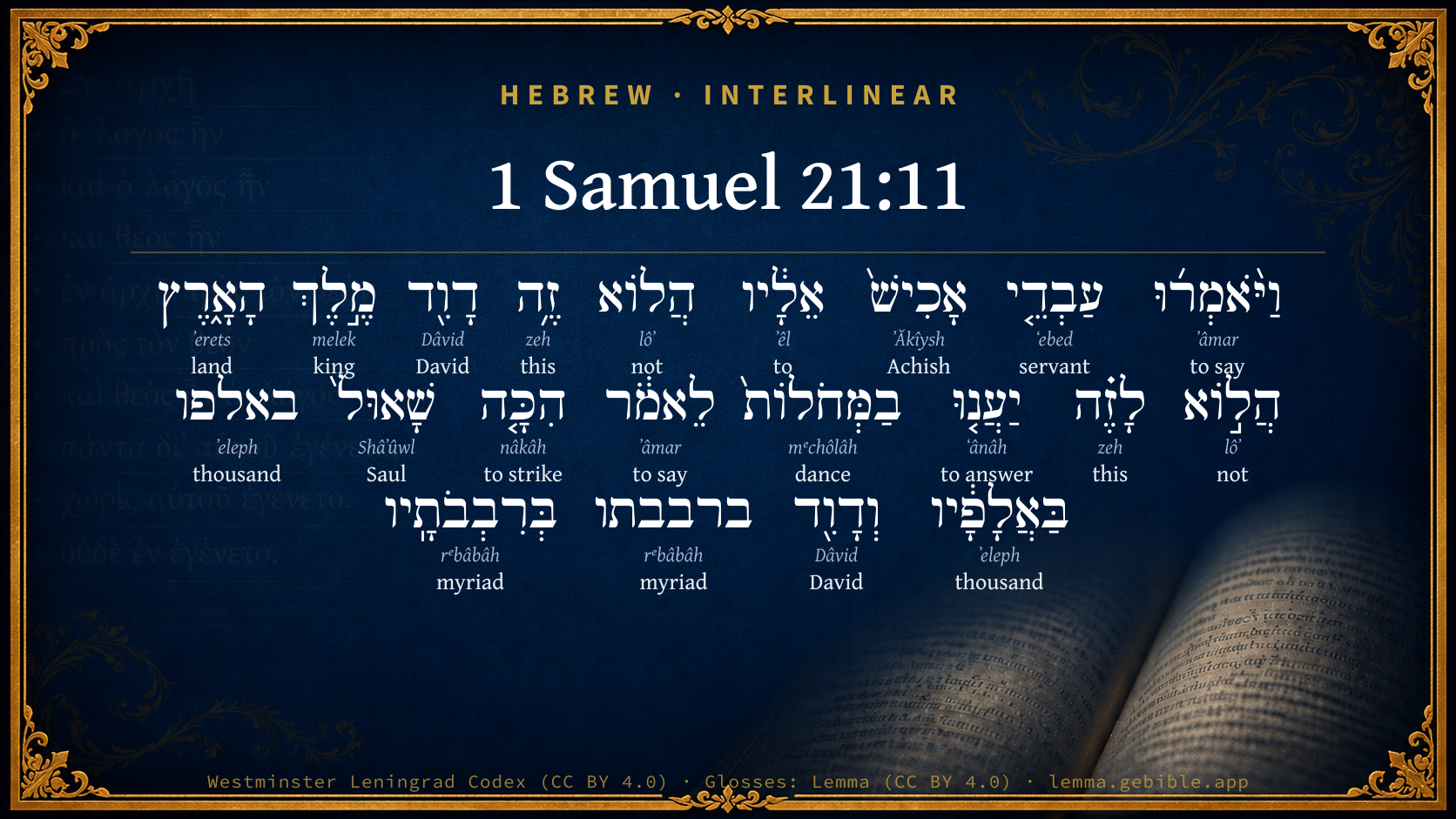
1 Samuel 21:11

Hebrew (Westminster Leningrad Codex) 1 Samuel 21:11 appears in the Hebrew Old Testament. The text above is from the Westminster Leningrad Codex. Each word links to its Strong’s number, a concise gloss, and parsing drawn from the Open Scriptures Hebrew Bible morphology. Click any word for its full Brown-Driver-Briggs (BDB) entry.
Download image
Cite this verse

1 Samuel 21:11 (World English Bible). Public Domain. Lemma interlinear Bible study tool, https://lemma.gebible.app/v/1-samuel/21/11.

Show BibTeX & RIS
BibTeX
RIS
English Translation
The servants of Achish said to him, "Isn't this David the king of the land? Didn't they sing one to another about him in dances, saying, 'Saul has slain his thousands, David his ten thousands?'"
World English Bible · Public Domain
Download a study sheet

One document with this verse’s original text, its word-by-word gloss line, the meaning frame, cross-references with their text, attributed commentary, and full source and license credits — printable, and it pastes into notes with its structure intact.

This verse Autodidact and up

Study sheet (.html) Plain text (.txt)

A passage Seminary Student

Up to 50 verses in one chapter. A passage sheet keeps up to 6 commentary sources and 12 cross-references per verse, in the order this page ranks them, and says so on the sheet whenever that leaves anything out. Ask for a single verse and you get the Autodidact verse sheet above.

Everything on this page stays free to read, with no account — the sheet is a download of what is already on screen, not access to it.

Want to remove ads? Support Godless Engineer
Compare translations 3

The same verse in 3 English versions, stacked beneath the original-language interlinear above. Click any original word for its lexicon entry.

Each is an independent rendering of the whole verse — the interlinear is not word-aligned to these translations.

Highlighted words mark where these versions differ — a whole-verse word diff, not a word-by-word alignment.

  • World English Bible Public Domain
    The servants of Achish said to him, "Isn't this David the king of the land? Didn't they sing one to another about him in dances, saying, 'Saul has slain his thousands, David his ten thousands?'"
  • King James Version Public Domain
    And the servants of Achish said unto him, Is not this David the king of the land? did they not sing one to another of him in dances, saying, Saul hath slain his thousands, and David his ten thousands?
  • unfoldingWord Literal Text CC BY-SA 4.0
    But the servants of Achish said to him, “ not this David the king of the land? Do they not sing about this in the dances, saying, ‘Saul has struck his thousands, and David his myriads’?”

unfoldingWord Literal Text — © unfoldingWord, licensed CC BY-SA 4.0. Word-aligned USFM3 via Door43 (git.door43.org/unfoldingWord/en_ult).

Versions to compare (up to 4)

3 of 4 selected

Show all 18 translations

Every available English version of this verse, each an independent rendering of the whole verse.

  • World English Bible Public Domain
    The servants of Achish said to him, "Isn't this David the king of the land? Didn't they sing one to another about him in dances, saying, 'Saul has slain his thousands, David his ten thousands?'"
  • Berean Standard Bible Public Domain
    But the servants of Achish said to him, “Is this not David, the king of the land? Did they not sing about him in their dances, saying: ‘Saul has slain his thousands, and David his tens of thousands’?”
  • Majority Standard Bible Public Domain
    But the servants of Achish said to him, “Is this not David, the king of the land? Did they not sing about him in their dances, saying: ‘Saul has slain his thousands, and David his tens of thousands’?”
  • King James Version Public Domain
    And the servants of Achish said unto him, Is not this David the king of the land? did they not sing one to another of him in dances, saying, Saul hath slain his thousands, and David his ten thousands?
  • American Standard Version (1901) Public Domain
    And the servants of Achish said unto him, Is not this David the king of the land? did they not sing one to another of him in dances, saying, Saul hath slain his thousands, And David his ten thousands?
  • Revised Version (1885) Public Domain
    And the servants of Achish said unto him, Is not this David the king of the land? did they not sing one to another of him in dances, saying, Saul hath slain his thousands, and David his ten thousands?
  • Geneva Bible (1599) Public Domain
    And the seruants of Achish said vnto him, Is not this Dauid the King of the land? did they not sing vnto him in daunces, saying, Saul hath slayne his thousand, and Dauid his ten thousande?
  • Douay-Rheims (1899) Public Domain
    And the servants of Achis, when they saw David, said to him: Is not this David the king of the land? Did they not sing to him in their dances, saying: Saul hath slain his thousands, and David his ten thousands?
  • Young's Literal Translation Public Domain
    and the servants of Achish say unto him, `Is not this David king of the land? is it not of this one they sing in dances, saying, `Saul smote among his thousands, and David among his myriads?'
  • Literal Standard Version CC BY-SA 4.0
    and the servants of Achish say to him, “Is this not David, the king of the land? Is it not of this one [that] they sing in dances, saying, Saul struck among his thousands, and David among his myriads?”
  • Unlocked Literal Bible CC BY-SA 4.0
    Achish's servants said to him, “Is not this David, the king of the land? Did they not sing to one another about him in dances, 'Saul has killed his thousands, and David his ten thousands?'”
  • unfoldingWord Literal Text CC BY-SA 4.0
    But the servants of Achish said to him, “ not this David the king of the land? Do they not sing about this in the dances, saying, ‘Saul has struck his thousands, and David his myriads’?”
  • Darby Bible Public Domain
    And the servants of Achish said to him, Is not this David the king of the land? did they not sing one to another of him in dances, saying, Saul has smitten his thousands, and David his ten thousands?
  • World Messianic Bible Public Domain
    The servants of Achish said to him, “Isn’t this David the king of the land? Didn’t they sing to one another about him in dances, saying, ‘Saul has slain his thousands, and David his ten thousands’?”
  • Webster's Bible Public Domain
    And the servants of Achish said to him, Is not this David the king of the land? did they not sing one to another of him in dances, saying, Saul hath slain his thousands, and David his ten thousands?
  • Free Bible Version CC BY-SA 4.0
    But Achish's officials asked the king, “Isn't this David, the king of that country? Didn't they sing about him in their dances, ‘Saul has killed his thousands, and David his tens of thousands’?”
  • Bible in Basic English Public Domain
    And the servants of Achish said to him, Is not this David, the king of the land? did they not make songs about him in their dances, saying, Saul has put to death thousands, and David tens of thousands?
  • JPS Tanakh (1917) Public Domain
    (21-12) And the servants of Achish said unto him: 'Is not this David the king of the land? Did they not sing one to another of him in dances, saying: Saul hath slain his thousands, and David his ten thousands?'

Literal Standard Version (2020), Covenant Press — licensed CC BY-SA 4.0. Text via the HelloAO Bible API (eBible.org). Unlocked Literal Bible (unfoldingWord) — licensed CC BY-SA 4.0. Text via the HelloAO Bible API (eBible.org). unfoldingWord Literal Text — © unfoldingWord, licensed CC BY-SA 4.0. Word-aligned USFM3 via Door43 (git.door43.org/unfoldingWord/en_ult). Free Bible Version, Dr. Jonathan Gallagher — licensed CC BY-SA 4.0. Text via the HelloAO Bible API (eBible.org).

Word by word

More ways to search: Search by grammar → Find every occurrence → Compare this word →

Practice this passage: Drill this verse → Learn its vocabulary →

בַמְּחֹלוֹת֙
mᵉchôlâh
H4246
“in/at the · dances”
Preposition, Determined + Noun, Common, Feminine, Plural, Absolute
Part of Speech
Preposition + Noun
Type
Common
Gender
Feminine
Number
Plural
State
Absolute
Full BDB Definition

Origin: from H4284

TWOT: 623h

dancing, dance
  1. וַיֹּ֨אמְר֜וּ ʼâmar H559 “and · to say” Conjunction + Verb, Qal, Sequential Imperfect, 3rd Person, Masculine, Plural
  2. עַבְדֵ֤י ʻebed H5650 “servants of” Noun, Common, Masculine, Plural, Construct
  3. אָכִישׁ֙ ʼĂkîysh H397 “Achish” Noun, Proper
  4. אֵלָ֔יו ʼêl H413 “to · him” Preposition + Suffix, Personal, 3rd Person, Masculine, Singular
  5. הֲלוֹא lôʼ H3808 “not” Particle, Interrogative + Particle, Negative
  6. זֶ֥ה zeh H2088 “this” Pronoun, Demonstrative, Masculine, Singular
  7. דָוִ֖ד Dâvid H1732 “David” Noun, Proper
  8. מֶ֣לֶךְ melek H4428 “king of” Noun, Common, Masculine, Singular, Construct
  9. הָאָ֑רֶץ ʼerets H776 “the · land” Particle, Definite Article + Noun, Common, Both, Singular, Absolute
  10. הֲל֣וֹא lôʼ H3808 “not” Particle, Interrogative + Particle, Negative
  11. לָזֶ֗ה zeh H2088 “to/for · this” Preposition + Pronoun, Demonstrative, Masculine, Singular
  12. יַעֲנ֤וּ ʻânâh H6030 “to answer” Verb, Qal, Imperfect, 3rd Person, Masculine, Plural
  13. לֵאמֹ֔ר ʼâmar H559 “to say” Preposition + Verb, Qal, Infinitive Construct
  14. הִכָּ֤ה nâkâh H5221 “to strike” Verb, Hiphil, Perfect, 3rd Person, Masculine, Singular
  15. שָׁאוּל֙ Shâʼûwl H7586 “Saul” Noun, Proper
  16. באלפו ʼeleph H505 “in/at · thousand · his” Preposition + Adjective, Cardinal number, Both, Plural, Construct + Suffix, Personal, 3rd Person, Masculine, Singular
  17. בַּאֲלָפָ֔יו ʼeleph H505 “in/at · thousand · his” Preposition + Adjective, Cardinal number, Both, Plural, Construct + Suffix, Personal, 3rd Person, Masculine, Singular
  18. וְדָוִ֖ד Dâvid H1732 “and · David” Conjunction + Noun, Proper
  19. ברבבתו rᵉbâbâh H7233 “in/at · myriads · his” Preposition + Noun, Common, Feminine, Plural, Construct + Suffix, Personal, 3rd Person, Masculine, Singular
  20. בְּרִבְבֹתָֽיו rᵉbâbâh H7233 “in/at · myriads · his” Preposition + Noun, Common, Feminine, Plural, Construct + Suffix, Personal, 3rd Person, Masculine, Singular

About this verse

These counts appear in no published source. They are computed here, from the morphology-tagged text and Lemma’s own curated glosses. What Lemma adds →

21
words
15
distinct lemmas
Historical
section

Notable vocabulary

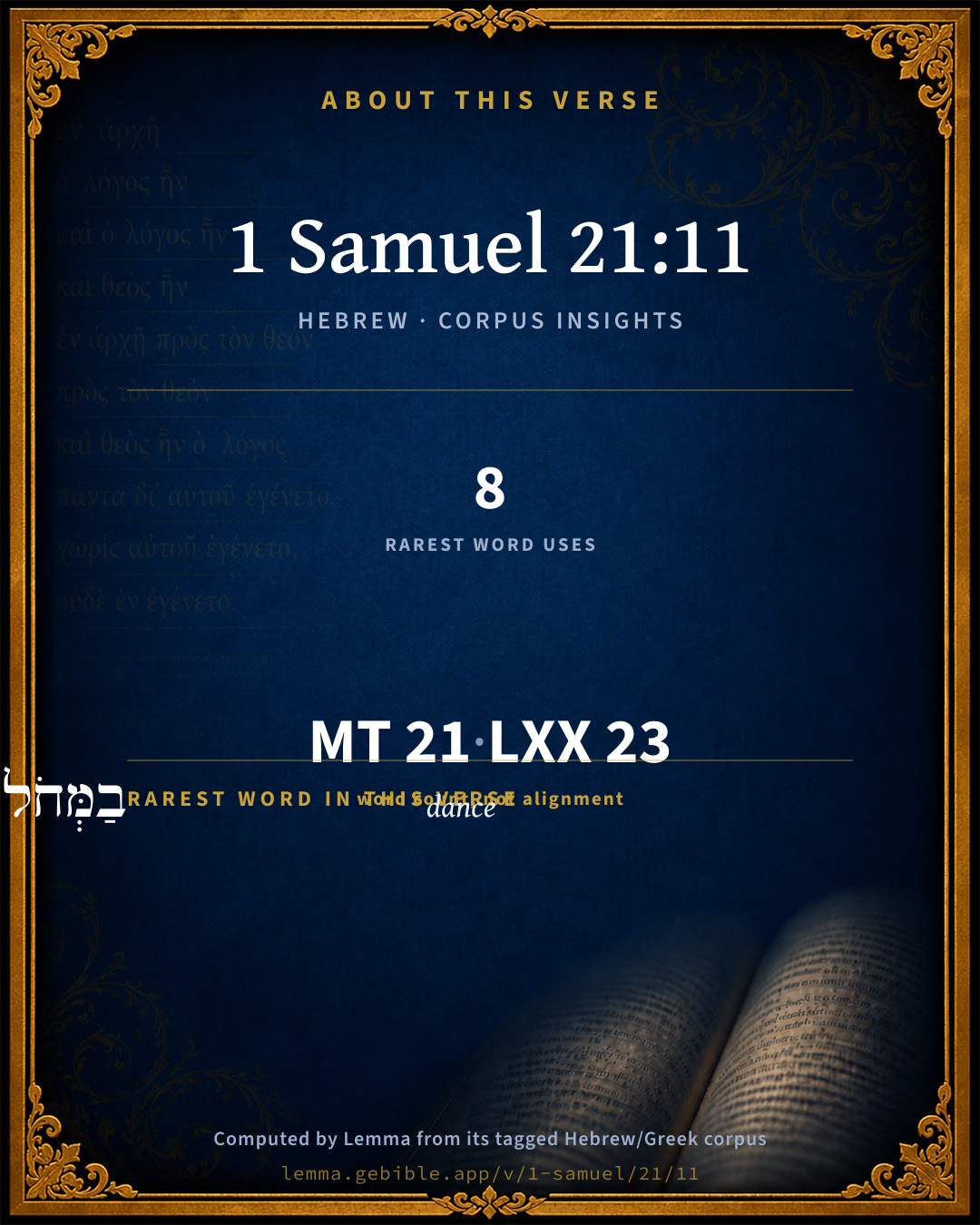
The rarest word here is בַמְּחֹלוֹת֙ dance H4246 — appearing just 8 times in the whole Hebrew Bible.

Shared distinctive vocabulary

בַמְּחֹלוֹת֙ dance H4246 occurs in 8 verses of the Hebrew Bible. Also found in:

Grammatical profile

  • 4 verbs
  • 10 nouns
  • 2 adjectives
  • 2 pronouns
  • 1 preposition
  • 2 particles

Verb forms

  • וַיֹּ֨אמְר֜וּ Qal · Sequential Imperfect
  • יַעֲנ֤וּ Qal · Imperfect
  • לֵאמֹ֔ר Qal · Infinitive Construct
  • הִכָּ֤ה Hiphil · Perfect

Repetition

Words recur within this verse — often emphatic in Hebrew:

  • וַיֹּ֨אמְר֜וּ to say H559 ×2
  • דָוִ֖ד David H1732 ×2
  • באלפו thousand H505 ×2
  • ברבבתו myriad H7233 ×2
  • הֲלוֹא not H3808 ×2
  • זֶ֥ה this H2088 ×2

Hebrew & Septuagint length

In English translation the verse runs 35 words from the Hebrew and 38 from the Septuagint (LXX English) — closely comparable.

A rough comparison of the two English renderings, which tokenize alike — not a word-level alignment.

Word counts can differ between the Hebrew and the Greek without any difference in meaning — e.g. the Hebrew direct-object marker אֵת has no separate Greek word, and Greek often adds the article ὁ.

In the original languages it is 21 Hebrew tokens and 23 Greek tokens — but the two are counted differently (Hebrew bundles its prefixes and suffixes into one token; the Greek is in lemma form), so that isn’t a like-for-like length.

Cross-references

4

Topical passages linked to 1 Samuel 21:11 in the Treasury of Scripture Knowledge — connected by theme and wording, ordered by reader-vote popularity; previews shown in the World English Bible.

  • 1 Samuel 29:5 Is not this David, of whom they sang one to another in dances, saying, Saul has slain his thousands, David his ten thousands?
  • 1 Samuel 16:1 Yahweh said to Samuel, How long will you mourn for Saul, seeing I have rejected him from being king over Israel? fill your horn with oil, and go: I will send you to Jesse the Bethlehemite; for I have provided me a king among his sons.
  • 1 Samuel 18:7–8 The women sang one to another as they played, and said, Saul has slain his thousands, David his ten thousands.
  • Psalms 56:1–13 Be merciful to me, God, for man wants to swallow me up. All day long, he attacks and oppresses me.

Cross-references courtesy of OpenBible.info (CC BY 4.0).

Hebrew and Greek witnesses Masoretic Hebrew ↔ Greek Septuagint

The same verse in the two great witnesses to the Old Testament, shown verse-for-verse.

These are two independent witnesses, not word-aligned to each other, and the Septuagint is shown in lemma (dictionary) form.

Hebrew 1 Samuel 21:11 Masoretic · Westminster Leningrad Codex

וַיֹּ֨אמְר֜וּ עַבְדֵ֤י אָכִישׁ֙ אֵלָ֔יו הֲלוֹא זֶ֥ה דָוִ֖ד מֶ֣לֶךְ הָאָ֑רֶץ הֲל֣וֹא לָזֶ֗ה יַעֲנ֤וּ בַמְּחֹלוֹת֙ לֵאמֹ֔ר הִכָּ֤ה שָׁאוּל֙ באלפו בַּאֲלָפָ֔יו וְדָוִ֖ד ברבבתו בְּרִבְבֹתָֽיו

The servants of Achish said to him, "Isn't this David the king of the land? Didn't they sing one to another about him in dances, saying, 'Saul has slain his thousands, David his ten thousands?'"

World English Bible · Public Domain

Greek LXX 1 Samuel 21:11 Septuagint · lemma form

καί δίδωμι αὐτός αὐτός καί ἀναἵστημι δαυίδ καί φεύγω ἐν ὁ ἡμέρα ἐκεῖνος ἐκ πρόσωπον σαούλ καί ἔρχομαι δαυίδ πρός αγχους βασιλεύς γεθ

And the servants of Anchus said to him, Is not this David the king of the land? Did not the dancing women begin the song to him, saying, Saul has struck his thousand, and David his ten thousands?

LXX2012 (modern English Septuagint) · Public Domain

Hebrew: Westminster Leningrad Codex (CC BY 4.0). Greek: Septuagint (public domain); English from LXX2012 (modern English Septuagint) (Public Domain). How the Septuagint differs from the Hebrew →

Targum (Aramaic paraphrase)

1

The Targum is the ancient Jewish Aramaic paraphrase of the Hebrew Scriptures — an interpretive translation, not the Hebrew text itself. Onkelos (literal) and Pseudo-Jonathan (expansive) render the Torah, and Jonathan the Prophets. Coverage is partial: where no permissively-licensed English translation exists for a verse, only the Aramaic is shown. This is verse-level text, not a word-by-word alignment to the Hebrew.

  1. Targum Jonathan Prophets (Joshua–Malachi)
    וְקָם דָוִד וַעֲרַק בְּיוֹמָא הַהוּא מִן קֳדָם שָׁאוּל וַאֲתָא לְוַת אָכִישׁ מַלְכָּא דְגָת:

    (no public-domain English translation for this verse)

    Targum Jonathan — Aramaic: “Mikraot Gedolot” (public domain). English: “Sefaria Community Translation” (CC0 1.0 (public-domain dedication)); “London "Chaldee Paraphrase," 1871” (public domain). Text via Sefaria.

Commentary

Notes on 1 Samuel 21:11 from classic Christian and Jewish commentators (each source and its license shown beneath its notes). The classic Christian expositions comment on the surrounding passage and are grouped to its opening verse, so a note may address several verses; the Jewish commentaries on the Tanakh (Rashi and others) are per-verse, so they appear only where the commentator wrote on this verse.

Lemma curates 59 commentaries, every one of them public domain or Creative Commons licensed, each selected and text-cleaned for this edition rather than reprinted as found. About our sources →

Trapp's Complete Commentary

John Trapp

1Sa 21:11 And the servants of Achish said unto him, [Is] not this David the king of the land? did they not sing one to another of him in dances, saying, Saul hath slain his thousands, and David his ten thousands?

Ver. 11. And the servants of Achish.] Who had some way discovered and apprehended David, and then his sword - got by a lie - could not but be prejudicial to him. It was a great mercy that the Philistines had not slain him with it; like as it was to Peter, that the rude soldiers had not cut him in pieces when he cut off Malchus’s ear; but David prayed hard when he was in their hands, {Psa 34:6} and so escaped.

John Trapp, A Commentary or Exposition upon All the Books of the Old and New Testament (1647–1656) — public domain. Text from a community e-Sword module.

The Biblical Illustrator

Joseph S. Exell

1Sa_21:11

And he changed his behaviour before them.

David scrabbling at the gate

Taking the behaviour of David as a suggestion, I wish to tell you how many of the wise, and the brave, and the regal sometimes play the fool.

I. I remark that those men as badly play the fool as this man of the text, who in any crisis of life take their case out of the hand of God. David, in this case, acted as though there were no God to lift him out of the predicament. The life of the most insignificant man is too vast for any human management.

II. I remark that all those persons play the fool, as certainly as did this man of the text, who allow the technicalities of religion to stop their salvation.

III. I go still further, and say to you that those men play the fool who undertake to pay out eternity for time.

IV. I say to you that those men play the fool who, while they admit the righteousness of religion, set it down for future attendance. (T. De Witt Talmage.)

.

The Biblical Illustrator, edited by Joseph S. Exell (c. 1880s–1900s) — public domain. Text from a community e-Sword module.

Joseph Benson's Commentary

1Sa 21:11. King of the land — Of Canaan. They call him king, either more generally for the governor, the most eminent captain and commander, or, as the king elect, the person designed to be king: for, by this time, the fame of Saul’s rejection, and David’s destination to the kingdom, was got abroad among the Israelites, and from them, probably, to the Philistines. Did they not sing, &c. — And therefore consider what to do; and now our great enemy is in thy hand, be sure thou never let him go alive.

Joseph Benson's Commentary on the Old and New Testaments (1811–1818) — public domain. Text from a community e-Sword module.

Tyndale Open Study Notes

Tyndale Open Resources

21:11 the king of the land: David’s reputation as a mighty warrior even greater than King Saul (see 18:7) had grown to the point where foreigners began referring to him as Israel’s king.

Tyndale Open Study Notes — © Tyndale Open Resources, licensed CC BY-SA 4.0. Text via the HelloAO Bible API.

Ellicott's Commentary for English Readers

(11) Is not this David?—Some expositors have supposed, but quite needlessly, that it was the sword of Goliath which betrayed the identity of the hero; but although David in his humility did not suspect how widely spread was his fame, he was evidently as well known in Philistia as in his own land. That popular lilt, the folk-song of the Israelitish maidens, which sang of the prowess of David, the son of Jesse, was no doubt current in frontier towns like Gath, and at once the fugitive was recognised. We hear of no attempt made upon his life, or even against his liberty. The feeling among his generous foes was rather pitiful admiration mingled with wonder at seeing the doer of such splendid achievements in poverty and in exile.

David the king.—Here, again, the title king is vaguely used. Neither the people of Gath nor his own countrymen—save, perhaps, a few chosen spirits—knew of the sacred anointing by Samuel at Bethlehem. The appellation simply means: Is not this the renowned warrior, the greatest man in Israel of whom the people sing? Saul, our sovereign, has been a valiant captain over us, and has slain his thousands; but this one is greater still, he has slain his ten thousands.

A Bible Commentary for English Readers, edited by Charles John Ellicott (1878–1897) — public domain. Text from a community e-Sword module.

The Cambridge Bible for Schools and Colleges

gen. ed. J. J. S. Perowne

11. the king of the land] The natural exaggeration of popular rumour. David had appeared as chief leader in the Philistine wars.

did they not sing, &c.] Do they not sing. It had become a popular song. See on 1Sa_18:7.

The Cambridge Bible for Schools and Colleges (gen. ed. J. J. S. Perowne; Cambridge University Press, 1878–1918) — public domain. Text from a community e-Sword module.

John Gill's Exposition

And the servants of Achish said unto him,.... Who knew who David was, and perceiving that he was respected by Achish:

is not this David the king of the land? of the land of the Philistines; so some render the words, "the king of this land" (q); which belongs unto him for his conquest of Goliath; for this was what was proposed by him, that whoever was the conqueror should possess the kingdom; and seeing it belongs to him, O Achish, why dost thou admit him to court? thou wilt be driven from the throne, and we shall be his servants, and not thine (r): but rather they mean the king of the land of Israel, having heard that he was anointed king by Samuel, and was to succeed Saul; or rather, they called him so because he led out the armies of Israel as their general, and being victorious was more respected than even Saul was; for they had heard what the women sung in their songs as follows:

did they not sing one to another of him in dances, saying, Saul hath slain his thousands, and David his ten thousands? which are the burden of their song, Sa1 18:7; and from whence the servants of Achish concluded, that he was in greater authority or honour, and in greater esteem than Saul their king was.

(q) "rex hujus regionis", Vatablus. (r) Vid. Jarchium & Jesaiam in loc.

John Gill's Exposition of the Whole Bible (1746–1763) — public domain (CC PDM 1.0). Text via the HelloAO Bible API.

Albert Barnes' Notes on the Bible

The king of the land - The Philistines gave him the title which their own lords bore.

Albert Barnes' Notes on the Bible (1834–1885) — public domain. Text from a community e-Sword/MySword module.

Haydock's Catholic Bible Commentary

Land, equal to a king in glory. (Menochius) --- Perhaps they had heard of the rejection of Saul, and reflected that their own country belonged to him, according to the terms proposed by Goliath. (Calmet)

George Leo Haydock (1774–1849), Haydock's Catholic Family Bible and Commentary, 1859 edition — public domain. Excludes Psalms (Douay-Rheims chapter numbering differs from Protestant) and Deuterocanonical books (Catholic canon only).

Matthew Poole's English Annotations

The king of the land, or, of this land, i.e. of the land of Canaan. They call him king, either more generally for the governor, as that word is used Deu 33:5, for the most eminent captain and commander, and, as it were, the king of the Israelitish armies; or rather, more specially, the king, to wit, the king elect, the person designed to be king; for by this time the fame of Saul’s rejection, and David’s destination to the kingdom, was got abroad among the Israelites, and from them probably to the Philistines’ ears.

Did they not sing one to another of him in dances, saying, Saul hath slain his thousands, and David his ten thousands? and therefore consider what to do; and now thine and our great enemy is in thy hand, be sure thou never let him go alive.

Matthew Poole's English Annotations on the Holy Bible (1683–1685) — public domain. Text from a community e-Sword/MySword module.

Whedon's Commentary on the Bible

Daniel D. Whedon

11. The servants of Achish — Who brought David into the royal presence. Where and in what manner these servants met with David we are not told; but the supposition, based on the title of Psalm lvi, is exceedingly plausible: that they had taken him captive while he was wandering in the land of Philistia.

King of the land — “Thus they call David, not because his anointing and Divine election were known to them, but on account of his victorious deeds, which had thrown Saul entirely into the shade.” — Keil.

Daniel D. Whedon (gen. ed.), Commentary on the Old and New Testaments (1874–1909) — public domain. Text from a community e-Sword module.

The Pulpit Commentary

David the king of the land. The servants of Achish use the title of king in a very general way. Thus Achish, though really a seren, (see 1Sa_5:11) is called king of Gath; and they meant nothing more as regards David than that he was Israel"s great man, though in accepting Goliath"s challenge he had undertaken what in old time was regarded as the king"s especial duty. Did they not sing one to another of him in dances? The Hebrew method of singing was by choruses, who sang and danced in turns to the music of their tambours. (see on 1Sa_18:7) David evidently had hoped not to be recognised, but to be admitted to serve as a soldier, or in some other capacity, without many questions being asked. As we find an Edomite in Saul"s service, Cushites, Maachathites, and other foreigners in the employment of David, there was probably much of this desertion of one service for another, especially as kings in those days had absolute authority and their displeasure was death.

The Pulpit Commentary (1880–1919), ed. H.D.M. Spence-Jones & Joseph S. Exell — public domain. Text from a community e-Sword module.

John Wesley's Explanatory Notes

King of the land - Of Canaan. They call him king, either more generally for the governor, the most eminent captain and commander, or, as the king elect, the person designed to be king: for, by this time, the fame of Saul's rejection, and David's destination to the kingdom, was got abroad among the Israelites, and from them, probably to the Philistines. Did they not sing, &c. - And therefore consider what to do; and now our great enemy is in thy hand, be sure thou never let him go alive.

John Wesley, Explanatory Notes Upon the Whole Bible (1754–1765) — public domain. Text via the GEBible commentary corpus.

Lesson kit

Teaching starters — assembled from the data on this page, not authored interpretation. Every prompt links to the verse data it draws on. Edit before teaching.

1 Samuel, in the Historical, opens this verse with 21 words (15 distinct Hebrew lemmas). Its most distinctive word is mᵉchôlâh (“dance”). A historical commentator’s framing appears above. Read the whole chapter for the surrounding context.

Discussion questions

  1. The word mᵉchôlâh carries the sense “dance.” How does it shape the verse?
  2. How does Exodus 15:20, which shares the word «dance», read alongside this verse?
  3. What does the repetition of “to say” (2× in this one verse) do in this verse?
  4. These translations render this verse differently. What is at stake in choosing one wording over another?
  5. «וַיֹּ֨אמְר֜וּ» is a Qal Sequential Imperfect verb. How does that grammatical form shape the action described?
  6. Compare how Trapp's Complete Commentary and The Biblical Illustrator read this verse. Where do they agree or differ?

Things to notice

Reading settings

Reading text

Shown beneath each verse's original-language words.

Old Testament
Old Testament edition

Read the OT as the Masoretic Hebrew (MT) or the Greek Septuagint (LXX).

English shown for the Greek Septuagint (in the Hebrew ↔ Greek comparison).

Comparing translations? Open the Compare panel on any verse page to stack up to four side by side.