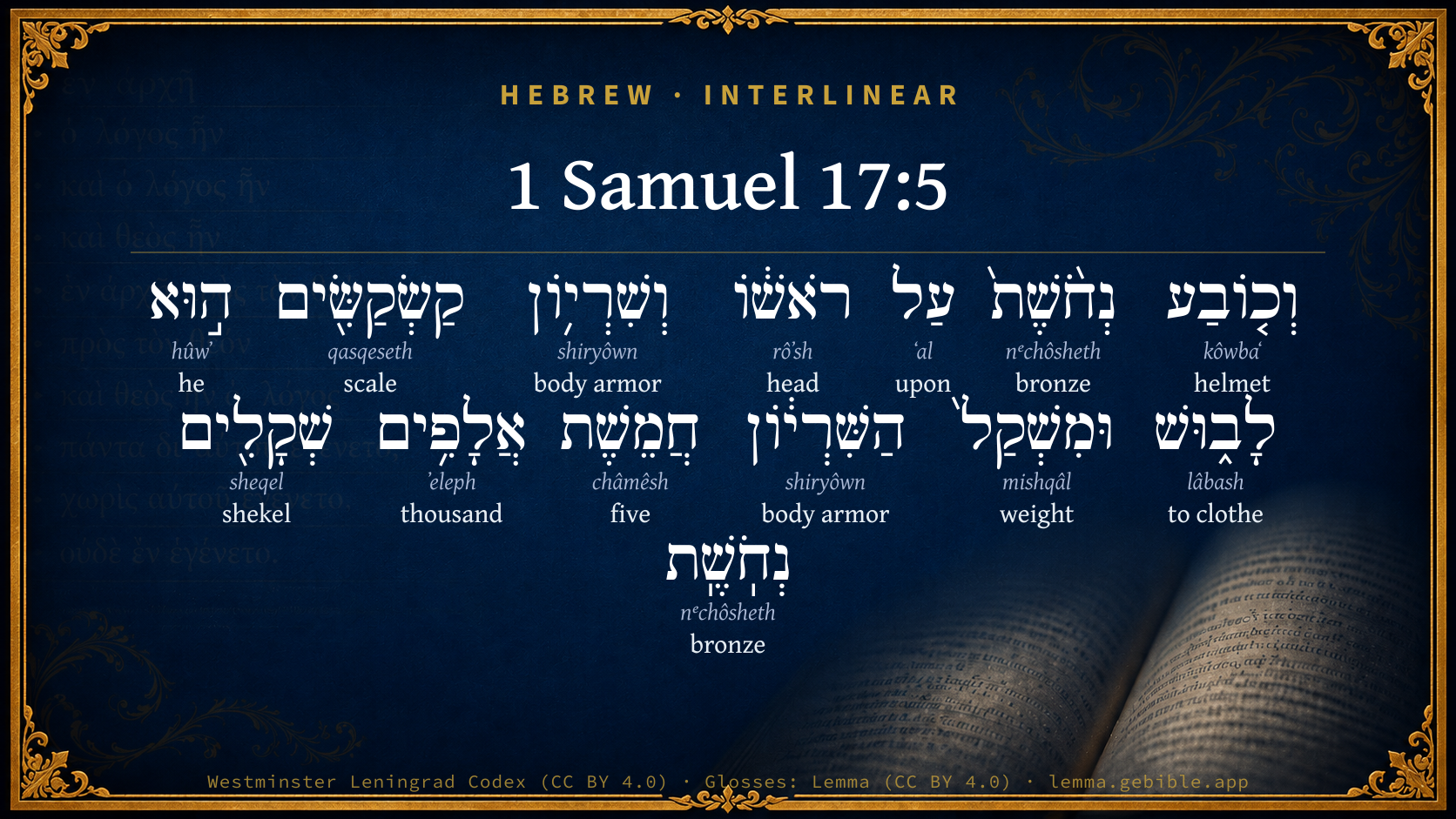
1 Samuel 17:5

Hebrew (Westminster Leningrad Codex) 1 Samuel 17:5 appears in the Hebrew Old Testament. The text above is from the Westminster Leningrad Codex. Each word links to its Strong’s number, a concise gloss, and parsing drawn from the Open Scriptures Hebrew Bible morphology. Click any word for its full Brown-Driver-Briggs (BDB) entry.
Download image
Cite this verse

1 Samuel 17:5 (World English Bible). Public Domain. Lemma interlinear Bible study tool, https://lemma.gebible.app/v/1-samuel/17/5.

Show BibTeX & RIS
BibTeX
RIS
English Translation
He had a helmet of brass on his head, and he was clad with a coat of mail; and the weight of the coat was five thousand shekels of brass.
World English Bible · Public Domain
Highlights
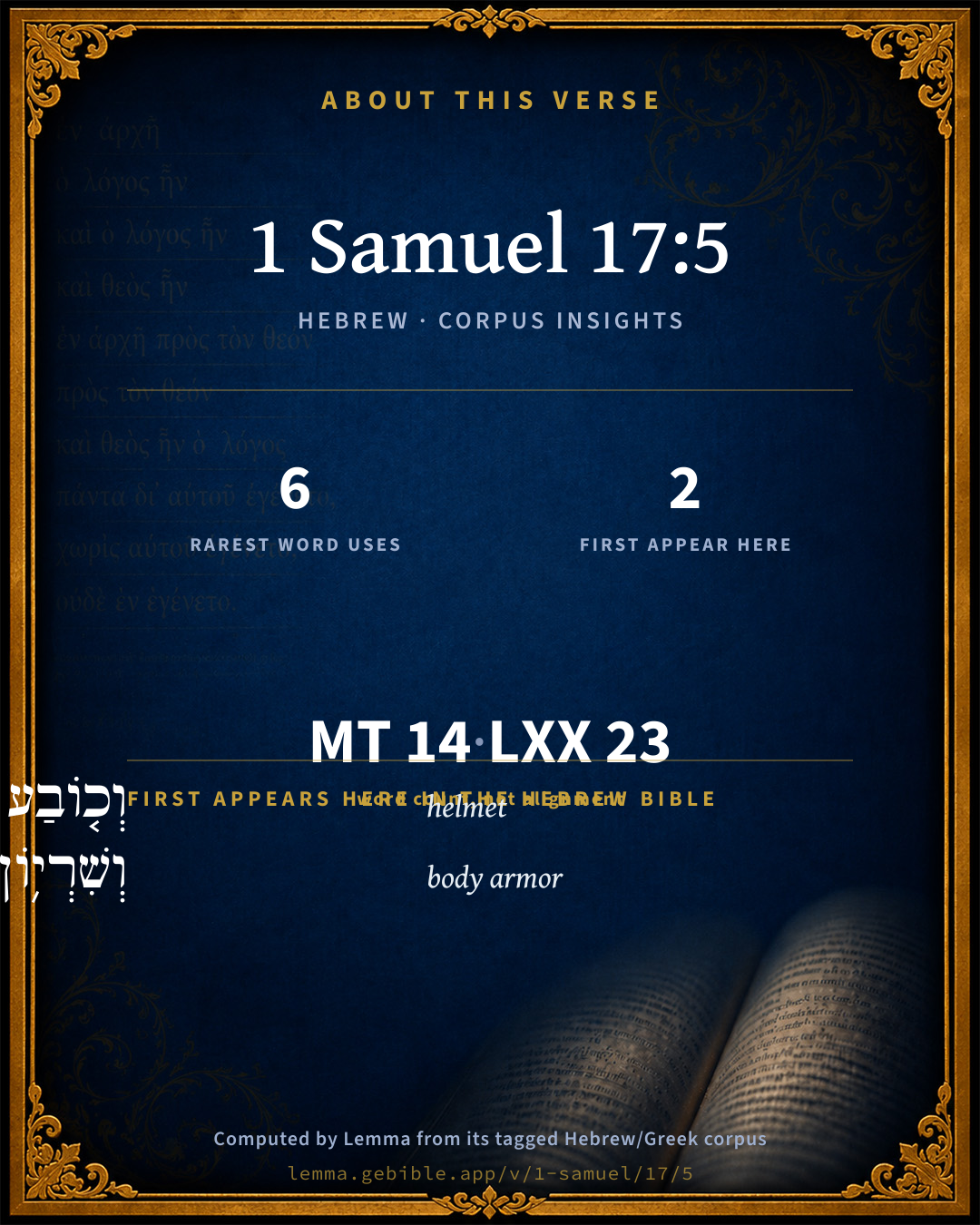
  • 2 first appearances in the Hebrew Bible
Full analysis ↓
Download a study sheet

One document with this verse’s original text, its word-by-word gloss line, the meaning frame, cross-references with their text, attributed commentary, and full source and license credits — printable, and it pastes into notes with its structure intact.

This verse Autodidact and up

Study sheet (.html) Plain text (.txt)

A passage Seminary Student

Up to 50 verses in one chapter. A passage sheet keeps up to 6 commentary sources and 12 cross-references per verse, in the order this page ranks them, and says so on the sheet whenever that leaves anything out. Ask for a single verse and you get the Autodidact verse sheet above.

Everything on this page stays free to read, with no account — the sheet is a download of what is already on screen, not access to it.

Want to remove ads? Support Godless Engineer
Compare translations 3

The same verse in 3 English versions, stacked beneath the original-language interlinear above. Click any original word for its lexicon entry.

Each is an independent rendering of the whole verse — the interlinear is not word-aligned to these translations.

Highlighted words mark where these versions differ — a whole-verse word diff, not a word-by-word alignment.

  • World English Bible Public Domain
    He had a helmet of brass on his head, and he was clad with a coat of mail; and the weight of the coat was five thousand shekels of brass.
  • King James Version Public Domain
    And he had an helmet of brass upon his head, and he was armed with a coat of mail; and the weight of the coat was five thousand shekels of brass.
  • unfoldingWord Literal Text CC BY-SA 4.0
    And a helmet of bronze on his head, and he was clothed a coat of scales. And the weight of the coat 5,000 shekels of bronze.

unfoldingWord Literal Text — © unfoldingWord, licensed CC BY-SA 4.0. Word-aligned USFM3 via Door43 (git.door43.org/unfoldingWord/en_ult).

Versions to compare (up to 4)

3 of 4 selected

Show all 18 translations

Every available English version of this verse, each an independent rendering of the whole verse.

  • World English Bible Public Domain
    He had a helmet of brass on his head, and he was clad with a coat of mail; and the weight of the coat was five thousand shekels of brass.
  • Berean Standard Bible Public Domain
    and he had a bronze helmet on his head. He wore a bronze coat of mail weighing five thousand shekels,
  • Majority Standard Bible Public Domain
    and he had a bronze helmet on his head. He wore a bronze coat of mail weighing five thousand shekels,
  • King James Version Public Domain
    And he had an helmet of brass upon his head, and he was armed with a coat of mail; and the weight of the coat was five thousand shekels of brass.
  • American Standard Version (1901) Public Domain
    And he had a helmet of brass upon his head, and he was clad with a coat of mail; and the weight of the coat was five thousand shekels of brass.
  • Revised Version (1885) Public Domain
    And he had an helmet of brass upon his head, and he was clad with a coat of mail; and the weight of the coat was five thousand shekels of brass.
  • Geneva Bible (1599) Public Domain
    Aud had an helmet of brasse vpon his head, and a brigandine vpon him: and the weight of his brigandine was fiue thousand shekels of brasse.
  • Douay-Rheims (1899) Public Domain
    And he had a helmet of brass upon his head, and he was clothed with a coat of mail with scales, and the weight of his coat of mail was five thousand sicles of brass:
  • Young's Literal Translation Public Domain
    and a helmet of brass `is' on his head, and `with' a scaled coat of mail he `is' clothed, and the weight of the coat of mail `is' five thousand shekels of brass,
  • Literal Standard Version CC BY-SA 4.0
    and a helmet of bronze [is] on his head, and he is clothed [with] a scaled coat of mail, and the weight of the coat of mail [is] five thousand shekels of bronze,
  • Unlocked Literal Bible CC BY-SA 4.0
    He had a helmet of bronze on his head, and he was armed with a coat of chainmail. The coat weighed five thousand shekels of bronze.
  • unfoldingWord Literal Text CC BY-SA 4.0
    And a helmet of bronze on his head, and he was clothed a coat of scales. And the weight of the coat 5,000 shekels of bronze.
  • Darby Bible Public Domain
    And he had a helmet of bronze upon his head, and he was clothed with a corselet of scales; and the weight of the corselet was five thousand shekels of bronze.
  • World Messianic Bible Public Domain
    He had a helmet of bronze on his head, and he wore a coat of mail; and the weight of the coat was five thousand shekels of bronze.
  • Webster's Bible Public Domain
    And he had a helmet of brass upon his head, and he was armed with a coat of mail; and the weight of the coat was five thousand shekels of brass.
  • Free Bible Version CC BY-SA 4.0
    He had on his head a bronze helmet and he wore a bronze coat of mail weighing five thousand shekels.
  • Bible in Basic English Public Domain
    And he had a head-dress of brass on his head, and he was dressed in a coat of metal, the weight of which was five thousand shekels of brass.
  • JPS Tanakh (1917) Public Domain
    And he had a helmet of brass upon his head, and he was clad with a coat of mail; and the weight of the coat was five thousand shekels of brass.

Literal Standard Version (2020), Covenant Press — licensed CC BY-SA 4.0. Text via the HelloAO Bible API (eBible.org). Unlocked Literal Bible (unfoldingWord) — licensed CC BY-SA 4.0. Text via the HelloAO Bible API (eBible.org). unfoldingWord Literal Text — © unfoldingWord, licensed CC BY-SA 4.0. Word-aligned USFM3 via Door43 (git.door43.org/unfoldingWord/en_ult). Free Bible Version, Dr. Jonathan Gallagher — licensed CC BY-SA 4.0. Text via the HelloAO Bible API (eBible.org).

Word by word

More ways to search: Search by grammar → Find every occurrence → Compare this word →

Practice this passage: Drill this verse → Learn its vocabulary →

וְכ֤וֹבַע
kôwbaʻ
H3553
“and · helmet of”
Conjunction + Noun, Common, Masculine, Singular, Construct
Part of Speech
Conjunction + Noun
Type
Common
Gender
Masculine
Number
Singular
State
Construct
Full BDB Definition

Origin: from an unused root meaning to be high or rounded

TWOT: 960

helmet
  1. נְחֹ֨שֶׁת֙ nᵉchôsheth H5178 “bronze” Noun, Common, Feminine, Singular, Absolute
  2. עַל ʻal H5921 “upon” Preposition
  3. רֹאשׁ֔וֹ rôʼsh H7218 “head · his” Noun, Common, Masculine, Singular, Construct + Suffix, Personal, 3rd Person, Masculine, Singular
  4. וְשִׁרְי֥וֹן shiryôwn H8302 “and · body armor of” Conjunction + Noun, Common, Both, Singular, Construct
  5. קַשְׂקַשִּׂ֖ים qasqeseth H7193 “scales” Noun, Common, Feminine, Plural, Absolute
  6. ה֣וּא hûwʼ H1931 “he” Pronoun, Personal, 3rd Person, Masculine, Singular
  7. לָב֑וּשׁ lâbash H3847 “clothed” Verb, Qal, Participle Passive, Masculine, Singular, Absolute
  8. וּמִשְׁקַל֙ mishqâl H4948 “and · weight of” Conjunction + Noun, Common, Masculine, Singular, Construct
  9. הַשִּׁרְי֔וֹן shiryôwn H8302 “the · body armor” Particle, Definite Article + Noun, Common, Both, Singular, Absolute
  10. חֲמֵשֶׁת châmêsh H2568 “five” Adjective, Cardinal number, Masculine, Singular, Construct
  11. אֲלָפִ֥ים ʼeleph H505 “thousand” Adjective, Cardinal number, Both, Plural, Absolute
  12. שְׁקָלִ֖ים sheqel H8255 “shekels” Noun, Common, Masculine, Plural, Absolute
  13. נְחֹֽשֶֽׁת nᵉchôsheth H5178 “bronze” Noun, Common, Feminine, Singular, Absolute

About this verse

These counts appear in no published source. They are computed here, from the morphology-tagged text and Lemma’s own curated glosses. What Lemma adds →

14
words
12
distinct lemmas
Historical
section

Notable vocabulary

The rarest word here is וְכ֤וֹבַע helmet H3553 — appearing just 6 times in the whole Hebrew Bible.

First appearance in Scripture

These words make their first canonical appearance in the Hebrew Bible here:

  • וְכ֤וֹבַע helmet H3553
  • וְשִׁרְי֥וֹן body armor H8302

Shared distinctive vocabulary

וְכ֤וֹבַע helmet H3553 occurs in 6 verses of the Hebrew Bible. Also found in:

Grammatical profile

  • 1 verb
  • 9 nouns
  • 2 adjectives
  • 1 pronoun
  • 1 preposition

Verb forms

  • לָב֑וּשׁ Qal · Participle Passive

Repetition

Words recur within this verse — often emphatic in Hebrew:

  • נְחֹ֨שֶׁת֙ bronze H5178 ×2
  • וְשִׁרְי֥וֹן body armor H8302 ×2

Hebrew & Septuagint length

In English translation the verse runs 30 words from the Hebrew and 30 from the Septuagint (LXX English) — the same length.

A rough comparison of the two English renderings, which tokenize alike — not a word-level alignment.

Word counts can differ between the Hebrew and the Greek without any difference in meaning — e.g. the Hebrew direct-object marker אֵת has no separate Greek word, and Greek often adds the article ὁ.

In the original languages it is 14 Hebrew tokens and 23 Greek tokens — but the two are counted differently (Hebrew bundles its prefixes and suffixes into one token; the Greek is in lemma form), so that isn’t a like-for-like length.

Hebrew and Greek witnesses Masoretic Hebrew ↔ Greek Septuagint

The same verse in the two great witnesses to the Old Testament, shown verse-for-verse.

These are two independent witnesses, not word-aligned to each other, and the Septuagint is shown in lemma (dictionary) form.

Hebrew 1 Samuel 17:5 Masoretic · Westminster Leningrad Codex

וְכ֤וֹבַע נְחֹ֨שֶׁת֙ עַל רֹאשׁ֔וֹ וְשִׁרְי֥וֹן קַשְׂקַשִּׂ֖ים ה֣וּא לָב֑וּשׁ וּמִשְׁקַל֙ הַשִּׁרְי֔וֹן חֲמֵשֶׁת אֲלָפִ֥ים שְׁקָלִ֖ים נְחֹֽשֶֽׁת

He had a helmet of brass on his head, and he was clad with a coat of mail; and the weight of the coat was five thousand shekels of brass.

World English Bible · Public Domain

Greek LXX 1 Samuel 17:5 Septuagint · lemma form

καί περικεφαλαία ἐπί ὁ κεφαλή αὐτός καί θώραξ ἁλυσιδωτός αὐτός ἐνδύω καί ὁ σταθμός ὁ θώραξ αὐτός πέντε χιλιάς σίκλος χαλκοῦς καί σίδηρος

And he had a helmet upon his head, and he wore a breastplate of chain armor; and the weight of his breastplate was five thousand shekels of brass and iron.

LXX2012 (modern English Septuagint) · Public Domain

On this verse, Haydock's Catholic Bible Commentary discusses the Septuagint’s reading. Read the note in Commentary ↓

Hebrew: Westminster Leningrad Codex (CC BY 4.0). Greek: Septuagint (public domain); English from LXX2012 (modern English Septuagint) (Public Domain). How the Septuagint differs from the Hebrew →

Targum (Aramaic paraphrase)

1

The Targum is the ancient Jewish Aramaic paraphrase of the Hebrew Scriptures — an interpretive translation, not the Hebrew text itself. Onkelos (literal) and Pseudo-Jonathan (expansive) render the Torah, and Jonathan the Prophets. Coverage is partial: where no permissively-licensed English translation exists for a verse, only the Aramaic is shown. This is verse-level text, not a word-by-word alignment to the Hebrew.

  1. Targum Jonathan Prophets (Joshua–Malachi)
    וְקוּלַס דִנְחַשׁ עַל רֵישֵׁיהּ וְשִׁרְיָן גַלְבִּין הוּא לָבֵישׁ וּמַתְקַל שִׁרְיוֹנָא חַמְשָׁא אַלְפִין תִּקְלֵי נְחָשָׁא:

    (no public-domain English translation for this verse)

    Targum Jonathan — Aramaic: “Mikraot Gedolot” (public domain). English: “Sefaria Community Translation” (CC0 1.0 (public-domain dedication)); “London "Chaldee Paraphrase," 1871” (public domain). Text via Sefaria.

Commentary

Notes on 1 Samuel 17:5 from classic Christian and Jewish commentators (each source and its license shown beneath its notes). The classic Christian expositions comment on the surrounding passage and are grouped to its opening verse, so a note may address several verses; the Jewish commentaries on the Tanakh (Rashi and others) are per-verse, so they appear only where the commentator wrote on this verse.

Lemma curates 59 commentaries, every one of them public domain or Creative Commons licensed, each selected and text-cleaned for this edition rather than reprinted as found. About our sources →

Trapp's Complete Commentary

John Trapp

1Sa 17:5 And [he had] an helmet of brass upon his head, and he [was] armed with a coat of mail; and the weight of the coat [was] five thousand shekels of brass.

Ver. 5. And he had an helmet of brass (or steel) upon his head.] Which yet could not save his head. No armour is of proof against the Almighty. If he set himself against a man, no other helps can relieve him. Brass and steel cannot fence one against fire and water. "Now God is a consuming fire," and his "breath a stream of brimstone." {Isa 30:33}

And he was armed with a coat of mail.] Lorica squamata, like fish scales, one lying over another, to ward off deadly darts, or other weapons of war, leviathan like.

Five thousand shekels of brass.] That is, One hundred and fifty-six pounds, and more, besides all the weight of his other arms; which yet he could well wield and make use of in fight.

John Trapp, A Commentary or Exposition upon All the Books of the Old and New Testament (1647–1656) — public domain. Text from a community e-Sword module.

Joseph Benson's Commentary

1Sa 17:5-7. He was armed with a coat of mail — Made of plates of brass laid over one another like the scales of a fish. Five thousand shekels of brass — The common shekel contained a fourth part of an ounce; and so five thousand shekels made one thousand two hundred and fifty ounces, or seventy-eight pounds; which weight was not unsuitable to a man of such vast strength as his height speaks him to have been. Greaves — Boots. The staff of his spear like a weaver’s beam — On which the weavers fasten their web. It was like this for thickness. And though the whole weight of Goliath’s armour may seem prodigious, yet it is not so much by far as one Athanatus did manage, of whom Pliny relates that he saw him come into the theatre with arms weighing twelve thousand ounces. A shield —

Probably for state; for he that was clad in brass little needed a shield.

Joseph Benson's Commentary on the Old and New Testaments (1811–1818) — public domain. Text from a community e-Sword module.

Tyndale Open Study Notes

Tyndale Open Resources

17:5-7 Although Goliath was a fully armored warrior of terrifying size, he did not have God—a far mightier warrior—on his side (17:45-47).

Tyndale Open Study Notes — © Tyndale Open Resources, licensed CC BY-SA 4.0. Text via the HelloAO Bible API.

Geneva Bible (1599)

Geneva Bible translators

Or, coat of plate.

That is, 156 pounds 4 ounces after half an ounce the shekel: and 600 shekels weight amounteth to 18 pounds 3 quarters.

Geneva Bible (1599) marginal notes — public domain. Text via Bolls.life.

Jamieson, Fausset & Brown

Robert Jamieson, A. R. Fausset & David Brown

helmet of brass--The Philistine helmet had the appearance of a row of feathers set in a tiara, or metal band, to which were attached scales of the same material, for the defense of the neck and the sides of the face [OSBORN].

a coat of mail--a kind of corslet, quilted with leather or plates of metal, reaching only to the chest, and supported by shoulder straps, leaving the shoulders and arms at full liberty.

Jamieson, Fausset & Brown — Commentary Critical and Explanatory on the Whole Bible (1871) — public domain (CC PDM 1.0). Text via the HelloAO Bible API.

Adam Clarke's Commentary

Verse 5. He was armed with a coat of mail] The words in the original, שרון קשקשים shiryon kaskassim, mean a coat of mail formed of plates of brass overlapping each other, like the scales of a fish, or tiles of a house. This is the true notion of the original terms.

With thin plates of brass or iron, overlapping each other, were the ancient coats of mail formed in different countries; many formed in this way may be now seen in the tower of London.

The weight - five thousand shekels] Following Bishop Cumberland's tables, and rating the shekel at two hundred and nineteen grains, and the Roman ounce at four hundred and thirty-eight grains, we find that Goliath's coat of mail, weighing five thousand shekels, was exactly one hundred and fifty-six pounds four ounces avoirdupois. A vast weight for a coat of mail, but not all out of proportion to the man.

Adam Clarke's Commentary on the Bible (1810–1826) — public domain. Text from a community e-Sword/MySword module.

Ellicott's Commentary for English Readers

(5) A coat of mail.—More accurately, breastplate of scales. This armour has been sometimes understood as “chain armour,” but it is more probable that the Philistine armour was made of metal scales, like those of a fish, whose defensive coat was, no doubt, imitated at a very early date by this warlike race, who dwelt on the sea-shore, and whose life and worship were so closely connected with the great sea. This coat of mail, or corselet, was flexible, and covered the back and sides of the wearer. The weight of the different pieces of the giant’s panoply largely exceeds the weight of mediæval suits of armour.

A Bible Commentary for English Readers, edited by Charles John Ellicott (1878–1897) — public domain. Text from a community e-Sword module.

The Cambridge Bible for Schools and Colleges

gen. ed. J. J. S. Perowne

5. a coat of mail] “A corselet of scales,” made of overlapping plates of metal, and protecting the body almost down to the knees. Armour of this kind is represented in the Assyrian sculptures. See Layard’s Nineveh II. 335. Cp. Virg. Aen. XI. 487, “Turnus … thoraca indutus aenis Horrebat squamis.”

five thousand shekels] Estimated at about 157 pounds avoirdupois.

The Cambridge Bible for Schools and Colleges (gen. ed. J. J. S. Perowne; Cambridge University Press, 1878–1918) — public domain. Text from a community e-Sword module.

John Gill's Exposition

And he had an helmet of brass upon his head,.... This was a piece of armour, which covered the head in the day of battle; these were usually made of the skins of beasts, of leather, and which were covered with plates of iron, or brass; and sometimes made of all iron, or of brass (g); as this seems to have been:

and he was armed with a coat of mail; which reached from the neck to the middle, and consisted of various plates of brass laid on one another, like the scales of fishes (h), so close together that no dart or arrow could pierce between:

and the weight of the coat was five thousand shekels of brass: which made one hundred and fifty six pounds and a quarter of zygostatic or avoirdupois weight; and therefore he must be a very strong man indeed to carry such a weight. So the armour of the ancient Romans were all of brass, as this man's; their helmets, shields, greaves, coats of mail, all of brass, as Livy says (i); and so in the age of the Grecian heroes (j).

(g) Vid. Lydium "de re militari": l. 3. c. 5. p. 63. (h) "----Rutilum thoraca indutus anis Horrebat squamis----" Virgil. Aeneid. l. 11. (i) Hist. l. 1. c. 22. (j) Pausan. Messenica, l. 3. p. 163. So Homer frequently describes the Grecians with a coat of mail of brass.

John Gill's Exposition of the Whole Bible (1746–1763) — public domain (CC PDM 1.0). Text via the HelloAO Bible API.

Albert Barnes' Notes on the Bible

Coat of mail - Or “breastplate of scales.” A kind of metal shirt, protecting the back as well as the breast, and made of scales like those of a fish; as was the corselet of Rameses III, now in the British Museum. The terms, helmet, coat, and clothed (armed the King James Version) are the same as those used in Isa 59:17.

Five thousand shekels - Probably about 157 pounds avoirdupois (see Exo 38:12). It is very probable that Goliath’s brass coat may have been long preserved as a trophy, as we know his sword was, and so the weight of it ascertained.

Albert Barnes' Notes on the Bible (1834–1885) — public domain. Text from a community e-Sword/MySword module.

Haydock's Catholic Bible Commentary

Scales, like those of fishes. Septuagint insinuate, that it was armed with things resembling fish-hooks; Greek: alisidoton, hamata. --- Brass, which was used for the armour of the ancients. Plutarch (in Demetrio) speaks of a coat of mail weighing forty pounds: the usual weight was twenty pounds. (Lipsius) --- The strength of the giant must have borne proportion with his size. (Calmet)

George Leo Haydock (1774–1849), Haydock's Catholic Family Bible and Commentary, 1859 edition — public domain. Excludes Psalms (Douay-Rheims chapter numbering differs from Protestant) and Deuterocanonical books (Catholic canon only).

Matthew Poole's English Annotations

The common shekel contained only a fourth part of an ounce; and so 5000 shekels made 1250 ounces, which make exactly 78 pounds; which weight is not unsuitable to a man of such vast greatness and strength, as his height speaks him to be.

Matthew Poole's English Annotations on the Holy Bible (1683–1685) — public domain. Text from a community e-Sword/MySword module.

Whedon's Commentary on the Bible

Daniel D. Whedon

5. A helmet of brass — A defensive armour for the head.

A coat of mail — Literally, a coat of scales. A defensive armour for the body, consisting of plates of brass overlapping each other like the scales on a fish, or shingles on a roof. The Hebrew word is rendered habergeon in 2Ch_26:14, and Neh_4:16.

Weight… five thousand shekels — Reckoning the shekel at half an ounce avoirdupois, the weight of the scale armour would be about one hundred and fifty pounds.

Daniel D. Whedon (gen. ed.), Commentary on the Old and New Testaments (1874–1909) — public domain. Text from a community e-Sword module.

John Wesley's Explanatory Notes

Coat of mail - Made of brass plates laid over one another, like the scales of a fish. The weight, &c. - The common shekel contained a fourth part of an ounce; and so five thousand shekels made one thousand two hundred and fifty ounces, or seventy- eight pounds: which weight is not unsuitable to a man of such vast strength as his height speaks him to be.

John Wesley, Explanatory Notes Upon the Whole Bible (1754–1765) — public domain. Text via the GEBible commentary corpus.

Rashi

Rabbi Shlomo Yitzchaki (Rashi)

Scaled armor. Like fish scales, made of iron, spread over the coat (another version: the holes of the coat), a scale [covering] each hole.

Rashi on the Tanakh — English translations: “The Judaica Press complete Tanach with Rashi, translated by A. J. Rosenberg” (CC BY 4.0); “Pentateuch with Rashi's commentary by M. Rosenbaum and A.M. Silbermann, 1929-1934” (public domain); “The Metsudah Tanach series, Lakewood, N.J” (CC BY 4.0); and “The Book of Joshua, Metsudah Publications, 1997” (CC BY 4.0). Text via Sefaria.

Lesson kit

Teaching starters — assembled from the data on this page, not authored interpretation. Every prompt links to the verse data it draws on. Edit before teaching.

1 Samuel, in the Historical, opens this verse with 14 words (12 distinct Hebrew lemmas). Its most distinctive word is kôwbaʻ (“helmet”). A historical commentator’s framing appears above. Read the whole chapter for the surrounding context.

Discussion questions

  1. The word kôwbaʻ carries the sense “helmet.” How does it shape the verse?
  2. 2 words make their first appearance in Scripture here. What does this debut establish?
  3. How does 2 Chronicles 26:14, which shares the word «helmet», read alongside this verse?
  4. What does the repetition of “bronze” (2× in this one verse) do in this verse?
  5. These translations render this verse differently. What is at stake in choosing one wording over another?
  6. «לָב֑וּשׁ» is a Qal Participle Passive verb. How does that grammatical form shape the action described?
  7. Compare how Trapp's Complete Commentary and Joseph Benson's Commentary read this verse. Where do they agree or differ?

Things to notice

Reading settings

Reading text

Shown beneath each verse's original-language words.

Old Testament
Old Testament edition

Read the OT as the Masoretic Hebrew (MT) or the Greek Septuagint (LXX).

English shown for the Greek Septuagint (in the Hebrew ↔ Greek comparison).

Comparing translations? Open the Compare panel on any verse page to stack up to four side by side.