
Joshua 22:30

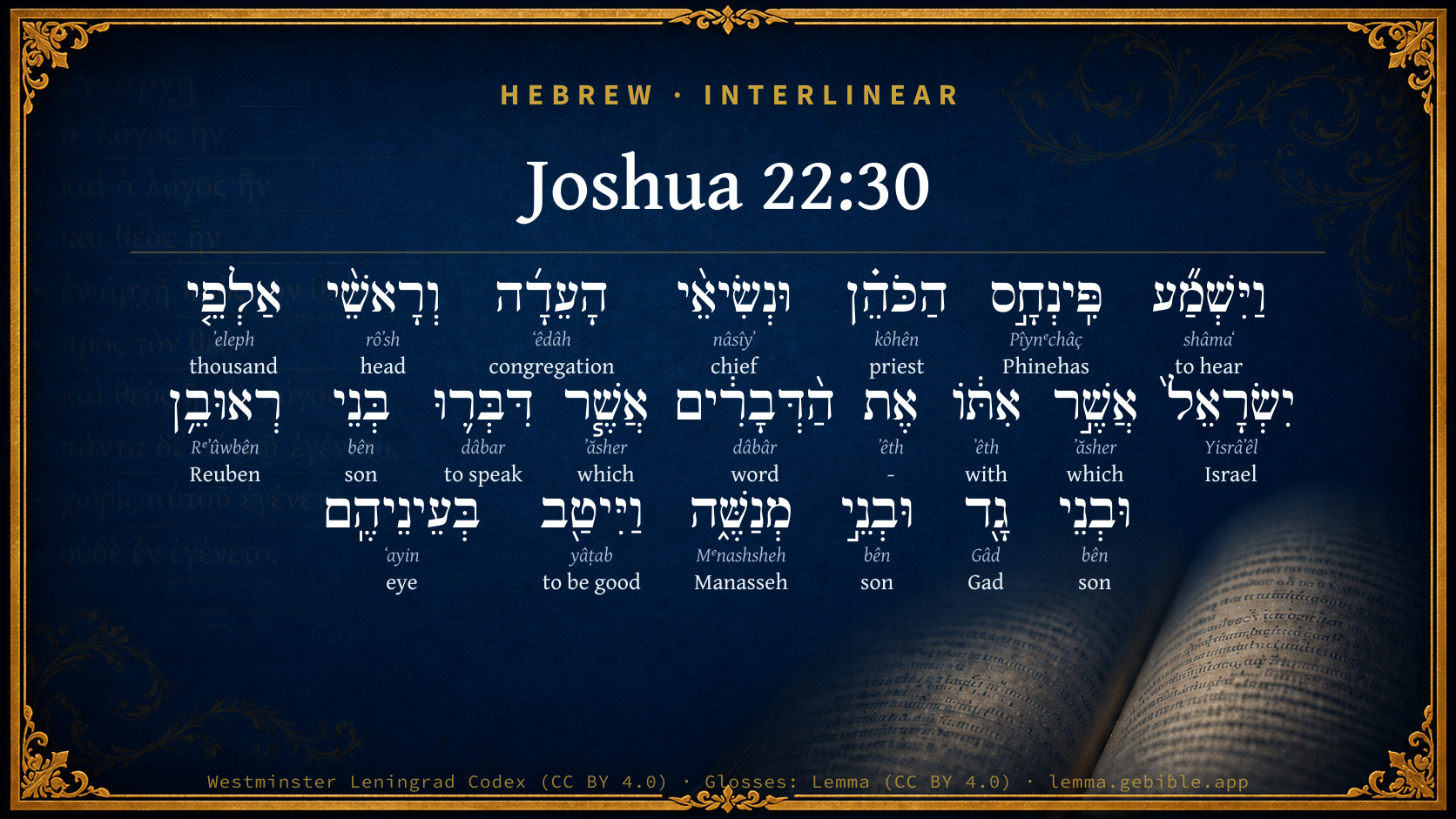
Hebrew (Westminster Leningrad Codex) Joshua 22:30 appears in the Hebrew Old Testament. The text above is from the Westminster Leningrad Codex. Each word links to its Strong’s number, a concise gloss, and parsing drawn from the Open Scriptures Hebrew Bible morphology. Click any word for its full Brown-Driver-Briggs (BDB) entry.
Download image
Cite this verse

Joshua 22:30 (World English Bible). Public Domain. Lemma interlinear Bible study tool, https://lemma.gebible.app/v/joshua/22/30.

Show BibTeX & RIS
BibTeX
RIS
English Translation
When Phinehas the priest, and the princes of the congregation, even the heads of the thousands of Israel that were with him, heard the words that the children of Reuben and the children of Gad and the children of Manasseh spoke, it pleased them well.
World English Bible · Public Domain
Download a study sheet

One document with this verse’s original text, its word-by-word gloss line, the meaning frame, cross-references with their text, attributed commentary, and full source and license credits — printable, and it pastes into notes with its structure intact.

This verse Autodidact and up

Study sheet (.html) Plain text (.txt)

A passage Seminary Student

Up to 50 verses in one chapter. A passage sheet keeps up to 6 commentary sources and 12 cross-references per verse, in the order this page ranks them, and says so on the sheet whenever that leaves anything out. Ask for a single verse and you get the Autodidact verse sheet above.

Everything on this page stays free to read, with no account — the sheet is a download of what is already on screen, not access to it.

Want to remove ads? Support Godless Engineer
Compare translations 3

The same verse in 3 English versions, stacked beneath the original-language interlinear above. Click any original word for its lexicon entry.

Each is an independent rendering of the whole verse — the interlinear is not word-aligned to these translations.

Highlighted words mark where these versions differ — a whole-verse word diff, not a word-by-word alignment.

  • World English Bible Public Domain
    When Phinehas the priest, and the princes of the congregation, even the heads of the thousands of Israel that were with him, heard the words that the children of Reuben and the children of Gad and the children of Manasseh spoke, it pleased them well.
  • King James Version Public Domain
    And when Phinehas the priest, and the princes of the congregation and heads of the thousands of Israel which were with him, heard the words that the children of Reuben and the children of Gad and the children of Manasseh spake, it pleased them.
  • unfoldingWord Literal Text CC BY-SA 4.0
    And Phinehas the priest and the leaders of the congregation and the heads of the thousands of Israel who with him heard the words that the sons of Reuben and the sons of Gad and the sons of Manasseh spoke. And it was good in their eyes.

unfoldingWord Literal Text — © unfoldingWord, licensed CC BY-SA 4.0. Word-aligned USFM3 via Door43 (git.door43.org/unfoldingWord/en_ult).

Versions to compare (up to 4)

3 of 4 selected

Show all 18 translations

Every available English version of this verse, each an independent rendering of the whole verse.

  • World English Bible Public Domain
    When Phinehas the priest, and the princes of the congregation, even the heads of the thousands of Israel that were with him, heard the words that the children of Reuben and the children of Gad and the children of Manasseh spoke, it pleased them well.
  • Berean Standard Bible Public Domain
    When Phinehas the priest and the chiefs of the congregation—the heads of Israel’s clans who were with him—heard what the descendants of Reuben, Gad, and Manasseh had to say, they were satisfied.
  • Majority Standard Bible Public Domain
    When Phinehas the priest and the chiefs of the congregation—the heads of Israel’s clans who were with him—heard what the descendants of Reuben, Gad, and Manasseh had to say, they were satisfied.
  • King James Version Public Domain
    And when Phinehas the priest, and the princes of the congregation and heads of the thousands of Israel which were with him, heard the words that the children of Reuben and the children of Gad and the children of Manasseh spake, it pleased them.
  • American Standard Version (1901) Public Domain
    And when Phinehas the priest, and the princes of the congregation, even the heads of the thousands of Israel that were with him, heard the words that the children of Reuben and the children of Gad and the children of Manasseh spake, it pleased them well.
  • Revised Version (1885) Public Domain
    And when Phinehas the priest, and the princes of the congregation, even the heads of the thousands of Israel which were with him, heard the words that the children of Reuben and the children of Gad and the children of Manasseh spake, it pleased them well.
  • Geneva Bible (1599) Public Domain
    And when Phinehas the Priest, and the princes of the Congregation and heads ouer the thousands of Israel which were with him, heard the wordes, that the children of Reuben, and children of Gad, and the children of Manasseh spake, they were well content.
  • Douay-Rheims (1899) Public Domain
    And when Phinees the priest, and the princes of the embassage, who were with him, had heard this, they were satisfied: and they admitted most willingly the words of the children of Ruben, and Gad, and of the half tribe of Manasses.
  • Young's Literal Translation Public Domain
    And Phinehas the priest, and the princes of the company, and the heads of the thousands of Israel, who `are' with him, hear the words which the sons of Reuben, and the sons of Gad, and the sons of Manasseh have spoken, and it is good in their eyes.
  • Literal Standard Version CC BY-SA 4.0
    And Phinehas the priest, and the princes of the congregation, and the heads of the thousands of Israel, who [are] with him, hear the words which the sons of Reuben, and the sons of Gad, and the sons of Manasseh have spoken, and it is good in their eyes.
  • Unlocked Literal Bible CC BY-SA 4.0
    When Phinehas the priest and the leaders of the people, that is, the heads of the clans of Israel who were with him, heard the words that the people of Reuben, Gad, and Manasseh said, that it was good in their eyes.
  • unfoldingWord Literal Text CC BY-SA 4.0
    And Phinehas the priest and the leaders of the congregation and the heads of the thousands of Israel who with him heard the words that the sons of Reuben and the sons of Gad and the sons of Manasseh spoke. And it was good in their eyes.
  • Darby Bible Public Domain
    And when Phinehas the priest and the princes of the assembly and the heads of the thousands of Israel that were with him heard the words that the children of Reuben and the children of Gad and the children of Manasseh spoke, it was good in their sight.
  • World Messianic Bible Public Domain
    When Phinehas the priest, and the princes of the congregation, even the heads of the thousands of Israel that were with him, heard the words that the children of Reuben and the children of Gad and the children of Manasseh spoke, it pleased them well.
  • Webster's Bible Public Domain
    And when Phinehas the priest, and the princes of the congregation, and heads of the thousands of Israel who were with him, heard the words that the children of Reuben, and the children of Gad, and the children of Manasseh spoke, it pleased them.
  • Free Bible Version CC BY-SA 4.0
    When Phinehas and the Israelite leaders heard this from the tribes of Reuben and Gad, and the half-tribe of Manasseh they were delighted.
  • Bible in Basic English Public Domain
    Then Phinehas the priest and the chiefs of the meeting and the heads of the families of Israel who were with him, hearing what the children of Reuben and the children of Gad and the children of Manasseh said, were pleased.
  • JPS Tanakh (1917) Public Domain
    And when Phinehas the priest, and the princes of the congregation, even the heads of the thousands of Israel that were with him, heard the words that the children of Reuben and the children of Gad and the children of Manasseh spoke, it pleased them well.

Literal Standard Version (2020), Covenant Press — licensed CC BY-SA 4.0. Text via the HelloAO Bible API (eBible.org). Unlocked Literal Bible (unfoldingWord) — licensed CC BY-SA 4.0. Text via the HelloAO Bible API (eBible.org). unfoldingWord Literal Text — © unfoldingWord, licensed CC BY-SA 4.0. Word-aligned USFM3 via Door43 (git.door43.org/unfoldingWord/en_ult). Free Bible Version, Dr. Jonathan Gallagher — licensed CC BY-SA 4.0. Text via the HelloAO Bible API (eBible.org).

Word by word

More ways to search: Search by grammar → Find every occurrence → Compare this word →

Practice this passage: Drill this verse → Learn its vocabulary →

פִּֽינְחָ֣ס
Pîynᵉchâç
H6372
“Phinehas”
Noun, Proper
Part of Speech
Noun
Type
Proper
Full BDB Definition

Origin: apparently from H6310 and a variation of H5175

TWOT: None

Phinehas = "mouth of brass" - son of Eleazar and grandson of Aaron; his zealousness for the Lord averted a plague on Israel and gained him the promise of the Lord of an everlasting priesthood in his family - a priest and the son of the priest Eli - the father of a helper of Ezra
  1. וַיִּשְׁמַ֞ע shâmaʻ H8085 “and · to hear” Conjunction + Verb, Qal, Sequential Imperfect, 3rd Person, Masculine, Singular
  2. הַכֹּהֵ֗ן kôhên H3548 “the · priest” Particle, Definite Article + Noun, Common, Masculine, Singular, Absolute
  3. וּנְשִׂיאֵ֨י nâsîyʼ H5387 “and · chiefs of” Conjunction + Noun, Common, Masculine, Plural, Construct
  4. הָעֵדָ֜ה ʻêdâh H5712 “the · congregation” Particle, Definite Article + Noun, Common, Feminine, Singular, Absolute
  5. וְרָאשֵׁ֨י rôʼsh H7218 “and · heads of” Conjunction + Noun, Common, Masculine, Plural, Construct
  6. אַלְפֵ֤י ʼeleph H505 “thousand” Adjective, Cardinal number, Both, Plural, Construct
  7. יִשְׂרָאֵל֙ Yisrâʼêl H3478 “Israel” Noun, Proper
  8. אֲשֶׁ֣ר ʼăsher H834 “which” Particle, Relative
  9. אִתּ֔וֹ ʼêth H854 “with · him” Preposition + Suffix, Personal, 3rd Person, Masculine, Singular
  10. אֶת ʼêth H853 “-” Particle, Direct Object
  11. הַ֨דְּבָרִ֔ים dâbâr H1697 “the · words” Particle, Definite Article + Noun, Common, Masculine, Plural, Absolute
  12. אֲשֶׁ֧ר ʼăsher H834 “which” Particle, Relative
  13. דִּבְּר֛וּ dâbar H1696 “to speak” Verb, Piel, Perfect, 3rd Person, Common, Plural
  14. בְּנֵי bên H1121 “sons of” Noun, Common, Masculine, Plural, Construct
  15. רְאוּבֵ֥ן Rᵉʼûwbên H7205 “Reuben” Noun, Proper
  16. וּבְנֵי bên H1121 “and · sons of” Conjunction + Noun, Common, Masculine, Plural, Construct
  17. גָ֖ד Gâd H1410 “Gad” Noun, Proper
  18. וּבְנֵ֣י bên H1121 “and · sons of” Conjunction + Noun, Common, Masculine, Plural, Construct
  19. מְנַשֶּׁ֑ה Mᵉnashsheh H4519 “Manasseh” Noun, Proper
  20. וַיִּיטַ֖ב yâṭab H3190 “and · to be good” Conjunction + Verb, Qal, Sequential Imperfect, 3rd Person, Masculine, Singular
  21. בְּעֵינֵיהֶֽם ʻayin H5869 “in/at · eyes · their” Preposition + Noun, Common, Both, Dual, Construct + Suffix, Personal, 3rd Person, Masculine, Plural

About this verse

These counts appear in no published source. They are computed here, from the morphology-tagged text and Lemma’s own curated glosses. What Lemma adds →

22
words
19
distinct lemmas
Historical
section

Notable vocabulary

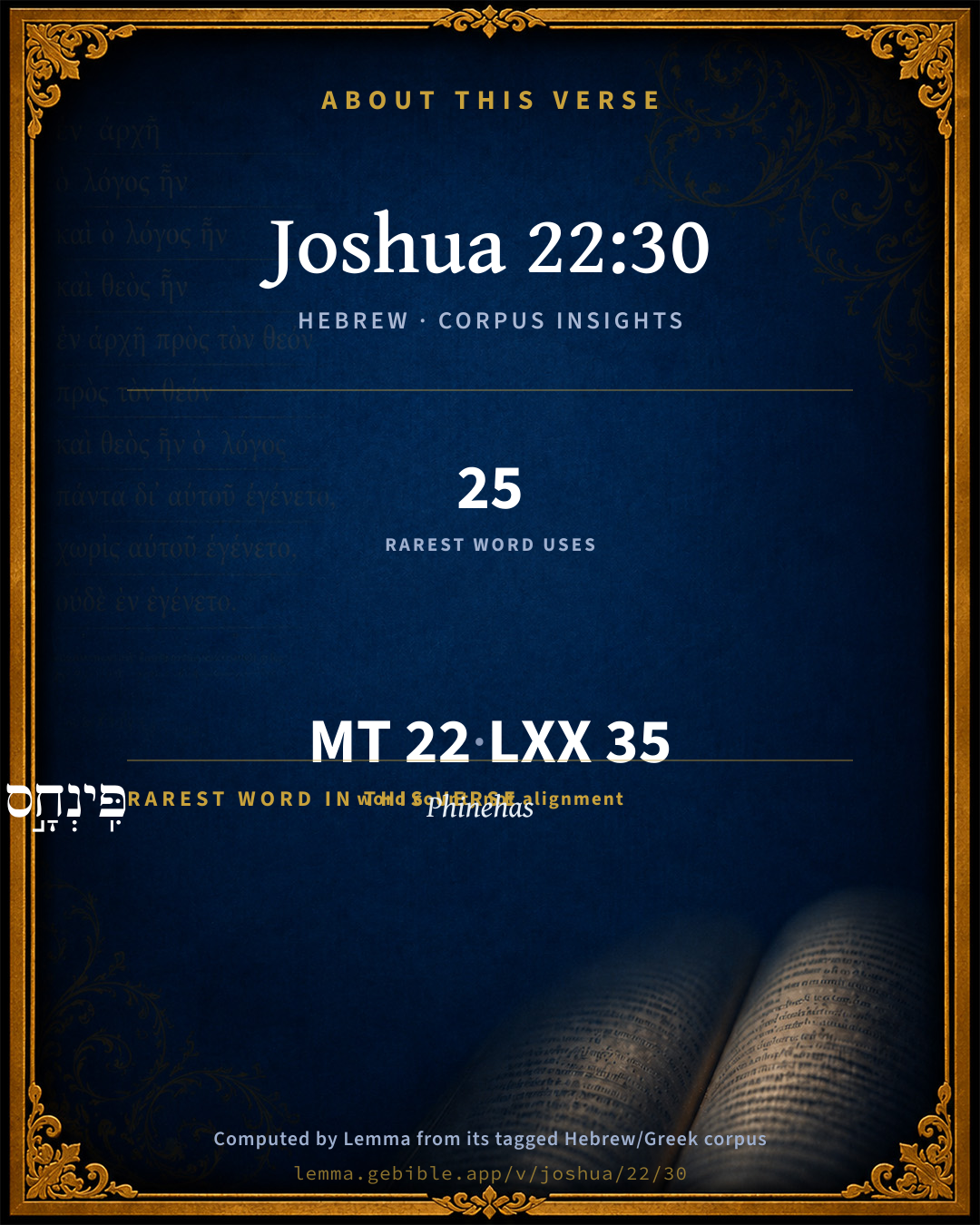
The rarest word here is פִּֽינְחָ֣ס Phinehas H6372 — appearing just 25 times in the whole Hebrew Bible.

Shared distinctive vocabulary

פִּֽינְחָ֣ס Phinehas H6372 occurs in 24 verses of the Hebrew Bible. Also found in:

Grammatical profile

  • 3 verbs
  • 14 nouns
  • 1 adjective
  • 1 preposition
  • 3 particles

Verb forms

  • וַיִּשְׁמַ֞ע Qal · Sequential Imperfect
  • דִּבְּר֛וּ Piel · Perfect
  • וַיִּיטַ֖ב Qal · Sequential Imperfect

Repetition

Words recur within this verse — often emphatic in Hebrew:

  • בְּנֵי son H1121 ×3
  • אֲשֶׁ֣ר which H834 ×2

Hebrew & Septuagint length

In English translation the verse runs 45 words from the Hebrew and 41 from the Septuagint (LXX English) — closely comparable.

A rough comparison of the two English renderings, which tokenize alike — not a word-level alignment.

Word counts can differ between the Hebrew and the Greek without any difference in meaning — e.g. the Hebrew direct-object marker אֵת has no separate Greek word, and Greek often adds the article ὁ.

In the original languages it is 22 Hebrew tokens and 35 Greek tokens — but the two are counted differently (Hebrew bundles its prefixes and suffixes into one token; the Greek is in lemma form), so that isn’t a like-for-like length.

Cross-references

9

Topical passages linked to Joshua 22:30 in the Treasury of Scripture Knowledge — connected by theme and wording, ordered by reader-vote popularity; previews shown in the World English Bible.

  • Joshua 22:33 The thing pleased the children of Israel; and the children of Israel blessed God, and spoke no more of going up against them to war, to destroy the land in which the children of Reuben and the children of Gad lived.
  • Genesis 28:8 Esau saw that the daughters of Canaan didn't please Isaac, his father.
  • Judges 8:3 God has delivered into your hand the princes of Midian, Oreb and Zeeb: and what was I able to do in comparison with you? Then their anger was abated toward him, when he had said that.
  • 1 Samuel 25:32–33 David said to Abigail, Blessed be Yahweh, the God of Israel, who sent you this day to meet me:
  • 1 Samuel 29:6 Then Achish called David, and said to him, As Yahweh lives, you have been upright, and your going out and your coming in with me in the host is good in my sight; for I have not found evil in you since the day of your coming to me to this day: nevertheless the lords don't favor you.
  • 2 Chronicles 30:4 The thing was right in the eyes of the king and of all the assembly.
  • Esther 1:21 The saying pleased the king and the princes; and the king did according to the word of Memucan:
  • Proverbs 15:1 A gentle answer turns away wrath, But a harsh word stirs up anger.
  • Acts 11:18 When they heard these things, they held their peace, and glorified God, saying, "Then God has also granted to the Gentiles repentance to life!"

Cross-references courtesy of OpenBible.info (CC BY 4.0).

Hebrew and Greek witnesses Masoretic Hebrew ↔ Greek Septuagint

The same verse in the two great witnesses to the Old Testament, shown verse-for-verse.

These are two independent witnesses, not word-aligned to each other, and the Septuagint is shown in lemma (dictionary) form.

Hebrew Joshua 22:30 Masoretic · Westminster Leningrad Codex

וַיִּשְׁמַ֞ע פִּֽינְחָ֣ס הַכֹּהֵ֗ן וּנְשִׂיאֵ֨י הָעֵדָ֜ה וְרָאשֵׁ֨י אַלְפֵ֤י יִשְׂרָאֵל֙ אֲשֶׁ֣ר אִתּ֔וֹ אֶת הַ֨דְּבָרִ֔ים אֲשֶׁ֧ר דִּבְּר֛וּ בְּנֵי רְאוּבֵ֥ן וּבְנֵי גָ֖ד וּבְנֵ֣י מְנַשֶּׁ֑ה וַיִּיטַ֖ב בְּעֵינֵיהֶֽם

When Phinehas the priest, and the princes of the congregation, even the heads of the thousands of Israel that were with him, heard the words that the children of Reuben and the children of Gad and the children of Manasseh spoke, it pleased them well.

World English Bible · Public Domain

Greek LXX Joshua 22:30 Septuagint · lemma form

καί ἀκούω φινεες ὁ ἱερεύς καί πᾶς ὁ ἄρχων ὁ συναγωγή ἰσραήλ ὅς εἰμί μετά αὐτός ὁ λόγος ὅς λαλέω ὁ υἱός ρουβην καί ὁ υἱός γαδ καί ὁ ἥμισυς φυλή μανασσή καί ἀρέσκω αὐτός

And Phinees the priest and all the chiefs of the congregation of Israel who were with him heard the words which the children of Ruben, and the children of Gad, and the half tribe of Manasse spoke; and it pleased them.

LXX2012 (modern English Septuagint) · Public Domain

Hebrew: Westminster Leningrad Codex (CC BY 4.0). Greek: Septuagint (public domain); English from LXX2012 (modern English Septuagint) (Public Domain). How the Septuagint differs from the Hebrew →

Targum (Aramaic paraphrase)

1

The Targum is the ancient Jewish Aramaic paraphrase of the Hebrew Scriptures — an interpretive translation, not the Hebrew text itself. Onkelos (literal) and Pseudo-Jonathan (expansive) render the Torah, and Jonathan the Prophets. Coverage is partial: where no permissively-licensed English translation exists for a verse, only the Aramaic is shown. This is verse-level text, not a word-by-word alignment to the Hebrew.

  1. Targum Jonathan Prophets (Joshua–Malachi)
    וּשְׁמַע פִּינְחָס כַּהֲנָא וְרַבְרְבֵי כְנִשְׁתָּא וְרֵישֵׁי אַלְפַיָא דְיִשְׂרָאֵל דִי עִמֵיהּ יַת פִּתְגָמַיָא דִי מַלִילוּ בְּנֵי רְאוּבֵן וּבְנֵי גָד וּבְנֵי מְנַשֶׁה וּשְׁפַר בְּעֵינֵיהוֹן:

    (no public-domain English translation for this verse)

    Targum Jonathan — Aramaic: “Mikraot Gedolot” (public domain). English: “Sefaria Community Translation” (CC0 1.0 (public-domain dedication)); “London "Chaldee Paraphrase," 1871” (public domain). Text via Sefaria.

Commentary

Notes on Joshua 22:30 from classic Christian and Jewish commentators (each source and its license shown beneath its notes). The classic Christian expositions comment on the surrounding passage and are grouped to its opening verse, so a note may address several verses; the Jewish commentaries on the Tanakh (Rashi and others) are per-verse, so they appear only where the commentator wrote on this verse.

Lemma curates 59 commentaries, every one of them public domain or Creative Commons licensed, each selected and text-cleaned for this edition rather than reprinted as found. About our sources →

Trapp's Complete Commentary

John Trapp

Jos 22:30 And when Phinehas the priest, and the princes of the congregation and heads of the thousands of Israel which [were] with him, heard the words that the children of Reuben and the children of Gad and the children of Manasseh spake, it pleased them.

Ver. 30. It pleased them.] Heb., It was good in their eyes; they showed themselves free from malignity and morosity: {Rom 1:29} they were well satisfied, and well apaid that all was so well.

John Trapp, A Commentary or Exposition upon All the Books of the Old and New Testament (1647–1656) — public domain. Text from a community e-Sword module.

Joseph Benson's Commentary

Jos 22:30-31. It pleased them — They were fully satisfied with this answer. We perceive that the Lord is among us — By his gracious presence and preventing goodness, in keeping you from so great an offence, and all of us from those calamities that would have followed it. Out of the hand of the Lord — That is, from the wrath and dreadful judgments of God. By avoiding that sin which would have involved both you and us in a most bloody war, you have delivered us from the evils we feared. He that prevents an approaching disease or mischief, doth as truly deliver a man from it, as he that cures or removes it after it hath been inflicted.

Joseph Benson's Commentary on the Old and New Testaments (1811–1818) — public domain. Text from a community e-Sword module.

Geneva Bible (1599)

Geneva Bible translators

Hebrew, it was good in their eyes.

Geneva Bible (1599) marginal notes — public domain. Text via Bolls.life.

John Calvin's Commentaries

30. And when Phinehas the priest, etc Phinehas and the ambassadors rightly temper their zeal, when, instead of harshly insisting and urging the prejudice which they had conceived, they blandly and willingly admit the excuse. Many persons, if once offended and exasperated by any matter, cannot be appeased by any defense, and always find something maliciously and unjustly to carp at, rather than seem to yield to reason. The example here is worthy of observation. It teaches us that if at any time we conceive offence in regard to a matter not sufficiently known, we must beware of obstinacy, and be ready instantly to take an equitable view. Moreover, when the children of Reuben, Gad, and Manasseh are found free from crime, Phinehas and the ambassadors ascribe it to the grace of God. For by the words, We know that Jehovah is in the midst of us, they intimate that God was propitious to them, and had taken care of their safety.

This is to be carefully observed; for we are able to infer from it that we never revolt from God, or fall off to impiety unless he abandon us, and give us up when thus abandoned to a reprobate mind. All idolatry, therefore, shows that God has previously been alienated, and is about to punish us by inflicting judicial blindness. Meanwhile, we must hold that we persevere in piety only in so far as God is present to sustain us by his hand, and confirm us in perseverance by the agency of his Spirit. Phinehas and the ambassadors speak as if they had been delivered by the children of Reuben, Gad, and Manasseh, because there was no longer any ground to fear the divine vengeance, when all suspicion of criminality had been removed. At last similar equity and humanity are displayed by the whole people, when accepting the defense of their brethren they gave thanks to God for having kept his people free from criminality.

Though they had been suddenly inflamed, they depart with calm minds. In like manner the two tribes and the half tribe carefully exert themselves to perform their duty by giving a name to the altar, which, by explaining its proper use, might draw off the people from all superstition.

John Calvin's Commentaries (1540-1563) — public domain. Text from the Calvin Translation Society English edition (1840s-50s) via the Christian Classics Ethereal Library (ccel.org). Calvin's coverage is partial (roughly two-thirds of the Bible); uncommented books and verses are honest gaps, never fabricated. The 19th-century editor's footnotes and remarks are omitted so the notes are faithfully Calvin's own voice.

The Cambridge Bible for Schools and Colleges

gen. ed. J. J. S. Perowne

30. it pleased them] Or, it was good in their eyes. Comp. Gen_34:18, “And their words pleased Hamor, and Shechem Hamor’s son;” Gen_41:37, “And the thing was good in the eyes of Pharaoh;” Gen_45:16, “And it pleased Pharaoh well, and his servants” (where see Margin); and see 2Sa_3:36; 1Ki_3:10.

The Cambridge Bible for Schools and Colleges (gen. ed. J. J. S. Perowne; Cambridge University Press, 1878–1918) — public domain. Text from a community e-Sword module.

John Gill's Exposition

And Phinehas the son of Eleazar the priest,.... As the mouth of the deputation, and in their name:

said unto the children of Reuben, and to the children of Gad, and to the children of Manasseh; the representatives of them assembled together on this occasion:

this day we perceive that the Lord is among us; his Shechinah, as the Targum; his powerful Presence in preserving their brethren from committing a trespass, as they feared; his gracious Presence smiling upon them; and as the God of peace and order, and not of confusion, uniting and cementing their hearts in love to one another:

because ye have not committed this trespass against the Lord; which they were fearful and jealous of they had, but they found that the Lord had been good and gracious in preserving them from it:

now ye have delivered the children of Israel out of the hand of the Lord; into which they would have fallen, had that been the case, and would have felt the effects of the divine resentment, but now they were secure from them.

John Gill's Exposition of the Whole Bible (1746–1763) — public domain (CC PDM 1.0). Text via the HelloAO Bible API.

Matthew Poole's English Annotations

They were fully satisfied with this answer.

Matthew Poole's English Annotations on the Holy Bible (1683–1685) — public domain. Text from a community e-Sword/MySword module.

The Pulpit Commentary

It pleased them. The genuine. ness of their zeal for God"s service is shown by their readiness to be appeased by a plain explanation. Had they been actuated by jealousy or party spirit, they would have admitted no defence, or have endeavoured out of the clearest exculpation to find some new topic for complaint. So religious party spirit has been wont to inflame men"s minds in later times, so that they desired rather victory over a supposed antagonist than the discovery that no offence at all bad been committed. True religious zeal is slow to anger, and easy to be appeased, when it appears that no harm has been intended. It might have been contended in this case, if controversy rather than truth had been the object, that the action had a dangerous tendency; that though the altar was not intended for sacrifice, it might be used for that purpose; that it was unwise to put a temptation in the way of future ages to substitute worship there for worship in the tabernacle. Such arguments are not unknown even to Christian zealots. Israel was satisfied that no harm was intended. It was not thought necessary to point out possibilities which were not likely to be realised.

HOMILIES BY R. GLOVER Ver. 30. A misunderstanding.

Rarely do we find such an instance of misconception as is here recounted. The two and a half tribes, whose territory lay to the west of Jordan, had acted with the highest honour. During the five or six years occupied in the conquest of their land, they had voluntarily accepted the task of fighting and fighting in the van in all the battles of Israel. When they leave completed task behind them, they return laden with spoil: rich in the gratitude of their brethren; solemnly blessed by Joshua. And yet within a few weeks, all their brethren including those of their own tribes who had settled to the west of Jordan are up in arms, ready to exterminate them. All this change is brought about by one of the most deplorable things in life A MISUNDERSTANDING. Such things happen still, and it may illustrate and remove some of them if we observe the course of this. In the misunderstanding before us, we observe, first

I THE INNOCENT CAUSE. The two and a half tribes were, as they explain, solicitous to keep in unity with Israel. The possibility of their being treated as outsiders weighed on them. The erection of an altar precisely the same in pattern with that in the tabernacle struck them as a means of embodying a testimony that they had enjoyed the same access to the sanctuary with their brethren on the west of Jordan. By weighty precepts, Moses had forbidden any multiplication of altars. One God, one worship, one people, was to be the rule: Levites in every tribe, sacrifice only in the central consecrated spot. They were alive to the sin of schism, and the wickedness of seceding from their people, and the thought of it does not enter their minds. They would have acted more wisely if they had consulted the priests first, explaining their desire and purpose. But their very innocence makes them neglect to take precautions against being misunderstood. So far from desiring to break, they are solicitous to keep the unity of Israel. And the altar which their brethren think will destroy was erected by them to keep it. Yet they are misunderstood. So shall we be, and so will others be by us. There is hardly a word we can speak but can carry two meanings, or an act we can do but can carry two aspects. And if we attempt by the avoidance of speech or action to escape misunderstanding the endeavour will be in vain. At the same time, the fact that a large proportion say 75 per cent of misunderstandings have an innocent cause should set us on our guard against the next thing we observe here, viz.

II A HASTY CONSTRUCTION PUT UPON IT. How discreditable was this haste to assume that the worst explanation was the truest! If any part of the community had proved their patriotism, brotherliness, their honour, and their faith, it was these unselfish warriors who had laboured so generously for the general well being. But haste always leaves its fair judgment at home. It argues from its fears, its temper, its prejudice, its suspicions. Judgment being a slow-moving thing, that does net come to conclusions quick enough for its purpose. And so here, instantly there is put upon this act the construction that it evinces a purpose of secession, first, from the religion, and, next, from the people of Israel. Israel is not the only community disposed to hasty and harsh constructions. There is in all of us a vile readiness to believe the worst of men; a certain disposition to chuckle over the discover, of what seems a fault; an evil suspicion, arrogating to itself peculiar wisdom, suggests always that the worst view must be true. Observe here, the hasty construction is not only miststaken but utterly mistaken. It has concluded the very opposite of the truth. And our hasty constructions are not more accurate. Let us be on our guard. The truth may be the very opposite of what on the first blush it appears to be. What seems presumptuous and unholy may spring from the deepest devoutness. Observe thirdly

III A SENSIBLE INQUIRY. Phinehas, the high priest, and the ten princes of the nine and a half tribes are sent first of all to ask, "What trespass is this that ye have committed?" Some cooler heads and calmer hearts have suggested that before civil war be entered on there should he, at least, an explanation sought. None can cavil at a suggestion so prudent and pertinent. The best men for such a task are sent, not with weapons of war, but with words of peace words still hasty and suspicious, but yet spoken in love and with a desire for the right. Then, for the first time, the two and a half tribes learn the evil construction which might be put on their deed. And the surprise with which they receive the accusation, convince all of their innocence of the things of which they were accused. The simple inquiry was all that was necessary to get the most perfect satisfaction. How many misunderstandings would at once be billed if men had just the courage to ask a question! But the suspicion which hastily concludes the worst is generally wedded to the cowardice which dare not ask if its conclusions are right, and so misunderstandings endure. If in a friend there is that which pains you, ask himself why he does it. Let the inquiry be a respectful one. Let the priestly and princely part of your nature make it. Let it be direct and full. Let no fear of being suspected to be yourself uncharitable permit you to be uncharitable. "If thy brother sin against thee, go and tell him his fault, between thee and him alone." If there was more of the manliness that would expostulate, there would be more of the saintliness that could forgive. Lastly, observe that the inquiry leads to

IV A HAPPY TERMINATION. There was every probability of the misunderstanding having a most disastrous termination. What would have been the issue of such a war? To crush a third part of Israel, and that the most warlike portion, would probably have cost the lives of another third; and the remnant surviving would at once have been at the mercy of the remnants of the Canaanite still surviving, and able to form strong alliances with Phoenician and Philistine neighbours. The extinction of Israel neither more nor less trembled on the verge of probability through this misunderstanding. Blessed are the peacemakers. The inquiry elicits the most satisfactory facts. The momentary, doubt of their brethren"s good faith passes away. Their confidence in their faith and patriotism is resumed; for many, many centuries mutual suspicion is destroyed, and Israel on both sides of Jordan is an undivided people. A little wisdom, a little delay in speech or action until knowledge becomes certainty, a brotherly approach to those who have offended us, might bring outmost hopeless misunderstandings to the same.satisfactory end. G.

HOMILIES BY J. WAITE Vers. 30, 31. A mistake and its rectification.

When Joshua dismissed the trans-Jordanic tribes to their homes he pronounced his benediction upon them, in grateful acknowledgment of the services they had rendered to their brethren of the other tribes, and with full confidence in their loyalty to the God of Israel. It soon seemed, however, as if this confidence had been misplaced. Their building of a "great altar over against the Land of Canaan" had a suspicious appearance. What could it be intended for but as a rival to the altar at Shiloh, and therefore a wicked violation of the Divine command in reference to the one chosen place of sacrifice? (Lev_17:8, 9 De 12) The issue proved this suspicion to be groundless; and what seemed likely at first to lead to a serious breach in the religious unity of the nation ended in a signal manifestation of the presence of the "one Lord" in the midst of it (ver. 31). We see here

I A NOBLE EXAMPLE OF ZEAL FOR GOD AND FOR THE PURITY OF HIS WORSHIP. It was a true instinct that warned the leaders of the ten tribes of the danger of a rival altar on the other side of the Jordan. They saw how easily the river might become a cause of moral and spiritual separation, the geographical boundary a dividing line of conflicting sympathies and interests. A flame of holy indignation was kindled within them at the thought of the glory of Israel being thus turned to shame. Their zeal is shown

(1) in their instant resolution forcibly to arrest the evil at its very beginning (ver. 12). Though they had so lately ceased from war, they will at once take up arms again, even against their brethren and compatriots, rather than suffer this wickedness to be done.

(2) In the wise measures they adopt. They will hear and judge before they strike, and the dignity of the appointed court of inquiry (Phinehas and a representative prince from each of the tribes) indicates their sense of the solemnity of the crisis.

(3) In the earnestness of their remonstrance. Their words are somewhat overstrained (ver. 16). The slightest departure from the appointed order is to them an act of guilty rebellion.

(4) In the sense they have of the latent propensities of the people to idolatry, in spite of all the sad lessons of the past (ver. 17).

(5) In their readiness to suffer loss themselves by the narrowing of their own inheritance rather than this supposed evil should be done. All of which is greatly to their honour, inasmuch as it shows how true they were to their allegiance to the God of Israel, and how earnest their purpose to maintain the religious unity of the commonwealth.

II A SUCCESSFUL ACT OF SELF VINDICATION. If the suspected tribes were rash in raising the altar without having first consulted the heads of the nation, and especially the high priest from whom the will of God was to be known, and without duly considering the aspect it might bear to their brethren on the other side of the river, yet they themselves were also wronged by this too hasty judgment on the meaning and motive of their deed. The honesty of their purpose is abundantly made manifest. Note

(1) the spirit in which they receive the remonstrance. This at once bespeaks the purity of their intent. It is a serious charge that is brought against them, but they meet it with no angry recrimination. There is surprise, but nothing like resentment. This, perhaps, not only quenched the arrow of rebuke, but turned it back upon the source from whence it came. "Innocence doth make false accusation blush," and the guilelessness of their bearing must have brought a feeling of shame to their accusers, for having so hastily condemned them. In nothing is the moral quality of a man indicated more than in the way in which he receives an unmerited rebuke.

(2) Their desire to approve themselves to their brethren, as well as to Him who knew what was in their hearts. "The Lord God of gods, he knoweth, and Israel he shall know" (ver. 22). No right feeling man will be indifferent to the good opinion of his fellow men.

(3) Their thorough religious sympathy with the leaders of the people. The building of the altar, instead of being meant as an act of revolt, was done for fear of this very thing. We are reminded not only how possible it is to mistake men"s motives, but how the same motive may prompt to actions that seem to be at variance. Formal differences and separations in the Church are not necessarily schism. They may be the outgrowth of that very loyalty to truth and conscience which is one of the main elements of its living unity. The principle that binds men in allegiance to Christ may be at the root of much that seems to separate them from one another. A truly upright spirit rejoices in spiritual uprightness that may assume forms widely different from its own; and that is the most Christian conscience that most respects the consciences of others.

(4) Their prudent regard to the possibilities of the future. Not as a substitute for the altar at Shiloh, but as the shadow and memorial of it, did they rear this altar; that their children, looking upon it, might never fail to claim their part and lot in the fellowship of Israel. The loyalty of a godly soul will always manifest itself in the desire and practical endeavour to hand down its own inheritance of blessing unimpaired to coming generations.

III A GREAT CALAMITY AVERTED BY A POLICY OF MUTUAL FORBEARANCE. What might have been a disastrous feud was arrested at the beginning by a few frank outspoken words. Honesty of purpose on the one side detected and appreciated honesty of purpose on the other. The "soft answer turned away wrath." "Charity covered the multitude of sins." And thus the very altar that seemed likely to break the bond of the nation"s unity, rather became a witness to it and a means of strengthening it. So may it ever be. The true cure for the discords of social life and of Church life lies in fidelity to conscience, tempered by the forbearance of love. "If thy brother trespass against thee, go and tell him his fault between him and thee alone; if he shall hear thee, thou hast gained thy brother". (Mat_18:15) "Let us not therefore judge one another any more; but judge this rather, that no man put a stumbling block or an occasion to fall in his brother"s way". W. (Rom_14:18)

The Pulpit Commentary (1880–1919), ed. H.D.M. Spence-Jones & Joseph S. Exell — public domain. Text from a community e-Sword module.

John Wesley's Explanatory Notes

Pleased them - They were fully satisfied with this answer.

John Wesley, Explanatory Notes Upon the Whole Bible (1754–1765) — public domain. Text via the GEBible commentary corpus.

Keil & Delitzsch

C. F. Keil & F. Delitzsch

This explanation pleased the delegates of the congregation, so that Phinehas bore this testimony to the tribes on the east of the Jordan: "Now (to-day) we perceive that Jehovah is in the midst of us; because (אשׁר, quod, as in Gen 31:49, etc.) ye have not committed this unfaithfulness towards Jehovah, since (אז, then, if ye had only this intention) ye have saved the children of Israel out of the hand of Jehovah," i.e., preserved them from His judgments.

Keil & Delitzsch — Biblical Commentary on the Old Testament (1861–1891) — public domain (CC PDM 1.0). Text via the HelloAO Bible API. (Old Testament only.)

unfoldingWord translationNotes

Door43 World Missions Community

heard the words

"heard the message"

was good in their eyes

Here "in their eyes" means "in their opinion." (See: Idiom)

committed this breach of faith against him

"broken your promise to him"

you have rescued the people of Israel out of the hand of Yahweh

Here "the hand of Yahweh" refers to his punishment. Protecting the people is spoken of as rescuing them from his hand. AT: "you have kept Yahweh from punishing us" (See: Metonymy)

translationWords

Phinehas

priest

faith

hand

unfoldingWord translationNotes — © Distant Shores Media and the Door43 World Missions Community, licensed CC BY-SA 4.0. Source: git.door43.org/Door43/en_tn.

Lesson kit

Teaching starters — assembled from the data on this page, not authored interpretation. Every prompt links to the verse data it draws on. Edit before teaching.

Joshua, in the Historical, opens this verse with 22 words (19 distinct Hebrew lemmas). Its most distinctive word is Pîynᵉchâç (“Phinehas”). A historical commentator’s framing appears above. Read the whole chapter for the surrounding context.

Discussion questions

  1. The word Pîynᵉchâç carries the sense “Phinehas.” How does it shape the verse?
  2. How does Exodus 6:25, which shares the word «Phinehas», read alongside this verse?
  3. What does the repetition of “son” (3× in this one verse) do in this verse?
  4. The translations on this page render this verse differently — a whole-verse word diff, not a word-by-word alignment. What might account for the different wordings?
  5. «וַיִּשְׁמַ֞ע» is a Qal Sequential Imperfect verb. How does that grammatical form shape the action described?
  6. Compare how Trapp's Complete Commentary and Joseph Benson's Commentary read this verse. Where do they agree or differ?

Things to notice

Reading settings

Reading text

Shown beneath each verse's original-language words.

Old Testament
Old Testament edition

Read the OT as the Masoretic Hebrew (MT) or the Greek Septuagint (LXX).

English shown for the Greek Septuagint (in the Hebrew ↔ Greek comparison).

Comparing translations? Open the Compare panel on any verse page to stack up to four side by side.