
1 Kings 10:26

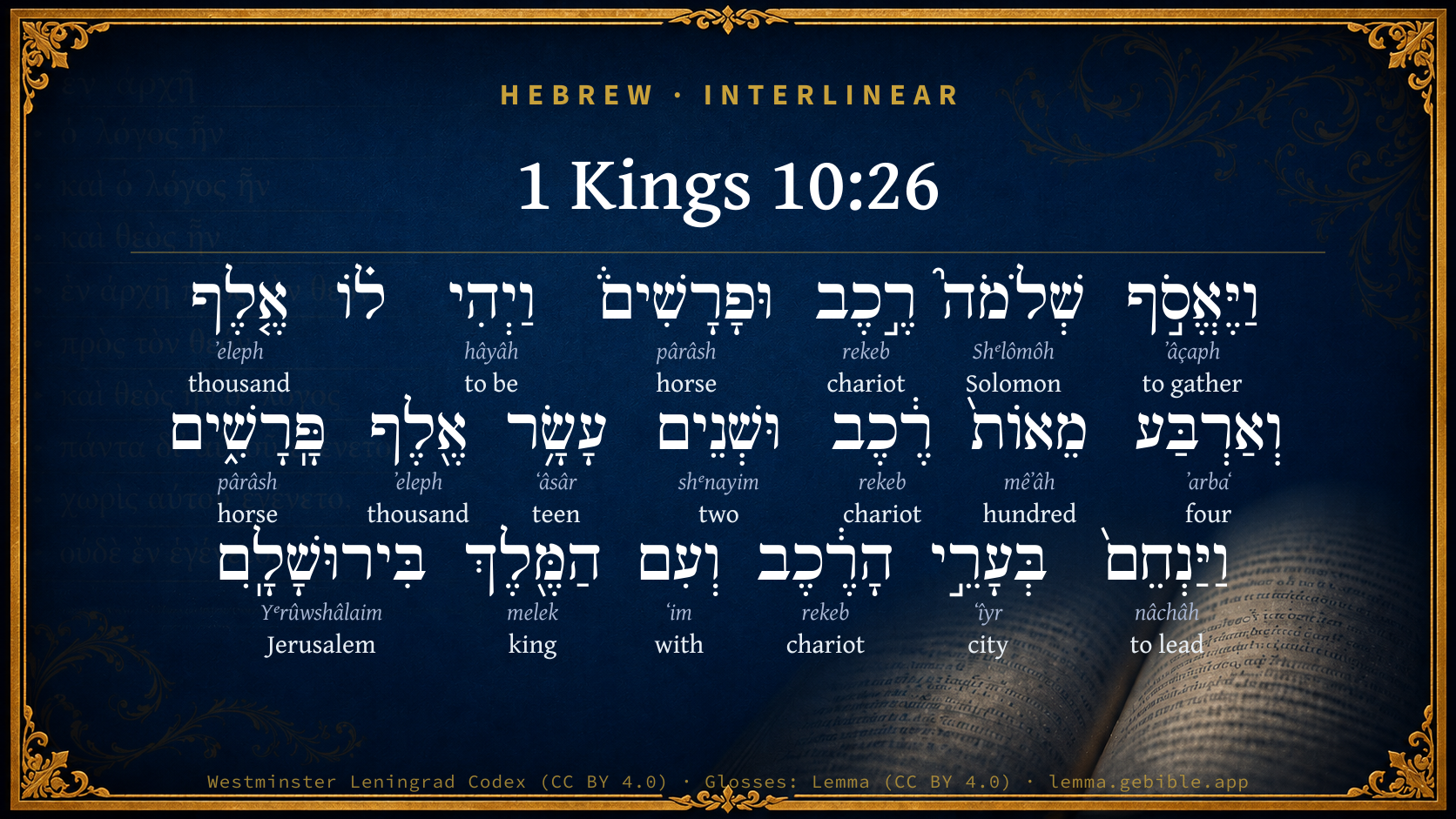
Hebrew (Westminster Leningrad Codex) 1 Kings 10:26 appears in the Hebrew Old Testament. The text above is from the Westminster Leningrad Codex. Each word links to its Strong’s number, a concise gloss, and parsing drawn from the Open Scriptures Hebrew Bible morphology. Click any word for its full Brown-Driver-Briggs (BDB) entry.
Download image
Cite this verse

1 Kings 10:26 (World English Bible). Public Domain. Lemma interlinear Bible study tool, https://lemma.gebible.app/v/1-kings/10/26.

Show BibTeX & RIS
BibTeX
RIS
English Translation
Solomon gathered together chariots and horsemen: and he had a thousand and four hundred chariots, and twelve thousand horsemen, that he bestowed in the chariot cities, and with the king at Jerusalem.
World English Bible · Public Domain
Download a study sheet

One document with this verse’s original text, its word-by-word gloss line, the meaning frame, cross-references with their text, attributed commentary, and full source and license credits — printable, and it pastes into notes with its structure intact.

This verse Autodidact and up

Study sheet (.html) Plain text (.txt)

A passage Seminary Student

Up to 50 verses in one chapter. A passage sheet keeps up to 6 commentary sources and 12 cross-references per verse, in the order this page ranks them, and says so on the sheet whenever that leaves anything out. Ask for a single verse and you get the Autodidact verse sheet above.

Everything on this page stays free to read, with no account — the sheet is a download of what is already on screen, not access to it.

Want to remove ads? Support Godless Engineer
Compare translations 3

The same verse in 3 English versions, stacked beneath the original-language interlinear above. Click any original word for its lexicon entry.

Each is an independent rendering of the whole verse — the interlinear is not word-aligned to these translations.

Highlighted words mark where these versions differ — a whole-verse word diff, not a word-by-word alignment.

  • World English Bible Public Domain
    Solomon gathered together chariots and horsemen: and he had a thousand and four hundred chariots, and twelve thousand horsemen, that he bestowed in the chariot cities, and with the king at Jerusalem.
  • King James Version Public Domain
    And Solomon gathered together chariots and horsemen: and he had a thousand and four hundred chariots, and twelve thousand horsemen, whom he bestowed in the cities for chariots, and with the king at Jerusalem.
  • unfoldingWord Literal Text CC BY-SA 4.0
    And Solomon accumulated chariotry and horsemen. And 1,400 chariots and 12,000 horsemen were to him. And he stationed them in the cities of chariotry and with the king in Jerusalem.

unfoldingWord Literal Text — © unfoldingWord, licensed CC BY-SA 4.0. Word-aligned USFM3 via Door43 (git.door43.org/unfoldingWord/en_ult).

Versions to compare (up to 4)

3 of 4 selected

Show all 18 translations

Every available English version of this verse, each an independent rendering of the whole verse.

  • World English Bible Public Domain
    Solomon gathered together chariots and horsemen: and he had a thousand and four hundred chariots, and twelve thousand horsemen, that he bestowed in the chariot cities, and with the king at Jerusalem.
  • Berean Standard Bible Public Domain
    Solomon accumulated 1,400 chariots and 12,000 horses, which he stationed in the chariot cities and also with him in Jerusalem.
  • Majority Standard Bible Public Domain
    Solomon accumulated 1,400 chariots and 12,000 horses, which he stationed in the chariot cities and also with him in Jerusalem.
  • King James Version Public Domain
    And Solomon gathered together chariots and horsemen: and he had a thousand and four hundred chariots, and twelve thousand horsemen, whom he bestowed in the cities for chariots, and with the king at Jerusalem.
  • American Standard Version (1901) Public Domain
    And Solomon gathered together chariots and horsemen: and he had a thousand and four hundred chariots, and twelve thousand horsemen, that he bestowed in the chariot cities, and with the king at Jerusalem.
  • Revised Version (1885) Public Domain
    And Solomon gathered together chariots and horsemen: and he had a thousand and four hundred chariots, and twelve thousand horsemen, which he bestowed in the chariot cities, and with the king at Jerusalem.
  • Geneva Bible (1599) Public Domain
    Then Salomon gathered together charrets and horsemen: and he had a thousand and foure hundreth charets, and twelue thousande horsemen, whome hee placed in the charet cities, and with the King at Ierusalem.
  • Douay-Rheims (1899) Public Domain
    And Solomon gathered together chariots and horsemen, and he had a thousand four hundred chariots, and twelve thousand horseman: and he bestowed them in fenced cities, and with the king in Jerusalem.
  • Young's Literal Translation Public Domain
    And Solomon gathereth chariots, and horsemen, and he hath a thousand and four hundred chariots, and twelve thousand horsemen, and he placeth them in the cities of the chariot, and with the king in Jerusalem.
  • Literal Standard Version CC BY-SA 4.0
    And Solomon gathers chariots, and horsemen, and he has one thousand and four hundred chariots, and twelve thousand horsemen, and he places them in the cities of the chariot, and with the king in Jerusalem.
  • Unlocked Literal Bible CC BY-SA 4.0
    Solomon gathered together chariots and horsemen. He had 1,400 chariots and twelve thousand horsemen that he stationed in the chariot cities and with himself in Jerusalem.
  • unfoldingWord Literal Text CC BY-SA 4.0
    And Solomon accumulated chariotry and horsemen. And 1,400 chariots and 12,000 horsemen were to him. And he stationed them in the cities of chariotry and with the king in Jerusalem.
  • Darby Bible Public Domain
    And Solomon gathered chariots and horsemen; and he had a thousand four hundred chariots, and twelve thousand horsemen; and he placed them in the chariot-cities, and with the king at Jerusalem.
  • World Messianic Bible Public Domain
    Solomon gathered together chariots and horsemen. He had one thousand four hundred chariots and twelve thousand horsemen. He kept them in the chariot cities and with the king at Jerusalem.
  • Webster's Bible Public Domain
    And Solomon collected chariots and horsemen: and he had a thousand and four hundred chariots, and twelve thousand horsemen, whom he bestowed in the cities for chariots, and with the king at Jerusalem.
  • Free Bible Version CC BY-SA 4.0
    Solomon accumulated 1,400 chariots and 12,000 horsemen. He kept them in the chariot towns, and also with him in Jerusalem.
  • Bible in Basic English Public Domain
    And Solomon got together war-carriages and horsemen; he had one thousand, four hundred carriages and twelve thousand horsemen, whom he kept, some in the carriage-towns and some with the king at Jerusalem.
  • JPS Tanakh (1917) Public Domain
    And Solomon gathered together chariots and horsemen; and he had a thousand and four hundred chariots, and twelve thousand horsemen, that he bestowed in the chariot cities, and with the king at Jerusalem.

Literal Standard Version (2020), Covenant Press — licensed CC BY-SA 4.0. Text via the HelloAO Bible API (eBible.org). Unlocked Literal Bible (unfoldingWord) — licensed CC BY-SA 4.0. Text via the HelloAO Bible API (eBible.org). unfoldingWord Literal Text — © unfoldingWord, licensed CC BY-SA 4.0. Word-aligned USFM3 via Door43 (git.door43.org/unfoldingWord/en_ult). Free Bible Version, Dr. Jonathan Gallagher — licensed CC BY-SA 4.0. Text via the HelloAO Bible API (eBible.org).

Word by word

More ways to search: Search by grammar → Find every occurrence → Compare this word →

Practice this passage: Drill this verse → Learn its vocabulary →

וַיַּנְחֵם֙
nâchâh
H5148
“and · to lead · them”
Conjunction + Verb, Hiphil, Sequential Imperfect, 3rd Person, Masculine, Singular + Suffix, Personal, 3rd Person, Masculine, Plural
Part of Speech
Conjunction + Verb
Stem
Hiphil
Form
Sequential Imperfect
Person
3rd Person
Gender
Masculine
Number
Singular
Full BDB Definition

Origin: a primitive root

TWOT: 1341

to lead, guide - (Qal) to lead, bring - (Hiphil) to lead, guide
  1. וַיֶּאֱסֹ֣ף ʼâçaph H622 “and · to gather” Conjunction + Verb, Qal, Sequential Imperfect, 3rd Person, Masculine, Singular
  2. שְׁלֹמֹה֮ Shᵉlômôh H8010 “Solomon” Noun, Proper
  3. רֶ֣כֶב rekeb H7393 “chariot” Noun, Common, Masculine, Singular, Absolute
  4. וּפָרָשִׁים֒ pârâsh H6571 “and · horses” Conjunction + Noun, Common, Masculine, Plural, Absolute
  5. וַיְהִי hâyâh H1961 “and · to be” Conjunction + Verb, Qal, Sequential Imperfect, 3rd Person, Masculine, Singular
  6. אֶ֤לֶף ʼeleph H505 “thousand” Adjective, Cardinal number, Both, Singular, Absolute
  7. וְאַרְבַּע ʼarbaʻ H702 “and · four” Conjunction + Adjective, Cardinal number, Feminine, Singular, Absolute
  8. מֵאוֹת֙ mêʼâh H3967 “hundred” Adjective, Cardinal number, Both, Plural, Absolute
  9. רֶ֔כֶב rekeb H7393 “chariot” Noun, Common, Masculine, Singular, Absolute
  10. וּשְׁנֵים shᵉnayim H8147 “and · two” Conjunction + Adjective, Cardinal number, Masculine, Dual, Absolute
  11. עָשָׂ֥ר ʻâsâr H6240 “teen” Adjective, Cardinal number, Masculine, Singular, Absolute
  12. אֶ֖לֶף ʼeleph H505 “thousand” Adjective, Cardinal number, Both, Singular, Absolute
  13. פָּֽרָשִׁ֑ים pârâsh H6571 “horses” Noun, Common, Masculine, Plural, Absolute
  14. בְּעָרֵ֣י ʻîyr H5892 “in/at · cities of” Preposition + Noun, Common, Feminine, Plural, Construct
  15. הָרֶ֔כֶב rekeb H7393 “the · chariot” Particle, Definite Article + Noun, Common, Masculine, Singular, Absolute
  16. וְעִם ʻim H5973 “and · with” Conjunction + Preposition
  17. הַמֶּ֖לֶךְ melek H4428 “the · king” Particle, Definite Article + Noun, Common, Masculine, Singular, Absolute
  18. בִּירוּשָׁלִָֽם Yᵉrûwshâlaim H3389 “in/at · Jerusalem” Preposition + Noun, Proper

About this verse

These counts appear in no published source. They are computed here, from the morphology-tagged text and Lemma’s own curated glosses. What Lemma adds →

20
words
15
distinct lemmas
Historical
section

Shared distinctive vocabulary

וַיַּנְחֵם֙ to lead H5148 occurs in 39 verses of the Hebrew Bible. Also found in:

Grammatical profile

  • 3 verbs
  • 9 nouns
  • 6 adjectives
  • 2 prepositions

Verb forms

  • וַיֶּאֱסֹ֣ף Qal · Sequential Imperfect
  • וַיְהִי Qal · Sequential Imperfect
  • וַיַּנְחֵם֙ Hiphil · Sequential Imperfect

Repetition

Words recur within this verse — often emphatic in Hebrew:

  • רֶ֣כֶב chariot H7393 ×3
  • וּפָרָשִׁים֒ horse H6571 ×2
  • אֶ֤לֶף thousand H505 ×2

Hebrew & Septuagint length

In English translation the verse runs 32 words from the Hebrew and 51 from the Septuagint (LXX English) — the Septuagint runs noticeably longer here. See the side-by-side →

A rough comparison of the two English renderings, which tokenize alike — not a word-level alignment.

Word counts can differ between the Hebrew and the Greek without any difference in meaning — e.g. the Hebrew direct-object marker אֵת has no separate Greek word, and Greek often adds the article ὁ.

Cross-references

6

Topical passages linked to 1 Kings 10:26 in the Treasury of Scripture Knowledge — connected by theme and wording, ordered by reader-vote popularity; previews shown in the World English Bible.

  • 2 Chronicles 9:25 Solomon had four thousand stalls for horses and chariots, and twelve thousand horsemen, that he bestowed in the chariot cities, and with the king at Jerusalem.
  • 1 Kings 4:26 Solomon had forty thousand stalls of horses for his chariots, and twelve thousand horsemen.
  • Deuteronomy 17:16 Only he shall not multiply horses to himself, nor cause the people to return to Egypt, to the end that he may multiply horses; because Yahweh has said to you, You shall henceforth return no more that way.
  • 1 Kings 9:19 and all the store-cities that Solomon had, and the cities for his chariots, and the cities for his horsemen, and that which Solomon desired to build for his pleasure in Jerusalem, and in Lebanon, and in all the land of his dominion.
  • 2 Chronicles 1:14–17 Solomon gathered chariots and horsemen: and he had one thousand four hundred chariots, and twelve thousand horsemen, that he placed in the chariot cities, and with the king at Jerusalem.
  • Isaiah 2:7 Their land is full of silver and gold, Neither is there any end of their treasures. Their land also is full of horses, Neither is there any end of their chariots.

Cross-references courtesy of OpenBible.info (CC BY 4.0).

Hebrew and Greek witnesses Masoretic Hebrew ↔ Greek Septuagint

The same verse in the two great witnesses to the Old Testament, shown verse-for-verse.

Here the Septuagint runs noticeably longer than the Hebrew — LXX2012 (modern English Septuagint) 51 words vs World English Bible 32. A rough length comparison of the two English translations, not a word-level alignment — read both below.

These are two independent witnesses, not word-aligned to each other, and the Septuagint is shown in lemma (dictionary) form.

Hebrew 1 Kings 10:26 Masoretic · Westminster Leningrad Codex

וַיֶּאֱסֹ֣ף שְׁלֹמֹה֮ רֶ֣כֶב וּפָרָשִׁים֒ וַיְהִי ל֗וֹ אֶ֤לֶף וְאַרְבַּע מֵאוֹת֙ רֶ֔כֶב וּשְׁנֵים עָשָׂ֥ר אֶ֖לֶף פָּֽרָשִׁ֑ים וַיַּנְחֵם֙ בְּעָרֵ֣י הָרֶ֔כֶב וְעִם הַמֶּ֖לֶךְ בִּירוּשָׁלִָֽם

Solomon gathered together chariots and horsemen: and he had a thousand and four hundred chariots, and twelve thousand horsemen, that he bestowed in the chariot cities, and with the king at Jerusalem.

World English Bible · Public Domain

Greek LXX 1 Kings 10:26 Septuagint · lemma form

καί εἰμί ὁ σαλωμών τέσσαρες χιλιάς θῆλυς ἵππος εἰς ἅρμα καί δώδεκα χιλιάς ἱππεύς καί τίθημι αὐτός ἐν ὁ πόλις ὁ ἅρμα καί μετά ὁ βασιλεύς ἐν ἰερουσαλήμ καί εἰμί ἡγέομαι πᾶς ὁ βασιλεύς ἀπό ὁ ποταμός καί ἕως γῆ ἀλλόφυλος καί ἕως ὅριον αἴγυπτος

And Solomon had four thousand mares for his chariots, and twelve thousand horsemen: and he put them in the cities of his chariots, and with the king in Jerusalem: and he ruled over all the kings from the river to the land of the Philistines, and to the borders of Egypt.

LXX2012 (modern English Septuagint) · Public Domain

On this verse, The Cambridge Bible for Schools and Colleges discusses the Septuagint’s reading. Read the note in Commentary ↓

Hebrew: Westminster Leningrad Codex (CC BY 4.0). Greek: Septuagint (public domain); English from LXX2012 (modern English Septuagint) (Public Domain). How the Septuagint differs from the Hebrew →

Targum (Aramaic paraphrase)

1

The Targum is the ancient Jewish Aramaic paraphrase of the Hebrew Scriptures — an interpretive translation, not the Hebrew text itself. Onkelos (literal) and Pseudo-Jonathan (expansive) render the Torah, and Jonathan the Prophets. Coverage is partial: where no permissively-licensed English translation exists for a verse, only the Aramaic is shown. This is verse-level text, not a word-by-word alignment to the Hebrew.

  1. Targum Jonathan Prophets (Joshua–Malachi)
    וּכְנַשׁ שְׁלֹמֹה רְתִיכִין וּפָרָשִׁין וַהֲווֹ לֵיהּ אֶלֶף וְאַרְבַּע מְאָה רְתִיכִין וּתְרֵי עֲסַר אַלְפִין פָּרָשִׁין וְאַשְׁרִינוּן בְּקִירְוֵי רְתִיכַיָא בַּר מִדַהֲווֹ עִם מַלְכָּא בִּירוּשְׁלֵם:

    (no public-domain English translation for this verse)

    Targum Jonathan — Aramaic: “Mikraot Gedolot” (public domain). English: “Sefaria Community Translation” (CC0 1.0 (public-domain dedication)); “London "Chaldee Paraphrase," 1871” (public domain). Text via Sefaria.

Commentary

Notes on 1 Kings 10:26 from classic Christian and Jewish commentators (each source and its license shown beneath its notes). The classic Christian expositions comment on the surrounding passage and are grouped to its opening verse, so a note may address several verses; the Jewish commentaries on the Tanakh (Rashi and others) are per-verse, so they appear only where the commentator wrote on this verse.

Lemma curates 59 commentaries, every one of them public domain or Creative Commons licensed, each selected and text-cleaned for this edition rather than reprinted as found. About our sources →

Trapp's Complete Commentary

John Trapp

1Ki 10:26 And Solomon gathered together chariots and horsemen: and he had a thousand and four hundred chariots, and twelve thousand horsemen, whom he bestowed in the cities for chariots, and with the king at Jerusalem.

Ver. 26. And Solomon gathered.] This he did contrary to the law, {Deu 17:16} wherefore also he and his family soon after suffered a change: Gloria enim eius mox facta est ingloria, et fama infamia, ac opulentia paupertas. {a}

{a} Sic transit gloria mundi.

John Trapp, A Commentary or Exposition upon All the Books of the Old and New Testament (1647–1656) — public domain. Text from a community e-Sword module.

Joseph Benson's Commentary

1Ki 10:26. Solomon gathered together chariots and horsemen — Ah! what availed thy boasted wisdom, Solomon, when thou forsookest the only true wisdom, obedience to the commandment of the Lord! Ah! what availed it that thou wast wiser than all the children of the east; that thou couldst speak of trees, from the cedar-tree that was in Lebanon, even unto the hyssop — and of beasts, and of fowls, and of creeping things; when thou forgottest the beginning and the end of wisdom, the fear of the Lord? God had commanded that the kings of Israel should not multiply horses, (Deu 17:16,) and here we find the wisest of their kings multiplying them to a vast extent! Nor did he stop here, but having disobeyed in one point, he soon proceeded to transgress in another. Contrary to the divine prohibition, he also multiplied wives, and the consequence was, as the Lord predicted it would be in such a case, his wives turned away his heart after their gods. And, shameful to tell! the wise Solomon, who not long before had professed that there was no god in heaven above or in the earth beneath, but the God of Israel, is persuaded by his wives to erect altars to Ashtaroth, to Milcom, to Chemosh, and to Molech, and other abominable idols of the heathen, and that even in the hill before Jerusalem, the city of God, the holy city, joining the altars of devils to the altars of the TRUE and ONLY GOD! O sad change! and shameful stupidity! O shocking blindness! and this found in one of the wisest men! Alas! what is man! and what his best wisdom, when he forsakes the word of the Lord! Jer 8:9. What a striking example have we here, that a wilful departing from the commandments of God even in the smallest point at the beginning, may, and probably will, by degrees, lead into the greatest errors, the foulest crimes, and consequently the greatest misery!

Joseph Benson's Commentary on the Old and New Testaments (1811–1818) — public domain. Text from a community e-Sword module.

Tyndale Open Study Notes

Tyndale Open Resources

10:26 1,400 chariots: Prior to Solomon, chariots were not a significant part of Israel’s army. In fact, Deut 17:16 condemns kings for accumulating horses rather than relying on God. Although archaeological confirmation of the presence of chariots in Solomon’s day is debated, his chariot cities are commonly identified as Hazor, Megiddo, and Gezer (1 Kgs 9:15, 19). The Assyrian king Shalmaneser III reported facing a heavy contingent of enemy chariots at the Battle of Qarqar (853 BC), 2,000 of which were supplied by King Ahab of Israel.

Tyndale Open Study Notes — © Tyndale Open Resources, licensed CC BY-SA 4.0. Text via the HelloAO Bible API.

Jamieson, Fausset & Brown

Robert Jamieson, A. R. Fausset & David Brown

--(See on Ch2 1:14 [and Ch2 9:25].)

Next: 1 Kings Chapter 11

Jamieson, Fausset & Brown — Commentary Critical and Explanatory on the Whole Bible (1871) — public domain (CC PDM 1.0). Text via the HelloAO Bible API.

Adam Clarke's Commentary

Verse 26. He had a thousand and four hundred chariots] 1Kg 4:26.

Adam Clarke's Commentary on the Bible (1810–1826) — public domain. Text from a community e-Sword/MySword module.

Ellicott's Commentary for English Readers

(26) Gathered together chariots.—See above, 1Ki_4:26. This gathering of chariots—the sign of military conquest and extended empire—is evidently noticed here in connection with the growth of commerce and wealth, as one of the powers which held Solomon’s kingdom together. Josephus (Ant. viii. 7, 4), in mentioning them, gives a vivid description of the use of these chariots and horsemen for progresses of royal magnificence and pleasure. But their chief use was. no doubt, military. The “chariot cities” would be the fortified posts, in the various parts of Solomon’s own dominions and in the tributary countries.

A Bible Commentary for English Readers, edited by Charles John Ellicott (1878–1897) — public domain. Text from a community e-Sword module.

The Cambridge Bible for Schools and Colleges

gen. ed. J. J. S. Perowne

26. And Solomon gathered together chariots and horsemen] By reason, as Josephus tells us, of the great number of horses which were brought to him in these yearly offerings. The word פרשׁ (parash) here rendered ‘horsemen’ means both the horse for riding and the rider. Just as we speak of so many hundred ‘horse’. סוס (sus) on the other hand was the draught horse.

Here we find the first institution of cavalry in Israel in defiance of the Deuteronomic law. If this book was compiled after Deuteronomy was written we should expect some reference to this violation. There is such a reference about another matter in 1Ki_11:2.

a thousand and four hundred chariots, and twelve thousand horsemen] The LXX. gives for the first clause ‘four thousand mares for his chariots,’ which agrees as far as the number is concerned with 2Ch_9:25, ‘four thousand stalls for horses and chariots’: though in 2Ch_1:14 we have precisely the same number both of chariots and horsemen specified as is given here.

at Jerusalem] After this the LXX. adds ‘and he was chief over all the kings from the River even unto the land of the Philistines and to the borders of Egypt.’

The Cambridge Bible for Schools and Colleges (gen. ed. J. J. S. Perowne; Cambridge University Press, 1878–1918) — public domain. Text from a community e-Sword module.

John Gill's Exposition

And the king made silver to be in Jerusalem as stones,.... By the vast quantity he received from Tarshish; this is an hyperbolical expression:

and cedars made he to be as the sycamore trees that are the vale for abundance; not by the growth of them, but by the importation of them from the dominion of Hiram; this is said in the same figurative way; of the sycamore trees, Rauwolff says (g), they are what the Moors and Arabians calls "mumeitz"; which he describes to be as large and as high as white mulberry trees, and having almost the same leaves, but rounder, and their fruit not unlike our figs, only sweeter, and no little seeds within, and not so good; and are therefore not esteemed, and are commonly sold to the poorer sort, and that they grow in all fields and grounds; of which See Gill on Amo 7:14.

(g) Travels, par. 1. c. 4. p. 37.

John Gill's Exposition of the Whole Bible (1746–1763) — public domain (CC PDM 1.0). Text via the HelloAO Bible API.

Albert Barnes' Notes on the Bible

See 1Ki 4:26 note. Until the time of Solomon, war-chariots had not been in use among the Jews, except to a very small extent 1Ch 18:4. Hence, it was necessary for him to put himself on an equality in this respect with neighboring powers.

Cities for chariots - They were probably fortresses upon the borders of his territory, in which he maintained the standing army necessary for the support of his dominion.

Albert Barnes' Notes on the Bible (1834–1885) — public domain. Text from a community e-Sword/MySword module.

Haydock's Catholic Bible Commentary

Hunderd chariots. Paralipomenon, forty thousand horses, in the stables, and 12,000 chariots and horsemen; though the chariots may be referred to the former number, conformably to the Hebrew, and to chap. iv. 26. (Menochius) --- Many of the horses were not employed in the chariots, (Salien) which were 1400 in number, 2 Paralipomenon i. 14. (Menochius)

George Leo Haydock (1774–1849), Haydock's Catholic Family Bible and Commentary, 1859 edition — public domain. Excludes Psalms (Douay-Rheims chapter numbering differs from Protestant) and Deuterocanonical books (Catholic canon only).

Matthew Poole's English Annotations

Solomon gathered together chariots and horsemen; like a wise prince, in deep peace providing for war.

A thousand and four hundred chariots: See Poole "1Ki 4:26".

Matthew Poole's English Annotations on the Holy Bible (1683–1685) — public domain. Text from a community e-Sword/MySword module.

The Pulpit Commentary

And Solomon gathered together his chariots and horsemen, and he had a thousand and four hundred chariots these words have an important bearing on, 1Ki_4:26, where see note and twelve thousand horsemen. The question may suggest itself here, why did Solomon, who was a "man of peace," maintain such a formidable array of chariots and horsemen? For not only was it in contravention of Deu_17:16 (cf., 1Sa_8:11) but it was entirely unnecessary, especially for a nation inhabiting a hilly country like that of Israel. We find, consequently, that David, when he took a thousand chariots from Hadarezer, (1Ch_18:4) only reserved for his own use one hundred of them, though he was at the time engaged in war. It may perhaps be said that this force was necessary to keep the tributary kings in due subjection. But it seems quite as likely that it was maintained largely for the sake of pomp and display. Solomon seems to have determined in every way, and at any cost, to rival and surpass all contemporary kings. The maintenance of this large force of cavalry is another token of declension, whom he bestowed in the cities for chariots, (1Ki_9:19) and with the king at Jerusalem.

The Pulpit Commentary (1880–1919), ed. H.D.M. Spence-Jones & Joseph S. Exell — public domain. Text from a community e-Sword module.

unfoldingWord translationNotes

Door43 World Missions Community

1,400 chariots and twelve thousand horsemen

"one thousand four hundred chariots and 12,000 horsemen" (See: Numbers)

The king had silver in Jerusalem, as much as the stones on the ground

The narrator uses exaggeration to emphasize the great amount of silver that was in Jerusalem. AT: "The king had so much silver in Jerusalem, it was like there was as much silver as there was stones on the ground" (See: Hyperbole and Generalization)

translationWords

chariot

horseman

Jerusalem

cedar

fig

unfoldingWord translationNotes — © Distant Shores Media and the Door43 World Missions Community, licensed CC BY-SA 4.0. Source: git.door43.org/Door43/en_tn.

Rashi

Rabbi Shlomo Yitzchaki (Rashi)

Fourteen hundred chariots. But in Divrei Hayomim it states, “seventeen hundred.” Therefore I say that fourteen hundred were in the chariot cities, and three hundred were with the king in Yerusholayim. And this is the explanation in Divrei Hayomim, “and he stationed them in the chariot cities, and with the king there were other chariots in Yerusholayim.” And while here, this is the explanation, and he stationed them in the chariot cities and with the king; and in Yerusholayim [were additional ones].

He placed them. And he led them.

Rashi on the Tanakh — English translations: “The Judaica Press complete Tanach with Rashi, translated by A. J. Rosenberg” (CC BY 4.0); “Pentateuch with Rashi's commentary by M. Rosenbaum and A.M. Silbermann, 1929-1934” (public domain); “The Metsudah Tanach series, Lakewood, N.J” (CC BY 4.0); and “The Book of Joshua, Metsudah Publications, 1997” (CC BY 4.0). Text via Sefaria.

Lesson kit

Teaching starters — assembled from the data on this page, not authored interpretation. Every prompt links to the verse data it draws on. Edit before teaching.

1 Kings, in the Historical, opens this verse with 20 words (15 distinct Hebrew lemmas). Its most distinctive word is nâchâh (“to lead”). The Greek Septuagint runs longer here. A historical commentator’s framing appears above. Read the whole chapter for the surrounding context.

Discussion questions

  1. The word nâchâh carries the sense “to lead.” How does it shape the verse?
  2. Genesis 24:27 shares the word «to lead» with this verse. How do the two illuminate each other?
  3. “chariot” occurs 3× in this one verse. What is the effect of the repetition?
  4. Compared with the Hebrew, the Septuagint runs longer here. What questions does that raise?
  5. These translations render this verse differently. What is at stake in choosing one wording over another?
  6. The verb «וַיֶּאֱסֹ֣ף» is Qal Sequential Imperfect. How does its form color the action?
  7. Reading how Trapp's Complete Commentary and Joseph Benson's Commentary read this verse, where do the two commentators agree and where do they part?

Things to notice

Reading settings

Reading text

Shown beneath each verse's original-language words.

Old Testament
Old Testament edition

Read the OT as the Masoretic Hebrew (MT) or the Greek Septuagint (LXX).

English shown for the Greek Septuagint (in the Hebrew ↔ Greek comparison).

Comparing translations? Open the Compare panel on any verse page to stack up to four side by side.