
Judges 17:3

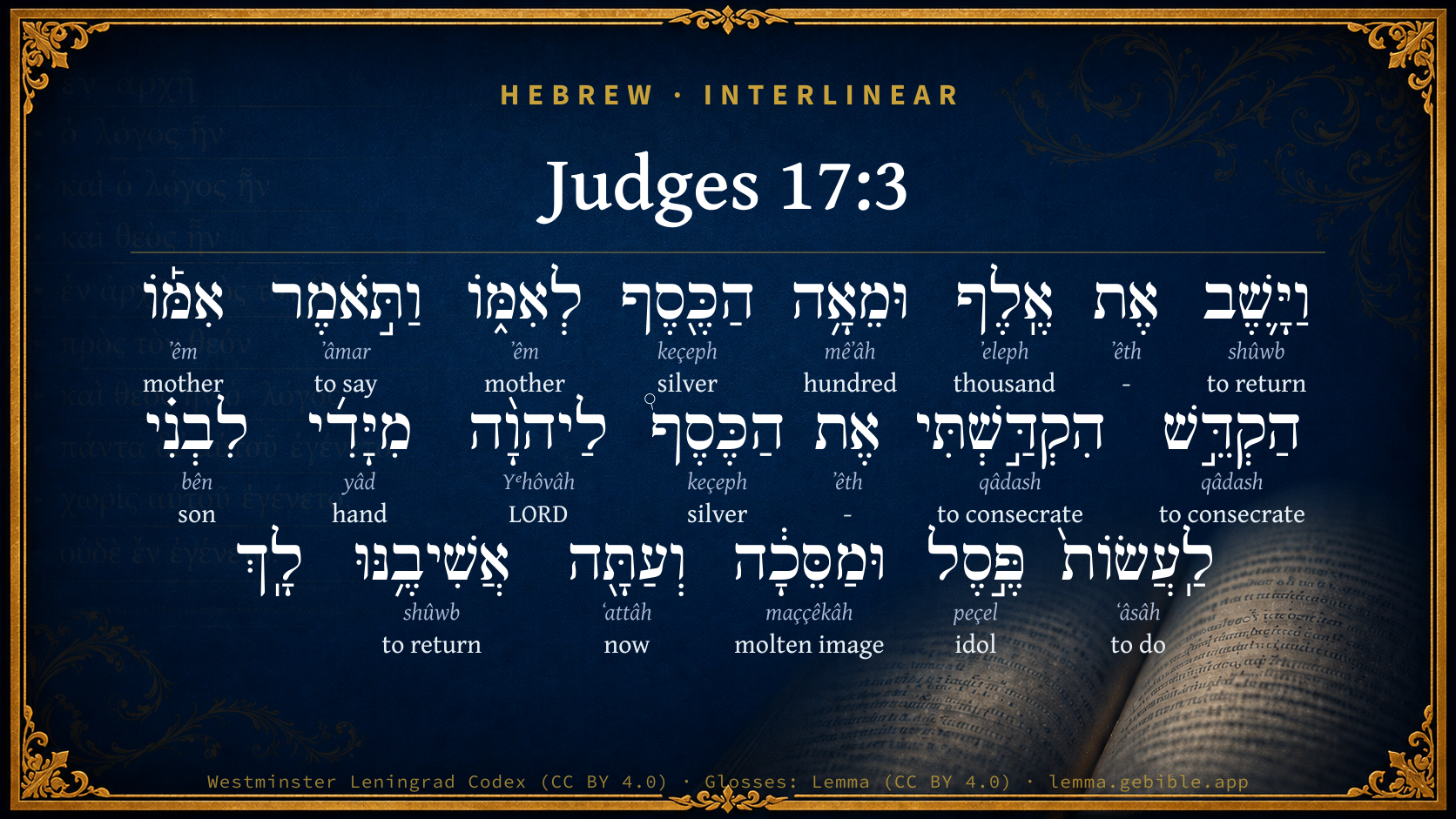
Hebrew (Westminster Leningrad Codex) Judges 17:3 appears in the Hebrew Old Testament. The text above is from the Westminster Leningrad Codex. Each word links to its Strong’s number, a concise gloss, and parsing drawn from the Open Scriptures Hebrew Bible morphology. Click any word for its full Brown-Driver-Briggs (BDB) entry.
Download image
Cite this verse

Judges 17:3 (World English Bible). Public Domain. Lemma interlinear Bible study tool, https://lemma.gebible.app/v/judges/17/3.

Show BibTeX & RIS
BibTeX
RIS
English Translation
He restored the eleven hundred [pieces] of silver to his mother; and his mother said, I most assuredly dedicate the silver to Yahweh from my hand for my son, to make an engraved image and a molten image: now therefore I will restore it to you.
World English Bible · Public Domain
Download a study sheet

One document with this verse’s original text, its word-by-word gloss line, the meaning frame, cross-references with their text, attributed commentary, and full source and license credits — printable, and it pastes into notes with its structure intact.

This verse Autodidact and up

Study sheet (.html) Plain text (.txt)

A passage Seminary Student

Up to 50 verses in one chapter. A passage sheet keeps up to 6 commentary sources and 12 cross-references per verse, in the order this page ranks them, and says so on the sheet whenever that leaves anything out. Ask for a single verse and you get the Autodidact verse sheet above.

Everything on this page stays free to read, with no account — the sheet is a download of what is already on screen, not access to it.

Want to remove ads? Support Godless Engineer
Compare translations 3

The same verse in 3 English versions, stacked beneath the original-language interlinear above. Click any original word for its lexicon entry.

Each is an independent rendering of the whole verse — the interlinear is not word-aligned to these translations.

Highlighted words mark where these versions differ — a whole-verse word diff, not a word-by-word alignment.

  • World English Bible Public Domain
    He restored the eleven hundred [pieces] of silver to his mother; and his mother said, I most assuredly dedicate the silver to Yahweh from my hand for my son, to make an engraved image and a molten image: now therefore I will restore it to you.
  • King James Version Public Domain
    And when he had restored the eleven hundred shekels of silver to his mother, his mother said, I had wholly dedicated the silver unto the LORD from my hand for my son, to make a graven image and a molten image: now therefore I will restore it unto thee.
  • unfoldingWord Literal Text CC BY-SA 4.0
    And he returned the 1, 100 silver to his mother, and his mother said, “Consecrating, I consecrate the silver to Yahweh, from my hand to my son to make an idol and a molded image. And now, I return it to you.”

unfoldingWord Literal Text — © unfoldingWord, licensed CC BY-SA 4.0. Word-aligned USFM3 via Door43 (git.door43.org/unfoldingWord/en_ult).

Versions to compare (up to 4)

3 of 4 selected

Show all 18 translations

Every available English version of this verse, each an independent rendering of the whole verse.

  • World English Bible Public Domain
    He restored the eleven hundred [pieces] of silver to his mother; and his mother said, I most assuredly dedicate the silver to Yahweh from my hand for my son, to make an engraved image and a molten image: now therefore I will restore it to you.
  • Berean Standard Bible Public Domain
    And when he had returned the eleven hundred shekels of silver to his mother, she said, “I wholly dedicate the silver to the LORD for my son’s benefit, to make a graven image and a molten idol. Therefore I will now return it to you.”
  • Majority Standard Bible Public Domain
    And when he had returned the eleven hundred shekels of silver to his mother, she said, “I wholly dedicate the silver to the LORD for my son’s benefit, to make a graven image and a molten idol. Therefore I will now return it to you.”
  • King James Version Public Domain
    And when he had restored the eleven hundred shekels of silver to his mother, his mother said, I had wholly dedicated the silver unto the LORD from my hand for my son, to make a graven image and a molten image: now therefore I will restore it unto thee.
  • American Standard Version (1901) Public Domain
    And he restored the eleven hundred `pieces' of silver to his mother; and his mother said, I verily dedicate the silver unto Jehovah from my hand for my son, to make a graven image and a molten image: now therefore I will restore it unto thee.
  • Revised Version (1885) Public Domain
    And he restored the eleven hundred pieces of silver to his mother, and his mother said, I verily dedicate the silver unto the LORD from my hand for my son, to make a graven image and a molten image: now therefore I will restore it unto thee.
  • Geneva Bible (1599) Public Domain
    And when he had restored the eleuen hundreth shekels of siluer to his mother, his mother sayd, I had dedicate the siluer to the Lord of mine hand for my sonne, to make a grauen and molten image. Now therfore I will giue it thee again.
  • Douay-Rheims (1899) Public Domain
    So he restored them to his mother, who said to him: I have consecrated and vowed this silver to the Lord, that my son may receive it at my hand, and make a graven and a molten god, so now I deliver it to thee.
  • Young's Literal Translation Public Domain
    And he giveth back the eleven hundred silverlings to his mother, and his mother saith, `I had certainly sanctified the silver to Jehovah, from my hand, for my son, to make a graven image, and a molten image; and now, I give it back to thee.'
  • Literal Standard Version CC BY-SA 4.0
    And he gives back the eleven hundred pieces of silver to his mother, and his mother says, “I had certainly sanctified the silver to YHWH, from my hand, for my son, to make a carved image, and a molten image; and now, I give it back to you.”
  • Unlocked Literal Bible CC BY-SA 4.0
    He restored the 1,100 pieces of silver to his mother and his mother said, “I set apart this silver to Yahweh, for my son to make carved and cast metal figures. So now, I restore it to you.”
  • unfoldingWord Literal Text CC BY-SA 4.0
    And he returned the 1, 100 silver to his mother, and his mother said, “Consecrating, I consecrate the silver to Yahweh, from my hand to my son to make an idol and a molded image. And now, I return it to you.”
  • Darby Bible Public Domain
    And he restored the eleven hundred pieces of silver to his mother; and his mother said, "I consecrate the silver to the LORD from my hand for my son, to make a graven image and a molten image; now therefore I will restore it to you."
  • World Messianic Bible Public Domain
    He restored the eleven hundred pieces of silver to his mother, then his mother said, “I most certainly dedicate the silver to the LORD from my hand for my son, to make a carved image and a molten image. Now therefore I will restore it to you.”
  • Webster's Bible Public Domain
    And when he had restored the eleven hundred shekels of silver to his mother, his mother said, I had wholly dedicated the silver to the LORD from my hand for my son, to make a graven image and a molten image: now therefore I will restore it to thee.
  • Free Bible Version CC BY-SA 4.0
    He gave back to his mother the eleven hundred shekels of silver. His mother announced, “I'm completely dedicating this money to the Lord. I'm handing it over to my son to have an idol carved, an image made with molten silver. So now I return it to you.”
  • Bible in Basic English Public Domain
    And he gave back the eleven hundred shekels of silver to his mother, and his mother said, I have made the silver holy to the Lord from me for my son, to make a pictured image and a metal image.
  • JPS Tanakh (1917) Public Domain
    And he restored the eleven hundred pieces of silver to his mother, and his mother said: 'I verily dedicate the silver unto the LORD from my hand for my son, to make a graven image and a molten image; now therefore I will restore it unto thee.'

Literal Standard Version (2020), Covenant Press — licensed CC BY-SA 4.0. Text via the HelloAO Bible API (eBible.org). Unlocked Literal Bible (unfoldingWord) — licensed CC BY-SA 4.0. Text via the HelloAO Bible API (eBible.org). unfoldingWord Literal Text — © unfoldingWord, licensed CC BY-SA 4.0. Word-aligned USFM3 via Door43 (git.door43.org/unfoldingWord/en_ult). Free Bible Version, Dr. Jonathan Gallagher — licensed CC BY-SA 4.0. Text via the HelloAO Bible API (eBible.org).

Word by word

More ways to search: Search by grammar → Find every occurrence → Compare this word →

Practice this passage: Drill this verse → Learn its vocabulary →

וּמַסֵּכָ֔ה
maççêkâh
H4541
“and · molten image”
Conjunction + Noun, Common, Feminine, Singular, Absolute
Part of Speech
Conjunction + Noun
Type
Common
Gender
Feminine
Number
Singular
State
Absolute
Full BDB Definition

Origin: from H5258

TWOT: 1375c , 1376a

a pouring, libation, molten metal, cast image, drink offering - libation (with covenant sacrifice) - molten metal, molten image, molten gods - web, covering, veil, woven stuff
  1. וַיָּ֛שֶׁב shûwb H7725 “and · to return” Conjunction + Verb, Hiphil, Sequential Imperfect, 3rd Person, Masculine, Singular
  2. אֶת ʼêth H853 “-” Particle, Direct Object
  3. אֶֽלֶף ʼeleph H505 “thousand” Adjective, Cardinal number, Both, Singular, Absolute
  4. וּמֵאָ֥ה mêʼâh H3967 “and · hundred” Conjunction + Adjective, Cardinal number, Both, Singular, Absolute
  5. הַכֶּ֖סֶף keçeph H3701 “the · silver” Particle, Definite Article + Noun, Common, Masculine, Singular, Absolute
  6. לְאִמּ֑וֹ ʼêm H517 “to/for · mother · his” Preposition + Noun, Common, Feminine, Singular, Construct + Suffix, Personal, 3rd Person, Masculine, Singular
  7. וַתֹּ֣אמֶר ʼâmar H559 “and · to say” Conjunction + Verb, Qal, Sequential Imperfect, 3rd Person, Feminine, Singular
  8. אִמּ֡וֹ ʼêm H517 “mother · his” Noun, Common, Feminine, Singular, Construct + Suffix, Personal, 3rd Person, Masculine, Singular
  9. הַקְדֵּ֣שׁ qâdash H6942 “to consecrate” Verb, Hiphil, Infinitive Absolute
  10. הִקְדַּ֣שְׁתִּי qâdash H6942 “to consecrate” Verb, Hiphil, Perfect, 1st Person, Common, Singular
  11. אֶת ʼêth H853 “-” Particle, Direct Object
  12. הַכֶּסֶף֩ keçeph H3701 “the · silver” Particle, Definite Article + Noun, Common, Masculine, Singular, Absolute
  13. לַיהוָ֨ה Yᵉhôvâh H3068 “to/for · LORD” Preposition + Noun, Proper
  14. מִיָּדִ֜י yâd H3027 “from · hand · my” Preposition + Noun, Common, Both, Singular, Construct + Suffix, Personal, 1st Person, Common, Singular
  15. לִבְנִ֗י bên H1121 “to/for · son · my” Preposition + Noun, Common, Masculine, Singular, Construct + Suffix, Personal, 1st Person, Common, Singular
  16. לַֽעֲשׂוֹת֙ ʻâsâh H6213 “to do” Preposition + Verb, Qal, Infinitive Construct
  17. פֶּ֣סֶל peçel H6459 “idol” Noun, Common, Masculine, Singular, Absolute
  18. וְעַתָּ֖ה ʻattâh H6258 “and · now” Conjunction + Adverb
  19. אֲשִׁיבֶ֥נּוּ shûwb H7725 “to return · him” Verb, Hiphil, Imperfect, 1st Person, Common, Singular + Suffix, Personal, 3rd Person, Masculine, Singular

About this verse

These counts appear in no published source. They are computed here, from the morphology-tagged text and Lemma’s own curated glosses. What Lemma adds →

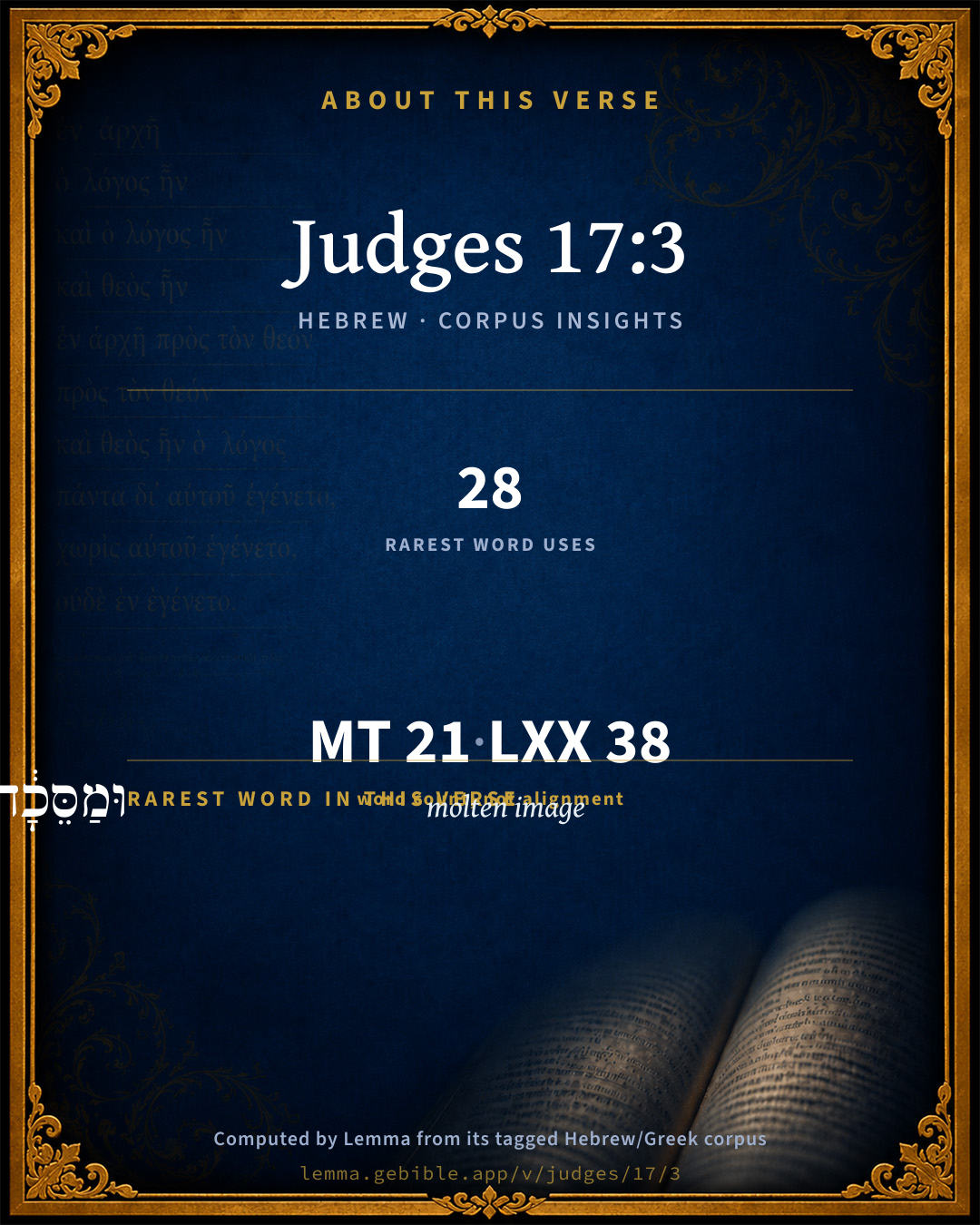
21
words
15
distinct lemmas
Historical
section

Shared distinctive vocabulary

וּמַסֵּכָ֔ה molten image H4541 occurs in 28 verses of the Hebrew Bible. Also found in:

Grammatical profile

  • 6 verbs
  • 9 nouns
  • 2 adjectives
  • 1 preposition
  • 1 adverb
  • 2 particles

Verb forms

  • וַיָּ֛שֶׁב Hiphil · Sequential Imperfect
  • וַתֹּ֣אמֶר Qal · Sequential Imperfect
  • הַקְדֵּ֣שׁ Hiphil · Infinitive Absolute
  • הִקְדַּ֣שְׁתִּי Hiphil · Perfect
  • לַֽעֲשׂוֹת֙ Qal · Infinitive Construct
  • אֲשִׁיבֶ֥נּוּ Hiphil · Imperfect

Repetition

Words recur within this verse — often emphatic in Hebrew:

  • וַיָּ֛שֶׁב to return H7725 ×2
  • הַכֶּ֖סֶף silver H3701 ×2
  • לְאִמּ֑וֹ mother H517 ×2
  • הַקְדֵּ֣שׁ to consecrate H6942 ×2

Hebrew & Septuagint length

In English translation the verse runs 46 words from the Hebrew and 48 from the Septuagint (LXX English) — closely comparable.

A rough comparison of the two English renderings, which tokenize alike — not a word-level alignment.

Word counts can differ between the Hebrew and the Greek without any difference in meaning — e.g. the Hebrew direct-object marker אֵת has no separate Greek word, and Greek often adds the article ὁ.

In the original languages it is 21 Hebrew tokens and 38 Greek tokens — but the two are counted differently (Hebrew bundles its prefixes and suffixes into one token; the Greek is in lemma form), so that isn’t a like-for-like length.

Cross-references

15

Topical passages linked to Judges 17:3 in the Treasury of Scripture Knowledge — connected by theme and wording, ordered by reader-vote popularity; previews shown in the World English Bible.

  • Exodus 20:4 "You shall not make for yourselves an idol, nor any image of anything that is in the heavens above, or that is in the earth beneath, or that is in the water under the earth:
  • Leviticus 19:4 "'Don't turn to idols, nor make molten gods for yourselves. I am Yahweh your God.
  • Exodus 20:23 You shall most certainly not make alongside of me gods of silver, or gods of gold for yourselves.
  • Exodus 34:17 You shall make no cast idols for yourselves.
  • Deuteronomy 12:3 and you shall break down their altars, and dash in pieces their pillars, and burn their Asherim with fire; and you shall cut down the engraved images of their gods; and you shall destroy their name out of that place.
  • Judges 17:13 Then said Micah, Now know I that Yahweh will do me good, seeing I have a Levite to my priest.
  • Judges 18:5 They said to him, Ask counsel, we pray you, of God, that we may know whether our way which we go shall be prosperous.
  • Psalms 115:4–8 Their idols are silver and gold, The work of men's hands.
  • Isaiah 40:18–25 To whom then will you liken God? or what likeness will you compare to him?
  • Isaiah 44:9–20 Those who fashion an engraved image are all of them vanity; and the things that they delight in shall not profit; and their own witnesses don't see, nor know: that they may be disappointed.
  • Isaiah 66:3 He who kills an ox is as he who kills a man; he who sacrifices a lamb, as he who breaks a dog's neck; he who offers an offering, [as he who offers] pig's blood; he who burns frankincense, as he who blesses an idol. Yes, they have chosen their own ways, and their soul delights in their abominations:
  • Jeremiah 10:3–5 For the customs of the peoples are vanity; for one cuts a tree out of the forest, the work of the hands of the workman with the axe.
  • Jeremiah 10:8 But they are together brutish and foolish: the instruction of idols! it is but a stock.
  • Habakkuk 2:18–19 "What value does the engraved image have, that its maker has engraved it; the molten image, even the teacher of lies, that he who fashions its form trusts in it, to make mute idols?
  • John 16:2 They will put you out of the synagogues. Yes, the time comes that whoever kills you will think that he offers service to God.

Cross-references courtesy of OpenBible.info (CC BY 4.0).

Hebrew and Greek witnesses Masoretic Hebrew ↔ Greek Septuagint

The same verse in the two great witnesses to the Old Testament, shown verse-for-verse.

These are two independent witnesses, not word-aligned to each other, and the Septuagint is shown in lemma (dictionary) form.

Hebrew Judges 17:3 Masoretic · Westminster Leningrad Codex

וַיָּ֛שֶׁב אֶת אֶֽלֶף וּמֵאָ֥ה הַכֶּ֖סֶף לְאִמּ֑וֹ וַתֹּ֣אמֶר אִמּ֡וֹ הַקְדֵּ֣שׁ הִקְדַּ֣שְׁתִּי אֶת הַכֶּסֶף֩ לַיהוָ֨ה מִיָּדִ֜י לִבְנִ֗י לַֽעֲשׂוֹת֙ פֶּ֣סֶל וּמַסֵּכָ֔ה וְעַתָּ֖ה אֲשִׁיבֶ֥נּוּ לָֽךְ

He restored the eleven hundred [pieces] of silver to his mother; and his mother said, I most assuredly dedicate the silver to Yahweh from my hand for my son, to make an engraved image and a molten image: now therefore I will restore it to you.

World English Bible · Public Domain

Greek LXX Judges 17:3 Septuagint · lemma form

καί ἀποδίδωμι ὁ χίλιοι καί ἑκατόν ὁ ἀργύριον ὁ μήτηρ αὐτός καί εἶπον ὁ μήτηρ αὐτός ἁγιάζω ἁγιάζω ὁ ἀργύριον ὁ κύριος ἐκ χείρ ἐγώ ὁ υἱός ἐγώ ὁ ποιέω γλυπτός καί χωνευτός καί νῦν ἀποδίδωμι σύ αὐτός

And he restored the eleven hundred pieces of silver to his mother; and his mother said, I had wholly consecrated the money to the Lord out of my hand for my son, to make a graven and a molten image, and now I will restore it to you.

LXX2012 (modern English Septuagint) · Public Domain

On this verse, The Cambridge Bible for Schools and Colleges discusses the Septuagint’s reading. Read the note in Commentary ↓

Hebrew: Westminster Leningrad Codex (CC BY 4.0). Greek: Septuagint (public domain); English from LXX2012 (modern English Septuagint) (Public Domain). How the Septuagint differs from the Hebrew →

Targum (Aramaic paraphrase)

1

The Targum is the ancient Jewish Aramaic paraphrase of the Hebrew Scriptures — an interpretive translation, not the Hebrew text itself. Onkelos (literal) and Pseudo-Jonathan (expansive) render the Torah, and Jonathan the Prophets. Coverage is partial: where no permissively-licensed English translation exists for a verse, only the Aramaic is shown. This is verse-level text, not a word-by-word alignment to the Hebrew.

  1. Targum Jonathan Prophets (Joshua–Malachi)
    וַאֲתֵיב יַת אֲלַף וּמְאָה סַלְעִין דִכְסַף לְאִמֵיהּ וַאֲמַרַת אִמֵיהּ אַקְדָשָׁא אַקְדֵשִׁית יַת כַּסְפָּא קֳדָם יְיָ מִן יְדִי לִבְרִי לְמֶעְבַּד צְלַם וּמַתְּכָא וּכְעַן אֲתֵבִינֵיהּ לָךְ:

    (no public-domain English translation for this verse)

    Targum Jonathan — Aramaic: “Mikraot Gedolot” (public domain). English: “Sefaria Community Translation” (CC0 1.0 (public-domain dedication)); “London "Chaldee Paraphrase," 1871” (public domain). Text via Sefaria.

Commentary

Notes on Judges 17:3 from classic Christian and Jewish commentators (each source and its license shown beneath its notes). The classic Christian expositions comment on the surrounding passage and are grouped to its opening verse, so a note may address several verses; the Jewish commentaries on the Tanakh (Rashi and others) are per-verse, so they appear only where the commentator wrote on this verse.

Lemma curates 59 commentaries, every one of them public domain or Creative Commons licensed, each selected and text-cleaned for this edition rather than reprinted as found. About our sources →

Trapp's Complete Commentary

John Trapp

Jdg 17:3 And when he had restored the eleven hundred [shekels] of silver to his mother, his mother said, I had wholly dedicated the silver unto the LORD from my hand for my son, to make a graven image and a molten image: now therefore I will restore it unto thee.

Ver. 3. And when he had restored.] Restore your ill-gotten goods, saith father Latimer, or else you will cough in hell, and the devil will laugh at you.

I had wholly dedicated the silver.] Many women are very superstitious. In the Papacy, sundry crosses graven in the pavements of their churches, have indulgences annexed for every time they are kissed: which is so often done, by the women especially, that hard marble is worn with it. {a}

To make a graven image.] To despite the Lord with seeming honours. A good intention here excused not. Men that would be approved in Christ, as Apelles was, {Rom 16:10} must "come to the light" of God’s word, "that it may be made manifest that their deeds are wrought in God." {Joh 3:21}

{a} Spec. Europ.

John Trapp, A Commentary or Exposition upon All the Books of the Old and New Testament (1647–1656) — public domain. Text from a community e-Sword module.

Joseph Benson's Commentary

Jdg 17:3. I had wholly dedicated the silver unto the Lord — The meaning seems to be, that when she had lost the money, she vowed, that if she recovered it, she would dedicate it to the Lord, and her superstitious ignorance made her conceive that she could do this in no better way than in laying it out in images of some kind to be made use of in his worship. In the Hebrew here, the word for Lord is Jehovah, the incommunicable name of the true God, whereby it is apparent that neither she nor her son intended to forsake the true God, but only to worship him by an image, which also the Israelites designed to do when they made the calf in the wilderness, (Exo 32:1,) and Jeroboam afterward. Hence this Micah rejoiced when he had got a priest of the Lord’s appointment. Their error lay in worshipping God according to their own fancies, and not as he had commanded. But this chapter and the following show that the Israelites were at this time fallen into a most deplorable and shameful ignorance of God and his law. For my son — For the benefit of thyself and family; that you need not be continually going to Shiloh to worship, but may do it at home. Therefore I will restore it unto thee — To dispose of it, as I say, in making an image.

Joseph Benson's Commentary on the Old and New Testaments (1811–1818) — public domain. Text from a community e-Sword module.

Geneva Bible (1599)

Geneva Bible translators

Contrary to the commandment of God and true religion practiced under Joshua, they forsook the Lord and fell to idolatry.

Geneva Bible (1599) marginal notes — public domain. Text via Bolls.life.

Jamieson, Fausset & Brown

Robert Jamieson, A. R. Fausset & David Brown

a graven image and a molten image--The one carved from a block of wood or stone, to be plated over with silver; the other, a figure formed of the solid metal cast into a mould. It is observable, however, that only two hundred shekels were given to the founder. Probably the expense of making two such figures of silver, with their appurtenances (pedestals, bases, &c.), might easily cost, in those days, two hundred shekels, which (at 2 shillings, 4 pence each, is about 23 pounds) would be a sum not adequate to the formation of large statues [TAYLOR, Fragments].

Jamieson, Fausset & Brown — Commentary Critical and Explanatory on the Whole Bible (1871) — public domain (CC PDM 1.0). Text via the HelloAO Bible API.

Adam Clarke's Commentary

Verse 3. I had wholly dedicated] From this it appears that Micah's mother, though she made a superstitious use of the money, had no idolatrous design, for she expressly says she had dedicated it ליהוה layhovah, to Jehovah; and this appears to have been the reason why she poured imprecations on him who had taken it.

Adam Clarke's Commentary on the Bible (1810–1826) — public domain. Text from a community e-Sword/MySword module.

Ellicott's Commentary for English Readers

(3) I had wholly dedicated the silver.—Literally, Consecrating, I consecrated—either, “I have now consecrated it” as a thanksgiving for its restoration, or “I had done so before it was stolen.”

For my son—i.e., for your benefit.

To make a graven image and a molten image.—Whether in the universal decadence of religion, the people, untaught by a careless priesthood, had become ignorant of the second commandment, or whether she justified her conduct by the same considerations which have been used even in the Christian Church in favour of image-worship, we cannot tell. The word used for a graven image is pesel, and for a molten image is massecah. They are the very words used in the curse against idolaters in Deu_27:15. Some suppose the two words to be used by Hendiadys (like “cups and gold” for “golden cups” ) to describe one silver image adorned with sculptured ornament. All that is clear is that the pesel is the more prominent, but the details are left quite vague. It is therefore impossible to determine whether the graven and molten image consisted of one or of two silver “calves,” like that of the wilderness, and those afterwards set up by Jeroboam at Dan and Bethel. This, however, was a form which the violation of the second commandment was constantly liable to take, and it probably involved much less blame than other violations of it—not, as is often stated, because the Israelites had become familiar with the worship of Apis and Mnevis in Egypt, but because the calf was a recognised cherubic emblem, and had consequently been deliberately sanctioned in the symbolism of the Temple. (See Exo_20:4; Exo_20:23; Exo_32:4-5; 1Ki_7:25, &c.) Some suppose that the massecah was the pedestal of the pesel, and that it was too heavy for the Danites to carry away, since it is not mentioned among the things which they seized.

Now therefore I will restore it unto thee.—Rather, for thee—in which case “I will restore it” may possibly mean “use it for its original purpose for thy advantage.” If not, a slight correction would give us the much simpler reading of the Syriac, “restore it to me.”

A Bible Commentary for English Readers, edited by Charles John Ellicott (1878–1897) — public domain. Text from a community e-Sword module.

The Cambridge Bible for Schools and Colleges

gen. ed. J. J. S. Perowne

3. from my hand for my son] LXX. cod. A and Luc. reads from my hand alone, with a slight change in the Hebr.; i.e. the mother alone, the rightful owner, could carry out the vow; so Moore, Lagrange. But the emphasis on alone is not particularly required, and the text may be retained. Following the rearrangement above, the mother, not suspecting who the culprit is, consecrates her money for the benefit of her son.

a graven image and a molten image] According to etymology the one (pesel) was carved out of stone or wood, the other (massçkah) cast in metal; elsewhere both are named together to denote idols of any kind (Deu_27:15, Isa_42:17); and in usage the etymological distinction was not always observed, a pesel, for example, could be cast in gold and silver (Isa_40:19; Isa_44:10). In the present narrative the two words are combined, as though two images were meant; but Jdg_17:4 end and Jdg_18:20 refer to only one pesel in Micah’s house, the one which was afterwards set up at Dan, Jdg_18:30-31. Probably, therefore, we must take and a molten image as an explanatory addition inserted here and in Jdg_17:4, Jdg_18:14; Jdg_18:17-18 by a scribe who thought that the silver and the founder in Jdg_17:4 necessarily implied a massçkah.

The pesel here must have been an image of Jehovah, for it was made of silver which had been consecrated to Him; and the writer, so far from expressing an objection to the thing, records the making of it as a pious act. Throughout the early period images were used in the worship of Jehovah. Golden bull-calves symbolized Jehovah at Dan and Beth-el, 1Ki_12:28, cf. Exo_32:4; the prohibition of molten gods (massçkah) in the ancient code Exo_34:17 J may be aimed at these. It was not till the viiith century that the prophets began to oppose the use of images (Hos_10:5; Hos_10:8; Hos_13:2, Amo_8:14); and in agreement with the prophets, the Decalogue forbids an image (pesel) of any kind, Exo_20:4 E = Deu_5:8. But while images of Jehovah existed in the various local shrines, we hear of none at Shiloh (Jdg_18:31) and Jerusalem, where the ark was kept; these sanctuaries had a different character, and probably maintained a higher type of worship.

The Cambridge Bible for Schools and Colleges (gen. ed. J. J. S. Perowne; Cambridge University Press, 1878–1918) — public domain. Text from a community e-Sword module.

John Gill's Exposition

And when he had restored the eleven hundred shekels of silver to his mother,.... The whole sum, having embezzled none of it:

his mother said, I had wholly dedicated the silver unto the Lord from my hand, for my son to make a graven image and a molten image; this she had done either before it was stolen, and it troubled her the more, and caused her the rather to curse the man that had taken it; or after it was stolen, that if it should be recovered again she would appropriate it to such an use; so Abarbinel; and by the Lord, or Jehovah, she doubtless meant the true God; for she had no intention to forsake him, but to worship him in and by these images, and which she designed for the use of her son and his family, that they might not go so far as Shiloh to worship at the tabernacle there:

therefore I will restore it unto thee; for that use, and so gave him the money again, to be laid out in images, or to make images of it.

John Gill's Exposition of the Whole Bible (1746–1763) — public domain (CC PDM 1.0). Text via the HelloAO Bible API.

Albert Barnes' Notes on the Bible

Such a superstitious and unlawful mode of worshipping Yahweh is quite of a piece with Jdg 8:27; Jdg 11:31; 1Ki 12:28, etc. It argues but slight acquaintance with the Ten Commandments, which, from the ignorance of reading and writing, were probably not familiar to the Israelites in those unsettled times. The mother intimates that the consecration of the silver was for the benefit of her son and his house, not for her own selfish advantage: and that she adheres to her original design of consecrating this silver for her son’s benefit.

Albert Barnes' Notes on the Bible (1834–1885) — public domain. Text from a community e-Sword/MySword module.

Haydock's Catholic Bible Commentary

God. Hebrew pesel umaseca. The word thing, would perhaps be as well substituted, as (Haydock) all are not convinced that the woman was guilty of idolatry. (Cajetan) --- The same figure might be both graven and molten. The image was first carved, and then covered with plates of gold, &c., in the more ancient times. (Calmet) --- There might be two figures made by Michas. (Salien) --- The Theraphim denote "images which foretel what is to happen." (Rabbins; Tirinus) --- But this is not always the case. (Haydock)

George Leo Haydock (1774–1849), Haydock's Catholic Family Bible and Commentary, 1859 edition — public domain. Excludes Psalms (Douay-Rheims chapter numbering differs from Protestant) and Deuterocanonical books (Catholic canon only).

Matthew Poole's English Annotations

The Lord; in the Hebrew it is Jehovah, the incommunicable name of God; whereby it is apparent that neither she nor her son intended to forsake the true God or his worship; as appears from his rejoicing when he had got a priest of the Lord’s appointment, of the tribe of Levi, Jdg 17:13; but only to worship God by an image; which also it is apparent that both the Israelites, Exo 32:1, &c., and Jeroboam afterwards, designed to do.

For my son; either, first, For the honour and benefit of thyself and family; that you need not be continually going to Shiloh to worship, but may do it as well at home by these images. Or, secondly, That thou mayst cause these things to be made; to which end she restored all the money to him, as it here follows.

A graven image and a molten image; many think this was but one image, partly graven, and partly molten. But it seems more probable that they were two distinct images, because they are so plainly distinguished, Jdg 18:17,18, where also some other words come between them. It is true, the graven image alone is mentioned, Jdg 18:20,30,31, not exclusively to the other, as appears from what is said just before; but by a common synecdoche, whereby one is put for all, especially where that one is esteemed the chief.

I will restore it unto thee to dispose of, as I say.

Matthew Poole's English Annotations on the Holy Bible (1683–1685) — public domain. Text from a community e-Sword/MySword module.

Whedon's Commentary on the Bible

Daniel D. Whedon

3. I had wholly dedicated — Rather, I have wholly dedicated. Her purpose to sanctify the silver unto the Lord seems to have originated with the pleasure with which she received it from the hand of her son.

Graven image and a molten image — The former was carved out of either metal or wood, the latter cast or poured; but the difference of form or make between the two is hard to determine. Keil conjectures that the graven image was an image of a bull, like the golden calf at Sinai. But these images were not meant for idols to be worshipped, though they naturally led to idolatry. They seem to have been looked upon as household or tutelary gods, not to be worshipped as gods, yet to be reverenced as talismans. This act of Micah and his mother was, however, a coming nearer to idolatry than the act of Gideon in setting up his famous ephod in Ophrah, and yet this home idolatry of Micah may have been a consequence of Gideon’s wrong example. Compare note on Jdg_8:27.

Now therefore I will restore — Rather, and now I restore it to thee, that is, for the purpose of making images to place in Micah’s house of gods. Jdg_17:5.

Daniel D. Whedon (gen. ed.), Commentary on the Old and New Testaments (1874–1909) — public domain. Text from a community e-Sword module.

The Pulpit Commentary

I had wholly dedicated. It is not clear whether the words are to be rendered as in the A.V, had dedicated, expressing the dedication of them before they were stolen, or whether they merely express her present purpose so to dedicate them. But the A.V makes very good sense. Her former purpose had been that the money should be given for her son"s benefit to make his house a house of gods. Now that he had confessed, she resumed her purpose. Now therefore I restore it unto thee that is, in the shape of the graven and molten images, as it follows in the next verse. The narrative gives a curious example of the semi-idolatry of the times. A graven image and a molten image. There is a good deal of difficulty in assigning the exact meaning of the two words here used, and their relation to one another in the worship to which they belong. The molten image (massechah), however, seems to be pretty certainly the metal, here the silver, image of a calf, the form which the corrupt worship of Jehovah took from the time when Aaron made the molten calf Exo_32:4, called there egel massechah, a molten calf) to the time when Jeroboam set up the golden calves at Dan and Bethel. (1Ki_12:28, 1Ki_12:29) And that massechah means something molten is certain both from its etymology (nasach, to pour) and from what Aaron said in Exo_32:24: "I cast it into the fire, and there came out this calf." Here too Micah"s mother gives the silver to the founder, i.e. to the fuser of metals. The pesel, or graven image, on the other hand, is something hewn or graven, whether in wood or stone, and sometimes overlaid with gold and silver. (Deu_7:25) One might have thought, from the language of ver. 4, and from the mention of the pesel alone in Jud_1:18:30, 31, that only one image is here intended, which was graven with the chisel after it was cast, as Aaron"s calf seems to have been. But in Jud_1:18:17, 18 they are mentioned separately, with the ephod and teraphim named between them, so that they must be distinct. From the above passages the pesel or graven image would seem to have been the most important object, and the difficulty is to assign the true relation of the massechah or molten image to it. Hengstenberg thinks the massechah was a pedestal on which the pesel stood, and that the ephod was the robe with which the pesel was clothed, and that the teraphim were certain tokens or emblems attached to the ephod which gave oracular answers. But this is not much more than guess-work. Berthean considers the ephod, here as elsewhere, to be the priest"s garment, put on when performing the most solemn services, and specially when seeking an answer from God. And he thinks that the massechah formed a part of the ornament of the ephod, because in Jud_1:18:18 the Hebrew has "the pesel of the ephod." The teraphin he thinks are idols, a kind of Dii minores associated with the worship of Jehovah in this impure worship. But there does not seem to be any means at present of arriving at any certainty. The massechah might be a rich gold or silver overlaying of the wooden image, possibly movable, or it might be the separate image of a calf supposed to belong, as it were, to the pesel, and to symbolise the attributes of the Godhead.

The Pulpit Commentary (1880–1919), ed. H.D.M. Spence-Jones & Joseph S. Exell — public domain. Text from a community e-Sword module.

John Wesley's Explanatory Notes

The Lord - In the Hebrew it is, Jehovah, the incommunicable name of God. Whereby it is apparent, that neither she, nor her son, intended to forsake the true God; as appears from his rejoicing when he had got a priest of the Lord's appointment, but only to worship God by an image; which also both the Israelites, Exod. xxxii, 1, &c. and Jeroboam afterwards, designed to do. For my son - For the benefit of thyself and family; that you need not be continually going to Shiloh to worship, but may do it at home. To thee - To dispose of, as I say.

John Wesley, Explanatory Notes Upon the Whole Bible (1754–1765) — public domain. Text via the GEBible commentary corpus.

unfoldingWord translationNotes

Door43 World Missions Community

1,100 pieces

"one thousand one hundred" (See: Numbers)

set apart

This means to dedicate something to a specific purpose. AT: "dedicate" (See: Idiom)

cast metal

metal that has been melted and poured into a mold to form a special shape

I restore it to you

"I give it back to you"

two hundred pieces of silver

"200 pieces of silver" (See: Numbers)

they were placed in the house of Micah

The word "they" refers to the metal figures. This may be stated in active form. AT: "Micah placed them in his house" (See: Active or Passive)

translationWords

restore

silver

Yahweh

son

works

house

unfoldingWord translationNotes — © Distant Shores Media and the Door43 World Missions Community, licensed CC BY-SA 4.0. Source: git.door43.org/Door43/en_tn.

Rashi

Rabbi Shlomo Yitzchaki (Rashi)

He returned the eleven hundred silver pieces to his mother. He verbalized his intent to return it to her, hence, wherever it was, it reverted to her possession.

I expressly consecrated the silver, from my hand to my son's. I resolved to deliver it from my hand to yours for the purpose of making an image and a molten figure. Give it to me now, so that I may return it from my hand to you. Some say that this woman was Delilah, since Scripture specifies eleven hundred pieces of silver. However, they are in error, as Michah preceded Shimshon by many years. But the episodes are juxtaposed because of the corrupt silver, which was of equal value in each of the incidents. The silver inflicted injury in both cases.

Rashi on the Tanakh — English translations: “The Judaica Press complete Tanach with Rashi, translated by A. J. Rosenberg” (CC BY 4.0); “Pentateuch with Rashi's commentary by M. Rosenbaum and A.M. Silbermann, 1929-1934” (public domain); “The Metsudah Tanach series, Lakewood, N.J” (CC BY 4.0); and “The Book of Joshua, Metsudah Publications, 1997” (CC BY 4.0). Text via Sefaria.

Lesson kit

Teaching starters — assembled from the data on this page, not authored interpretation. Every prompt links to the verse data it draws on. Edit before teaching.

Judges, in the Historical, opens this verse with 21 words (15 distinct Hebrew lemmas). Its most distinctive word is maççêkâh (“molten image”). A historical commentator’s framing appears above. Read the whole chapter for the surrounding context.

Discussion questions

  1. How does “molten image” (maççêkâh) shape what this verse is saying?
  2. How does Exodus 32:4, which shares the word «molten image», read alongside this verse?
  3. What does the repetition of “to return” (2× in this one verse) do in this verse?
  4. These translations render this verse differently. What is at stake in choosing one wording over another?
  5. «וַיָּ֛שֶׁב» is a Hiphil Sequential Imperfect verb. How does that grammatical form shape the action described?
  6. Compare how Trapp's Complete Commentary and Joseph Benson's Commentary read this verse. Where do they agree or differ?

Things to notice

Reading settings

Reading text

Shown beneath each verse's original-language words.

Old Testament
Old Testament edition

Read the OT as the Masoretic Hebrew (MT) or the Greek Septuagint (LXX).

English shown for the Greek Septuagint (in the Hebrew ↔ Greek comparison).

Comparing translations? Open the Compare panel on any verse page to stack up to four side by side.