Judges 20:21

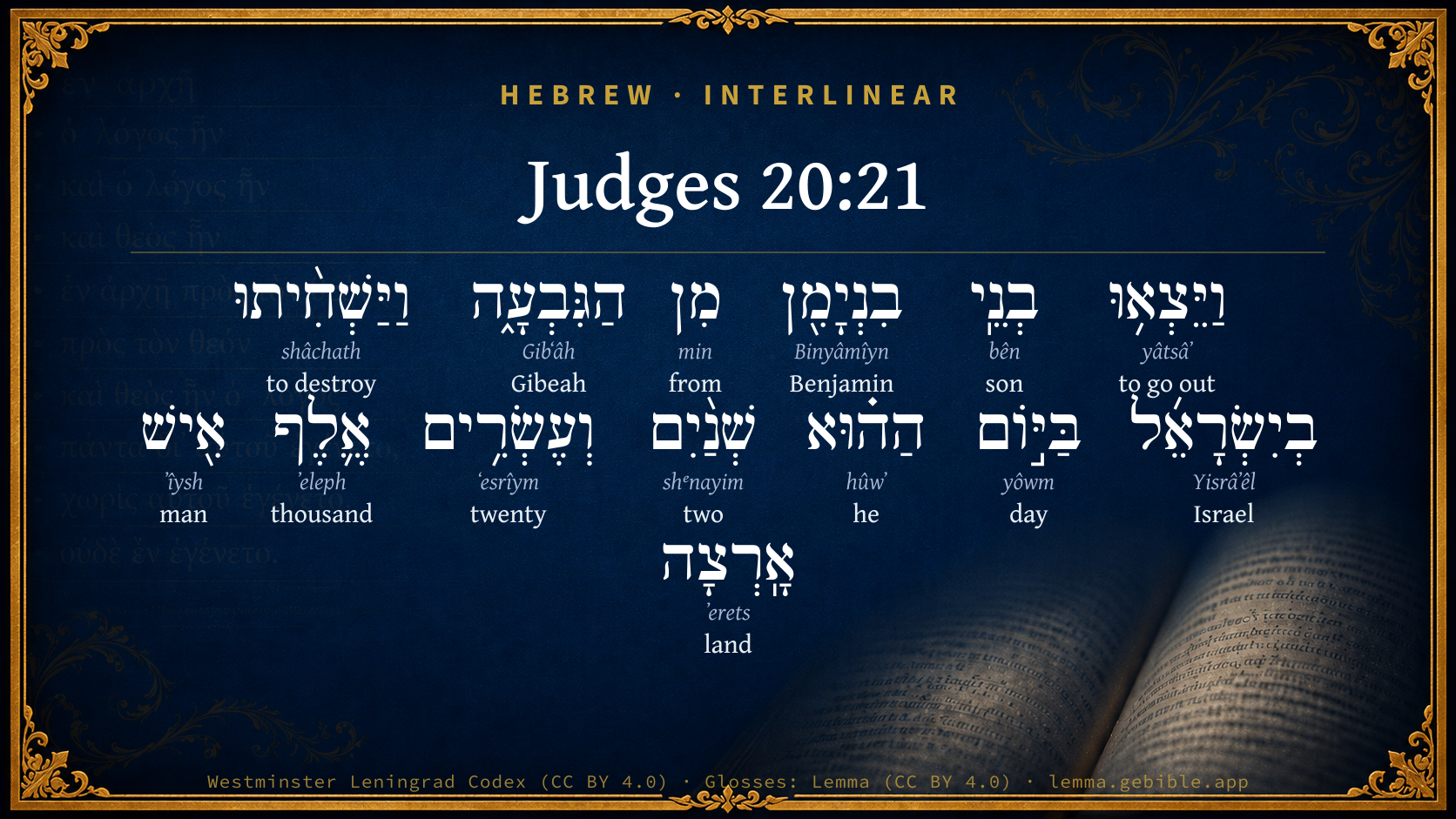
Hebrew (Westminster Leningrad Codex) Judges 20:21 appears in the Hebrew Old Testament. The text above is from the Westminster Leningrad Codex. Each word links to its Strong’s number, a concise gloss, and parsing drawn from the Open Scriptures Hebrew Bible morphology. Click any word for its full Brown-Driver-Briggs (BDB) entry.
Download image
Cite this verse

Judges 20:21 (World English Bible). Public Domain. Lemma interlinear Bible study tool, https://lemma.gebible.app/v/judges/20/21.

Show BibTeX & RIS
BibTeX
RIS
English Translation
The children of Benjamin came forth out of Gibeah, and destroyed down to the ground of the Israelites on that day Twenty-two thousand men.
World English Bible · Public Domain
Download a study sheet

One document with this verse’s original text, its word-by-word gloss line, the meaning frame, cross-references with their text, attributed commentary, and full source and license credits — printable, and it pastes into notes with its structure intact.

This verse Autodidact and up

Study sheet (.html) Plain text (.txt)

A passage Seminary Student

Up to 50 verses in one chapter. A passage sheet keeps up to 6 commentary sources and 12 cross-references per verse, in the order this page ranks them, and says so on the sheet whenever that leaves anything out. Ask for a single verse and you get the Autodidact verse sheet above.

Everything on this page stays free to read, with no account — the sheet is a download of what is already on screen, not access to it.

Want to remove ads? Support Godless Engineer
Compare translations 3

The same verse in 3 English versions, stacked beneath the original-language interlinear above. Click any original word for its lexicon entry.

Each is an independent rendering of the whole verse — the interlinear is not word-aligned to these translations.

Highlighted words mark where these versions differ — a whole-verse word diff, not a word-by-word alignment.

  • World English Bible Public Domain
    The children of Benjamin came forth out of Gibeah, and destroyed down to the ground of the Israelites on that day Twenty-two thousand men.
  • King James Version Public Domain
    And the children of Benjamin came forth out of Gibeah, and destroyed down to the ground of the Israelites that day twenty and two thousand men.
  • unfoldingWord Literal Text CC BY-SA 4.0
    And the sons of Benjamin came out from Gibeah, and they destroyed down to the ground 22,000 men from Israel on that day.

unfoldingWord Literal Text — © unfoldingWord, licensed CC BY-SA 4.0. Word-aligned USFM3 via Door43 (git.door43.org/unfoldingWord/en_ult).

Versions to compare (up to 4)

3 of 4 selected

Show all 18 translations

Every available English version of this verse, each an independent rendering of the whole verse.

  • World English Bible Public Domain
    The children of Benjamin came forth out of Gibeah, and destroyed down to the ground of the Israelites on that day Twenty-two thousand men.
  • Berean Standard Bible Public Domain
    And the Benjamites came out of Gibeah and cut down 22,000 Israelites on the battlefield that day.
  • Majority Standard Bible Public Domain
    And the Benjamites came out of Gibeah and cut down 22,000 Israelites on the battlefield that day.
  • King James Version Public Domain
    And the children of Benjamin came forth out of Gibeah, and destroyed down to the ground of the Israelites that day twenty and two thousand men.
  • American Standard Version (1901) Public Domain
    And the children of Benjamin came forth out of Gibeah, and destroyed down to the ground of the Israelites on that day twenty and two thousand men.
  • Revised Version (1885) Public Domain
    And the children of Benjamin came forth out of Gibeah, and destroyed down to the ground of the Israelites on that day twenty and two thousand men.
  • Geneva Bible (1599) Public Domain
    And the children of Beniamin came out of Gibeah, and slewe downe to the ground of the Israelites that day two and twentie thousand men.
  • Douay-Rheims (1899) Public Domain
    And the children of Benjamin coming out of Gabaa, slew of the children of Israel that day two and twenty thousand men.
  • Young's Literal Translation Public Domain
    and the sons of Benjamin come out from Gibeah, and destroy in Israel on that day two and twenty thousand men -- to the earth.
  • Literal Standard Version CC BY-SA 4.0
    and the sons of Benjamin come out from Gibeah, and destroy twenty-two thousand men in Israel on that day—to the earth.
  • Unlocked Literal Bible CC BY-SA 4.0
    The people of Benjamin came out of Gibeah, and they killed twenty-two thousand men of the army of Israel on that day.
  • unfoldingWord Literal Text CC BY-SA 4.0
    And the sons of Benjamin came out from Gibeah, and they destroyed down to the ground 22,000 men from Israel on that day.
  • Darby Bible Public Domain
    The Benjaminites came out of Gib'e-ah, and felled to the ground on that day twenty-two thousand men of the Israelites.
  • World Messianic Bible Public Domain
    The children of Benjamin came out of Gibeah, and on that day destroyed twenty-two thousand of the Israelite men down to the ground.
  • Webster's Bible Public Domain
    And the children of Benjamin came forth from Gibeah, and destroyed down to the ground of the Israelites that day twenty and two thousand men.
  • Free Bible Version CC BY-SA 4.0
    But the Benjamites came out of Gibeah and slaughtered twenty-two thousand Israelites on the battlefield that day.
  • Bible in Basic English Public Domain
    Then the children of Benjamin came out from Gibeah, cutting down twenty-two thousand of the Israelites that day.
  • JPS Tanakh (1917) Public Domain
    And the children of Benjamin came forth out of Gibeah, and destroyed down to the ground of the Israelites on that day twenty and two thousand men.

Literal Standard Version (2020), Covenant Press — licensed CC BY-SA 4.0. Text via the HelloAO Bible API (eBible.org). Unlocked Literal Bible (unfoldingWord) — licensed CC BY-SA 4.0. Text via the HelloAO Bible API (eBible.org). unfoldingWord Literal Text — © unfoldingWord, licensed CC BY-SA 4.0. Word-aligned USFM3 via Door43 (git.door43.org/unfoldingWord/en_ult). Free Bible Version, Dr. Jonathan Gallagher — licensed CC BY-SA 4.0. Text via the HelloAO Bible API (eBible.org).

Word by word

More ways to search: Search by grammar → Find every occurrence → Compare this word →

Practice this passage: Drill this verse → Learn its vocabulary →

הַגִּבְעָ֑ה
Gibʻâh
H1390
“the · Gibeah”
Particle, Definite Article + Noun, Proper
Part of Speech
Particle + Noun
Type
Proper
Full BDB Definition

Origin: the same as H1389

TWOT: None

Gibeah = "hill" - a city in the mountain district of Judah - a city of Benjamin, birthplace of king Saul - a city in Kirjath-jearim of Ephraim
  1. וַיֵּצְא֥וּ yâtsâʼ H3318 “and · to go out” Conjunction + Verb, Qal, Sequential Imperfect, 3rd Person, Masculine, Plural
  2. בְנֵֽי bên H1121 “sons of” Noun, Common, Masculine, Plural, Construct
  3. בִנְיָמִ֖ן Binyâmîyn H1144 “Benjamin” Noun, Proper
  4. מִן min H4480 “from” Preposition
  5. וַיַּשְׁחִ֨יתוּ shâchath H7843 “and · to destroy” Conjunction + Verb, Hiphil, Sequential Imperfect, 3rd Person, Masculine, Plural
  6. בְיִשְׂרָאֵ֜ל Yisrâʼêl H3478 “in/at · Israel” Preposition + Noun, Proper
  7. בַּיּ֣וֹם yôwm H3117 “in/at the · day” Preposition, Determined + Noun, Common, Masculine, Singular, Absolute
  8. הַה֗וּא hûwʼ H1931 “the · he” Particle, Definite Article + Pronoun, Personal, 3rd Person, Masculine, Singular
  9. שְׁנַ֨יִם shᵉnayim H8147 “two” Adjective, Cardinal number, Masculine, Dual, Absolute
  10. וְעֶשְׂרִ֥ים ʻesrîym H6242 “and · twenty” Conjunction + Adjective, Cardinal number, Both, Plural, Absolute
  11. אֶ֛לֶף ʼeleph H505 “thousand” Adjective, Cardinal number, Both, Singular, Absolute
  12. אִ֖ישׁ ʼîysh H376 “man” Noun, Common, Masculine, Singular, Absolute
  13. אָֽרְצָה ʼerets H776 “land · toward” Noun, Common, Both, Singular, Absolute + Suffix, Demonstrative

About this verse

These counts appear in no published source. They are computed here, from the morphology-tagged text and Lemma’s own curated glosses. What Lemma adds →

14
words
14
distinct lemmas
Historical
section

Shared distinctive vocabulary

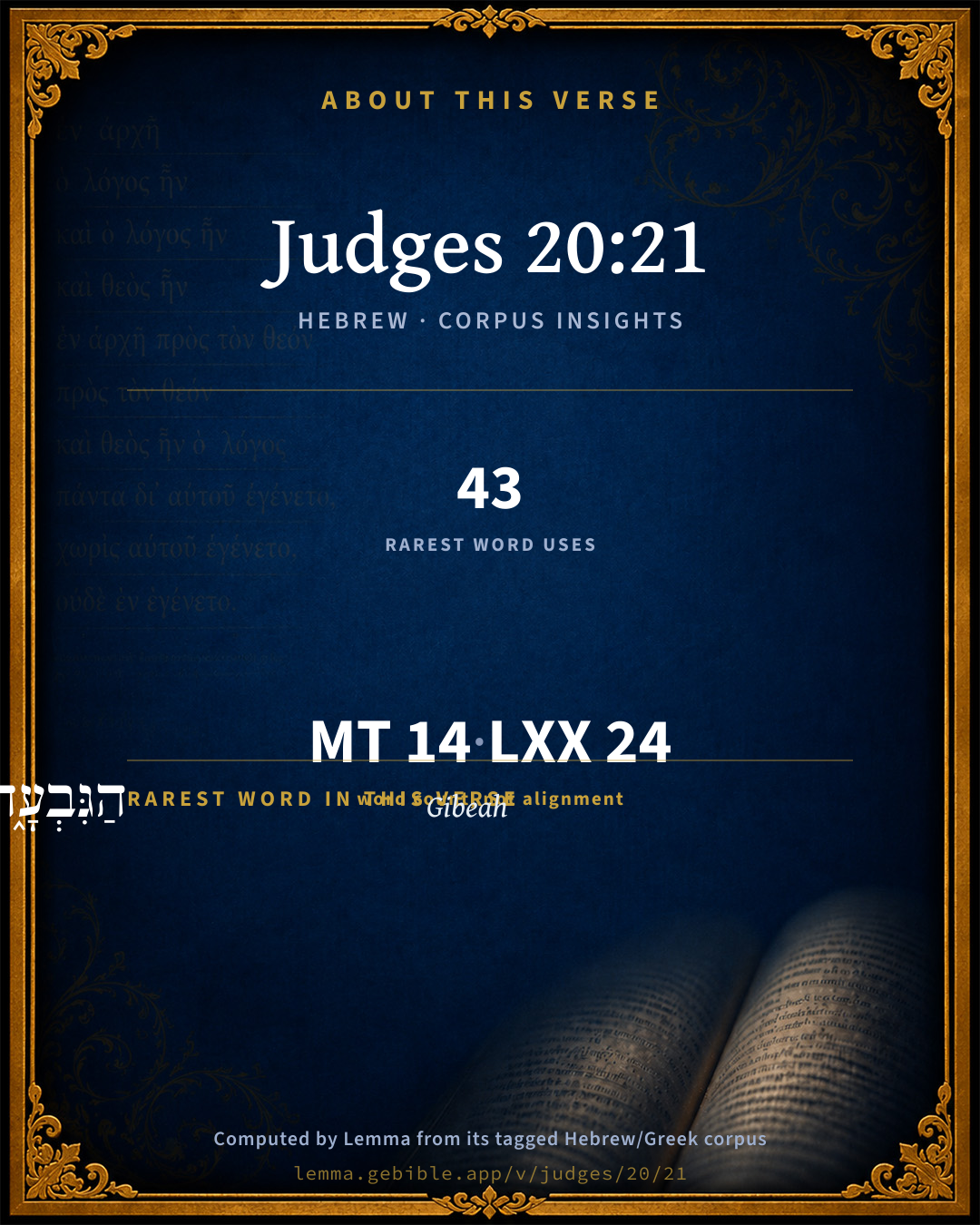
הַגִּבְעָ֑ה Gibeah H1390 occurs in 42 verses of the Hebrew Bible. Also found in:

Grammatical profile

  • 2 verbs
  • 7 nouns
  • 3 adjectives
  • 1 pronoun
  • 1 preposition

Verb forms

  • וַיֵּצְא֥וּ Qal · Sequential Imperfect
  • וַיַּשְׁחִ֨יתוּ Hiphil · Sequential Imperfect

Hebrew & Septuagint length

In English translation the verse runs 24 words from the Hebrew and 26 from the Septuagint (LXX English) — closely comparable.

A rough comparison of the two English renderings, which tokenize alike — not a word-level alignment.

Word counts can differ between the Hebrew and the Greek without any difference in meaning — e.g. the Hebrew direct-object marker אֵת has no separate Greek word, and Greek often adds the article ὁ.

In the original languages it is 14 Hebrew tokens and 24 Greek tokens — but the two are counted differently (Hebrew bundles its prefixes and suffixes into one token; the Greek is in lemma form), so that isn’t a like-for-like length.

Cross-references

10

Topical passages linked to Judges 20:21 in the Treasury of Scripture Knowledge — connected by theme and wording, ordered by reader-vote popularity; previews shown in the World English Bible.

  • Judges 20:25 Benjamin went forth against them out of Gibeah the second day, and destroyed down to the ground of the children of Israel again eighteen thousand men; all these drew the sword.
  • Jeremiah 12:1 Righteous are you, Yahweh, when I contend with you; yet would I reason the cause with you: why does the way of the wicked prosper? why are all they at ease who deal very treacherously?
  • Hosea 10:9 "Israel, you have sinned from the days of Gibeah. There they remained. The battle against the children of iniquity doesn't overtake them in Gibeah.
  • Genesis 49:27 "Benjamin is a ravenous wolf. In the morning he will devour the prey. At evening he will divide the spoil."
  • Deuteronomy 23:9 When you go forth in camp against your enemies, then you shall keep you from every evil thing.
  • 2 Chronicles 28:10 Now you purpose to keep under the children of Judah and Jerusalem for bondservants and bondmaids to you: [but] aren't there even with you trespasses of your own against Yahweh your God?
  • Psalms 33:16 There is no king saved by the multitude of a host. A mighty man is not delivered by great strength.
  • Psalms 73:18–19 Surely you set them in slippery places. You throw them down to destruction.
  • Psalms 77:19 Your way was through the sea; Your paths through the great waters. Your footsteps were not known.
  • Ecclesiastes 9:1–3 For all this I laid to my heart, even to explore all this: that the righteous, and the wise, and their works, are in the hand of God; whether it is love or hatred, man doesn't know it; all is before them.

Cross-references courtesy of OpenBible.info (CC BY 4.0).

Hebrew and Greek witnesses Masoretic Hebrew ↔ Greek Septuagint

The same verse in the two great witnesses to the Old Testament, shown verse-for-verse.

These are two independent witnesses, not word-aligned to each other, and the Septuagint is shown in lemma (dictionary) form.

Hebrew Judges 20:21 Masoretic · Westminster Leningrad Codex

וַיֵּצְא֥וּ בְנֵֽי בִנְיָמִ֖ן מִן הַגִּבְעָ֑ה וַיַּשְׁחִ֨יתוּ בְיִשְׂרָאֵ֜ל בַּיּ֣וֹם הַה֗וּא שְׁנַ֨יִם וְעֶשְׂרִ֥ים אֶ֛לֶף אִ֖ישׁ אָֽרְצָה

The children of Benjamin came forth out of Gibeah, and destroyed down to the ground of the Israelites on that day Twenty-two thousand men.

World English Bible · Public Domain

Greek LXX Judges 20:21 Septuagint · lemma form

καί ἐκἔρχομαι ὁ υἱός βενιαμίν ἀπό ὁ γαβαα καί διαφθείρω ἐν ἰσραήλ ἐν ὁ ἡμέρα ἐκεῖνος δύο καί εἴκοσι χιλιάς ἀνήρ ἐπί ὁ γῆ

And the sons of Benjamin went forth from Gabaa, and they destroyed in Israel on that day two and twenty thousand men down to the ground.

LXX2012 (modern English Septuagint) · Public Domain

Hebrew: Westminster Leningrad Codex (CC BY 4.0). Greek: Septuagint (public domain); English from LXX2012 (modern English Septuagint) (Public Domain). How the Septuagint differs from the Hebrew →

Targum (Aramaic paraphrase)

1

The Targum is the ancient Jewish Aramaic paraphrase of the Hebrew Scriptures — an interpretive translation, not the Hebrew text itself. Onkelos (literal) and Pseudo-Jonathan (expansive) render the Torah, and Jonathan the Prophets. Coverage is partial: where no permissively-licensed English translation exists for a verse, only the Aramaic is shown. This is verse-level text, not a word-by-word alignment to the Hebrew.

  1. Targum Jonathan Prophets (Joshua–Malachi)
    וּנְפַקוּ בְנֵי בִנְיָמִין מִן גִבְעָתָא וְחַבִּילוּ בְּיִשְׂרָאֵל בְּיוֹמָא הַהוּא עַסְרִין וּתְרֵין אַלְפִין גַבְרָא קְטִילִין רְמָן לְאַרְעָא:

    (no public-domain English translation for this verse)

    Targum Jonathan — Aramaic: “Mikraot Gedolot” (public domain). English: “Sefaria Community Translation” (CC0 1.0 (public-domain dedication)); “London "Chaldee Paraphrase," 1871” (public domain). Text via Sefaria.

Commentary

Notes on Judges 20:21 from classic Christian and Jewish commentators (each source and its license shown beneath its notes). The classic Christian expositions comment on the surrounding passage and are grouped to its opening verse, so a note may address several verses; the Jewish commentaries on the Tanakh (Rashi and others) are per-verse, so they appear only where the commentator wrote on this verse.

Lemma curates 59 commentaries, every one of them public domain or Creative Commons licensed, each selected and text-cleaned for this edition rather than reprinted as found. About our sources →

Trapp's Complete Commentary

John Trapp

Jdg 20:21 And the children of Benjamin came forth out of Gibeah, and destroyed down to the ground of the Israelites that day twenty and two thousand men.

Ver. 21. And destroyed down to the ground … twenty and two thousand men.] They slew so many upon the turf, as we phrase it, and that with a great deal of eagerness and earnestness; such as Scanderbeg expressed when, in fighting against the Turks, the blood did oftentimes burst out of his lips. {a}

{a} Turk. Hist., p. 287.

John Trapp, A Commentary or Exposition upon All the Books of the Old and New Testament (1647–1656) — public domain. Text from a community e-Sword module.

Joseph Benson's Commentary

Jdg 20:21. The children of Benjamin came forth out of Gibeah — Those forces which were left in Gibeah for its defence issued out upon the Israelites in their rear, while the other Benjamites fought against them in front. And destroyed that day twenty and two thousand — Since they were engaged in so good a cause, and God himself bid them go up, it may seem strange that they should receive such a defeat. But it is to be observed, he only bid them go, but did not promise them success. And undoubtedly they were highly blameable that they did not ask counsel of him in such an important matter as going to war with their brethren. For we find they absolutely determined upon it without doing so, and only inquired who should be in the van of their army. The Benjamites certainly deserved punishment. But to engage with them in a civil war was certainly what they ought not to have done without consulting God. It may be, if they had done so, God would have directed them to have sent another message, and that in HIS name, to the Benjamites, which might have had the desired effect, without proceeding to shed the blood of brethren, and exposing their own to be shed by brethren in such an awful manner. Add to this, that these tribes had many and great sins reigning among themselves, and they should not have proceeded to so great a work with polluted hands; but should have pulled the beam out of their own eye, before they attempted to take that out of their brother Benjamin’s eye: which, because they did not, God doth it for them, bringing them through the fire, that they might be purged from their dross. And God would hereby show, that the race is not to the swift, nor the battle to the strong. We must never lay that weight on an arm of flesh which only the Rock of ages will bear.

Joseph Benson's Commentary on the Old and New Testaments (1811–1818) — public domain. Text from a community e-Sword module.

Geneva Bible (1599)

Geneva Bible translators

This God permitted, because the Israelites partly in their strength, and partly God would by this means punish their sins.

Geneva Bible (1599) marginal notes — public domain. Text via Bolls.life.

Adam Clarke's Commentary

Verse 21. Destroyed down to the ground - twenty-two thousand men.] That is, so many were left dead on the field of battle.

Adam Clarke's Commentary on the Bible (1810–1826) — public domain. Text from a community e-Sword/MySword module.

Ellicott's Commentary for English Readers

(21) Came forth out of Gibeah.—The whole armed force of the tribe had therefore assembled to save the wicked town from assault. Like many of the towns of Palestine (as their names indicate), it was on a hill, and therefore easily defensible against the very imperfect siege operations of the ancients.

Destroyed down to the ground—i.e., laid them dead on the ground, as in Jdg_6:25.

Twenty and two thousand men.—This immense slaughter shows the extraordinary fierceness of the battle. The Benjamite force must have nearly killed a man apiece.

A Bible Commentary for English Readers, edited by Charles John Ellicott (1878–1897) — public domain. Text from a community e-Sword module.

The Cambridge Bible for Schools and Colleges

gen. ed. J. J. S. Perowne

21. The numbers here and in Jdg_20:25 are again prodigious: the Benjamites, without losing a man themselves (as is implied in Jdg_20:35; Jdg_20:44-47), kill 40,000 Israelites in the two battles. Why this loss on the Israelite side? Probably the narrator considered that even the champions of the divine justice were not free from blame; they had not begun the holy war with due religious observances. Or, if Jdg_20:18 is not a later addition, because they had consulted the oracle merely to enquire which tribe should go up first.

The Cambridge Bible for Schools and Colleges (gen. ed. J. J. S. Perowne; Cambridge University Press, 1878–1918) — public domain. Text from a community e-Sword module.

John Gill's Exposition

And the children of Benjamin came forth out of Gibeah,.... Which was their place of rendezvous, and which they came to defend; and in and about which they had stationed their whole army of 26,000 men:

and destroyed down to the ground: killed dead upon the spot:

of the Israelites that day twenty and two thousand men; wanting but 4000 of their whole number, excepting the men of Gibeah, which was such a rebuff the Israelites did not expect, being engaged in so just a cause, and having such a numerous army. Several Jewish, writers (q) think this was on account of their idolatry, that though they were very zealous to revenge corporeal adultery in the case of the Levite's concubine, and to remove such iniquity from Israel; yet were not zealous to revenge and put away spiritual adultery or idolatry in the case of the Danites, who had set up the image of Micah, and so had spread idolatry not only in their own tribe, but throughout Israel; and therefore God took this opportunity to avenge his own quarrel, and rebuke them for their sin; and now did Benjamin raven as a wolf, according to Jacob's prophecy, Gen 49:27.

(q) T. Bab. Sanhedrin, fol. 103. 2. Pirke Eliezer, c. 28. Jarchi & Kimchi in loc.

John Gill's Exposition of the Whole Bible (1746–1763) — public domain (CC PDM 1.0). Text via the HelloAO Bible API.

Albert Barnes' Notes on the Bible

Gibeah, being on a hill, was difficult of access to an attacking army, and gave great advantage to the defenders, who fought from higher ground, and probably defended a narrow pass, while their companions on the walls could gall the assailants with their slingstones.

Albert Barnes' Notes on the Bible (1834–1885) — public domain. Text from a community e-Sword/MySword module.

Matthew Poole's English Annotations

Quest. Why would God suffer them to have so great a loss in so good a cause?

Answ. Because they had many and great sins reigning amongst themselves, and they should not have come to so great a work of God as this with polluted hands, but should have pulled the beam out of their own eye, before they attempted to take that out of their brother Benjamin’s eye; which because they did not, God doth it for them, making them by this loss more clearly to see their own sins, and their need of God’s help, without which their great numbers were insignificant; and bringing them through the fire, that they might be purged from their dross; it being probable that the great God, who governs every stroke in battles, did so order things, that their worst and rotten members should be cut off, which was a great blessing to the whole commonwealth.

Matthew Poole's English Annotations on the Holy Bible (1683–1685) — public domain. Text from a community e-Sword/MySword module.

Whedon's Commentary on the Bible

Daniel D. Whedon

THE WAR AGAINST BENJAMIN, Jdg_20:20-48.

21. Destroyed down to the ground — That is, smote them so that they lay dead upon the ground.

Twenty and two thousand — Almost as many as all Benjamin’s host contained. Compare Jdg_20:15. But of the Benjamites very few seem to have fallen.

Daniel D. Whedon (gen. ed.), Commentary on the Old and New Testaments (1874–1909) — public domain. Text from a community e-Sword module.

The Pulpit Commentary

Came forth out of Gibeah, etc. Gibeah (sometimes called Geba, literally, the hill) was doubtless very difficult to assault, and the steep approach greatly favoured the defenders. The men of Judah probably came up carelessly, and with an overweening confidence, and so met with a terrible disaster. The word destroyed here used is the same as is applied to the destroying angel. (Exo_12:23 2Sa_24:16; see also 2Ch_24:23)

The Pulpit Commentary (1880–1919), ed. H.D.M. Spence-Jones & Joseph S. Exell — public domain. Text from a community e-Sword module.

John Wesley's Explanatory Notes

Destroyed, &c. - Why would God suffer them to have so great a loss in so good a cause? Because they had many and great sins reigning among themselves, and they should not have come to so great a work of God, with polluted hands, but should have pulled the beam out of their own eye, before they attempted to take that out of their brother Benjamin's eye: which because they did not, God doth it for them, bringing them through the fire, that they might he purged from their dross; it being probable that the great God who governs every stroke in battle, did so order things, that their worst members should be cut off, which was a great blessing to the whole common - wealth. And God would hereby shew, that the race is not to the swift, nor the battle to the strong. We must never lay that weight on an arm of flesh, which only the Rock of Ages will bear.

John Wesley, Explanatory Notes Upon the Whole Bible (1754–1765) — public domain. Text via the GEBible commentary corpus.

Rashi

Rabbi Shlomo Yitzchaki (Rashi)

They crushed. They were punished because they were not equally vengeful over the incident of the figure of Michah, which had already taken place.

Rashi on the Tanakh — English translations: “The Judaica Press complete Tanach with Rashi, translated by A. J. Rosenberg” (CC BY 4.0); “Pentateuch with Rashi's commentary by M. Rosenbaum and A.M. Silbermann, 1929-1934” (public domain); “The Metsudah Tanach series, Lakewood, N.J” (CC BY 4.0); and “The Book of Joshua, Metsudah Publications, 1997” (CC BY 4.0). Text via Sefaria.

Lesson kit

Teaching starters — assembled from the data on this page, not authored interpretation. Every prompt links to the verse data it draws on. Edit before teaching.

Judges, in the Historical, opens this verse with 14 words (14 distinct Hebrew lemmas). Its most distinctive word is Gibʻâh (“Gibeah”). A historical commentator’s framing appears above. Read the whole chapter for the surrounding context.

Discussion questions

  1. How does “Gibeah” (Gibʻâh) shape what this verse is saying?
  2. How does Joshua 15:57, which shares the word «Gibeah», read alongside this verse?
  3. These translations render this verse differently. What is at stake in choosing one wording over another?
  4. «וַיֵּצְא֥וּ» is a Qal Sequential Imperfect verb. How does that grammatical form shape the action described?
  5. Compare how Trapp's Complete Commentary and Joseph Benson's Commentary read this verse. Where do they agree or differ?

Things to notice

Reading settings

Reading text

Shown beneath each verse's original-language words.

Old Testament
Old Testament edition

Read the OT as the Masoretic Hebrew (MT) or the Greek Septuagint (LXX).

English shown for the Greek Septuagint (in the Hebrew ↔ Greek comparison).

Comparing translations? Open the Compare panel on any verse page to stack up to four side by side.