
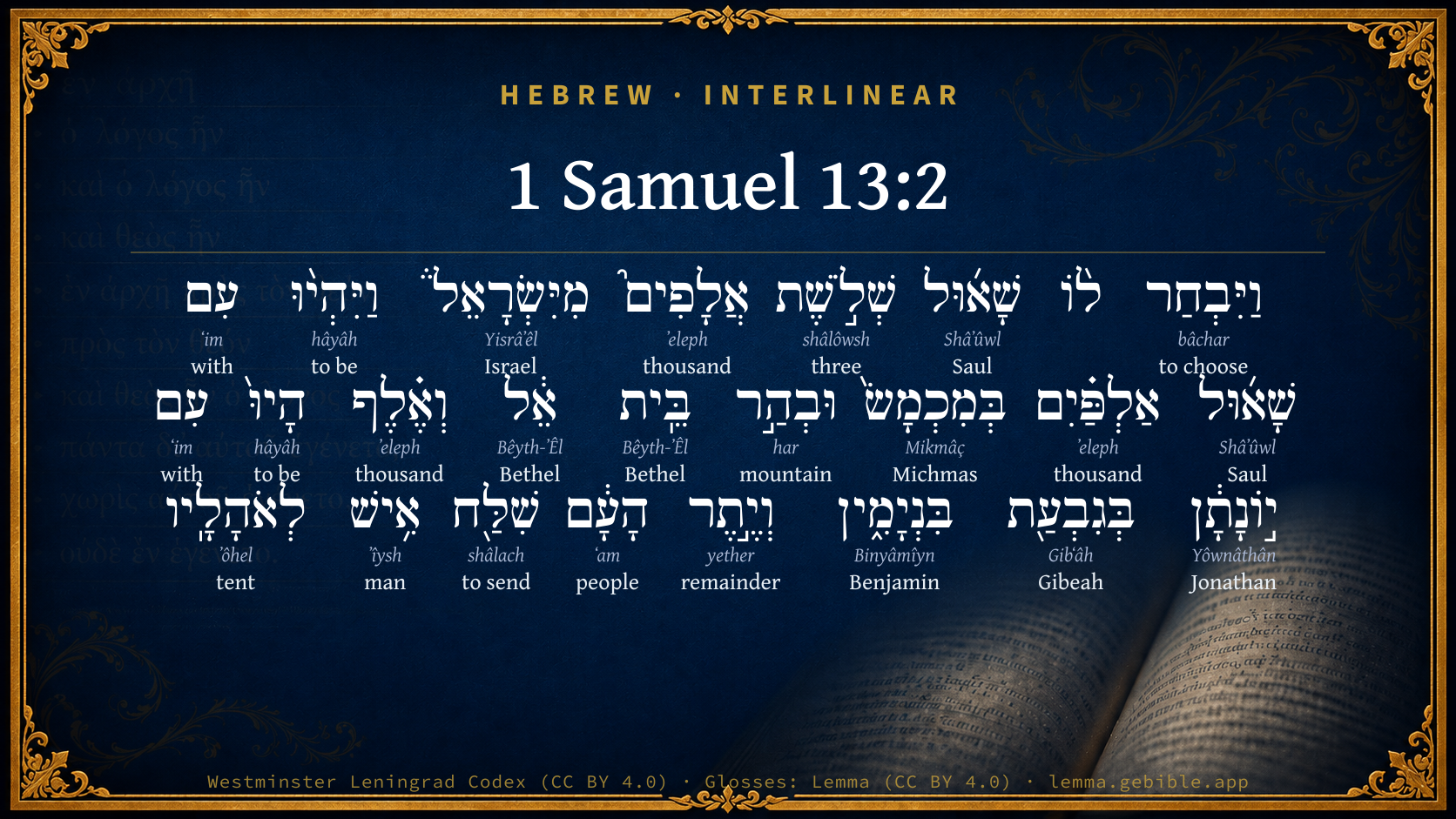
1 Samuel 13:2

Hebrew (Westminster Leningrad Codex) 1 Samuel 13:2 appears in the Hebrew Old Testament. The text above is from the Westminster Leningrad Codex. Each word links to its Strong’s number, a concise gloss, and parsing drawn from the Open Scriptures Hebrew Bible morphology. Click any word for its full Brown-Driver-Briggs (BDB) entry.
Download image
Cite this verse

1 Samuel 13:2 (World English Bible). Public Domain. Lemma interlinear Bible study tool, https://lemma.gebible.app/v/1-samuel/13/2.

Show BibTeX & RIS
BibTeX
RIS
English Translation
Saul chose him three thousand men of Israel, of which two thousand were with Saul in Michmash and in the Mount of Bethel, and one thousand were with Jonathan in Gibeah of Benjamin: and the rest of the people he sent every man to his tent.
World English Bible · Public Domain
Highlights
  • 1 first appearance in the Hebrew Bible
Full analysis ↓
Download a study sheet

One document with this verse’s original text, its word-by-word gloss line, the meaning frame, cross-references with their text, attributed commentary, and full source and license credits — printable, and it pastes into notes with its structure intact.

This verse Autodidact and up

Study sheet (.html) Plain text (.txt)

A passage Seminary Student

Up to 50 verses in one chapter. A passage sheet keeps up to 6 commentary sources and 12 cross-references per verse, in the order this page ranks them, and says so on the sheet whenever that leaves anything out. Ask for a single verse and you get the Autodidact verse sheet above.

Everything on this page stays free to read, with no account — the sheet is a download of what is already on screen, not access to it.

Want to remove ads? Support Godless Engineer
Compare translations 3

The same verse in 3 English versions, stacked beneath the original-language interlinear above. Click any original word for its lexicon entry.

Each is an independent rendering of the whole verse — the interlinear is not word-aligned to these translations.

Highlighted words mark where these versions differ — a whole-verse word diff, not a word-by-word alignment.

  • World English Bible Public Domain
    Saul chose him three thousand men of Israel, of which two thousand were with Saul in Michmash and in the Mount of Bethel, and one thousand were with Jonathan in Gibeah of Benjamin: and the rest of the people he sent every man to his tent.
  • King James Version Public Domain
    Saul chose him three thousand men of Israel; whereof two thousand were with Saul in Michmash and in mount Bethel, and a thousand were with Jonathan in Gibeah of Benjamin: and the rest of the people he sent every man to his tent.
  • unfoldingWord Literal Text CC BY-SA 4.0
    And Saul chose for himself 3,000 from Israel. And 2,000 were with Saul in Michmash and in the hill country of Bethel, and 1,000 were with Jonathan in Gibeah of Benjamin. And the rest of the people, he sent away, a man to his tent.

unfoldingWord Literal Text — © unfoldingWord, licensed CC BY-SA 4.0. Word-aligned USFM3 via Door43 (git.door43.org/unfoldingWord/en_ult).

Versions to compare (up to 4)

3 of 4 selected

Show all 18 translations

Every available English version of this verse, each an independent rendering of the whole verse.

  • World English Bible Public Domain
    Saul chose him three thousand men of Israel, of which two thousand were with Saul in Michmash and in the Mount of Bethel, and one thousand were with Jonathan in Gibeah of Benjamin: and the rest of the people he sent every man to his tent.
  • Berean Standard Bible Public Domain
    He chose for himself three thousand men of Israel: Two thousand were with Saul at Michmash and in the hill country of Bethel, and a thousand were with Jonathan in Gibeah of Benjamin. And the rest of the troops he sent away, each to his own home.
  • Majority Standard Bible Public Domain
    He chose for himself three thousand men of Israel: Two thousand were with Saul at Michmash and in the hill country of Bethel, and a thousand were with Jonathan in Gibeah of Benjamin. And the rest of the troops he sent away, each to his own home.
  • King James Version Public Domain
    Saul chose him three thousand men of Israel; whereof two thousand were with Saul in Michmash and in mount Bethel, and a thousand were with Jonathan in Gibeah of Benjamin: and the rest of the people he sent every man to his tent.
  • American Standard Version (1901) Public Domain
    Saul chose him three thousand men of Israel, whereof two thousand were with Saul in Michmash and in the mount of Beth-el, and a thousand were with Jonathan in Gibeah of Benjamin: and the rest of the people he sent every man to his tent.
  • Revised Version (1885) Public Domain
    And Saul chose him three thousand men of Israel; whereof two thousand were with Saul in Michmash and in the mount of Beth-el, and a thousand were with Jonathan in Gibeah of Benjamin: and the rest of the people he sent every man to his tent.
  • Geneva Bible (1599) Public Domain
    Then Saul chose him three thousand of Israel: and two thousande were with Saul in Michmash, and in mount Beth-el, and a thousande were with Ionathan in Gibeah of Beniamin: and the rest of the people he sent euery one to his tent.
  • Douay-Rheims (1899) Public Domain
    And Saul chose him three thousand men of Israel: and two thousand were with Saul in Machmas, and in mount Bethel: and a thousand with Jonathan in Gabaa of Benjamin, and the rest of the people he sent back every man to their dwellings.
  • Young's Literal Translation Public Domain
    and Saul chooseth for himself three thousand `men' out of Israel; and two thousand are with Saul in Michmash, and in the hill-country of Beth-El; and a thousand have been with Jonathan in Gibeah of Benjamin; and the remnant of the people he hath sent each to his tents.
  • Literal Standard Version CC BY-SA 4.0
    then Saul chooses for himself three thousand [men] out of Israel; and two thousand are with Saul in Michmash, and in the hill-country of Beth-El; and one thousand have been with Jonathan in Gibeah of Benjamin; and he has sent each one of the remnant of the people to his tents.
  • Unlocked Literal Bible CC BY-SA 4.0
    he chose three thousand men of Israel. Two thousand were with him in Michmash and in the hill country of Bethel, while a thousand were with Jonathan in Gibeah of Benjamin. The rest of the soldiers he sent home, each man to his tent.
  • unfoldingWord Literal Text CC BY-SA 4.0
    And Saul chose for himself 3,000 from Israel. And 2,000 were with Saul in Michmash and in the hill country of Bethel, and 1,000 were with Jonathan in Gibeah of Benjamin. And the rest of the people, he sent away, a man to his tent.
  • Darby Bible Public Domain
    And Saul chose him three thousand men out of Israel: there were with Saul two thousand in Michmash and in mount Bethel, and a thousand were with Jonathan in Gibeah of Benjamin; and the rest of the people he sent every man to his tent.
  • World Messianic Bible Public Domain
    Saul chose for himself three thousand men of Israel, of which two thousand were with Saul in Michmash and in the Mount of Bethel, and one thousand were with Jonathan in Gibeah of Benjamin. He sent the rest of the people to their own tents.
  • Webster's Bible Public Domain
    Saul chose him three thousand men of Israel; of which two thousand were with Saul in Michmash and in mount Beth-el, and a thousand were with Jonathan in Gibeah of Benjamin: and the rest of the people he sent every man to his tent.
  • Free Bible Version CC BY-SA 4.0
    Saul had chosen three thousand men of Israel. Two thousand of them were with Saul in Michmash and the hill country of Bethel, and another thousand were with Jonathan in Gibeah of Benjamin. He sent the rest of the army home.
  • Bible in Basic English Public Domain
    And Saul took for himself three thousand men of Israel, of whom he kept two thousand with him in Michmash and in the mountain of Beth-el, and a thousand were with Jonathan in Gibeah in the land of Benjamin: the rest of the people he sent back to their tents.
  • JPS Tanakh (1917) Public Domain
    And Saul chose him three thousand men of Israel; whereof two thousand were with Saul in Michmas and in the mount of Beth-el, and a thousand were with Jonathan in Gibeath-benjamin; and the rest of the people he sent every man to his tent.

Literal Standard Version (2020), Covenant Press — licensed CC BY-SA 4.0. Text via the HelloAO Bible API (eBible.org). Unlocked Literal Bible (unfoldingWord) — licensed CC BY-SA 4.0. Text via the HelloAO Bible API (eBible.org). unfoldingWord Literal Text — © unfoldingWord, licensed CC BY-SA 4.0. Word-aligned USFM3 via Door43 (git.door43.org/unfoldingWord/en_ult). Free Bible Version, Dr. Jonathan Gallagher — licensed CC BY-SA 4.0. Text via the HelloAO Bible API (eBible.org).

Word by word

More ways to search: Search by grammar → Find every occurrence → Compare this word →

Practice this passage: Drill this verse → Learn its vocabulary →

בְּמִכְמָשׂ֙
Mikmâç
H4363
“in/at · Michmas”
Preposition + Noun, Proper
Part of Speech
Preposition + Noun
Type
Proper
Full BDB Definition

Origin: from H3647

TWOT: None

Michmas or Michmash = "hidden" - a city in Benjamin lying near Ramah and approximately 10 miles
  1. וַיִּבְחַר bâchar H977 “and · to choose” Conjunction + Verb, Qal, Sequential Imperfect, 3rd Person, Masculine, Singular
  2. שָׁא֜וּל Shâʼûwl H7586 “Saul” Noun, Proper
  3. שְׁלֹ֣שֶׁת shâlôwsh H7969 “three” Adjective, Cardinal number, Masculine, Singular, Construct
  4. אֲלָפִים֮ ʼeleph H505 “thousand” Adjective, Cardinal number, Both, Plural, Absolute
  5. מִיִּשְׂרָאֵל֒ Yisrâʼêl H3478 “from · Israel” Preposition + Noun, Proper
  6. וַיִּהְי֨וּ hâyâh H1961 “and · to be” Conjunction + Verb, Qal, Sequential Imperfect, 3rd Person, Masculine, Plural
  7. עִם ʻim H5973 “with” Preposition
  8. שָׁא֜וּל Shâʼûwl H7586 “Saul” Noun, Proper
  9. אַלְפַּ֗יִם ʼeleph H505 “thousand” Adjective, Cardinal number, Both, Plural, Absolute
  10. וּבְהַ֣ר har H2022 “and · in/at · mountain of” Conjunction + Preposition + Noun, Common, Masculine, Singular, Construct
  11. בֵּֽית Bêyth-ʼÊl H1008 “Bethel” Noun, Proper
  12. אֵ֔ל Bêyth-ʼÊl H1008 “Bethel” Noun, Proper
  13. וְאֶ֗לֶף ʼeleph H505 “and · thousand” Conjunction + Adjective, Cardinal number, Both, Singular, Absolute
  14. הָיוּ֙ hâyâh H1961 “to be” Verb, Qal, Perfect, 3rd Person, Common, Plural
  15. עִם ʻim H5973 “with” Preposition
  16. י֣וֹנָתָ֔ן Yôwnâthân H3129 “Jonathan” Noun, Proper
  17. בְּגִבְעַ֖ת Gibʻâh H1390 “in/at · Gibeah” Preposition + Noun, Proper
  18. בִּנְיָמִ֑ין Binyâmîyn H1144 “Benjamin” Noun, Proper
  19. וְיֶ֣תֶר yether H3499 “and · remainder of” Conjunction + Noun, Common, Masculine, Singular, Construct
  20. הָעָ֔ם ʻam H5971 “the · people” Particle, Definite Article + Noun, Common, Masculine, Singular, Absolute
  21. שִׁלַּ֖ח shâlach H7971 “to send” Verb, Piel, Perfect, 3rd Person, Masculine, Singular
  22. אִ֥ישׁ ʼîysh H376 “man” Noun, Common, Masculine, Singular, Absolute
  23. לְאֹהָלָֽיו ʼôhel H168 “to/for · tents · his” Preposition + Noun, Common, Masculine, Plural, Construct + Suffix, Personal, 3rd Person, Masculine, Singular

About this verse

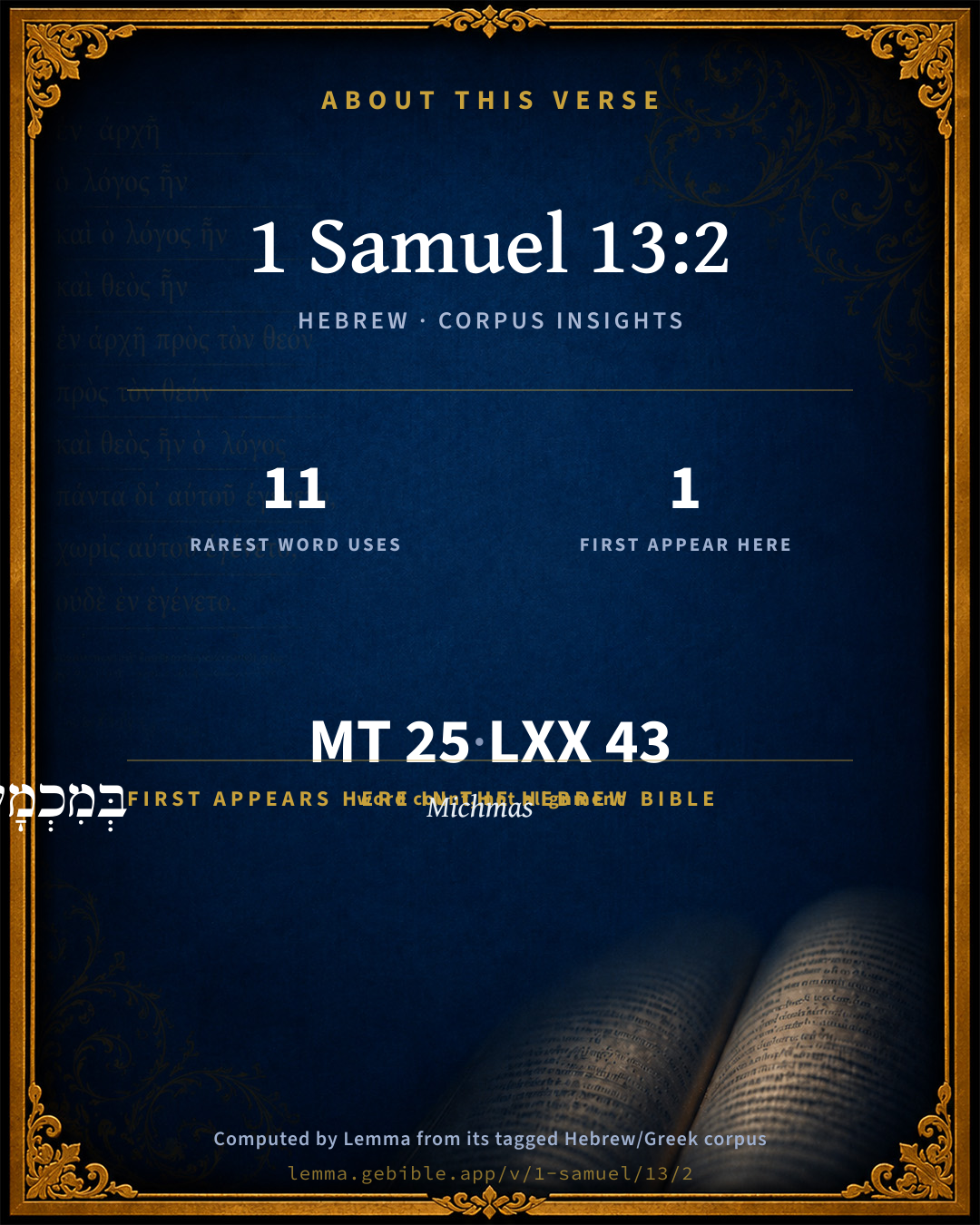
These counts appear in no published source. They are computed here, from the morphology-tagged text and Lemma’s own curated glosses. What Lemma adds →

25
words
18
distinct lemmas
Historical
section

Notable vocabulary

The rarest word here is בְּמִכְמָשׂ֙ Michmas H4363 — appearing just 11 times in the whole Hebrew Bible.

First appearance in Scripture

This word makes its first canonical appearance in the Hebrew Bible here:

  • בְּמִכְמָשׂ֙ Michmas H4363

Shared distinctive vocabulary

בְּמִכְמָשׂ֙ Michmas H4363 occurs in 11 verses of the Hebrew Bible. Also found in:

Grammatical profile

  • 4 verbs
  • 14 nouns
  • 4 adjectives
  • 3 prepositions

Verb forms

  • וַיִּבְחַר Qal · Sequential Imperfect
  • וַיִּהְי֨וּ Qal · Sequential Imperfect
  • הָיוּ֙ Qal · Perfect
  • שִׁלַּ֖ח Piel · Perfect

Repetition

Words recur within this verse — often emphatic in Hebrew:

  • אֲלָפִים֮ thousand H505 ×3
  • שָׁא֜וּל Saul H7586 ×2
  • וַיִּהְי֨וּ to be H1961 ×2
  • בֵּֽית Bethel H1008 ×2
  • עִם with H5973 ×2

Hebrew & Septuagint length

In the original languages it is 25 Hebrew tokens and 43 Greek tokens — but the two are counted differently (Hebrew bundles its prefixes and suffixes into one token; the Greek is in lemma form), so that isn’t a like-for-like length.

Cross-references

12

Topical passages linked to 1 Samuel 13:2 in the Treasury of Scripture Knowledge — connected by theme and wording, ordered by reader-vote popularity; previews shown in the World English Bible.

  • 1 Samuel 10:26 Saul also went to his house to Gibeah; and there went with him the host, whose hearts God had touched.
  • 1 Samuel 13:5 The Philistines assembled themselves together to fight with Israel, thirty thousand chariots, and six thousand horsemen, and people as the sand which is on the sea-shore in multitude: and they came up, and encamped in Michmash, eastward of Beth Aven.
  • 1 Samuel 14:31 They struck of the Philistines that day from Michmash to Aijalon. The people were very faint;
  • 1 Samuel 13:23 The garrison of the Philistines went out to the pass of Michmash.
  • Joshua 18:28 and Zelah, Eleph, and the Jebusite (the same is Jerusalem), Gibeath, [and] Kiriath; fourteen cities with their villages. This is the inheritance of the children of Benjamin according to their families.
  • Judges 19:12 His master said to him, We won't turn aside into the city of a foreigner, that is not of the children of Israel; but we will pass over to Gibeah.
  • 1 Samuel 8:11 He said, This will be the manner of the king who shall reign over you: he will take your sons, and appoint them to him, for his chariots, and to be his horsemen; and they shall run before his chariots;
  • 1 Samuel 14:5 The one crag rose up on the north in front of Michmash, and the other on the south in front of Geba.
  • 1 Samuel 14:52 There was sore war against the Philistines all the days of Saul: and when Saul saw any mighty man, or any valiant man, he took him to him.
  • 1 Samuel 15:34 Then Samuel went to Ramah; and Saul went up to his house to Gibeah of Saul.
  • 2 Samuel 21:6 let seven men of his sons be delivered to us, and we will hang them up to Yahweh in Gibeah of Saul, the chosen of Yahweh. The king said, I will give them.
  • Isaiah 10:28–29 He is come to Aiath, he is passed through Migron; at Michmash he lays up his baggage;

Cross-references courtesy of OpenBible.info (CC BY 4.0).

Hebrew and Greek witnesses Masoretic Hebrew ↔ Greek Septuagint

The same verse in the two great witnesses to the Old Testament, shown verse-for-verse.

These are two independent witnesses, not word-aligned to each other, and the Septuagint is shown in lemma (dictionary) form.

Hebrew 1 Samuel 13:2 Masoretic · Westminster Leningrad Codex

וַיִּבְחַר ל֨וֹ שָׁא֜וּל שְׁלֹ֣שֶׁת אֲלָפִים֮ מִיִּשְׂרָאֵל֒ וַיִּהְי֨וּ עִם שָׁא֜וּל אַלְפַּ֗יִם בְּמִכְמָשׂ֙ וּבְהַ֣ר בֵּֽית אֵ֔ל וְאֶ֗לֶף הָיוּ֙ עִם י֣וֹנָתָ֔ן בְּגִבְעַ֖ת בִּנְיָמִ֑ין וְיֶ֣תֶר הָעָ֔ם שִׁלַּ֖ח אִ֥ישׁ לְאֹהָלָֽיו

Saul chose him three thousand men of Israel, of which two thousand were with Saul in Michmash and in the Mount of Bethel, and one thousand were with Jonathan in Gibeah of Benjamin: and the rest of the people he sent every man to his tent.

World English Bible · Public Domain

Greek LXX 1 Samuel 13:2 Septuagint · lemma form

καί ἐκλέγω σαούλ ἑαυτοῦ τρεῖς χιλιάς ἀνήρ ἐκ ὁ ἀνήρ ἰσραήλ καί εἰμί μετά σαούλ δισχίλιοι ἐν μαχεμας καί ἐν ὁ ὄρος βαιθηλ χίλιοι εἰμί μετά ιωναθαν ἐν γαβεε ὁ βενιαμίν καί ὁ κατάλοιπος ὁ λαός ἐκ ἀποστέλλω ἕκαστος εἰς ὁ σκήνωμα αὐτός

No English rendering of this Greek verse — the small residue in the structurally divergent books.

On this verse, Keil & Delitzsch discusses the Septuagint’s reading. Read the note in Commentary ↓

Hebrew: Westminster Leningrad Codex (CC BY 4.0). Greek: Septuagint (public domain); English from a public-domain English Septuagint. How the Septuagint differs from the Hebrew →

Targum (Aramaic paraphrase)

1

The Targum is the ancient Jewish Aramaic paraphrase of the Hebrew Scriptures — an interpretive translation, not the Hebrew text itself. Onkelos (literal) and Pseudo-Jonathan (expansive) render the Torah, and Jonathan the Prophets. Coverage is partial: where no permissively-licensed English translation exists for a verse, only the Aramaic is shown. This is verse-level text, not a word-by-word alignment to the Hebrew.

  1. Targum Jonathan Prophets (Joshua–Malachi)
    וּבְחַר לֵיהּ שָׁאוּל תְּלָתָא אַלְפִין מִיִשְׂרָאֵל וַהֲווֹ עִם שָׁאוּל תְּרֵין אַלְפִין בְּמִכְמָשׁ וּבְטוּר בֵּית אֵל וְאַלְפָא הֲווֹ עִם יוֹנָתָן בְּגִבְעֲתָא דְבֵית בִּנְיָמִין וּשְׁאַר עַמָא שְׁלַח גְבַר לְקִירְוֹהִי:

    (no public-domain English translation for this verse)

    Targum Jonathan — Aramaic: “Mikraot Gedolot” (public domain). English: “Sefaria Community Translation” (CC0 1.0 (public-domain dedication)); “London "Chaldee Paraphrase," 1871” (public domain). Text via Sefaria.

Commentary

Notes on 1 Samuel 13:2 from classic Christian and Jewish commentators (each source and its license shown beneath its notes). The classic Christian expositions comment on the surrounding passage and are grouped to its opening verse, so a note may address several verses; the Jewish commentaries on the Tanakh (Rashi and others) are per-verse, so they appear only where the commentator wrote on this verse.

Lemma curates 59 commentaries, every one of them public domain or Creative Commons licensed, each selected and text-cleaned for this edition rather than reprinted as found. About our sources →

Trapp's Complete Commentary

John Trapp

1Sa 13:2 Saul chose him three thousand [men] of Israel; [whereof] two thousand were with Saul in Michmash and in mount Bethel, and a thousand were with Jonathan in Gibeah of Benjamin: and the rest of the people he sent every man to his tent.

Ver. 2. Saul chose him three thousand men of Israel.] Praesidiarios milites et stationarios, for a selected band to be ready on all occasions: and it was but needful; for the Philistines had well nigh ousted him from his kingdom: and therefore after that he had defeated them, he is said to "take the kingdom again," say some. {1Sa 14:47}

John Trapp, A Commentary or Exposition upon All the Books of the Old and New Testament (1647–1656) — public domain. Text from a community e-Sword module.

The Biblical Illustrator

Joseph S. Exell

1Sa_13:2-7

Saul chose him three thousand men of Israel.

Aggression upon the camp of evil

The spiritual application of this incident teaches us that every man in the Church is a soldier acting under Divine leadership, or human leadership Divinely appointed, and that the solemn and unchangeable duty of the great army is to make daily aggression upon the whole camp of evil. The very existence of that camp should be regarded as a challenge. There need be no waiting for formal defiance; the Christian army is justified in regarding the existence of any form or colour of evil as a call to immediate onslaught. We fight not against men, but against their corruptions. We do not kill our brother men, we seek by Divine instrumentalities to slay the evils which have debased their manhood. There must be war in the world until all evil is driven out of it. Physical carnage is incompatible with the Spirit of Christ, and is, therefore ever to be regarded with horror and inexpressible detestation; but the grand spiritual war is never to cease until the last black spot of wickedness is taken away from the fair robe of the moral creation. Judging by what is seen in the spirit and action of nominal Christians, who could justly regard them as men of intrepidity and invincible resoluteness? What trembling, what hesitation, what nightmare fancies, what ghostly noises in the night, what nameless spectres have combined to make the Church afraid! What a genius the Church has for creating fears! How afraid the Church is of sensationalism, offending the weak, annoying the sensitive, disturbing the slumbering! What wonder if amid all this unworthy hesitation the war should be going against the Divine standard! But we must not look at the people: our eyes must be upon the Captain of our salvation. In his heart there is no misgiving; he must reign till he hath put all enemies under his feet; he never turns back from the war; his sword is always highest in the air, pointing the road to danger and to victory. (J. Parker, D. D.)

The Biblical Illustrator, edited by Joseph S. Exell (c. 1880s–1900s) — public domain. Text from a community e-Sword module.

Keil & Delitzsch

C. F. Keil & F. Delitzsch

The war with the Philistines (1 Samuel 13-14) certainly falls, at least so far as the commencement is concerned, in the very earliest part of Saul's reign. This we must infer partly from the fact, that at the very time when Saul was seeking for his father's asses, there was a military post of the Philistines at Gibeah (Sa1 10:5), and therefore the Philistines had already occupied certain places in the land; and partly also from the fact, that according to this chapter Saul selected an army of 3000 men out of the whole nation, took up his post at Michmash with 2000 of them, placing the other thousand at Gibeah under his son Jonathan, and sent the rest of the people home (Sa1 13:2), because his first intention was simply to check the further advance of the Philistines. The dismission of the rest of the people to their own homes presupposes that the whole of the fighting men of the nation were assembled together. But as no other summoning together of the people has been mentioned before, except to the war upon the Ammonites at Jabesh (Sa1 11:6-7), where all Israel gathered together, and at the close of which Samuel had called the people and their king to Gilgal (Sa1 11:14), the assumption is a very probable one, that it was there at Gilgal, after the renewal of the monarchy, that Saul formed the resolution at once to make war upon the Philistines, and selected 3000 fighting men for the purpose out of the whole number that were collected together, and then dismissed the remainder to their homes. In all probability Saul did not consider that either he or the Israelites were sufficiently prepared as yet to undertake a war upon the Philistines generally, and therefore resolved, in the first place, only to attack the outpost of the Philistines, which was advanced as far as Gibeah, with a small number of picked soldiers. According to this simple view of affairs, the war here described took place at the very commencement of Saul's reign; and the chapter before us is closely connected with the preceding one.

Sa1 13:2

Saul posted himself at Michmash and on the mount of Bethel with his two thousand men. Michmash, the present Mukhmas, a village in ruins upon the northern ridge of the Wady Suweinit, according to the Onom. (s. v. Machmas), was only nine Roman miles to the north of Jerusalem, whereas it took Robinson three hours and a half to go from one to the other (Pal. ii. p. 117). Bethel (Beitin; see at Jos 7:2) is to the north-west of this, at a distance of two hours' journey, if you take the road past Deir-Diwan. The mountain (הר) of Bethel cannot be precisely determined. Bethel itself was situated upon very high ground; and the ruins of Beitin are completely surrounded by heights (Rob. ii. p. 126; and v. Raumer, Pal. pp. 178-9). Jonathan stationed himself with his thousand men at (by) Gibeah of Benjamin, the native place and capital of Saul, which was situated upon Tell el Phul (see at Jos 18:28), about an hour and a half form Michmas.

Sa1 13:3-4

"And Jonathan smote the garrison of the Philistines that was at Geba," probably the military post mentioned in Sa1 10:5, which had been advanced in the meantime as far as Geba. For Geba is not to be confounded with Gibeah, from which it is clearly distinguished in Sa1 13:16 as compared with Sa1 13:15, but is the modern Jeba, between the Wady Suweinit and Wady Fara, to the north-west of Ramah (er-Rm; see at Jos 18:24). "The Philistines heard this. And Saul had the trumpet blown throughout the whole land, and proclamation made: let the Hebrews hear it." לאמר after בּשּׁופר תּקע points out the proclamation that was made after the alarm given by the shophar (see Sa2 20:1; Kg1 1:34, Kg1 1:39, etc.). The object to "let them hear" may be easily supplied from the context, viz., Jonathan's feat of arms. Saul had this trumpeted in the whole land, not only as a joyful message for the Hebrews, but also as an indirect summons to the whole nation to rise and make war upon the Philistines. In the word שׁמע (hear), there is often involved the idea of observing, laying to heart that which is heard. If we understand ישׁמעוּ in this sense here, and the next verse decidedly hints at it, there is no ground whatever for the objection which Thenius, who follows the lxx, has raised to העברים ישׁמעוּ. He proposes this emendation, העברים ישׁמעוּ, "let the Hebrews fall away," according to the Alex. text ἠθετήκασιν οἱ δοῦλοι, without reflecting that the very expression οἱδοῦλοι is sufficient to render the Alex. reading suspicious, and that Saul could not have summoned the people in all the land to fall away from the Philistines, since they had not yet conquered and taken possession of the whole. Moreover, the correctness of ישׁמעוּ is confirmed by ישׁמעוּ ישׂראל וכל in Sa1 13:4. "All Israel heard," not the call to fall away, but the news, "Saul has smitten a garrison of the Philistines, and Israel has also made itself stinking with the Philistines," i.e., hated in consequence of the bold and successful attack made by Jonathan, which proved that the Israelites would no longer allow themselves to be oppressed by the Philistines. "And the people let themselves be called together after Saul to Gilgal." הצּעק, to permit to summon to war (as in Jdg 7:23-24). The words are incorrectly rendered by the Vulgate, "clamavit ergo populus post Saul," and by Luther, "Then the people cried after Saul to Gilgal." Saul drew back to Gilgal, when the Philistines advanced with a large army, to make preparations for the further conflict (see at Sa1 13:13).

Sa1 13:5

The Philistines also did not delay to avenge the defeat at Geba. They collected an innumerable army: 30,000 chariots, 6000 horsemen, and people, i.e., foot-soldiers, without number (as the sand by the sea-shore; cf. Jdg 7:12; Jos 11:4, etc.). רכב by the side of פּרשׁים can only mean war chariots. 30,000 war chariots, however, bear no proportion whatever to 6000 horsemen, not only because the number of war chariots is invariably smaller than that of the horsemen (cf. Sa2 10:18; Kg1 10:26; Ch2 12:3), but also, as Bochart observes in his Hieroz. p. i. lib. ii. c. 9, because such a number of war chariots is never met with either in sacred or profane history, not even in the case of nations that were much more powerful than the Philistines. The number is therefore certainly corrupt, and we must either read 3000 (אל שׁלשׁת instead of אל שׁלשׁים), according to the Syriac and Arabic, or else simply 1000; and in the latter case the origin of the number thirty must be attributed to the fact, that through the oversight of a copyist the ל of the word ישׂראל was written twice, and consequently the second ל was taken for the numeral thirty. This army was encamped "at Michmash, before (i.e., in the front, or on the western side of) Bethaven:" for, according to Jos 7:2, Bethaven was to the east of Michmash; and קדמת when it occurs in geographical accounts, does not "always mean to the east," as Thenius erroneously maintains, but invariably means simply "in front" (see at Gen 2:14).

(Note: Consequently there is no ground whatever for altering the text according to the confused rendering of the lxx, ἐν Μαχμὰς ἐξ ἐναντὶας Βαιθωρὼν κατὰ νότου, for the purpose of substituting for the correct statement in the text a description which would be geographically wrong, viz., to the south-east of Beth-horon, since Michmash was neither to the south nor to the south-east, but to the east of Beth-horon.)

Sa1 13:6-7

When the Israelites saw that they had come into a strait (צר־לו), for the people were oppressed (by the Philistines), they hid themselves in the caves, thorn-bushes, rocks (i.e., clefts of the rocks), fortresses (צרחים: see at Jdg 9:46), and pits (which were to be found in the land); and Hebrews also went over the Jordan into the land of Gad and Gilead, whilst Saul was still at Gilgal; and all the people (the people of war who had been called together, v. 4) trembled behind him, i.e., were gathered together in his train, or assembled round him as leader, trembling or in despair.

The Gilgal mentioned here cannot be Jiljilia, which is situated upon the high ground, as assumed in the Comm. on Joshua, pp. 68f., but must be the Gilgal in the valley of the Jordan. This is not only favoured by the expression ירדוּ (the Philistines will come down from Michmash to Gilgal, Sa1 13:12), but also by ויּעל (Samuel went up from Gilgal to Gibeah, Sa1 13:15), and by the general attitude of Saul and his army towards the Philistines. As the Philistines advanced with a powerful army, after Jonathan's victory over their garrison at Geba (to the south of Michmash), and encamped at Michmash (Sa1 13:5); and Saul, after withdrawing from Gilgal, where he had gathered the Israelites together (Sa1 13:4, Sa1 13:8, Sa1 13:12), with Jonathan and the six hundred men who were with him when the muster took place, took up his position at Geba (Sa1 13:15, Sa1 13:16), from which point Jonathan attacked the Philistine post in the pass of Michmash (Sa1 13:23, and Sa1 14:1.): Saul must have drawn back from the advancing army of the Philistines to the Gilgal in the Jordan valley, to make ready for the battle by collecting soldiers and presenting sacrifices, and then, after this had been done, must have advanced once more to Gibeah and Geba to commence the war with the army of the Philistines that was encamped at Michmash. If, on the other hand, he had gone northwards to Jiljilia from Michmash, where he was first stationed, to escape the advancing army of the Philistines; he would have had to attack the Philistines from the north when they were encamped at Michmash, and could not possibly have returned to Geba without coming into conflict with the Philistines, since Michmash was situated between Jiljilia and Geba.

Keil & Delitzsch — Biblical Commentary on the Old Testament (1861–1891) — public domain (CC PDM 1.0). Text via the HelloAO Bible API. (Old Testament only.)

Tyndale Open Study Notes

Tyndale Open Resources

13:2 Earlier, Saul had employed 330,000 troops to fight against a much less formidable foe (11:8). The selection here of 3,000 special troops probably does not reflect overconfidence (cp. Josh 7:3-4). Rather, Saul likely recognized the need for a smaller, highly trained, elite militia to deal with the troublesome Philistines (see 1 Sam 14:52). • Micmash was located in Benjamin about two miles northwest of Saul’s home in Gibeah.

Tyndale Open Study Notes — © Tyndale Open Resources, licensed CC BY-SA 4.0. Text via the HelloAO Bible API.

Jamieson, Fausset & Brown

Robert Jamieson, A. R. Fausset & David Brown

Saul chose him three thousand men of Israel--This band of picked men was a bodyguard, who were kept constantly on duty, while the rest of the people were dismissed till their services might be needed. It seems to have been his tactics to attack the Philistine garrisons in the country by different detachments, rather than by risking a general engagement; and his first operations were directed to rid his native territory of Benjamin of these enemies.

Jamieson, Fausset & Brown — Commentary Critical and Explanatory on the Whole Bible (1871) — public domain (CC PDM 1.0). Text via the HelloAO Bible API.

Adam Clarke's Commentary

Verse 2. Two thousand were with Saul] Saul, no doubt, meditated the redemption of his country from the Philistines; and having chosen three thousand men, he thought best to divide them into companies, and send one against the Philistine garrison at Michmash, another against that at Beth-el, and the third against that at Gibeah: he perhaps hoped, by surprising these garrisons, to get swords and spears for his men, of which we find, (1Sa 13:22), they were entirely destitute.

Adam Clarke's Commentary on the Bible (1810–1826) — public domain. Text from a community e-Sword/MySword module.

Ellicott's Commentary for English Readers

(2) Saul chose him three thousand men of Israel.—This is a very important statement, as it tells us of the first beginning of a standing army in Israel. This was the first step towards the development of Israel into a great military power. It was Saul’s military genius and foresight which enabled David and Solomon to make those great conquests which raised Israel for a time to the position of one of the greatest Eastern Powers. The really great life of Saul was frittered away in repelling what may be termed Israel’s domestic enemies. such as the Philistines, Moabites, Ammonites, and Edomites; but he left behind him a powerful and disciplined army, and a nation carefully trained to war. It has been asked, how was it, considering the position of Israel and the Philistines at that juncture—the latter people possessing evidently not a few strong places in the territories of the tribes, from whence they were in the habit of sallying forth, and harassing and pillaging the people—that Saul, instead of at once declaring war, dismissed the people gathered at Gilgal, only retaining so few? The probability is that Saul, with true military instinct, saw that Israel was at this period by no means trained or armed to undertake a regular war with such an enemy. He therefore adopted the wise course here related.

Whereof two thousand were with Saul in Michmash.—Michmash was a position strongly situated at the head of a pass some nine miles north-east of Jerusalem. The “one thousand” he placed under the command of his son Jonathan, and stationed them in the neighbourhood of his old home, where he would have the benefit of the aid of his family and kinsfolk. This is the first mention of the gallant and chivalrous prince, the story of whose unbroken and romantic friendship with David is one of the most touching episodes of these books. “If the substance of this narrative was written in David’s reign, we may perhaps see the effect of David’s generous and loving nature in the care taken to give Jonathan his due place of honour in the history.”—Speaker’s Commentary.

A Bible Commentary for English Readers, edited by Charles John Ellicott (1878–1897) — public domain. Text from a community e-Sword module.

The Cambridge Bible for Schools and Colleges

gen. ed. J. J. S. Perowne

2. Saul chose him three thousand men] And Saul chose, &c. The formation of a standing army marks an important epoch in the history of a nation. It was a natural result of the election of a king, who was to be a military leader. Cp. 1Sa_14:52. This body was only large enough to form a nucleus for the general levy of fighting men (1Sa_13:4), like the hus-carls of the Saxon kings for the Land-Fyrd. See Green’s Hist. of the Engl. People, p. 75.

in Michmash] The villages of Mŭkhmâs and Jeba preserve the names and mark the sites of Michmash and Geba. They stand on the N. and S. respectively of the Wady es Suweinit, a deep ravine with precipitous sides running from the highlands of Benjamin to Jericho. “About two miles S. E. of Ai it becomes a narrow gorge with vertical precipices some 800 feet high.” Jonathan was in Gibeah, a few miles to the S. W. of Geba. See note on 1Sa_10:5. We may conjecture that when Saul occupied Michmash the Philistines transferred their post, which had previously been at Gibeah (1Sa_10:5), to Geba, in order to watch him more closely. Jonathan thereupon seized Gibeah, from which he made the successful sally described in 1Sa_13:3.

mount Beth-el] The high ground between Bethel and Michmash.

Jonathan] The first mention of Saul’s eldest son, whose memory is famous not so much for his military achievements, as for his fast friendship with David. The name Jonathan means “the gift of Jehovah,” and may be compared with the Greek Theodore.

The Cambridge Bible for Schools and Colleges (gen. ed. J. J. S. Perowne; Cambridge University Press, 1878–1918) — public domain. Text from a community e-Sword module.

John Gill's Exposition

Saul chose him three thousand men of Israel,.... Out of the 300,000 that went with him to fight the Ammonites, and returned with him to Gilgal, where he now was, and had stayed as may be supposed about a year, since now he had reigned two years. These 3000 men some of them doubtless were appointed as a guard about his person, and the rest were a standing army to preserve the peace of the nation, to protect them from their enemies, to watch the motions of the Philistines, and to be ready on any sudden invasion:

whereof two thousand were with Saul in Michmash, and in Mount Bethel; "Michmash", according to Bunting, (s) was four miles from Gilgal. Jerom (t) says, in his time it was shown a large village on the borders of Aella, or Jerusalem, retaining its ancient name, nine miles distant from it, near the village Rama. Adrichomius (u) says it is now called Byra, and Mr. Maundrell (w) observes that it is supposed by some to be the same with Beer, whither Jotham fled after he had delivered his parable, Jdg 9:21. Michmash is in the Misnah (x) celebrated for the best wheat being brought from it; and near to it, as appears from hence, was Bethel, and the mount of that name; and so Jerom (y) speaks of Bethel as over against Michmash; and this mount very probably is the same said to be on the east of Bethel, where Abraham built an altar, Gen 12:8 for Michmash lay to the east of Bethel:

and one thousand were with Jonathan in Gibeah of Benjamin; the native place of Saul, and this Jonathan was the son of Saul, Sa1 13:16. According to Bunting (z), Gibeah, where Jonathan was stationed, was eight miles from Michmash:

and the rest of the people he sent every man to his tent; to their own houses; or, as the Targum, to their cities; these were they that came at his summons, and were numbered at Bezek, and went with him to the relief of Jabeshgilead, and had been with him ever since, and now dismissed.

(s) Travels of the Patriarchs, &c. p. 126. (t) De loc Heb. fol. 93. F. (u) Thestrum Terrae S. p. 28. (w) Journey from Aleppo, p. 64. (x) Menachot, c. 8. sect. 1. (y) Ut supra, (De loc Heb.) fol. 89. G. (z) Ut supra, (Travels of the Patriarchs, &c.) p. 127.

John Gill's Exposition of the Whole Bible (1746–1763) — public domain (CC PDM 1.0). Text via the HelloAO Bible API.

Albert Barnes' Notes on the Bible

The state of things which preceded the events described in this chapter seems to have been a comparative peace between Israel and the Philistines, since Saul had only 3,000 men under arms. At the same time Philistine garrisons continued to occupy the country of the Israelites in certain strong places, whereof one was at Geba (Jeba), in the immediate neighborhood of Gibeah 1Sa 10:5; 1Sa 13:3, and exactly opposite Michmash (Mukhmas), which was on the northern edge of the great Wady Suweinit.

Albert Barnes' Notes on the Bible (1834–1885) — public domain. Text from a community e-Sword/MySword module.

Haydock's Catholic Bible Commentary

Dwellings, from Galgal (Salien) or from some other general assembly. (Calmet) --- These 3000 were to be the king’s guards, supported at the expense of the nation, that the people might begin to feel one part of the royal prerogative. (Salien, the year before Christ 1089)

George Leo Haydock (1774–1849), Haydock's Catholic Family Bible and Commentary, 1859 edition — public domain. Excludes Psalms (Douay-Rheims chapter numbering differs from Protestant) and Deuterocanonical books (Catholic canon only).

Matthew Poole's English Annotations

Saul chose, Heb. and (i.e. then, as that adverb is oft used, as Gen 3:5; 18:10, &c.)

Saul chose. Three thousand men of Israel; which he thought sufficient for constant attendance and service, intending to summon the rest when need should be.

Michmash; a tract of ground near Ramah and Beth-el, in the border of Benjamin, and near to the Philistines.

Matthew Poole's English Annotations on the Holy Bible (1683–1685) — public domain. Text from a community e-Sword/MySword module.

Whedon's Commentary on the Bible

Daniel D. Whedon

2. Saul chose… three thousand… of Israel — This was probably the first act of his reign, and done at Gilgal immediately after the renewal of the kingdom there. Then all the fighting men of the nation were assembled, numbering over three hundred thousand, (1Sa_11:8,) and there could have been no more opportune occasion on which to select a choice standing army.

Michmash — This ancient city lay four miles southeast of Beth-el, and its site is identical with the modern Mukhmas, where the traveller still finds many foundations of large hewn stones, and columns lying among them.

Mount Beth-el — Like mount Ephraim (1Sa_1:1) not a single mountain, but a range of hills, intermediate between Beth-el and Michmash. On these heights Saul stationed his two thousand warriors, and for the time probably had his headquarters at Michmash.

A thousand were with Jonathan in Gibeah of Benjamin — This city was called Gibeah of Benjamin, because it belonged to that tribe. Jos_18:28; Jdg_19:14. Its site was at the base of the modern Tuleil-el-Ful, five miles southwest of Michmash. It appears from this passage that Saul had, at the beginning of his reign, a son old enough to take charge of a garrison of a thousand men. He must have been, then, at least forty years of age. Here we first meet with Jonathan, the strategic warrior and fast friend of David.

The rest of the people — Who had assembled at Gilgal to witness the inauguration of Saul. Having chosen from among them three thousand valiant men, he dismissed the remainder to their homes.

Daniel D. Whedon (gen. ed.), Commentary on the Old and New Testaments (1874–1909) — public domain. Text from a community e-Sword module.

The Pulpit Commentary

OCCASION OF THE FIRST WAR AGAINST THE PHILISTINES (vers. 2-7).

Saul chose him. Literally, "And Saul chose him," the usual way of commencing the narrative of a king"s reign. He probably selected these 3000 men at the end of the war with the Ammonites, to strengthen the small bodyguard which he had gathered round him at Gibeah. (1Sa_10:26) As being always in arms, they would become highly disciplined, and form the nucleus and centre of all future military operations. (see on 1Sa_14:52) He stationed these on either side of the defile in the mountain range of Bethel, so exactly described in Isa_10:28, Isa_10:29, where Sennacherib, as we read, leaves his carriage, i.e. his baggage, at Michmash, and after defiling through the pass, arrives at Geba. Gibeah, where Jonathan was posted with 1000 of these picked warriors, was Saul"s home, and his son would have the benefit there of the aid of Kish and Abner, while Michmash was the more exposed place, situate about seven miles northeast of Jerusalem. Conder ("Tent Work," 2:110) describes this defile as "a narrow gorge with vertical precipices some 800 feet high a great crack or fissure in the country, which is peculiar in this respect, that you only become aware of its existence when close to the brink; for on the north the narrow spur of hills hides it, and on the south a flat plateau extends to the top of the crags. On the south side of this great chasm stands Geba of Benjamin, on a rocky knoll, with caverns beneath the houses, and arable land to the east; and on the opposite side, considerably lower than Geba, is the little village of Michmash, on a sort of saddle, backed by an open and fertile corn valley. This valley was famous for producing excellent barley. Every man to his tent. This with us would be a warlike phrase; but as the mass of the Israelites then dwelt in tents, it means simply their dispersion homewards; and so the Syriac translates, "He dismissed them each to his house". (see Psa_69:25)

The Pulpit Commentary (1880–1919), ed. H.D.M. Spence-Jones & Joseph S. Exell — public domain. Text from a community e-Sword module.

Lesson kit

Teaching starters — assembled from the data on this page, not authored interpretation. Every prompt links to the verse data it draws on. Edit before teaching.

1 Samuel, in the Historical, opens this verse with 25 words (18 distinct Hebrew lemmas). Its most distinctive word is Mikmâç (“Michmas”). A historical commentator’s framing appears above. Read the whole chapter for the surrounding context.

Discussion questions

  1. How does “Michmas” (Mikmâç) shape what this verse is saying?
  2. The word “Michmas” first appears here in Scripture. What is being introduced at this debut?
  3. 1 Samuel 13:5 shares the word «Michmas» with this verse. How do the two illuminate each other?
  4. “thousand” occurs 3× in this one verse. What is the effect of the repetition?
  5. These translations render this verse differently; the difference is in the English rendering, not the original. What questions does that raise?
  6. The verb «וַיִּבְחַר» is Qal Sequential Imperfect. How does its form color the action?
  7. Reading how Trapp's Complete Commentary and The Biblical Illustrator read this verse, where do the two commentators agree and where do they part?

Things to notice

Reading settings

Reading text

Shown beneath each verse's original-language words.

Old Testament
Old Testament edition

Read the OT as the Masoretic Hebrew (MT) or the Greek Septuagint (LXX).

English shown for the Greek Septuagint (in the Hebrew ↔ Greek comparison).

Comparing translations? Open the Compare panel on any verse page to stack up to four side by side.