
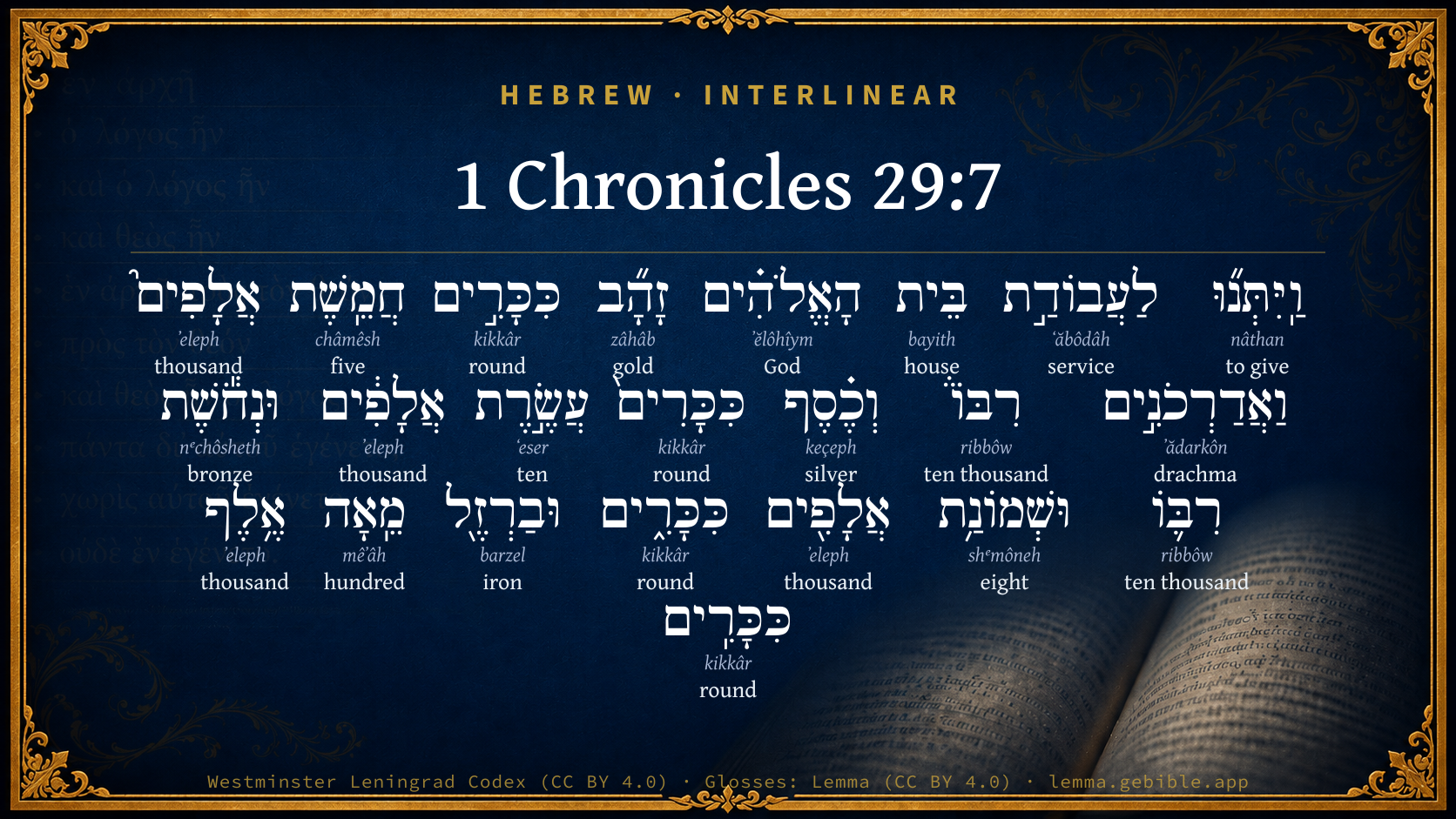
1 Chronicles 29:7

Hebrew (Westminster Leningrad Codex) 1 Chronicles 29:7 appears in the Hebrew Old Testament. The text above is from the Westminster Leningrad Codex. Each word links to its Strong’s number, a concise gloss, and parsing drawn from the Open Scriptures Hebrew Bible morphology. Click any word for its full Brown-Driver-Briggs (BDB) entry.
Download image
Cite this verse

1 Chronicles 29:7 (World English Bible). Public Domain. Lemma interlinear Bible study tool, https://lemma.gebible.app/v/1-chronicles/29/7.

Show BibTeX & RIS
BibTeX
RIS
English Translation
and they gave for the service of the house of God of gold five thousand talents and ten thousand darics, and of silver ten thousand talents, and of brass eighteen thousand talents, and of iron a hundred thousand talents.
World English Bible · Public Domain
Highlights
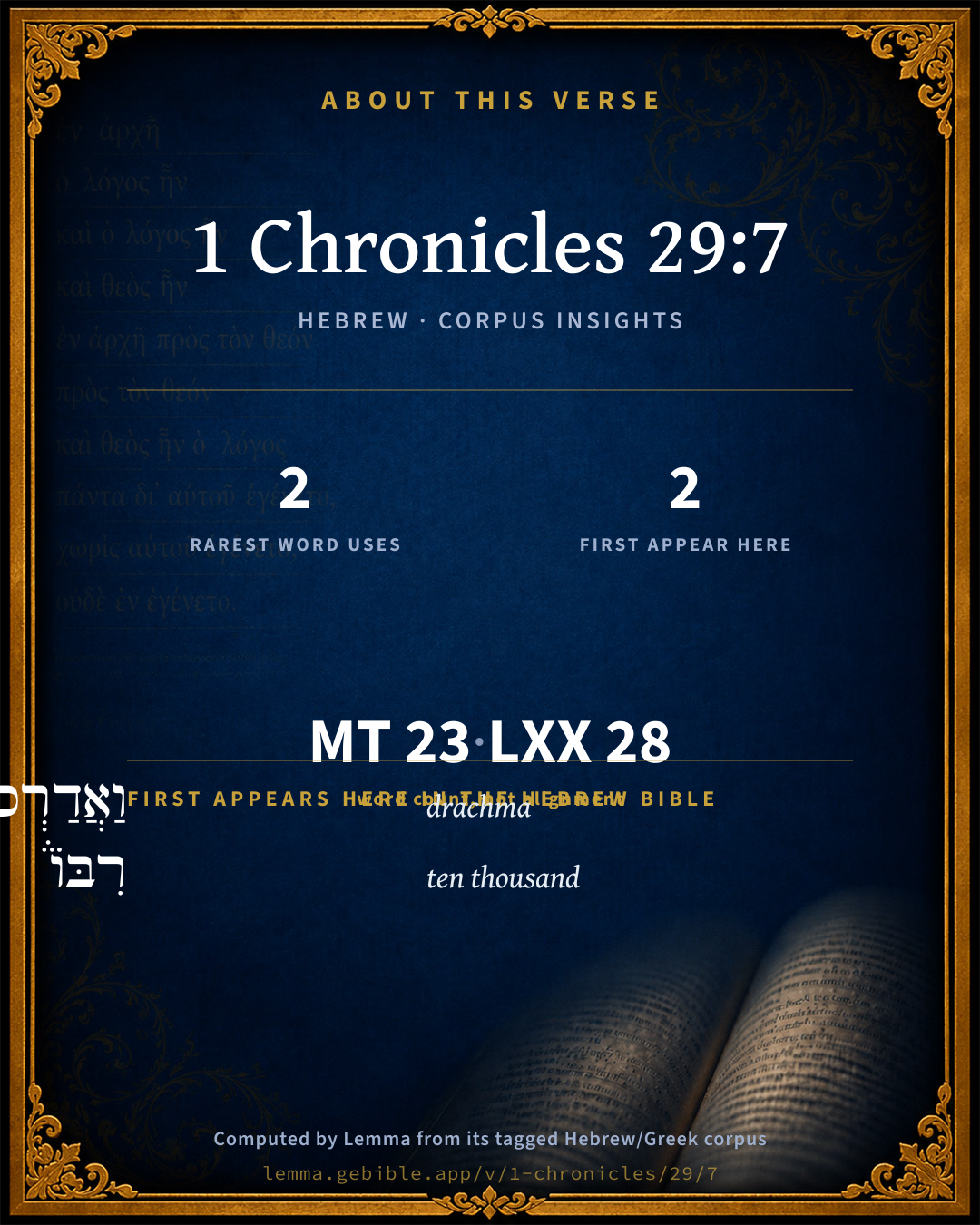
  • 2 first appearances in the Hebrew Bible
Full analysis ↓
Download a study sheet

One document with this verse’s original text, its word-by-word gloss line, the meaning frame, cross-references with their text, attributed commentary, and full source and license credits — printable, and it pastes into notes with its structure intact.

This verse Autodidact and up

Study sheet (.html) Plain text (.txt)

A passage Seminary Student

Up to 50 verses in one chapter. A passage sheet keeps up to 6 commentary sources and 12 cross-references per verse, in the order this page ranks them, and says so on the sheet whenever that leaves anything out. Ask for a single verse and you get the Autodidact verse sheet above.

Everything on this page stays free to read, with no account — the sheet is a download of what is already on screen, not access to it.

Want to remove ads? Support Godless Engineer
Compare translations 3

The same verse in 3 English versions, stacked beneath the original-language interlinear above. Click any original word for its lexicon entry.

Each is an independent rendering of the whole verse — the interlinear is not word-aligned to these translations.

Highlighted words mark where these versions differ — a whole-verse word diff, not a word-by-word alignment.

  • World English Bible Public Domain
    and they gave for the service of the house of God of gold five thousand talents and ten thousand darics, and of silver ten thousand talents, and of brass eighteen thousand talents, and of iron a hundred thousand talents.
  • King James Version Public Domain
    And gave for the service of the house of God of gold five thousand talents and ten thousand drams, and of silver ten thousand talents, and of brass eighteen thousand talents, and one hundred thousand talents of iron.
  • unfoldingWord Literal Text CC BY-SA 4.0
    And they gave gold for the service of the house of God, 5,000 kikkars and one myriad darics, and silver, 10,000 kikkars, and bronze, 18,000 kikkars, and iron, 100,000 kikkars.

unfoldingWord Literal Text — © unfoldingWord, licensed CC BY-SA 4.0. Word-aligned USFM3 via Door43 (git.door43.org/unfoldingWord/en_ult).

Versions to compare (up to 4)

3 of 4 selected

Show all 18 translations

Every available English version of this verse, each an independent rendering of the whole verse.

  • World English Bible Public Domain
    and they gave for the service of the house of God of gold five thousand talents and ten thousand darics, and of silver ten thousand talents, and of brass eighteen thousand talents, and of iron a hundred thousand talents.
  • Berean Standard Bible Public Domain
    Toward the service of God’s house they gave 5,000 talents and 10,000 darics of gold, 10,000 talents of silver, 18,000 talents of bronze, and 100,000 talents of iron.
  • Majority Standard Bible Public Domain
    Toward the service of God’s house they gave 5,000 talents and 10,000 darics of gold, 10,000 talents of silver, 18,000 talents of bronze, and 100,000 talents of iron.
  • King James Version Public Domain
    And gave for the service of the house of God of gold five thousand talents and ten thousand drams, and of silver ten thousand talents, and of brass eighteen thousand talents, and one hundred thousand talents of iron.
  • American Standard Version (1901) Public Domain
    and they gave for the service of the house of God of gold five thousand talents and ten thousand darics, and of silver ten thousand talents, and of brass eighteen thousand talents, and of iron a hundred thousand talents.
  • Revised Version (1885) Public Domain
    and they gave for the service of the house of God of gold five thousand talents and ten thousand darics, and of silver ten thousand talents, and of brass eighteen thousand talents, and of iron a hundred thousand talents.
  • Geneva Bible (1599) Public Domain
    And they gaue for the seruice of the house of God fiue thousande talents of golde, and ten thousand pieces, and ten thousand talents of siluer, and eighteene thousand talents of brasse, and one hundreth thousand talents of yron.
  • Douay-Rheims (1899) Public Domain
    And they gave for the works of the house of the Lord, of gold, five thousand talents, and ten thousand solids: of silver ten thousand talents: and of brass eighteen thousand talents: and of iron a hundred thousand talents.
  • Young's Literal Translation Public Domain
    And they give for the service of the house of God, of gold -- talents five thousand, and drams a myriad; and of silver -- talents ten thousand, and of brass -- a myriad and eight thousand talents; and of iron -- a hundred thousand talents;
  • Literal Standard Version CC BY-SA 4.0
    And they give for the service of the house of God five thousand talents and ten thousand drams of gold, and ten thousand talents of silver, and eighteen thousand talents of bronze, and one hundred thousand talents of iron;
  • Unlocked Literal Bible CC BY-SA 4.0
    They gave for the service of God's house five thousand talents and ten thousand darics of gold, ten thousand talents of silver, eighteen thousand talents of bronze, and 100,000 talents of iron.
  • unfoldingWord Literal Text CC BY-SA 4.0
    And they gave gold for the service of the house of God, 5,000 kikkars and one myriad darics, and silver, 10,000 kikkars, and bronze, 18,000 kikkars, and iron, 100,000 kikkars.
  • Darby Bible Public Domain
    And they gave for the service of the house of God five thousand talents and ten thousand darics of gold, and ten thousand talents of silver, and eighteen thousand talents of brass, and one hundred thousand talents of iron.
  • World Messianic Bible Public Domain
    and they gave for the service of God’s house of gold five thousand talents and ten thousand darics, of silver ten thousand talents, of bronze eighteen thousand talents, and of iron one hundred thousand talents.
  • Webster's Bible Public Domain
    And gave for the service of the house of God of gold five thousand talents and ten thousand drams, and of silver ten thousand talents, and of brass eighteen thousand talents, and one hundred thousand talents of iron.
  • Free Bible Version CC BY-SA 4.0
    They gave to the service of the house of God 5,000 talents and 10,000 darics of gold, 10,000 talents of silver, 18,000 talents of bronze, and 100,000 talents of iron.
  • Bible in Basic English Public Domain
    And they gave for the use of the house of the Lord, five thousand talents and ten thousand darics of gold, and ten thousand talents of silver, and eighteen thousand talents of brass, and a hundred thousand talents of iron.
  • JPS Tanakh (1917) Public Domain
    and they gave for the service of the house of God of gold five thousand talents and ten thousand darics, and of silver ten thousand talents, and of brass eighteen thousand talents, and of iron a hundred thousand talents.

Literal Standard Version (2020), Covenant Press — licensed CC BY-SA 4.0. Text via the HelloAO Bible API (eBible.org). Unlocked Literal Bible (unfoldingWord) — licensed CC BY-SA 4.0. Text via the HelloAO Bible API (eBible.org). unfoldingWord Literal Text — © unfoldingWord, licensed CC BY-SA 4.0. Word-aligned USFM3 via Door43 (git.door43.org/unfoldingWord/en_ult). Free Bible Version, Dr. Jonathan Gallagher — licensed CC BY-SA 4.0. Text via the HelloAO Bible API (eBible.org).

Word by word

More ways to search: Search by grammar → Find every occurrence → Compare this word →

Practice this passage: Drill this verse → Learn its vocabulary →

וַאֲדַרְכֹנִ֣ים
ʼădarkôn
H150
“and · drachmas”
Conjunction + Noun, Common, Masculine, Plural, Absolute
Part of Speech
Conjunction + Noun
Type
Common
Gender
Masculine
Number
Plural
State
Absolute
Full BDB Definition

Origin: of Persian origin

TWOT: 28 . 1

drachma, dram, daric - unit of weight and value (of gold, money) equal to 128 grains or 4.32 grams
  1. וַֽיִּתְּנ֞וּ nâthan H5414 “and · to give” Conjunction + Verb, Qal, Sequential Imperfect, 3rd Person, Masculine, Plural
  2. לַעֲבוֹדַ֣ת ʻăbôdâh H5656 “to/for · service of” Preposition + Noun, Common, Feminine, Singular, Construct
  3. בֵּית bayith H1004 “house of” Noun, Common, Masculine, Singular, Construct
  4. הָאֱלֹהִ֗ים ʼĕlôhîym H430 “the · God(s)” Particle, Definite Article + Noun, Common, Masculine, Plural, Absolute
  5. זָהָ֞ב zâhâb H2091 “gold” Noun, Common, Masculine, Singular, Absolute
  6. כִּכָּרִ֣ים kikkâr H3603 “talents” Noun, Common, Both, Plural, Absolute
  7. חֲמֵֽשֶׁת châmêsh H2568 “five” Adjective, Cardinal number, Masculine, Singular, Construct
  8. אֲלָפִים֮ ʼeleph H505 “thousand” Adjective, Cardinal number, Both, Plural, Absolute
  9. רִבּוֹ֒ ribbôw H7239 “ten thousand” Adjective, Cardinal number, Both, Singular, Absolute
  10. וְכֶ֗סֶף keçeph H3701 “and · silver” Conjunction + Noun, Common, Masculine, Singular, Absolute
  11. כִּכָּרִים֙ kikkâr H3603 “talents” Noun, Common, Both, Plural, Absolute
  12. עֲשֶׂ֣רֶת ʻeser H6235 “ten” Adjective, Cardinal number, Masculine, Singular, Construct
  13. אֲלָפִ֔ים ʼeleph H505 “thousand” Adjective, Cardinal number, Both, Plural, Absolute
  14. וּנְחֹ֕שֶׁת nᵉchôsheth H5178 “and · bronze” Conjunction + Noun, Common, Feminine, Singular, Absolute
  15. רִבּ֛וֹ ribbôw H7239 “ten thousand” Adjective, Cardinal number, Both, Singular, Absolute
  16. וּשְׁמוֹנַ֥ת shᵉmôneh H8083 “and · eight” Conjunction + Adjective, Cardinal number, Masculine, Singular, Construct
  17. אֲלָפִ֖ים ʼeleph H505 “thousand” Adjective, Cardinal number, Both, Plural, Absolute
  18. כִּכָּרִ֑ים kikkâr H3603 “talents” Noun, Common, Both, Plural, Absolute
  19. וּבַרְזֶ֖ל barzel H1270 “and · iron” Conjunction + Noun, Common, Masculine, Singular, Absolute
  20. מֵֽאָה mêʼâh H3967 “hundred” Adjective, Cardinal number, Both, Singular, Absolute
  21. אֶ֥לֶף ʼeleph H505 “thousand” Adjective, Cardinal number, Both, Singular, Absolute
  22. כִּכָּרִֽים kikkâr H3603 “talents” Noun, Common, Both, Plural, Absolute

About this verse

These counts appear in no published source. They are computed here, from the morphology-tagged text and Lemma’s own curated glosses. What Lemma adds →

23
words
16
distinct lemmas
Historical
section

Notable vocabulary

The rarest word here is וַאֲדַרְכֹנִ֣ים drachma H150 — appearing just 2 times in the whole Hebrew Bible.

First appearance in Scripture

These words make their first canonical appearance in the Hebrew Bible here:

  • וַאֲדַרְכֹנִ֣ים drachma H150
  • רִבּוֹ֒ ten thousand H7239

Shared distinctive vocabulary

וַאֲדַרְכֹנִ֣ים drachma H150 occurs in 2 verses of the Hebrew Bible. Also found in:

Grammatical profile

  • 1 verb
  • 12 nouns
  • 10 adjectives

Verb forms

  • וַֽיִּתְּנ֞וּ Qal · Sequential Imperfect

Repetition

Words recur within this verse — often emphatic in Hebrew:

  • כִּכָּרִ֣ים round H3603 ×4
  • אֲלָפִים֮ thousand H505 ×4
  • רִבּוֹ֒ ten thousand H7239 ×2

Hebrew & Septuagint length

In English translation the verse runs 39 words from the Hebrew and 41 from the Septuagint (LXX English) — closely comparable.

A rough comparison of the two English renderings, which tokenize alike — not a word-level alignment.

Word counts can differ between the Hebrew and the Greek without any difference in meaning — e.g. the Hebrew direct-object marker אֵת has no separate Greek word, and Greek often adds the article ὁ.

In the original languages it is 23 Hebrew tokens and 28 Greek tokens — but the two are counted differently (Hebrew bundles its prefixes and suffixes into one token; the Greek is in lemma form), so that isn’t a like-for-like length.

Cross-references

2

Topical passages linked to 1 Chronicles 29:7 in the Treasury of Scripture Knowledge — connected by theme and wording, ordered by reader-vote popularity; previews shown in the World English Bible.

  • Ezra 2:69 they gave after their ability into the treasury of the work sixty-one thousand darics of gold, and five thousand minas of silver, and one hundred priests' garments.
  • Nehemiah 7:70–71 Some from among the heads of fathers' [houses] gave to the work. The governor gave to the treasury one thousand darics of gold, fifty basins, and five hundred thirty priests' garments.

Cross-references courtesy of OpenBible.info (CC BY 4.0).

Hebrew and Greek witnesses Masoretic Hebrew ↔ Greek Septuagint

The same verse in the two great witnesses to the Old Testament, shown verse-for-verse.

These are two independent witnesses, not word-aligned to each other, and the Septuagint is shown in lemma (dictionary) form.

Hebrew 1 Chronicles 29:7 Masoretic · Westminster Leningrad Codex

וַֽיִּתְּנ֞וּ לַעֲבוֹדַ֣ת בֵּית הָאֱלֹהִ֗ים זָהָ֞ב כִּכָּרִ֣ים חֲמֵֽשֶׁת אֲלָפִים֮ וַאֲדַרְכֹנִ֣ים רִבּוֹ֒ וְכֶ֗סֶף כִּכָּרִים֙ עֲשֶׂ֣רֶת אֲלָפִ֔ים וּנְחֹ֕שֶׁת רִבּ֛וֹ וּשְׁמוֹנַ֥ת אֲלָפִ֖ים כִּכָּרִ֑ים וּבַרְזֶ֖ל מֵֽאָה אֶ֥לֶף כִּכָּרִֽים

and they gave for the service of the house of God of gold five thousand talents and ten thousand darics, and of silver ten thousand talents, and of brass eighteen thousand talents, and of iron a hundred thousand talents.

World English Bible · Public Domain

Greek LXX 1 Chronicles 29:7 Septuagint · lemma form

καί δίδωμι εἰς ὁ ἔργον οἶκος κύριος χρυσίον τάλαντον πεντακισχίλιοι καί χρυσοῦς μύριοι καί ἀργύριον τάλαντον δέκα χιλιάς καί χαλκοῦς τάλαντον μύριοι ὀκτακισχίλιοι καί σίδηρος τάλαντον χιλιάς ἑκατόν

And they gave for the works of the house of the Lord five thousand talents of gold, and ten thousand gold pieces, and ten thousand talents of silver, and eighteen thousand talents of brass, and one hundred thousand talents of iron.

LXX2012 (modern English Septuagint) · Public Domain

On this verse, Trapp's Complete Commentary discusses the Septuagint’s reading. Read the note in Commentary ↓

Hebrew: Westminster Leningrad Codex (CC BY 4.0). Greek: Septuagint (public domain); English from LXX2012 (modern English Septuagint) (Public Domain). How the Septuagint differs from the Hebrew →

Commentary

Notes on 1 Chronicles 29:7 from classic Christian and Jewish commentators (each source and its license shown beneath its notes). The classic Christian expositions comment on the surrounding passage and are grouped to its opening verse, so a note may address several verses; the Jewish commentaries on the Tanakh (Rashi and others) are per-verse, so they appear only where the commentator wrote on this verse.

Lemma curates 59 commentaries, every one of them public domain or Creative Commons licensed, each selected and text-cleaned for this edition rather than reprinted as found. About our sources →

Trapp's Complete Commentary

John Trapp

1Ch 29:7 And gave for the service of the house of God of gold five thousand talents and ten thousand drams, and of silver ten thousand talents, and of brass eighteen thousand talents, and one hundred thousand talents of iron.

Ver. 7. And ten thousand drams.] Shillings, some render it: the Rabbis say the word signifieth a piece of silver money, the value whereof is now not known; the Septuagint render it drams both here and in Ezr 8:27. The word here used, saith one, signifieth to do some great work, for it is Adarchon, which cometh of Adar, strong or mighty, and Con, to prepare; because money is the monarch of the world, and bears most mastery: but others, with more likelihood, say that Adarchon is made of the Greek Dραχμη, quales sunt nonnullae vocis Chaldaicae et Syracae.

John Trapp, A Commentary or Exposition upon All the Books of the Old and New Testament (1647–1656) — public domain. Text from a community e-Sword module.

Tyndale Open Study Notes

Tyndale Open Resources

29:7 10,000 gold coins: Persian darics were first minted during the reign of King Darius I of Persia (522–486 BC). In describing the Temple gifts presented during the days of Solomon, the Chronicler converted the information of his sources into the equivalents of his own day, just as the NLT converts Hebrew weights and measures to modern equivalents.

Tyndale Open Study Notes — © Tyndale Open Resources, licensed CC BY-SA 4.0. Text via the HelloAO Bible API.

Jamieson, Fausset & Brown

Robert Jamieson, A. R. Fausset & David Brown

drams--rather, darics, a Persian coin, with which the Jews from the time of the captivity became familiar, and which was afterwards extensively circulated in the countries of Western Asia. It is estimated as equal in value to 25s. of British currency.

of brass eighteen thousand talents, and one hundred thousand talents of iron--In Scripture, iron is always referred to as an article of comparatively low value, and of greater abundance and cheaper than bronze [NAPIER].

Jamieson, Fausset & Brown — Commentary Critical and Explanatory on the Whole Bible (1871) — public domain (CC PDM 1.0). Text via the HelloAO Bible API.

Adam Clarke's Commentary

Verse 7. Of gold five thousand talents] These, at five thousand and seventy-five pounds, fifteen shillings, and seven pence halfpenny each, amount to twenty-five millions, three hundred and seventy-eight thousand nine hundred and six pounds, five shillings, sterling. If, with Dr. Prideaux, we estimate the golden talent at upwards of seven thousand pounds sterling, the value of these five thousand talents will be much more considerable. See Clarke on Ex 25:39; "Mt 18:24"; and the calculations at the end of Clarke's notes on "2Ch 9:29".

Ten thousand drams] Probably golden darics, worth each about twenty shillings, amounting to ten thousand pounds.

Of silver ten thousand talents] These, at three hundred and fifty-three pounds, eleven shillings, and ten-pence halfpenny, each, amount to three millions five hundred and thirty-five thousand, nine hundred and thirty-seven pounds, ten shillings, sterling.

Brass eighteen thousand talents] Each six hundred and fifty-seven thousand grains, amount to one thousand and twenty-six tons, eleven hundred weight, and one quarter.

One hundred thousand talents of iron] Each six hundred and fifty-seven thousand grains, amount to five thousand seven hundred and three tons, two hundred weight, and a half.

Adam Clarke's Commentary on the Bible (1810–1826) — public domain. Text from a community e-Sword/MySword module.

Ellicott's Commentary for English Readers

(7) And gave . . . of gold.—And they gave . . . gold, five thousand talents; between thirty and forty millions sterling (!).

Ten thousand drams.—Rather, Darics. The Daric (Greek, Δαρεικὸς) was a Persian gold coin, value about £1 2s., first struck by the great Darius, son of Hystaspes (B.C. 521-485). It remained current in Western Asia long after the fall of the Persian Empire. The Hebrew word (’ãdarkônîm) occurs again only once, viz., at Ezr_8:27, where it clearly means Darics, and is so rendered by the Syriac (dγrξkϋnκ). The darkôn (or darbôn) is mentioned in the Talmud as a Persian coin. The chronicler, or his authority, has evidently substituted a familiar modern term for some ancient expression of value. No real coins are mentioned in Scripture before the age of the exile.

Silver ten thousand talents.—About £4,000,000 in modern value (see 1Ki_10:21; 1Ki_10:27); or, according to Schrader, who argues from Assyrian data, £3,750,000. The value of the bronze and the iron must have been much greater then than now. (See Note on 1Ch_22:14.)

A Bible Commentary for English Readers, edited by Charles John Ellicott (1878–1897) — public domain. Text from a community e-Sword module.

The Cambridge Bible for Schools and Colleges

gen. ed. J. J. S. Perowne

7. five thousand talents] i.e. of uncoined gold by weight.

ten thousand drams] R.V. ten thousand darics. A daric was a Persian gold coin worth about 22 shillings. The translation of A.V. drams (i.e. drachmæ) may however be right. The value of a gold drachma is about 9s. 5d. The total sum given in this verse sounds impossibly large; cp. 1Ch_22:14, note.

The Cambridge Bible for Schools and Colleges (gen. ed. J. J. S. Perowne; Cambridge University Press, 1878–1918) — public domain. Text from a community e-Sword module.

John Gill's Exposition

And gave for the service of the house of God,.... For building and adorning it, and providing proper utensils for it:

of gold five thousand talents; which, according to Scheuchzer (l), came to 61,100,000 ducats of gold: and these, with "the 10,000 drachms"; make of our money, according to Brerewood (m), 22,507,500 pounds; some reckon a drachm at two ducats and a half, and somewhat more (n):

and of silver ten thousand talents; which, according to the former writer, amounted to 450,000,000 imperials, or rix dollars; and, according to the latter, they made of our money 3,750,000 pounds:

and of brass eighteen thousand talents, and one hundred thousand talents of iron; the weight of each of which were so much.

(l) Ut supra. (Physica Sacra, vol. 4. p. 631.) (m) Ut supra. (Physica Sacra, vol. 4. p. 631.) (n) Eisenschmidius apud Scheuchzer. ib. p. 635.

John Gill's Exposition of the Whole Bible (1746–1763) — public domain (CC PDM 1.0). Text via the HelloAO Bible API.

Albert Barnes' Notes on the Bible

The word here translated “dram” is regarded by most critics as the Hebrew equivalent of the Persian “daric,” or ordinary gold coin, worth about 22 shillings of British money (circa 1880’s). Not, however, that the Jews possessed darics in David’s time: the writer wished to express, in language that would be intelligible to his readers, the value of the gold subscribed, and therefore he translated the terms employed in his documents, whatever they were, into terms that were in use in his own day. The doric became current in Palestine soon after the return from the captivity Ezr 2:69; Ezr 8:27; Neh 7:70-72.

Albert Barnes' Notes on the Bible (1834–1885) — public domain. Text from a community e-Sword/MySword module.

Haydock's Catholic Bible Commentary

Solids. Septuagint, "pieces of gold;" Greek: chrusous. Hebrew adarcnim, which Protestants render "drachms," (Haydock) after the Syriac, &c. Others think that the Darics, used in Persia, are meant, though they did not exist in David’s time. Esdras might reduce the money to correspond with the coin with which his countrymen were then acquainted, 2 Esdras vii. 70. (Pelletier) --- The Daric was equivalent to the golden sicle, which was only half the weight of one of silver, though this is not certain. (Calmet) --- A solid was only the sixth part of an ounce, whereas the sicle weighed half an ounce, or four drachms. --- Talents were always of the same weight, 125 Roman pounds. (Menochius)

George Leo Haydock (1774–1849), Haydock's Catholic Family Bible and Commentary, 1859 edition — public domain. Excludes Psalms (Douay-Rheims chapter numbering differs from Protestant) and Deuterocanonical books (Catholic canon only).

The Pulpit Commentary

The Authorized Version translation drams occurs also twice in Ezra and twice in Nehemiah. There is no doubt that the coin referred to is the Persian daric, with which the Jews became familiar during the time of their exile. The Hebrew word appears in three different forms.

1. As wOmKrda here and Ezr_8:27.

2. As wOmKrD Ezr_2:69; Neh_7:70-72.

3. As workD in rabbinical writings, but not in Scripture.

Respecting the possible derivations of the words in the first and second forms, see Gesenins"s "Lexicon," sub voce, and Conder"s "Handbook to the Bible" (2nd edit., p. 181). The obverse of the coin shows the image of a king, with bow and spear. The value of the coin is variously computed at thirteen shillings and sixpence or twenty. two shillings and sixpence. Keil suggests that the mention of darics as well as talents in this verse may point to some of the gold being contributed in the shape of coin instead of talents-weight. This does not seem likely, however, because, of course, the daric itself was not in use in Jerusalem in David"s time, and any gold coin that was then in use might have received mention on its own account, even if translated also into the daric. The Septuagint translates in this verse merely by the word crusouv, the Vulgate by solidos. Under any circumstances, the coin is to be distinguished from the dracnh. Specimens of the daric, both in gold and silver, exist in the Paris and Vienna Museums. The Hebrew word for the ten thousand preceding the so-called drams of this verse is the word for "myriad" (wOBri, a shortened form of twOBr), found also in Ezr_2:64; Neh_7:66; Dan_11:12; Jon_4:11.

The Pulpit Commentary (1880–1919), ed. H.D.M. Spence-Jones & Joseph S. Exell — public domain. Text from a community e-Sword module.

Keil & Delitzsch

C. F. Keil & F. Delitzsch

And gave for the service of the house of God,.... For building and adorning it, and providing proper utensils for it:

of gold five thousand talents; which, according to Scheuchzer (l), came to 61,100,000 ducats of gold: and these, with "the 10,000 drachms"; make of our money, according to Brerewood (m), 22,507,500 pounds; some reckon a drachm at two ducats and a half, and somewhat more (n):

and of silver ten thousand talents; which, according to the former writer, amounted to 450,000,000 imperials, or rix dollars; and, according to the latter, they made of our money 3,750,000 pounds:

and of brass eighteen thousand talents, and one hundred thousand talents of iron; the weight of each of which were so much.

(l) Ut supra. (Physica Sacra, vol. 4. p. 631.) (m) Ut supra. (Physica Sacra, vol. 4. p. 631.) (n) Eisenschmidius apud Scheuchzer. ib. p. 635.

Keil & Delitzsch — Biblical Commentary on the Old Testament (1861–1891) — public domain (CC PDM 1.0). Text via the HelloAO Bible API. (Old Testament only.)

Rashi

Rabbi Shlomo Yitzchaki (Rashi)

and ten thousand darics - quinons or quinens in Old French, drachmas.

Rashi on the Tanakh — English translations: “The Judaica Press complete Tanach with Rashi, translated by A. J. Rosenberg” (CC BY 4.0); “Pentateuch with Rashi's commentary by M. Rosenbaum and A.M. Silbermann, 1929-1934” (public domain); “The Metsudah Tanach series, Lakewood, N.J” (CC BY 4.0); and “The Book of Joshua, Metsudah Publications, 1997” (CC BY 4.0). Text via Sefaria.

Lesson kit

Teaching starters — assembled from the data on this page, not authored interpretation. Every prompt links to the verse data it draws on. Edit before teaching.

1 Chronicles, in the Historical, opens this verse with 23 words (16 distinct Hebrew lemmas). Its most distinctive word is ʼădarkôn (“drachma”). A historical commentator’s framing appears above. Read the whole chapter for the surrounding context.

Discussion questions

  1. How does “drachma” (ʼădarkôn) shape what this verse is saying?
  2. 2 words make their first appearance in Scripture here. What does this debut establish?
  3. How does Ezra 8:27, which shares the word «drachma», read alongside this verse?
  4. What does the repetition of “round” (4× in this one verse) do in this verse?
  5. These translations render this verse differently. What is at stake in choosing one wording over another?
  6. «וַֽיִּתְּנ֞וּ» is a Qal Sequential Imperfect verb. How does that grammatical form shape the action described?
  7. Compare how Trapp's Complete Commentary and Tyndale Open Study Notes read this verse. Where do they agree or differ?

Things to notice

Reading settings

Reading text

Shown beneath each verse's original-language words.

Old Testament
Old Testament edition

Read the OT as the Masoretic Hebrew (MT) or the Greek Septuagint (LXX).

English shown for the Greek Septuagint (in the Hebrew ↔ Greek comparison).

Comparing translations? Open the Compare panel on any verse page to stack up to four side by side.