
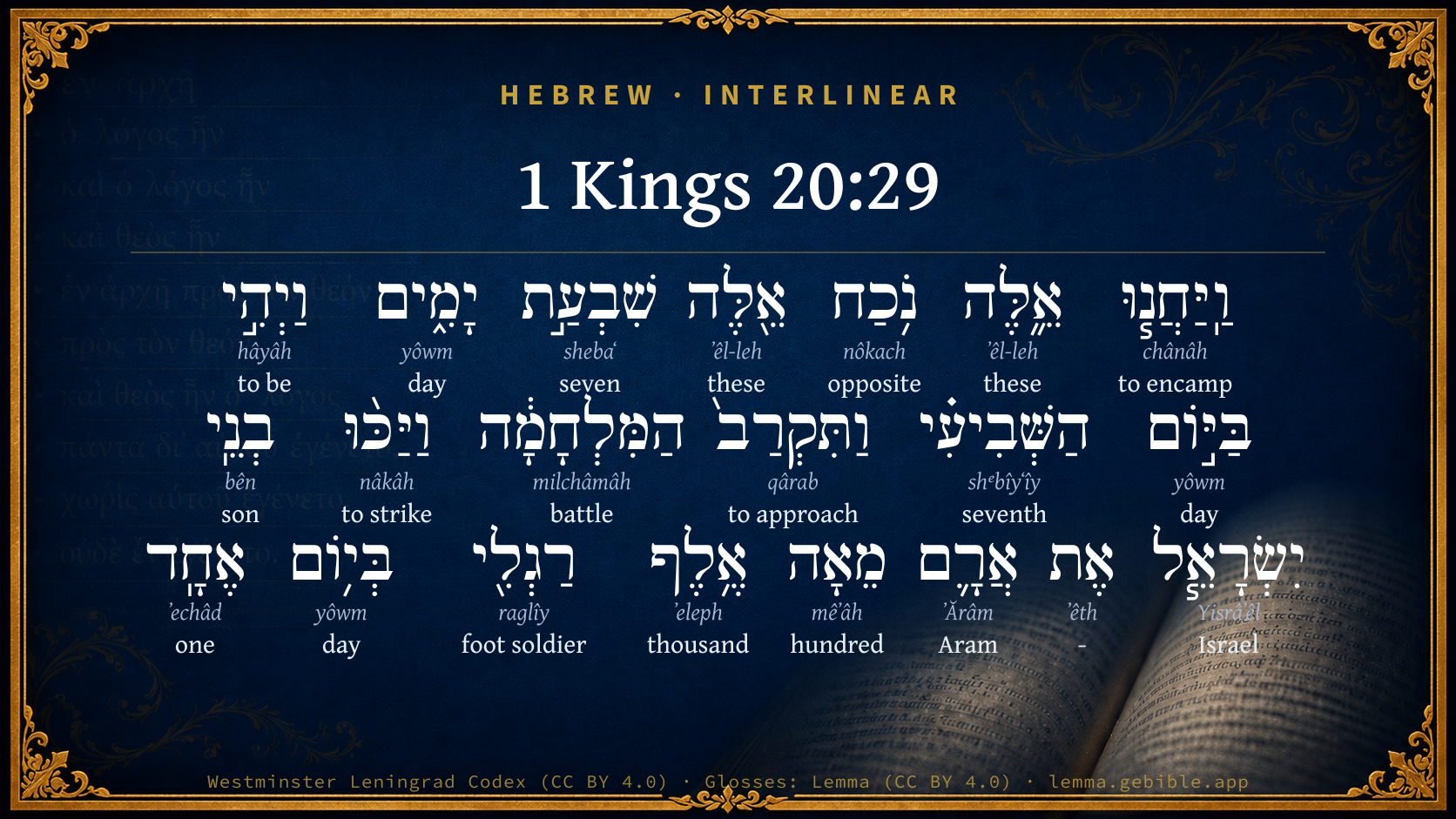
1 Kings 20:29

Hebrew (Westminster Leningrad Codex) 1 Kings 20:29 appears in the Hebrew Old Testament. The text above is from the Westminster Leningrad Codex. Each word links to its Strong’s number, a concise gloss, and parsing drawn from the Open Scriptures Hebrew Bible morphology. Click any word for its full Brown-Driver-Briggs (BDB) entry.
Download image
Cite this verse

1 Kings 20:29 (World English Bible). Public Domain. Lemma interlinear Bible study tool, https://lemma.gebible.app/v/1-kings/20/29.

Show BibTeX & RIS
BibTeX
RIS
English Translation
They encamped one over against the other seven days. So it was, that in the seventh day the battle was joined; and the children of Israel killed of the Syrians one hundred thousand footmen in one day.
World English Bible · Public Domain
Download a study sheet

One document with this verse’s original text, its word-by-word gloss line, the meaning frame, cross-references with their text, attributed commentary, and full source and license credits — printable, and it pastes into notes with its structure intact.

This verse Autodidact and up

Study sheet (.html) Plain text (.txt)

A passage Seminary Student

Up to 50 verses in one chapter. A passage sheet keeps up to 6 commentary sources and 12 cross-references per verse, in the order this page ranks them, and says so on the sheet whenever that leaves anything out. Ask for a single verse and you get the Autodidact verse sheet above.

Everything on this page stays free to read, with no account — the sheet is a download of what is already on screen, not access to it.

Want to remove ads? Support Godless Engineer
Compare translations 3

The same verse in 3 English versions, stacked beneath the original-language interlinear above. Click any original word for its lexicon entry.

Each is an independent rendering of the whole verse — the interlinear is not word-aligned to these translations.

Highlighted words mark where these versions differ — a whole-verse word diff, not a word-by-word alignment.

  • World English Bible Public Domain
    They encamped one over against the other seven days. So it was, that in the seventh day the battle was joined; and the children of Israel killed of the Syrians one hundred thousand footmen in one day.
  • King James Version Public Domain
    And they pitched one over against the other seven days. And so it was, that in the seventh day the battle was joined: and the children of Israel slew of the Syrians an hundred thousand footmen in one day.
  • unfoldingWord Literal Text CC BY-SA 4.0
    And they camped, these opposite these, seven days. And it happened on the seventh day that the battle approached, and the sons of Israel struck Aram, 100,000 foot soldiers in one day.

unfoldingWord Literal Text — © unfoldingWord, licensed CC BY-SA 4.0. Word-aligned USFM3 via Door43 (git.door43.org/unfoldingWord/en_ult).

Versions to compare (up to 4)

3 of 4 selected

Show all 18 translations

Every available English version of this verse, each an independent rendering of the whole verse.

  • World English Bible Public Domain
    They encamped one over against the other seven days. So it was, that in the seventh day the battle was joined; and the children of Israel killed of the Syrians one hundred thousand footmen in one day.
  • Berean Standard Bible Public Domain
    For seven days the armies camped opposite each other, and on the seventh day the battle ensued, and the Israelites struck down the Arameans—a hundred thousand foot soldiers in one day.
  • Majority Standard Bible Public Domain
    For seven days the armies camped opposite each other, and on the seventh day the battle ensued, and the Israelites struck down the Arameans—a hundred thousand foot soldiers in one day.
  • King James Version Public Domain
    And they pitched one over against the other seven days. And so it was, that in the seventh day the battle was joined: and the children of Israel slew of the Syrians an hundred thousand footmen in one day.
  • American Standard Version (1901) Public Domain
    And they encamped one over against the other seven days. And so it was, that in the seventh day the battle was joined; and the children of Israel slew of the Syrians a hundred thousand footmen in one day.
  • Revised Version (1885) Public Domain
    And they encamped one over against the other seven days. And so it was, that in the seventh day the battle was joined; and the children of Israel slew of the Syrians an hundred thousand footmen in one day.
  • Geneva Bible (1599) Public Domain
    And they pitched one ouer against the other seuen dayes, and in the seuenth day the battel was ioyned: and the children of Israel slew of the Aramites an hundreth thousand footemen in one day.
  • Douay-Rheims (1899) Public Domain
    And both sides set their armies in array one against the other seven days, and on the seventh day the battle was fought: and the children of Israel slew of the Syrians a hundred thousand footmen in one day.
  • Young's Literal Translation Public Domain
    And they encamp one over-against another seven days, and it cometh to pass on the seventh day, that the battle draweth near, and the sons of Israel smite Aram -- a hundred thousand footmen in one day.
  • Literal Standard Version CC BY-SA 4.0
    And they encamp opposite one another [for] seven days, and it comes to pass on the seventh day, that the battle draws near, and the sons of Israel strike one hundred thousand footmen of Aram in one day.
  • Unlocked Literal Bible CC BY-SA 4.0
    So the armies camped opposite each other for seven days. Then on the seventh day the battle started. The people of Israel killed 100,000 Aramean footmen in one day.
  • unfoldingWord Literal Text CC BY-SA 4.0
    And they camped, these opposite these, seven days. And it happened on the seventh day that the battle approached, and the sons of Israel struck Aram, 100,000 foot soldiers in one day.
  • Darby Bible Public Domain
    And they encamped one over against the other seven days; and it came to pass that on the seventh day the battle was joined; and the children of Israel smote of the Syrians a hundred thousand footmen in one day.
  • World Messianic Bible Public Domain
    They encamped opposite each other for seven days. Then on the seventh day the battle was joined; and the children of Israel killed one hundred thousand footmen of the Syrians in one day.
  • Webster's Bible Public Domain
    And they encamped one over against the other seven days. And so it was, that in the seventh day the battle was joined: and the children of Israel slew of the Syrians a hundred thousand footmen in one day.
  • Free Bible Version CC BY-SA 4.0
    The armies camped opposite each other for seven days. On the seventh day the battle took place. The Israelites killed 100,000 of the Aramean infantry in one day.
  • Bible in Basic English Public Domain
    Now the two armies kept their positions facing one another for seven days. And on the seventh day the fight was started; and the children of Israel put to the sword a hundred thousand Aramaean footmen in one day.
  • JPS Tanakh (1917) Public Domain
    And they encamped one over against the other seven days. And so it was, that in the seventh day the battle was joined; and the children of Israel slew of the Arameans a hundred thousand footmen in one day.

Literal Standard Version (2020), Covenant Press — licensed CC BY-SA 4.0. Text via the HelloAO Bible API (eBible.org). Unlocked Literal Bible (unfoldingWord) — licensed CC BY-SA 4.0. Text via the HelloAO Bible API (eBible.org). unfoldingWord Literal Text — © unfoldingWord, licensed CC BY-SA 4.0. Word-aligned USFM3 via Door43 (git.door43.org/unfoldingWord/en_ult). Free Bible Version, Dr. Jonathan Gallagher — licensed CC BY-SA 4.0. Text via the HelloAO Bible API (eBible.org).

Word by word

More ways to search: Search by grammar → Find every occurrence → Compare this word →

Practice this passage: Drill this verse → Learn its vocabulary →

רַגְלִ֖י
raglîy
H7273
“foot soldier”
Adjective, Adjective, Masculine, Singular, Absolute
Part of Speech
Adjective
Type
Adjective
Gender
Masculine
Number
Singular
State
Absolute
Full BDB Definition

Origin: from H7272

TWOT: 2113b

on foot - man on foot, footman, foot soldier
  1. וַֽיַּחֲנ֧וּ chânâh H2583 “and · to encamp” Conjunction + Verb, Qal, Sequential Imperfect, 3rd Person, Masculine, Plural
  2. אֵ֦לֶּה ʼêl-leh H428 “these” Pronoun, Demonstrative, Common, Plural
  3. נֹ֥כַח nôkach H5227 “opposite” Preposition
  4. אֵ֖לֶּה ʼêl-leh H428 “these” Pronoun, Demonstrative, Common, Plural
  5. שִׁבְעַ֣ת shebaʻ H7651 “seven” Adjective, Cardinal number, Masculine, Singular, Construct
  6. יָמִ֑ים yôwm H3117 “days” Noun, Common, Masculine, Plural, Absolute
  7. וַיְהִ֣י hâyâh H1961 “and · to be” Conjunction + Verb, Qal, Sequential Imperfect, 3rd Person, Masculine, Singular
  8. בַּיּ֣וֹם yôwm H3117 “in/at the · day” Preposition, Determined + Noun, Common, Masculine, Singular, Absolute
  9. הַשְּׁבִיעִ֗י shᵉbîyʻîy H7637 “the · seventh” Particle, Definite Article + Adjective, Ordinal number, Masculine, Singular, Absolute
  10. וַתִּקְרַב֙ qârab H7126 “and · to approach” Conjunction + Verb, Qal, Sequential Imperfect, 3rd Person, Feminine, Singular
  11. הַמִּלְחָמָ֔ה milchâmâh H4421 “the · battle” Particle, Definite Article + Noun, Common, Feminine, Singular, Absolute
  12. וַיַּכּ֨וּ nâkâh H5221 “and · to strike” Conjunction + Verb, Hiphil, Sequential Imperfect, 3rd Person, Masculine, Plural
  13. בְנֵֽי bên H1121 “sons of” Noun, Common, Masculine, Plural, Construct
  14. יִשְׂרָאֵ֧ל Yisrâʼêl H3478 “Israel” Noun, Proper
  15. אֶת ʼêth H853 “-” Particle, Direct Object
  16. אֲרָ֛ם ʼĂrâm H758 “Aram” Noun, Proper
  17. מֵאָה mêʼâh H3967 “hundred” Adjective, Cardinal number, Both, Singular, Absolute
  18. אֶ֥לֶף ʼeleph H505 “thousand” Adjective, Cardinal number, Both, Singular, Absolute
  19. בְּי֥וֹם yôwm H3117 “in/at · day” Preposition + Noun, Common, Masculine, Singular, Absolute
  20. אֶחָֽד ʼechâd H259 “one” Adjective, Cardinal number, Masculine, Singular, Absolute

About this verse

These counts appear in no published source. They are computed here, from the morphology-tagged text and Lemma’s own curated glosses. What Lemma adds →

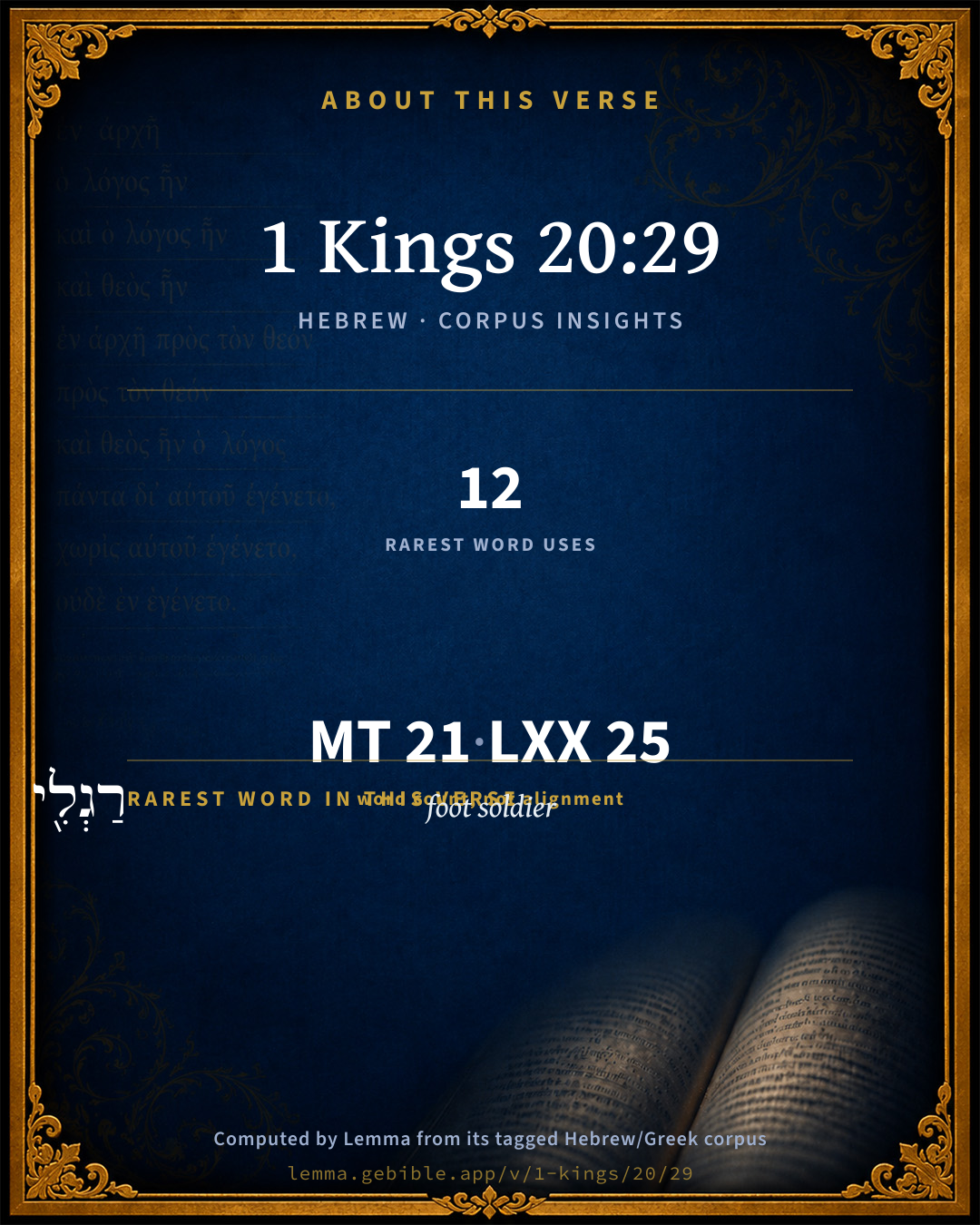
21
words
18
distinct lemmas
Historical
section

Notable vocabulary

The rarest word here is רַגְלִ֖י foot soldier H7273 — appearing just 12 times in the whole Hebrew Bible.

Shared distinctive vocabulary

רַגְלִ֖י foot soldier H7273 occurs in 12 verses of the Hebrew Bible. Also found in:

Grammatical profile

  • 4 verbs
  • 7 nouns
  • 6 adjectives
  • 2 pronouns
  • 1 preposition
  • 1 particle

Verb forms

  • וַֽיַּחֲנ֧וּ Qal · Sequential Imperfect
  • וַיְהִ֣י Qal · Sequential Imperfect
  • וַתִּקְרַב֙ Qal · Sequential Imperfect
  • וַיַּכּ֨וּ Hiphil · Sequential Imperfect

Repetition

Words recur within this verse — often emphatic in Hebrew:

  • יָמִ֑ים day H3117 ×3
  • אֵ֦לֶּה these H428 ×2

Hebrew & Septuagint length

In English translation the verse runs 37 words from the Hebrew and 34 from the Septuagint (LXX English) — closely comparable.

A rough comparison of the two English renderings, which tokenize alike — not a word-level alignment.

Word counts can differ between the Hebrew and the Greek without any difference in meaning — e.g. the Hebrew direct-object marker אֵת has no separate Greek word, and Greek often adds the article ὁ.

In the original languages it is 21 Hebrew tokens and 25 Greek tokens — but the two are counted differently (Hebrew bundles its prefixes and suffixes into one token; the Greek is in lemma form), so that isn’t a like-for-like length.

Cross-references

8

Topical passages linked to 1 Kings 20:29 in the Treasury of Scripture Knowledge — connected by theme and wording, ordered by reader-vote popularity; previews shown in the World English Bible.

  • Joshua 6:15 It happened on the seventh day, that they rose early at the dawning of the day, and compassed the city after the same manner seven times: only on the day they compassed the city seven times.
  • 1 Samuel 17:16 The Philistine drew near morning and evening, and presented himself forty days.
  • 2 Samuel 10:18 The Syrians fled before Israel; and David killed of the Syrians [the men of] seven hundred chariots, and forty thousand horsemen, and struck Shobach the captain of their host, so that he died there.
  • 2 Chronicles 13:17 Abijah and his people killed them with a great slaughter: so there fell down slain of Israel five hundred thousand chosen men.
  • 2 Chronicles 20:23–25 For the children of Ammon and Moab stood up against the inhabitants of Mount Seir, utterly to kill and destroy them: and when they had made an end of the inhabitants of Seir, everyone helped to destroy another.
  • 2 Chronicles 28:6 For Pekah the son of Remaliah killed in Judah one hundred twenty thousand in one day, all of them valiant men; because they had forsaken Yahweh, the God of their fathers.
  • Psalms 10:16 Yahweh is King forever and ever! The nations will perish out of his land.
  • Isaiah 37:36 The angel of Yahweh went forth, and struck in the camp of the Assyrians one hundred and eighty-five thousand; and when men arose early in the morning, behold, these were all dead bodies.

Cross-references courtesy of OpenBible.info (CC BY 4.0).

Hebrew and Greek witnesses Masoretic Hebrew ↔ Greek Septuagint

The same verse in the two great witnesses to the Old Testament, shown verse-for-verse.

These are two independent witnesses, not word-aligned to each other, and the Septuagint is shown in lemma (dictionary) form.

Hebrew 1 Kings 20:29 Masoretic · Westminster Leningrad Codex

וַֽיַּחֲנ֧וּ אֵ֦לֶּה נֹ֥כַח אֵ֖לֶּה שִׁבְעַ֣ת יָמִ֑ים וַיְהִ֣י בַּיּ֣וֹם הַשְּׁבִיעִ֗י וַתִּקְרַב֙ הַמִּלְחָמָ֔ה וַיַּכּ֨וּ בְנֵֽי יִשְׂרָאֵ֧ל אֶת אֲרָ֛ם מֵאָה אֶ֥לֶף רַגְלִ֖י בְּי֥וֹם אֶחָֽד

They encamped one over against the other seven days. So it was, that in the seventh day the battle was joined; and the children of Israel killed of the Syrians one hundred thousand footmen in one day.

World English Bible · Public Domain

Greek LXX 1 Kings 20:29 Septuagint · lemma form

ὁράω ὡς κατανύσσω αχααβ ἀπό πρόσωπον ἐγώ οὐ ἐπιἄγω ὁ κακία ἐν ὁ ἡμέρα αὐτός ἀλλά ἐν ὁ ἡμέρα ὁ υἱός αὐτός ἐπιἄγω ὁ κακία

Have you seen how Achaab has been pricked to the heart before me? I will not bring on the evil in his days, but in his son's days will I bring on the evil.

LXX2012 (modern English Septuagint) · Public Domain

Hebrew: Westminster Leningrad Codex (CC BY 4.0). Greek: Septuagint (public domain); English from LXX2012 (modern English Septuagint) (Public Domain). How the Septuagint differs from the Hebrew →

Targum (Aramaic paraphrase)

1

The Targum is the ancient Jewish Aramaic paraphrase of the Hebrew Scriptures — an interpretive translation, not the Hebrew text itself. Onkelos (literal) and Pseudo-Jonathan (expansive) render the Torah, and Jonathan the Prophets. Coverage is partial: where no permissively-licensed English translation exists for a verse, only the Aramaic is shown. This is verse-level text, not a word-by-word alignment to the Hebrew.

  1. Targum Jonathan Prophets (Joshua–Malachi)
    וּשְׁרוֹ אִלֵין לָקֳבֵיל אִלֵין שַׁבְעָא יוֹמִין וַהֲוָה בְּיוֹמָא שְׁבִיעָאָה וּקְרִיבוּ עָבְדֵי קְרָבָא וּמְחוֹ (כָּל) בְּנֵי יִשְׂרָאֵל יַת אֱנַשׁ אֲרָם מְאָה אַלְפִין גְבַר רִגְלֵי בְּיוֹמָא חָד:

    (no public-domain English translation for this verse)

    Targum Jonathan — Aramaic: “Mikraot Gedolot” (public domain). English: “Sefaria Community Translation” (CC0 1.0 (public-domain dedication)); “London "Chaldee Paraphrase," 1871” (public domain). Text via Sefaria.

Commentary

Notes on 1 Kings 20:29 from classic Christian and Jewish commentators (each source and its license shown beneath its notes). The classic Christian expositions comment on the surrounding passage and are grouped to its opening verse, so a note may address several verses; the Jewish commentaries on the Tanakh (Rashi and others) are per-verse, so they appear only where the commentator wrote on this verse.

Lemma curates 59 commentaries, every one of them public domain or Creative Commons licensed, each selected and text-cleaned for this edition rather than reprinted as found. About our sources →

Trapp's Complete Commentary

John Trapp

1Ki 20:29 And they pitched one over against the other seven days. And [so] it was, that in the seventh day the battle was joined: and the children of Israel slew of the Syrians an hundred thousand footmen in one day.

Ver. 29. And they pitched one over against the other.] So did the Turks and Christians, under Baldwin, king of Jerusalem: for three months’ space they lay facing one another, and then both armies rose; the Christians fearing the multitude of the Turks, and the Turks the valour of the Christians: wherefore they returned without any notable thing done. {a} But these Israelites neither stayed so long, nor did so little; for after seven days’ waiting for the enemy’s onset, they fell on, and made a huge slaughter.

{a} Turk. Hist., 27.

John Trapp, A Commentary or Exposition upon All the Books of the Old and New Testament (1647–1656) — public domain. Text from a community e-Sword module.

Joseph Benson's Commentary

1Ki 20:29. They pitched one over against the other seven days — It may seem strange that they should look one another in the face so long, without coming to any action; for the Syrians had so much advantage in their numbers, that one would have thought they would have immediately encompassed the Israelites, and have destroyed them all: but perhaps the Israelites continued all these days on the rising ground, and the Syrians did not dare to attack them till they came down into the plain. Israel slew of the Syrians a hundred thousand footmen in one day — In all probability they surprised them by a sudden, unexpected attack; and God dismayed them, and struck such a terror into them, that they could make no resistance.

Joseph Benson's Commentary on the Old and New Testaments (1811–1818) — public domain. Text from a community e-Sword module.

Adam Clarke's Commentary

Verse 29. Slew a hundred thousand footmen in one day.] This number is enormous; but the MSS. and versions give no various reading.

Adam Clarke's Commentary on the Bible (1810–1826) — public domain. Text from a community e-Sword/MySword module.

The Cambridge Bible for Schools and Colleges

gen. ed. J. J. S. Perowne

29. seven days] Perhaps there was some religious idea on the part of the Israelites connected with this time of waiting before they began the battle. After the promise of the man of God, the conflict would have a religious sanction and be entered on with confidence.

an hundred thousand footmen] The number is very large, but Josephus gives the same. If it be correct, the slaughter can hardly have been effected in any other way but by a panic in which these troops cut and trampled down one another.

The Cambridge Bible for Schools and Colleges (gen. ed. J. J. S. Perowne; Cambridge University Press, 1878–1918) — public domain. Text from a community e-Sword module.

John Gill's Exposition

And they pitched one over against the other seven days,.... Very probably the Israelites pitched upon an hill, and the Syrians waited till they changed their position, not caring to fall upon them, though so very supernumerary to them, for the reason before given:

and so it was, that in the seventh day the battle was joined; or they that made war drew nigh, as the Targum, and both sides engaged in battle:

and the children of Israel slew of the Syrians 100,000 footmen in one day; which was a prodigious slaughter to be made by so small an army; the hand of the Lord was visible in it.

John Gill's Exposition of the Whole Bible (1746–1763) — public domain (CC PDM 1.0). Text via the HelloAO Bible API.

Haydock's Catholic Bible Commentary

Days. The Syrians durst not begin the attack. (Haydock)

George Leo Haydock (1774–1849), Haydock's Catholic Family Bible and Commentary, 1859 edition — public domain. Excludes Psalms (Douay-Rheims chapter numbering differs from Protestant) and Deuterocanonical books (Catholic canon only).

Whedon's Commentary on the Bible

Daniel D. Whedon

29. A hundred thousand — This number is in keeping with the immense numbers which are represented as following the king of Syria. Compare 1Ki_20:10; 1Ki_20:25; 1Ki_20:27.

Daniel D. Whedon (gen. ed.), Commentary on the Old and New Testaments (1874–1909) — public domain. Text from a community e-Sword module.

The Pulpit Commentary

And they pitched one over against the other Heb. these opposite these seven days. The Syrians, despite their overwhelming numbers, appear to have been afraid to attack, and the Israelites were naturally reluctant, despite the promise they had received, to join battle with so great a host. And so it was, that in the seventh day the battle was Joined Heb. the war drew near. It may have been by the direction of the man of God that the Israelites attacked on the seventh day, or the precedent of Jericho (Jos_6:15) may have influenced their leaders; or the number seven, properly the mark and signature of the covenant, may have come to be regarded superstitiously in fact, as a lucky number (cf. Isa_65:11; Est_3:7) and the children of Israel slew of the Syrians a hundred thousand footmen in one day. This prodigious slaughter may well create surprise. That two comparatively small companies should be able, physically, to slay, with the rude weapons of that age, 100, 000 warriors, fighting for their lives, seems hardly credible. It is probable, therefore, that the numbers here, as elsewhere, have been exaggerated in the course of transcription. Another explanation of the difficulty has, indeed, been suggested by Bahr, viz., that WKYw may signify here, as it undoubtedly does elsewhere, "defeated," "put to flight" (see Gen_14:5; 1Sa_13:4, etc.) And the Hebrew at first sight seems to favour this idea, for it may be rendered literally, they smote Syria, a hundred thousand, etc. The 100, 000 would then represent the entire strength of the Syrian infantry. But the mention of the "footmen" and of "one day" alike suggests that it is of slaughter, not dispersion, that the historian speaks.

Seven days." Compare the "seven thousand" of ver. 15, and Jos_6:4, Jos_6:15, Jos_6:16. He hath commanded His covenant forever (Ps 3; cf. 1Ch_16:15; Psa_89:28, Psa_89:34) By this act, Israel

(1) showed that they remembered the works of the Lord, His wonders of old time; and

(2) they reminded Him of His holy covenant. (Luk_1:72-74)

The Pulpit Commentary (1880–1919), ed. H.D.M. Spence-Jones & Joseph S. Exell — public domain. Text from a community e-Sword module.

Keil & Delitzsch

C. F. Keil & F. Delitzsch

After seven days the battle was fought. The Israelites smote the Syrians, a hundred thousand men in one day; and when the rest fled to Aphek, into the city, the wall fell upon twenty-seven thousand men, ἵνα δὲ κακεῖνοι καὶ οὗτοι μάθωσιν, ὡς θεήλατος ἡ πλεεγεέ (Theodoret). The flying Syrians had probably some of them climbed the wall of the city to offer resistance to the Israelites in pursuit, and some of them sought to defend themselves by taking shelter behind it. And during the conflict, through the special interposition of God, the wall fell and buried the Syrians who were there. The cause of the fall is not given. Thenius assumes that it was undermined, in order to remove all idea of any miraculous working of the omnipotence of God. Benhadad himself fled into the city "room to room," i.e., from one room to another (cf. Kg1 22:25; Ch2 18:24).

Keil & Delitzsch — Biblical Commentary on the Old Testament (1861–1891) — public domain (CC PDM 1.0). Text via the HelloAO Bible API. (Old Testament only.)

unfoldingWord translationNotes

Door43 World Missions Community

seven days

"7 days" (See: Numbers)

100,000

"one hundred thousand" (See: Numbers)

footmen

A "footman" is a soldier who marches on foot.

The rest fled to Aphek

The expression "the rest" assumes the words "of the Aramean soldiers." AT: "The rest of the Aramean soldiers" (See: Ellipsis)

Aphek

This is the name of a town. (See: How to Translate Names)

twenty-seven thousand

"27,000" (See: Numbers)

unfoldingWord translationNotes — © Distant Shores Media and the Door43 World Missions Community, licensed CC BY-SA 4.0. Source: git.door43.org/Door43/en_tn.

Lesson kit

Teaching starters — assembled from the data on this page, not authored interpretation. Every prompt links to the verse data it draws on. Edit before teaching.

1 Kings, in the Historical, opens this verse with 21 words (18 distinct Hebrew lemmas). Its most distinctive word is raglîy (“foot soldier”). A historical commentator’s framing appears above. Read the whole chapter for the surrounding context.

Discussion questions

  1. How does “foot soldier” (raglîy) shape what this verse is saying?
  2. Exodus 12:37 shares the word «foot soldier» with this verse. How do the two illuminate each other?
  3. “day” occurs 3× in this one verse. What is the effect of the repetition?
  4. These translations render this verse differently; the difference is in the English rendering, not the original. What questions does that raise?
  5. The verb «וַֽיַּחֲנ֧וּ» is Qal Sequential Imperfect. How does its form color the action?
  6. Reading how Trapp's Complete Commentary and Joseph Benson's Commentary read this verse, where do the two commentators agree and where do they part?

Things to notice

Reading settings

Reading text

Shown beneath each verse's original-language words.

Old Testament
Old Testament edition

Read the OT as the Masoretic Hebrew (MT) or the Greek Septuagint (LXX).

English shown for the Greek Septuagint (in the Hebrew ↔ Greek comparison).

Comparing translations? Open the Compare panel on any verse page to stack up to four side by side.