
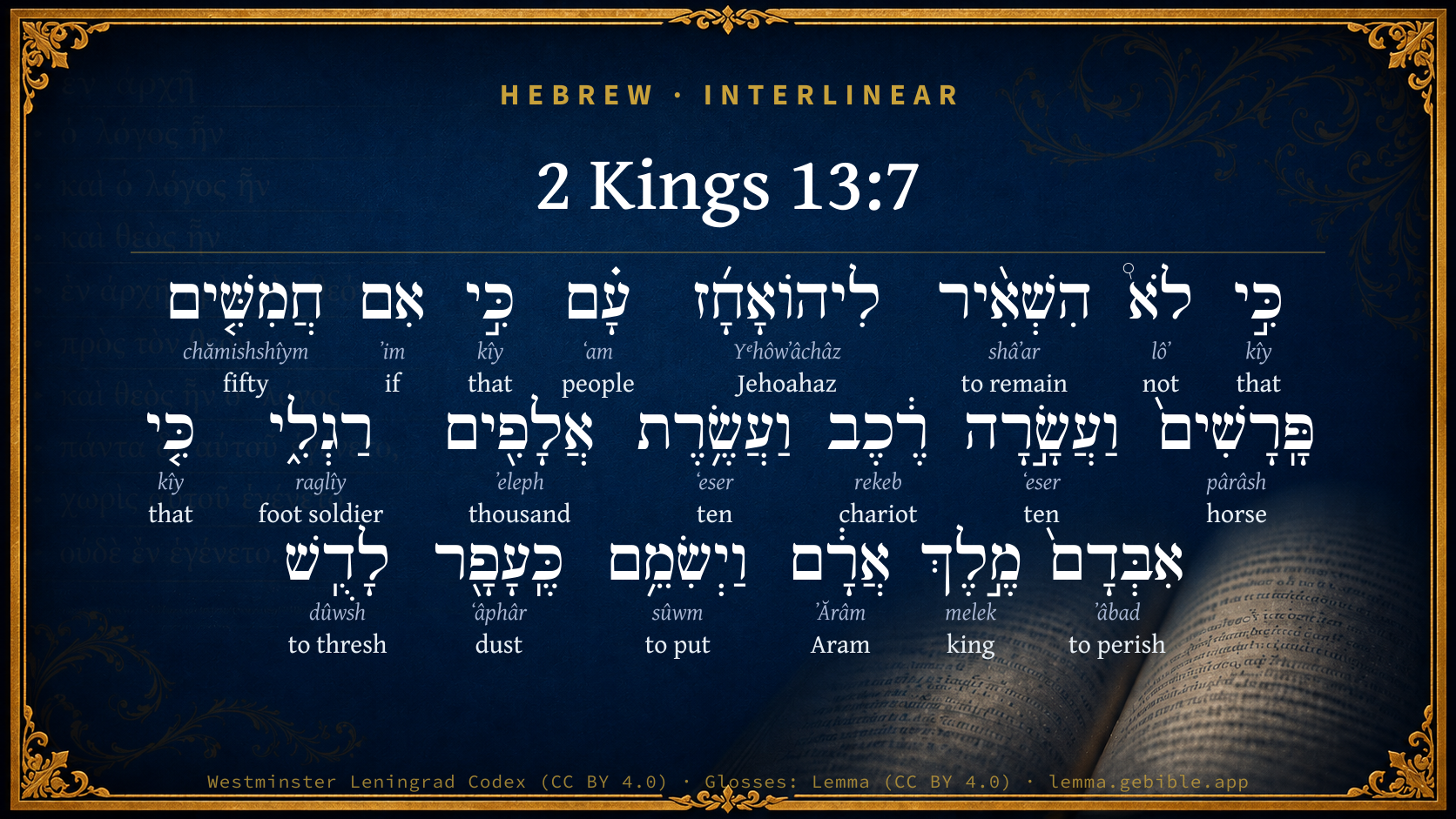
2 Kings 13:7

Hebrew (Westminster Leningrad Codex) 2 Kings 13:7 appears in the Hebrew Old Testament. The text above is from the Westminster Leningrad Codex. Each word links to its Strong’s number, a concise gloss, and parsing drawn from the Open Scriptures Hebrew Bible morphology. Click any word for its full Brown-Driver-Briggs (BDB) entry.
Download image
Cite this verse

2 Kings 13:7 (World English Bible). Public Domain. Lemma interlinear Bible study tool, https://lemma.gebible.app/v/2-kings/13/7.

Show BibTeX & RIS
BibTeX
RIS
English Translation
For he didn't leave to Jehoahaz of the people save fifty horsemen, and ten chariots, and ten thousand footmen; for the king of Syria destroyed them, and made them like the dust in threshing.
World English Bible · Public Domain
Download a study sheet

One document with this verse’s original text, its word-by-word gloss line, the meaning frame, cross-references with their text, attributed commentary, and full source and license credits — printable, and it pastes into notes with its structure intact.

This verse Autodidact and up

Study sheet (.html) Plain text (.txt)

A passage Seminary Student

Up to 50 verses in one chapter. A passage sheet keeps up to 6 commentary sources and 12 cross-references per verse, in the order this page ranks them, and says so on the sheet whenever that leaves anything out. Ask for a single verse and you get the Autodidact verse sheet above.

Everything on this page stays free to read, with no account — the sheet is a download of what is already on screen, not access to it.

Want to remove ads? Support Godless Engineer
Compare translations 3

The same verse in 3 English versions, stacked beneath the original-language interlinear above. Click any original word for its lexicon entry.

Each is an independent rendering of the whole verse — the interlinear is not word-aligned to these translations.

Highlighted words mark where these versions differ — a whole-verse word diff, not a word-by-word alignment.

  • World English Bible Public Domain
    For he didn't leave to Jehoahaz of the people save fifty horsemen, and ten chariots, and ten thousand footmen; for the king of Syria destroyed them, and made them like the dust in threshing.
  • King James Version Public Domain
    Neither did he leave of the people to Jehoahaz but fifty horsemen, and ten chariots, and ten thousand footmen; for the king of Syria had destroyed them, and had made them like the dust by threshing.
  • unfoldingWord Literal Text CC BY-SA 4.0
    For he did not leave people to Jehoahaz except 50 horsemen and 10 chariots and 10,000 foot soldiers, for the king of Aram destroyed them and made them like dust to threshing.

unfoldingWord Literal Text — © unfoldingWord, licensed CC BY-SA 4.0. Word-aligned USFM3 via Door43 (git.door43.org/unfoldingWord/en_ult).

Versions to compare (up to 4)

3 of 4 selected

Show all 18 translations

Every available English version of this verse, each an independent rendering of the whole verse.

  • World English Bible Public Domain
    For he didn't leave to Jehoahaz of the people save fifty horsemen, and ten chariots, and ten thousand footmen; for the king of Syria destroyed them, and made them like the dust in threshing.
  • Berean Standard Bible Public Domain
    Jehoahaz had no army left, except fifty horsemen, ten chariots, and ten thousand foot soldiers, because the king of Aram had destroyed them and made them like the dust at threshing.
  • Majority Standard Bible Public Domain
    Jehoahaz had no army left, except fifty horsemen, ten chariots, and ten thousand foot soldiers, because the king of Aram had destroyed them and made them like the dust at threshing.
  • King James Version Public Domain
    Neither did he leave of the people to Jehoahaz but fifty horsemen, and ten chariots, and ten thousand footmen; for the king of Syria had destroyed them, and had made them like the dust by threshing.
  • American Standard Version (1901) Public Domain
    For he left not to Jehoahaz of the people save fifty horsemen, and ten chariots, and ten thousand footmen; for the king of Syria destroyed them, and made them like the dust in threshing.
  • Revised Version (1885) Public Domain
    For he left not to Jehoahaz of the people save fifty horsemen, and ten chariots, and ten thousand footmen; for the king of Syria destroyed them, and made them like the dust in threshing.
  • Geneva Bible (1599) Public Domain
    For he had left of the people to Iehoahaz but fiftie horsemen, and tenne charets, and tenne thousand footemen, because the King of Aram had destroyed them, and made them like dust beaten to pouder.
  • Douay-Rheims (1899) Public Domain
    And Joachaz had no more left of the people than fifty horsemen, and ten chariots, and ten thousand footmen: for the king of Syria had slain them, and had brought them low as dust by thrashing in the barnfloor.
  • Young's Literal Translation Public Domain
    for he left not to Jehoahaz of the people except fifty horsemen, and ten chariots, and ten thousand footmen, for the king of Aram hath destroyed them, and maketh them as dust for threshing.
  • Literal Standard Version CC BY-SA 4.0
    for he did not leave to Jehoahaz of the people except fifty horsemen, and ten chariots, and ten thousand footmen, for the king of Aram has destroyed them, and makes them as dust for threshing.
  • Unlocked Literal Bible CC BY-SA 4.0
    The Arameans left Jehoahaz with only fifty horsemen, ten chariots, and ten thousand footmen, for the king of Aram had destroyed them and made them like the chaff at threshing time.
  • unfoldingWord Literal Text CC BY-SA 4.0
    For he did not leave people to Jehoahaz except 50 horsemen and 10 chariots and 10,000 foot soldiers, for the king of Aram destroyed them and made them like dust to threshing.
  • Darby Bible Public Domain
    For he had left of the people to Jehoahaz but fifty horsemen, and ten chariots, and ten thousand footmen; for the king of Syria had destroyed them, and had made them like the dust by threshing.
  • World Messianic Bible Public Domain
    For he didn’t leave to Jehoahaz of the people any more than fifty horsemen, and ten chariots, and ten thousand footmen; for the king of Syria destroyed them and made them like the dust in threshing.
  • Webster's Bible Public Domain
    Neither did he leave of the people to Jehoahaz but fifty horsemen, and ten chariots, and ten thousand footmen; for the king of Syria had destroyed them, and had made them like the dust by threshing.
  • Free Bible Version CC BY-SA 4.0
    All that was left of Jehoahaz's army were fifty horsemen, ten chariots, and ten thousand soldiers, for the king of Aram had destroyed the rest, turning them into dust like that when grain is threshed.
  • Bible in Basic English Public Domain
    For out of all his army, Jehoahaz had only fifty horsemen and ten carriages and ten thousand footmen; the king of Aram had given them up to destruction, crushing them like dust.
  • JPS Tanakh (1917) Public Domain
    For there was not left to Jehoahaz of the people save fifty horsemen, and ten chariots, and ten thousand footmen; for the king of Aram destroyed them, and made them like the dust in threshing.

Literal Standard Version (2020), Covenant Press — licensed CC BY-SA 4.0. Text via the HelloAO Bible API (eBible.org). Unlocked Literal Bible (unfoldingWord) — licensed CC BY-SA 4.0. Text via the HelloAO Bible API (eBible.org). unfoldingWord Literal Text — © unfoldingWord, licensed CC BY-SA 4.0. Word-aligned USFM3 via Door43 (git.door43.org/unfoldingWord/en_ult). Free Bible Version, Dr. Jonathan Gallagher — licensed CC BY-SA 4.0. Text via the HelloAO Bible API (eBible.org).

Word by word

More ways to search: Search by grammar → Find every occurrence → Compare this word →

Practice this passage: Drill this verse → Learn its vocabulary →

רַגְלִ֑י
raglîy
H7273
“foot soldier”
Adjective, Adjective, Masculine, Singular, Absolute
Part of Speech
Adjective
Type
Adjective
Gender
Masculine
Number
Singular
State
Absolute
Full BDB Definition

Origin: from H7272

TWOT: 2113b

on foot - man on foot, footman, foot soldier
  1. כִּ֣י kîy H3588 “that” Conjunction
  2. לֹא֩ lôʼ H3808 “not” Particle, Negative
  3. הִשְׁאִ֨יר shâʼar H7604 “to remain” Verb, Hiphil, Perfect, 3rd Person, Masculine, Singular
  4. לִיהוֹאָחָ֜ז Yᵉhôwʼâchâz H3059 “to/for · Jehoahaz” Preposition + Noun, Proper
  5. עָ֗ם ʻam H5971 “people” Noun, Common, Masculine, Singular, Absolute
  6. כִּ֣י kîy H3588 “that” Conjunction
  7. אִם ʼim H518 “if” Conjunction
  8. חֲמִשִּׁ֤ים chămishshîym H2572 “fifty” Adjective, Cardinal number, Both, Plural, Absolute
  9. פָּֽרָשִׁים֙ pârâsh H6571 “horses” Noun, Common, Masculine, Plural, Absolute
  10. וַעֲשָׂ֣רָה ʻeser H6235 “and · ten” Conjunction + Adjective, Cardinal number, Masculine, Singular, Absolute
  11. רֶ֔כֶב rekeb H7393 “chariot” Noun, Common, Masculine, Singular, Absolute
  12. וַעֲשֶׂ֥רֶת ʻeser H6235 “and · ten” Conjunction + Adjective, Cardinal number, Masculine, Singular, Construct
  13. אֲלָפִ֖ים ʼeleph H505 “thousand” Adjective, Cardinal number, Both, Plural, Absolute
  14. כִּ֤י kîy H3588 “that” Conjunction
  15. אִבְּדָם֙ ʼâbad H6 “to perish · them” Verb, Piel, Perfect, 3rd Person, Masculine, Singular + Suffix, Personal, 3rd Person, Masculine, Plural
  16. מֶ֣לֶךְ melek H4428 “king of” Noun, Common, Masculine, Singular, Construct
  17. אֲרָ֔ם ʼĂrâm H758 “Aram” Noun, Proper
  18. וַיְשִׂמֵ֥ם sûwm H7760 “and · to put · them” Conjunction + Verb, Qal, Sequential Imperfect, 3rd Person, Masculine, Singular + Suffix, Personal, 3rd Person, Masculine, Plural
  19. כֶּֽעָפָ֖ר ʻâphâr H6083 “like/as the · dust” Preposition, Determined + Noun, Common, Masculine, Singular, Absolute
  20. לָדֻֽשׁ dûwsh H1758 “to thresh” Preposition + Verb, Qal, Infinitive Construct

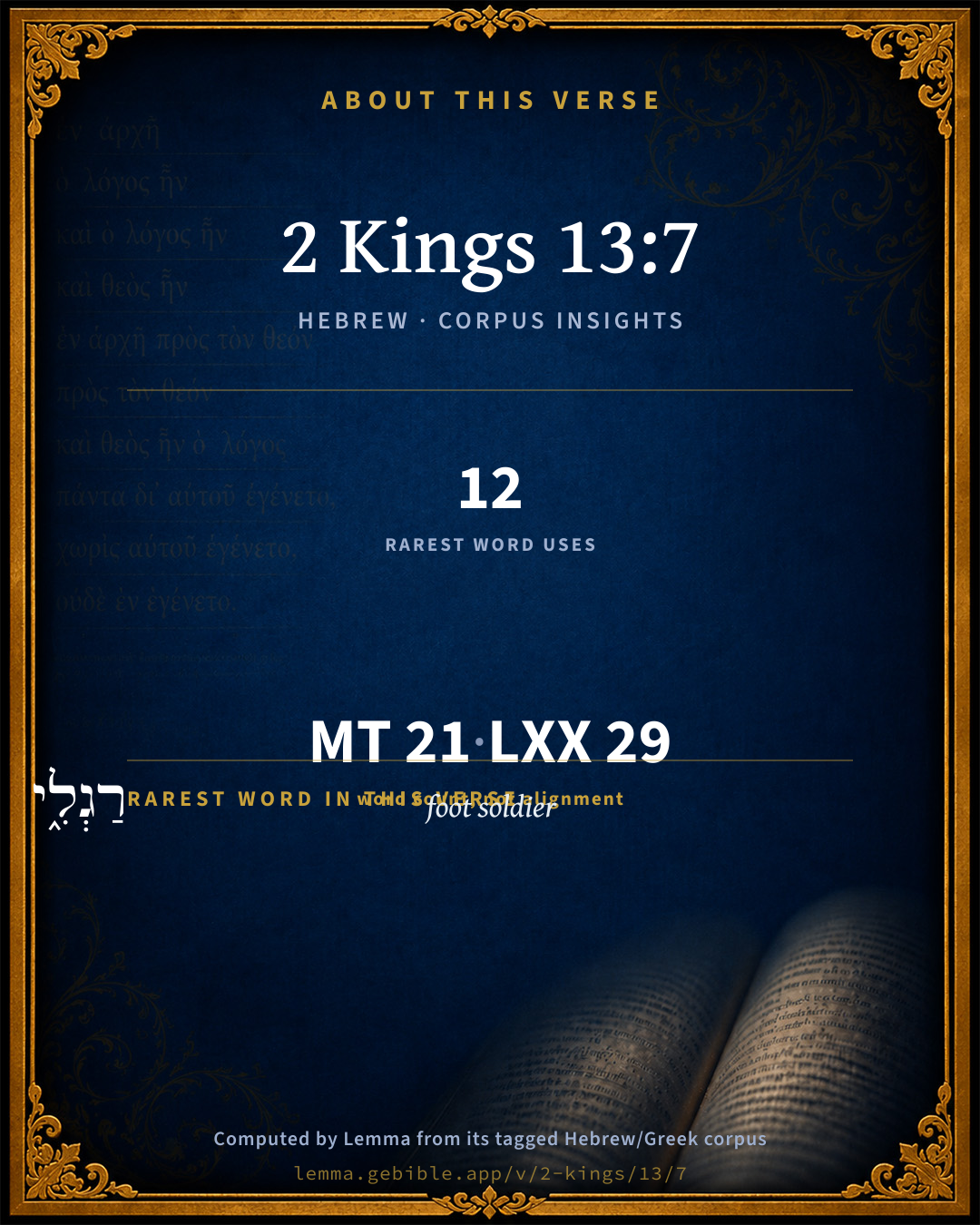
About this verse

These counts appear in no published source. They are computed here, from the morphology-tagged text and Lemma’s own curated glosses. What Lemma adds →

21
words
18
distinct lemmas
Historical
section

Notable vocabulary

The rarest word here is רַגְלִ֑י foot soldier H7273 — appearing just 12 times in the whole Hebrew Bible.

Shared distinctive vocabulary

רַגְלִ֑י foot soldier H7273 occurs in 12 verses of the Hebrew Bible. Also found in:

Grammatical profile

  • 4 verbs
  • 7 nouns
  • 5 adjectives
  • 4 conjunctions
  • 1 particle

Verb forms

  • הִשְׁאִ֨יר Hiphil · Perfect
  • אִבְּדָם֙ Piel · Perfect
  • וַיְשִׂמֵ֥ם Qal · Sequential Imperfect
  • לָדֻֽשׁ Qal · Infinitive Construct

Repetition

Words recur within this verse — often emphatic in Hebrew:

  • וַעֲשָׂ֣רָה ten H6235 ×2
  • כִּ֣י that H3588 ×3

Hebrew & Septuagint length

In English translation the verse runs 34 words from the Hebrew and 35 from the Septuagint (LXX English) — closely comparable.

A rough comparison of the two English renderings, which tokenize alike — not a word-level alignment.

Word counts can differ between the Hebrew and the Greek without any difference in meaning — e.g. the Hebrew direct-object marker אֵת has no separate Greek word, and Greek often adds the article ὁ.

In the original languages it is 21 Hebrew tokens and 29 Greek tokens — but the two are counted differently (Hebrew bundles its prefixes and suffixes into one token; the Greek is in lemma form), so that isn’t a like-for-like length.

Cross-references

13

Topical passages linked to 2 Kings 13:7 in the Treasury of Scripture Knowledge — connected by theme and wording, ordered by reader-vote popularity; previews shown in the World English Bible.

  • Amos 1:3 Thus says Yahweh: "For three transgressions of Damascus, yes, for four, I will not turn away its punishment; Because they have threshed Gilead with threshing instruments of iron;
  • 2 Kings 10:32 In those days Yahweh began to cut off from Israel: and Hazael struck them in all the borders of Israel;
  • 1 Samuel 13:6–7 When the men of Israel saw that they were in a strait (for the people were distressed), then the people did hide themselves in caves, and in thickets, and in rocks, and in coverts, and in pits.
  • 1 Samuel 13:15 Samuel arose, and got him up from Gilgal to Gibeah of Benjamin. Saul numbered the people who were present with him, about six hundred men.
  • 1 Samuel 13:19–23 Now there was no smith found throughout all the land of Israel; for the Philistines said, Lest the Hebrews make them swords or spears:
  • 1 Kings 20:15 Then he mustered the young men of the princes of the provinces, and they were two hundred and thirty-two: and after them he mustered all the people, even all the children of Israel, being seven thousand.
  • 1 Kings 20:27 The children of Israel were mustered, and were provisioned, and went against them: and the children of Israel encamped before them like two little flocks of kids; but the Syrians filled the country.
  • 2 Kings 8:12 Hazael said, Why weeps my lord? He answered, Because I know the evil that you will do to the children of Israel: their strongholds will you set on fire, and their young men will you kill with the sword, and will dash in pieces their little ones, and rip up their women with child.
  • Psalms 18:42 Then I beat them small as the dust before the wind. I cast them out as the mire of the streets.
  • Isaiah 36:8 Now therefore, please give pledges to my master the king of Assyria, and I will give you two thousand horses, if you are able on your part to set riders on them.
  • Isaiah 41:2 Who has raised up one from the east, whom he calls in righteousness to his foot? he gives nations before him, and makes him rule over kings; he gives them as the dust to his sword, as the driven stubble to his bow.
  • Isaiah 41:15–16 Behold, I have made you [to be] a new sharp threshing instrument having teeth; you shall thresh the mountains, and beat them small, and shall make the hills as chaff.
  • Joel 3:14 Multitudes, multitudes in the valley of decision! For the day of Yahweh is near, in the valley of decision.

Cross-references courtesy of OpenBible.info (CC BY 4.0).

Hebrew and Greek witnesses Masoretic Hebrew ↔ Greek Septuagint

The same verse in the two great witnesses to the Old Testament, shown verse-for-verse.

These are two independent witnesses, not word-aligned to each other, and the Septuagint is shown in lemma (dictionary) form.

Hebrew 2 Kings 13:7 Masoretic · Westminster Leningrad Codex

כִּ֣י לֹא֩ הִשְׁאִ֨יר לִיהוֹאָחָ֜ז עָ֗ם כִּ֣י אִם חֲמִשִּׁ֤ים פָּֽרָשִׁים֙ וַעֲשָׂ֣רָה רֶ֔כֶב וַעֲשֶׂ֥רֶת אֲלָפִ֖ים רַגְלִ֑י כִּ֤י אִבְּדָם֙ מֶ֣לֶךְ אֲרָ֔ם וַיְשִׂמֵ֥ם כֶּֽעָפָ֖ר לָדֻֽשׁ

For he didn't leave to Jehoahaz of the people save fifty horsemen, and ten chariots, and ten thousand footmen; for the king of Syria destroyed them, and made them like the dust in threshing.

World English Bible · Public Domain

Greek LXX 2 Kings 13:7 Septuagint · lemma form

ὅτι οὐ ὑπολείπω ὁ ιωαχας λαός ἀλλά ἤ πεντήκοντα ἱππεύς καί δέκα ἅρμα καί δέκα χιλιάς πεζός ὅτι ἀποὀλλύω αὐτός βασιλεύς συρία καί τίθημι αὐτός ὡς χοῦς εἰς καταπάτησις

Whereas there was not left any army to Joachaz, except fifty horsemen, and ten chariots, and ten thousand infantry: for the king of Syria had destroyed them, and they made them as dust for trampling.

LXX2012 (modern English Septuagint) · Public Domain

On this verse, The Cambridge Bible for Schools and Colleges discusses the Septuagint’s reading. Read the note in Commentary ↓

Hebrew: Westminster Leningrad Codex (CC BY 4.0). Greek: Septuagint (public domain); English from LXX2012 (modern English Septuagint) (Public Domain). How the Septuagint differs from the Hebrew →

Targum (Aramaic paraphrase)

1

The Targum is the ancient Jewish Aramaic paraphrase of the Hebrew Scriptures — an interpretive translation, not the Hebrew text itself. Onkelos (literal) and Pseudo-Jonathan (expansive) render the Torah, and Jonathan the Prophets. Coverage is partial: where no permissively-licensed English translation exists for a verse, only the Aramaic is shown. This is verse-level text, not a word-by-word alignment to the Hebrew.

  1. Targum Jonathan Prophets (Joshua–Malachi)
    אֲרֵי לָא אַשְׁאַר לִיהוֹאָחָז עַם אֱלָהֵין חַמְשִׁין פְּרָשִׁין וַעֲסַר רְתִיכִין וְעַסְרָא אַלְפִין גְבַר רַגְלִין אֲרֵי אַבְּדִינוּן מַלְכָּא דַאֲרָם וְשַׁוִינוּן כְּעַפְרָא לְדָיֵשׁ:

    (no public-domain English translation for this verse)

    Targum Jonathan — Aramaic: “Mikraot Gedolot” (public domain). English: “Sefaria Community Translation” (CC0 1.0 (public-domain dedication)); “London "Chaldee Paraphrase," 1871” (public domain). Text via Sefaria.

Commentary

Notes on 2 Kings 13:7 from classic Christian and Jewish commentators (each source and its license shown beneath its notes). The classic Christian expositions comment on the surrounding passage and are grouped to its opening verse, so a note may address several verses; the Jewish commentaries on the Tanakh (Rashi and others) are per-verse, so they appear only where the commentator wrote on this verse.

Lemma curates 59 commentaries, every one of them public domain or Creative Commons licensed, each selected and text-cleaned for this edition rather than reprinted as found. About our sources →

Trapp's Complete Commentary

John Trapp

2Ki 13:7 Neither did he leave of the people to Jehoahaz but fifty horsemen, and ten chariots, and ten thousand footmen; for the king of Syria had destroyed them, and had made them like the dust by threshing.

Ver. 7. Had made them like the dust by threshing.] Grain may be broken and scattered by overmuch threshing; so was Israel by the Syrian oppression.

John Trapp, A Commentary or Exposition upon All the Books of the Old and New Testament (1647–1656) — public domain. Text from a community e-Sword module.

Joseph Benson's Commentary

2Ki 13:7. Neither did he leave, &c. — That is, the king of Syria, who so terribly oppressed the Israelites. For this verse must be considered as connected with 2Ki 13:4, 2Ki 13:5-6 being included in a parenthesis, as is done in our translation. By the people, of whom the king of Syria left so few, the Israelitish army, or men of war, are here meant, as the following words evince. For the king of Syria had destroyed them — God gave them into his hand, to make this destruction among them, killing some, and carrying others captive. And had made them like the dust by thrashing — Had broken, and, as it were, ground them to dust or powder, as the corn is many times broken by thrashing.

Joseph Benson's Commentary on the Old and New Testaments (1811–1818) — public domain. Text from a community e-Sword module.

Tyndale Open Study Notes

Tyndale Open Resources

13:7 Years of Aramean oppression severely reduced Israel’s army. Only God could save Israel from complete destruction (13:4-5). Ultimately, only God can rescue a helpless and lost humanity (Ps 35:10; Rom 5:6-8).

Tyndale Open Study Notes — © Tyndale Open Resources, licensed CC BY-SA 4.0. Text via the HelloAO Bible API.

Geneva Bible (1599)

Geneva Bible translators

That is, Hazael and Ben-Hadad his son, as verse 3. Read of Hazael, 2 Kings 8:12.

Geneva Bible (1599) marginal notes — public domain. Text via Bolls.life.

Jamieson, Fausset & Brown

Robert Jamieson, A. R. Fausset & David Brown

made them like the dust in threshing--Threshing in the East is performed in the open air upon a level plot of ground, daubed over with a covering to prevent, as much as possible, the earth, sand, or gravel from rising; a great quantity of them all, notwithstanding this precaution, must unavoidably be taken up with the grain; at the same time the straw is shattered to pieces. Hence it is a most significant figure, frequently employed by Orientals to describe a state of national suffering, little short of extermination (Isa 21:10; Mic 4:12; Jer 51:33). The figure originated in a barbarous war custom, which Hazael literally followed (Amo 1:3-4; compare Sa2 18:31; Jdg 8:7).

Jamieson, Fausset & Brown — Commentary Critical and Explanatory on the Whole Bible (1871) — public domain (CC PDM 1.0). Text via the HelloAO Bible API.

Ellicott's Commentary for English Readers

(7) Neither did he leave of the people to Jehoahaz.—Rather, For he had not left to Jehoahaz (any) people (i.e., war folk; 1Ki_16:15). The subject appears to be Jehovah. The narrative returns, after the long parenthesis, to the statement of 2Ki_13:4, “and Jehoahaz besought Jehovah (for he had not left, &c.).” Or we might render, “one had not left,” i.e., “there was not left.”

Fifty horsemen, and ten chariots.—The mention of so small a number appears to indicate the result of the Israelite losses in some great battle, or in successive engagements. The destruction of these particular kinds of forces was equivalent to complete disarmament, and rendered further resistance hopeless, as the Syrians were especially strong in chariots and horsemen. (See Note on 2Ki_2:12.)

Had made them like the dust by threshing.—Rather, and set them like the dust to trample on or tread underfoot. Israel was down-trodden by the conqueror. (Comp. 2Sa_22:43; Isa_10:6.)

A Bible Commentary for English Readers, edited by Charles John Ellicott (1878–1897) — public domain. Text from a community e-Sword module.

The Cambridge Bible for Schools and Colleges

gen. ed. J. J. S. Perowne

7. Neither did he leave of the people to Jehoahaz but fifty horsemen] R.V. For he left not to Jehoahaz of the people save fifty horsemen. Not only does R.V. render the original here more exactly, but it indicates clearly where the parenthesis of the last two verses comes to an end. We have here the continuation of verse 4, and a picture of the character and extent of the Syrian oppression. When we call to mind that in David’s times (2Sa_24:9) the warriors of Israel were eight hundred thousand men, we can form some idea of the way in which Israel was now ‘cut short’.

the king of Syria had destroyed them, and had made them] The R.V. omits ‘had’ in both places. This is right, for the description refers to the time of Jehoahaz. Whether the destruction here mentioned was by making them slaves or by extermination, we cannot tell, but it is much the most probable that a warlike people like the Syrians would take soldiers prisoners and use them in their wars with Assyria and elsewhere.

like the dust by threshing] R.V. in threshing. The correct sense is given on the margin of R.V. ‘dust to trample on’. The Oriental manner of threshing is by the trampling of oxen’s feet, and the figure is used to signify the utter prostration of Israel. The LXX. also has the right idea, giving εἰς καταπάτησιν. For the word used thus of trampling under foot cf. Isa_25:10 ‘Moab shall be trodden down under him even as straw is trodden down’, where the margin gives twice over ‘threshed’. The reference in the margin of A.V. to Amo_1:3 where the cruelties of Damascus are described, ‘they have threshed Gilead with threshing instruments of iron’, probably does not apply to the account before us. All that is here meant is that Israel was utterly reduced and broken. The ‘dust in threshing’ of R.V. is an attempt to be literal and yet to avoid the implication of barbarity which is conveyed in A.V.

The Cambridge Bible for Schools and Colleges (gen. ed. J. J. S. Perowne; Cambridge University Press, 1878–1918) — public domain. Text from a community e-Sword module.

John Gill's Exposition

Neither did he leave of the people to Jehoahaz but fifty horsemen,.... This is to be connected with Kg2 13:4, the verses Kg2 12:5, being to be read in a parenthesis, as in our version, and to be understood of the king of Syria, who left no more to the king of Israel, not of the people of the land, but of his army, than fifty horsemen, all the rest being either taken and carried captive by him, or slain:

and ten chariots; military chariots, with the men they carried:

and ten thousand footmen; foot soldiers; to so small a number was his army reduced through wars with the Syrians:

for the king of Syria had destroyed them, and had made them like the dust by threshing: as corn or chaff may be reduced to dust by too much threshing; or as mire and clay by treading on it.

John Gill's Exposition of the Whole Bible (1746–1763) — public domain (CC PDM 1.0). Text via the HelloAO Bible API.

Albert Barnes' Notes on the Bible

The meaning is that “he, the king of Syria” (2Ki 13:4 Hazael) limited the standing army of Jehoahaz.

Like the dust by threshing - An expression not only employed metaphorically, and importing defeat, conquest, and grinding oppression Jer 51:33; Mic 4:12, but implying also the literal use of threshing-instruments in the execution of prisoners of war (marginal reference, and compare 2Sa 12:31).

Albert Barnes' Notes on the Bible (1834–1885) — public domain. Text from a community e-Sword/MySword module.

Haydock's Catholic Bible Commentary

Floor. Amos (i. 3.) informs us, that Hazael had crushed the inhabitants of Galaad to death with iron chariots.

George Leo Haydock (1774–1849), Haydock's Catholic Family Bible and Commentary, 1859 edition — public domain. Excludes Psalms (Douay-Rheims chapter numbering differs from Protestant) and Deuterocanonical books (Catholic canon only).

Matthew Poole's English Annotations

Neither did he, i.e. the king of Syria, 2Ki 13:4, with which this verse is to be joined; 2Ki 13:5,6 being put within a parenthesis, as it is in our translation. But this verse may be translated otherwise, Although he (either the king of Syria, 2Ki 13:4, or the Lord, 2Ki 13:5, to whom judgments are oft ascribed, even when wicked men are the instruments of executing it) had not left, &c. And so it may be joined with the next foregoing verse, as a great aggravation of their impenitency, and obstinate continuance in their idolatry, notwithstanding such terrible judgments, which in all reason should have driven them from it. Leave of the people, i.e. of his army, or men of war, as the following words evince.

Had made them like the dust by threshing, i.e. had broken and ground them to dust, or powder, as the corn is many times broken by threshing.

Matthew Poole's English Annotations on the Holy Bible (1683–1685) — public domain. Text from a community e-Sword/MySword module.

Whedon's Commentary on the Bible

Daniel D. Whedon

7. Neither did he leave of the people — Literally, for he left not to Jehoahaz a people, except, etc. The connexion is most natural with 2Ki_13:4, and 2Ki_13:5-6 are properly put in parenthesis, as in the English version.

Made them like the dust by threshing — The king of Syria had oppressed and destroyed them almost to annihilation. Perhaps he had actually destroyed many with threshing instruments of iron, as, according to Amo_1:3, he did the inhabitants of Gilead. See also 2Sa_12:31, note.

Daniel D. Whedon (gen. ed.), Commentary on the Old and New Testaments (1874–1909) — public domain. Text from a community e-Sword module.

The Pulpit Commentary

Neither did he leave of the people to Jehoahaz but fifty horsemen, and ten chariots, and ten thousand footmen. This verse seems to be an exegetical note on ver. 4, which perhaps it once followed immediately, the parenthetic section (vers. 5 and 6) having been added later, as an afterthought, either by the original writer, or perhaps by a later hand. The meaning seems to be that Hazael limited the standing army of Jehoahaz to fifty horsemen, ton chariots, and ten thousand footmen, not that he slew the entire military population except this small remnant. The policy of limiting the forces to be maintained by a subject-king was one known to the Romans, and has often been adopted in the East. It is still a part of our own policy in the government of India. The limitation left the country at the mercy of all its neighbors (see ver. 20). For the king of Syria had destroyed them, and had made them like the dust by threshing. Possibly this means no more than an utter destruction a trampling in the dust, as we phrase it. (see Jer_51:33; Mic_4:12, Mic_4:13; and perhaps Isa_21:10) But it may be an allusion to that destruction of prisoners by means of a threshing instrument, which was certainly sometimes practiced (2Sa_12:31; Pro_20:26) and which is made a special charge against Damascus. (Amo_1:3 See Pusey"s "Minor Prophets," p. 158)

The Pulpit Commentary (1880–1919), ed. H.D.M. Spence-Jones & Joseph S. Exell — public domain. Text from a community e-Sword module.

John Wesley's Explanatory Notes

He - The king of Syria. People - Of his army, or men of war.

John Wesley, Explanatory Notes Upon the Whole Bible (1754–1765) — public domain. Text via the GEBible commentary corpus.

Lesson kit

Teaching starters — assembled from the data on this page, not authored interpretation. Every prompt links to the verse data it draws on. Edit before teaching.

2 Kings, in the Historical, opens this verse with 21 words (18 distinct Hebrew lemmas). Its most distinctive word is raglîy (“foot soldier”). A historical commentator’s framing appears above. Read the whole chapter for the surrounding context.

Discussion questions

  1. How does “foot soldier” (raglîy) shape what this verse is saying?
  2. How does Exodus 12:37, which shares the word «foot soldier», read alongside this verse?
  3. What does the repetition of “ten” (2× in this one verse) do in this verse?
  4. These translations render this verse differently; the difference is in the English rendering, not the original. What questions does that raise?
  5. «הִשְׁאִ֨יר» is a Hiphil Perfect verb. How does that grammatical form shape the action described?
  6. Compare how Trapp's Complete Commentary and Joseph Benson's Commentary read this verse. Where do they agree or differ?

Things to notice

Reading settings

Reading text

Shown beneath each verse's original-language words.

Old Testament
Old Testament edition

Read the OT as the Masoretic Hebrew (MT) or the Greek Septuagint (LXX).

English shown for the Greek Septuagint (in the Hebrew ↔ Greek comparison).

Comparing translations? Open the Compare panel on any verse page to stack up to four side by side.