
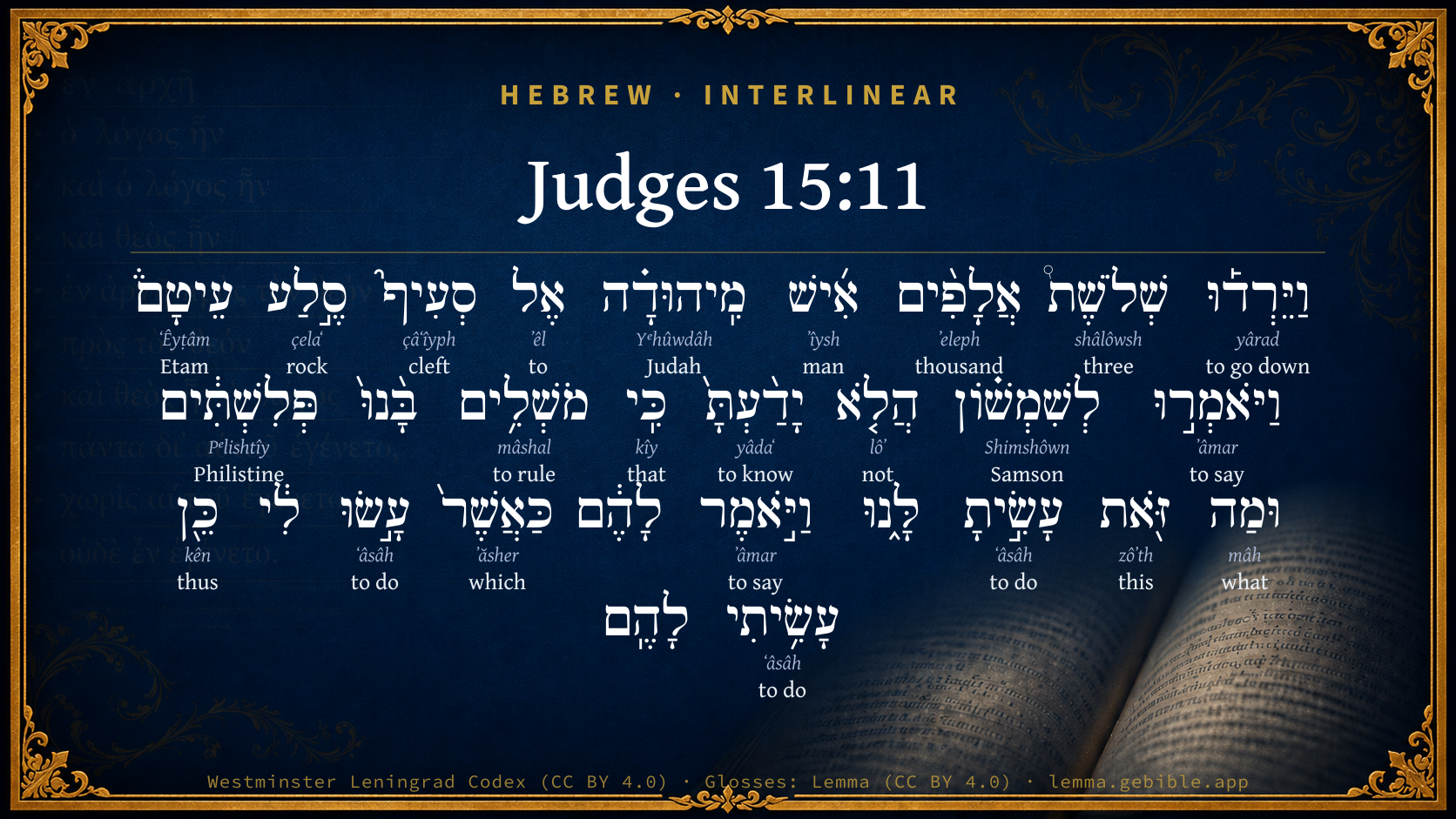
Judges 15:11

Hebrew (Westminster Leningrad Codex) Judges 15:11 appears in the Hebrew Old Testament. The text above is from the Westminster Leningrad Codex. Each word links to its Strong’s number, a concise gloss, and parsing drawn from the Open Scriptures Hebrew Bible morphology. Click any word for its full Brown-Driver-Briggs (BDB) entry.
Download image
Cite this verse

Judges 15:11 (World English Bible). Public Domain. Lemma interlinear Bible study tool, https://lemma.gebible.app/v/judges/15/11.

Show BibTeX & RIS
BibTeX
RIS
English Translation
Then three thousand men of Judah went down to the cleft of the rock of Etam, and said to Samson, "Don't you know that the Philistines are rulers over us? What then is this that you have done to us?" He said to them, As they did to me, so have I done to them.
World English Bible · Public Domain
Download a study sheet

One document with this verse’s original text, its word-by-word gloss line, the meaning frame, cross-references with their text, attributed commentary, and full source and license credits — printable, and it pastes into notes with its structure intact.

This verse Autodidact and up

Study sheet (.html) Plain text (.txt)

A passage Seminary Student

Up to 50 verses in one chapter. A passage sheet keeps up to 6 commentary sources and 12 cross-references per verse, in the order this page ranks them, and says so on the sheet whenever that leaves anything out. Ask for a single verse and you get the Autodidact verse sheet above.

Everything on this page stays free to read, with no account — the sheet is a download of what is already on screen, not access to it.

Want to remove ads? Support Godless Engineer
Compare translations 3

The same verse in 3 English versions, stacked beneath the original-language interlinear above. Click any original word for its lexicon entry.

Each is an independent rendering of the whole verse — the interlinear is not word-aligned to these translations.

Highlighted words mark where these versions differ — a whole-verse word diff, not a word-by-word alignment.

  • World English Bible Public Domain
    Then three thousand men of Judah went down to the cleft of the rock of Etam, and said to Samson, "Don't you know that the Philistines are rulers over us? What then is this that you have done to us?" He said to them, As they did to me, so have I done to them.
  • King James Version Public Domain
    Then three thousand men of Judah went to the top of the rock Etam, and said to Samson, Knowest thou not that the Philistines are rulers over us? what is this that thou hast done unto us? And he said unto them, As they did unto me, so have I done unto them.
  • unfoldingWord Literal Text CC BY-SA 4.0
    Then 3,000 men from Judah went down to the cleft of the rock of Etam, and they said to Samson, “Do you not know that the Philistines are ruling over us? So what is this you have done to us?” And he said to them, “Just as they did to me, so I have done to them.”

unfoldingWord Literal Text — © unfoldingWord, licensed CC BY-SA 4.0. Word-aligned USFM3 via Door43 (git.door43.org/unfoldingWord/en_ult).

Versions to compare (up to 4)

3 of 4 selected

Show all 18 translations

Every available English version of this verse, each an independent rendering of the whole verse.

  • World English Bible Public Domain
    Then three thousand men of Judah went down to the cleft of the rock of Etam, and said to Samson, "Don't you know that the Philistines are rulers over us? What then is this that you have done to us?" He said to them, As they did to me, so have I done to them.
  • Berean Standard Bible Public Domain
    In response, three thousand men of Judah went to the cave at the rock of Etam, and they asked Samson, “Do you not realize that the Philistines rule over us? What have you done to us?” “I have done to them what they did to me,” he replied.
  • Majority Standard Bible Public Domain
    In response, three thousand men of Judah went to the cave at the rock of Etam, and they asked Samson, “Do you not realize that the Philistines rule over us? What have you done to us?” “I have done to them what they did to me,” he replied.
  • King James Version Public Domain
    Then three thousand men of Judah went to the top of the rock Etam, and said to Samson, Knowest thou not that the Philistines are rulers over us? what is this that thou hast done unto us? And he said unto them, As they did unto me, so have I done unto them.
  • American Standard Version (1901) Public Domain
    Then three thousand men of Judah went down to the cleft of the rock of Etam, and said to Samson, Knowest thou not that the Philistines are rulers over us? what then is this that thou hast done unto us? And he said unto them, As they did unto me, so have I done unto them.
  • Revised Version (1885) Public Domain
    Then three thousand men of Judah went down to the cleft of the rock of Etam, and said to Samson, Knowest thou not that the Philistines are rulers over us? what then is this that thou hast done unto us? And he said unto them, As they did unto me, so have I done unto them.
  • Geneva Bible (1599) Public Domain
    Then three thousande men of Iudah went to the top of the rocke Etam, and sayde to Samson, Knowest thou not that the Philistims are rulers ouer vs? Wherefore then hast thou done thus vnto vs? And he answered them, As they did vnto me, so haue I done vnto them.
  • Douay-Rheims (1899) Public Domain
    Wherefore three thousand men of Juda, went down to the cave of the rock Etam, and said to Samson: Knowest thou not that the Philistines rule over us? Why wouldst thou do thus? And he said to them: As they did to me, so have I done to them.
  • Young's Literal Translation Public Domain
    And three thousand men of Judah go down unto the cleft of the rock Etam, and say to Samson, `Hast thou now known that the Philistines are rulers over us? and what `is' this thou hast done to us?' And he saith to them, `As they did to me, so I did to them.'
  • Literal Standard Version CC BY-SA 4.0
    And three thousand men of Judah go down to the cleft of the rock of Etam, and say to Samson, “Have you now known that the Philistines are rulers over us? And what [is] this you have done to us?” And he says to them, “As they did to me, so I did to them.”
  • Unlocked Literal Bible CC BY-SA 4.0
    Then three thousand men of Judah went down to the cave in the cliff of Etam, and they said to Samson, “Do you not know that the Philistines are rulers over us? What is this you have done to us?” Samson said to them, “They did to me, and so I have done to them.”
  • unfoldingWord Literal Text CC BY-SA 4.0
    Then 3,000 men from Judah went down to the cleft of the rock of Etam, and they said to Samson, “Do you not know that the Philistines are ruling over us? So what is this you have done to us?” And he said to them, “Just as they did to me, so I have done to them.”
  • Darby Bible Public Domain
    Then three thousand men of Judah went down to the cleft of the rock of Etam, and said to Samson, "Do you not know that the Philistines are rulers over us? What then is this that you have done to us?" And he said to them, "As they did to me, so have I done to them."
  • World Messianic Bible Public Domain
    Then three thousand men of Judah went down to the cave in Etam’s rock, and said to Samson, “Don’t you know that the Philistines are rulers over us? What then is this that you have done to us?” He said to them, “As they did to me, so I have done to them.”
  • Webster's Bible Public Domain
    Then three thousand men of Judah went to the top of the rock Etam, and said to Samson, Knowest thou not that the Philistines are rulers over us? what is this that thou hast done to us? And he said to them, As they did to me, so have I done to them.
  • Free Bible Version CC BY-SA 4.0
    Three thousand men of Judah went to the cave at the rock of Etam and asked Samson, “Don't you understand that the Philistines rule over us? What do you think you're doing to us?” “I only did what they did to me,” he replied.
  • Bible in Basic English Public Domain
    Then three thousand of the men of Judah went down to the crack of the rock of Etam, and said to Samson, Is it not clear to you that the Philistines are our rulers? What is this you have done to us? And he said to them, I only did to them as they did to me.
  • JPS Tanakh (1917) Public Domain
    Then three thousand men of Judah went down to the cleft of the rock of Etam, and said to Samson: 'Knowest thou not that the Philistines are rulers over us? what then is this that thou hast done unto us?' And he said unto them: 'As they did unto me, so have I done unto them.'

Literal Standard Version (2020), Covenant Press — licensed CC BY-SA 4.0. Text via the HelloAO Bible API (eBible.org). Unlocked Literal Bible (unfoldingWord) — licensed CC BY-SA 4.0. Text via the HelloAO Bible API (eBible.org). unfoldingWord Literal Text — © unfoldingWord, licensed CC BY-SA 4.0. Word-aligned USFM3 via Door43 (git.door43.org/unfoldingWord/en_ult). Free Bible Version, Dr. Jonathan Gallagher — licensed CC BY-SA 4.0. Text via the HelloAO Bible API (eBible.org).

Word by word

More ways to search: Search by grammar → Find every occurrence → Compare this word →

Practice this passage: Drill this verse → Learn its vocabulary →

עֵיטָם֒
ʻÊyṭâm
H5862
“Etam”
Noun, Proper
Part of Speech
Noun
Type
Proper
Full BDB Definition

Origin: from H5861

TWOT: None

Etam = "lair of wild beasts" - a village of the tribe of Simeon - a town in Judah fortified and garrisoned by king Rehoboam of Judah and located between Bethlehem and Tekoa - a cliff; site uncertain
  1. וַיֵּרְד֡וּ yârad H3381 “and · to go down” Conjunction + Verb, Qal, Sequential Imperfect, 3rd Person, Masculine, Plural
  2. שְׁלֹשֶׁת֩ shâlôwsh H7969 “three” Adjective, Cardinal number, Masculine, Singular, Construct
  3. אֲלָפִ֨ים ʼeleph H505 “thousand” Adjective, Cardinal number, Both, Plural, Absolute
  4. אִ֜ישׁ ʼîysh H376 “man” Noun, Common, Masculine, Singular, Absolute
  5. מִֽיהוּדָ֗ה Yᵉhûwdâh H3063 “from · Judah” Preposition + Noun, Proper
  6. אֶל ʼêl H413 “to” Preposition
  7. סְעִיף֮ çâʻîyph H5585 “cleft of” Noun, Common, Masculine, Singular, Construct
  8. סֶ֣לַע çelaʻ H5553 “rock of” Noun, Common, Masculine, Singular, Construct
  9. וַיֹּאמְר֣וּ ʼâmar H559 “and · to say” Conjunction + Verb, Qal, Sequential Imperfect, 3rd Person, Masculine, Plural
  10. לְשִׁמְשׁ֗וֹן Shimshôwn H8123 “to/for · Samson” Preposition + Noun, Proper
  11. הֲלֹ֤א lôʼ H3808 “not” Particle, Interrogative + Particle, Negative
  12. יָדַ֨עְתָּ֙ yâdaʻ H3045 “to know” Verb, Qal, Perfect, 2nd Person, Masculine, Singular
  13. כִּֽי kîy H3588 “that” Conjunction
  14. מֹשְׁלִ֥ים mâshal H4910 “ruling” Verb, Qal, Participle Active, Masculine, Plural, Absolute
  15. פְּלִשְׁתִּ֔ים Pᵉlishtîy H6430 “Philistines” Noun, Gentilic, Masculine, Plural, Absolute
  16. וּמַה mâh H4100 “and · what” Conjunction + Particle, Interrogative
  17. זֹּ֖את zôʼth H2063 “this” Pronoun, Demonstrative, Feminine, Singular
  18. עָשִׂ֣יתָ ʻâsâh H6213 “to do” Verb, Qal, Perfect, 2nd Person, Masculine, Singular
  19. וַיֹּ֣אמֶר ʼâmar H559 “and · to say” Conjunction + Verb, Qal, Sequential Imperfect, 3rd Person, Masculine, Singular
  20. כַּאֲשֶׁר֙ ʼăsher H834 “like/as · which” Preposition + Particle, Relative
  21. עָ֣שׂוּ ʻâsâh H6213 “to do” Verb, Qal, Perfect, 3rd Person, Common, Plural
  22. כֵּ֖ן kên H3651 “thus” Particle, Demonstrative
  23. עָשִׂ֥יתִי ʻâsâh H6213 “to do” Verb, Qal, Perfect, 1st Person, Common, Singular

About this verse

These counts appear in no published source. They are computed here, from the morphology-tagged text and Lemma’s own curated glosses. What Lemma adds →

29
words
21
distinct lemmas
Historical
section

Notable vocabulary

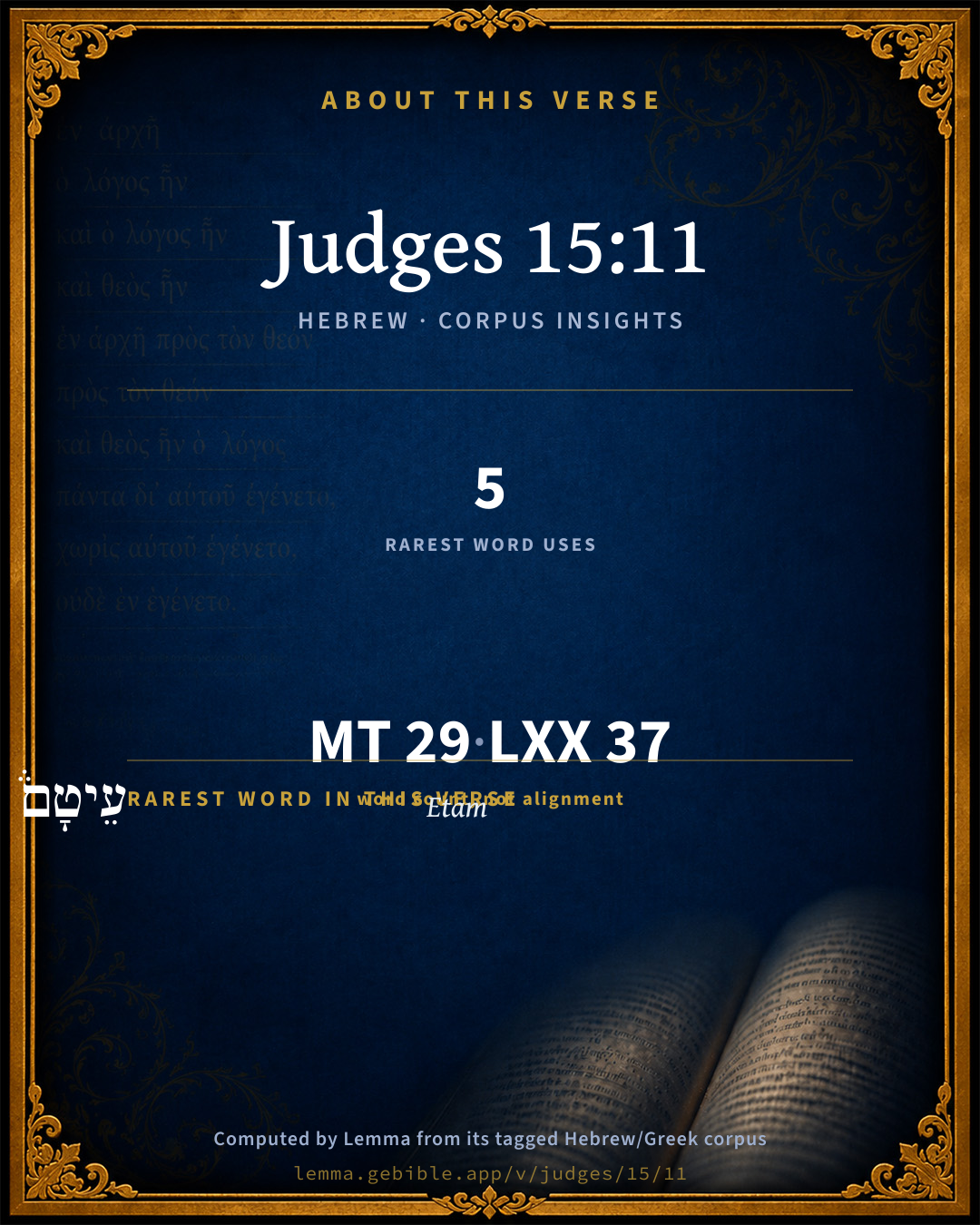
The rarest word here is עֵיטָם֒ Etam H5862 — appearing just 5 times in the whole Hebrew Bible.

Shared distinctive vocabulary

עֵיטָם֒ Etam H5862 occurs in 5 verses of the Hebrew Bible. Also found in:

Grammatical profile

  • 8 verbs
  • 7 nouns
  • 2 adjectives
  • 1 pronoun
  • 6 prepositions
  • 1 conjunction
  • 4 particles

Verb forms

  • וַיֵּרְד֡וּ Qal · Sequential Imperfect
  • וַיֹּאמְר֣וּ Qal · Sequential Imperfect
  • יָדַ֨עְתָּ֙ Qal · Perfect
  • מֹשְׁלִ֥ים Qal · Participle Active
  • עָשִׂ֣יתָ Qal · Perfect
  • וַיֹּ֣אמֶר Qal · Sequential Imperfect
  • עָ֣שׂוּ Qal · Perfect
  • עָשִׂ֥יתִי Qal · Perfect

Repetition

Words recur within this verse — often emphatic in Hebrew:

  • עָשִׂ֣יתָ to do H6213 ×3
  • וַיֹּאמְר֣וּ to say H559 ×2

Hebrew & Septuagint length

In English translation the verse runs 55 words from the Hebrew and 56 from the Septuagint (LXX English) — closely comparable.

A rough comparison of the two English renderings, which tokenize alike — not a word-level alignment.

Word counts can differ between the Hebrew and the Greek without any difference in meaning — e.g. the Hebrew direct-object marker אֵת has no separate Greek word, and Greek often adds the article ὁ.

In the original languages it is 29 Hebrew tokens and 37 Greek tokens — but the two are counted differently (Hebrew bundles its prefixes and suffixes into one token; the Greek is in lemma form), so that isn’t a like-for-like length.

Cross-references

5

Topical passages linked to Judges 15:11 in the Treasury of Scripture Knowledge — connected by theme and wording, ordered by reader-vote popularity; previews shown in the World English Bible.

  • Judges 13:1 The children of Israel again did that which was evil in the sight of Yahweh; and Yahweh delivered them into the hand of the Philistines forty years.
  • Judges 14:4 But his father and his mother didn't know that it was of Yahweh; for he sought an occasion against the Philistines. Now at that time the Philistines had rule over Israel.
  • Psalms 106:40–42 Therefore Yahweh burned with anger against his people. He abhorred his inheritance.
  • Deuteronomy 28:13 Yahweh will make you the head, and not the tail; and you shall be above only, and you shall not be beneath; if you shall listen to the commandments of Yahweh your God, which I command you this day, to observe and to do [them],
  • Deuteronomy 28:47–48 Because you didn't serve Yahweh your God with joyfulness, and with gladness of heart, by reason of the abundance of all things;

Cross-references courtesy of OpenBible.info (CC BY 4.0).

Hebrew and Greek witnesses Masoretic Hebrew ↔ Greek Septuagint

The same verse in the two great witnesses to the Old Testament, shown verse-for-verse.

These are two independent witnesses, not word-aligned to each other, and the Septuagint is shown in lemma (dictionary) form.

Hebrew Judges 15:11 Masoretic · Westminster Leningrad Codex

וַיֵּרְד֡וּ שְׁלֹשֶׁת֩ אֲלָפִ֨ים אִ֜ישׁ מִֽיהוּדָ֗ה אֶל סְעִיף֮ סֶ֣לַע עֵיטָם֒ וַיֹּאמְר֣וּ לְשִׁמְשׁ֗וֹן הֲלֹ֤א יָדַ֨עְתָּ֙ כִּֽי מֹשְׁלִ֥ים בָּ֨נוּ֙ פְּלִשְׁתִּ֔ים וּמַה זֹּ֖את עָשִׂ֣יתָ לָּ֑נוּ וַיֹּ֣אמֶר לָהֶ֔ם כַּאֲשֶׁר֙ עָ֣שׂוּ לִ֔י כֵּ֖ן עָשִׂ֥יתִי לָהֶֽם

Then three thousand men of Judah went down to the cleft of the rock of Etam, and said to Samson, "Don't you know that the Philistines are rulers over us? What then is this that you have done to us?" He said to them, As they did to me, so have I done to them.

World English Bible · Public Domain

Greek LXX Judges 15:11 Septuagint · lemma form

καί καταβαίνω τρισχίλιοι ἀνήρ ἀπό ιουδα εἰς τρυμαλιά πέτρα ηταμ καί εἶπον ὁ σαμψων οὐ οἶδα ὅτι κυριεύω ὁ ἀλλόφυλος ἐγώ καί τίς οὗτος ποιέω ἐγώ καί εἶπον αὐτός σαμψων ὅς τρόπος ποιέω ἐγώ οὕτως ποιέω αὐτός

And the three thousand men of Juda went down to the hole of the rock Etam, and they said to Sampson, Know you not that the Philistines rule over us? and what is this that you have done to us? and Sampson said to them, As they did to me, so have I done to them.

LXX2012 (modern English Septuagint) · Public Domain

On this verse, John Gill's Exposition discusses the Septuagint’s reading. Read the note in Commentary ↓

Hebrew: Westminster Leningrad Codex (CC BY 4.0). Greek: Septuagint (public domain); English from LXX2012 (modern English Septuagint) (Public Domain). How the Septuagint differs from the Hebrew →

Targum (Aramaic paraphrase)

1

The Targum is the ancient Jewish Aramaic paraphrase of the Hebrew Scriptures — an interpretive translation, not the Hebrew text itself. Onkelos (literal) and Pseudo-Jonathan (expansive) render the Torah, and Jonathan the Prophets. Coverage is partial: where no permissively-licensed English translation exists for a verse, only the Aramaic is shown. This is verse-level text, not a word-by-word alignment to the Hebrew.

  1. Targum Jonathan Prophets (Joshua–Malachi)
    וּנְחָתוּ תְּלָתָא אַלְפִין גַבְרָא מִדְבֵית יְהוּדָה לִשְׁקֵיף כֵּיף עֵיטָם וַאֲמַרוּ לְשִׁמְשׁוֹן הֲלָא יְדַעְתָּא אֲרֵי שַׁלְטִין בָּנָא פְּלִשְׁתָּאֵי וּמַה דָא עֲבַדְתְּ לָנָא וַאֲמַר לְהוֹן כְּמָא דַעֲבַדוּ לִי כֵּן עַבְדֵית לְהוֹן:

    (no public-domain English translation for this verse)

    Targum Jonathan — Aramaic: “Mikraot Gedolot” (public domain). English: “Sefaria Community Translation” (CC0 1.0 (public-domain dedication)); “London "Chaldee Paraphrase," 1871” (public domain). Text via Sefaria.

Commentary

Notes on Judges 15:11 from classic Christian and Jewish commentators (each source and its license shown beneath its notes). The classic Christian expositions comment on the surrounding passage and are grouped to its opening verse, so a note may address several verses; the Jewish commentaries on the Tanakh (Rashi and others) are per-verse, so they appear only where the commentator wrote on this verse.

Lemma curates 59 commentaries, every one of them public domain or Creative Commons licensed, each selected and text-cleaned for this edition rather than reprinted as found. About our sources →

Trapp's Complete Commentary

John Trapp

Jdg 15:11 Then three thousand men of Judah went to the top of the rock Etam, and said to Samson, Knowest thou not that the Philistines [are] rulers over us? what [is] this [that] thou hast done unto us? And he said unto them, As they did unto me, so have I done unto them.

Ver. 11. As they did unto me.] He pleadeth ius talionis, for his own defence. This would not have held good if Samson had been a private person, and the wrong had been done to himself only, {Pro 20:22; Pro 24:19; Pro 17:13 Rom 12:17; Rom 12:19} though tallying of injuries is by carnal people held but justice, and counted manhood; whereas indeed it is doghood rather. But public revenge is justly exercised by the magistrate; who yet must not rashly make war, but remember what was once gravely spoken by our Henry VII: If we princes should take every occasion that is offered, the world should never be quiet, but wearied with continual brawls.

John Trapp, A Commentary or Exposition upon All the Books of the Old and New Testament (1647–1656) — public domain. Text from a community e-Sword module.

Joseph Benson's Commentary

Jdg 15:11-12. What hast thou done unto us? — Thou hast by these actions punished, not them only, but us, who are sure to smart for it. We are come down to bind thee — Why not rather to fight under thy banner? Because sin dispirits men, nay, infatuates them, and hides from their eyes the things that belong to their peace. That we may deliver thee to the Philistines — This shows how dastardly the tribe of Judah was grown, and how much they stood in fear of the Philistines, that they should so readily give up a person of such extraordinary strength and courage, and who was so capable of annoying their enemies. But they seem not to have considered him as a judge or deliverer appointed for them by God, but as a mere private man, who acted of his own will, and who had rashly stirred up the anger of the Philistines, with whom they were afraid to contend: and Samson, to make them easy, and that no damage might come upon them, consented that they should deliver him bound to the Philistines; knowing that his strength would be sufficient to break whatever cords they should bind him with. Swear unto me — Not that he feared them, or could not as easily have conquered them as he did the host of the Philistines: but because he would be free from all temptation of doing them harm, though it were in his own defence.

Joseph Benson's Commentary on the Old and New Testaments (1811–1818) — public domain. Text from a community e-Sword module.

Geneva Bible (1599)

Geneva Bible translators

Such was their gross ignorance, that they judged God’s great benefits to be a plague unto them.

Geneva Bible (1599) marginal notes — public domain. Text via Bolls.life.

Adam Clarke's Commentary

Verse 11. Three thousand men of Judah went] It appears evidently from this that Samson was strongly posted, and they thought that no less than three thousand men were necessary to reduce him.

Adam Clarke's Commentary on the Bible (1810–1826) — public domain. Text from a community e-Sword/MySword module.

Ellicott's Commentary for English Readers

(11) Went to the top of the rock Etam.—Rather, went down to the cave of the rock Etam. They would easily gain information as to Samson’s hiding-place.

What is this that thou hast done unto us?—The abject condition into which the Lion Tribe had sunk can best be estimated by this reproach against the national hero, and still more by their baseness in betraying him. He finds no sympathy. There are no patriots in search of heroes. What might not this 3,000 have achieved if they had been like Gideon’s 300?

A Bible Commentary for English Readers, edited by Charles John Ellicott (1878–1897) — public domain. Text from a community e-Sword module.

John Gill's Exposition

Then three thousand of Judah went up to the top of the rock of Etam,.... Or "went down" (g); that is, into the cave of the rock of Etam, as the Septuagint and Vulgate Latin versions; and so it is taken by David de Pomis (h) for a cave dug in the rock: this was a large number that went to take one man; the reason is, they knew his great strength:

and said to Samson, knowest thou not that the Philistines are rulers over us? and therefore it must be a very unwise thing to disoblige and provoke them, when it lay in their power to oppress them yet more and more, to increase their tribute, and make their burdens heavier, and even take away their lives:

what is this that thou hast done unto us? they ask not what he had done to them, but unto us; though they mean that, but express themselves thus, because what he had done to the Philistines was the occasion of their coming up against them, and so eventually it was doing them ill:

and he said unto them, as they did unto me, so have I done to them; they had done him ill, and therefore he did ill to them; they had burnt his wife and her father with fire, and he had slain many of them; at least this was what he thought fit to say in his own vindication; otherwise what he did was not in a way of private revenge, but on account of the injury done to the people of Israel, he taking what was done to them as done to himself, the chief magistrate and judge of Israel.

(g) "et descenderunt", Pagninus, Montanus; "descenderunt ergo", V. L. Tigurine version. (h) Tzemach David, fol. 112. 3.

John Gill's Exposition of the Whole Bible (1746–1763) — public domain (CC PDM 1.0). Text via the HelloAO Bible API.

Albert Barnes' Notes on the Bible

The dispirited men of Judah were prepared to give up their champion, in order to conciliate their masters. This shows how hard was the task of the Judge, whose office it was to restore his countrymen to freedom and independence.

Albert Barnes' Notes on the Bible (1834–1885) — public domain. Text from a community e-Sword/MySword module.

Matthew Poole's English Annotations

What is this that thou hast done unto us? thou hast by these actions punished not them, as thou intendest; but us, who being under their dominion, are sure to smart for it.

Matthew Poole's English Annotations on the Holy Bible (1683–1685) — public domain. Text from a community e-Sword/MySword module.

Whedon's Commentary on the Bible

Daniel D. Whedon

11. Went to the top of the rock — Hebrew, went down, that is, from the higher hill country of Judah.

Knowest thou not that the Philistines are rulers over us — The lion of Judah was cowed by the presence of the enemy; and so utterly humbled and subdued by the Philistines were the leaders of this tribe that they readily became instruments in their hands to capture and deliver up to them their nation’s great champion.

Daniel D. Whedon (gen. ed.), Commentary on the Old and New Testaments (1874–1909) — public domain. Text from a community e-Sword module.

The Pulpit Commentary

Men of Judah. It is rather three thousand men went down from Judah, showing that the rock Etam was below. The top. It should be the cleft, as in ver. 8. Knowest thou not, etc. The language of these cowardly men shows how completely the Philistine yoke was fastened upon the necks of Judah. The history gives no account of the Philistine conquest; except the brief allusion in Jud_1:10:6, 7; but Samson"s story brings to light the existence of it. The abject state to which they were reduced is shown By their complaint of Samson, What is this that thou hast done unto us?" instead of hailing him as a deliverer. As they did unto me, etc. It is instructive to read Samson"s defence of himself in the very words used by the Philistines in ver. 10. "An eye for an eye, and a tooth for a tooth." There is no end to rendering "evil for evil."

The Pulpit Commentary (1880–1919), ed. H.D.M. Spence-Jones & Joseph S. Exell — public domain. Text from a community e-Sword module.

John Wesley's Explanatory Notes

Unto us - Thou hast by these actions punished not them only, but us, who are sure to smart for it.

John Wesley, Explanatory Notes Upon the Whole Bible (1754–1765) — public domain. Text via the GEBible commentary corpus.

unfoldingWord translationNotes

Door43 World Missions Community

three thousand men of Judah

"3,000 men of Judah" (See: Numbers)

cave in the cliff of Etam

See how you translated this phrase in Judges 15:8.

Do you not know that the Philistines are rulers over us? What is this you have done to us?

The men of Judah ask Samson these questions to rebuke him. This questions may be written as a statements. AT: "You know that the Philistines are rulers over us but you act like they are not. What you have done has caused us great harm." (See: Rhetorical Question)

They did to me, and so I have done to them

Samson is referring to how they killed his wife and how he killed them in revenge. This can be stated clearly. AT: "They killed my wife, so I killed them" (See: Assumed Knowledge and Implicit Information)

translationWords

Judah

Samson

Philistines

rule

unfoldingWord translationNotes — © Distant Shores Media and the Door43 World Missions Community, licensed CC BY-SA 4.0. Source: git.door43.org/Door43/en_tn.

Lesson kit

Teaching starters — assembled from the data on this page, not authored interpretation. Every prompt links to the verse data it draws on. Edit before teaching.

Judges, in the Historical, opens this verse with 29 words (21 distinct Hebrew lemmas). Its most distinctive word is ʻÊyṭâm (“Etam”). A historical commentator’s framing appears above. Read the whole chapter for the surrounding context.

Discussion questions

  1. What does “Etam” (ʻÊyṭâm) contribute to the verse as a whole?
  2. Judges 15:8 shares the word «Etam» with this verse. How do the two illuminate each other?
  3. “to do” occurs 3× in this one verse. What is the effect of the repetition?
  4. These translations render this verse differently; the difference is in the English rendering, not the original. What questions does that raise?
  5. The verb «וַיֵּרְד֡וּ» is Qal Sequential Imperfect. How does its form color the action?
  6. Reading how Trapp's Complete Commentary and Joseph Benson's Commentary read this verse, where do the two commentators agree and where do they part?

Things to notice

Reading settings

Reading text

Shown beneath each verse's original-language words.

Old Testament
Old Testament edition

Read the OT as the Masoretic Hebrew (MT) or the Greek Septuagint (LXX).

English shown for the Greek Septuagint (in the Hebrew ↔ Greek comparison).

Comparing translations? Open the Compare panel on any verse page to stack up to four side by side.