
2 Chronicles 12:3

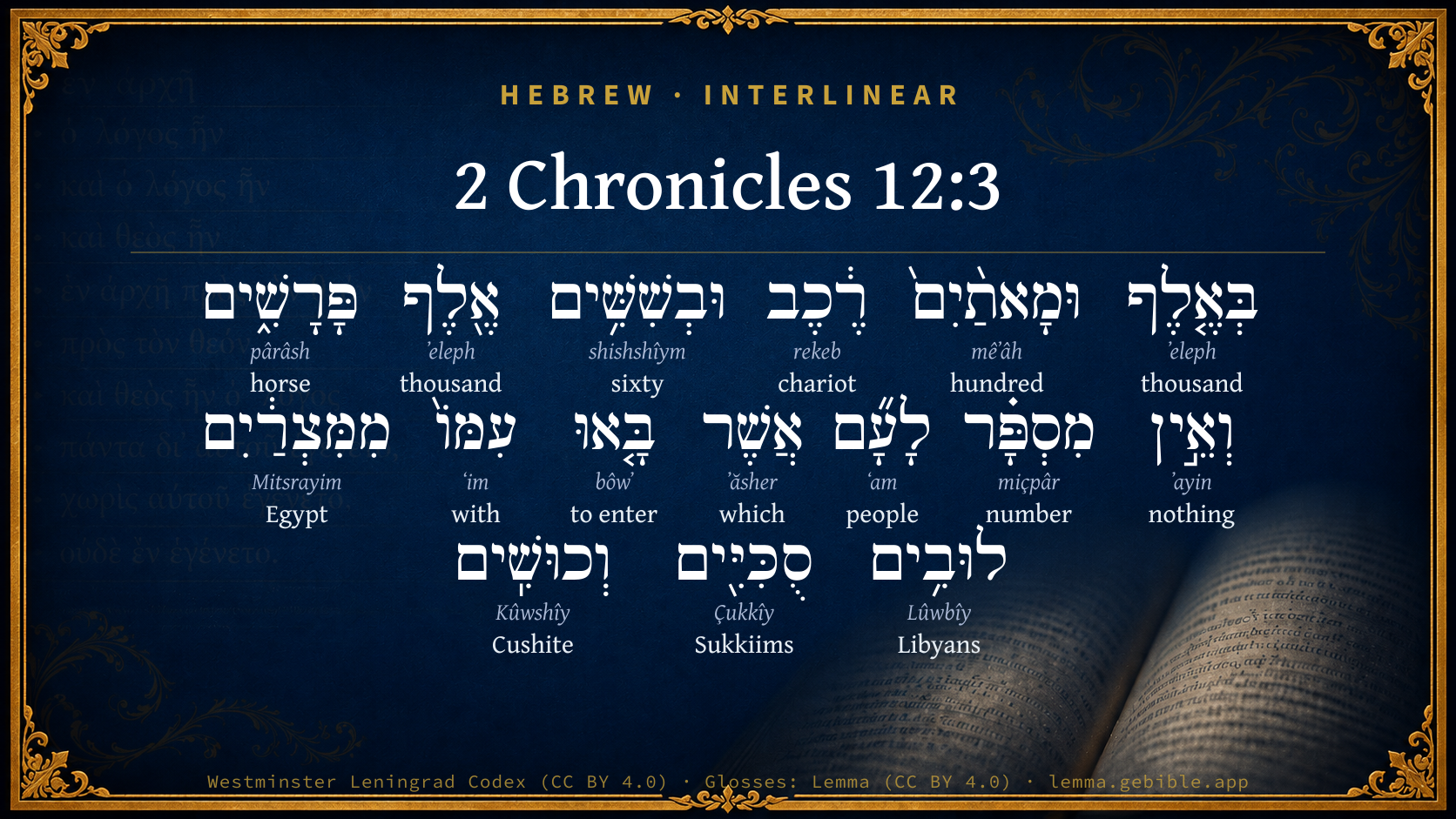
Hebrew (Westminster Leningrad Codex) 2 Chronicles 12:3 appears in the Hebrew Old Testament. The text above is from the Westminster Leningrad Codex. Each word links to its Strong’s number, a concise gloss, and parsing drawn from the Open Scriptures Hebrew Bible morphology. Click any word for its full Brown-Driver-Briggs (BDB) entry.
Download image
Cite this verse

2 Chronicles 12:3 (World English Bible). Public Domain. Lemma interlinear Bible study tool, https://lemma.gebible.app/v/2-chronicles/12/3.

Show BibTeX & RIS
BibTeX
RIS
English Translation
with twelve hundred chariots, and sixty thousand horsemen. The people were without number who came with him out of Egypt: the Lubim, the Sukkiim, and the Ethiopians.
World English Bible · Public Domain
Highlights
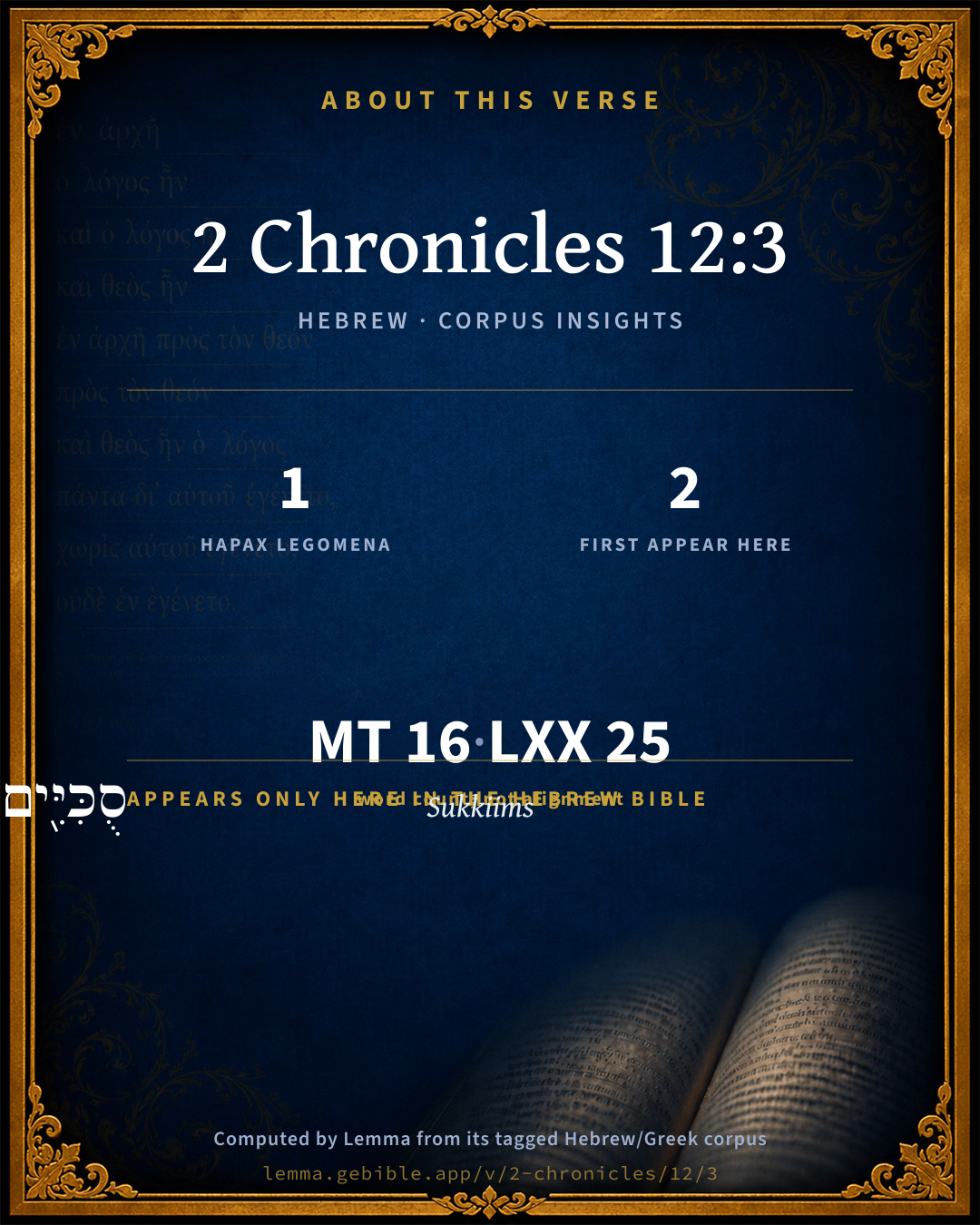
  • 1 hapax legomenon — only here in the Hebrew Bible
  • 2 first appearances in the Hebrew Bible
Full analysis ↓
Download a study sheet

One document with this verse’s original text, its word-by-word gloss line, the meaning frame, cross-references with their text, attributed commentary, and full source and license credits — printable, and it pastes into notes with its structure intact.

This verse Autodidact and up

Study sheet (.html) Plain text (.txt)

A passage Seminary Student

Up to 50 verses in one chapter. A passage sheet keeps up to 6 commentary sources and 12 cross-references per verse, in the order this page ranks them, and says so on the sheet whenever that leaves anything out. Ask for a single verse and you get the Autodidact verse sheet above.

Everything on this page stays free to read, with no account — the sheet is a download of what is already on screen, not access to it.

Want to remove ads? Support Godless Engineer
Compare translations 3

The same verse in 3 English versions, stacked beneath the original-language interlinear above. Click any original word for its lexicon entry.

Each is an independent rendering of the whole verse — the interlinear is not word-aligned to these translations.

Highlighted words mark where these versions differ — a whole-verse word diff, not a word-by-word alignment.

  • World English Bible Public Domain
    with twelve hundred chariots, and sixty thousand horsemen. The people were without number who came with him out of Egypt: the Lubim, the Sukkiim, and the Ethiopians.
  • King James Version Public Domain
    With twelve hundred chariots, and threescore thousand horsemen: and the people were without number that came with him out of Egypt; the Lubims, the Sukkiims, and the Ethiopians.
  • unfoldingWord Literal Text CC BY-SA 4.0
    With 1,200 chariots, and 60,000 horsemen, and there was no number for the people who came with him from Egypt: Libyans, Sukkites, and Cushites.

unfoldingWord Literal Text — © unfoldingWord, licensed CC BY-SA 4.0. Word-aligned USFM3 via Door43 (git.door43.org/unfoldingWord/en_ult).

Versions to compare (up to 4)

3 of 4 selected

Show all 18 translations

Every available English version of this verse, each an independent rendering of the whole verse.

  • World English Bible Public Domain
    with twelve hundred chariots, and sixty thousand horsemen. The people were without number who came with him out of Egypt: the Lubim, the Sukkiim, and the Ethiopians.
  • Berean Standard Bible Public Domain
    with 1,200 chariots, 60,000 horsemen, and countless troops who came with him out of Egypt—Libyans, Sukkites, and Cushites.
  • Majority Standard Bible Public Domain
    with 1,200 chariots, 60,000 horsemen, and countless troops who came with him out of Egypt—Libyans, Sukkites, and Cushites.
  • King James Version Public Domain
    With twelve hundred chariots, and threescore thousand horsemen: and the people were without number that came with him out of Egypt; the Lubims, the Sukkiims, and the Ethiopians.
  • American Standard Version (1901) Public Domain
    with twelve hundred chariots, and threescore thousand horsemen. And the people were without number that came with him out of Egypt: the Lubim, the Sukkiim, and the Ethiopians.
  • Revised Version (1885) Public Domain
    with twelve hundred chariots, and threescore thousand horsemen: and the people were without number that came with him out of Egypt; the Lubim, the Sukkiim, and the Ethiopians.
  • Geneva Bible (1599) Public Domain
    With twelue hundreth charets, and three score thousande horsemen, and the people were without nomber, that came with him from Egypt, euen the Lubims, Sukkiims, and the Ethiopians.
  • Douay-Rheims (1899) Public Domain
    With twelve hundred chariots and threescore thousand horsemen: and the people were without number that came with him out of Egypt, to wit, Libyans, and Troglodites, and Ethiopians.
  • Young's Literal Translation Public Domain
    with a thousand and two hundred chariots, and with sixty thousand horsemen, and there is no number to the people who have come with him out of Egypt -- Lubim, Sukkiim, and Cushim --
  • Literal Standard Version CC BY-SA 4.0
    with one thousand and two hundred chariots, and with sixty thousand horsemen, and there is no number to the people who have come with him out of Egypt—Lubim, Sukkiim, and Cushim—
  • Unlocked Literal Bible CC BY-SA 4.0
    He came with twelve hundred chariots and sixty thousand horsemen. Soldiers without number came with him from Egypt: Libyans, Sukkites, and Cushites.
  • unfoldingWord Literal Text CC BY-SA 4.0
    With 1,200 chariots, and 60,000 horsemen, and there was no number for the people who came with him from Egypt: Libyans, Sukkites, and Cushites.
  • Darby Bible Public Domain
    with twelve hundred chariots and sixty thousand horsemen; and the people were without number that came with him out of Egypt: Libyans, Sukkites, and Ethiopians.
  • World Messianic Bible Public Domain
    with twelve hundred chariots and sixty thousand horsemen. The people were without number who came with him out of Egypt: the Lubim, the Sukkiim, and the Ethiopians.
  • Webster's Bible Public Domain
    With twelve hundred chariots, and sixty thousand horsemen: and the people were without number that came with him out of Egypt; the Lubims, the Sukkiims, and the Cushites.
  • Free Bible Version CC BY-SA 4.0
    He came with 1,200 chariots, 60,000 horsemen, and an army from Egypt that couldn't be counted—Libyans, Sukkites, and Cushites.
  • Bible in Basic English Public Domain
    With twelve hundred war-carriages and sixty thousand horsemen: and the people who came with him out of Egypt were more than might be numbered: Lubim and Sukkiim and Ethiopians.
  • JPS Tanakh (1917) Public Domain
    with twelve hundred chariots, and threescore thousand horsemen; and the people were without number that came with him out of Egypt; the Lubim, the Sukkiim, and the Ethiopians.

Literal Standard Version (2020), Covenant Press — licensed CC BY-SA 4.0. Text via the HelloAO Bible API (eBible.org). Unlocked Literal Bible (unfoldingWord) — licensed CC BY-SA 4.0. Text via the HelloAO Bible API (eBible.org). unfoldingWord Literal Text — © unfoldingWord, licensed CC BY-SA 4.0. Word-aligned USFM3 via Door43 (git.door43.org/unfoldingWord/en_ult). Free Bible Version, Dr. Jonathan Gallagher — licensed CC BY-SA 4.0. Text via the HelloAO Bible API (eBible.org).

Word by word

More ways to search: Search by grammar → Find every occurrence → Compare this word →

Practice this passage: Drill this verse → Learn its vocabulary →

סֻכִּיִּ֖ים
Çukkîy
H5525
“Sukkiims”
Noun, Gentilic, Masculine, Plural, Absolute
Part of Speech
Noun
Type
Gentilic
Gender
Masculine
Number
Plural
State
Absolute
Full BDB Definition

Origin: patrial from an unknown name (perhaps H5520 )

TWOT: None

Sukkiims = "booth dwellers" - a people who supplied warriors for the Egyptian army under Shishak
  1. בְּאֶ֤לֶף ʼeleph H505 “in/at · thousand” Preposition + Adjective, Cardinal number, Both, Singular, Absolute
  2. וּמָאתַ֨יִם֙ mêʼâh H3967 “and · hundred” Conjunction + Adjective, Cardinal number, Both, Dual, Absolute
  3. רֶ֔כֶב rekeb H7393 “chariot” Noun, Common, Masculine, Singular, Absolute
  4. וּבְשִׁשִּׁ֥ים shishshîym H8346 “and · in/at · sixty” Conjunction + Preposition + Adjective, Cardinal number, Both, Plural, Absolute
  5. אֶ֖לֶף ʼeleph H505 “thousand” Adjective, Cardinal number, Both, Singular, Absolute
  6. פָּרָשִׁ֑ים pârâsh H6571 “horses” Noun, Common, Masculine, Plural, Absolute
  7. וְאֵ֣ין ʼayin H369 “and · nothing” Conjunction + Particle, Negative
  8. מִסְפָּ֗ר miçpâr H4557 “number” Noun, Common, Masculine, Singular, Absolute
  9. לָעָ֞ם ʻam H5971 “to/for the · people” Preposition, Determined + Noun, Common, Masculine, Singular, Absolute
  10. אֲשֶׁר ʼăsher H834 “which” Particle, Relative
  11. בָּ֤אוּ bôwʼ H935 “to enter” Verb, Qal, Perfect, 3rd Person, Common, Plural
  12. עִמּוֹ֙ ʻim H5973 “with · him” Preposition + Suffix, Personal, 3rd Person, Masculine, Singular
  13. מִמִּצְרַ֔יִם Mitsrayim H4714 “from · Egypt” Preposition + Noun, Proper
  14. לוּבִ֥ים Lûwbîy H3864 “Libyans” Noun, Gentilic, Masculine, Plural, Absolute
  15. וְכוּשִֽׁים Kûwshîy H3569 “and · Cushites” Conjunction + Noun, Gentilic, Masculine, Plural, Absolute

About this verse

These counts appear in no published source. They are computed here, from the morphology-tagged text and Lemma’s own curated glosses. What Lemma adds →

16
words
15
distinct lemmas
Historical
section

Notable vocabulary

1 hapax legomenon — a word that appears only here in the entire Hebrew Bible:

  • סֻכִּיִּ֖ים Sukkiims H5525

First appearance in Scripture

These words make their first canonical appearance in the Hebrew Bible here:

  • לוּבִ֥ים Libyans H3864
  • סֻכִּיִּ֖ים Sukkiims H5525

Shared distinctive vocabulary

לוּבִ֥ים Libyans H3864 occurs in 4 verses of the Hebrew Bible. Also found in:

Grammatical profile

  • 1 verb
  • 8 nouns
  • 4 adjectives
  • 1 preposition
  • 2 particles

Verb forms

  • בָּ֤אוּ Qal · Perfect

Repetition

A word recurs within this verse — often emphatic in Hebrew:

  • בְּאֶ֤לֶף thousand H505 ×2

Hebrew & Septuagint length

In English translation the verse runs 27 words from the Hebrew and 26 from the Septuagint (LXX English) — closely comparable.

A rough comparison of the two English renderings, which tokenize alike — not a word-level alignment.

Word counts can differ between the Hebrew and the Greek without any difference in meaning — e.g. the Hebrew direct-object marker אֵת has no separate Greek word, and Greek often adds the article ὁ.

In the original languages it is 16 Hebrew tokens and 25 Greek tokens — but the two are counted differently (Hebrew bundles its prefixes and suffixes into one token; the Greek is in lemma form), so that isn’t a like-for-like length.

Cross-references

13

Topical passages linked to 2 Chronicles 12:3 in the Treasury of Scripture Knowledge — connected by theme and wording, ordered by reader-vote popularity; previews shown in the World English Bible.

  • 2 Chronicles 16:8 Weren't the Ethiopians and the Lubim a huge host, with chariots and horsemen exceeding many? yet, because you did rely on Yahweh, he delivered them into your hand.
  • Nahum 3:9 Cush and Egypt were her boundless strength. Put and Libya were her helpers.
  • Daniel 11:43 But he shall have power over the treasures of gold and of silver, and over all the precious things of Egypt; and the Libyans and the Ethiopians shall be at his steps.
  • Genesis 10:6–8 The sons of Ham: Cush, Mizraim, Put, and Canaan.
  • Judges 4:13 Sisera gathered together all his chariots, even nine hundred chariots of iron, and all the people who were with him, from Harosheth of the Gentiles, to the river Kishon.
  • Judges 6:5 For they came up with their cattle and their tents; they came in as locusts for multitude; both they and their camels were without number: and they came into the land to destroy it.
  • 1 Samuel 13:5 The Philistines assembled themselves together to fight with Israel, thirty thousand chariots, and six thousand horsemen, and people as the sand which is on the sea-shore in multitude: and they came up, and encamped in Michmash, eastward of Beth Aven.
  • 2 Samuel 10:18 The Syrians fled before Israel; and David killed of the Syrians [the men of] seven hundred chariots, and forty thousand horsemen, and struck Shobach the captain of their host, so that he died there.
  • 2 Chronicles 14:9 There came out against them Zerah the Ethiopian with an army of a million troops, and three hundred chariots; and he came to Mareshah.
  • 2 Chronicles 14:12 So Yahweh struck the Ethiopians before Asa, and before Judah; and the Ethiopians fled.
  • Isaiah 43:3 For I am Yahweh your God, the Holy One of Israel, your Savior; I have given Egypt as your ransom, Ethiopia and Seba in your place.
  • Ezekiel 30:5 Ethiopia, and Put, and Lud, and all the mixed people, and Cub, and the children of the land that is in league, shall fall with them by the sword.
  • Revelation 9:16 The number of the armies of the horsemen was two hundred million. I heard the number of them.

Cross-references courtesy of OpenBible.info (CC BY 4.0).

Hebrew and Greek witnesses Masoretic Hebrew ↔ Greek Septuagint

The same verse in the two great witnesses to the Old Testament, shown verse-for-verse.

These are two independent witnesses, not word-aligned to each other, and the Septuagint is shown in lemma (dictionary) form.

Hebrew 2 Chronicles 12:3 Masoretic · Westminster Leningrad Codex

בְּאֶ֤לֶף וּמָאתַ֨יִם֙ רֶ֔כֶב וּבְשִׁשִּׁ֥ים אֶ֖לֶף פָּרָשִׁ֑ים וְאֵ֣ין מִסְפָּ֗ר לָעָ֞ם אֲשֶׁר בָּ֤אוּ עִמּוֹ֙ מִמִּצְרַ֔יִם לוּבִ֥ים סֻכִּיִּ֖ים וְכוּשִֽׁים

with twelve hundred chariots, and sixty thousand horsemen. The people were without number who came with him out of Egypt: the Lubim, the Sukkiim, and the Ethiopians.

World English Bible · Public Domain

Greek LXX 2 Chronicles 12:3 Septuagint · lemma form

ἐν χίλιοι καί διακόσιοι ἅρμα καί ἑξήκοντα χιλίας ἵππος καί οὐ εἰμί ἀριθμός ὁ πλῆθος ὁ ἔρχομαι μετά αὐτός ἐκ αἴγυπτος λίβυες τρωγλοδύται καί αἰθίοψ

with twelve hundred chariots, and sixty thousand horses: and there was no number of the multitude that came with him from Egypt; Libyans, Trogodytes, and Ethiopians.

LXX2012 (modern English Septuagint) · Public Domain

On this verse, Adam Clarke's Commentary discusses the Septuagint’s reading. Read the note in Commentary ↓

Hebrew: Westminster Leningrad Codex (CC BY 4.0). Greek: Septuagint (public domain); English from LXX2012 (modern English Septuagint) (Public Domain). How the Septuagint differs from the Hebrew →

Commentary

Notes on 2 Chronicles 12:3 from classic Christian and Jewish commentators (each source and its license shown beneath its notes). The classic Christian expositions comment on the surrounding passage and are grouped to its opening verse, so a note may address several verses; the Jewish commentaries on the Tanakh (Rashi and others) are per-verse, so they appear only where the commentator wrote on this verse.

Lemma curates 59 commentaries, every one of them public domain or Creative Commons licensed, each selected and text-cleaned for this edition rather than reprinted as found. About our sources →

Trapp's Complete Commentary

John Trapp

2Ch 12:3 With twelve hundred chariots, and threescore thousand horsemen: and the people [were] without number that came with him out of Egypt; the Lubims, the Sukkiims, and the Ethiopians.

Ver. 3. The Lubims.] Or, Lybians. {Nah 3:9}

The Sukkiims.] Or, Scenites, such as dwelt in tents. The same are called Nomades and Troglodytes, of whom Mela {a} saith that they were Nullarum opum domini, strident potius quam loquunur, specus subeunt, alunturque serpentibus, beggarly, barbarous, savage people, all which made against the Jews, but for the fulfilling of God’s threatenings. {Deu 28:15-68}

{a} Lib. i.

John Trapp, A Commentary or Exposition upon All the Books of the Old and New Testament (1647–1656) — public domain. Text from a community e-Sword module.

Joseph Benson's Commentary

2Ch 12:3. The Lubims — The people of Lybia, a famous country of Africa, adjoining to Egypt. And the Sukkiims were the Troglodytes, a people who lived on the western side of the Red sea, and had that name from their dwelling in dens and caves of the earth, which is also the meaning of the Hebrew word סכיים, succhiim, here used. As for the people called Cush, which we translate Ethiopians, they were either those to the south of Egypt, or the Scenitæ in Arabia.

Joseph Benson's Commentary on the Old and New Testaments (1811–1818) — public domain. Text from a community e-Sword module.

Tyndale Open Study Notes

Tyndale Open Resources

12:3 Sukkites are not mentioned elsewhere in the Bible but are known from Egyptian history as Libyans from the oases of the western desert. • and Ethiopians: Shishak was an Ethiopian from southern Egypt.

Tyndale Open Study Notes — © Tyndale Open Resources, licensed CC BY-SA 4.0. Text via the HelloAO Bible API.

Geneva Bible (1599)

Geneva Bible translators

Which were a people of Africa called the Troglodytes because they dwelled in holes.

Or, black Moores.

Geneva Bible (1599) marginal notes — public domain. Text via Bolls.life.

Jamieson, Fausset & Brown

Robert Jamieson, A. R. Fausset & David Brown

the Lubims--the Libyans of northeastern Africa.

the Sukkiims--Some think these were the Kenite Arabs, dwellers in tents, but others maintain more justly that these were Arab troglodytes, who inhabited the caverns of a mountain range on the western coast of the Red Sea.

and the Ethiopians--from the regions south of Egypt. By the overwhelming force of numbers, they took the fortresses of Judah which had been recently put in a state of defense, and marched to lay siege to the capital. While Shishak and his army was before Jerusalem, the prophet Shemaiah addressed Rehoboam and the princes, tracing this calamity to the national apostasy and threatening them with utter destruction in consequence of having forsaken God (Ch2 12:6).

Jamieson, Fausset & Brown — Commentary Critical and Explanatory on the Whole Bible (1871) — public domain (CC PDM 1.0). Text via the HelloAO Bible API.

Adam Clarke's Commentary

Verse 3. The Lubims] Supposed to be a people of Libya, adjoining to Egypt; sometimes called Phut in Scripture, as the people are called Lehabim and Ludim.

The Sukkiims] The Troglodytes, a people of Egypt on the coast of the Red Sea. They were called Troglodytes, Τρωγλοδυται, οἱ τας τρωγλας οικουντες, "because they dwelt in caves." - Hesych. This agrees with what Pliny says of them, Troglodytae specus excavant, haec illis domus; "The Troglodytes dig themselves caves; and these serve them for houses." This is not very different from the import of the original name סכיים Sukkiyim, from סכה sachah, to cover or overspread; (hence סוך such, a tabernacle;) the people who were covered (emphatically) under the earth. The Septuagint translate by the word Τρωγλοδυται, Troglodytes.

The Ethiopians.] כושים Cushim. Various people were called by this name, particularly a people bordering on the northern coast of the Red Sea; but these are supposed to have come from a country of that name on the south of Egypt.

Adam Clarke's Commentary on the Bible (1810–1826) — public domain. Text from a community e-Sword/MySword module.

Ellicott's Commentary for English Readers

(3) With twelve hundred chariots.—The short account in Kings says nothing of the numbers or constituents of the invading host. The totals here assigned are probably round numbers founded on a rough estimate. The cavalry are exactly fifty times as many as the chariots. Thenius finds the numbers “not in credible.”

The Lubims, the Sukkiims, and the Ethi-opians.—Rather, Lybians, Sukkîyans, and Cushites (without the definite article). These were “the people”—i.e., the footmen. The Lybians and Cushites are mentioned together as auxiliaries of Egypt in Nah_3:9. (Comp. 2Ch_16:8.) The Sukkîyans are unknown, but the LXX. and Vulg. render Troglodytes, or cave-dwellers, meaning, it would seem, the Ethiopian Troglodytes of the mountains on the western shore of the Arabian Gulf. (Comp. sukkô, “his lair,” Psa_10:9.)

A Bible Commentary for English Readers, edited by Charles John Ellicott (1878–1897) — public domain. Text from a community e-Sword module.

The Cambridge Bible for Schools and Colleges

gen. ed. J. J. S. Perowne

3. with twelve hundred chariots] The details given in this verse are absent from 1 Kin.

Lubims] R.V. Lubim (cp. 2Ch_16:8). The “s” is not needed, “im” being a mark of the Heb. plural as in “Cherubim” and “Seraphim.” The Lubim are no doubt the Libyans.

Sukkiims] R.V. Sukkiim. LXX. Τρωγλοδύται, i.e. the cave dwellers of the mountains which fringe the west coast of the Red Sea. But whether these are really meant here is doubtful.

The Cambridge Bible for Schools and Colleges (gen. ed. J. J. S. Perowne; Cambridge University Press, 1878–1918) — public domain. Text from a community e-Sword module.

John Gill's Exposition

With twelve hundred chariots, and threescore thousand horsemen; and the people were without number,.... The foot soldiers; their number, according to Josephus (h) was 400,000:

that came with him out of Egypt; the above numerous army came from thence with him, which was famous for horses and chariots of war, see Exo 14:7, what follow seem to have joined him after he came out of Egypt, or whom he subdued in his way; the Lubim or Lybians, inhabitants of Libya, a country near Egypt the same with the Lehabim; of whom see Gen 10:13,

the Sukkiims; who were either the Scenite Arabs, who dwelt in tents, as this word signifies; or the Troglodytes, according to the Septuagint and Vulgate Latin versions, who dwelt in dens and caves, in which sense the word "Succah" is sometimes used, Job 38:40 and in their country was a town called Suchae, mentioned by Pliny (i); they inhabited near the Red sea; and if Shishak is the same with Sesostris, as is thought, these people were subdued by him, as Herodotus (k) and Strabo (l) testify:

and the Ethiopians; some think these were the Cushite Arabs, and that Sesostris came into Arabia is testified by the above writers; though rather the proper Ethiopians are meant, since they are joined with the Lubim or Africans; and since, as Herodotus (m) says, he ruled over Ethiopia; and Diodorus Siculus (n) says he fought with them, and obliged them to pay him tribute.

(h) Antiqu. l. 8. c. 10. sect. 2. (i) Nat. Hist. l. 6. c. 29. (k) Euterpe, sive, l. 2. c. 102. (l) Geograph. l. 16. p. 529. (m) Ut supra, (Euterpe, sive, l. 2.) c. 110. (n) Bibliothec. l. 1. p. 50.

John Gill's Exposition of the Whole Bible (1746–1763) — public domain (CC PDM 1.0). Text via the HelloAO Bible API.

Albert Barnes' Notes on the Bible

twelve hundred chariots - This number is not unusnal (compare Exo 14:7; 1Ki 10:26). Benhadad brought 1,200 chariots into the field against Shalmaneser II; and Ahabhad at the same time a force of 2,000 chariots (compare the 1Ki 20:1 note).

The Lubims or “Libyans” Dan 11:43, were a people of Africa, distinct from the Egyptians and the Ethiopians dwelling in their immediate neighborhood. They were called Ribu or Libu by the Egyptians. See Gen 10:13.

Sukkiims - This name does not occur elsewhere. The Septuagint, who rendered the word “Troglodytes,” regarded the Sukkiim probably as the “cave-dwellers” along the western shore of the Red Sea; but the conjecture that the word means “tent-dwellers” is plausible, and would point rather to a tribe of Arahs (Scenitae).

Albert Barnes' Notes on the Bible (1834–1885) — public domain. Text from a community e-Sword/MySword module.

Haydock's Catholic Bible Commentary

Troglodites, who dwell in caverns, near the Red Sea. Pliny ([Natural History?] v. 8., and vi. 29.) speaks of the city Suca, which in Hebrew means a tent, as here we read succiyim, (Haydock) "dwelling in tents;" which some explain of the Arabs, who are called Scenites, on the same account. (Tirinus) --- People of this description, without any fixed abode, inhabited the Stony as well as the Desert Arabia, chap. xiv. 14.

George Leo Haydock (1774–1849), Haydock's Catholic Family Bible and Commentary, 1859 edition — public domain. Excludes Psalms (Douay-Rheims chapter numbering differs from Protestant) and Deuterocanonical books (Catholic canon only).

Matthew Poole's English Annotations

The Lubims; a people of Africa bordering upon Egypt; of whom See Poole "2Ch 16:8"; See Poole "Dan 11:43"; See Poole "Nah 3:9".

The Sukkiims; a people living in tents, as the word signifies; and such there were not far from Egypt, both in Africa and in Arabia.

The Ethiopians; either those beyond Egypt, or the Arabians.

Matthew Poole's English Annotations on the Holy Bible (1683–1685) — public domain. Text from a community e-Sword/MySword module.

Whedon's Commentary on the Bible

Daniel D. Whedon

3. The Lubim — Libyans, Dan_11:43; probably identical with the Lehabim of Gen_10:13. They were an African nation, apparently under Egyptian rule, and are repeatedly mentioned in connexion with the Egyptians and Ethiopians. Compare 1Ch_16:8; Nah_3:9. They peopled the African coast along the Mediterranean, west of Egypt.

The Sukkiim — “This name does not occur elsewhere. The Seventy, who rendered the word by ‘Troglodytes,’ regarded the Sukkiim probably as the ‘cave-dwellers’ along the western shore of the Red Sea, who are mentioned by Strabo and others; but the conjecture of Gesenius, that the word means ‘tent dwellers,’ is plausible, and would point rather to a tribe of Arabs.” — Rawlinson. The Ethiopians inhabited the country south of Egypt, which was watered by the Upper Nile. Compare 2Ki_19:9; Est_1:1.

Daniel D. Whedon (gen. ed.), Commentary on the Old and New Testaments (1874–1909) — public domain. Text from a community e-Sword module.

The Pulpit Commentary

Twelve hundred chariots. The parallel does not give the numbers. These are large, but not inconsistent with those mentioned in other connections, whether those of Solomon, or, going further back, of Pharaoh. Lubims. The letter s is orthographically redundant in this, as also in the following names, the forms being already plural. The Lubim mean the Libyans, west of Egypt. They are probably the people represented on the Egyptian monuments as Lebu, of Semitic type, subjugated by Egypt"s kings in the thirteenth century B.C. They were among the oldest of colonists, that drifted along the coast of Africa, north of the Great Desert, from the East, and are perhaps the same as the Lehabim. (2Ch_16:8; Nah_3:9; Dan_11:43; Jer_46:9; Eze_38:5) Sukkiims. Probably an Arab tribe, though the Septuagint Version gives Trwgodutai, as though taking them for Troglodytes in the hills west of the Red Sea; so, too, the Vulgate.

Gesenius at once renders the tent-dwellers, and sets the people in question down for some African tribe. They are not mentioned elsewhere so as to be recognized. Ethiopians. These were ethnically Cushites, but the territorial application of the term was confined to the African Cushite settlers. It is remarkable that, in 2Ch_21:16, Ethiopians are classed with Arabians, but otherwise with African peoples, and in particular (Psa_68:31; Isa_20:3, 4 43:3 45:14; Jer_46:9; Eze_30:5 Eze_38:5) They were many-tribed, and the Sabaeans were a leading tribe of them. It is evident that Shishak could draw from a large and varied dominion subject to his dynasty at this time.

The Pulpit Commentary (1880–1919), ed. H.D.M. Spence-Jones & Joseph S. Exell — public domain. Text from a community e-Sword module.

John Wesley's Explanatory Notes

Lubims - A people of Africk bordering upon Egypt. Sukkiims - A people living in tents, as the word signifies; and such there were not far from Egypt, both in Africk and in Arabia. Ethiopians - Either those beyond Egypt, or the Arabians.

John Wesley, Explanatory Notes Upon the Whole Bible (1754–1765) — public domain. Text via the GEBible commentary corpus.

Lesson kit

Teaching starters — assembled from the data on this page, not authored interpretation. Every prompt links to the verse data it draws on. Edit before teaching.

2 Chronicles, in the Historical, opens this verse with 16 words (15 distinct Hebrew lemmas). Its most distinctive word is Çukkîy (“Sukkiims”). A historical commentator’s framing appears above. Read the whole chapter for the surrounding context.

Discussion questions

  1. The word Çukkîy carries the sense “Sukkiims.” How does it shape the verse?
  2. This verse holds 1 word here found nowhere else in the Hebrew Bible. What might the rare word draw attention to?
  3. 2 words here appear for the first time in Scripture. What is being introduced at this debut?
  4. 2 Chronicles 16:8 shares the word «Libyans» with this verse. How do the two illuminate each other?
  5. “thousand” occurs 2× in this one verse. What is the effect of the repetition?
  6. These translations render this verse differently. What is at stake in choosing one wording over another?
  7. The verb «בָּ֤אוּ» is Qal Perfect. How does its form color the action?
  8. Reading how Trapp's Complete Commentary and Joseph Benson's Commentary read this verse, where do the two commentators agree and where do they part?

Things to notice

  • 1 word in this verse appears nowhere else in the Hebrew Bible.
  • 2 words make their first canonical appearance in Scripture here.
  • This verse counts 16 Hebrew ↔ 25 Greek words.
  • These translations choose different wording for 19 words in this verse.
  • “thousand” occurs 2× in this single verse.

Reading settings

Reading text

Shown beneath each verse's original-language words.

Old Testament
Old Testament edition

Read the OT as the Masoretic Hebrew (MT) or the Greek Septuagint (LXX).

English shown for the Greek Septuagint (in the Hebrew ↔ Greek comparison).

Comparing translations? Open the Compare panel on any verse page to stack up to four side by side.