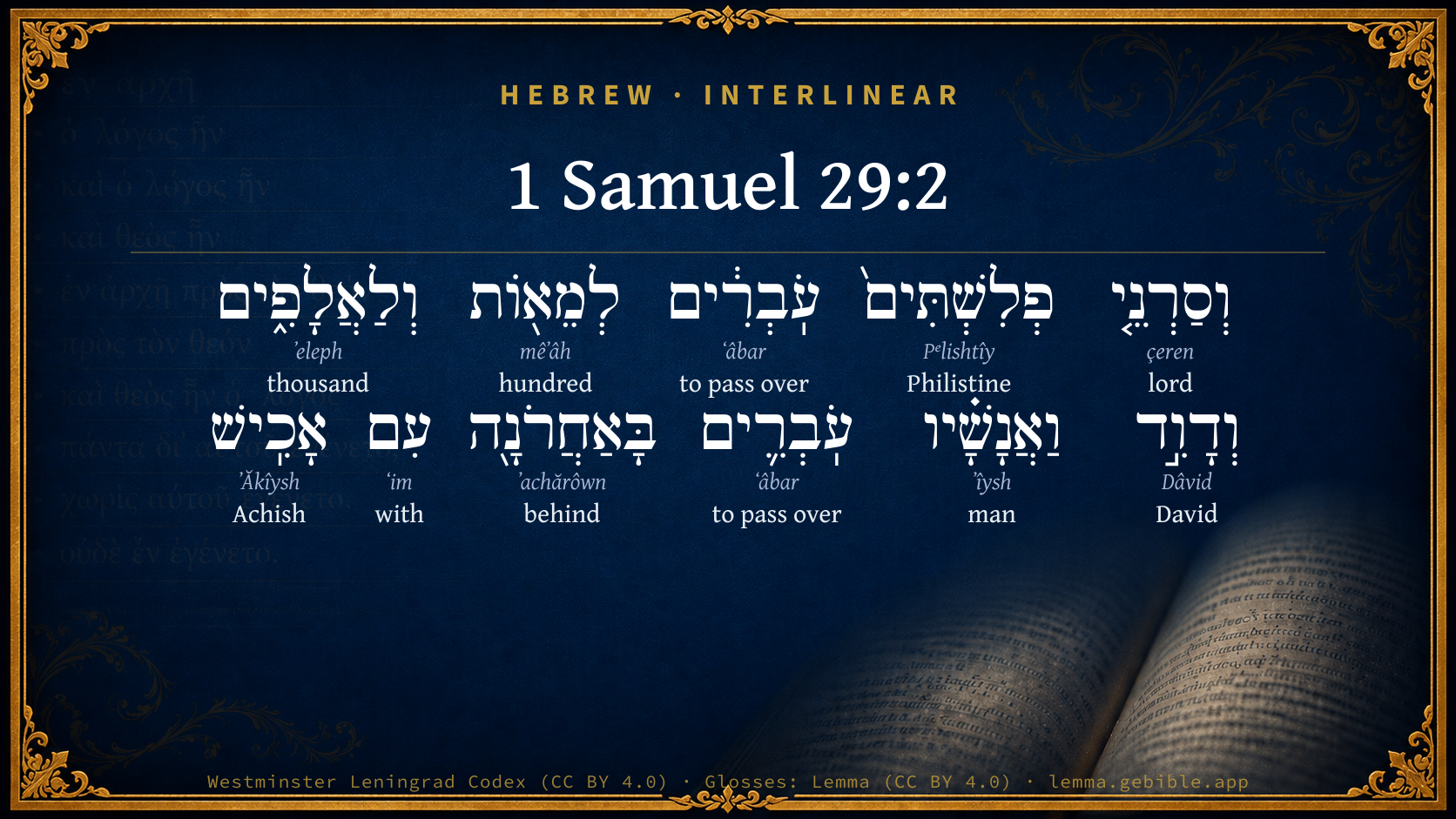
1 Samuel 29:2

Hebrew (Westminster Leningrad Codex) 1 Samuel 29:2 appears in the Hebrew Old Testament. The text above is from the Westminster Leningrad Codex. Each word links to its Strong’s number, a concise gloss, and parsing drawn from the Open Scriptures Hebrew Bible morphology. Click any word for its full Brown-Driver-Briggs (BDB) entry.
Download image
Cite this verse

1 Samuel 29:2 (World English Bible). Public Domain. Lemma interlinear Bible study tool, https://lemma.gebible.app/v/1-samuel/29/2.

Show BibTeX & RIS
BibTeX
RIS
English Translation
The lords of the Philistines passed on by hundreds, and by thousands; and David and his men passed on in the rearward with Achish.
World English Bible · Public Domain
Download a study sheet

One document with this verse’s original text, its word-by-word gloss line, the meaning frame, cross-references with their text, attributed commentary, and full source and license credits — printable, and it pastes into notes with its structure intact.

This verse Autodidact and up

Study sheet (.html) Plain text (.txt)

A passage Seminary Student

Up to 50 verses in one chapter. A passage sheet keeps up to 6 commentary sources and 12 cross-references per verse, in the order this page ranks them, and says so on the sheet whenever that leaves anything out. Ask for a single verse and you get the Autodidact verse sheet above.

Everything on this page stays free to read, with no account — the sheet is a download of what is already on screen, not access to it.

Want to remove ads? Support Godless Engineer
Compare translations 3

The same verse in 3 English versions, stacked beneath the original-language interlinear above. Click any original word for its lexicon entry.

Each is an independent rendering of the whole verse — the interlinear is not word-aligned to these translations.

Highlighted words mark where these versions differ — a whole-verse word diff, not a word-by-word alignment.

  • World English Bible Public Domain
    The lords of the Philistines passed on by hundreds, and by thousands; and David and his men passed on in the rearward with Achish.
  • King James Version Public Domain
    And the lords of the Philistines passed on by hundreds, and by thousands: but David and his men passed on in the rearward with Achish.
  • unfoldingWord Literal Text CC BY-SA 4.0
    Now the lords of the Philistines were passing over by hundreds and by thousands, and David and his men were passing over in the rear with Achish.

unfoldingWord Literal Text — © unfoldingWord, licensed CC BY-SA 4.0. Word-aligned USFM3 via Door43 (git.door43.org/unfoldingWord/en_ult).

Versions to compare (up to 4)

3 of 4 selected

Show all 18 translations

Every available English version of this verse, each an independent rendering of the whole verse.

  • World English Bible Public Domain
    The lords of the Philistines passed on by hundreds, and by thousands; and David and his men passed on in the rearward with Achish.
  • Berean Standard Bible Public Domain
    As the Philistine leaders marched out their units of hundreds and thousands, David and his men marched behind them with Achish.
  • Majority Standard Bible Public Domain
    As the Philistine leaders marched out with their units of hundreds and thousands, David and his men marched behind them with Achish.
  • King James Version Public Domain
    And the lords of the Philistines passed on by hundreds, and by thousands: but David and his men passed on in the rearward with Achish.
  • American Standard Version (1901) Public Domain
    And the lords of the Philistines passed on by hundreds, and by thousands; and David and his men passed on in the rearward with Achish.
  • Revised Version (1885) Public Domain
    And the lords of the Philistines passed on by hundreds, and by thousands: and David and his men passed on in the rearward with Achish.
  • Geneva Bible (1599) Public Domain
    And the princes of the Philistims went foorth by hundreths and thousandes, but Dauid and his men came behinde with Achish.
  • Douay-Rheims (1899) Public Domain
    And the lords of the Philistines marched with their hundreds and their thousands: but David and his men were in the rear with Achis.
  • Young's Literal Translation Public Domain
    and the princes of the Philistines are passing on by hundreds, and by thousands, and David and his men are passing on in the rear with Achish.
  • Literal Standard Version CC BY-SA 4.0
    and the princes of the Philistines are passing on by hundreds, and by thousands, and David and his men are passing on in the rear with Achish.
  • Unlocked Literal Bible CC BY-SA 4.0
    The princes of the Philistines passed on by hundreds and by thousands; David and his men passed on in the rear guard with Achish.
  • unfoldingWord Literal Text CC BY-SA 4.0
    Now the lords of the Philistines were passing over by hundreds and by thousands, and David and his men were passing over in the rear with Achish.
  • Darby Bible Public Domain
    And the lords of the Philistines passed on by hundreds and by thousands; and David and his men passed on in the rearward with Achish.
  • World Messianic Bible Public Domain
    The lords of the Philistines passed on by hundreds and by thousands; and David and his men passed on in the rear with Achish.
  • Webster's Bible Public Domain
    And the lords of the Philistines passed on by hundreds, and by thousands: but David and his men passed on in the rear with Achish.
  • Free Bible Version CC BY-SA 4.0
    The Philistine rulers were marching out in their divisions of hundreds and thousands with David and his men at the rear with King Achish.
  • Bible in Basic English Public Domain
    And the lords of the Philistines went on with their hundreds and their thousands, and David and his men came after with Achish.
  • JPS Tanakh (1917) Public Domain
    And the lords of the Philistines passed on by hundreds, and by thousands; and David and his men passed on in the rearward with Achish.

Literal Standard Version (2020), Covenant Press — licensed CC BY-SA 4.0. Text via the HelloAO Bible API (eBible.org). Unlocked Literal Bible (unfoldingWord) — licensed CC BY-SA 4.0. Text via the HelloAO Bible API (eBible.org). unfoldingWord Literal Text — © unfoldingWord, licensed CC BY-SA 4.0. Word-aligned USFM3 via Door43 (git.door43.org/unfoldingWord/en_ult). Free Bible Version, Dr. Jonathan Gallagher — licensed CC BY-SA 4.0. Text via the HelloAO Bible API (eBible.org).

Word by word

More ways to search: Search by grammar → Find every occurrence → Compare this word →

Practice this passage: Drill this verse → Learn its vocabulary →

אָכִֽישׁ
ʼĂkîysh
H397
“Achish”
Noun, Proper
Part of Speech
Noun
Type
Proper
Full BDB Definition

Origin: of uncertain derivation

TWOT: None

Achish = "I will blacken (or terrify)" or " only a man" - Philistine king of Gath
  1. וְסַרְנֵ֤י çeren H5633 “and · lords of” Conjunction + Noun, Common, Masculine, Plural, Construct
  2. פְלִשְׁתִּים֙ Pᵉlishtîy H6430 “Philistines” Noun, Gentilic, Masculine, Plural, Absolute
  3. עֹֽבְרִ֔ים ʻâbar H5674 “passing over” Verb, Qal, Participle Active, Masculine, Plural, Absolute
  4. לְמֵא֖וֹת mêʼâh H3967 “to/for · hundred” Preposition + Adjective, Cardinal number, Both, Plural, Absolute
  5. וְלַאֲלָפִ֑ים ʼeleph H505 “and · to/for · thousand” Conjunction + Preposition + Adjective, Cardinal number, Both, Plural, Absolute
  6. וְדָוִ֣ד Dâvid H1732 “and · David” Conjunction + Noun, Proper
  7. וַאֲנָשָׁ֗יו ʼîysh H376 “and · men · his” Conjunction + Noun, Common, Masculine, Plural, Construct + Suffix, Personal, 3rd Person, Masculine, Singular
  8. עֹֽבְרִ֛ים ʻâbar H5674 “passing over” Verb, Qal, Participle Active, Masculine, Plural, Absolute
  9. בָּאַחֲרֹנָ֖ה ʼachărôwn H314 “in/at the · behind” Preposition, Determined + Adjective, Adjective, Feminine, Singular, Absolute
  10. עִם ʻim H5973 “with” Preposition

About this verse

These counts appear in no published source. They are computed here, from the morphology-tagged text and Lemma’s own curated glosses. What Lemma adds →

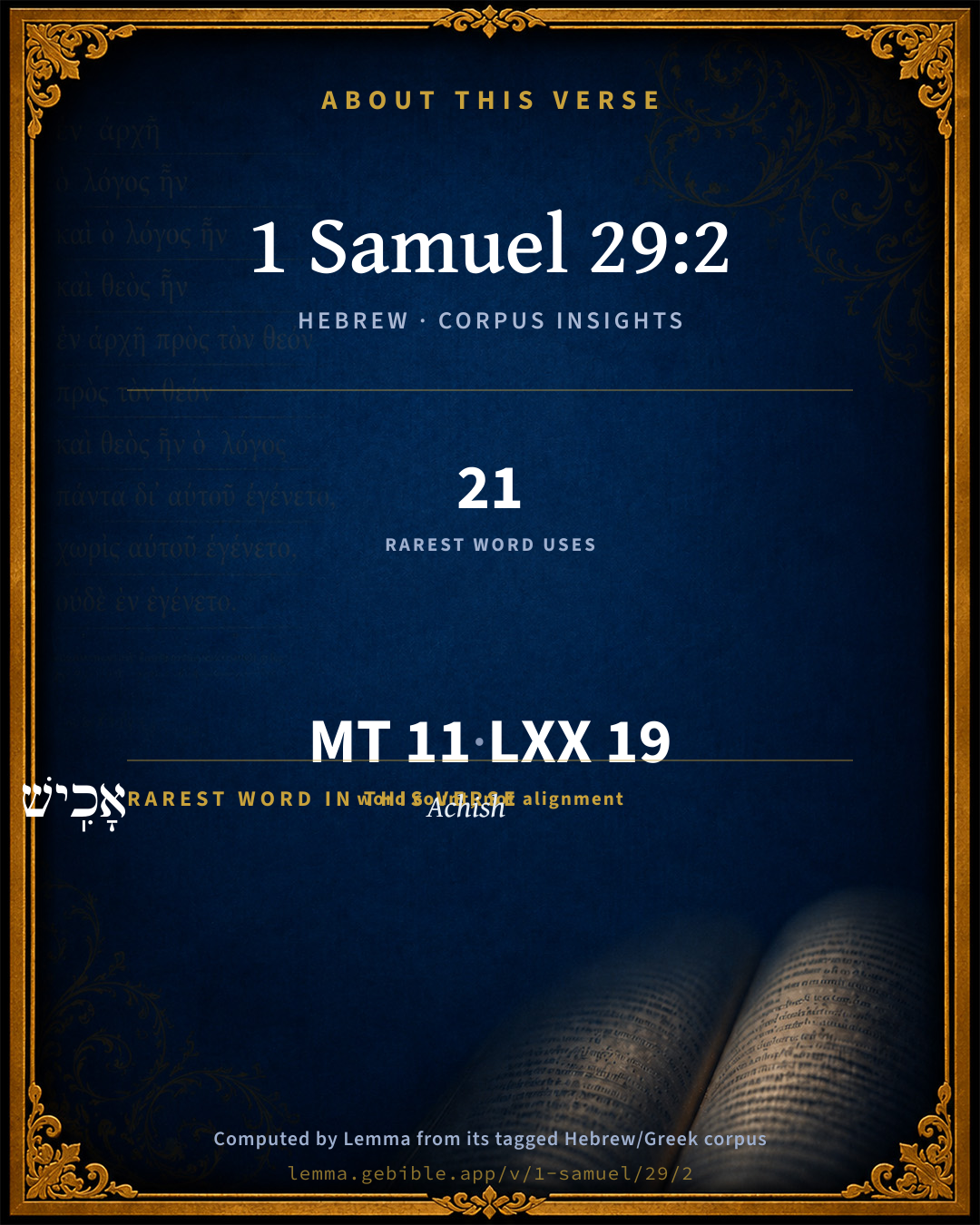
11
words
10
distinct lemmas
Historical
section

Notable vocabulary

The rarest word here is אָכִֽישׁ Achish H397 — appearing just 21 times in the whole Hebrew Bible.

Shared distinctive vocabulary

אָכִֽישׁ Achish H397 occurs in 20 verses of the Hebrew Bible. Also found in:

Grammatical profile

  • 2 verbs
  • 5 nouns
  • 3 adjectives
  • 1 preposition

Verb forms

  • עֹֽבְרִ֔ים Qal · Participle Active
  • עֹֽבְרִ֛ים Qal · Participle Active

Repetition

A word recurs within this verse — often emphatic in Hebrew:

  • עֹֽבְרִ֔ים to pass over H5674 ×2

Hebrew & Septuagint length

In English translation the verse runs 24 words from the Hebrew and 24 from the Septuagint (LXX English) — the same length.

A rough comparison of the two English renderings, which tokenize alike — not a word-level alignment.

Word counts can differ between the Hebrew and the Greek without any difference in meaning — e.g. the Hebrew direct-object marker אֵת has no separate Greek word, and Greek often adds the article ὁ.

In the original languages it is 11 Hebrew tokens and 19 Greek tokens — but the two are counted differently (Hebrew bundles its prefixes and suffixes into one token; the Greek is in lemma form), so that isn’t a like-for-like length.

Cross-references

5

Topical passages linked to 1 Samuel 29:2 in the Treasury of Scripture Knowledge — connected by theme and wording, ordered by reader-vote popularity; previews shown in the World English Bible.

  • 1 Samuel 28:1–2 It happened in those days, that the Philistines gathered their hosts together for warfare, to fight with Israel. Achish said to David, Know you assuredly, that you shall go out with me in the host, you and your men.
  • Joshua 13:3 from the Shihor, which is before Egypt, even to the border of Ekron northward, [which] is reckoned to the Canaanites; the five lords of the Philistines; the Gazites, and the Ashdodites, the Ashkelonites, the Gittites, and the Ekronites; also the Avvim,
  • 1 Samuel 29:6–7 Then Achish called David, and said to him, As Yahweh lives, you have been upright, and your going out and your coming in with me in the host is good in my sight; for I have not found evil in you since the day of your coming to me to this day: nevertheless the lords don't favor you.
  • 1 Samuel 5:8–11 They sent therefore and gathered all the lords of the Philistines to them, and said, What shall we do with the ark of the God of Israel? They answered, Let the ark of the God of Israel be carried about to Gath. They carried the ark of the God of Israel [there].
  • 1 Samuel 6:4 Then they said, "What shall be the trespass-offering which we shall return to him?" They said, "Five golden tumors, and five golden mice, [according to] the number of the lords of the Philistines; for one plague was on you all, and on your lords.

Cross-references courtesy of OpenBible.info (CC BY 4.0).

Hebrew and Greek witnesses Masoretic Hebrew ↔ Greek Septuagint

The same verse in the two great witnesses to the Old Testament, shown verse-for-verse.

These are two independent witnesses, not word-aligned to each other, and the Septuagint is shown in lemma (dictionary) form.

Hebrew 1 Samuel 29:2 Masoretic · Westminster Leningrad Codex

וְסַרְנֵ֤י פְלִשְׁתִּים֙ עֹֽבְרִ֔ים לְמֵא֖וֹת וְלַאֲלָפִ֑ים וְדָוִ֣ד וַאֲנָשָׁ֗יו עֹֽבְרִ֛ים בָּאַחֲרֹנָ֖ה עִם אָכִֽישׁ

The lords of the Philistines passed on by hundreds, and by thousands; and David and his men passed on in the rearward with Achish.

World English Bible · Public Domain

Greek LXX 1 Samuel 29:2 Septuagint · lemma form

καί σατράπης ἀλλόφυλος παραπορεύομαι εἰς ἑκατοντάς καί χιλιάς καί δαυίδ καί ὁ ἀνήρ αὐτός παραπορεύομαι ἐπί ἔσχατος μετά αγχους

And the lords of the Philistines went on by hundreds and thousands, and David and his men went on in the rear with Anchus.

LXX2012 (modern English Septuagint) · Public Domain

Hebrew: Westminster Leningrad Codex (CC BY 4.0). Greek: Septuagint (public domain); English from LXX2012 (modern English Septuagint) (Public Domain). How the Septuagint differs from the Hebrew →

Targum (Aramaic paraphrase)

1

The Targum is the ancient Jewish Aramaic paraphrase of the Hebrew Scriptures — an interpretive translation, not the Hebrew text itself. Onkelos (literal) and Pseudo-Jonathan (expansive) render the Torah, and Jonathan the Prophets. Coverage is partial: where no permissively-licensed English translation exists for a verse, only the Aramaic is shown. This is verse-level text, not a word-by-word alignment to the Hebrew.

  1. Targum Jonathan Prophets (Joshua–Malachi)
    וְטוּרְנֵי פְּלִשְׁתָּאֵי עָבְרִין לְמָאֲוָן וּלְאַלְפִין וְדָוִד וְגַבְרוֹהִי עָבְרִין בְּבַתְרַיְתָא עִם אָכִישׁ:

    (no public-domain English translation for this verse)

    Targum Jonathan — Aramaic: “Mikraot Gedolot” (public domain). English: “Sefaria Community Translation” (CC0 1.0 (public-domain dedication)); “London "Chaldee Paraphrase," 1871” (public domain). Text via Sefaria.

Commentary

Notes on 1 Samuel 29:2 from classic Christian and Jewish commentators (each source and its license shown beneath its notes). The classic Christian expositions comment on the surrounding passage and are grouped to its opening verse, so a note may address several verses; the Jewish commentaries on the Tanakh (Rashi and others) are per-verse, so they appear only where the commentator wrote on this verse.

Lemma curates 59 commentaries, every one of them public domain or Creative Commons licensed, each selected and text-cleaned for this edition rather than reprinted as found. About our sources →

Trapp's Complete Commentary

John Trapp

1Sa 29:2 And the lords of the Philistines passed on by hundreds, and by thousands: but David and his men passed on in the rereward with Achish.

Ver. 2. Passed on by hundreds, and by thousands.] Lustrabrant exercitum, they made a general muster, and took a view of their forces, by their several companies, regiments, and brigades.

In the rereward with Achish.] Whom they had chosen general; wherefore also he brought up the rear, having David and his men for his bodyguard, which the Philistines as much stomached as the French ever did their king’s guard of Scots.

John Trapp, A Commentary or Exposition upon All the Books of the Old and New Testament (1647–1656) — public domain. Text from a community e-Sword module.

Geneva Bible (1599)

Geneva Bible translators

Or, captains.

According to their bands, or ensigns.

Geneva Bible (1599) marginal notes — public domain. Text via Bolls.life.

Jamieson, Fausset & Brown

Robert Jamieson, A. R. Fausset & David Brown

David and his men passed on in the rereward with Achish--as the commander of the lifeguards of Achish, who was general of this invading army of the Philistines.

Jamieson, Fausset & Brown — Commentary Critical and Explanatory on the Whole Bible (1871) — public domain (CC PDM 1.0). Text via the HelloAO Bible API.

Adam Clarke's Commentary

Verse 2. By hundreds, and by thousands] They were probably divided, as the Jewish armies, by fifties, hundreds, and thousands; each having its proper officer or captain.

Adam Clarke's Commentary on the Bible (1810–1826) — public domain. Text from a community e-Sword/MySword module.

Ellicott's Commentary for English Readers

(2) And the lords of the Philistines passed on by hundreds, and by thousands.—The orderly advance of this great military nation is thus described. The “lords” a different term to the expression “princes.” There were apparently in the Philistine federation five sovereign princes, of whom Achish of Gath was one. Beneath these were other chieftains, who seemingly had great control over the sovereign princes.

David and his men.—David, in return for the lands round Ziklag given him by the King of Gath, seems to have owed a kind of military service to his suzerain Achish. The difference in the arms and equipment of the Israelitish warriors in the division of David, which was marching under the standard of Gath, no doubt excited questions. The general appearance of the Hebrews was, of course, well known to their hereditary Philistine foes.

A Bible Commentary for English Readers, edited by Charles John Ellicott (1878–1897) — public domain. Text from a community e-Sword module.

The Cambridge Bible for Schools and Colleges

gen. ed. J. J. S. Perowne

2. And the lords, &c.] Render, Now the lords … were passing on. The narrative now goes back to a point of time during the march of the Philistine army northwards, probably soon after the junction of the confederate forces from the different cities of the league. It must have been after they had passed the Philistine frontier, as David “returned into the land of the Philistines” (1Sa_29:11), but soon after, as he reached Ziklag on the third day (1Sa_30:1).

the lords] For the special title Seren translated “lord” see on ch. 1Sa_5:8. They were marching at the head of “the hundreds and the thousands” which were the military divisions of the army.

the rereward] The rear-guard, ward and guard being related as wise and guise, Cp. Isa_52:12.

The Cambridge Bible for Schools and Colleges (gen. ed. J. J. S. Perowne; Cambridge University Press, 1878–1918) — public domain. Text from a community e-Sword module.

John Gill's Exposition

And the lords of the Philistines passed on by hundreds, and by thousands,.... Not that there were so many lords, for there were but five of them; but these marched, some at the head of hundreds with them, and others at the head of thousands:

but David and his men passed on in the rereward with Achish; who being the generalissimo brought up the rear, and David, whom he had appointed captain of his bodyguards, attended him with his men, which in point of gratitude he could not refuse; and yet was in the greatest strait and difficulty how to act, it being both against his conscience and his interest to fight against Israel, and was waiting and hoping for some appearance of Providence to deliver him out of this dilemma, and which was quickly seen; but Abarbinel thinks David had no other notion in going to the battle, but of being the bodyguard of Achish, and accompanying him, and that he should not fight against Israel, nor for the Philistines: neither harm the one, nor help the other.

John Gill's Exposition of the Whole Bible (1746–1763) — public domain (CC PDM 1.0). Text via the HelloAO Bible API.

Albert Barnes' Notes on the Bible

The lords - See Jdg 3:3 note, as distinguished from ordinary “princes” 1Sa 29:3. The military divisions of the Philistine army were by hundreds and by thousands, like those of the Israelites 1Sa 8:12. David and his men formed a body-guard to Achish 1Sa 28:2.

Albert Barnes' Notes on the Bible (1834–1885) — public domain. Text from a community e-Sword/MySword module.

Haydock's Catholic Bible Commentary

Thousands, making the troops pass in review, as the Hebrew insinuates. Their army seems to have been divided, in the same manner as that of the Israelites, each company of 10, 50, &c., having its respective officer, under the five lords. --- Were. Hebrew, "passed." David’s band was connected with the troops of Achis, yet so that they might be easily distinguished by their dress, &c. (Calmet) --- The Roman Triarii, who were esteemed the bravest soldiers, occupied the rear. (Menochius) --- Josephus gives us to understand that Achis was the commander in chief. (Antiquities vi. 14.) (Tirinus)

George Leo Haydock (1774–1849), Haydock's Catholic Family Bible and Commentary, 1859 edition — public domain. Excludes Psalms (Douay-Rheims chapter numbering differs from Protestant) and Deuterocanonical books (Catholic canon only).

Matthew Poole's English Annotations

i.e. As the life-guard of Achish, as he had promised, 1Sa 28:2, Achish being, as it seems, the general of the army.

Matthew Poole's English Annotations on the Holy Bible (1683–1685) — public domain. Text from a community e-Sword/MySword module.

The Pulpit Commentary

Vers. 2, 3. The lords of the Philistines passed on. Evidently they were on their march northward, with their troops arranged in divisions, when David"s presence in the rearward with the contingent of Achish was noticed. The princes not the strict word for the Philistine lords, (see on 1Sa_5:8) but a loose, general term used again in ver. 4 on having it reported to them in the course of a day or two that there was a body of strange troops in the army of Gath, asked, What do these Hebrews here? Hebrew, "What these Hebrews?" i.e. What mean these Hebrews? using of them the ordinary Philistine term of contempt. Achish answers that these men were the followers of David, who, having deserted from Saul, had been with him these days or these years, i.e. an indefinitely long time, during which he had conducted himself with the utmost fidelity to his new master.

HOMILIES BY D. FRASER Ver. 2.

A false position.

What a dilemma for David! He could not refuse the confidence he had sought from Achish. He could not renounce the allegiance he had so recently pledged. If he should disobey the king of Gath, he could look for nothing but indignant reproach and a traitor"s doom. If he should obey him, he would, in course of a few days, be fighting against his own nation, and bringing them again under the yoke of the Philistines; and this would be worse than death. Perplexed and reluctant, he marched in the rear of the invading army, suffering inwardly all the more that he was obliged to hide his unwillingness, and to affect a zeal against Israel which his heart disowned. See in this story

I THE ILLUSTRATION OF DIVINE PROVIDENCE. While David wrought himself into a most critical position, and an apparently fatal embroilment with the Philistines, the Lord wrought wonderfully through the very errors of his servant, so as to preserve him in safety, and open his way to a higher destiny. It was well appointed that he should be out of the land of Israel at this time, so that he should neither hasten nor hinder the discomfiture of Saul, and that the Philistines should give him shelter, and yet not involve him in the crime of desolating and enslaving his native land.

How to escape from the dilemma in which he was caught baffled even David"s ready mind; but the Lord always knows how to deliver. He does so through means and agencies that are natural; in this case through the very natural jealousy of the Philistine lords, and their proper military prudence, objecting to have the person of the king intrusted to the keeping of a band of Israelites, and that band commanded by a skilful and daring captain in the rear of their army, where their defection would be most dangerous. "The lords favour thee not," said Achish. And, like our kings in old times, who durst not disregard the voice of the barons, Achish intimated to David that it was best for him to retire from the army. David was quite acute enough to see the advantage which the Philistine chiefs were unwittingly conferring upon him. They, as his enemies, helped him out of the dilemma in which he had been placed by Achish, his friend. Such things are not infrequent in the providence of God. Often a man"s enemies open to him the way out of great difficulty. Disfavour is shown, or a sharp word spoken, and it turns out a great advantage. The wrath of opponents or rivals may act as so much dynamite to explode a rock of obstruction which friendly hands cannot remove, and so to clear the path of deliverance.

II THE ILLUSTRATION OF HUMAN LIFE. See how a man may fall through want of moral firmness into a false position utterly unworthy of his character. It was, as respects David"s integrity, unfortunate that he found such favour with the Philistine king. It is always a misfortune to be successful in the beginning of wrong doing, for it soothes the conscience and leads one on to compromise himself more deeply. And one false step leads to another. David"s unbelief led him into a course of deceit and dissimulation from which he saw no way of escape, and every day drew him further into a position which was false and unworthy. It is a story full of admonition and warning. One may easily let himself into a trap from which he cannot let himself out. One may take a false step, which involves another and another, till there is a course of deflection. An object is gained, but in the success the conscience is soiled; and then the penalty is that one is compelled to act out the part he has assumed, to go on in the way on which he only meant to venture for a time and for a purpose. He thought to do a questionable thing and then return to his integrity; but lo! he is in a maze, and cannot find the way out. The gain which he sought turns out to be a loss; the favour which he craftily won proves to be a burden and a danger; and there is no remedy. It is very unsafe to possess great powers of deception. David had them, and they nearly ruined him. But the experience through which he passed taught him to abhor deceit, and to desire, what God desires, truth in the inward parts. For proof of this see Psa_15:1, 2 34:12, 13 51:6. Mark, too, how he appeals to the God of truth, and, ashamed of his own unveracity in certain passages of his early life, puts all his dependence in his later years on the veracity and faithfulness of God, who has made with him an "everlasting covenant, ordered in all things and sure". (see 2Sa_23:5; Psa_25:10 Psa_31:5) The security of our salvation rests not on our tenacity of faith, but on the truth of God our Saviour. He cannot lie. The Son of David, our Prince of life, is faithful and true; and he who is our God in Christ Jesus will never fail those who rely on his word. "Yet he abideth faithful; he cannot deny himself. F.

The Pulpit Commentary (1880–1919), ed. H.D.M. Spence-Jones & Joseph S. Exell — public domain. Text from a community e-Sword module.

John Wesley's Explanatory Notes

With Achish - As the life-guard of Achish. Achish being, as it seems, the general of the army.

John Wesley, Explanatory Notes Upon the Whole Bible (1754–1765) — public domain. Text via the GEBible commentary corpus.

Lesson kit

Teaching starters — assembled from the data on this page, not authored interpretation. Every prompt links to the verse data it draws on. Edit before teaching.

1 Samuel, in the Historical, opens this verse with 11 words (10 distinct Hebrew lemmas). Its most distinctive word is ʼĂkîysh (“Achish”). A historical commentator’s framing appears above. Read the whole chapter for the surrounding context.

Discussion questions

  1. What does “Achish” (ʼĂkîysh) contribute to the verse as a whole?
  2. How does 1 Samuel 21:10, which shares the word «Achish», read alongside this verse?
  3. What does the repetition of “to pass over” (2× in this one verse) do in this verse?
  4. These translations render this verse differently; the difference is in the English rendering, not the original. What questions does that raise?
  5. «עֹֽבְרִ֔ים» is a Qal Participle Active verb. How does that grammatical form shape the action described?
  6. Compare how Trapp's Complete Commentary and Geneva Bible (1599) read this verse. Where do they agree or differ?

Things to notice

Reading settings

Reading text

Shown beneath each verse's original-language words.

Old Testament
Old Testament edition

Read the OT as the Masoretic Hebrew (MT) or the Greek Septuagint (LXX).

English shown for the Greek Septuagint (in the Hebrew ↔ Greek comparison).

Comparing translations? Open the Compare panel on any verse page to stack up to four side by side.