2 Samuel 18:7

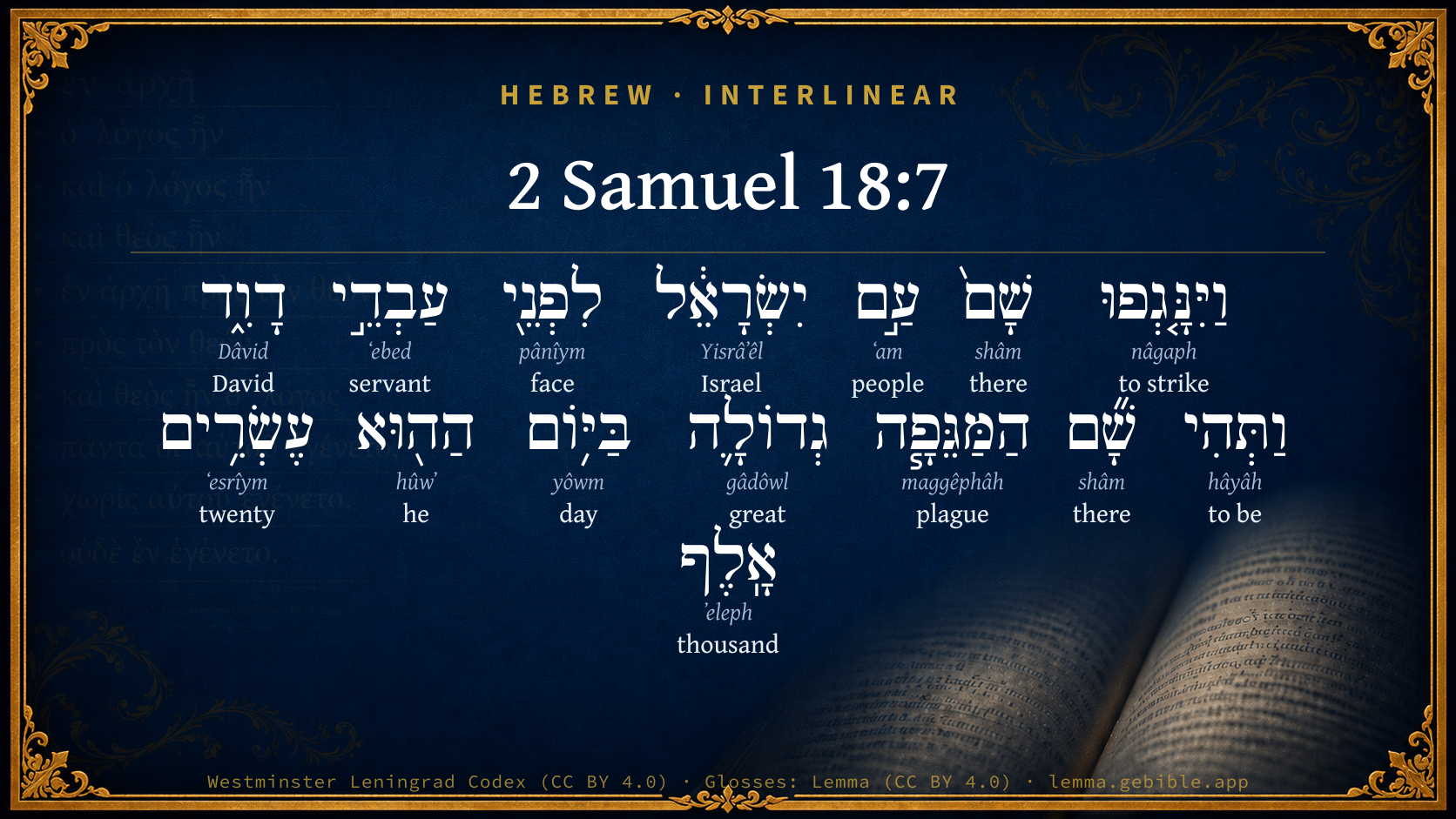
Hebrew (Westminster Leningrad Codex) 2 Samuel 18:7 appears in the Hebrew Old Testament. The text above is from the Westminster Leningrad Codex. Each word links to its Strong’s number, a concise gloss, and parsing drawn from the Open Scriptures Hebrew Bible morphology. Click any word for its full Brown-Driver-Briggs (BDB) entry.
Download image
Cite this verse

2 Samuel 18:7 (World English Bible). Public Domain. Lemma interlinear Bible study tool, https://lemma.gebible.app/v/2-samuel/18/7.

Show BibTeX & RIS
BibTeX
RIS
English Translation
The people of Israel were struck there before the servants of David, and there was a great slaughter there that day of twenty thousand men.
World English Bible · Public Domain
Download a study sheet

One document with this verse’s original text, its word-by-word gloss line, the meaning frame, cross-references with their text, attributed commentary, and full source and license credits — printable, and it pastes into notes with its structure intact.

This verse Autodidact and up

Study sheet (.html) Plain text (.txt)

A passage Seminary Student

Up to 50 verses in one chapter. A passage sheet keeps up to 6 commentary sources and 12 cross-references per verse, in the order this page ranks them, and says so on the sheet whenever that leaves anything out. Ask for a single verse and you get the Autodidact verse sheet above.

Everything on this page stays free to read, with no account — the sheet is a download of what is already on screen, not access to it.

Want to remove ads? Support Godless Engineer
Compare translations 3

The same verse in 3 English versions, stacked beneath the original-language interlinear above. Click any original word for its lexicon entry.

Each is an independent rendering of the whole verse — the interlinear is not word-aligned to these translations.

Highlighted words mark where these versions differ — a whole-verse word diff, not a word-by-word alignment.

  • World English Bible Public Domain
    The people of Israel were struck there before the servants of David, and there was a great slaughter there that day of twenty thousand men.
  • King James Version Public Domain
    Where the people of Israel were slain before the servants of David, and there was there a great slaughter that day of twenty thousand men.
  • unfoldingWord Literal Text CC BY-SA 4.0
    And the people of Israel were struck there to the face of the servants of David. And the striking there was great on that day, 20,000.

unfoldingWord Literal Text — © unfoldingWord, licensed CC BY-SA 4.0. Word-aligned USFM3 via Door43 (git.door43.org/unfoldingWord/en_ult).

Versions to compare (up to 4)

3 of 4 selected

Show all 18 translations

Every available English version of this verse, each an independent rendering of the whole verse.

  • World English Bible Public Domain
    The people of Israel were struck there before the servants of David, and there was a great slaughter there that day of twenty thousand men.
  • Berean Standard Bible Public Domain
    There the people of Israel were defeated by David’s servants, and the slaughter was great that day—twenty thousand men.
  • Majority Standard Bible Public Domain
    There the people of Israel were defeated by David’s servants, and the slaughter was great that day—twenty thousand men.
  • King James Version Public Domain
    Where the people of Israel were slain before the servants of David, and there was there a great slaughter that day of twenty thousand men.
  • American Standard Version (1901) Public Domain
    And the people of Israel were smitten there before the servants of David, and there was a great slaughter there that day of twenty thousand men.
  • Revised Version (1885) Public Domain
    And the people of Israel were smitten there before the servants of David, and there was a great slaughter there that day of twenty thousand men.
  • Geneva Bible (1599) Public Domain
    Where the people of Israel were slaine before the seruants of Dauid: so there was a great slaughter that day, euen of twentie thousande.
  • Douay-Rheims (1899) Public Domain
    And the people of Israel were defeated there by David's army, and a great slaughter was made that day of twenty thousand men.
  • Young's Literal Translation Public Domain
    and smitten there are the people of Israel before the servants of David, and the smiting there is great on that day -- twenty thousand;
  • Literal Standard Version CC BY-SA 4.0
    and the people of Israel are struck there before the servants of David, and the striking there is great on that day—twenty thousand;
  • Unlocked Literal Bible CC BY-SA 4.0
    The army of Israel was defeated there before the soldiers of David; there was a great slaughter there that day of twenty thousand men.
  • unfoldingWord Literal Text CC BY-SA 4.0
    And the people of Israel were struck there to the face of the servants of David. And the striking there was great on that day, 20,000.
  • Darby Bible Public Domain
    And the people of Israel were routed before the servants of David, and there was a great slaughter there that day: twenty thousand men.
  • World Messianic Bible Public Domain
    The people of Israel were struck there before David’s servants, and there was a great slaughter there that day of twenty thousand men.
  • Webster's Bible Public Domain
    Where the people of Israel were slain before the servants of David, and there was there a great slaughter that day of twenty thousand men.
  • Free Bible Version CC BY-SA 4.0
    The Israelites were defeated by David's men and many were killed that day—some twenty thousand.
  • Bible in Basic English Public Domain
    And the people of Israel were overcome there by the servants of David, and there was a great destruction that day, and twenty thousand men were put to the sword.
  • JPS Tanakh (1917) Public Domain
    And the people of Israel were smitten there before the servants of David, and there was a great slaughter there that day of twenty thousand men.

Literal Standard Version (2020), Covenant Press — licensed CC BY-SA 4.0. Text via the HelloAO Bible API (eBible.org). Unlocked Literal Bible (unfoldingWord) — licensed CC BY-SA 4.0. Text via the HelloAO Bible API (eBible.org). unfoldingWord Literal Text — © unfoldingWord, licensed CC BY-SA 4.0. Word-aligned USFM3 via Door43 (git.door43.org/unfoldingWord/en_ult). Free Bible Version, Dr. Jonathan Gallagher — licensed CC BY-SA 4.0. Text via the HelloAO Bible API (eBible.org).

Word by word

More ways to search: Search by grammar → Find every occurrence → Compare this word →

Practice this passage: Drill this verse → Learn its vocabulary →

הַמַּגֵּפָ֧ה
maggêphâh
H4046
“the · plague”
Particle, Definite Article + Noun, Common, Feminine, Singular, Absolute
Part of Speech
Particle + Noun
Type
Common
Gender
Feminine
Number
Singular
State
Absolute
Full BDB Definition

Origin: from H5062

TWOT: 1294b

blow, slaughter, plague, pestilence, strike, smite - blow (fatal stroke) - slaughter (of battle) - plague, pestilence (divine judgment)
  1. וַיִּנָּ֤גְפוּ nâgaph H5062 “and · to strike” Conjunction + Verb, Niphal, Sequential Imperfect, 3rd Person, Masculine, Plural
  2. שָׁם֙ shâm H8033 “there” Adverb
  3. עַ֣ם ʻam H5971 “people of” Noun, Common, Masculine, Singular, Construct
  4. יִשְׂרָאֵ֔ל Yisrâʼêl H3478 “Israel” Noun, Proper
  5. לִפְנֵ֖י pânîym H6440 “to/for · face(s) of” Preposition + Noun, Common, Both, Plural, Construct
  6. עַבְדֵ֣י ʻebed H5650 “servants of” Noun, Common, Masculine, Plural, Construct
  7. דָוִ֑ד Dâvid H1732 “David” Noun, Proper
  8. וַתְּהִי hâyâh H1961 “and · to be” Conjunction + Verb, Qal, Sequential Imperfect, 3rd Person, Feminine, Singular
  9. שָׁ֞ם shâm H8033 “there” Adverb
  10. גְדוֹלָ֛ה gâdôwl H1419 “great” Adjective, Adjective, Feminine, Singular, Absolute
  11. בַּיּ֥וֹם yôwm H3117 “in/at the · day” Preposition, Determined + Noun, Common, Masculine, Singular, Absolute
  12. הַה֖וּא hûwʼ H1931 “the · he” Particle, Definite Article + Pronoun, Personal, 3rd Person, Masculine, Singular
  13. עֶשְׂרִ֥ים ʻesrîym H6242 “twenty” Adjective, Cardinal number, Both, Plural, Absolute
  14. אָֽלֶף ʼeleph H505 “thousand” Adjective, Cardinal number, Both, Singular, Absolute

About this verse

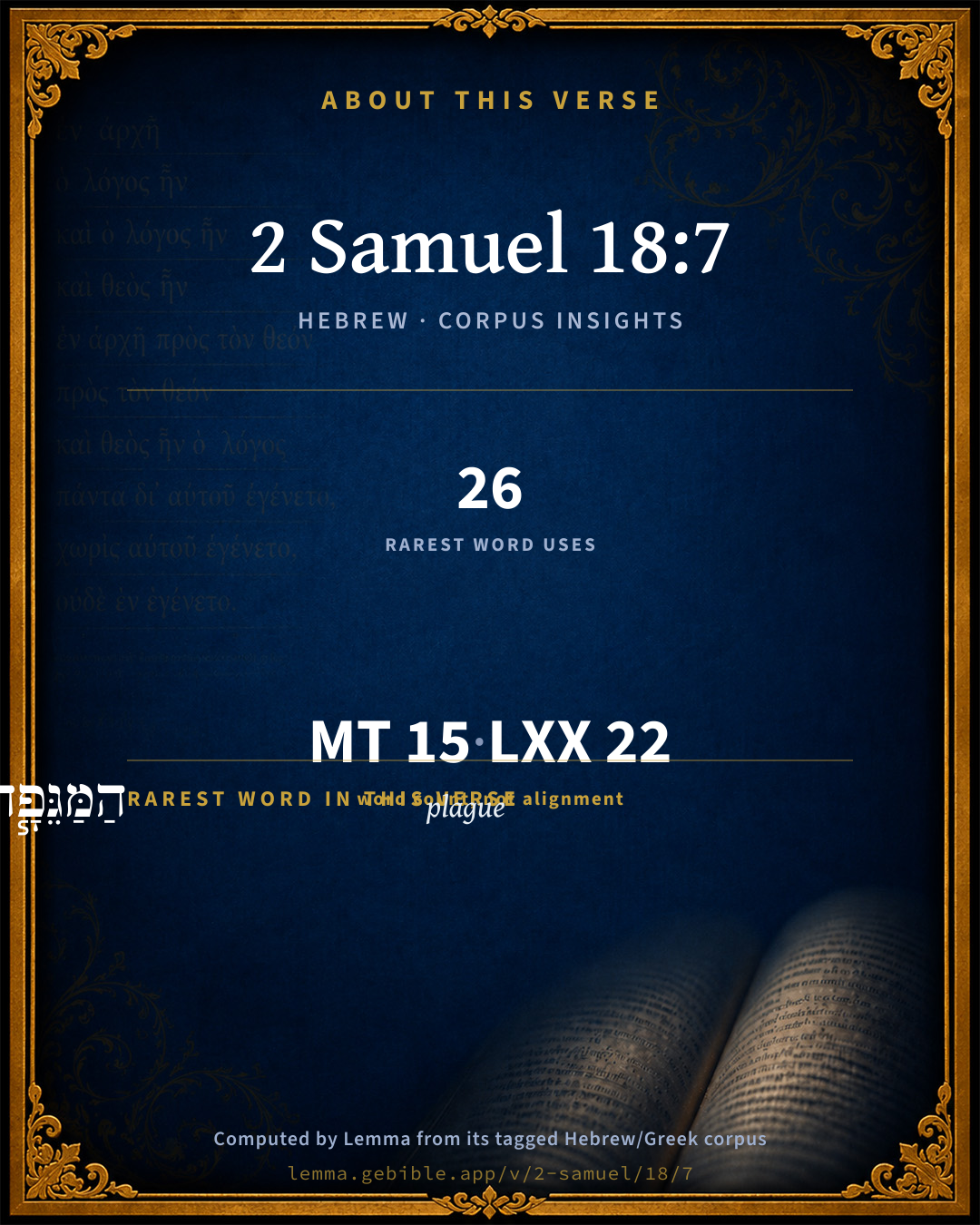
These counts appear in no published source. They are computed here, from the morphology-tagged text and Lemma’s own curated glosses. What Lemma adds →

15
words
14
distinct lemmas
Historical
section

Shared distinctive vocabulary

הַמַּגֵּפָ֧ה plague H4046 occurs in 25 verses of the Hebrew Bible. Also found in:

Grammatical profile

  • 2 verbs
  • 7 nouns
  • 3 adjectives
  • 1 pronoun
  • 2 adverbs

Verb forms

  • וַיִּנָּ֤גְפוּ Niphal · Sequential Imperfect
  • וַתְּהִי Qal · Sequential Imperfect

Repetition

A word recurs within this verse — often emphatic in Hebrew:

  • שָׁם֙ there H8033 ×2

Hebrew & Septuagint length

In English translation the verse runs 25 words from the Hebrew and 26 from the Septuagint (LXX English) — closely comparable.

A rough comparison of the two English renderings, which tokenize alike — not a word-level alignment.

Word counts can differ between the Hebrew and the Greek without any difference in meaning — e.g. the Hebrew direct-object marker אֵת has no separate Greek word, and Greek often adds the article ὁ.

In the original languages it is 15 Hebrew tokens and 22 Greek tokens — but the two are counted differently (Hebrew bundles its prefixes and suffixes into one token; the Greek is in lemma form), so that isn’t a like-for-like length.

Cross-references

9

Topical passages linked to 2 Samuel 18:7 in the Treasury of Scripture Knowledge — connected by theme and wording, ordered by reader-vote popularity; previews shown in the World English Bible.

  • Proverbs 24:21 My son, fear Yahweh and the king. Don't join those who are rebellious:
  • 2 Samuel 2:17 The battle was very severe that day: and Abner was beaten, and the men of Israel, before the servants of David.
  • 2 Samuel 2:26 Then Abner called to Joab, and said, "Shall the sword devour forever? Don't you know that it will be bitterness in the latter end? How long shall it be then, before you bid the people return from following their brothers?"
  • 2 Samuel 2:31 But the servants of David had struck of Benjamin, and of Abner's men, [so that] three hundred sixty men died.
  • 2 Samuel 15:6 In this manner Absalom did to all Israel who came to the king for judgment: so Absalom stole the hearts of the men of Israel.
  • 2 Samuel 19:41–43 Behold, all the men of Israel came to the king, and said to the king, Why have our brothers the men of Judah stolen you away, and brought the king, and his household, over the Jordan, and all David's men with him?
  • 2 Chronicles 13:16–17 The children of Israel fled before Judah; and God delivered them into their hand.
  • 2 Chronicles 28:6 For Pekah the son of Remaliah killed in Judah one hundred twenty thousand in one day, all of them valiant men; because they had forsaken Yahweh, the God of their fathers.
  • Proverbs 11:21 Most assuredly, the evil man will not be unpunished, But the seed of the righteous will be delivered.

Cross-references courtesy of OpenBible.info (CC BY 4.0).

Hebrew and Greek witnesses Masoretic Hebrew ↔ Greek Septuagint

The same verse in the two great witnesses to the Old Testament, shown verse-for-verse.

These are two independent witnesses, not word-aligned to each other, and the Septuagint is shown in lemma (dictionary) form.

Hebrew 2 Samuel 18:7 Masoretic · Westminster Leningrad Codex

וַיִּנָּ֤גְפוּ שָׁם֙ עַ֣ם יִשְׂרָאֵ֔ל לִפְנֵ֖י עַבְדֵ֣י דָוִ֑ד וַתְּהִי שָׁ֞ם הַמַּגֵּפָ֧ה גְדוֹלָ֛ה בַּיּ֥וֹם הַה֖וּא עֶשְׂרִ֥ים אָֽלֶף

The people of Israel were struck there before the servants of David, and there was a great slaughter there that day of twenty thousand men.

World English Bible · Public Domain

Greek LXX 2 Samuel 18:7 Septuagint · lemma form

καί πταίω ἐκεῖ ὁ λαός ἰσραήλ ἐνώπιον ὁ παῖς δαυίδ καί γίγνομαι ὁ θραῦσις μέγας ἐν ὁ ἡμέρα ἐκεῖνος εἴκοσι χιλίας ἀνήρ

And the people of Israel fell down there before the servants of David, and there was a great slaughter in that day, even twenty thousand men.

LXX2012 (modern English Septuagint) · Public Domain

Hebrew: Westminster Leningrad Codex (CC BY 4.0). Greek: Septuagint (public domain); English from LXX2012 (modern English Septuagint) (Public Domain). How the Septuagint differs from the Hebrew →

Targum (Aramaic paraphrase)

1

The Targum is the ancient Jewish Aramaic paraphrase of the Hebrew Scriptures — an interpretive translation, not the Hebrew text itself. Onkelos (literal) and Pseudo-Jonathan (expansive) render the Torah, and Jonathan the Prophets. Coverage is partial: where no permissively-licensed English translation exists for a verse, only the Aramaic is shown. This is verse-level text, not a word-by-word alignment to the Hebrew.

  1. Targum Jonathan Prophets (Joshua–Malachi)
    וְאִתַּבָּרוּ תַמָן עַם יִשְׂרָאֵל קֳדָם עַבְדֵי דָוִד וַהֲוַת תַּמָן מְחָתָא רַבְּתָא בְּיוֹמָא הַהוּא עַסְרִין אַלְפִין:

    (no public-domain English translation for this verse)

    Targum Jonathan — Aramaic: “Mikraot Gedolot” (public domain). English: “Sefaria Community Translation” (CC0 1.0 (public-domain dedication)); “London "Chaldee Paraphrase," 1871” (public domain). Text via Sefaria.

Commentary

Notes on 2 Samuel 18:7 from classic Christian and Jewish commentators (each source and its license shown beneath its notes). The classic Christian expositions comment on the surrounding passage and are grouped to its opening verse, so a note may address several verses; the Jewish commentaries on the Tanakh (Rashi and others) are per-verse, so they appear only where the commentator wrote on this verse.

Lemma curates 59 commentaries, every one of them public domain or Creative Commons licensed, each selected and text-cleaned for this edition rather than reprinted as found. About our sources →

Trapp's Complete Commentary

John Trapp

2Sa 18:7 Where the people of Israel were slain before the servants of David, and there was there a great slaughter that day of twenty thousand [men].

Ver. 7. Where the people of Israel were slain.] For a just reward of their unjust rebellion: besides a great sort of them who having tasted of the sweetness of war, dulce bellum inexpertis, threw down their arms, and ran home ad beatos rastros, benedictura aratrum, sanctamque stivam, {a} as the divine chronologer saith of the seditious boors of Germany beaten by the princes, together with Munzer, their general, who was taken and executed according to his deserts.

{a} Bucholc.

John Trapp, A Commentary or Exposition upon All the Books of the Old and New Testament (1647–1656) — public domain. Text from a community e-Sword module.

Jamieson, Fausset & Brown

Robert Jamieson, A. R. Fausset & David Brown

the people of Israel were slain--This designation, together with the immense slaughter mentioned later, shows the large extent to which the people were enlisted in this unhappy civil contest.

Jamieson, Fausset & Brown — Commentary Critical and Explanatory on the Whole Bible (1871) — public domain (CC PDM 1.0). Text via the HelloAO Bible API.

Adam Clarke's Commentary

Verse 7. Twenty thousand men.] Whether these were slain on the field of battle, or whether they were reckoned with those slain in the wood of Ephraim, we know not.

Adam Clarke's Commentary on the Bible (1810–1826) — public domain. Text from a community e-Sword/MySword module.

Ellicott's Commentary for English Readers

(7) Twenty Thousand.—This number seems large, but we really know nothing of the size of the forces engaged on either side; and if the phrase “that day” be taken, as often, with sufficient latitude to include the whole campaign of which this battle was the culmination, there is nothing surprising in the destruction of 20,000 men. Of the human causes of the victory nothing is told. We may assume that the advantage of thorough military organisation and generalship was on David’s side; but, in addition to this, was the vast power of the right, the prestige of law and authority.

A Bible Commentary for English Readers, edited by Charles John Ellicott (1878–1897) — public domain. Text from a community e-Sword module.

John Gill's Exposition

Where the people of Israel were slain before the servants of David,.... That is, the people of Israel that were under Absalom, these were beaten by David's army:

and there was a great slaughter that day of twenty thousand men; including both those that fell in the field of battle, and that were slain in the pursuit; and this is to be understood only of Absalom's party.

John Gill's Exposition of the Whole Bible (1746–1763) — public domain (CC PDM 1.0). Text via the HelloAO Bible API.

Matthew Poole's English Annotations

The people of Israel, i.e. the soldiers of Absalom; so called, partly to note that all Israel (some few excepted) were engaged in this rebellion, which made David’s deliverance more glorious and remarkable; and partly in opposition to David’s men, who, as to the main body, or most considerable part, were of the tribe of Judah, or had followed him from Judah.

Matthew Poole's English Annotations on the Holy Bible (1683–1685) — public domain. Text from a community e-Sword/MySword module.

Whedon's Commentary on the Bible

Daniel D. Whedon

7. Twenty thousand — Surely the multitude that followed Absalom must have been like the sand of the sea. 2Sa_17:11.

Daniel D. Whedon (gen. ed.), Commentary on the Old and New Testaments (1874–1909) — public domain. Text from a community e-Sword module.

Lesson kit

Teaching starters — assembled from the data on this page, not authored interpretation. Every prompt links to the verse data it draws on. Edit before teaching.

2 Samuel, in the Historical, opens this verse with 15 words (14 distinct Hebrew lemmas). Its most distinctive word is maggêphâh (“plague”). A historical commentator’s framing appears above. Read the whole chapter for the surrounding context.

Discussion questions

  1. What does “plague” (maggêphâh) contribute to the verse as a whole?
  2. How does Exodus 9:14, which shares the word «plague», read alongside this verse?
  3. What does the repetition of “there” (2× in this one verse) do in this verse?
  4. These translations render this verse differently; the difference is in the English rendering, not the original. What questions does that raise?
  5. «וַיִּנָּ֤גְפוּ» is a Niphal Sequential Imperfect verb. How does that grammatical form shape the action described?
  6. Compare how Trapp's Complete Commentary and Jamieson, Fausset & Brown read this verse. Where do they agree or differ?

Things to notice

Reading settings

Reading text

Shown beneath each verse's original-language words.

Old Testament
Old Testament edition

Read the OT as the Masoretic Hebrew (MT) or the Greek Septuagint (LXX).

English shown for the Greek Septuagint (in the Hebrew ↔ Greek comparison).

Comparing translations? Open the Compare panel on any verse page to stack up to four side by side.