Deuteronomy 32:30

Hebrew (Westminster Leningrad Codex) Deuteronomy 32:30 appears in the Hebrew Old Testament. The text above is from the Westminster Leningrad Codex. Each word links to its Strong’s number, a concise gloss, and parsing drawn from the Open Scriptures Hebrew Bible morphology. Click any word for its full Brown-Driver-Briggs (BDB) entry.
Download image
Cite this verse

Deuteronomy 32:30 (World English Bible). Public Domain. Lemma interlinear Bible study tool, https://lemma.gebible.app/v/deuteronomy/32/30.

Show BibTeX & RIS
BibTeX
RIS
English Translation
How should one chase a thousand, Two put ten thousand to flight, Except their Rock had sold them, Yahweh had delivered them up?
World English Bible · Public Domain
Download a study sheet

One document with this verse’s original text, its word-by-word gloss line, the meaning frame, cross-references with their text, attributed commentary, and full source and license credits — printable, and it pastes into notes with its structure intact.

This verse Autodidact and up

Study sheet (.html) Plain text (.txt)

A passage Seminary Student

Up to 50 verses in one chapter. A passage sheet keeps up to 6 commentary sources and 12 cross-references per verse, in the order this page ranks them, and says so on the sheet whenever that leaves anything out. Ask for a single verse and you get the Autodidact verse sheet above.

Everything on this page stays free to read, with no account — the sheet is a download of what is already on screen, not access to it.

Want to remove ads? Support Godless Engineer
Compare translations 3

The same verse in 3 English versions, stacked beneath the original-language interlinear above. Click any original word for its lexicon entry.

Each is an independent rendering of the whole verse — the interlinear is not word-aligned to these translations.

Highlighted words mark where these versions differ — a whole-verse word diff, not a word-by-word alignment.

  • World English Bible Public Domain
    How should one chase a thousand, Two put ten thousand to flight, Except their Rock had sold them, Yahweh had delivered them up?
  • King James Version Public Domain
    How should one chase a thousand, and two put ten thousand to flight, except their Rock had sold them, and the LORD had shut them up?
  • unfoldingWord Literal Text CC BY-SA 4.0
    How could one chase a thousand, or two put to flight ten thousands, unless their Rock sold them, and Yahweh gave them up?

unfoldingWord Literal Text — © unfoldingWord, licensed CC BY-SA 4.0. Word-aligned USFM3 via Door43 (git.door43.org/unfoldingWord/en_ult).

Versions to compare (up to 4)

3 of 4 selected

Show all 18 translations

Every available English version of this verse, each an independent rendering of the whole verse.

  • World English Bible Public Domain
    How should one chase a thousand, Two put ten thousand to flight, Except their Rock had sold them, Yahweh had delivered them up?
  • Berean Standard Bible Public Domain
    How could one man pursue a thousand, or two put ten thousand to flight, unless their Rock had sold them, unless the LORD had given them up?
  • Majority Standard Bible Public Domain
    How could one man pursue a thousand, or two put ten thousand to flight, unless their Rock had sold them, unless the LORD had given them up?
  • King James Version Public Domain
    How should one chase a thousand, and two put ten thousand to flight, except their Rock had sold them, and the LORD had shut them up?
  • American Standard Version (1901) Public Domain
    How should one chase a thousand, And two put ten thousand to flight, Except their Rock had sold them, And Jehovah had delivered them up?
  • Revised Version (1885) Public Domain
    How should one chase a thousand, And two put ten thousand to flight, Except their Rock had sold them, And the LORD had delivered them up?
  • Geneva Bible (1599) Public Domain
    How should one chase a thousand, and two put ten thousande to flight, except their strong God had sold the, and the Lord had shut them vp?
  • Douay-Rheims (1899) Public Domain
    How should one pursue after a thousand, and two chase ten thousand? Was it not, because their God had sold them, and the Lord had shut them up?
  • Young's Literal Translation Public Domain
    How doth one pursue a thousand, And two cause a myriad to flee! If not -- that their rock hath sold them, And Jehovah hath shut them up?
  • Literal Standard Version CC BY-SA 4.0
    How does one pursue a thousand, || And two cause a myriad to flee, || If not that their Rock has sold them, || And YHWH has shut them up?
  • Unlocked Literal Bible CC BY-SA 4.0
    How could one chase a thousand, and two put ten thousand to flight, unless their Rock had sold them, and Yahweh had given them up?
  • unfoldingWord Literal Text CC BY-SA 4.0
    How could one chase a thousand, or two put to flight ten thousands, unless their Rock sold them, and Yahweh gave them up?
  • Darby Bible Public Domain
    How could one chase a thousand, And two put ten thousand to flight, Were it not that their Rock had sold them, And Jehovah had delivered them up?
  • World Messianic Bible Public Domain
    How could one chase a thousand, and two put ten thousand to flight, unless their Rock had sold them, and the LORD had delivered them up?
  • Webster's Bible Public Domain
    How should one chase a thousand, and two put ten thousand to flight, except their Rock had sold them, and the LORD had shut them up?
  • Free Bible Version CC BY-SA 4.0
    How on earth could one man chase after a thousand, or two make ten thousand run away, unless their Rock of protection had sold them, unless the Lord had surrendered them?
  • Bible in Basic English Public Domain
    How would it be possible for one to overcome a thousand, and two to send ten thousand in flight, if their rock had not let them go, if the Lord had not given them up?
  • JPS Tanakh (1917) Public Domain
    How should one chase a thousand, and two put ten thousand to flight, except their Rock had given them over and the LORD had delivered them up?

Literal Standard Version (2020), Covenant Press — licensed CC BY-SA 4.0. Text via the HelloAO Bible API (eBible.org). Unlocked Literal Bible (unfoldingWord) — licensed CC BY-SA 4.0. Text via the HelloAO Bible API (eBible.org). unfoldingWord Literal Text — © unfoldingWord, licensed CC BY-SA 4.0. Word-aligned USFM3 via Door43 (git.door43.org/unfoldingWord/en_ult). Free Bible Version, Dr. Jonathan Gallagher — licensed CC BY-SA 4.0. Text via the HelloAO Bible API (eBible.org).

Word by word

More ways to search: Search by grammar → Find every occurrence → Compare this word →

Practice this passage: Drill this verse → Learn its vocabulary →

רְבָבָ֑ה
rᵉbâbâh
H7233
“myriad”
Noun, Common, Feminine, Singular, Absolute
Part of Speech
Noun
Type
Common
Gender
Feminine
Number
Singular
State
Absolute
Full BDB Definition

Origin: from H7231

TWOT: 2099d

multitude, myriad, ten thousand
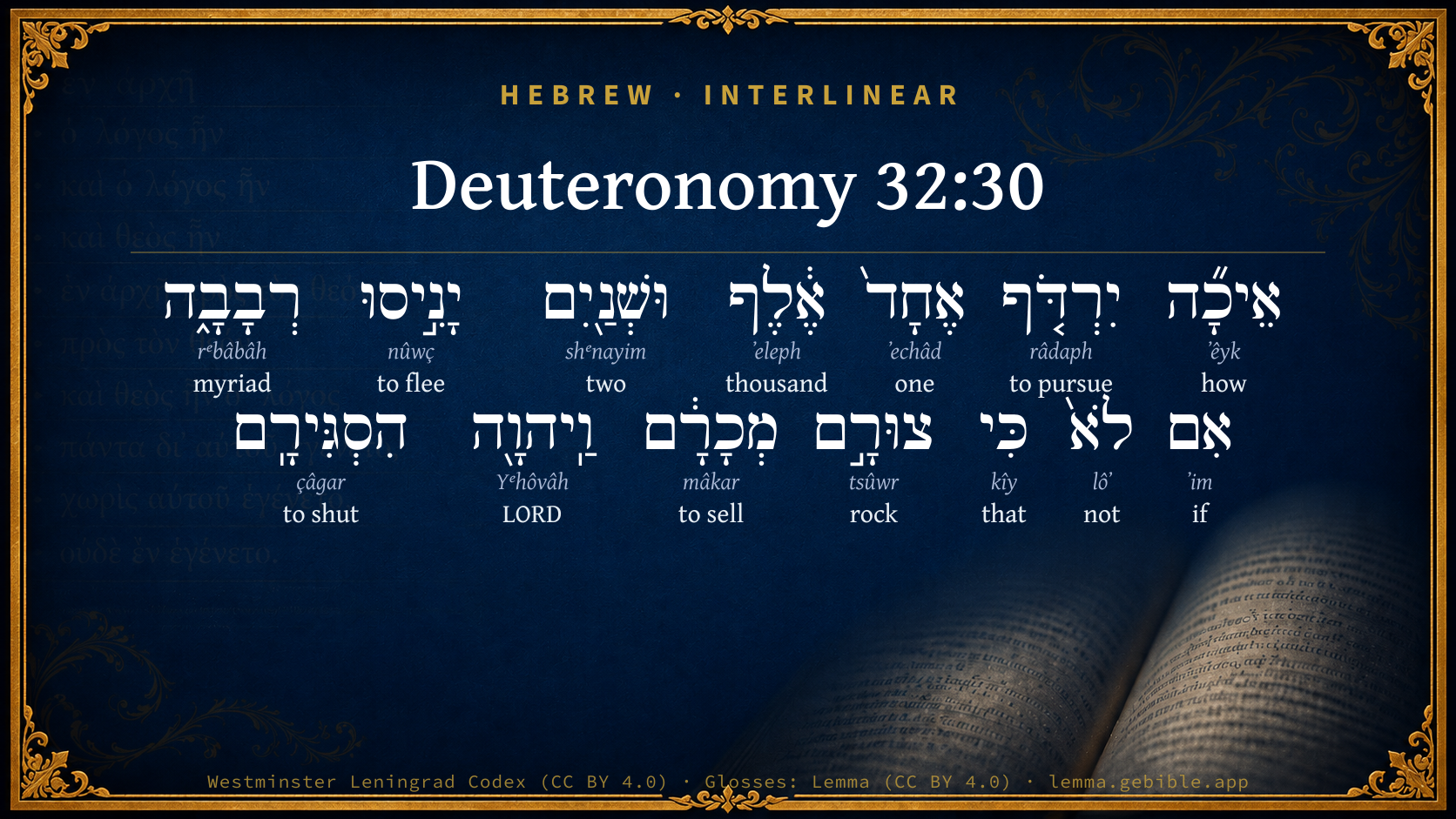
  1. אֵיכָ֞ה ʼêyk H349 “how” Particle, Interrogative
  2. יִרְדֹּ֤ף râdaph H7291 “to pursue” Verb, Qal, Imperfect, 3rd Person, Masculine, Singular
  3. אֶחָד֙ ʼechâd H259 “one” Adjective, Cardinal number, Masculine, Singular, Absolute
  4. אֶ֔לֶף ʼeleph H505 “thousand” Adjective, Cardinal number, Both, Singular, Absolute
  5. וּשְׁנַ֖יִם shᵉnayim H8147 “and · two” Conjunction + Adjective, Cardinal number, Masculine, Dual, Absolute
  6. יָנִ֣יסוּ nûwç H5127 “to flee” Verb, Hiphil, Imperfect, 3rd Person, Masculine, Plural
  7. אִם ʼim H518 “if” Conjunction
  8. לֹא֙ lôʼ H3808 “not” Particle, Negative
  9. כִּי kîy H3588 “that” Conjunction
  10. צוּרָ֣ם tsûwr H6697 “rock · their” Noun, Common, Masculine, Singular, Construct + Suffix, Personal, 3rd Person, Masculine, Plural
  11. מְכָרָ֔ם mâkar H4376 “to sell · them” Verb, Qal, Perfect, 3rd Person, Masculine, Singular + Suffix, Personal, 3rd Person, Masculine, Plural
  12. וַֽיהוָ֖ה Yᵉhôvâh H3068 “and · LORD” Conjunction + Noun, Proper
  13. הִסְגִּירָֽם çâgar H5462 “to shut · them” Verb, Hiphil, Perfect, 3rd Person, Masculine, Singular + Suffix, Personal, 3rd Person, Masculine, Plural

About this verse

These counts appear in no published source. They are computed here, from the morphology-tagged text and Lemma’s own curated glosses. What Lemma adds →

14
words
14
distinct lemmas
Pentateuch
section

Notable vocabulary

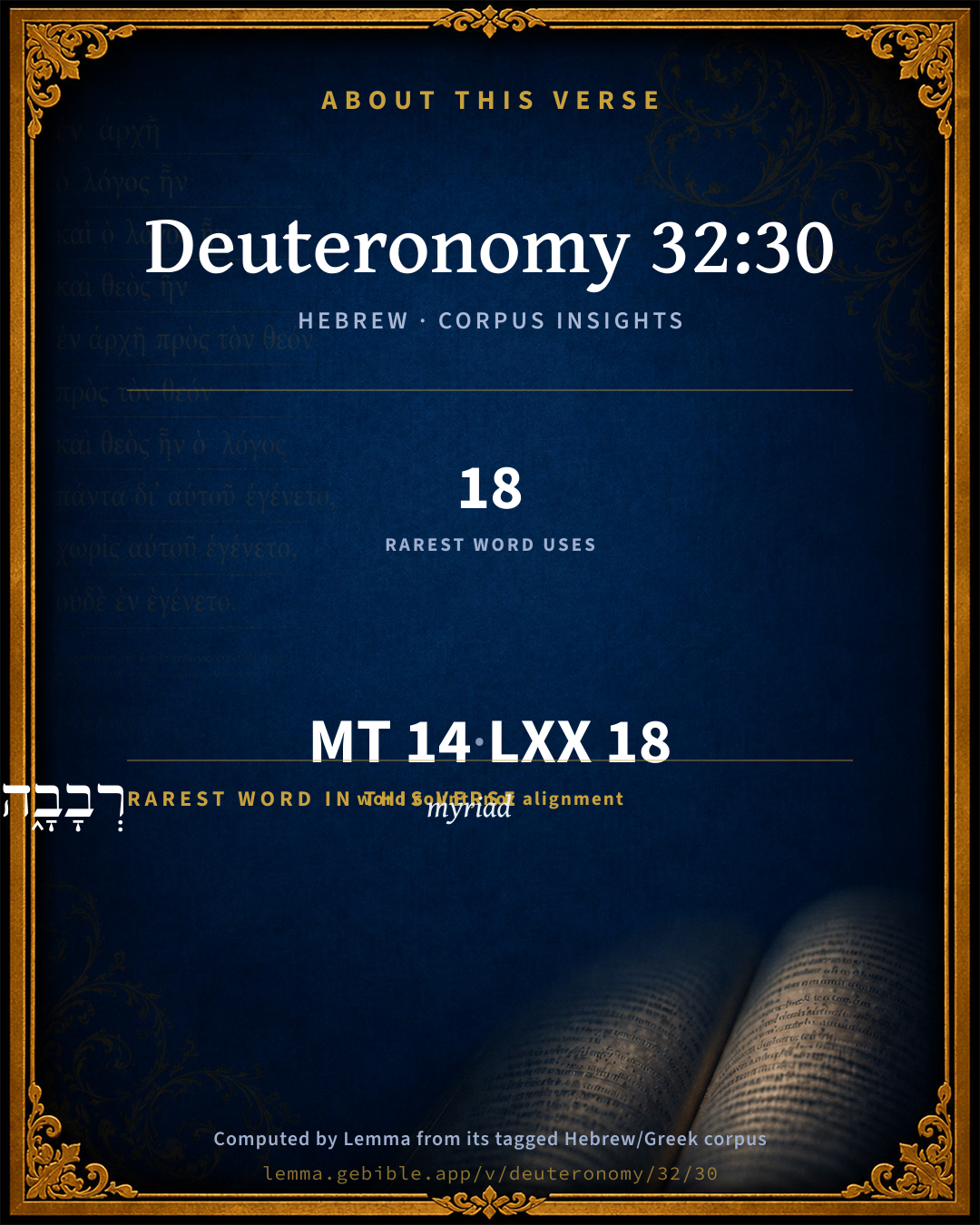
The rarest word here is רְבָבָ֑ה myriad H7233 — appearing just 18 times in the whole Hebrew Bible.

Shared distinctive vocabulary

רְבָבָ֑ה myriad H7233 occurs in 16 verses of the Hebrew Bible. Also found in:

Grammatical profile

  • 4 verbs
  • 3 nouns
  • 3 adjectives
  • 2 conjunctions
  • 2 particles

Verb forms

  • יִרְדֹּ֤ף Qal · Imperfect
  • יָנִ֣יסוּ Hiphil · Imperfect
  • מְכָרָ֔ם Qal · Perfect
  • הִסְגִּירָֽם Hiphil · Perfect

Hebrew & Septuagint length

In English translation the verse runs 23 words from the Hebrew and 24 from the Septuagint (LXX English) — closely comparable.

A rough comparison of the two English renderings, which tokenize alike — not a word-level alignment.

Word counts can differ between the Hebrew and the Greek without any difference in meaning — e.g. the Hebrew direct-object marker אֵת has no separate Greek word, and Greek often adds the article ὁ.

In the original languages it is 14 Hebrew tokens and 18 Greek tokens — but the two are counted differently (Hebrew bundles its prefixes and suffixes into one token; the Greek is in lemma form), so that isn’t a like-for-like length.

Cross-references

13

Topical passages linked to Deuteronomy 32:30 in the Treasury of Scripture Knowledge — connected by theme and wording, ordered by reader-vote popularity; previews shown in the World English Bible.

  • Leviticus 26:8 Five of you shall chase a hundred, and a hundred of you shall chase ten thousand; and your enemies shall fall before you by the sword.
  • Joshua 23:10 One man of you shall chase a thousand; for Yahweh your God, he it is who fights for you, as he spoke to you.
  • Isaiah 30:17 One thousand [shall flee] at the threat of one; at the threat of five shall you flee: until you be left as a beacon on the top of a mountain, and as an ensign on a hill.
  • Psalms 31:8 You have not shut me up into the hand of the enemy. You have set my feet in a large place.
  • Judges 7:22–23 They blew the three hundred trumpets, and Yahweh set every man's sword against his fellow, and against all the host; and the host fled as far as Beth-shittah toward Zererah, as far as the border of Abel Meholah, by Tabbath.
  • Psalms 44:12 You sell your people for nothing, And have gained nothing from their sale.
  • Judges 3:8 Therefore the anger of Yahweh was kindled against Israel, and he sold them into the hand of Cushan Rishathaim king of Mesopotamia: and the children of Israel served Cushan Rishathaim eight years.
  • 1 Samuel 14:15–17 There was a trembling in the camp, in the field, and among all the people; the garrison, and the spoilers, they also trembled; and the earth quaked: so there was an exceeding great trembling.
  • 2 Chronicles 24:24 For the army of the Syrians came with a small company of men; and Yahweh delivered a very great host into their hand, because they had forsaken Yahweh, the God of their fathers. So they executed judgment on Joash.
  • Isaiah 52:3 For thus says Yahweh, You were sold for nothing; and you shall be redeemed without money.
  • Judges 2:14 The anger of Yahweh was kindled against Israel, and he delivered them into the hands of spoilers who despoiled them; and he sold them into the hands of their enemies round about, so that they could not any longer stand before their enemies.
  • Job 11:10 If he passes by, or confines, Or convenes a court, then who can oppose him?
  • Isaiah 50:1 Thus says Yahweh, Where is the bill of your mother's divorce, with which I have put her away? or which of my creditors is it to whom I have sold you? Behold, for your iniquities were you sold, and for your transgressions was your mother put away.

Cross-references courtesy of OpenBible.info (CC BY 4.0).

Hebrew and Greek witnesses Masoretic Hebrew ↔ Greek Septuagint

The same verse in the two great witnesses to the Old Testament, shown verse-for-verse.

These are two independent witnesses, not word-aligned to each other, and the Septuagint is shown in lemma (dictionary) form.

Hebrew Deuteronomy 32:30 Masoretic · Westminster Leningrad Codex

אֵיכָ֞ה יִרְדֹּ֤ף אֶחָד֙ אֶ֔לֶף וּשְׁנַ֖יִם יָנִ֣יסוּ רְבָבָ֑ה אִם לֹא֙ כִּי צוּרָ֣ם מְכָרָ֔ם וַֽיהוָ֖ה הִסְגִּירָֽם

How should one chase a thousand, Two put ten thousand to flight, Except their Rock had sold them, Yahweh had delivered them up?

World English Bible · Public Domain

Greek LXX Deuteronomy 32:30 Septuagint · lemma form

πῶς διώκω εἷς χίλιοι καί δύο μετακινέω μυριάς εἰ μή ὁ θεός ἀποδίδωμι αὐτός καί κύριος παραδίδωμι αὐτός

How should one pursue a thousand, and two rout tens of thousands, if God had not sold them, and the Lord delivered them up?

LXX2012 (modern English Septuagint) · Public Domain

Hebrew: Westminster Leningrad Codex (CC BY 4.0). Greek: Septuagint (public domain); English from LXX2012 (modern English Septuagint) (Public Domain). How the Septuagint differs from the Hebrew →

Targum (Aramaic paraphrase)

2

The Targum is the ancient Jewish Aramaic paraphrase of the Hebrew Scriptures — an interpretive translation, not the Hebrew text itself. Onkelos (literal) and Pseudo-Jonathan (expansive) render the Torah, and Jonathan the Prophets. Coverage is partial: where no permissively-licensed English translation exists for a verse, only the Aramaic is shown. This is verse-level text, not a word-by-word alignment to the Hebrew.

  1. Targum Onkelos Torah (Genesis–Deuteronomy)
    אֶכְדֵין יִרְדוֹף חַד אַלְפָא וּתְרֵין יֶעֶרְקוּן לְרִבּוֹתָא אֶלָהֵן (אֲרֵי) תַּקִיפְהוֹן מְסָרִנוּן וַייָ אַשְׁלֵמִנוּן

    (no public-domain English translation for this verse)

    Targum Onkelos — Aramaic: “Onkelos Genesis” (public domain); “Onkelos Exodus” (public domain); “Onkelos Leviticus” (public domain); “Onkelos Numbers” (public domain); “Onkelos Deuteronomy” (public domain). English: “Sefaria Community Translation” (CC0 1.0 (public-domain dedication)); “J.W. Etheridge. The Targums of Onkelos and Jonathan Ben Uzziel on the Pentateuch. London: Longmans, Green, 1862” (public domain). Text via Sefaria.

  2. Targum Pseudo-Jonathan Torah (Genesis–Deuteronomy)
    הֵיכְדֵין יְהֵי סַנְאָה חַד רָדִיף אֶלֶף מִנְהוֹן וּתְרֵין יְעִירְקוּן לְרִבּוּתָא מִנְהוֹן אֱלָהֵן מְטוֹל דְתַקִיפְהוֹן מְסָרִינוּן וַיְיָ אַשְׁלֵימִינוּן

    How will one foe pursue a thousand of them, and two put ten thousand of them to flight, unless He who is their strength deliver them, and the Lord avenge them!

    Targum Pseudo-Jonathan — Aramaic: “Targum Jonathan on Genesis” (public domain); “Targum Jonathan on Exodus” (public domain); “Targum Jonathan on Leviticus” (public domain); “Targum Jonathan on Numbers” (public domain); “Targum Jonathan on Deuteronomy” (public domain). English: “The Targum of Jonathan ben Uzziel, trans. J. W. Etheridge, London, 1862” (public domain). Text via Sefaria.

Commentary

Notes on Deuteronomy 32:30 from classic Christian and Jewish commentators (each source and its license shown beneath its notes). The classic Christian expositions comment on the surrounding passage and are grouped to its opening verse, so a note may address several verses; the Jewish commentaries on the Tanakh (Rashi and others) are per-verse, so they appear only where the commentator wrote on this verse.

Lemma curates 59 commentaries, every one of them public domain or Creative Commons licensed, each selected and text-cleaned for this edition rather than reprinted as found. About our sources →

Trapp's Complete Commentary

John Trapp

Deu 32:30 How should one chase a thousand, and two put ten thousand to flight, except their Rock had sold them, and the LORD had shut them up?

Ver. 30. How should one chase a thousand?] i.e., How should one of the enemies chase a thousand Israelites, who had a promise of better things, {Lev 26:8} but that having first sold themselves for nought, {Isa 52:3} they were now sold by God, who would own them no longer? {Psa 31:7-8}

John Trapp, A Commentary or Exposition upon All the Books of the Old and New Testament (1647–1656) — public domain. Text from a community e-Sword module.

Tyndale Open Study Notes

Tyndale Open Resources

32:30 How could one person chase a thousand: When God gives his people over to destruction, they are vulnerable against all odds. • their Rock: Here the metaphor is used ironically. The very one upon whom Israel should stand as the source of their strength will desert them because of their own wickedness and unfaithfulness (see 32:4).

Tyndale Open Study Notes — © Tyndale Open Resources, licensed CC BY-SA 4.0. Text via the HelloAO Bible API.

Geneva Bible (1599)

Geneva Bible translators

Or, delivered them to their enemies.

Geneva Bible (1599) marginal notes — public domain. Text via Bolls.life.

Adam Clarke's Commentary

Verse 30. How should one chase a thousand] If therefore they had not forgotten their Rock, God their author and defence, it could not possibly have come to pass that a thousand of them should flee before one of their enemies.

Adam Clarke's Commentary on the Bible (1810–1826) — public domain. Text from a community e-Sword/MySword module.

Ellicott's Commentary for English Readers

(30) How should one (of their enemies) chase a thousand (of them).—Comp. the verse in Deu_28:25, and more especially Lev_26:8; Lev_26:17; Lev_26:36.

Had sold them.—Here first used of Jehovah. It is a common expression in the book of Judges (Deu_2:14; Deu_3:8; Deu_4:2; Deu_10:7; 1Sa_12:9).

Had shut them up (into the hand of their enemies).—Comp. Psa_78:62, “He shut up His people also unto the sword.”

A Bible Commentary for English Readers, edited by Charles John Ellicott (1878–1897) — public domain. Text from a community e-Sword module.

The Cambridge Bible for Schools and Colleges

gen. ed. J. J. S. Perowne

30. How could one, etc.] Some ignominious rout of Israel.

delivered them up] Cp. Deu_23:15 (16).

The Cambridge Bible for Schools and Colleges (gen. ed. J. J. S. Perowne; Cambridge University Press, 1878–1918) — public domain. Text from a community e-Sword module.

John Gill's Exposition

For their rock is not as our rock,.... That is, the gods of the Heathens, the rock in which they trusted, are not like the God of Israel, the rock of salvation, in which all true believers, whether Jews or Gentiles, place their confidence; and indeed let that be what it will, that is short of Christ the rock, men lay the stress of their salvation on, it is no rock, but sand, and will stand them in no stead; see Mat 7:24,

even our enemies themselves being judges; as has been confessed of the God of Israel by the Heathens; see Exo 14:25; and was by Titus with respect to the destruction of Jerusalem; See Gill on Deu 32:27; and by the Roman emperors when conquered by the Christians, who asked pardon of the God of the Christians, and owned that the God of Constantine was the true God; See Gill on Rev 6:16.

John Gill's Exposition of the Whole Bible (1746–1763) — public domain (CC PDM 1.0). Text via the HelloAO Bible API.

Haydock's Catholic Bible Commentary

Thousand. In the battles which the Israelites had fought, the hand of God had appeared so visibly in their defence, giving them the victory over nations much more numerous, (Calmet) that all must confess their defeat must be in punishment of some former transgression, and that it is not the mighty hand of the enemy, but God himself, who chastises his people, as he had foretold, chap. xxviii. 7, 25, 49. (Haydock) --- Of this the neighbouring nations were convinced, as Achior declared to the Holofernes, Judith v. 17. When the Hebrews neglected the law of God they were oppressed, and their conversion was presently rewarded with liberty, (Calmet) and a profusion of blessings.

George Leo Haydock (1774–1849), Haydock's Catholic Family Bible and Commentary, 1859 edition — public domain. Excludes Psalms (Douay-Rheims chapter numbering differs from Protestant) and Deuterocanonical books (Catholic canon only).

Matthew Poole's English Annotations

How should one chase a thousand? whence should this miraculous change come, that whereas God had promised that five Israelites should chase an hundred of their enemies, &c., Deu 26:8, now, on the contrary,

one enemy

should chase a thousand Israelites?

Their Rock, i.e. their God, as before, Deu 32:4,18, who was their only refuge and defence; had sold them, to wit, for bond-slaves, had quitted his right and relation to them, and given them up into their enemies’ hands.

Shut them up, as it were, in the net which their enemies had laid for them.

Matthew Poole's English Annotations on the Holy Bible (1683–1685) — public domain. Text from a community e-Sword/MySword module.

The Pulpit Commentary

If Israel were wise, they could easily overcome all their foes through the help of the Almighty; (Lev_26:8) but having forsaken him, they were left by him, and so came under the power of the enemy.

Vers. 30-35. The devil"s counterfeit coin.

It is not in the power of Satan to originate any new thing. Knowing that his power is restricted, the utmost he can do is to make spurious imitations of God"s good things. His base purpose is to deceive man with spectral illusions. His nefarious design is to raise before the world"s eye an empty mirage of a carnal paradise.

I EVERY MAN CRAVES FOR SOME GROUND OF CONFIDENCE, EXTERNAL TO HIMSELF. To the men of the East, this external foundation of trust was best described as a rock. What the solid rock is amid the loose alluvial soil of Egypt, or amid the shifting sand of the desert, that God is designed to be unto every man. Complete independence is impossible to created man. He can never be self-contained nor self-nourished. Pure atheism has never been a permanent resting-place for the human heart. When the invisible God is forsaken, the human mind swings toward idolatry. The carnal mind finds delight in a ground of confidence that is visible and tangible. Some god we must have, if it be only the shadowy deity named Fate, or Law, or Chance.

II COMPLETE CONTRAST EXISTS BETWEEN THE OBJECTS OF HUMAN TRUST. The only point of similarity is the name. The devil borrows this, so as the better to throw dust in the eyes of his followers. Our God is a Rock; the world also has its counterfeit rock. By the judgments and verdict of worldly men, our Rock differs in tote from theirs. Their rock, they acknowledge, is unstable and unreliable. They trust it simply because they know not a better. It is misnamed a rock. Their rock ofttimes deserts them in the hour of greatest need. Ah! fortune, say they, is fickle. Very tyrannical and self-willed is fate. But our God is a Rock in very deed. He never forsakes his liege disciples. In the darkest hour he is nearest the shadow of a great rock in a weary land." Their misnamed rock encourages them to enter the battle-field, and then forsakes them. They are "sold to the enemy.

III NOTWITHSTANDING THE CONTRAST IN THESE OBJECTS OF TRUST, THE FALSE IS A CLEVER IMITATION OF THE TRUE. All through life, we find that the false counterfeits the true. The thief puts on the pretence of honesty. The villain trains himself to use fair speech. The adulterer wears the garb of virtue. Beauty is the robe of God, but the devil fabricates meretricious tinsel. He, too, has his "Promised Land," but it is a fool"s paradise. He has his vine, but his vine is the vine of Sodom, which generates drunkenness and unchastity. He also has his fields, but they are fields of Gomorrah. The fruits are pleasant to the eye, but they turn to ashes in the mouth. There is the appearance of grapes, but lo! the juice is gall the clusters are bitterness itself. And not only is the experience disappointing, it is even disastrous and deadly. This pretended wine is only poison, it is a gilded pill. Cruel deceit has provided this counterfeit banquet. Beneath the glamour of a fair exterior, there is the "serpent"s venom." Thus fares it with all who leave their God. They find out the bitter mistake at last. So sang Byron in his last days

The worm, the canker, and the grief Are mine alone.

IV SUCH HUMAN EXPERIENCES OF THE FALSE, GOD USES IN THE GOVERNMENT OF THE WORLD. "Is not this laid up in store with me, and sealed up among my treasures?" God knew well what the effects of an idolatrous course would be, what bitter vexation and disaster would come at last. But he foresaw that it was better for men that they should pass through this experience than that he should remove the possibility of it. He might have prevented, by exercise of power, the stratagems of the tempter. He might have curtailed Satan"s freedom, and put on him chains of darkness from the first. But his infinite wisdom has decided otherwise. He foresees more glorious results from this method, so he patiently waits; he calmly watches the stages of the process. "Their foot," says he, "shall slide in due time." "The day of their calamity is at hand." Now, it is difficult to discern between a grain of living seed and a grain of dead sand; but put both into the furrowed field, and give them time, so when the day of harvest comes, the man who sowed the sand will be covered with shame, while he who sowed good seed will bear gladly his sheaves into the heavenly garner. Our business now is to discriminate between God"s corn and the devil"s chaff. "The day will declare it. D.

The Pulpit Commentary (1880–1919), ed. H.D.M. Spence-Jones & Joseph S. Exell — public domain. Text from a community e-Sword module.

John Wesley's Explanatory Notes

One - Israelite. Their rock - Their God, who was their refuge and defense. Sold them - Namely, for bond-slaves, had given themselves up into their enemies hands. Shut them up - As it were in the net which their enemies had laid for them.

John Wesley, Explanatory Notes Upon the Whole Bible (1754–1765) — public domain. Text via the GEBible commentary corpus.

unfoldingWord translationNotes

Door43 World Missions Community

General Information:

Moses speaks a poetic song to the people of Israel. He continues to quote Yahweh's words and tell them more of what they would have understood if they were wise (Deuteronomy 32:29). (See: Parallelism)

How could one chase a thousand ... Yahweh had given them up?

Moses uses a question to scold the people for not being wise enough to understand why their enemies are defeating them. This question can be translated as a statement as in the UDB. (See: Rhetorical Question)

How could one chase a thousand, and two put ten thousand to flight

You can make clear the understood information. AT: "How could 1 enemy soldier chase 1,000 of your men, and 2 enemy soldiers cause 10,000 of your men to run away" (See: Numbers and Ellipsis)

unless their Rock had sold them

The word "Rock" refers to Yahweh who is strong and able to protect his people. AT: "unless Yahweh, their Rock, had handed them over" (See: Metaphor)

their Rock ... our Rock

"The Rock" here is a proper name that Moses gives to Yahweh, who, like a rock, is strong and able to protect his people. Translate "Rock" as in Deuteronomy 32:4. (See: Metaphor)

our enemies' rock is not like our Rock

The enemies' idols and false gods are not powerful like Yahweh.

just as even our enemies admit

"not only do we say so, but our enemies say so also"

translationWords

Yahweh

adversary

unfoldingWord translationNotes — © Distant Shores Media and the Door43 World Missions Community, licensed CC BY-SA 4.0. Source: git.door43.org/Door43/en_tn.

Rashi

Rabbi Shlomo Yitzchaki (Rashi)

איכה ירדף אחד HOW ONE MAN of the nations COULD PURSUE אלף A THOUSAND of the Israelites.

אם לא כי צורם מכרם EXCEPT THAT THEIR ROCK HAD DELIVERED THEM — sold them and delivered them into our hands, 'delivrer' in old French (Eng. = deliver).

Rashi on the Tanakh — English translations: “The Judaica Press complete Tanach with Rashi, translated by A. J. Rosenberg” (CC BY 4.0); “Pentateuch with Rashi's commentary by M. Rosenbaum and A.M. Silbermann, 1929-1934” (public domain); “The Metsudah Tanach series, Lakewood, N.J” (CC BY 4.0); and “The Book of Joshua, Metsudah Publications, 1997” (CC BY 4.0). Text via Sefaria.

Lesson kit

Teaching starters — assembled from the data on this page, not authored interpretation. Every prompt links to the verse data it draws on. Edit before teaching.

Deuteronomy, in the Pentateuch, opens this verse with 14 words (14 distinct Hebrew lemmas). Its most distinctive word is rᵉbâbâh (“myriad”). A historical commentator’s framing appears above. Read the whole chapter for the surrounding context.

Discussion questions

  1. The word rᵉbâbâh carries the sense “myriad.” How does it shape the verse?
  2. How does Genesis 24:60, which shares the word «myriad», read alongside this verse?
  3. The translations on this page render this verse differently — a whole-verse word diff, not a word-by-word alignment. What might account for the different wordings?
  4. «יִרְדֹּ֤ף» is a Qal Imperfect verb. How does that grammatical form shape the action described?
  5. Compare how Trapp's Complete Commentary and Tyndale Open Study Notes read this verse. Where do they agree or differ?

Things to notice

Reading settings

Reading text

Shown beneath each verse's original-language words.

Old Testament
Old Testament edition

Read the OT as the Masoretic Hebrew (MT) or the Greek Septuagint (LXX).

English shown for the Greek Septuagint (in the Hebrew ↔ Greek comparison).

Comparing translations? Open the Compare panel on any verse page to stack up to four side by side.