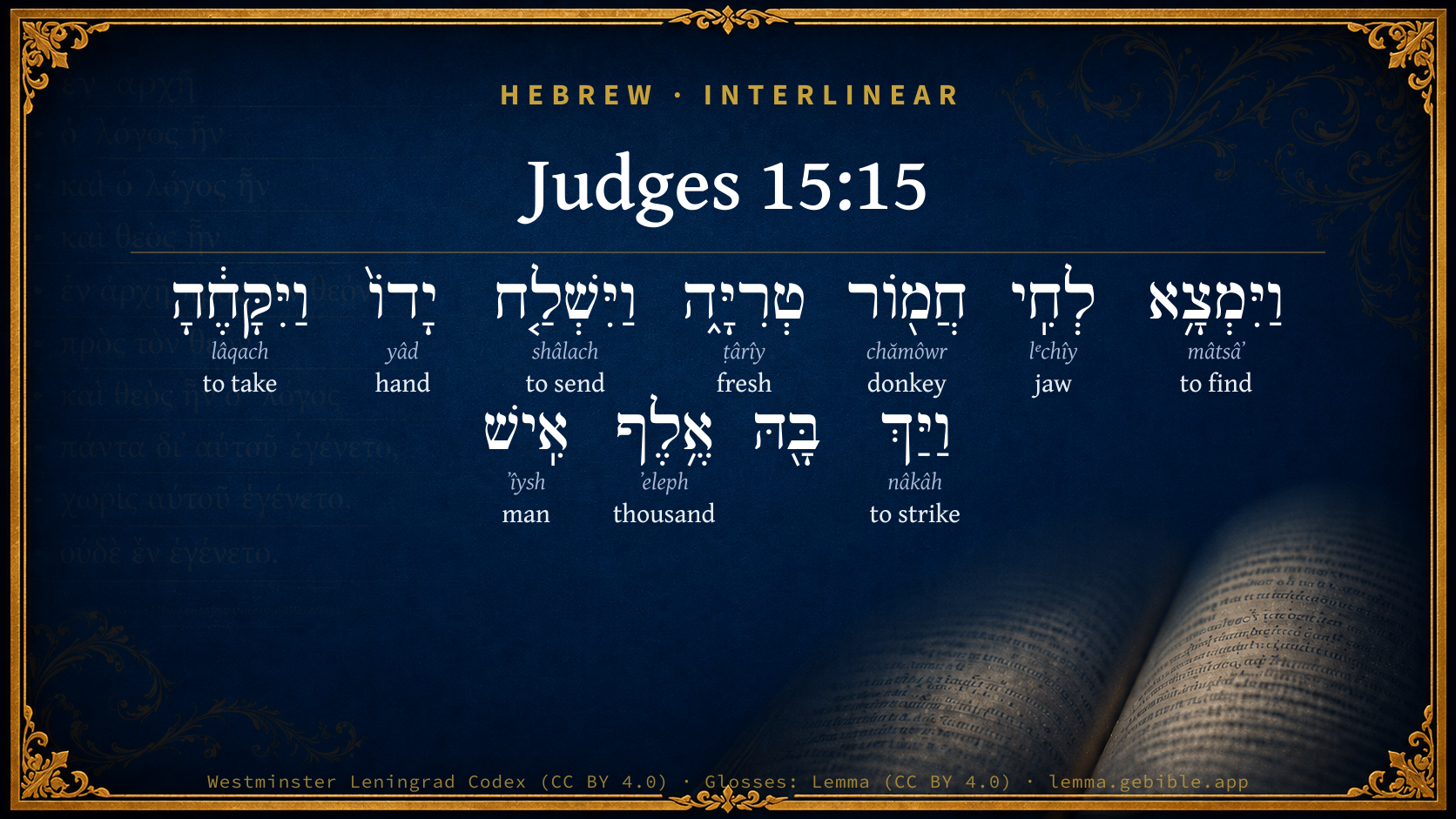
Judges 15:15

Hebrew (Westminster Leningrad Codex) Judges 15:15 appears in the Hebrew Old Testament. The text above is from the Westminster Leningrad Codex. Each word links to its Strong’s number, a concise gloss, and parsing drawn from the Open Scriptures Hebrew Bible morphology. Click any word for its full Brown-Driver-Briggs (BDB) entry.
Download image
Cite this verse

Judges 15:15 (World English Bible). Public Domain. Lemma interlinear Bible study tool, https://lemma.gebible.app/v/judges/15/15.

Show BibTeX & RIS
BibTeX
RIS
English Translation
He found a fresh jawbone of a donkey, and put forth his hand, and took it, and struck a thousand men therewith.
World English Bible · Public Domain
Highlights
  • 1 first appearance in the Hebrew Bible
Full analysis ↓
Download a study sheet

One document with this verse’s original text, its word-by-word gloss line, the meaning frame, cross-references with their text, attributed commentary, and full source and license credits — printable, and it pastes into notes with its structure intact.

This verse Autodidact and up

Study sheet (.html) Plain text (.txt)

A passage Seminary Student

Up to 50 verses in one chapter. A passage sheet keeps up to 6 commentary sources and 12 cross-references per verse, in the order this page ranks them, and says so on the sheet whenever that leaves anything out. Ask for a single verse and you get the Autodidact verse sheet above.

Everything on this page stays free to read, with no account — the sheet is a download of what is already on screen, not access to it.

Want to remove ads? Support Godless Engineer
Compare translations 3

The same verse in 3 English versions, stacked beneath the original-language interlinear above. Click any original word for its lexicon entry.

Each is an independent rendering of the whole verse — the interlinear is not word-aligned to these translations.

Highlighted words mark where these versions differ — a whole-verse word diff, not a word-by-word alignment.

  • World English Bible Public Domain
    He found a fresh jawbone of a donkey, and put forth his hand, and took it, and struck a thousand men therewith.
  • King James Version Public Domain
    And he found a new jawbone of an ass, and put forth his hand, and took it, and slew a thousand men therewith.
  • unfoldingWord Literal Text CC BY-SA 4.0
    And he found a fresh jawbone of a donkey, and he stretched out his hand and took it, and with it he struck 1,000 men.

unfoldingWord Literal Text — © unfoldingWord, licensed CC BY-SA 4.0. Word-aligned USFM3 via Door43 (git.door43.org/unfoldingWord/en_ult).

Versions to compare (up to 4)

3 of 4 selected

Show all 18 translations

Every available English version of this verse, each an independent rendering of the whole verse.

  • World English Bible Public Domain
    He found a fresh jawbone of a donkey, and put forth his hand, and took it, and struck a thousand men therewith.
  • Berean Standard Bible Public Domain
    He found the fresh jawbone of a donkey, reached out his hand and took it, and struck down a thousand men.
  • Majority Standard Bible Public Domain
    He found the fresh jawbone of a donkey, reached out his hand and took it, and struck down a thousand men.
  • King James Version Public Domain
    And he found a new jawbone of an ass, and put forth his hand, and took it, and slew a thousand men therewith.
  • American Standard Version (1901) Public Domain
    And he found a fresh jawbone of an ass, and put forth his hand, and took it, and smote a thousand men therewith.
  • Revised Version (1885) Public Domain
    And he found a new jawbone of an ass, and put forth his hand, and took it, and smote a thousand men therewith.
  • Geneva Bible (1599) Public Domain
    And he found a new iawebone of an asse, and put forth his hand, and caught it, and slewe a thousand men therewith.
  • Douay-Rheims (1899) Public Domain
    And finding a jawbone, even the jawbone of an ass which lay there, catching it up, be slew therewith a thousand men.
  • Young's Literal Translation Public Domain
    and he findeth a fresh jaw-bone of an ass, and putteth forth his hand and taketh it, and smiteth with it -- a thousand men.
  • Literal Standard Version CC BY-SA 4.0
    and he finds a fresh jawbone of a donkey, and puts forth his hand and takes it, and strikes down one thousand men with it.
  • Unlocked Literal Bible CC BY-SA 4.0
    Samson found a fresh jawbone of a donkey, and he picked it up and killed a thousand men with it.
  • unfoldingWord Literal Text CC BY-SA 4.0
    And he found a fresh jawbone of a donkey, and he stretched out his hand and took it, and with it he struck 1,000 men.
  • Darby Bible Public Domain
    And he found a fresh jawbone of an ass, and put out his hand and seized it, and with it he slew a thousand men.
  • World Messianic Bible Public Domain
    He found a fresh jawbone of a donkey, put out his hand, took it, and struck a thousand men with it.
  • Webster's Bible Public Domain
    And he found a fresh jaw-bone of an ass, and put forth his hand, and took it, and slew a thousand men with it.
  • Free Bible Version CC BY-SA 4.0
    He grabbed the fresh jawbone of a donkey, using it to kill a thousand Philistines.
  • Bible in Basic English Public Domain
    And taking up the mouth-bone of an ass newly dead, which he saw by chance on the earth, he put to death a thousand men with it.
  • JPS Tanakh (1917) Public Domain
    And he found a new jawbone of an ass, and put forth his hand, and took it, and smote a thousand men therewith.

Literal Standard Version (2020), Covenant Press — licensed CC BY-SA 4.0. Text via the HelloAO Bible API (eBible.org). Unlocked Literal Bible (unfoldingWord) — licensed CC BY-SA 4.0. Text via the HelloAO Bible API (eBible.org). unfoldingWord Literal Text — © unfoldingWord, licensed CC BY-SA 4.0. Word-aligned USFM3 via Door43 (git.door43.org/unfoldingWord/en_ult). Free Bible Version, Dr. Jonathan Gallagher — licensed CC BY-SA 4.0. Text via the HelloAO Bible API (eBible.org).

Word by word

More ways to search: Search by grammar → Find every occurrence → Compare this word →

Practice this passage: Drill this verse → Learn its vocabulary →

טְרִיָּ֑ה
ṭârîy
H2961
“fresh”
Adjective, Adjective, Feminine, Singular, Absolute
Part of Speech
Adjective
Type
Adjective
Gender
Feminine
Number
Singular
State
Absolute
Full BDB Definition

Origin: from an unused root apparently meaning to be moist

TWOT: 824a

fresh, new
  1. וַיִּמְצָ֥א mâtsâʼ H4672 “and · to find” Conjunction + Verb, Qal, Sequential Imperfect, 3rd Person, Masculine, Singular
  2. לְחִֽי lᵉchîy H3895 “jaw of” Noun, Common, Both, Singular, Construct
  3. חֲמ֖וֹר chămôwr H2543 “donkey” Noun, Common, Both, Singular, Absolute
  4. וַיִּשְׁלַ֤ח shâlach H7971 “and · to send” Conjunction + Verb, Qal, Sequential Imperfect, 3rd Person, Masculine, Singular
  5. יָדוֹ֙ yâd H3027 “hand · his” Noun, Common, Both, Singular, Construct + Suffix, Personal, 3rd Person, Masculine, Singular
  6. וַיִּקָּחֶ֔הָ lâqach H3947 “and · to take · her” Conjunction + Verb, Qal, Sequential Imperfect, 3rd Person, Masculine, Singular + Suffix, Personal, 3rd Person, Feminine, Singular
  7. וַיַּךְ nâkâh H5221 “and · to strike” Conjunction + Verb, Hiphil, Sequential Imperfect, 3rd Person, Masculine, Singular
  8. אֶ֥לֶף ʼeleph H505 “thousand” Adjective, Cardinal number, Both, Singular, Absolute
  9. אִֽישׁ ʼîysh H376 “man” Noun, Common, Masculine, Singular, Absolute

About this verse

These counts appear in no published source. They are computed here, from the morphology-tagged text and Lemma’s own curated glosses. What Lemma adds →

11
words
10
distinct lemmas
Historical
section

Notable vocabulary

The rarest word here is טְרִיָּ֑ה fresh H2961 — appearing just 2 times in the whole Hebrew Bible.

First appearance in Scripture

This word makes its first canonical appearance in the Hebrew Bible here:

  • טְרִיָּ֑ה fresh H2961

Shared distinctive vocabulary

טְרִיָּ֑ה fresh H2961 occurs in 2 verses of the Hebrew Bible. Also found in:

Grammatical profile

  • 4 verbs
  • 4 nouns
  • 2 adjectives
  • 1 preposition

Verb forms

  • וַיִּמְצָ֥א Qal · Sequential Imperfect
  • וַיִּשְׁלַ֤ח Qal · Sequential Imperfect
  • וַיִּקָּחֶ֔הָ Qal · Sequential Imperfect
  • וַיַּךְ Hiphil · Sequential Imperfect

Hebrew & Septuagint length

In English translation the verse runs 22 words from the Hebrew and 29 from the Septuagint (LXX English) — closely comparable.

A rough comparison of the two English renderings, which tokenize alike — not a word-level alignment.

Word counts can differ between the Hebrew and the Greek without any difference in meaning — e.g. the Hebrew direct-object marker אֵת has no separate Greek word, and Greek often adds the article ὁ.

In the original languages it is 11 Hebrew tokens and 19 Greek tokens — but the two are counted differently (Hebrew bundles its prefixes and suffixes into one token; the Greek is in lemma form), so that isn’t a like-for-like length.

Cross-references

9

Topical passages linked to Judges 15:15 in the Treasury of Scripture Knowledge — connected by theme and wording, ordered by reader-vote popularity; previews shown in the World English Bible.

  • Leviticus 26:8 Five of you shall chase a hundred, and a hundred of you shall chase ten thousand; and your enemies shall fall before you by the sword.
  • Joshua 23:10 One man of you shall chase a thousand; for Yahweh your God, he it is who fights for you, as he spoke to you.
  • Judges 3:31 After him was Shamgar the son of Anath, who struck of the Philistines six hundred men with an ox-goad: and he also saved Israel.
  • 1 Samuel 17:49–50 David put his hand in his bag, and took there a stone, and slang it, and struck the Philistine in his forehead; and the stone sank into his forehead, and he fell on his face to the earth.
  • Judges 4:21 Then Jael Heber's wife took a tent-pin, and took a hammer in her hand, and went softly to him, and struck the pin into his temples, and it pierced through into the ground; for he was in a deep sleep; so he swooned and died.
  • 1 Corinthians 1:27–28 but God chose the foolish things of the world that he might put to shame those who are wise. God chose the weak things of the world, that he might put to shame the things that are strong;
  • Judges 7:16 He divided the three hundred men into three companies, and he put into the hands of all of them trumpets, and empty pitchers, with torches within the pitchers.
  • 1 Samuel 14:6 Jonathan said to the young man who bore his armor, Come, and let us go over to the garrison of these uncircumcised: it may be that Yahweh will work for us; for there is no restraint to Yahweh to save by many or by few.
  • 1 Samuel 14:14 That first slaughter, which Jonathan and his armor bearer made, was about twenty men, within as it were half a furrow's length in an acre of land.

Cross-references courtesy of OpenBible.info (CC BY 4.0).

Hebrew and Greek witnesses Masoretic Hebrew ↔ Greek Septuagint

The same verse in the two great witnesses to the Old Testament, shown verse-for-verse.

These are two independent witnesses, not word-aligned to each other, and the Septuagint is shown in lemma (dictionary) form.

Hebrew Judges 15:15 Masoretic · Westminster Leningrad Codex

וַיִּמְצָ֥א לְחִֽי חֲמ֖וֹר טְרִיָּ֑ה וַיִּשְׁלַ֤ח יָדוֹ֙ וַיִּקָּחֶ֔הָ וַיַּךְ בָּ֖הּ אֶ֥לֶף אִֽישׁ

He found a fresh jawbone of a donkey, and put forth his hand, and took it, and struck a thousand men therewith.

World English Bible · Public Domain

Greek LXX Judges 15:15 Septuagint · lemma form

καί εὑρίσκω σιαγών ὄνος ἐκῥίπτω καί ἐκτείνω ὁ χείρ αὐτός καί λαμβάνω αὐτός καί πατάσσω ἐν αὐτός χίλιοι ἀνήρ

And he found the jaw-bone of an ass that had been cast away, and he put forth his hand and took it, and struck with it a thousand men.

LXX2012 (modern English Septuagint) · Public Domain

On this verse, Haydock's Catholic Bible Commentary discusses the Septuagint’s reading. Read the note in Commentary ↓

Hebrew: Westminster Leningrad Codex (CC BY 4.0). Greek: Septuagint (public domain); English from LXX2012 (modern English Septuagint) (Public Domain). How the Septuagint differs from the Hebrew →

Targum (Aramaic paraphrase)

1

The Targum is the ancient Jewish Aramaic paraphrase of the Hebrew Scriptures — an interpretive translation, not the Hebrew text itself. Onkelos (literal) and Pseudo-Jonathan (expansive) render the Torah, and Jonathan the Prophets. Coverage is partial: where no permissively-licensed English translation exists for a verse, only the Aramaic is shown. This is verse-level text, not a word-by-word alignment to the Hebrew.

  1. Targum Jonathan Prophets (Joshua–Malachi)
    וְאַשְׁכַּח לוֹעָא דַחֲמָרָא בְּטִינָתָא וְאוֹשִׁיט יְדֵיהּ וְנַסְבָהּ וּקְטַל בָּהּ אֲלַף גַבְרָא:

    (no public-domain English translation for this verse)

    Targum Jonathan — Aramaic: “Mikraot Gedolot” (public domain). English: “Sefaria Community Translation” (CC0 1.0 (public-domain dedication)); “London "Chaldee Paraphrase," 1871” (public domain). Text via Sefaria.

Commentary

Notes on Judges 15:15 from classic Christian and Jewish commentators (each source and its license shown beneath its notes). The classic Christian expositions comment on the surrounding passage and are grouped to its opening verse, so a note may address several verses; the Jewish commentaries on the Tanakh (Rashi and others) are per-verse, so they appear only where the commentator wrote on this verse.

Lemma curates 59 commentaries, every one of them public domain or Creative Commons licensed, each selected and text-cleaned for this edition rather than reprinted as found. About our sources →

Trapp's Complete Commentary

John Trapp

Jdg 15:15 And he found a new jawbone of an ass, and put forth his hand, and took it, and slew a thousand men therewith.

Ver. 15. And he found a new jaw-bone of an ass.] This holy Hercules had no better a club to bestir him with; and it was sufficient. So was "the foolishness of preaching," to subdue the world under Christ, the true Samson, who, by his death, brake the bands of death, and destroyed his and our enemies.

And slew a thousand men therewith.] So did Shamgar six hundred with an ox-goad; David, Goliath, with a sling and stone. God can effect great matters by small means. How many thousands perish by a pestilential air, as 2Sa 1:25. The great cardinal of Lorraine was lighted to his lodging and to his long home at once by a poisoned torch. {a}

{a} Bucholc.

John Trapp, A Commentary or Exposition upon All the Books of the Old and New Testament (1647–1656) — public domain. Text from a community e-Sword module.

Joseph Benson's Commentary

Jdg 15:15. He found a new jaw-bone of an ass — New, and therefore more tough and strong; and slew a thousand men therewith — Some, to account partly for this wonderful achievement, have observed that these Philistines were, probably, unarmed, and that they were struck with a great panic, thinking that the three thousand men of Judah would aid Samson. But doubtless it is chiefly to be ascribed to the power and providence of God, who thus fulfilled his promise to his people, that one of them should chase a thousand, and that no one should be able to stand before them, Lev 26:8; Jos 23:10.

Joseph Benson's Commentary on the Old and New Testaments (1811–1818) — public domain. Text from a community e-Sword module.

Geneva Bible (1599)

Geneva Bible translators

That is, of an ass lately slain.

Geneva Bible (1599) marginal notes — public domain. Text via Bolls.life.

Adam Clarke's Commentary

Verse 15. He found a new jaw-bone of an ass] I rather think that the word טריה teriyah, which we translate new, and the margin moist, should be understood as signifying the tabia or putrid state of the ass from which this jawbone was taken. He found there a dead ass in a state of putrefaction; on which account he could the more easily separate the jaw from its integuments; this was a circumstance proper to be recorded by the historian, and a mark of the providence of God. But were we to understand it of a fresh jaw-bone, very lately separated from the head of an ass, the circumstance does not seem worthy of being recorded.

With the jaw-bore of an ass, heaps upon heaps] I cannot see the propriety of this rendering of the Hebrew words בלחי החמור חמור חמרתים bilchi hachamor, chemor chamorathayim; I believe they should be translated thus: -

"With the jaw-bone of this ass,

an ass (the foal) of two asses;

"With the jaw-bone of this ass

I have slain a thousand men."

This appears to have been a triumphal song on the occasion; and the words are variously rendered both by the versions, and by expositors.

Adam Clarke's Commentary on the Bible (1810–1826) — public domain. Text from a community e-Sword/MySword module.

Ellicott's Commentary for English Readers

(15) A new jawbone.—Literally, a moist jawbone—i.e., the jawbone of an animal recently dead, and before the bone had become brittle. In this instance, at any rate, Samson might feel himself absolved from the rule of ceremonial cleanness, which forbad him as a Nazarite to touch carcases. A jawbone is a mighty magic weapon in one of the Polynesian legends (Grey, Polyn. Mythology, p. 35), but that throws no light on this narrative.

Slew a thousand men.—The verb is rather smote than “slew,” and the expression (whether due to poetry or not) is to be taken generally, like “Saul has slain his thousands, and David his ten thousands.” If Goliath was able single-handed to strike terror into the whole army of Israel, Samson with his long locks and colossal strength would be still more likely to strike a terror into the Philistines, and all the more because a supernatural awe was doubtless attached by this time to his name and person. The very fact that, though armed only with this wretched weapon of offence, he yet dared to rush upon the Philistines would make them fly in wilder panic (Jos_23:10). “One man of you shall chase a thousand; for the Lord your God He it is that fighteth for you, as He hath promised you.” (Comp. Leviticus 26; Deu_32:30.) So we read that one of David’s heroes slew three hundred men (1Ch_11:11; comp. 2Sa_23:8). The Philistines, dull and superstitious, seem to have been peculiarly liable to these panics (1Sa_14:4-18). Bishop Patrick quotes a striking parallel from a song on the Emperor Aurelian.

A Bible Commentary for English Readers, edited by Charles John Ellicott (1878–1897) — public domain. Text from a community e-Sword module.

The Cambridge Bible for Schools and Colleges

gen. ed. J. J. S. Perowne

15. a thousand men] The numbers of course belong to the extraordinary character of the story. Moore notes that, according to Moslem tradition, the first blood in the cause of Islam was drawn with a similar weapon, the jawbone of a camel.

The Cambridge Bible for Schools and Colleges (gen. ed. J. J. S. Perowne; Cambridge University Press, 1878–1918) — public domain. Text from a community e-Sword module.

John Gill's Exposition

And he found a new jawbone of an ass,.... That is, the jawbone of an ass lately killed, which perhaps had some of the flesh upon it, the blood or purulent matter on it; for Jarchi says, he had read in the books of physicians, that the word here used signifies the sanies or purulent matter of a wound; however, it was moist, and fresh, and so tough and strong, and would bear to strike with, and give hard blows with, when an old jawbone would have been dry and brittle; and perhaps the asses of those countries were larger than ours, and so their jawbones bigger and stronger:

and put forth his hand and took it; it lay near him, being so disposed by the providence of God at the time and place where his cords were loosed from him, and he reached and took it up:

and slew one thousand men therewith, such was his great strength, that every blow he gave in all probability killed a man; there have been wonderful things done by mighty warriors, but none like this; they have by the use of warlike weapons destroyed many, as with the sword or spear, but not with such an instrument. One of David's worthies slew three hundred men at one time with his spear, Ch1 11:11 and Scanderbeg with his sword slew great numbers of the Turks with his own hand at different times; what comes nearest to this is Shamgar's killing six hundred Philistines with an ox goad, Jdg 3:31, this may be an emblem of the weak and contemptible means of the Gospel, the foolishness of preaching, by which Christ has conquered and subdued multitudes to himself.

John Gill's Exposition of the Whole Bible (1746–1763) — public domain (CC PDM 1.0). Text via the HelloAO Bible API.

Albert Barnes' Notes on the Bible

Slew a thousand men therewith - Compare the marginal references. The Philistines, seized with a panic at seeing Samson suddenly burst his cords and rush at them, offered no resistance, but fell an easy prey to the blows of their mighty foe. Some perhaps were dashed down the cliffs in their flight.

Albert Barnes' Notes on the Bible (1834–1885) — public domain. Text from a community e-Sword/MySword module.

Haydock's Catholic Bible Commentary

There. The Septuagint, Josephus, and the Vulgate agree, reading Hebrew truth, instead of the present teriya, "fresh," or raw, which seems an useless remark in this place. (Calmet) --- Asses are very large in Palestine. (Menochius)

George Leo Haydock (1774–1849), Haydock's Catholic Family Bible and Commentary, 1859 edition — public domain. Excludes Psalms (Douay-Rheims chapter numbering differs from Protestant) and Deuterocanonical books (Catholic canon only).

Matthew Poole's English Annotations

A new jawbone, and therefore more tough and strong.

Matthew Poole's English Annotations on the Holy Bible (1683–1685) — public domain. Text from a community e-Sword/MySword module.

Whedon's Commentary on the Bible

Daniel D. Whedon

15. New jawbone — Moist or fresh, as would be the case if the animal had recently died. Such a bone would be less liable to break than one old and thoroughly dried.

A thousand men — The host was, doubtless, more numerous, but many escaped. They probably became panicstricken when they saw this fearful foe suddenly break his bands, as with miraculous power, and rush upon them, smiting to the earth every Philistine that he encountered.

Daniel D. Whedon (gen. ed.), Commentary on the Old and New Testaments (1874–1909) — public domain. Text from a community e-Sword module.

The Pulpit Commentary

A most vivid and stirring description! The Spirit of the Lord, (Jud_1:14:19) with that suddenness which marks his extraordinary movements, (1Ki_18:12 2Ki_2:16 Act_2:2 Act_8:39, etc.) came upon Samson, and mightily strengthened him in his outer man. The strong new cords snapped asunder in an instant, and before the Philistines could recover from their terror at seeing their great enemy free, he had snatched up the heavy jawbone of an ass recently dead, and with it smote the flying Philistines till a thousand of them had fallen under his blows.

HOMILIES BY W.F. ADENEY Ver. 15. The jawbone of an ass.

I IT WAS A NOVEL WEAPON. Samson again shows his inventiveness and originality (see ver. 4). To succeed in sudden emergencies we must have presence of mind to choose and act rapidly and freshly. The slave of routine is helpless in every critical moment of life.

II IT WAS THE MOST CONVENIENT WEAPON AVAILABLE. If Samson could have laid his hand on a sword he would not have picked up the bone. It would be foolish, rash, and presumptuous to reject the better means in order to make a display of strength or originality in the use of inferior means. But when the only thing available is a comparatively poor expedient, it is better to use this than nothing. While we are waiting for the perfect weapons to be forged the opportunity for victory passes. Thus inferior men and inferior methods must often be used for want of better ones. It is wrong for us to refuse to do any work for Christ because we have not the best possible natural powers or cultivation. It is better to serve as we are than not at all.

III IT WAS A SIMPLE WEAPON. Many would have despaired with such a prospect as Samson"s. But difficulty is the inspiration of genius. In spiritual warfare God sometimes blesses the poorest means when faith and zeal are making the best use of them. God"s strength is thus most perfect in our weakness, because then we most reed it, are most likely to seek it trustfully, and will be most inclined to use it obediently.

IV IT WAS A RIDICULOUS WEAPON. The hero would seem to be humiliated as he condescended to use such a weapon. But he was great enough to despise ridicule. It is weak and wrong to decline to use the only available means of rendering God good service because we fear they are undignified. True dignity is found not in pedantry and pomp, but in simple, brave independence. Great needs conquer foolish vanity. When the Philistines are on us we are in no mood to ask or to care whether our conduct will excite the laughter of the idle. If Christians realised more fully the awful depth of the world"s sin and misery, they would be less sensitive to the trivial ridicule with which men may regard their work. How many promising lives have been poisoned by the narcotic of a false respectability!

V IT WAS A SUCCESSFUL WEAPON. This is the one matter of consequence. Success refutes all objections. Ridicule is now turned into admiration, The very simplicity and folly of the means increases the glory of the result. So the great question in the Christian warfare against evil is that this is effective. If so, all the world"s foolish criticism will be drowned in the triumph of victory. A.

The Pulpit Commentary (1880–1919), ed. H.D.M. Spence-Jones & Joseph S. Exell — public domain. Text from a community e-Sword module.

John Wesley's Explanatory Notes

New jaw-bone - And therefore the more tough and strong.

John Wesley, Explanatory Notes Upon the Whole Bible (1754–1765) — public domain. Text via the GEBible commentary corpus.

unfoldingWord translationNotes

Door43 World Missions Community

a fresh jawbone

This means that the donkey had died very recently and its bones had not yet begun to decay. A jawbone is the bone in which the lower rows of teeth are set.

a thousand men

"1,000 men" (See: Numbers)

the jawbone of a donkey

"a donkey's jawbone"

heaps upon heaps

This phrase describes how many people Samson killed. There were enough bodies to make large piles of bodies. AT: "I have made heaps of dead bodies" (See: Assumed Knowledge and Implicit Information)

translationWords

Samson

donkey

unfoldingWord translationNotes — © Distant Shores Media and the Door43 World Missions Community, licensed CC BY-SA 4.0. Source: git.door43.org/Door43/en_tn.

Rashi

Rabbi Shlomo Yitzchaki (Rashi)

Moist. Wet. I saw a medical lexicon which refers to pus oozing from a wound as טְרִיָה.

Rashi on the Tanakh — English translations: “The Judaica Press complete Tanach with Rashi, translated by A. J. Rosenberg” (CC BY 4.0); “Pentateuch with Rashi's commentary by M. Rosenbaum and A.M. Silbermann, 1929-1934” (public domain); “The Metsudah Tanach series, Lakewood, N.J” (CC BY 4.0); and “The Book of Joshua, Metsudah Publications, 1997” (CC BY 4.0). Text via Sefaria.

Lesson kit

Teaching starters — assembled from the data on this page, not authored interpretation. Every prompt links to the verse data it draws on. Edit before teaching.

Judges, in the Historical, opens this verse with 11 words (10 distinct Hebrew lemmas). Its most distinctive word is ṭârîy (“fresh”). A historical commentator’s framing appears above. Read the whole chapter for the surrounding context.

Discussion questions

  1. What does “fresh” (ṭârîy) contribute to the verse as a whole?
  2. The word “fresh” first appears here in Scripture. What is being introduced at this debut?
  3. Isaiah 1:6 shares the word «fresh» with this verse. How do the two illuminate each other?
  4. The translations on this page render this verse differently — a whole-verse word diff, not a word-by-word alignment. What might account for the different wordings?
  5. The verb «וַיִּמְצָ֥א» is Qal Sequential Imperfect. How does its form color the action?
  6. Reading how Trapp's Complete Commentary and Joseph Benson's Commentary read this verse, where do the two commentators agree and where do they part?

Things to notice

Reading settings

Reading text

Shown beneath each verse's original-language words.

Old Testament
Old Testament edition

Read the OT as the Masoretic Hebrew (MT) or the Greek Septuagint (LXX).

English shown for the Greek Septuagint (in the Hebrew ↔ Greek comparison).

Comparing translations? Open the Compare panel on any verse page to stack up to four side by side.