Ezra 1:9

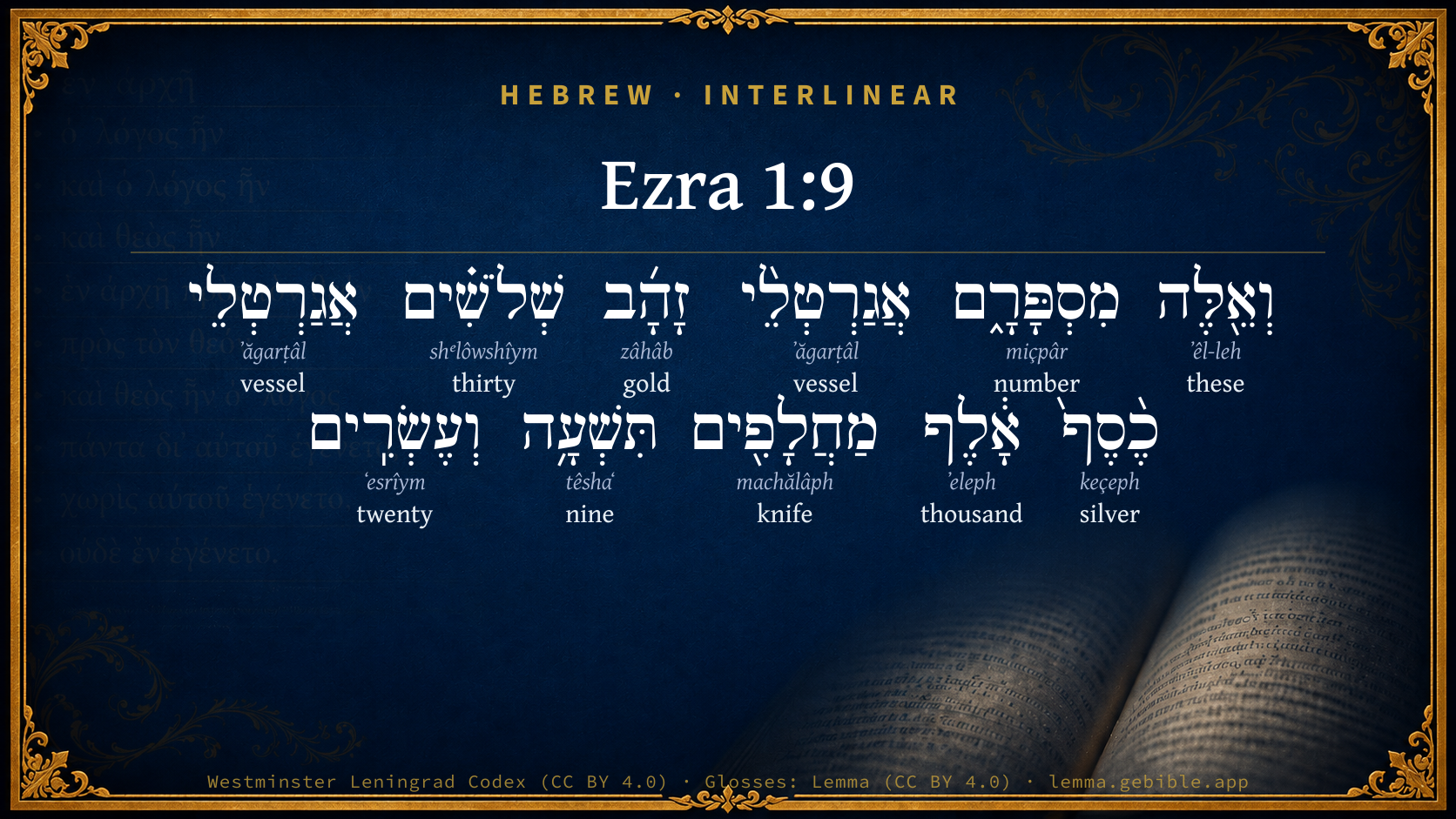
Hebrew (Westminster Leningrad Codex) Ezra 1:9 appears in the Hebrew Old Testament. The text above is from the Westminster Leningrad Codex. Each word links to its Strong’s number, a concise gloss, and parsing drawn from the Open Scriptures Hebrew Bible morphology. Click any word for its full Brown-Driver-Briggs (BDB) entry.
Download image
Cite this verse

Ezra 1:9 (World English Bible). Public Domain. Lemma interlinear Bible study tool, https://lemma.gebible.app/v/ezra/1/9.

Show BibTeX & RIS
BibTeX
RIS
English Translation
This is the number of them: thirty platters of gold, one thousand platters of silver, twenty-nine knives,
World English Bible · Public Domain
Highlights
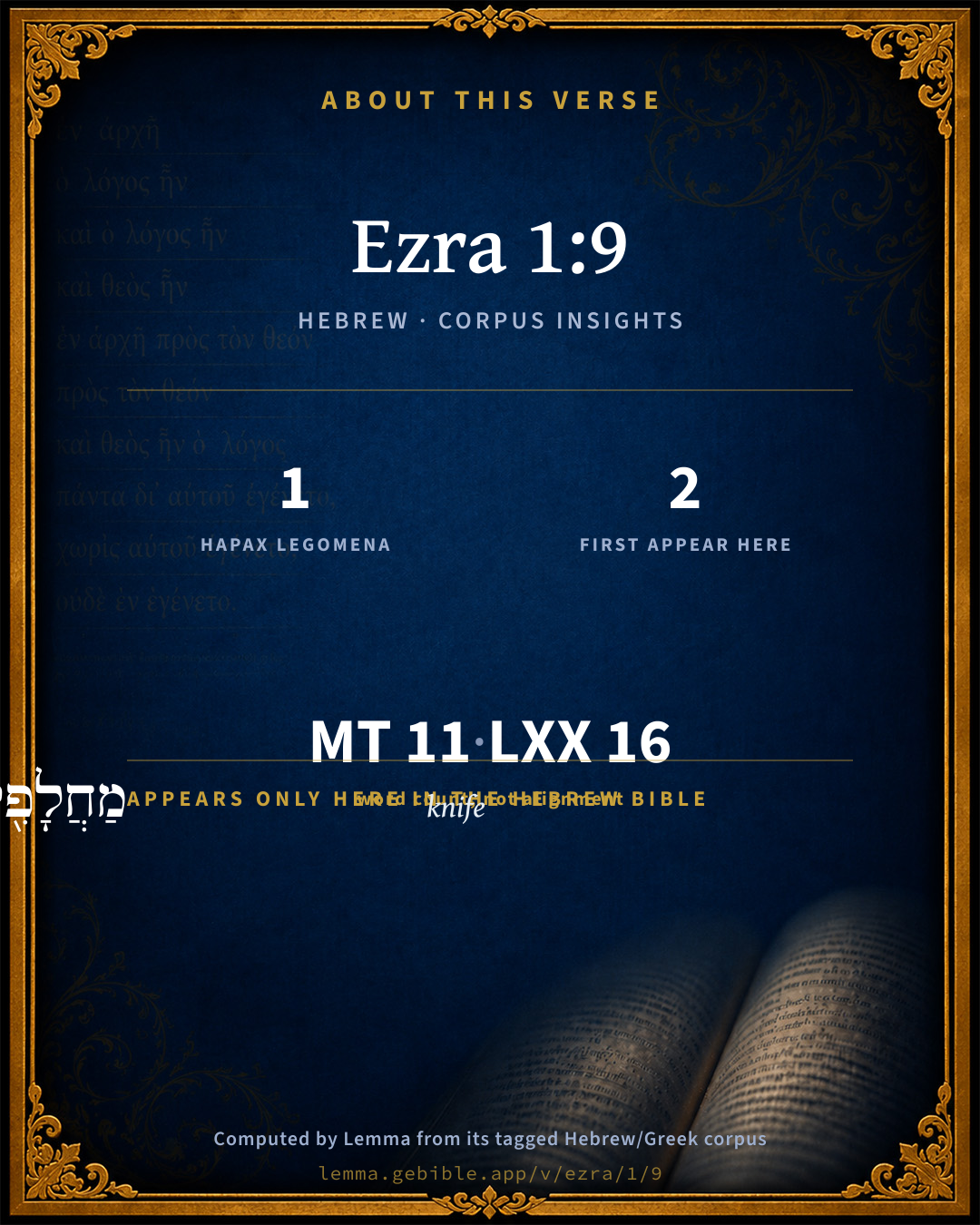
  • 1 hapax legomenon — only here in the Hebrew Bible
  • 2 first appearances in the Hebrew Bible
Full analysis ↓
Download a study sheet

One document with this verse’s original text, its word-by-word gloss line, the meaning frame, cross-references with their text, attributed commentary, and full source and license credits — printable, and it pastes into notes with its structure intact.

This verse Autodidact and up

Study sheet (.html) Plain text (.txt)

A passage Seminary Student

Up to 50 verses in one chapter. A passage sheet keeps up to 6 commentary sources and 12 cross-references per verse, in the order this page ranks them, and says so on the sheet whenever that leaves anything out. Ask for a single verse and you get the Autodidact verse sheet above.

Everything on this page stays free to read, with no account — the sheet is a download of what is already on screen, not access to it.

Want to remove ads? Support Godless Engineer
Compare translations 3

The same verse in 3 English versions, stacked beneath the original-language interlinear above. Click any original word for its lexicon entry.

Each is an independent rendering of the whole verse — the interlinear is not word-aligned to these translations.

Highlighted words mark where these versions differ — a whole-verse word diff, not a word-by-word alignment.

  • World English Bible Public Domain
    This is the number of them: thirty platters of gold, one thousand platters of silver, twenty-nine knives,
  • King James Version Public Domain
    And this is the number of them: thirty chargers of gold, a thousand chargers of silver, nine and twenty knives,
  • unfoldingWord Literal Text CC BY-SA 4.0
    And this was their number: 30 basins of gold, 1,000 basins of silver, 29 knives,

unfoldingWord Literal Text — © unfoldingWord, licensed CC BY-SA 4.0. Word-aligned USFM3 via Door43 (git.door43.org/unfoldingWord/en_ult).

Versions to compare (up to 4)

3 of 4 selected

Show all 18 translations

Every available English version of this verse, each an independent rendering of the whole verse.

  • World English Bible Public Domain
    This is the number of them: thirty platters of gold, one thousand platters of silver, twenty-nine knives,
  • Berean Standard Bible Public Domain
    This was the inventory: 30 gold dishes, 1,000 silver dishes, 29 silver utensils,
  • Majority Standard Bible Public Domain
    This was the inventory: 30 gold dishes, 1,000 silver dishes, 29 silver utensils,
  • King James Version Public Domain
    And this is the number of them: thirty chargers of gold, a thousand chargers of silver, nine and twenty knives,
  • American Standard Version (1901) Public Domain
    And this is the number of them: thirty platters of gold, a thousand platters of silver, nine and twenty knives,
  • Revised Version (1885) Public Domain
    And this is the number of them: thirty chargers of gold, a thousand chargers of silver, nine and twenty knives;
  • Geneva Bible (1599) Public Domain
    And this is the nomber of them, thirtie basins of golde, a thousand basins of siluer, nine and twentie kniues,
  • Douay-Rheims (1899) Public Domain
    And this is the number of them: thirty bowls of gold, a thousand bowls of silver, nine and twenty knives, thirty cups of gold,
  • Young's Literal Translation Public Domain
    And this `is' their number: dishes of gold thirty, dishes of silver a thousand, knives nine and twenty,
  • Literal Standard Version CC BY-SA 4.0
    And this [is] their number: dishes of gold thirty, dishes of silver one thousand, knives twenty-nine,
  • Unlocked Literal Bible CC BY-SA 4.0
    This was their number: thirty gold basins, one thousand silver basins, twenty-nine other basins,
  • unfoldingWord Literal Text CC BY-SA 4.0
    And this was their number: 30 basins of gold, 1,000 basins of silver, 29 knives,
  • Darby Bible Public Domain
    And this is the number of them: thirty chargers of gold, a thousand chargers of silver, nine-and-twenty knives,
  • World Messianic Bible Public Domain
    This is the number of them: thirty platters of gold, one thousand platters of silver, twenty-nine knives,
  • Webster's Bible Public Domain
    And this is the number of them: thirty chargers of gold, a thousand chargers of silver, nine and twenty knives,
  • Free Bible Version CC BY-SA 4.0
    This was the list: 30 gold basins, 1,000 silver basins, 29 silver silverware,
  • Bible in Basic English Public Domain
    And this is the number of them: there were thirty gold plates, a thousand silver plates, twenty-nine knives,
  • JPS Tanakh (1917) Public Domain
    And this is the number of them: thirty basins of gold, a thousand basins of silver, nine and twenty knives;

Literal Standard Version (2020), Covenant Press — licensed CC BY-SA 4.0. Text via the HelloAO Bible API (eBible.org). Unlocked Literal Bible (unfoldingWord) — licensed CC BY-SA 4.0. Text via the HelloAO Bible API (eBible.org). unfoldingWord Literal Text — © unfoldingWord, licensed CC BY-SA 4.0. Word-aligned USFM3 via Door43 (git.door43.org/unfoldingWord/en_ult). Free Bible Version, Dr. Jonathan Gallagher — licensed CC BY-SA 4.0. Text via the HelloAO Bible API (eBible.org).

Word by word

More ways to search: Search by grammar → Find every occurrence → Compare this word →

Practice this passage: Drill this verse → Learn its vocabulary →

מַחֲלָפִ֖ים
machălâph
H4252
“knives”
Noun, Common, Masculine, Plural, Absolute
Part of Speech
Noun
Type
Common
Gender
Masculine
Number
Plural
State
Absolute
Full BDB Definition

Origin: from H2498

TWOT: 666d

knife
  1. וְאֵ֖לֶּה ʼêl-leh H428 “and · these” Conjunction + Pronoun, Demonstrative, Common, Plural
  2. מִסְפָּרָ֑ם miçpâr H4557 “number · their” Noun, Common, Masculine, Singular, Construct + Suffix, Personal, 3rd Person, Masculine, Plural
  3. אֲגַרְטְלֵ֨י ʼăgarṭâl H105 “vessels of” Noun, Common, Masculine, Plural, Construct
  4. זָהָ֜ב zâhâb H2091 “gold” Noun, Common, Masculine, Singular, Absolute
  5. שְׁלֹשִׁ֗ים shᵉlôwshîym H7970 “thirty” Adjective, Cardinal number, Both, Plural, Absolute
  6. אֲגַרְטְלֵי ʼăgarṭâl H105 “vessels of” Noun, Common, Masculine, Plural, Construct
  7. כֶ֨סֶף֙ keçeph H3701 “silver” Noun, Common, Masculine, Singular, Absolute
  8. אָ֔לֶף ʼeleph H505 “thousand” Adjective, Cardinal number, Both, Singular, Absolute
  9. תִּשְׁעָ֥ה têshaʻ H8672 “nine” Adjective, Cardinal number, Masculine, Singular, Absolute
  10. וְעֶשְׂרִֽים ʻesrîym H6242 “and · twenty” Conjunction + Adjective, Cardinal number, Both, Plural, Absolute

About this verse

These counts appear in no published source. They are computed here, from the morphology-tagged text and Lemma’s own curated glosses. What Lemma adds →

11
words
10
distinct lemmas
Historical
section

Notable vocabulary

1 hapax legomenon — a word that appears only here in the entire Hebrew Bible:

  • מַחֲלָפִ֖ים knife H4252

First appearance in Scripture

These words make their first canonical appearance in the Hebrew Bible here:

  • אֲגַרְטְלֵ֨י vessel H105
  • מַחֲלָפִ֖ים knife H4252

Grammatical profile

  • 6 nouns
  • 4 adjectives
  • 1 pronoun

Repetition

A word recurs within this verse — often emphatic in Hebrew:

  • אֲגַרְטְלֵ֨י vessel H105 ×2

Hebrew & Septuagint length

In English translation the verse runs 17 words from the Hebrew and 20 from the Septuagint (LXX English) — closely comparable.

A rough comparison of the two English renderings, which tokenize alike — not a word-level alignment.

Word counts can differ between the Hebrew and the Greek without any difference in meaning — e.g. the Hebrew direct-object marker אֵת has no separate Greek word, and Greek often adds the article ὁ.

In the original languages it is 11 Hebrew tokens and 16 Greek tokens — but the two are counted differently (Hebrew bundles its prefixes and suffixes into one token; the Greek is in lemma form), so that isn’t a like-for-like length.

Cross-references

10

Topical passages linked to Ezra 1:9 in the Treasury of Scripture Knowledge — connected by theme and wording, ordered by reader-vote popularity; previews shown in the World English Bible.

  • Numbers 7:13 and his offering was: one silver platter, the weight of which was one hundred thirty shekels, one silver bowl of seventy shekels, after the shekel of the sanctuary; both of them full of fine flour mixed with oil for a meal offering;
  • Numbers 7:19–89 He offered for his offering: one silver platter, the weight of which was one hundred thirty shekels, one silver bowl of seventy shekels, after the shekel of the sanctuary; both of them full of fine flour mixed with oil for a meal offering;
  • 1 Kings 7:50 and the cups, and the snuffers, and the basins, and the spoons, and the fire pans, of pure gold; and the hinges, both for the doors of the inner house, the most holy place, and for the doors of the house, [to wit], of the temple, of gold.
  • 2 Chronicles 4:8 He made also ten tables, and placed them in the temple, five on the right side, and five on the left. He made one hundred basins of gold.
  • 2 Chronicles 4:11 Huram made the pots, and the shovels, and the basins. So Huram made an end of doing the work that he did for king Solomon in the house of God:
  • 2 Chronicles 4:21–22 and the flowers, and the lamps, and the tongs, of gold, and that perfect gold;
  • 2 Chronicles 24:14 When they had made an end, they brought the rest of the money before the king and Jehoiada, of which were made vessels for the house of Yahweh, even vessels with which to minister and to offer, and spoons, and vessels of gold and silver. They offered burnt offerings in the house of Yahweh continually all the days of Jehoiada.
  • Ezra 8:27 and twenty bowls of gold, of one thousand darics; and two vessels of fine bright brass, precious as gold.
  • Matthew 10:29–31 "Aren't two sparrows sold for an assarion? Not one of them falls on the ground apart from your Father's will,
  • Matthew 14:8 She, being prompted by her mother, said, "Give me here on a platter the head of John the Baptizer."

Cross-references courtesy of OpenBible.info (CC BY 4.0).

Hebrew and Greek witnesses Masoretic Hebrew ↔ Greek Septuagint

The same verse in the two great witnesses to the Old Testament, shown verse-for-verse.

These are two independent witnesses, not word-aligned to each other, and the Septuagint is shown in lemma (dictionary) form.

Hebrew Ezra 1:9 Masoretic · Westminster Leningrad Codex

וְאֵ֖לֶּה מִסְפָּרָ֑ם אֲגַרְטְלֵ֨י זָהָ֜ב שְׁלֹשִׁ֗ים אֲגַרְטְלֵי כֶ֨סֶף֙ אָ֔לֶף מַחֲלָפִ֖ים תִּשְׁעָ֥ה וְעֶשְׂרִֽים

This is the number of them: thirty platters of gold, one thousand platters of silver, twenty-nine knives,

World English Bible · Public Domain

Greek LXX Ezra 1:9 Septuagint · lemma form

καί οὗτος ὁ ἀριθμός αὐτός ψυκτήρ χρυσοῦς τριάκοντα καί ψυκτήρ ἀργυροῦς χίλιοι παραἀλλάσσω ἐννέα καί εἴκοσι

And this is their number: thirty gold basins, and a thousand silver basins, nine and twenty changes, thirty golden goblets,

LXX2012 (modern English Septuagint) · Public Domain

In the Septuagint this is one book — Esdras B (2 Esdras): Ezra is chapters 1–10, Nehemiah 11–23.

On this verse, The Cambridge Bible for Schools and Colleges discusses the Septuagint’s reading. Read the note in Commentary ↓

Hebrew: Westminster Leningrad Codex (CC BY 4.0). Greek: Septuagint (public domain); English from LXX2012 (modern English Septuagint) (Public Domain). How the Septuagint differs from the Hebrew →

Commentary

Notes on Ezra 1:9 from classic Christian and Jewish commentators (each source and its license shown beneath its notes). The classic Christian expositions comment on the surrounding passage and are grouped to its opening verse, so a note may address several verses; the Jewish commentaries on the Tanakh (Rashi and others) are per-verse, so they appear only where the commentator wrote on this verse.

Lemma curates 59 commentaries, every one of them public domain or Creative Commons licensed, each selected and text-cleaned for this edition rather than reprinted as found. About our sources →

Trapp's Complete Commentary

John Trapp

Ezr 1:9 And this [is] the number of them: thirty chargers of gold, a thousand chargers of silver, nine and twenty knives,

Ver. 9. And this is the number of them] Had they not been things of great price and use, they would not have been numbered: Son 6:8, the queens and concubines are numbered how many; but not the virgins, that bring not forth fruit to God. Men use not to count how many pebbles they have in their yard, or piles of grass in their field, as they do how many pence in their purse, or sheep in their fold. When the Great God shall count his people’s flittings, bottle up their tears (as sweet water), book up their sighs (as memorable matters), Psa 56:8, shall we not say of them as the Jews did of Lazarus, when Jesus wept, Behold, how he loves them? When the very hairs of their head are all numbered, Mat 10:30, so that not one of them falleth to the ground without their heavenly Father’s knowledge, what store, think we, setteth he by their persons, by their performances? I know thy work, and thy labour, Rev 2:19. I pity this people, they have been with me now three days, and fasting they are, and far from home, and faint they may, if sent away empty, Mat 15:32. Lo, is not this a wonderful condescension, that Christ should consider tantos tantillos et tales, and reckon every circumstance of their service so particularly and punctually, that he might give to every man according to his works? Oh, his jewels, his book of remembrance, &c., Mal 3:16-17; {See Trapp on "Mal 3:16"} {See Trapp on "Mal 3:17"}

Thirty chargers] Serving to hold such parts of the sacrifices as were to be eaten by the priests and others.

Nine and twenty knives] Sacrificing knives, richly hafted.

John Trapp, A Commentary or Exposition upon All the Books of the Old and New Testament (1647–1656) — public domain. Text from a community e-Sword module.

Tyndale Open Study Notes

Tyndale Open Resources

1:9-11 5,400 articles of gold and silver: The numbers listed total only 2,499 items. A parallel account, in the apocryphal book 1 Esdras 2:13-15, lists 5,469 items, while a list in the Jewish historian Josephus’s Antiquities 11.15 lists 5,220 objects. Ezra’s shortened list illustrates the kind of items included but does not include every item. Keeping track of consecrated utensils reduced the possibility of confusing these sacred items with the pagan utensils used in the worship of other gods.

Tyndale Open Study Notes — © Tyndale Open Resources, licensed CC BY-SA 4.0. Text via the HelloAO Bible API.

Geneva Bible (1599)

Geneva Bible translators

Which served to kill the beasts that were offered in sacrifice.

Geneva Bible (1599) marginal notes — public domain. Text via Bolls.life.

The Cambridge Bible for Schools and Colleges

gen. ed. J. J. S. Perowne

9. chargers] The word in the original does not occur elsewhere in the Bible. Its meaning is very uncertain: (1) the old Jewish interpretation quoted by Aben Ezra derived it from two words meaning ‘to collect’ and ‘a lamb’, and understood it to be applied to ‘vessels intended to receive the blood of victims’; (2) the LXX. translates by ‘wine-coolers’ (ψυκτῆρες); (3) Esdras by ‘libation-vessels’ (σπονδεῖα); (4) another rendering, based upon a similar root in Arabic, Syriac and Ethiopic, is ‘baskets’.

knives] The word in the original occurs here only in the Bible. Vulg. ‘cultri’. This rendering is very uncertain. Other interpretations are (1) ‘censers’, (θυΐσκαι) in 1 Esdras. (2) (?) ‘changes of raiment’—so apparently the LXX. παρηλλαγμένα—possibly cf. Jdg_14:19. (3) ‘vessels adorned with network’—so Ewald comparing a similar word in Jdg_16:13; Jdg_16:19.

The Cambridge Bible for Schools and Colleges (gen. ed. J. J. S. Perowne; Cambridge University Press, 1878–1918) — public domain. Text from a community e-Sword module.

John Gill's Exposition

And this is the number of them,.... Of the vessels delivered, as follows:

thirty chargers of gold, a thousand chargers of silver; these, according to Ben Melech, were vessels in which water was put to wash hands in; but rather they were, as Aben Ezra observes from the Jerusalem Talmud (r), vessels in which they gathered the blood of lambs and bullocks slain for sacrifices:

nine and twenty knives; which, because the handles of them were of gold or silver, were valuable, and might be very large knives, and what the priests used in slaying and cutting up the sacrifices.

(r) T. Hieros. Yoma, fol. 41. 1.

John Gill's Exposition of the Whole Bible (1746–1763) — public domain (CC PDM 1.0). Text via the HelloAO Bible API.

Albert Barnes' Notes on the Bible

Chargers - The word in the original thus translated occurs only in this passage. Its meaning is doubtful. Some derive it from a Hebrew root, “to hollow out,” and translate “cup” or “vessel.”

Knives - This is another doubtful word, only used here. The etymology points to some employment of basket-work.

Albert Barnes' Notes on the Bible (1834–1885) — public domain. Text from a community e-Sword/MySword module.

Haydock's Catholic Bible Commentary

Knives. Septuagint, &c., "changes" of garments. (Calmet)

George Leo Haydock (1774–1849), Haydock's Catholic Family Bible and Commentary, 1859 edition — public domain. Excludes Psalms (Douay-Rheims chapter numbering differs from Protestant) and Deuterocanonical books (Catholic canon only).

Matthew Poole's English Annotations

Large knives used in the killing of the sacrifices, which are here mentioned, because the hafts of them were made of or covered with gold or silver.

Matthew Poole's English Annotations on the Holy Bible (1683–1685) — public domain. Text from a community e-Sword/MySword module.

Whedon's Commentary on the Bible

Daniel D. Whedon

9. Chargers — Basins or cups. Sept. ψυκτηρες; Vulg. phialae, drinking vessels. According to Aben Ezra, they were basins used for collecting the blood of lambs. Others take the word in the sense of baskets.

Knives — מחלפים. Commonly explained as the slaughter knives by which the sacrificial victims were killed. The feminine form of the same word is used in Jdg_16:13; Jdg_16:19, for braids of hair, whence Ewald conjectures that the meaning here is some sort of vessels adorned with plaited work. Bertheau suggests that they were coal-pans, or censers, like those mentioned in 1Ki_7:50.

Daniel D. Whedon (gen. ed.), Commentary on the Old and New Testaments (1874–1909) — public domain. Text from a community e-Sword module.

The Pulpit Commentary

Chargers. Agarteley, a rare word, perhaps Persian. The LXX translate yukthrev, "wine-coolers;" the Vulgate has phialae, "vases;" the apocryphal Esdras, spondeia, "vessels for drink-offerings." Probably basons or bowls are intended. Knives. Machaldaphim, another rare word of doubtful sense. The LXX render parhllagmena, "changes," regarding the word as derived from "to exchange." The apocryphal Esdras has quiskai "censers." But the most usual translation is that of the A. V, "knives."

The Pulpit Commentary (1880–1919), ed. H.D.M. Spence-Jones & Joseph S. Exell — public domain. Text from a community e-Sword module.

unfoldingWord translationNotes

Door43 World Missions Community

General Information:

This is a list of numbered items.

thirty ... one thousand ... twenty-nine ... 410

"30 ... 1,000 ... 29 ... four hundred and ten" (See: Numbers)

basins ... bowls

objects used to hold water for washing

5,400 ... in all

"five thousand four hundred ... in all." This is the total number of items returned to Jerusalem from Babylon, which are listed above individually. (See: Numbers)

translationWords

gold

silver

exile

Babylon

Jerusalem

unfoldingWord translationNotes — © Distant Shores Media and the Door43 World Missions Community, licensed CC BY-SA 4.0. Source: git.door43.org/Door43/en_tn.

Rashi

Rabbi Shlomo Yitzchaki (Rashi)

their number of the vessels of the House of the Lord.

basins Heb. אֲגַרְטְלֵי. They are kinds of vessels.

knives Heb. מַחֲלָפִים. They are knives, and this expression refers to the chamber of the knives (בֵּית הַחֲלִיפוֹת). Because they would deposit the knives therein, it was called the chamber of the depository of the knives (לִשְּׁכַּת בֵּית הַחֲלִיפוֹת).

Rashi on the Tanakh — English translations: “The Judaica Press complete Tanach with Rashi, translated by A. J. Rosenberg” (CC BY 4.0); “Pentateuch with Rashi's commentary by M. Rosenbaum and A.M. Silbermann, 1929-1934” (public domain); “The Metsudah Tanach series, Lakewood, N.J” (CC BY 4.0); and “The Book of Joshua, Metsudah Publications, 1997” (CC BY 4.0). Text via Sefaria.

Lesson kit

Teaching starters — assembled from the data on this page, not authored interpretation. Every prompt links to the verse data it draws on. Edit before teaching.

Ezra, in the Historical, opens this verse with 11 words (10 distinct Hebrew lemmas). Its most distinctive word is machălâph (“knife”). A historical commentator’s framing appears above. Read the whole chapter for the surrounding context.

Discussion questions

  1. What does “knife” (machălâph) contribute to the verse as a whole?
  2. This verse holds 1 word here found nowhere else in the Hebrew Bible. What might the rare word draw attention to?
  3. 2 words here appear for the first time in Scripture. What is being introduced at this debut?
  4. Numbers 7:13 shares this passage’s theme. How do the two illuminate each other?
  5. “vessel” occurs 2× in this one verse. What is the effect of the repetition?
  6. These translations render this verse differently; the difference is in the English rendering, not the original. What questions does that raise?
  7. Reading how Trapp's Complete Commentary and Tyndale Open Study Notes read this verse, where do the two commentators agree and where do they part?

Things to notice

  • 1 word in this verse appears nowhere else in the Hebrew Bible.
  • 2 words make their first canonical appearance in Scripture here.
  • This verse counts 11 Hebrew ↔ 16 Greek words.
  • These translations choose different wording for 12 words in this verse.
  • “vessel” occurs 2× in this single verse.

Reading settings

Reading text

Shown beneath each verse's original-language words.

Old Testament
Old Testament edition

Read the OT as the Masoretic Hebrew (MT) or the Greek Septuagint (LXX).

English shown for the Greek Septuagint (in the Hebrew ↔ Greek comparison).

Comparing translations? Open the Compare panel on any verse page to stack up to four side by side.