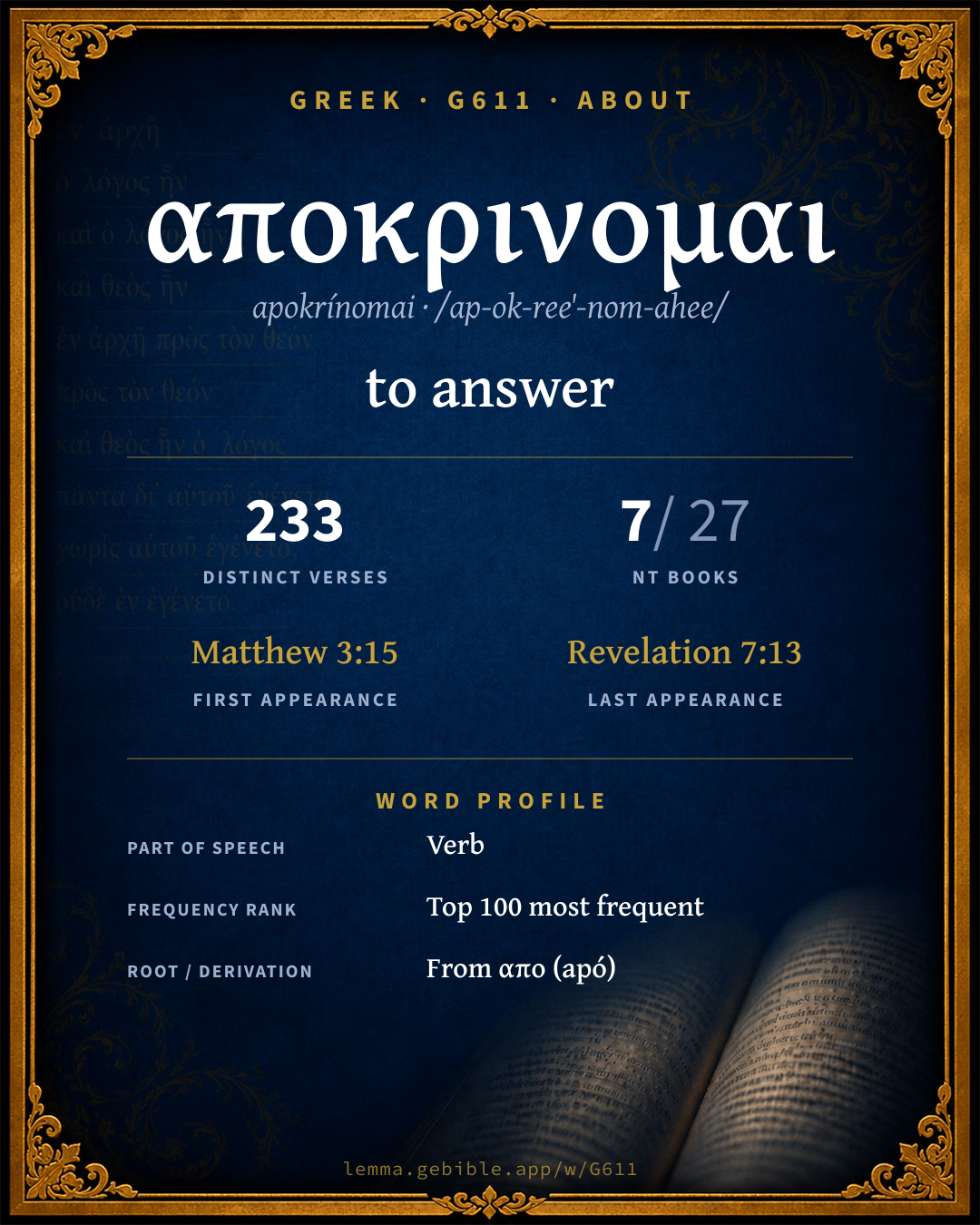
ἀποκρίνομαι
to answer
‘to answer’ is one of 2 main senses fuller range ↓
Full lexicon entry — Thayer's Greek Lexicon
From Thayer's Greek Lexicon
Where this word appears
See every Aorist-tense verb in the Greek New Testament →
Grammar key — what these labels mean
Part of speech
- Verb
- An action or state-of-being word.
Tense
- Aorist
- Action viewed as a simple whole, without regard to duration — often past (perfective aspect).
- Present
- Ongoing or general action in present time (imperfective aspect).
- Future
- Action expected in future time.
Voice
- Passive deponent
- Passive in form but active in meaning.
- Middle deponent
- Middle in form but active in meaning.
- Middle or Passive deponent
- Middle/passive in form but active in meaning.
Mood
- Participle
- A verbal adjective (“writing,” “having written”).
- Indicative
- States a fact or asks a factual question (the mood of reality).
- Imperative
- Expresses a command or request.
- Infinitive
- A verbal noun (“to write”), unmarked for person or number.
- Subjunctive
- Expresses probability, purpose, or possibility (the mood of contingency).
Case
- Nominative
- The case of the subject (and the predicate nominative).
Person
- 3rd person
- The one spoken about (“he / she / it / they”).
- 2nd person
- The one addressed (“you”).
- 1st person
- The speaker (“I / we”).
Gender
- Masculine
- Grammatically masculine.
- Feminine
- Grammatically feminine.
- Neuter
- Grammatically neuter.
Number
- Singular
- One.
- Plural
- More than one.
Grammatical forms 17 distinct
- Verb, Aorist, Passive deponent, Participle, Nominative, Singular, Masculine 96 times (41%)
- Verb, Aorist, Middle deponent, Indicative, 3rd person, Singular 88 times (38%)
- Verb, Aorist, Middle deponent, Indicative, 3rd person, Plural 19 times (8%)
- Verb, Aorist, Passive deponent, Participle, Nominative, Plural, Masculine 7 times (3%)
- Verb, Present, Middle or Passive deponent, Indicative, 2nd person, Singular 4 times (2%)
- Verb, Present, Middle or Passive deponent, Indicative, 3rd person, Singular 4 times (2%)
- Verb, Aorist, Passive deponent, Imperative, 2nd person, Plural 3 times (1%)
- Verb, Aorist, Middle deponent, Indicative, 1st person, Singular 2 times (1%)
+9 more forms (10 occurrences)
Parsed forms decoded from the imported morphology (Robinson–Tischendorf, public domain), counted across 233 parsed occurrences — not distinct verses.
Page 1 of 2 — showing verses 1–200 of 233 distinct verses where G611 appears, across 7 books. Click any verse to open its interlinear word-by-word view. Verse text shown in the World English Bible for context — . Each verse’s Greek form is shown with its reference; the English is not keyword-highlighted, since the data carries no word-level English alignment. Use “Compare translations” on any verse to read it across multiple English versions. This concordance covers the Greek New Testament; Septuagint (Greek Old Testament) occurrences of this word are not indexed here.
Matthew 56 verses
- Matthew 3:15 ἀποκριθεὶς aor pass.dep ptcp nom sg masc But Jesus, answering, said to him, "Allow it now, for this is the fitting way for us to fulfill all righteousness." Then he allowed him.
- Matthew 4:4 ἀποκριθεὶς aor pass.dep ptcp nom sg masc But he answered, "It is written, 'Man shall not live by bread alone, but by every word that proceeds out of the mouth of God.'"
- Matthew 8:8 ἀποκριθεὶς aor pass.dep ptcp nom sg masc The centurion answered, "Lord, I'm not worthy for you to come under my roof. Just say the word, and my servant will be healed.
- Matthew 11:4 ἀποκριθεὶς aor pass.dep ptcp nom sg masc Jesus answered them, "Go and tell John the things which you hear and see:
- Matthew 11:25 ἀποκριθεὶς aor pass.dep ptcp nom sg masc At that time, Jesus answered, "I thank you, Father, Lord of heaven and earth, that you hid these things from the wise and understanding, and revealed them to infants.
- Matthew 12:38 ἀπεκρίθησαν aor mid.dep ind 3pl Then certain of the scribes and Pharisees answered, "Teacher, we want to see a sign from you."
- Matthew 12:39 ἀποκριθεὶς aor pass.dep ptcp nom sg masc But he answered them, "An evil and adulterous generation seeks after a sign, but no sign will be given it but the sign of Jonah the prophet.
- Matthew 12:48 ἀποκριθεὶς aor pass.dep ptcp nom sg masc But he answered him who spoke to him, "Who is my mother? Who are my brothers?"
- Matthew 13:11 ἀποκριθεὶς aor pass.dep ptcp nom sg masc He answered them, "To you it is given to know the mysteries of the Kingdom of Heaven, but it is not given to them.
- Matthew 13:37 ἀποκριθεὶς aor pass.dep ptcp nom sg masc He answered them, "He who sows the good seed is the Son of Man,
- Matthew 14:28 ἀποκριθεὶς aor pass.dep ptcp nom sg masc Peter answered him and said, "Lord, if it is you, command me to come to you on the waters."
- Matthew 15:3 ἀποκριθεὶς aor pass.dep ptcp nom sg masc He answered them, "Why do you also disobey the commandment of God because of your tradition?
- Matthew 15:13 ἀποκριθεὶς aor pass.dep ptcp nom sg masc But he answered, "Every plant which my heavenly Father didn't plant will be uprooted.
- Matthew 15:15 ἀποκριθεὶς aor pass.dep ptcp nom sg masc Peter answered him, "Explain the parable to us."
- Matthew 15:23 ἀπεκρίθη aor mid.dep ind 3sg But he answered her not a word. His disciples came and begged him, saying, "Send her away; for she cries after us."
- Matthew 15:24 ἀποκριθεὶς aor pass.dep ptcp nom sg masc But he answered, "I wasn't sent to anyone but the lost sheep of the house of Israel."
- Matthew 15:26 ἀποκριθεὶς aor pass.dep ptcp nom sg masc But he answered, "It is not appropriate to take the children's bread and throw it to the dogs."
- Matthew 15:28 ἀποκριθεὶς aor pass.dep ptcp nom sg masc Then Jesus answered her, "Woman, great is your faith! Be it done to you even as you desire." And her daughter was healed from that hour.
- Matthew 16:2 ἀποκριθεὶς aor pass.dep ptcp nom sg masc But he answered them, "When it is evening, you say, 'It will be fair weather, for the sky is red.'
- Matthew 16:16 ἀποκριθεὶς aor pass.dep ptcp nom sg masc Simon Peter answered, "You are the Christ, the Son of the living God."
- Matthew 16:17 ἀποκριθεὶς aor pass.dep ptcp nom sg masc Jesus answered him, "Blessed are you, Simon Bar Jonah, for flesh and blood has not revealed this to you, but my Father who is in heaven.
- Matthew 17:4 ἀποκριθεὶς aor pass.dep ptcp nom sg masc Peter answered, and said to Jesus, "Lord, it is good for us to be here. If you want, let's make three tents here: one for you, one for Moses, and one for Elijah."
- Matthew 17:11 ἀποκριθεὶς aor pass.dep ptcp nom sg masc Jesus answered them, "Elijah indeed comes first, and will restore all things,
- Matthew 17:17 ἀποκριθεὶς aor pass.dep ptcp nom sg masc Jesus answered, "Faithless and perverse generation! How long will I be with you? How long will I bear with you? Bring him here to me."
- Matthew 19:4 ἀποκριθεὶς aor pass.dep ptcp nom sg masc He answered, "Haven't you read that he who made them from the beginning made them male and female,
- Matthew 19:27 ἀποκριθεὶς aor pass.dep ptcp nom sg masc Then Peter answered, "Behold, we have left everything, and followed you. What then will we have?"
- Matthew 20:13 ἀποκριθεὶς aor pass.dep ptcp nom sg masc "But he answered one of them, 'Friend, I am doing you no wrong. Didn't you agree with me for a denarius?
- Matthew 20:22 ἀποκριθεὶς aor pass.dep ptcp nom sg masc But Jesus answered, "You don't know what you are asking. Are you able to drink the cup that I am about to drink, and be baptized with the baptism that I am baptized with?" They said to him, "We are able."
- Matthew 21:21 ἀποκριθεὶς aor pass.dep ptcp nom sg masc Jesus answered them, "Most assuredly I tell you, if you have faith, and don't doubt, you will not only do what is done to the fig tree, but even if you told this mountain, 'Be taken up and cast into the sea,' it would be done.
- Matthew 21:24 ἀποκριθεὶς aor pass.dep ptcp nom sg masc Jesus answered them, "I also will ask you one question, which if you tell me, I likewise will tell you by what authority I do these things.
- Matthew 21:27 ἀποκριθέντες aor pass.dep ptcp nom pl masc They answered Jesus, and said, "We don't know." He also said to them, "Neither will I tell you by what authority I do these things.
- Matthew 21:29 ἀποκριθεὶς aor pass.dep ptcp nom sg masc He answered, 'I will not,' but afterward he changed his mind, and went.
- Matthew 21:30 ἀποκριθεὶς aor pass.dep ptcp nom sg masc He came to the second, and said the same thing. He answered, 'I go, sir,' but he didn't go.
- Matthew 22:1 ἀποκριθεὶς aor pass.dep ptcp nom sg masc Jesus answered and spoke again in parables to them, saying,
- Matthew 22:29 ἀποκριθεὶς aor pass.dep ptcp nom sg masc But Jesus answered them, "You are mistaken, not knowing the Scriptures, nor the power of God.
- Matthew 22:46 ἀποκριθῆναι aor pass.dep inf No one was able to answer him a word, neither dared any man from that day forth ask him any more questions.
- Matthew 24:2 ἀποκριθεὶς aor pass.dep ptcp nom sg masc But he answered them, "Don't you see all of these things? Most assuredly I tell you, there will not be left here one stone on another, that will not be thrown down."
- Matthew 24:4 ἀποκριθεὶς aor pass.dep ptcp nom sg masc Jesus answered them, "Be careful that no one leads you astray.
- Matthew 25:9 ἀπεκρίθησαν aor mid.dep ind 3pl But the wise answered, saying, 'What if there isn't enough for us and you? You go rather to those who sell, and buy for yourselves.'
- Matthew 25:12 ἀποκριθεὶς aor pass.dep ptcp nom sg masc But he answered, 'Most assuredly I tell you, I don't know you.'
- Matthew 25:26 ἀποκριθεὶς aor pass.dep ptcp nom sg masc "But his lord answered him, 'You wicked and slothful servant. You knew that I reap where I didn't sow, and gather where I didn't scatter.
- Matthew 25:37 ἀποκριθήσονται fut pass.dep ind 3pl "Then the righteous will answer him, saying, 'Lord, when did we see you hungry, and feed you; or thirsty, and give you a drink?
- Matthew 25:40 ἀποκριθεὶς aor pass.dep ptcp nom sg masc "The King will answer them, 'Most assuredly I tell you, inasmuch as you did it to one of the least of these my brothers, you did it to me.'
- Matthew 25:44 ἀποκριθήσονται fut pass.dep ind 3pl "Then they will also answer, saying, 'Lord, when did we see you hungry, or thirsty, or a stranger, or naked, or sick, or in prison, and didn't help you?'
- Matthew 25:45 ἀποκριθήσεται fut pass.dep ind 3sg "Then he will answer them, saying, 'Most assuredly I tell you, inasmuch as you didn't do it to one of the least of these, you didn't do it to me.'
- Matthew 26:23 ἀποκριθεὶς aor pass.dep ptcp nom sg masc He answered, "He who dipped his hand with me in the dish, the same will betray me.
- Matthew 26:25 ἀποκριθεὶς aor pass.dep ptcp nom sg masc Judas, who betrayed him, answered, "It isn't me, is it, Rabbi?" He said to him, "You said it."
- Matthew 26:33 ἀποκριθεὶς aor pass.dep ptcp nom sg masc But Peter answered him, "Even if all will be made to stumble because of you, I will never be made to stumble."
- Matthew 26:62 ἀποκρίνῃ pres mid/pass.dep ind 2sg The high priest stood up, and said to him, "Have you no answer? What is this that these testify against you?"
- Matthew 26:63 ἀποκριθεὶς aor pass.dep ptcp nom sg masc But Jesus held his peace. The high priest answered him, "I adjure you by the living God, that you tell us whether you are the Christ, the Son of God."
- Matthew 26:66 ἀποκριθέντες aor pass.dep ptcp nom pl masc What do you think?" They answered, "He is worthy of death!"
- Matthew 27:12 ἀπεκρίνατο aor mid.dep ind 3sg When he was accused by the chief priests and elders, he answered nothing.
- Matthew 27:14 ἀπεκρίθη aor mid.dep ind 3sg He gave him no answer, not even one word, so that the governor marveled greatly.
- Matthew 27:21 ἀποκριθεὶς aor pass.dep ptcp nom sg masc But the governor answered them, "Which of the two do you want me to release to you?" They said, "Barabbas!"
- Matthew 27:25 ἀποκριθεὶς aor pass.dep ptcp nom sg masc All the people answered, "May his blood be on us, and on our children!"
- Matthew 28:5 ἀποκριθεὶς aor pass.dep ptcp nom sg masc The angel answered the women, "Don't be afraid, for I know that you seek Jesus, who has been crucified.
Mark 30 verses
- Mark 3:33 ἀποκριθεὶς aor pass.dep ptcp nom sg masc He answered them, "Who are my mother and my brothers?"
- Mark 6:37 ἀποκριθεὶς aor pass.dep ptcp nom sg masc But he answered them, "You give them something to eat." They asked him, "Shall we go and buy two hundred denarii worth of bread, and give them something to eat?"
- Mark 7:28 ἀπεκρίθη aor mid.dep ind 3sg But she answered him, "Yes, Lord. Yet even the dogs under the table eat the children's crumbs."
- Mark 8:4 ἀπεκρίθησαν aor mid.dep ind 3pl His disciples answered him, "From where could one satisfy these people with bread here in a deserted place?"
- Mark 8:29 ἀποκριθεὶς aor pass.dep ptcp nom sg masc He said to them, "But who do you say that I am?" Peter answered, "You are the Christ."
- Mark 9:5 ἀποκριθεὶς aor pass.dep ptcp nom sg masc Peter answered Jesus, "Rabbi, it is good for us to be here. Let's make three tents: one for you, one for Moses, and one for Elijah."
- Mark 9:6 ἀποκριθῇ aor pass.dep subj 3sg For he didn't know what to say, for they were very afraid.
- Mark 9:17 ἀπεκρίθη aor mid.dep ind 3sg One of the multitude answered, "Teacher, I brought to you my son, who has a mute spirit;
- Mark 9:19 ἀποκριθεὶς aor pass.dep ptcp nom sg masc He answered him, "Unbelieving generation, how long shall I be with you? How long shall I bear with you? Bring him to me."
- Mark 10:3 ἀποκριθεὶς aor pass.dep ptcp nom sg masc He answered, "What did Moses command you?"
- Mark 10:24 ἀποκριθεὶς aor pass.dep ptcp nom sg masc The disciples were amazed at his words. But Jesus answered again, "Children, how hard is it for those who trust in riches to enter into the Kingdom of God!
- Mark 10:51 ἀποκριθεὶς aor pass.dep ptcp nom sg masc Jesus asked him, "What do you want me to do for you?" The blind man said to him, "Rhabboni, that I may see again."
- Mark 11:14 ἀποκριθεὶς aor pass.dep ptcp nom sg masc Jesus told it, "May no one ever eat fruit from you again!" and his disciples heard it.
- Mark 11:22 ἀποκριθεὶς aor pass.dep ptcp nom sg masc Jesus answered them, "Have faith in God.
- Mark 11:29 ἀποκρίθητέ aor pass.dep impv 2pl Jesus said to them, "I will ask you one question. Answer me, and I will tell you by what authority I do these things.
- Mark 11:30 ἀποκρίθητέ aor pass.dep impv 2pl The baptism of John -- was it from heaven, or from men? Answer me."
- Mark 11:33 ἀποκριθέντες aor pass.dep ptcp nom pl masc They answered Jesus, "We don't know." Jesus said to them, "Neither do I tell you by what authority I do these things."
- Mark 12:28 ἀπεκρίθη aor mid.dep ind 3sg One of the scribes came, and heard them questioning together. Knowing that he had answered them well, asked him, "Which commandment is the greatest of all?"
- Mark 12:29 ἀπεκρίθη aor mid.dep ind 3sg Jesus answered, "The greatest is, 'Hear, Israel, the Lord our God, the Lord is one:
- Mark 12:34 ἀπεκρίθη aor mid.dep ind 3sg When Jesus saw that he answered wisely, he said to him, "You are not far from the Kingdom of God." No one dared ask him any question after that.
- Mark 12:35 ἀποκριθεὶς aor pass.dep ptcp nom sg masc Jesus responded, as he taught in the temple, "How is it that the scribes say that the Christ is the son of David?
- Mark 14:40 ἀποκριθῶσιν aor pass.dep subj 3pl Again he returned, and found them sleeping, for their eyes were very heavy, and they didn't know what to answer him.
- Mark 14:48 ἀποκριθεὶς aor pass.dep ptcp nom sg masc Jesus answered them, "Have you come out, as against a robber, with swords and clubs to seize me?
- Mark 14:60 ἀποκρίνῃ pres mid/pass.dep ind 2sg The high priest stood up in the midst, and asked Jesus, "Have you no answer? What is it which these testify against you?"
- Mark 14:61 ἀπεκρίνατο aor mid.dep ind 3sg But he stayed quiet, and answered nothing. Again the high priest asked him, "Are you the Christ, the Son of the Blessed?"
- Mark 15:2 ἀποκριθεὶς aor pass.dep ptcp nom sg masc Pilate asked him, "Are you the King of the Jews?" He answered, "So you say."
- Mark 15:4 ἀποκρίνῃ pres mid/pass.dep ind 2sg Pilate again asked him, "Have you no answer? See how many things they testify against you!"
- Mark 15:5 ἀπεκρίθη aor mid.dep ind 3sg But Jesus made no further answer, so that Pilate marveled.
- Mark 15:9 ἀπεκρίθη aor mid.dep ind 3sg Pilate answered them, saying, "Do you want me to release to you the King of the Jews?"
- Mark 15:12 ἀποκριθεὶς aor pass.dep ptcp nom sg masc Pilate again asked them, "What then should I do to him whom you call the King of the Jews?"
Luke 47 verses
- Luke 1:19 ἀποκριθεὶς aor pass.dep ptcp nom sg masc The angel answered him, "I am Gabriel, who stands in the presence of God. I was sent to speak to you, and to bring you this good news.
- Luke 1:35 ἀποκριθεὶς aor pass.dep ptcp nom sg masc The angel answered her, "The Holy Spirit will come on you, and the power of the Most High will overshadow you. Therefore also the holy one who is born from you will be called the Son of God.
- Luke 1:60 ἀποκριθεῖσα aor pass.dep ptcp nom sg fem His mother answered, "Not so; but he will be called John."
- Luke 3:11 ἀποκριθεὶς aor pass.dep ptcp nom sg masc He answered them, "He who has two coats, let him give to him who has none. He who has food, let him do likewise."
- Luke 3:16 ἀπεκρίνατο aor mid.dep ind 3sg John answered them all, "I indeed baptize you with water, but he comes who is mightier than I, the latchet of whose sandals I am not worthy to loosen. He will baptize you in the Holy Spirit and fire,
- Luke 4:4 ἀπεκρίθη aor mid.dep ind 3sg Jesus answered him, saying, "It is written, 'Man shall not live by bread alone, but by every word of God.'"
- Luke 4:8 ἀποκριθεὶς aor pass.dep ptcp nom sg masc Jesus answered him, "Get behind me Satan! For it is written, 'You shall worship the Lord your God, and him only shall you serve.'"
- Luke 4:12 ἀποκριθεὶς aor pass.dep ptcp nom sg masc Jesus answering, said to him, "It has been said, 'You shall not tempt the Lord your God.'"
- Luke 5:5 ἀποκριθεὶς aor pass.dep ptcp nom sg masc Simon answered him, "Master, we worked all night, and took nothing; but at your word I will let down the net."
- Luke 5:22 ἀποκριθεὶς aor pass.dep ptcp nom sg masc But Jesus, perceiving their thoughts, answered them, "Why are you reasoning so in your hearts?
- Luke 5:31 ἀποκριθεὶς aor pass.dep ptcp nom sg masc Jesus answered them, "Those who are healthy have no need for a physician, but those who are sick do.
- Luke 6:3 ἀποκριθεὶς aor pass.dep ptcp nom sg masc Jesus, answering them, said, "Haven't you read what David did when he was hungry, he, and those who were with him;
- Luke 7:22 ἀποκριθεὶς aor pass.dep ptcp nom sg masc Jesus answered them, "Go and tell John the things which you have seen and heard: that the blind receive their sight, the lame walk, the lepers are cleansed, the deaf hear, the dead are raised up, and the poor have good news preached to them.
- Luke 7:40 ἀποκριθεὶς aor pass.dep ptcp nom sg masc Jesus answered him, "Simon, I have something to tell you." He said, "Teacher, say on."
- Luke 7:43 ἀποκριθεὶς aor pass.dep ptcp nom sg masc Simon answered, "He, I suppose, to whom he forgave the most." He said to him, "You have judged correctly."
- Luke 8:21 ἀποκριθεὶς aor pass.dep ptcp nom sg masc But he answered them, "My mother and my brothers are these who hear the word of God, and do it."
- Luke 8:50 ἀπεκρίθη aor mid.dep ind 3sg But Jesus hearing it, answered him, "Don't be afraid. Only believe, and she will be healed."
- Luke 9:19 ἀποκριθέντες aor pass.dep ptcp nom pl masc They answered, "'John the Baptizer,' but others say, 'Elijah,' and others, that one of the old prophets is risen again."
- Luke 9:20 ἀποκριθεὶς aor pass.dep ptcp nom sg masc He said to them, "But who do you say that I am?" Peter answered, "The Christ of God."
- Luke 9:41 ἀποκριθεὶς aor pass.dep ptcp nom sg masc Jesus answered, "Faithless and perverse generation, how long shall I be with you and bear with you? Bring your son here."
- Luke 9:49 Ἀποκριθεὶς aor pass.dep ptcp nom sg masc John answered, "Master, we saw someone casting out demons in your name, and we forbade him, because he doesn't follow with us."
- Luke 10:27 ἀποκριθεὶς aor pass.dep ptcp nom sg masc He answered, "You shall love the Lord your God with all your heart, with all your soul, with all your strength, and with all your mind; and your neighbor as yourself."
- Luke 10:28 ἀπεκρίθης aor mid.dep ind 2sg He said to him, "You have answered correctly. Do this, and you will live."
- Luke 10:41 ἀποκριθεὶς aor pass.dep ptcp nom sg masc Jesus answered her, "Martha, Martha, you are anxious and troubled about many things,
- Luke 11:7 ἀποκριθεὶς aor pass.dep ptcp nom sg masc and he from within will answer and say, 'Don't bother me. The door is now shut, and my children are with me in bed. I can't get up and give it to you'?
- Luke 11:45 Ἀποκριθεὶς aor pass.dep ptcp nom sg masc One of the lawyers answered him, "Teacher, in saying this you insult us also."
- Luke 13:2 ἀποκριθεὶς aor pass.dep ptcp nom sg masc Jesus answered them, "Do you think that these Galileans were worse sinners than all the other Galileans, because they suffered such things?
- Luke 13:8 ἀποκριθεὶς aor pass.dep ptcp nom sg masc He answered, 'Lord, leave it alone this year also, until I dig around it, and fertilize it.
- Luke 13:14 ἀποκριθεὶς aor pass.dep ptcp nom sg masc The ruler of the synagogue, being indignant because Jesus had healed on the Sabbath, said to the multitude, "There are six days in which men ought to work. Therefore come on those days and be healed, and not on the Sabbath day!"
- Luke 13:15 ἀπεκρίθη aor mid.dep ind 3sg Therefore the Lord answered him, "You hypocrites! Doesn't each one of you free his ox or his donkey from the stall on the Sabbath, and lead him away to water?
- Luke 13:25 ἀποκριθεὶς aor pass.dep ptcp nom sg masc When once the master of the house has risen up, and has shut the door, and you begin to stand outside, and to knock at the door, saying, 'Lord, Lord, open to us!' then he will answer and tell you, 'I don't know you or where you come from.'
- Luke 14:3 ἀποκριθεὶς aor pass.dep ptcp nom sg masc Jesus, answering, spoke to the lawyers and Pharisees, saying, "Is it lawful to heal on the Sabbath?"
- Luke 14:5 ἀποκριθεὶς aor pass.dep ptcp nom sg masc He answered them, "Which of you, if your son or an ox fell into a well, wouldn't immediately pull him out on a Sabbath day?"
- Luke 15:29 ἀποκριθεὶς aor pass.dep ptcp nom sg masc But he answered his father, 'Behold, these many years I have served you, and I never disobeyed a commandment of yours, but you never gave me a goat, that I might celebrate with my friends.
- Luke 17:17 ἀποκριθεὶς aor pass.dep ptcp nom sg masc Jesus answered, "Weren't the ten cleansed? But where are the nine?
- Luke 17:20 ἀπεκρίθη aor mid.dep ind 3sg Being asked by the Pharisees when the Kingdom of God would come, he answered them, "The Kingdom of God doesn't come with observation;
- Luke 17:37 ἀποκριθέντες aor pass.dep ptcp nom pl masc They answering, asked him, "Where, Lord?" He said to them, "Where the body is, there will the vultures also be gathered together."
- Luke 19:40 ἀποκριθεὶς aor pass.dep ptcp nom sg masc He answered them, "I tell you that if these were silent, the stones would cry out."
- Luke 20:3 ἀποκριθεὶς aor pass.dep ptcp nom sg masc He answered them, "I also will ask you one question. Tell me:
- Luke 20:7 ἀπεκρίθησαν aor mid.dep ind 3pl They answered that they didn't know where it was from.
- Luke 20:39 ἀποκριθέντες aor pass.dep ptcp nom pl masc Some of the scribes answered, "Teacher, you speak well."
- Luke 22:51 ἀποκριθεὶς aor pass.dep ptcp nom sg masc But Jesus answered, "Let me at least do this"--and he touched his ear, and healed him.
- Luke 22:68 ἀποκριθῆτε aor pass.dep impv 2pl and if I ask, you will in no way answer me or let me go.
- Luke 23:3 ἀποκριθεὶς aor pass.dep ptcp nom sg masc Pilate asked him, "Are you the King of the Jews?" He answered him, "So you say."
- Luke 23:9 ἀπεκρίνατο aor mid.dep ind 3sg He questioned him with many words, but he gave no answers.
- Luke 23:40 ἀποκριθεὶς aor pass.dep ptcp nom sg masc But the other answered, and rebuking him said, "Don't you even fear God, seeing you are under the same condemnation?
- Luke 24:18 ἀποκριθεὶς aor pass.dep ptcp nom sg masc One of them, named Cleopas, answered him, "Are you the only stranger in Jerusalem who doesn't know the things which have happened there in these days?"
John 78 verses
- John 1:21 ἀπεκρίθη aor mid.dep ind 3sg They asked him, "What then? Are you Elijah?" He said, "I am not." "Are you the Prophet?" He answered, "No."
- John 1:26 ἀπεκρίθη aor mid.dep ind 3sg John answered them, "I baptize in water, but among you stands one whom you don't know.
- John 1:49 ἀπεκρίθη aor mid.dep ind 3sg Nathanael answered him, "Rabbi, you are the Son of God! You are King of Israel!"
- John 1:50 ἀπεκρίθη aor mid.dep ind 3sg Jesus answered him, "Because I told you, 'I saw you underneath the fig tree,' do you believe? You will see greater things than these!"
- John 1:51 ἀπεκρίθη aor mid.dep ind 3sg He said to him, "Most assuredly, I tell you, hereafter you will see heaven opened, and the angels of God ascending and descending on the Son of Man."
- John 2:18 ἀπεκρίθησαν aor mid.dep ind 3pl The Jews therefore answered him, "What sign do you show us, seeing that you do these things?"
- John 2:19 ἀπεκρίθη aor mid.dep ind 3sg Jesus answered them, "Destroy this temple, and in three days I will raise it up."
- John 3:3 ἀπεκρίθη aor mid.dep ind 3sg Jesus answered him, "Most assuredly, I tell you, unless one is born anew, he can't see the Kingdom of God."
- John 3:5 ἀπεκρίθη aor mid.dep ind 3sg Jesus answered, "Most assuredly I tell you, unless one is born of water and spirit, he can't enter into the Kingdom of God!
- John 3:9 ἀπεκρίθη aor mid.dep ind 3sg Nicodemus answered him, "How can these things be?"
- John 3:10 ἀπεκρίθη aor mid.dep ind 3sg Jesus answered him, "Are you the teacher of Israel, and don't understand these things?
- John 3:27 ἀπεκρίθη aor mid.dep ind 3sg John answered, "A man can receive nothing, unless it has been given him from heaven.
- John 4:10 ἀπεκρίθη aor mid.dep ind 3sg Jesus answered her, "If you knew the gift of God, and who it is who says to you, 'Give me a drink,' you would have asked him, and he would have given you living water."
- John 4:13 ἀπεκρίθη aor mid.dep ind 3sg Jesus answered her, "Everyone who drinks of this water will thirst again,
- John 4:17 ἀπεκρίθη aor mid.dep ind 3sg The woman answered, "I have no husband." Jesus said to her, "You said well, 'I have no husband,'
- John 5:7 ἀπεκρίθη aor mid.dep ind 3sg The sick man answered him, "Sir, I have no one to put me into the pool when the water is stirred up, but while I'm coming, another steps down before me."
- John 5:11 ἀπεκρίθη aor mid.dep ind 3sg He answered them, "He who made me well, the same said to me, 'Take up your mat, and walk.'"
- John 5:17 ἀπεκρίνατο aor mid.dep ind 3sg But Jesus answered them, "My Father is still working, so I am working, too."
- John 5:19 Ἀπεκρίνατο aor mid.dep ind 3sg Jesus therefore answered them, "Most assuredly, I tell you, the Son can do nothing of himself, but what he sees the Father doing. For whatever things he does, these the Son also does likewise.
- John 6:7 ἀποκρίνεται pres mid/pass.dep ind 3sg Philip answered him, "Two hundred denarii worth of bread is not sufficient for them, that everyone of them may receive a little."
- John 6:26 ἀπεκρίθη aor mid.dep ind 3sg Jesus answered them, "Most assuredly I tell you, you seek me, not because you saw signs, but because you ate of the loaves, and were filled.
- John 6:29 ἀπεκρίθη aor mid.dep ind 3sg Jesus answered them, "This is the work of God, that you believe in him whom he has sent."
- John 6:43 ἀπεκρίθη aor mid.dep ind 3sg Therefore Jesus answered them, "Don't murmur among yourselves.
- John 6:68 ἀπεκρίθη aor mid.dep ind 3sg Simon Peter answered him, "Lord, to whom would we go? You have the words of eternal life.
- John 6:70 ἀπεκρίθη aor mid.dep ind 3sg Jesus answered them, "Didn't I choose you, the twelve, and one of you is a devil?"
- John 7:16 ἀπεκρίθη aor mid.dep ind 3sg Jesus therefore answered them, "My teaching is not mine, but his who sent me.
- John 7:20 ἀπεκρίθη aor mid.dep ind 3sg The multitude answered, "You have a demon! Who seeks to kill you?"
- John 7:21 ἀπεκρίθη aor mid.dep ind 3sg Jesus answered them, "I did one work, and you all marvel because of it.
- John 7:46 ἀπεκρίθησαν aor mid.dep ind 3pl The officers answered, "No man ever spoke like this man!"
- John 7:47 ἀπεκρίθησαν aor mid.dep ind 3pl The Pharisees therefore answered them, "You aren't also led astray, are you?
- John 7:52 ἀπεκρίθησαν aor mid.dep ind 3pl They answered him, "Are you also from Galilee? Search, and see that no prophet has arisen out of Galilee."
- John 8:14 ἀπεκρίθη aor mid.dep ind 3sg Jesus answered them, "Even if I testify about myself, my testimony is true, for I know where I came from, and where I am going; but you don't know where I came from, or where I am going.
- John 8:19 ἀπεκρίθη aor mid.dep ind 3sg They said therefore to him, "Where is your Father?" Jesus answered, "You know neither me, nor my Father. If you knew me, you would know my Father also."
- John 8:33 ἀπεκρίθησαν aor mid.dep ind 3pl They answered him, "We are Abraham's seed, and have never been in bondage to anyone. How do you say, 'You will be made free?'"
- John 8:34 ἀπεκρίθη aor mid.dep ind 3sg Jesus answered them, "Most assuredly I tell you, everyone who commits sin is the bondservant of sin.
- John 8:39 ἀπεκρίθησαν aor mid.dep ind 3pl They answered him, "Our father is Abraham." Jesus said to them, "If you were Abraham's children, you would do the works of Abraham.
- John 8:48 ἀπεκρίθησαν aor mid.dep ind 3pl Then the Jews answered him, "Don't we say well that you are a Samaritan, and have a demon?"
- John 8:49 ἀπεκρίθη aor mid.dep ind 3sg Jesus answered, "I don't have a demon, but I honor my Father, and you dishonor me.
- John 8:54 ἀπεκρίθη aor mid.dep ind 3sg Jesus answered, "If I glorify myself, my glory is nothing. It is my Father who glorifies me, of whom you say that he is our God.
- John 9:3 ἀπεκρίθη aor mid.dep ind 3sg Jesus answered, "Neither did this man sin, nor his parents; but, that the works of God might be revealed in him.
- John 9:11 ἀπεκρίθη aor mid.dep ind 3sg He answered, "A man called Jesus made mud, anointed my eyes, and said to me, 'Go to the pool of Siloam, and wash.' So I went away and washed, and I received sight."
- John 9:20 ἀπεκρίθησαν aor mid.dep ind 3pl His parents answered them, "We know that this is our son, and that he was born blind;
- John 9:25 ἀπεκρίθη aor mid.dep ind 3sg He therefore answered, "I don't know if he is a sinner. One thing I do know: that though I was blind, now I see."
- John 9:27 ἀπεκρίθη aor mid.dep ind 3sg He answered them, "I told you already, and you didn't listen. Why do you want to hear it again? You don't also want to become his disciples, do you?"
- John 9:30 ἀπεκρίθη aor mid.dep ind 3sg The man answered them, "How amazing! You don't know where he comes from, yet he opened my eyes.
- John 9:34 ἀπεκρίθησαν aor mid.dep ind 3pl They answered him, "You were altogether born in sins, and do you teach us?" They threw him out.
- John 9:36 ἀπεκρίθη aor mid.dep ind 3sg He answered, "Who is he, Lord, that I may believe in him?"
- John 10:25 ἀπεκρίθη aor mid.dep ind 3sg Jesus answered them, "I told you, and you don't believe. The works that I do in my Father's name, these testify about me.
- John 10:32 ἀπεκρίθη aor mid.dep ind 3sg Jesus answered them, "I have shown you many good works from my Father. For which of those works do you stone me?"
- John 10:33 ἀπεκρίθησαν aor mid.dep ind 3pl The Jews answered him, "We don't stone you for a good work, but for blasphemy: because you, being a man, make yourself God."
- John 10:34 ἀπεκρίθη aor mid.dep ind 3sg Jesus answered them, "Isn't it written in your law, 'I said, you are gods?'
- John 11:9 ἀπεκρίθη aor mid.dep ind 3sg Jesus answered, "Aren't there twelve hours of daylight? If a man walks in the day, he doesn't stumble, because he sees the light of this world.
- John 12:23 ἀποκρίνεται pres mid/pass.dep ind 3sg Jesus answered them, "The time has come for the Son of Man to be glorified.
- John 12:30 ἀπεκρίθη aor mid.dep ind 3sg Jesus answered, "This voice hasn't come for my sake, but for your sakes.
- John 12:34 ἀπεκρίθη aor mid.dep ind 3sg The multitude answered him, "We have heard out of the law that the Christ remains forever. How do you say, 'The Son of Man must be lifted up?' Who is this Son of Man?"
- John 13:7 ἀπεκρίθη aor mid.dep ind 3sg Jesus answered him, "You don't know what I am doing now, but you will understand later."
- John 13:8 ἀπεκρίθη aor mid.dep ind 3sg Peter said to him, "You will never wash my feet!" Jesus answered him, "If I don't wash you, you have no part with me."
- John 13:26 ἀποκρίνεται pres mid/pass.dep ind 3sg Jesus therefore answered, "It is he to whom I will give this piece of bread when I have dipped it." So when he had dipped the piece of bread, he gave it to Judas, the son of Simon Iscariot.
- John 13:36 ἀπεκρίθη aor mid.dep ind 3sg Simon Peter said to him, "Lord, where are you going?" Jesus answered, "Where I am going, you can't follow now, but you will follow afterwards."
- John 13:38 ἀποκρίνεται pres mid/pass.dep ind 3sg Jesus answered him, "Will you lay down your life for me? Most assuredly I tell you, the rooster won't crow until you have denied me three times.
- John 14:23 ἀπεκρίθη aor mid.dep ind 3sg Jesus answered him, "If a man loves me, he will keep my word. My Father will love him, and we will come to him, and make our home with him.
- John 16:31 ἀπεκρίθη aor mid.dep ind 3sg Jesus answered them, "Do you now believe?
- John 18:5 ἀπεκρίθησαν aor mid.dep ind 3pl They answered him, "Jesus of Nazareth." Jesus said to them, "I AM." Judas also, who betrayed him, was standing with them.
- John 18:8 ἀπεκρίθη aor mid.dep ind 3sg Jesus answered, "I told you that I AM. If therefore you seek me, let these go their way,"
- John 18:20 ἀπεκρίθη aor mid.dep ind 3sg Jesus answered him, "I spoke openly to the world. I always taught in synagogues, and in the temple, where the Jews always meet. I said nothing in secret.
- John 18:22 ἀποκρίνῃ pres mid/pass.dep ind 2sg When he had said this, one of the officers standing by slapped Jesus with his hand, saying, "Do you answer the high priest like that?"
- John 18:23 ἀπεκρίθη aor mid.dep ind 3sg Jesus answered him, "If I have spoken evil, testify of the evil; but if well, why do you beat me?"
About this entry
At a glance — auto-summarized from this page’s data, not written by a person. Every figure links to its source below. This summary describes the numbers; it doesn’t interpret them.
“to answer” is the headline sense of the Greek verb αποκρινομαι (apokrínomai). Translators differ — “answered” in the King James Version, then “replied” (Berean Standard Bible) and “answering” (unfoldingWord Literal Text), as the renderings breakdown shows. It turns up in 233 verses across 7 books, a common footprint. It concentrates in John, which alone accounts for 33% of its uses. Catalogued under 2 senses, its meaning is not single-sense. See the sense tree, 233-verse concordance, and the renderings breakdown below.
Gloss history
Strong's 1890 vs modern scholarship
About this word
Strong's G611 catalogs a Greek word from the Greek New Testament.
These counts are not copied from any lexicon or concordance. They are computed here, from the morphology-tagged Greek New Testament. What Lemma adds →
- 233
- distinct verses
- The word appears in 233 distinct verses.
- 7 / 27
- NT books
- The word appears in 7 of 27 New Testament books.
- #68
- by frequency
- Top 100 most frequent Greek words (rank 68 of 5,347 Greek words by occurrence).
View all 233 occurrences in the concordance →
By section of the New Testament
By traditional corpus
Conventional, traditional groupings — biblical authorship is debated, so this is a traditional corpus grouping, not an authorship claim. Some books belong to more than one corpus (Luke is in both the Gospels and the Lukan corpus, and so on), so these shares overlap and need not total 100%. Each figure is a share of the word’s 233 distinct verses.
- Gospels 211 verses · 91%
- Johannine 79 verses · 34%
- Lukan (Luke–Acts) 67 verses · 29%
- Pauline corpus 1 verse · 0%
- Revelation 1 verse · 0%
How translations render this word
Counts come from each version’s own published word-to-Strong’s tagging or interlinear alignment — an approximate guide to how each version renders this word, not a word-level alignment the data otherwise carries. Because each total is that version’s own tagged count, the per-version totals vary from one another and need not match the appearance or distinct-verse counts above. These counts may also differ from a printed concordance because Lemma counts each distinctly tagged rendering and does not collapse phrase taggings into a single head-word total. This is a fixed set of word-tagged versions (KJV, ASV, BSB, ULT) and does not change with the reading translation you choose elsewhere. Each version’s license is shown beside its name below (and on Sources).
- King James Version: Answered 145×, He answered 36×, Answering 24×
- American Standard Version: Answered 126×, He answered 30×, Answering 14×
- Berean Standard Bible: Replied 68×, Answered 48×, Said 12×
- unfoldingWord Literal Text: Answering 104×, Answered 72×, Replied 17×
King James Version Public Domain
Renders G611 across 249 tagged occurrences — most commonly:
Plus 8 renderings that appear only once — usually multi-word phrases or single function words the recovered tagging swept in, not distinct renderings. Not rendered by a distinct English word in 2 further occurrences.
American Standard Version Public Domain
Renders G611 across 238 tagged occurrences — most commonly:
Plus other, less common renderings. Plus 17 renderings that appear only once — usually multi-word phrases or single function words the recovered tagging swept in, not distinct renderings.
Berean Standard Bible Public Domain
Renders G611 across 206 tagged occurrences — most commonly:
Plus other, less common renderings. Plus 21 renderings that appear only once — usually multi-word phrases or single function words the recovered tagging swept in, not distinct renderings. Not rendered by a distinct English word in 10 further occurrences.
unfoldingWord Literal Text CC BY-SA 4.0
Renders G611 across 239 tagged occurrences — most commonly:
Plus 13 renderings that appear only once — usually multi-word phrases or single function words the recovered tagging swept in, not distinct renderings.
Senses in Thayer's
The 2 senses Thayer's distinguishes for this word, in lexicon order (not ranked by frequency or importance). The full entry — with sub-senses — is in the Lexicon Entry tab.
- to give an answer to a question proposed, to answer
- to begin to speak, but always where something has preceded (either said or done) to which the remarks refer
Word origin
Derived from απο (apó) (G575) — from.
Forms in the corpus
The 22 distinct written forms G611 takes in the Greek New Testament, most frequent first — each parse links to that tense’s occurrences in the concordance.
Same root — word family
Other Thayer's entries built from the same root as G611, grouped by Strong’s listed origin. These share a root / origin per the lexicon — not necessarily a shared meaning. Each links to that word’s own entry.
Derives from
Shares the same root
- απαγγελλω apangéllō G518 to report
- απαγχομαι apánchomai G519 to strangle
- απαγω apágō G520 to lead away
- απαιρω apaírō G522 to take away
- απαιτεω apaitéō G523 to demand back
- απαλγεω apalgéō G524 to cease grieving
- απαλλασσω apallássō G525 to depart
- απαλλοτριοω apallotrióō G526 to estrange
- απανταω apantáō G528 to meet
- απαρνεομαι aparnéomai G533 to deny
- απαρτι apárti G534 henceforth
- απαρχη aparchḗ G536 to offer firstfruits
- απαυγασμα apaúgasma G541 brightness
- απειδω apeídō G542 to look away
- απειμι ápeimi G548 to depart
- απειμι ápeimi G549 to depart
- απειπομην apeipómēn G550 to declare
- απεκδεχομαι apekdéchomai G553 waiting for
- απεκδυομαι apekdýomai G554 to despoil
- απελαυνω apelaúnō G556 to drive away
- απελεγμος apelegmós G557 censure
- απελευθερος apeleútheros G558 freedman
- απελπιζω apelpízō G560 not despairing
- απεναντι apénanti G561 opposite
+85 more words share this root (not shown).
Derived from this word
Compare all same-root words → Showing 4 of 113 — not the complete family. They share a root, not necessarily a meaning.
Septuagint usage
The same Greek word αποκρινομαι appears 227 times in the Greek Old Testament (Septuagint), across 215 verses in 31 books.
- 227
- LXX occurrences
- Tagged occurrences of this Greek word in the Septuagint.
- 215
- verses
- Distinct Septuagint verses containing this word.
- 31 / 39
- OT books
- The word appears in 31 of the 39 Old Testament books.
Sample Septuagint occurrences
- Genesis 18:9 ἀποκρίνω
- Exodus 4:1 ἀποκρίνω
- Numbers 11:28 ἀποκρίνω
- Deuteronomy 1:14 ἀποκρίνω
- Joshua 1:16 ἀποκρίνω
- Judges 5:29 ἀποκρίνω
- Ruth 2:6 ἀποκρίνω
- 1 Samuel 1:15 ἀποκρίνω
- 2 Samuel 1:16 ἀποκρίνω
- 1 Kings 1:28 ἀποκρίνω
- 2 Kings 1:10 ἀποκρίνω
- 1 Chronicles 10:13 ἀποκρίνω
Septuagint occurrences (same lexeme)
Every verse where the same Strong’s number (G611) appears in the Greek Septuagint — showing the first 50 of 215. Verse text shown in the World English Bible for context; the Greek form is the matched word — the English is not keyword-highlighted.
- Genesis 18:9 ἀποκρίνω They said to him, "Where is Sarah, your wife? He said, "See, in the tent."
- Genesis 18:27 ἀποκρίνω Abraham answered, "See now, I have taken it on myself to speak to the Lord, who am but dust and ashes.
- Genesis 23:5 ἀποκρίνω The children of Heth answered Abraham, saying to him,
- Genesis 23:10 ἀποκρίνω Now Ephron was sitting in the midst of the children of Heth. Ephron the Hittite answered Abraham in the hearing of the children of Heth, even of all who went in at the gate of his city, saying,
- Genesis 23:14 ἀποκρίνω Ephron answered Abraham, saying to him,
- Genesis 24:50 ἀποκρίνω Then Laban and Bethuel answered, "The thing proceeds from Yahweh. We can't speak to you bad or good.
- Genesis 27:37 ἀποκρίνω Isaac answered Esau, "Behold, I have made him your lord, and all his brothers have I given to him for servants. With grain and new wine have I sustained him. What then will I do for you, my son?"
- Genesis 27:39 ἀποκρίνω Isaac his father answered him, "Behold, of the fatness of the earth will be your dwelling, and of the dew of the sky from above.
- Genesis 31:14 ἀποκρίνω Rachel and Leah answered him, "Is there yet any portion or inheritance for us in our father's house?
- Genesis 31:31 ἀποκρίνω Jacob answered Laban, "Because I was afraid, for I said, 'Lest you should take your daughters from me by force.'
- Genesis 31:36 ἀποκρίνω Jacob was angry, and argued with Laban. Jacob answered Laban, "What is my trespass? What is my sin, that you have hotly pursued after me?
- Genesis 31:43 ἀποκρίνω Laban answered Jacob, "The daughters are my daughters, the children are my children, the flocks are my flocks, and all that you see is mine: and what can I do this day to these my daughters, or to their children whom they have borne?
- Genesis 34:13 ἀποκρίνω The sons of Jacob answered Shechem and Hamor his father with deceit, and spoke, because he had defiled Dinah their sister,
- Genesis 40:18 ἀποκρίνω Joseph answered, "This is the interpretation of it. The three baskets are three days.
- Genesis 41:16 ἀποκρίνω Joseph answered Pharaoh, saying, "It isn't in me. God will give Pharaoh an answer of peace."
- Genesis 42:22 ἀποκρίνω Reuben answered them, saying, "Didn't I tell you, saying, 'Don't sin against the child,' and you wouldn't listen? Therefore also, behold, his blood is required."
- Genesis 45:3 ἀποκρίνω Joseph said to his brothers, "I am Joseph! Does my father still live?" His brothers couldn't answer him; for they were terrified at his presence.
- Exodus 4:1 ἀποκρίνω Moses answered, "But, behold, they will not believe me, nor listen to my voice; for they will say, 'Yahweh has not appeared to you.'"
- Exodus 19:8 ἀποκρίνω All the people answered together, and said, "All that Yahweh has spoken we will do." Moses reported the words of the people to Yahweh.
- Exodus 19:19 ἀποκρίνω When the sound of the trumpet grew louder and louder, Moses spoke, and God answered him by a voice.
- Exodus 21:5 ἀποκρίνω But if the servant shall plainly say, 'I love my master, my wife, and my children. I will not go out free;'
- Exodus 24:3 ἀποκρίνω Moses came and told the people all the words of Yahweh, and all the ordinances; and all the people answered with one voice, and said, "All the words which Yahweh has spoken will we do."
- Numbers 11:28 ἀποκρίνω Joshua the son of Nun, the minister of Moses, one of his chosen men, answered, My lord Moses, forbid them.
- Numbers 13:26 ἀποκρίνω They went and came to Moses, and to Aaron, and to all the congregation of the children of Israel, to the wilderness of Paran, to Kadesh; and brought back word to them, and to all the congregation, and shown them the fruit of the land.
- Numbers 22:8 ἀποκρίνω He said to them, Lodge here this night, and I will bring you word again, as Yahweh shall speak to me: and the princes of Moab abode with Balaam.
- Numbers 22:18 ἀποκρίνω Balaam answered the servants of Balak, If Balak would give me his house full of silver and gold, I can't go beyond the word of Yahweh my God, to do less or more.
- Numbers 23:26 ἀποκρίνω But Balaam answered Balak, Didn't I tell you, saying, All that Yahweh speaks, that I must do?
- Numbers 32:31 ἀποκρίνω The children of Gad and the children of Reuben answered, saying, As Yahweh has said to your servants, so will we do.
- Deuteronomy 1:14 ἀποκρίνω You answered me, and said, The thing which you have spoken is good [for us] to do.
- Deuteronomy 1:41 ἀποκρίνω Then you answered and said to me, We have sinned against Yahweh, we will go up and fight, according to all that Yahweh our God commanded us. You girded on every man his weapons of war, and were forward to go up into the hill-country.
- Deuteronomy 20:11 ἀποκρίνω It shall be, if it make you answer of peace, and open to you, then it shall be, that all the people who are found therein shall become tributary to you, and shall serve you.
- Deuteronomy 21:7 ἀποκρίνω and they shall answer and say, Our hands have not shed this blood, neither have our eyes seen it.
- Deuteronomy 25:9 ἀποκρίνω then his brother's wife shall come to him in the presence of the elders, and loose his shoe from off his foot, and spit in his face; and she shall answer and say, So shall it be done to the man who does not build up his brother's house.
- Deuteronomy 26:5 ἀποκρίνω You shall answer and say before Yahweh your God, A Syrian ready to perish was my father; and he went down into Egypt, and sojourned there, few in number; and he became there a nation, great, mighty, and populous.
- Deuteronomy 27:14 ἀποκρίνω The Levites shall answer, and tell all the men of Israel with a loud voice,
- Deuteronomy 27:15 ἀποκρίνω Cursed be the man who makes an engraved or molten image, an abomination to Yahweh, the work of the hands of the craftsman, and sets it up in secret. All the people shall answer and say, Amen.
- Joshua 1:16 ἀποκρίνω They answered Joshua, saying, All that you have commanded us we will do, and wherever you send us we will go.
- Joshua 7:20 ἀποκρίνω Achan answered Joshua, and said, Of a truth I have sinned against Yahweh, the God of Israel, and thus and thus have I done:
- Joshua 9:24 ἀποκρίνω They answered Joshua, and said, Because it was certainly told your servants, how that Yahweh your God commanded his servant Moses to give you all the land, and to destroy all the inhabitants of the land from before you; therefore we were sore afraid for our lives because of you, and have done this thing.
- Joshua 14:7 ἀποκρίνω Forty years old was I when Moses the servant of Yahweh sent me from Kadesh-barnea to spy out the land; and I brought him word again as it was in my heart.
- Joshua 22:21 ἀποκρίνω Then the children of Reuben and the children of Gad and the half-tribe of Manasseh answered, and spoke to the heads of the thousands of Israel,
- Joshua 22:32 ἀποκρίνω Phinehas the son of Eleazar the priest, and the princes, returned from the children of Reuben, and from the children of Gad, out of the land of Gilead, to the land of Canaan, to the children of Israel, and brought them word again.
- Joshua 24:16 ἀποκρίνω The people answered, Far be it from us that we should forsake Yahweh, to serve other gods;
- Judges 5:29 ἀποκρίνω Her wise ladies answered her, Yes, she returned answer to herself,
- Judges 7:14 ἀποκρίνω His fellow answered, This is nothing else save the sword of Gideon the son of Joash, a man of Israel: into his hand God has delivered Midian, and all the host.
- Judges 8:8 ἀποκρίνω He went up there to Penuel, and spoke to them in like manner; and the men of Penuel answered him as the men of Succoth had answered.
- Judges 18:14 ἀποκρίνω Then the five men who went to spy out the country of Laish answered, and said to their brothers, Do you know that there is in these houses an ephod, and teraphim, and an engraved image, and a molten image? now therefore consider what you have to do.
- Judges 19:28 ἀποκρίνω He said to her, Up, and let us be going; but none answered: then he took her up on the donkey; and the man rose up, and got him to his place.
- Judges 20:4 ἀποκρίνω The Levite, the husband of the woman who was murdered, answered, I came into Gibeah that belongs to Benjamin, I and my concubine, to lodge.
- Ruth 2:6 ἀποκρίνω The servant who was set over the reapers answered, It is the Moabite lady who came back with Naomi out of the country of Moab:
These are occurrences of the same Greek lexeme (G611) in the Septuagint — not a translation of any one Hebrew word. The store carries no word-level Hebrew↔Greek alignment, so no Hebrew original is asserted here. Counts come from the recovered LXX Strong's tagging — high-frequency vocabulary is well covered, while rare or late forms may be untagged — so they reflect tagged occurrences and may slightly undercount.