
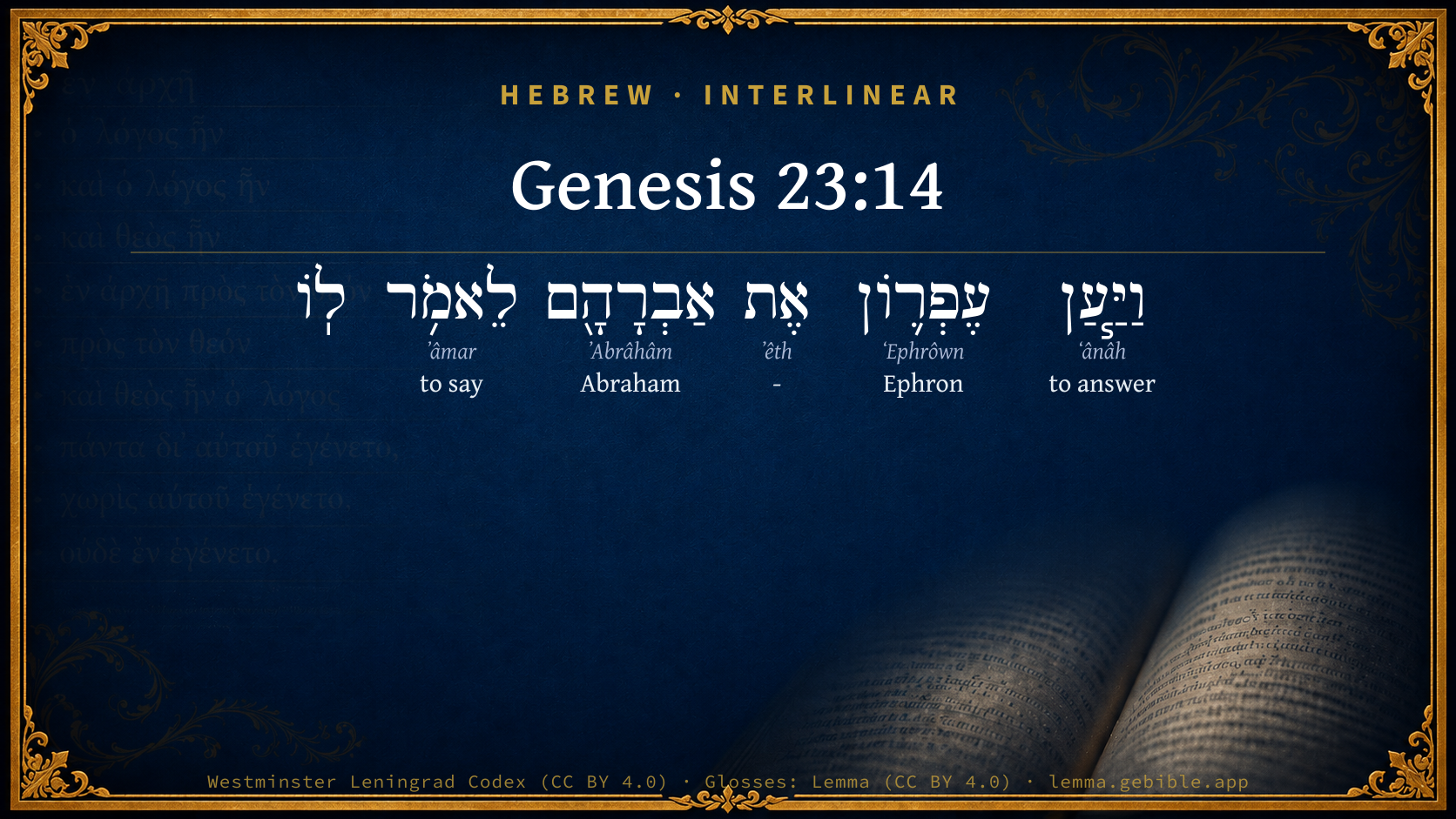
Genesis 23:14

Hebrew (Westminster Leningrad Codex) Genesis 23:14 appears in the Hebrew Old Testament. The text above is from the Westminster Leningrad Codex. Each word links to its Strong’s number, a concise gloss, and parsing drawn from the Open Scriptures Hebrew Bible morphology. Click any word for its full Brown-Driver-Briggs (BDB) entry.
Download image
Cite this verse

Genesis 23:14 (World English Bible). Public Domain. Lemma interlinear Bible study tool, https://lemma.gebible.app/v/genesis/23/14.

Show BibTeX & RIS
BibTeX
RIS
English Translation
Ephron answered Abraham, saying to him,
World English Bible · Public Domain
Download a study sheet

One document with this verse’s original text, its word-by-word gloss line, the meaning frame, cross-references with their text, attributed commentary, and full source and license credits — printable, and it pastes into notes with its structure intact.

This verse Autodidact and up

Study sheet (.html) Plain text (.txt)

A passage Seminary Student

Up to 50 verses in one chapter. A passage sheet keeps up to 6 commentary sources and 12 cross-references per verse, in the order this page ranks them, and says so on the sheet whenever that leaves anything out. Ask for a single verse and you get the Autodidact verse sheet above.

Everything on this page stays free to read, with no account — the sheet is a download of what is already on screen, not access to it.

Want to remove ads? Support Godless Engineer
Compare translations 3

The same verse in 3 English versions, stacked beneath the original-language interlinear above. Click any original word for its lexicon entry.

Each is an independent rendering of the whole verse — the interlinear is not word-aligned to these translations.

Highlighted words mark where these versions differ — a whole-verse word diff, not a word-by-word alignment.

  • World English Bible Public Domain
    Ephron answered Abraham, saying to him,
  • King James Version Public Domain
    And Ephron answered Abraham, saying unto him,
  • unfoldingWord Literal Text CC BY-SA 4.0
    Then Ephron answered Abraham, saying to him,

unfoldingWord Literal Text — © unfoldingWord, licensed CC BY-SA 4.0. Word-aligned USFM3 via Door43 (git.door43.org/unfoldingWord/en_ult).

Versions to compare (up to 4)

3 of 4 selected

Show all 18 translations

Every available English version of this verse, each an independent rendering of the whole verse.

  • World English Bible Public Domain
    Ephron answered Abraham, saying to him,
  • Berean Standard Bible Public Domain
    Ephron answered Abraham,
  • Majority Standard Bible Public Domain
    Ephron answered Abraham,
  • King James Version Public Domain
    And Ephron answered Abraham, saying unto him,
  • American Standard Version (1901) Public Domain
    And Ephron answered Abraham, saying unto him,
  • Revised Version (1885) Public Domain
    And Ephron answered Abraham, saying unto him,
  • Geneva Bible (1599) Public Domain
    Ephron then answered Abraham, saying vnto him,
  • Douay-Rheims (1899) Public Domain
    And Ephron answered:
  • Young's Literal Translation Public Domain
    And Ephron answereth Abraham, saying to him,
  • Literal Standard Version CC BY-SA 4.0
    And Ephron answers Abraham, saying to him,
  • Unlocked Literal Bible CC BY-SA 4.0
    Ephron answered Abraham, saying,
  • unfoldingWord Literal Text CC BY-SA 4.0
    Then Ephron answered Abraham, saying to him,
  • Darby Bible Public Domain
    And Ephron answered Abraham, saying to him,
  • World Messianic Bible Public Domain
    Ephron answered Abraham, saying to him,
  • Webster's Bible Public Domain
    And Ephron answered Abraham, saying to him,
  • Free Bible Version CC BY-SA 4.0
    Ephron replied to Abraham, telling him,
  • Bible in Basic English Public Domain
    So Ephron said to Abraham,
  • JPS Tanakh (1917) Public Domain
    And Ephron answered Abraham, saying unto him:

Literal Standard Version (2020), Covenant Press — licensed CC BY-SA 4.0. Text via the HelloAO Bible API (eBible.org). Unlocked Literal Bible (unfoldingWord) — licensed CC BY-SA 4.0. Text via the HelloAO Bible API (eBible.org). unfoldingWord Literal Text — © unfoldingWord, licensed CC BY-SA 4.0. Word-aligned USFM3 via Door43 (git.door43.org/unfoldingWord/en_ult). Free Bible Version, Dr. Jonathan Gallagher — licensed CC BY-SA 4.0. Text via the HelloAO Bible API (eBible.org).

Word by word

More ways to search: Search by grammar → Find every occurrence → Compare this word →

Practice this passage: Drill this verse → Learn its vocabulary →

עֶפְר֛וֹן
ʻEphrôwn
H6085
“Ephron”
Noun, Proper
Part of Speech
Noun
Type
Proper
Full BDB Definition

Origin: from the same as H6081

TWOT: None

Ephron = "fawn-like" - a Hittite, son of Zohar and the one from whom Abraham bought the field and cave of Machpelah (noun proper masculine) - a city on the borders of Benjamin (noun proper locative) - a mountain on the northern border of Judah (noun proper locative)
  1. וַיַּ֧עַן ʻânâh H6030 “and · to answer” Conjunction + Verb, Qal, Sequential Imperfect, 3rd Person, Masculine, Singular
  2. אֶת ʼêth H853 “-” Particle, Direct Object
  3. אַבְרָהָ֖ם ʼAbrâhâm H85 “Abraham” Noun, Proper
  4. לֵאמֹ֥ר ʼâmar H559 “to say” Preposition + Verb, Qal, Infinitive Construct

About this verse

These counts appear in no published source. They are computed here, from the morphology-tagged text and Lemma’s own curated glosses. What Lemma adds →

6
words
5
distinct lemmas
Pentateuch
section

Notable vocabulary

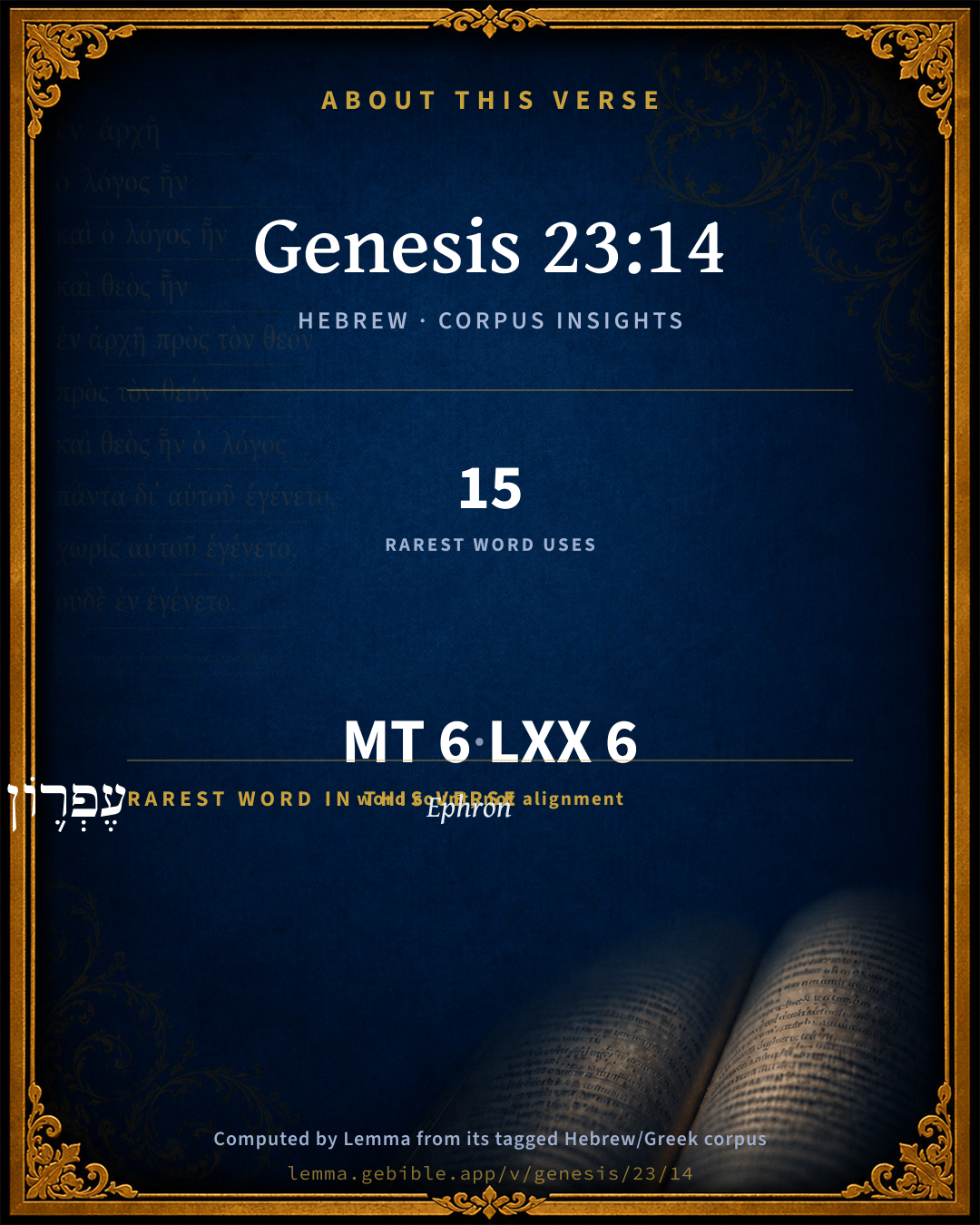
The rarest word here is עֶפְר֛וֹן Ephron H6085 — appearing just 15 times in the whole Hebrew Bible.

Shared distinctive vocabulary

עֶפְר֛וֹן Ephron H6085 occurs in 12 verses of the Hebrew Bible. Also found in:

Grammatical profile

  • 2 verbs
  • 2 nouns
  • 1 preposition
  • 1 particle

Verb forms

  • וַיַּ֧עַן Qal · Sequential Imperfect
  • לֵאמֹ֥ר Qal · Infinitive Construct

Hebrew & Septuagint length

In English translation the verse runs 6 words from the Hebrew and 5 from the Septuagint (LXX English) — closely comparable.

A rough comparison of the two English renderings, which tokenize alike — not a word-level alignment.

Word counts can differ between the Hebrew and the Greek without any difference in meaning — e.g. the Hebrew direct-object marker אֵת has no separate Greek word, and Greek often adds the article ὁ.

In the original languages it is 6 Hebrew tokens and 6 Greek tokens — but the two are counted differently (Hebrew bundles its prefixes and suffixes into one token; the Greek is in lemma form), so that isn’t a like-for-like length.

Hebrew and Greek witnesses Masoretic Hebrew ↔ Greek Septuagint

The same verse in the two great witnesses to the Old Testament, shown verse-for-verse.

These are two independent witnesses, not word-aligned to each other, and the Septuagint is shown in lemma (dictionary) form.

Hebrew Genesis 23:14 Masoretic · Westminster Leningrad Codex

וַיַּ֧עַן עֶפְר֛וֹן אֶת אַבְרָהָ֖ם לֵאמֹ֥ר לֽוֹ

Ephron answered Abraham, saying to him,

World English Bible · Public Domain

Greek LXX Genesis 23:14 Septuagint · lemma form

ἀποκρίνω δέ εφρων ὁ αβρααμ λέγω

But Ephron answered Abraam, saying,

LXX2012 (modern English Septuagint) · Public Domain

Hebrew: Westminster Leningrad Codex (CC BY 4.0). Greek: Septuagint (public domain); English from LXX2012 (modern English Septuagint) (Public Domain). How the Septuagint differs from the Hebrew →

Targum (Aramaic paraphrase)

2

The Targum is the ancient Jewish Aramaic paraphrase of the Hebrew Scriptures — an interpretive translation, not the Hebrew text itself. Onkelos (literal) and Pseudo-Jonathan (expansive) render the Torah, and Jonathan the Prophets. Coverage is partial: where no permissively-licensed English translation exists for a verse, only the Aramaic is shown. This is verse-level text, not a word-by-word alignment to the Hebrew.

  1. Targum Onkelos Torah (Genesis–Deuteronomy)
    וְאָתֵיב עֶפְרוֹן יָת אַבְרָהָם לְמֵימָר לֵהּ

    (no public-domain English translation for this verse)

    Targum Onkelos — Aramaic: “Onkelos Genesis” (public domain); “Onkelos Exodus” (public domain); “Onkelos Leviticus” (public domain); “Onkelos Numbers” (public domain); “Onkelos Deuteronomy” (public domain). English: “Sefaria Community Translation” (CC0 1.0 (public-domain dedication)); “J.W. Etheridge. The Targums of Onkelos and Jonathan Ben Uzziel on the Pentateuch. London: Longmans, Green, 1862” (public domain). Text via Sefaria.

  2. Targum Pseudo-Jonathan Torah (Genesis–Deuteronomy)
    וְאָתִיב עֶפְרוֹן יַת אַבְרָהָם לְמֵימַר לֵיהּ

    Ephron answered Abraham, saying to him,

    Targum Pseudo-Jonathan — Aramaic: “Targum Jonathan on Genesis” (public domain); “Targum Jonathan on Exodus” (public domain); “Targum Jonathan on Leviticus” (public domain); “Targum Jonathan on Numbers” (public domain); “Targum Jonathan on Deuteronomy” (public domain). English: “The Targum of Jonathan ben Uzziel, trans. J. W. Etheridge, London, 1862” (public domain). Text via Sefaria.

Commentary

Notes on Genesis 23:14 from classic Christian and Jewish commentators (each source and its license shown beneath its notes). The classic Christian expositions comment on the surrounding passage and are grouped to its opening verse, so a note may address several verses; the Jewish commentaries on the Tanakh (Rashi and others) are per-verse, so they appear only where the commentator wrote on this verse.

Lemma curates 59 commentaries, every one of them public domain or Creative Commons licensed, each selected and text-cleaned for this edition rather than reprinted as found. About our sources →

Trapp's Complete Commentary

John Trapp

Gen 23:14 And Ephron answered Abraham, saying unto him,

Gen 23:15 My lord, hearken unto me: the land [is worth] four hundred shekels of silver; what [is] that betwixt me and thee? bury therefore thy dead.

Ver. 14, 15. What is that between me and thee?] Who both are great friends, and well underlaid. See a like kind contestation between David and Araunah, 2Sa 24:22-23.

John Trapp, A Commentary or Exposition upon All the Books of the Old and New Testament (1647–1656) — public domain. Text from a community e-Sword module.

John Gill's Exposition

And Abraham hearkened unto Ephron,.... He agreed at once to give him the sum proposed, judging it to be a moderate price between man and man, and he was satisfied with it, and well content to pay him the money:

and Abraham weighed to Ephron the silver: for in those times money had no mark or stamp upon it to show its value, and therefore was not told by pieces, but weighed, by which its full worth was known; and that Ephron might have his whole and just demand, the silver was weighed to him:

which he had named, in the audience of the sons of Heth; who were witnesses of the bargain, of the price set by Ephron, and of the payment of it by Abraham:

four hundred shekels of silver: the sum before mentioned, Gen 23:15,

current money with the merchant; such as was used by merchants in buying and selling; such as they would receive, who knew the value of it, and were careful not to take any that was bad; wherefore such as would pass, with them would go anywhere, was current money; how all this is consistent with what Stephen says; See Gill on Act 7:16.

John Gill's Exposition of the Whole Bible (1746–1763) — public domain (CC PDM 1.0). Text via the HelloAO Bible API.

The Pulpit Commentary

Vers. 14, 15. And Ephron answered Abraham, saying unto him, My lord, hearken unto me: the land is worth four hundred shekels of silver. The word "shekel," from shakal, to weigh, here used for the first time, was not a stamped coin, but a piece of metal of definite weight, according to Exo_30:13, equal to twenty gerahs, or beans, from garar, to roll. Coined money was unknown to the Hebrews until after the captivity. In the time of the Maccabees (RAPC 1Ma 15:6) silver coins were struck bearing the inscription lar lq According to Josephus (Ant., iii. 8, 2) the shekel in use in his day was equal to four Athenian drachmae; and if, as is believed, these were one-fifth larger than the old shekels coined by Simon Maccabeus, the weight of the latter would be equal to three and one-third drachms, or two hundred grains, reckoning sixty grains to a drachm. It is impossible to ascertain the weight of the shekel current with the merchant in the time of Abraham; but reckoning it at a little less than 2s. 6d. sterling, the price of Ephron"s field must have been somewhat under a very consider able sum of money, which the Hittite merchant begins to depreciate by representing as a trifle, saying, What is that betwixt me and thee? words which are still heard in the East on similar occasions (vide " Land and Book," p. 578)bury therefore thy dead.

The Pulpit Commentary (1880–1919), ed. H.D.M. Spence-Jones & Joseph S. Exell — public domain. Text from a community e-Sword module.

unfoldingWord translationNotes

Door43 World Missions Community

Ephron

This is the name of a man. See how you translated this in Genesis 23:8. (See: How to Translate Names)

Please, my master, listen to me

"Hear me, my master" or "Listen to me, kind sir"

my master

This phrase is used to show respect to Abraham.

A piece of land worth four hundred shekels of silver, what is that between me and you?

Ephron meant that since he and Abraham were both so wealthy, 400 pieces of silver was a small amount. This rhetorical question can be translated as a statement. AT: "The piece of land is worth only four hundred shekels of silver. For you and me, that is nothing." (See: Rhetorical Question)

four hundred shekels of silver

This is about 4.5 kilograms of silver. (See: Biblical Weight)

four hundred

"400" (See: Numbers)

Bury your dead

The nominal adjective "dead" can be stated as a verb or simply as "wife." AT: "Go bury your wife who has died" or "Go bury your wife" (See: Nominal Adjectives)

Abraham weighed out to Ephron the amount of silver

"Abraham weighed the silver and gave Ephron the amount" or "Abraham counted out to Ephron the amount of silver"

the amount of silver that he had spoken

"the amount of silver that Ephron had said"

in the hearing of the sons of Heth

The abstract noun "the hearing" can be stated as "hear" or "listening." AT: "so that all the sons of Heth could hear him" or "while all the sons of Heth were listening" (See: Abstract Nouns)

the sons of Heth

Here "sons" stands for those who descended from Heth. See how you translated this in Genesis 23:3. AT: "the descendants of Heth" (See: How to Translate Names)

according to the standard measurement of the merchants

"using the standard measurement of weight that merchants used." This can be stated as a new sentence. AT: "He weighed the silver the same way that the merchants used to weigh it"

translationWords

Abraham

unfoldingWord translationNotes — © Distant Shores Media and the Door43 World Missions Community, licensed CC BY-SA 4.0. Source: git.door43.org/Door43/en_tn.

Lesson kit

Teaching starters — assembled from the data on this page, not authored interpretation. Every prompt links to the verse data it draws on. Edit before teaching.

Genesis, in the Pentateuch, opens this verse with 6 words (5 distinct Hebrew lemmas). Its most distinctive word is ʻEphrôwn (“Ephron”). A historical commentator’s framing appears above. Read the whole chapter for the surrounding context.

Discussion questions

  1. What does “Ephron” (ʻEphrôwn) contribute to the verse as a whole?
  2. Genesis 23:8 shares the word «Ephron» with this verse. How do the two illuminate each other?
  3. The verb «וַיַּ֧עַן» is Qal Sequential Imperfect. How does its form color the action?
  4. Reading how Trapp's Complete Commentary and John Gill's Exposition read this verse, where do the two commentators agree and where do they part?

Things to notice

Reading settings

Reading text

Shown beneath each verse's original-language words.

Old Testament
Old Testament edition

Read the OT as the Masoretic Hebrew (MT) or the Greek Septuagint (LXX).

English shown for the Greek Septuagint (in the Hebrew ↔ Greek comparison).

Comparing translations? Open the Compare panel on any verse page to stack up to four side by side.