

Colossians 4:6
Greek (Tischendorf 8th ed.) Colossians 4:6 appears in the Greek New Testament. The text above is from the Tischendorf 8th edition. Each word links to its Strong’s number and a concise gloss. Click any word for its full Thayer’s Greek Lexicon entry.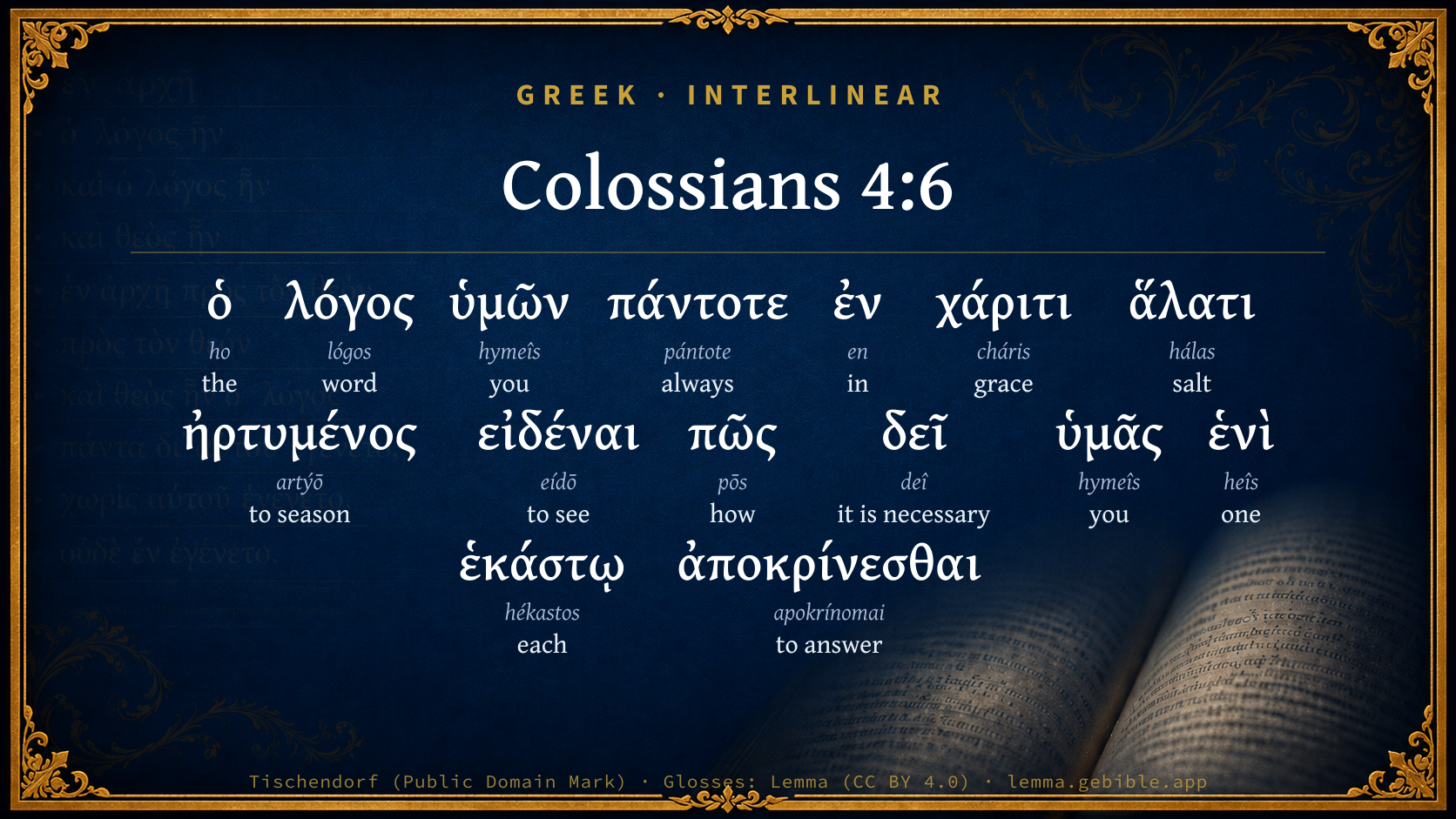
Let your speech always be with grace, seasoned with salt, that you may know how you ought to answer each one.
Download a study sheet
One document with this verse’s original text, its word-by-word gloss line, the meaning frame, cross-references with their text, attributed commentary, and full source and license credits — printable, and it pastes into notes with its structure intact.
This verse Autodidact and up
A passage Seminary Student
Up to 50 verses in one chapter. A passage sheet keeps up to 6 commentary sources and 12 cross-references per verse, in the order this page ranks them, and says so on the sheet whenever that leaves anything out. Ask for a single verse and you get the Autodidact verse sheet above.
Everything on this page stays free to read, with no account — the sheet is a download of what is already on screen, not access to it.
Compare translations 3
The same verse in 3 English versions, stacked beneath the original-language interlinear above. Click any original word for its lexicon entry.
Each is an independent rendering of the whole verse — the interlinear is not word-aligned to these translations.
Highlighted words mark where these versions differ — a whole-verse word diff, not a word-by-word alignment.
-
World English Bible Public Domain
Let your speech always be with grace, seasoned with salt, that you may know how you ought to answer each one.
-
King James Version Public Domain
Let your speech be alway with grace, seasoned with salt, that ye may know how ye ought to answer every man.
-
unfoldingWord Literal Text CC BY-SA 4.0
your words always with grace, seasoned with salt, to know how it is necessary for you to answer each one.
unfoldingWord Literal Text — © unfoldingWord, licensed CC BY-SA 4.0. Word-aligned USFM3 via Door43 (git.door43.org/unfoldingWord/en_ult).
Show all 19 translations
Every available English version of this verse, each an independent rendering of the whole verse.
-
World English Bible Public Domain
Let your speech always be with grace, seasoned with salt, that you may know how you ought to answer each one.
-
Berean Standard Bible Public Domain
Let your speech always be gracious, seasoned with salt, so that you may know how to answer everyone.
-
Majority Standard Bible Public Domain
Let your speech always be gracious, seasoned with salt, so that you may know how to answer everyone.
-
King James Version Public Domain
Let your speech be alway with grace, seasoned with salt, that ye may know how ye ought to answer every man.
-
American Standard Version (1901) Public Domain
Let your speech be always with grace, seasoned with salt, that ye may know how ye ought to answer each one.
-
Revised Version (1885) Public Domain
Let your speech be always with grace, seasoned with salt, that ye may know how ye ought to answer each one.
-
Geneva Bible (1599) Public Domain
Let your speach be gracious alwayes, and powdred with salt, that ye may know how to answere euery man.
-
Douay-Rheims (1899) Public Domain
Let your speech be always in grace seasoned with salt: that you may know how you ought to answer every man.
-
Young's Literal Translation Public Domain
your word always in grace -- with salt being seasoned -- to know how it behoveth you to answer each one.
-
Literal Standard Version CC BY-SA 4.0
your word always being seasoned with salt in grace—to know how it is necessary for you to answer each one.
-
Unlocked Literal Bible CC BY-SA 4.0
Let your words always be with grace. Let them be seasoned with salt, so that you may know how you should answer each person.
-
unfoldingWord Literal Text CC BY-SA 4.0
your words always with grace, seasoned with salt, to know how it is necessary for you to answer each one.
-
Darby Bible Public Domain
[Let] your word [be] always with grace, seasoned with salt, [so as] to know how ye ought to answer each one.
-
World Messianic Bible Public Domain
Let your speech always be with grace, seasoned with salt, that you may know how you ought to answer each one.
-
Webster's Bible Public Domain
Let your speech be always with grace, seasoned with salt, that ye may know how ye ought to answer every man.
-
Free Bible Version CC BY-SA 4.0
Always be gracious when you speak. Make sure it's in good taste, and think about how best to answer everyone.
-
Bible in Basic English Public Domain
Let your talk be with grace, mixed with salt, so that you may be able to give an answer to everyone.
-
Text-Critical English NT CC BY 4.0
Let your speech always be with grace, seasoned with salt, so that you may know how to answer each person.
-
Tyndale New Testament (1534) Public Domain
Let youre speache be all wayes well favoured and be powdred with salt that ye maye know how to answer every man.
Literal Standard Version (2020), Covenant Press — licensed CC BY-SA 4.0. Text via the HelloAO Bible API (eBible.org). Unlocked Literal Bible (unfoldingWord) — licensed CC BY-SA 4.0. Text via the HelloAO Bible API (eBible.org). unfoldingWord Literal Text — © unfoldingWord, licensed CC BY-SA 4.0. Word-aligned USFM3 via Door43 (git.door43.org/unfoldingWord/en_ult). Free Bible Version, Dr. Jonathan Gallagher — licensed CC BY-SA 4.0. Text via the HelloAO Bible API (eBible.org).
Word by word
More ways to search: Search by grammar → Find every occurrence → Compare this word →
Practice this passage: Drill this verse → Learn its vocabulary →
- Appears 3× in the Greek New Testament
- First appears at Mark 9:50
- Part of Speech
- Verb
- Tense
- Perfect
- Voice
- Passive
- Mood
- Participle
- Case
- Nominative
- Number
- Singular
- Gender
- Masculine
Full Thayer's Definition
- ὁ ho G3588 “the” Article, Nominative, Singular, Masculine
- λόγος lógos G3056 “word” Noun, Nominative, Singular, Masculine
- ὑμῶν hymeîs G5210 “you” Personal pronoun, 2nd person, Genitive, Plural
- πάντοτε pántote G3842 “always” Adverb
- ἐν en G1722 “in” Preposition
- χάριτι cháris G5485 “grace” Noun, Dative, Singular, Feminine
- ἅλατι hálas G217 “salt” Noun, Dative, Singular, Neuter
- ἠρτυμένος artýō G741 “to season” Verb, Perfect, Passive, Participle, Nominative, Singular, Masculine
- εἰδέναι eídō G1492 “to see” Verb, Perfect, Active, Infinitive
- πῶς pōs G4459 “how” Adverb
- δεῖ deî G1163 “it is necessary” Verb, Present, Active, Indicative, 3rd person, Singular
- ὑμᾶς hymeîs G5210 “you” Personal pronoun, 2nd person, Accusative, Plural
- ἑνὶ heîs G1520 “one” Adjective, Dative, Singular, Masculine
- ἑκάστῳ hékastos G1538 “each” Adjective, Dative, Singular, Masculine
- ἀποκρίνεσθαι apokrínomai G611 “to answer” Verb, Present, Middle or Passive deponent, Infinitive
About this verse
These counts appear in no published source. They are computed here, from the morphology-tagged text and Lemma’s own curated glosses. What Lemma adds →
- 15
- words
- 14
- distinct lemmas
- Pauline Epistles
- section
Notable vocabulary
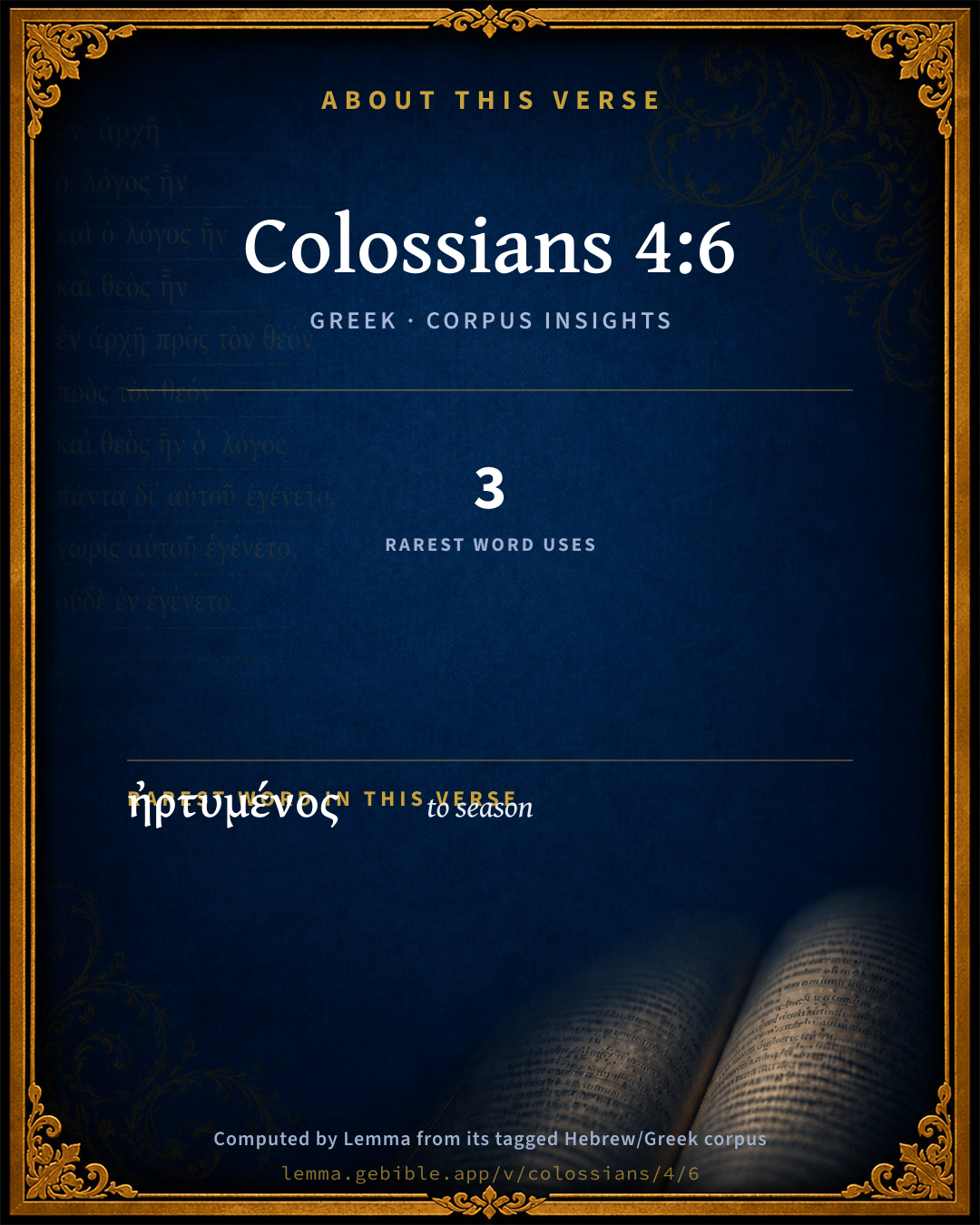
The rarest word here is ἠρτυμένος to season G741 — appearing just 3 times in the whole Greek New Testament.
Shared distinctive vocabulary
ἠρτυμένος to season G741 occurs in 3 verses of the Greek New Testament. Also found in:
Repetition
A word recurs within this verse:
- ὑμῶν you G5210 ×2
Cross-references
32Topical passages linked to Colossians 4:6 in the Treasury of Scripture Knowledge — connected by theme and wording, ordered by reader-vote popularity; previews shown in the World English Bible.
- Ephesians 4:29 Let no corrupt speech proceed out of your mouth, but such as is good for building up as the need may be, that it may give grace to those who hear.
- 1 Peter 3:15 But sanctify the Lord God in your hearts; and always be ready to give an answer to everyone who asks you a reason concerning the hope that is in you, with humility and fear:
- Ecclesiastes 10:12 The words of a wise man's mouth are gracious; but a fool is swallowed by his own lips.
- Mark 9:50 Salt is good, but if the salt has lost its saltiness, with what will you season it? Have salt in yourselves, and be at peace with one another."
- Proverbs 15:4 A gentle tongue is a tree of life, But deceit in it crushes the spirit.
- Proverbs 15:7 The lips of the wise spread knowledge; Not so with the heart of fools.
- Colossians 3:16 Let the word of Christ dwell in you richly; in all wisdom teaching and admonishing one another with psalms, hymns, and spiritual songs, singing with grace in your heart to the Lord.
- Proverbs 22:17–18 Turn your ear, and listen to the words of the wise. Apply your heart to my teaching.
- Proverbs 16:21–24 The wise in heart shall be called prudent. Pleasantness of the lips promotes instruction.
- Matthew 5:13 "You are the salt of the earth, but if the salt has lost its flavor, with what will it be salted? It is then good for nothing, but to be cast out and trodden under the feet of men.
- Proverbs 26:4–5 Don't answer a fool according to his folly, Lest you also be like him.
- Matthew 12:34–35 You offspring of vipers, how can you, being evil, speak good things? For out of the abundance of the heart, the mouth speaks.
- Psalms 105:2 Sing to him, sing praises to him! Tell of all his marvelous works.
- Psalms 119:46 I will also speak of your statutes before kings, And will not be disappointed.
- Proverbs 10:21 The lips of the righteous feed many, But the foolish die for lack of understanding.
- Proverbs 25:11–12 A word fitly spoken Is like apples of gold in settings of silver.
- Psalms 40:9–10 I have proclaimed glad news of righteousness in the great assembly. Behold, I will not seal my lips, Yahweh, you know.
- Psalms 78:3–4 Which we have heard and known, And our fathers have told us.
- Leviticus 2:13 Every offering of your meal offering you shall season with salt; neither shall you allow the salt of the covenant of your God to be lacking from your meal offering. With all your offerings you shall offer salt.
- 2 Kings 2:20–22 He said, Bring me a new jar, and put salt therein. They brought it to him.
- Psalms 37:30–31 The mouth of the righteous talks of wisdom. His tongue speaks justice.
- Psalms 45:2 You are the most excellent of the sons of men. Grace has anointed your lips, Therefore God has blessed you forever.
- Psalms 66:16 Come, and hear, all you who fear God. I will declare what he has done for my soul.
- Psalms 71:15–18 My mouth will tell about your righteousness, And of your salvation all day, Though I don't know its full measure.
- Psalms 71:23–24 My lips shall shout for joy! My soul, which you have redeemed, sings praises to you!
- Deuteronomy 6:6–7 These words, which I command you this day, shall be on your heart;
- Deuteronomy 11:19 You shall teach them your children, talking of them, when you sit in your house, and when you walk by the way, and when you lie down, and when you rise up.
- 1 Chronicles 16:24 Declare his glory among the nations, His marvelous works among all the peoples.
- Psalms 119:13 With my lips, I have declared all the ordinances of your mouth.
- Malachi 3:16–18 Then those who feared Yahweh spoke one with another; and Yahweh listened, and heard, and a book of memory was written before him, for those who feared Yahweh, and who honored his name.
- Luke 4:22 All testified about him, and wondered at the gracious words which proceeded out of his mouth, and they said, "Isn't this Joseph's son?"
- Luke 20:20–40 They watched him, and sent out spies, who pretended to be righteous, that they might trap him in something he said, so as to deliver him up to the power and authority of the governor.
Cross-references courtesy of OpenBible.info (CC BY 4.0).
Lesson kit
Teaching starters — assembled from the data on this page, not authored interpretation. Every prompt links to the verse data it draws on. Edit before teaching.
Colossians, in the Pauline Epistles, opens this verse with 15 words (14 distinct Greek lemmas). Its most distinctive word is artýō (“to season”). A historical commentator’s framing appears above. Read the whole chapter for the surrounding context.
Discussion questions
- The word artýō carries the sense “to season.” How does it shape the verse?
- Mark 9:50 shares the word «to season» with this verse. How do the two illuminate each other?
- “you” occurs 2× in this one verse. What is the effect of the repetition?
- The translations on this page render this verse differently — a whole-verse word diff, not a word-by-word alignment. What might account for the different wordings?
- Reading how The Biblical Illustrator and Tyndale Open Study Notes read this verse, where do the two commentators agree and where do they part?
Things to notice
- These translations choose different wording for 13 words in this verse.
- “you” occurs 2× in this single verse.
- 14 distinct Greek lemmas span 15 words in this verse.
Commentary
Notes on Colossians 4:6 from classic Christian and Jewish commentators (each source and its license shown beneath its notes). The classic Christian expositions comment on the surrounding passage and are grouped to its opening verse, so a note may address several verses; the Jewish commentaries on the Tanakh (Rashi and others) are per-verse, so they appear only where the commentator wrote on this verse.
Lemma curates 59 commentaries, every one of them public domain or Creative Commons licensed, each selected and text-cleaned for this edition rather than reprinted as found. About our sources →
The Biblical Illustrator
Joseph S. Exell
The Biblical Illustrator, edited by Joseph S. Exell (c. 1880s–1900s) — public domain. Text from a community e-Sword module.
Tyndale Open Study Notes
Tyndale Open Resources
Tyndale Open Study Notes — © Tyndale Open Resources, licensed CC BY-SA 4.0. Text via the HelloAO Bible API.
Bengel's Gnomon
Johann Albrecht Bengel
Bengel's Gnomon of the New Testament — English translation (T&T Clark, Edinburgh, 1860) — public domain. Text from a community e-Sword module.
Expositor's Greek Testament
ed. W. Robertson Nicoll
The Expositor's Greek Testament, edited by W. Robertson Nicoll (1897–1910) — public domain. Text from a community e-Sword module.
Geneva Bible (1599)
Geneva Bible translators
Geneva Bible (1599) marginal notes — public domain. Text via Bolls.life.
Jamieson, Fausset & Brown
Robert Jamieson, A. R. Fausset & David Brown
Jamieson, Fausset & Brown — Commentary Critical and Explanatory on the Whole Bible (1871) — public domain (CC PDM 1.0). Text via the HelloAO Bible API.
Adam Clarke's Commentary
Adam Clarke's Commentary on the Bible (1810–1826) — public domain. Text from a community e-Sword/MySword module.
John Calvin's Commentaries
John Calvin's Commentaries (1540-1563) — public domain. Text from the Calvin Translation Society English edition (1840s-50s) via the Christian Classics Ethereal Library (ccel.org). Calvin's coverage is partial (roughly two-thirds of the Bible); uncommented books and verses are honest gaps, never fabricated. The 19th-century editor's footnotes and remarks are omitted so the notes are faithfully Calvin's own voice.
Ellicott's Commentary for English Readers
A Bible Commentary for English Readers, edited by Charles John Ellicott (1878–1897) — public domain. Text from a community e-Sword module.
The Cambridge Bible for Schools and Colleges
gen. ed. J. J. S. Perowne
The Cambridge Bible for Schools and Colleges (gen. ed. J. J. S. Perowne; Cambridge University Press, 1878–1918) — public domain. Text from a community e-Sword module.
John Gill's Exposition
John Gill's Exposition of the Whole Bible (1746–1763) — public domain (CC PDM 1.0). Text via the HelloAO Bible API.
Trapp's Complete Commentary
John Trapp
John Trapp, A Commentary or Exposition upon All the Books of the Old and New Testament (1647–1656) — public domain. Text from a community e-Sword module.
Albert Barnes' Notes on the Bible
Albert Barnes' Notes on the Bible (1834–1885) — public domain. Text from a community e-Sword/MySword module.
Matthew Poole's English Annotations
Matthew Poole's English Annotations on the Holy Bible (1683–1685) — public domain. Text from a community e-Sword/MySword module.
Whedon's Commentary on the Bible
Daniel D. Whedon
Daniel D. Whedon (gen. ed.), Commentary on the Old and New Testaments (1874–1909) — public domain. Text from a community e-Sword module.
The Pulpit Commentary
The Pulpit Commentary (1880–1919), ed. H.D.M. Spence-Jones & Joseph S. Exell — public domain. Text from a community e-Sword module.
John Wesley's Explanatory Notes
John Wesley, Explanatory Notes Upon the Whole Bible (1754–1765) — public domain. Text via the GEBible commentary corpus.
Scofield Reference Notes
C. I. Scofield
The Scofield Reference Bible (1917 edition), notes by C. I. Scofield — public domain. Text from a community e-Sword module.
Burkitt's Expository Notes on the New Testament
William Burkitt
William Burkitt's Expository Notes on the New Testament (1700–1703) — public domain. Text from a community e-Sword module.
The People's New Testament
B. W. Johnson
B. W. Johnson's The People's New Testament with Notes (1889–1891) — public domain. Electronic text from the Christian Classics Ethereal Library (CCEL) ThML edition.
Cambridge Greek Testament for Schools and Colleges
Cambridge Greek Testament for Schools and Colleges (Cambridge University Press, 1896; 21 vols, various authors incl. Carr, Maclear, Plummer, Farrar, Lumby, Moule, M. R. James, Simcox) — public domain. Text from a community e-Sword module.
Alford’s Greek Testament
Henry Alford
Henry Alford, The Greek Testament (1849–1861) — public domain. Text from a community e-Sword module.
Vincent's Word Studies in the New Testament
Marvin R. Vincent
Marvin R. Vincent, Word Studies in the New Testament (1887–1900) — public domain. Text from a community e-Sword/MySword module.
Lightfoot's Colossians and Philemon
J. B. Lightfoot
J. B. Lightfoot, St Paul's Epistles to the Colossians and Philemon: a revised text with introductions, notes and dissertations (London: Macmillan, 1875) — public domain. Electronic text from Project Gutenberg (ebook #50857). Covers Colossians and Philemon only (the verse-by-verse notes; introductions and dissertations are omitted); Lightfoot's companion Galatians and Philippians volumes are not included, as the available public-domain scans carry garbled Greek that cannot be faithfully reproduced.