John 7:52

Greek (Tischendorf 8th ed.) John 7:52 appears in the Greek New Testament. The text above is from the Tischendorf 8th edition. Each word links to its Strong’s number and a concise gloss. Click any word for its full Thayer’s Greek Lexicon entry.
Download image
Cite this verse

John 7:52 (World English Bible). Public Domain. Lemma interlinear Bible study tool, https://lemma.gebible.app/v/john/7/52.

Show BibTeX & RIS
BibTeX
RIS
English Translation
They answered him, "Are you also from Galilee? Search, and see that no prophet has arisen out of Galilee."
World English Bible · Public Domain
Download a study sheet

One document with this verse’s original text, its word-by-word gloss line, the meaning frame, cross-references with their text, attributed commentary, and full source and license credits — printable, and it pastes into notes with its structure intact.

This verse Autodidact and up

Study sheet (.html) Plain text (.txt)

A passage Seminary Student

Up to 50 verses in one chapter. A passage sheet keeps up to 6 commentary sources and 12 cross-references per verse, in the order this page ranks them, and says so on the sheet whenever that leaves anything out. Ask for a single verse and you get the Autodidact verse sheet above.

Everything on this page stays free to read, with no account — the sheet is a download of what is already on screen, not access to it.

Want to remove ads? Support Godless Engineer
Compare translations 3

The same verse in 3 English versions, stacked beneath the original-language interlinear above. Click any original word for its lexicon entry.

Each is an independent rendering of the whole verse — the interlinear is not word-aligned to these translations.

Highlighted words mark where these versions differ — a whole-verse word diff, not a word-by-word alignment.

  • World English Bible Public Domain
    They answered him, "Are you also from Galilee? Search, and see that no prophet has arisen out of Galilee."
  • King James Version Public Domain
    They answered and said unto him, Art thou also of Galilee? Search, and look: for out of Galilee ariseth no prophet.
  • unfoldingWord Literal Text CC BY-SA 4.0
    They answered and said to him, “You are not also from Galilee, are you? Search, and see that no prophet rises up from Galilee.”

unfoldingWord Literal Text — © unfoldingWord, licensed CC BY-SA 4.0. Word-aligned USFM3 via Door43 (git.door43.org/unfoldingWord/en_ult).

Versions to compare (up to 4)

3 of 4 selected

Show all 19 translations

Every available English version of this verse, each an independent rendering of the whole verse.

  • World English Bible Public Domain
    They answered him, "Are you also from Galilee? Search, and see that no prophet has arisen out of Galilee."
  • Berean Standard Bible Public Domain
    “Aren’t you also from Galilee?” they replied. “Look into it, and you will see that no prophet comes out of Galilee.”
  • Majority Standard Bible Public Domain
    “Aren’t you also from Galilee?” they replied. “Look into it, and you will see that no prophet comes out of Galilee.”
  • King James Version Public Domain
    They answered and said unto him, Art thou also of Galilee? Search, and look: for out of Galilee ariseth no prophet.
  • American Standard Version (1901) Public Domain
    They answered and said unto him, Art thou also of Galilee? Search, and see that out of Galilee ariseth no prophet.
  • Revised Version (1885) Public Domain
    They answered and said unto him, Art thou also of Galilee? Search, and see that out of Galilee ariseth no prophet.
  • Geneva Bible (1599) Public Domain
    They answered, and said vnto him, Art thou also of Galile? Searche and looke: for out of Galile ariseth no Prophet.
  • Douay-Rheims (1899) Public Domain
    They answered, and said to him: Art thou also a Galilean? Search the scriptures, and see, that out of Galilee a prophet riseth not.
  • Young's Literal Translation Public Domain
    They answered and said to him, `Art thou also out of Galilee? search and see, that a prophet out of Galilee hath not risen;'
  • Literal Standard Version CC BY-SA 4.0
    They answered and said to him, “Are you also out of Galilee? Search and see that a prophet has not risen out of Galilee”; [[
  • Unlocked Literal Bible CC BY-SA 4.0
    They answered and said to him, “Are you also from Galilee? Search and see that no prophet comes from Galilee.”
  • unfoldingWord Literal Text CC BY-SA 4.0
    They answered and said to him, “You are not also from Galilee, are you? Search, and see that no prophet rises up from Galilee.”
  • Darby Bible Public Domain
    They answered and said to him, Art thou also of Galilee? Search and look, that no prophet arises out of Galilee.
  • World Messianic Bible Public Domain
    They answered him, “Are you also from Galilee? Search and see that no prophet has arisen out of Galilee.”
  • Webster's Bible Public Domain
    They answered and said to him, Art thou also from Galilee? Search, and look: for out of Galilee ariseth no prophet.
  • Free Bible Version CC BY-SA 4.0
    “So you're a Galilean as well, are you?” they replied. “Check the Scriptures and you'll discover that no prophet comes from Galilee!”
  • Bible in Basic English Public Domain
    This was their answer: And do you come from Galilee? Make search and you will see that no prophet comes out of Galilee.
  • Text-Critical English NT CC BY 4.0
    They answered him, “Are yoʋ also from Galilee? Search and see that no prophet has ever arisen from Galilee.”
  • Tyndale New Testament (1534) Public Domain
    They answered and sayde vnto him: arte thou also of Galile? Searche and loke for out of Galile aryseth no Prophet.

Literal Standard Version (2020), Covenant Press — licensed CC BY-SA 4.0. Text via the HelloAO Bible API (eBible.org). Unlocked Literal Bible (unfoldingWord) — licensed CC BY-SA 4.0. Text via the HelloAO Bible API (eBible.org). unfoldingWord Literal Text — © unfoldingWord, licensed CC BY-SA 4.0. Word-aligned USFM3 via Door43 (git.door43.org/unfoldingWord/en_ult). Free Bible Version, Dr. Jonathan Gallagher — licensed CC BY-SA 4.0. Text via the HelloAO Bible API (eBible.org).

Word by word

More ways to search: Search by grammar → Find every occurrence → Compare this word →

Practice this passage: Drill this verse → Learn its vocabulary →

ἐραύνησον
ereunáō
G2045
“to search”
Verb, Aorist, Active, Imperative, 2nd person, Singular
Part of Speech
Verb
Tense
Aorist
Voice
Active
Mood
Imperative
Person
2nd person
Number
Singular
Full Thayer's Definition

Origin: apparently from G2046 (through the idea of enquiry)

TDNT: 12:55,3

1. to search, examine into
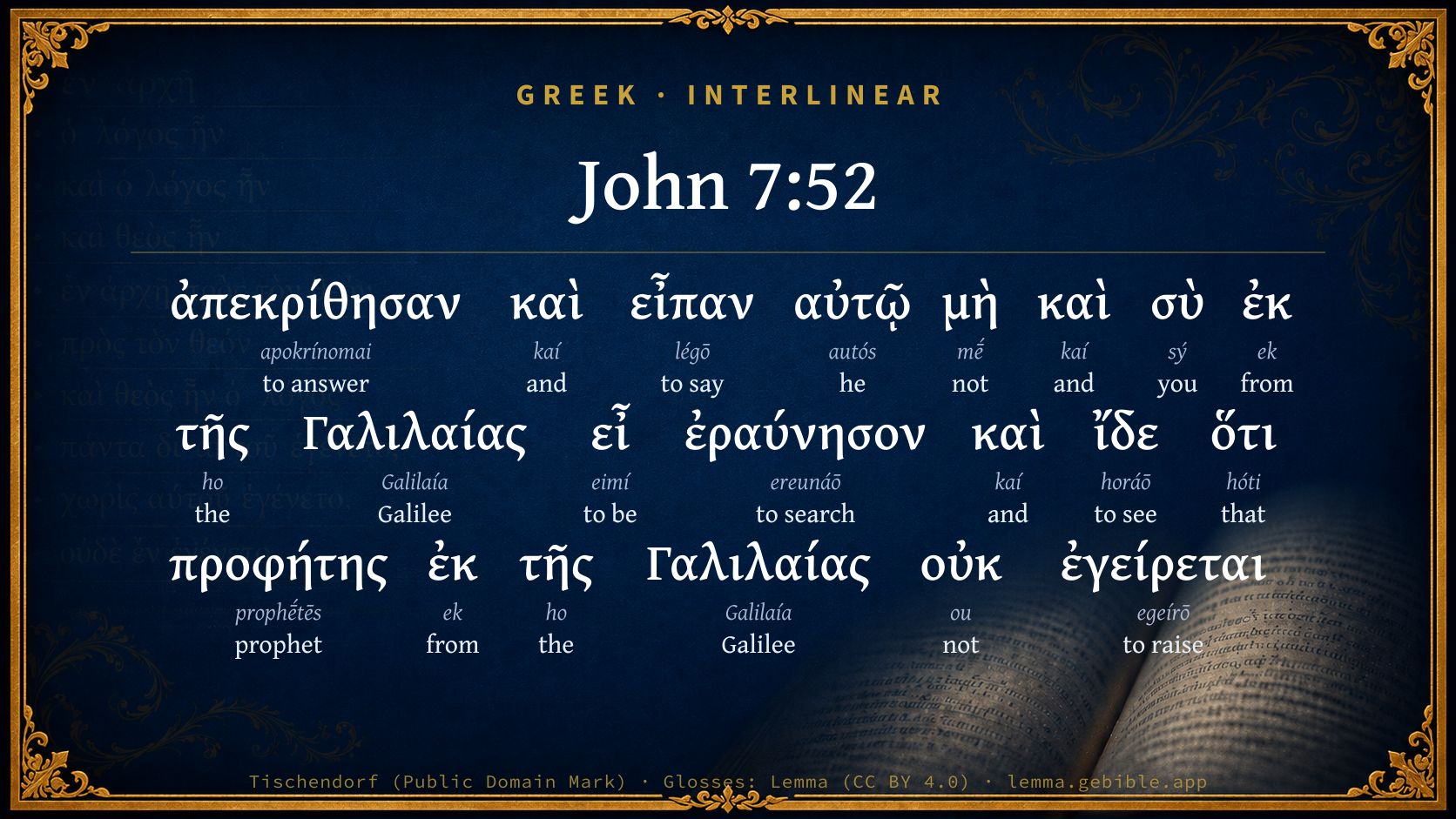
  1. ἀπεκρίθησαν apokrínomai G611 “to answer” Verb, Aorist, Middle deponent, Indicative, 3rd person, Plural
  2. καὶ kaí G2532 “and” Conjunction
  3. εἶπαν légō G3004 “to say” Verb, Aorist, Active, Indicative, 3rd person, Plural
  4. αὐτῷ autós G846 “he” Personal pronoun, Dative, Singular, Masculine
  5. μὴ mḗ G3361 “not” Particle, Negative
  6. καὶ kaí G2532 “and” Conjunction
  7. σὺ sý G4771 “you” Personal pronoun, 2nd person, Nominative, Singular
  8. ἐκ ek G1537 “from” Preposition
  9. τῆς ho G3588 “the” Article, Genitive, Singular, Feminine
  10. Γαλιλαίας Galilaía G1056 “Galilee” Noun, Genitive, Singular, Feminine
  11. εἶ eimí G1510 “to be” Verb, Present, Active, Indicative, 2nd person, Singular
  12. καὶ kaí G2532 “and” Conjunction
  13. ἴδε horáō G3708 “to see” Verb, Aorist, Active, Imperative, 2nd person, Singular
  14. ὅτι hóti G3754 “that” Conjunction
  15. προφήτης prophḗtēs G4396 “prophet” Noun, Nominative, Singular, Masculine
  16. ἐκ ek G1537 “from” Preposition
  17. τῆς ho G3588 “the” Article, Genitive, Singular, Feminine
  18. Γαλιλαίας Galilaía G1056 “Galilee” Noun, Genitive, Singular, Feminine
  19. οὐκ ou G3756 “not” Particle, Negative
  20. ἐγείρεται egeírō G1453 “to raise” Verb, Present, Passive, Indicative, 3rd person, Singular

About this verse

These counts appear in no published source. They are computed here, from the morphology-tagged text and Lemma’s own curated glosses. What Lemma adds →

21
words
16
distinct lemmas
Gospels
section

Notable vocabulary

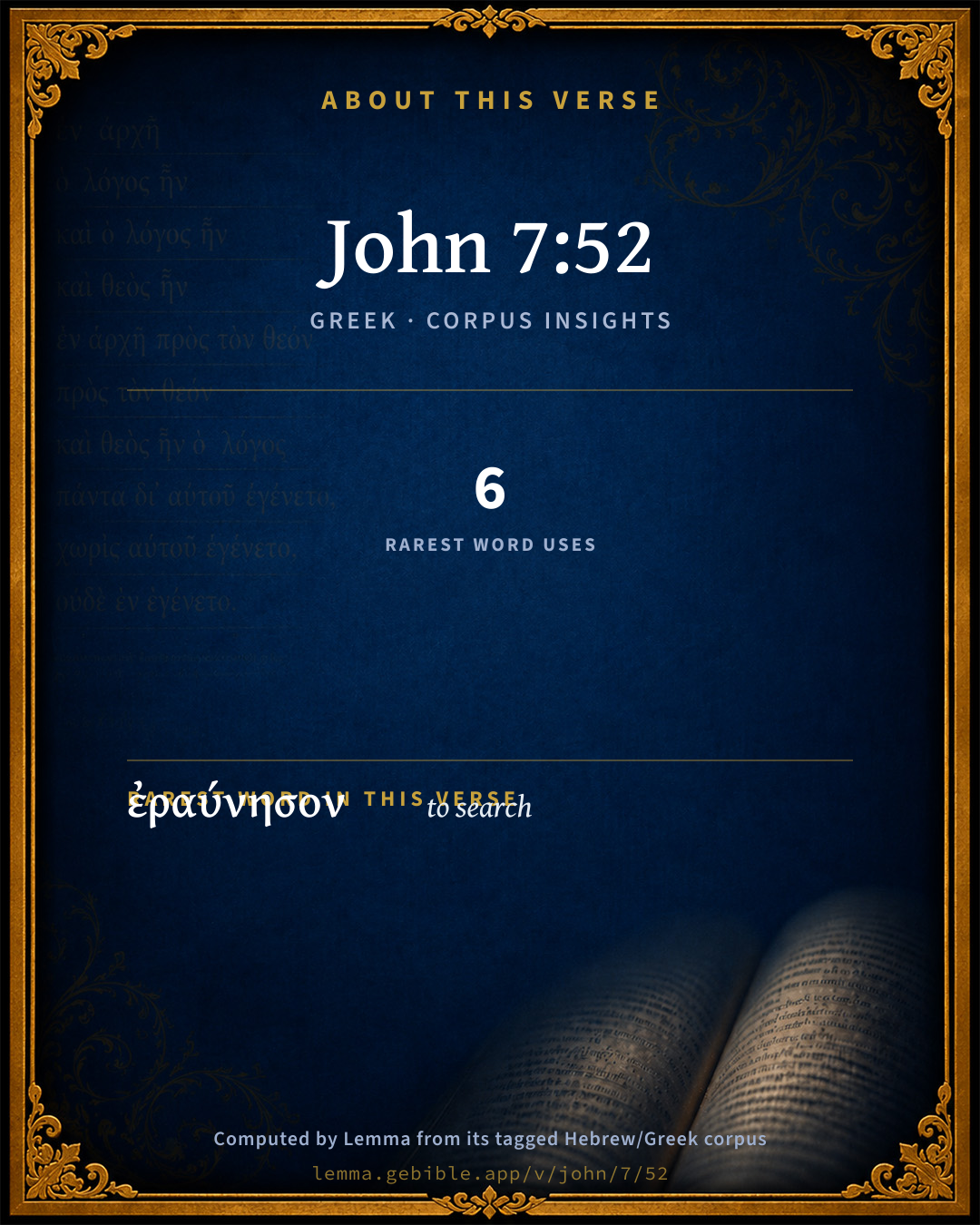
The rarest word here is ἐραύνησον to search G2045 — appearing just 6 times in the whole Greek New Testament.

Shared distinctive vocabulary

ἐραύνησον to search G2045 occurs in 6 verses of the Greek New Testament. Also found in:

Repetition

Words recur within this verse:

  • Γαλιλαίας Galilee G1056 ×2
  • καὶ and G2532 ×3
  • ἐκ from G1537 ×2
  • τῆς the G3588 ×2

Cross-references

9

Topical passages linked to John 7:52 in the Treasury of Scripture Knowledge — connected by theme and wording, ordered by reader-vote popularity; previews shown in the World English Bible.

  • John 7:41 Others said, "This is the Christ." But some said, "What, does the Christ come out of Galilee?
  • John 1:46 Nathanael said to him, "Can any good thing come out of Nazareth?" Philip said to him, "Come and see."
  • Isaiah 9:1–2 But there shall be no gloom to her who was in anguish. In the former time he brought into contempt the land of Zebulun and the land of Naphtali; but in the latter time has he made it glorious, by the way of the sea, beyond the Jordan, Galilee of the nations.
  • Matthew 4:15–16 "The land of Zebulun and the land of Naphtali, Toward the sea, beyond the Jordan, Galilee of the Gentiles,
  • Genesis 19:9 They said, "Stand back!" They said, "This one fellow came in to live as a foreigner, and he appoints himself a judge. Now will we deal worse with you, than with them!" They pressed hard on the man, even Lot, and drew near to break the door.
  • Exodus 2:14 He said, "Who made you a prince and a judge over us? Do you plan to kill me, as you killed the Egyptian?" Moses was afraid, and said, "Surely this thing is known."
  • 1 Kings 22:24 Then Zedekiah the son of Chenaanah came near, and struck Micaiah on the cheek, and said, Which way went the Spirit of Yahweh from me to speak to you?
  • Proverbs 9:7–8 He who corrects a mocker invites insult. He who reproves a wicked man invites abuse.
  • John 9:34 They answered him, "You were altogether born in sins, and do you teach us?" They threw him out.

Cross-references courtesy of OpenBible.info (CC BY 4.0).

Commentary

Notes on John 7:52 from classic Christian and Jewish commentators (each source and its license shown beneath its notes). The classic Christian expositions comment on the surrounding passage and are grouped to its opening verse, so a note may address several verses; the Jewish commentaries on the Tanakh (Rashi and others) are per-verse, so they appear only where the commentator wrote on this verse.

Lemma curates 59 commentaries, every one of them public domain or Creative Commons licensed, each selected and text-cleaned for this edition rather than reprinted as found. About our sources →

Tyndale Open Study Notes

Tyndale Open Resources

7:52 no prophet ever comes from Galilee! The Jewish leaders were apparently unaware that Jesus had been born in Bethlehem of Judea, not in Galilee (see Matt 2:1; Luke 2:1-7).

Tyndale Open Study Notes — © Tyndale Open Resources, licensed CC BY-SA 4.0. Text via the HelloAO Bible API.

Bengel's Gnomon

Johann Albrecht Bengel

Joh 7:52. Μή, whether) They feel sensible of the equity of his address to them; for which reason they make no reply to it: they only out of the conclusion itself create odium against Nicodemus, and they assail him, as though all the disciples of Jesus were Galileans, and as if He had none from any other quarter.—μὴ καὶ σὺ Γαλιλαῖος εἶ;) So the Lat. [Vulg.]: and that according to the mind of the Pharisees. The more modern Greek copies seem to have fastened on ἐκ τῆς Γαλιλαίας, instead of Γαλιλαῖος, from the words following immediately after. [Vulg. and [212][213] have ‘Galilæus.’ But [214][215][216] confirm the Rec. Text, ἘΚ Τῆς ΓΑΛΙΛΑΊΑς.]—ΚΑῚ ἼΔΕ) and see, i.e. you will see most easily. They appeal to experience, which however was not universal. [The hackneyed formula recurs to them afresh (comp. Joh 7:27, “When Christ cometh, no man knoweth whence He is”); which, however unimportant it might seen to be, when employed for sinister ends, was the occasion of causing them signal injury. Out of the amazing multitude of those who perish, you would hardly find any one who does not put a drag on the effectual working of saving truth in himself, owing to his being carried away by one or other πρώτῳ ψεύδει (falsehood at the outset).—V. g.]

[212] Vercellensis of the old ‘Itala,’ or Latin Version before Jerome’s, probably made in Africa, in the second century: the Gospels.

[213] Colbertinus, do.

[214] the Vatican MS., 1209: in Vat. Iibr., Rome: fourth cent.: O. and N. Test. def.

[215] Bezæ, or Cantabrig.: Univ. libr., Cambridge: fifth cent.: publ. by Kipling, 1793: Gospels, Acts, and some Epp. def.

[216] Borgiana: Veletri: part of John: fourth or fifth cent.: publ. by Georgi, 1789.

Bengel's Gnomon of the New Testament — English translation (T&T Clark, Edinburgh, 1860) — public domain. Text from a community e-Sword module.

Meyer's Critical & Exegetical Commentary

Heinrich August Wilhelm Meyer

Joh_7:52. Thou art not surely (like Jesus) from Galilee, so that your sympathy with Him is that of a fellow-countryman?

ὅτι προΦήτης, κ.τ.λ.] a prophet; not; no very distinguished prophet, nor any great number of prophets (Hengstenberg); nor again: a prophet has not appeared in Galilee in the person of Jesus (Godet); but the appearance of any prophet out of Galiles is, in a general way, denied as a matter of history; hence also the Perfect. The plain words can have no other meaning. To Godets altogether groundless objection, that John must in this case have written οὐδεὶς προΦ., the reference to Joh_4:44 is itself a sufficient answer. Inconsiderate zeal led the members of the Sanhedrim into historical erro; for, apart from the unknown birth-places of many prophets, Jonah at least, according to 2Ki_14:25, was of Galilee.[274] This error cannot be removed by any expedient either ertical[275] or exegetical; still it cannot be used as an argument aginst the genunieness of the Gospel (Bretschneider), for there was all the less need to add a correction of it, seeing that it did not apply to Jesus, who was not out of Galilee. This also tells against Baur, p. 169. The argument in ὅτι προΦ., κ.τ.λ. is from the general to the particular (to say nothing of the Messiah!), and is a conclusion from a negative induction.

[274] Not Elias also, whose Thisbe lay in Gilead (see Thenius on 1Ki_17:1; Fritzsche on Tob_1:2; Kurtz, in Herzogs Encyhl. III. p. 754). It is very doubtful, further, whether the Elkosh, whence Nahum came, was in Galilee or anywhere in Palestine, and not rather in Assyria (Michaelis, Eichhorn, Ewald, and most). Hosea came from the northern kingdom of Israel (Samaria); see Hos_7:1; Hos_7:5.

[275] By giving preference, namely, to the reading ἐγείρεται, according to which only the present appearance of a prophet in Galilee is denied (so also Tiele, Spec. contin. annotationem in loc. nonnull. ev. Joh., Amsterdam 1853). This ἐγείρεται would have its support and meaning only in the experience of history, because προφήτης, without the article, is quite general, and cannot mean the Messiah. This also in answer to Baeumlein.

Meyer — Critical and Exegetical Commentary on the New Testament — English translation by Peter Christie, edited by Frederick Crombie (T&T Clark, 1880) — public domain. Text from a community e-Sword module.

Expositor's Greek Testament

ed. W. Robertson Nicoll

Joh 7:52 . This remonstrance is exasperatingly true, and turns the bitterness of the Pharisaic party on Nicod mus, μὴ καὶ … ἐγήγερται . “Art thou also, as well as Jesus, from Galilee, and thus disposed to befriend your countryman?” Cf. Mar 14:70 . By this they betray that their own hostility was a merely personal matter, and not founded on careful examination. “Search and see, because [or ‘that’] out of Galilee there arises no prophet.” That is, as Westcott interprets, “Galilee is not the true country of the prophets: we cannot look for Messiah to come from thence”. They overlooked the circumstance that one or two exceptions to this rule existed.

The Expositor's Greek Testament, edited by W. Robertson Nicoll (1897–1910) — public domain. Text from a community e-Sword module.

Jamieson, Fausset & Brown

Robert Jamieson, A. R. Fausset & David Brown

thou of Galilee--in this taunt expressing their scorn of the party. Even a word of caution, or the gentlest proposal to inquire before condemning, was with them equivalent to an espousal of the hated One.

Search . . . out of Galilee . . . no prophet--Strange! For had not Jonah (of Gath-hepher) and even Elijah (of Thisbe) arisen out of Galilee? And there it may be more, of whom we have no record. But rage is blind, and deep prejudice distorts all facts. Yet it looks as if they were afraid of losing Nicodemus, when they take the trouble to reason the point at all. It was just because he had "searched," as they advised him, that he went the length even that he did.

Jamieson, Fausset & Brown — Commentary Critical and Explanatory on the Whole Bible (1871) — public domain (CC PDM 1.0). Text via the HelloAO Bible API.

Adam Clarke's Commentary

Verse 52. Art thou also of Galilee?] They knew very well that he was not; but they spoke this by way of reproach. As if they had said, thou art no better than he is, as thou takest his part. Many of the Galileans had believed on him, Which the Jews considered to be a reproach. Art thou his disciple, as the Galileans are?

Search, and look] Examine the Scriptures, search the public registers, and thou wilt see that out of Galilee there ariseth no prophet. Neither the Messiah, nor any other prophet, has ever proceeded from Galilee, nor ever can. This conclusion, says Calmet, was false and impertinent: false, because Jonah was of Gathheper, in Galilee: see 2Kg 14:25, compared with Jos 19:13. The Prophet Nahum was also a Galilean, for he was of the tribe of Simeon; and some suppose that Malachi was of the same place. The conclusion was false, because there not having been a prophet from any particular place was no argument that there never could be one, as the place had not been proscribed.

Adam Clarke's Commentary on the Bible (1810–1826) — public domain. Text from a community e-Sword/MySword module.

John Calvin's Commentaries

52. Art thou also from Galilee? They say that all who favor Christ are from Galilee, and this is spoken reproachfully, as if he could not have any person among his followers except from the small and unknown corner of Galilee The extreme violence to which they are excited against Nicodemus, shows with what furious hatred they burned against Christ; for he had not avowedly undertaken to defend Christ, but had only said that he ought not to be condemned before he was heard Thus among the Papists in our own day, no man can show the slightest token of candour that the Gospel may not be oppressed, but immediately the enemies fly into a passion, and exclaim that he is a heretic.

John Calvin's Commentaries (1540-1563) — public domain. Text from the Calvin Translation Society English edition (1840s-50s) via the Christian Classics Ethereal Library (ccel.org). Calvin's coverage is partial (roughly two-thirds of the Bible); uncommented books and verses are honest gaps, never fabricated. The 19th-century editor's footnotes and remarks are omitted so the notes are faithfully Calvin's own voice.

Ellicott's Commentary for English Readers

(52) Art thou also of Galilee?—They seek to avoid his question, to which there could have been but one answer, by a counter-question expressing their surprise at the position he is taking: “Surely thou art not also of Galilee?” “Thou art not His countryman, as many of this multitude are?” They imply that Nicodemus could not have asked a question which claimed for Jesus the simple justice of the Law itself, without being, like Him, a Galilean.

Search, and look: for out of Galilee ariseth no prophet.—The words mean, “Search the records, examine, scrutinize the authorities.” (Comp. Joh_5:39.) They seek to pass from the matter of fact immediately before them to the question of authority. Their generalisation includes an historical error which cannot be explained away. Jonah is described in 2Ki_14:25 as of Gathhepher, which was a town of Zebulun, in Lower Galilee. Possibly Elkosh, the birthplace of Nahum, was also in Galilee, and Hosea was certainly a prophet of the Northern Kingdom, though not necessarily of Galilee. Adverse criticism would lay this error also to the charge of the Evangelist. (Comp. Notes on Joh_7:42, and Joh_1:45; Joh_8:33.) But the obvious explanation is, that the Sanhedrin, in their zeal to press their foregone conclusion that Jesus is not a prophet, are not bound by strict accuracy; and it is not unlikely that, in the general contempt of Judæans for Galilee, this assertion had become a by-word, especially with men with so little of the historical sense as the later Rabbis. As compared with Judæa, it was true that Galilee was not a country of prophets, and by-words of this kind often rest on imperfect generalisations. We have seen that of the great prophets of Christianity all were Galileans. Judas Iscariot alone, of the Twelve Apostles, was probably a Judæan (Note on Joh_6:71).

A Bible Commentary for English Readers, edited by Charles John Ellicott (1878–1897) — public domain. Text from a community e-Sword module.

The Cambridge Bible for Schools and Colleges

gen. ed. J. J. S. Perowne

52. Art thou also of Galilee?] ‘Surely thou dost not sympathize with Him as being a fellow-countryman?’ They share the popular belief that Jesus was by birth a Galilean (Joh_7:41).

out of Galilee ariseth no prophet] Either their temper makes them forgetful, or in the heat of controversy they prefer a sweeping statement to a qualified one. Jonah of Gath-hepher (2Ki_14:25) was certainly of Galilee; Nahum of Elkosh may have been, but the situation of Elkosh is uncertain; Hosea was of the northern kingdom, but whether of Galilee or not is unknown; Abelmeholah, whence Elisha came, was in the north part of the Jordan valley, possibly in Galilee. Anyhow, their statement is only a slight and very natural exaggeration (comp. 4 Joh_7:29). Judging from the past, Galilee was not very likely to produce a Prophet, much less the Messiah.

Of the various questions which arise respecting the paragraph that follows (Joh_7:53 to Joh_8:11) one at least may be answered with something like certainty,—that it is no part of the Gospel of S. John. (1) In both tone and style it is very unlike his writings. His favourite words and expressions are wanting; others that he rarely or never uses are found. (2) It breaks the course of the narrative, which runs smoothly enough if this paragraph be omitted; and hence a few of the MSS. which contain it place it at the end of the Gospel. (3) All the very serious amount of external evidence which tells against the passage being part of the Gospel narrative at all of course tells against its being by S. John, and in this respect is not counterbalanced by other considerations. So that the internal and external evidence when put together is overwhelmingly against the paragraph being part of the Fourth Gospel.

With regard to the question whether the section is a genuine portion of the Gospel history, the internal evidence is wholly in favour of its being so, while the balance of external testimony is decidedly on the same side. (1) The style is similar to the Synoptic Gospels, especially to S. Luke; and four inferior MSS. insert the passage at the end of Luke 21, the place m the history into which it fits best. (2) It bears the impress of truth and is fully in harmony with Christ’s conduct on other occasions; yet it is quite original and cannot be a divergent account of any other incident in the Gospels. (3) It is easy to see how prudential reasons may in some cases have caused its omission (the fear of giving, as S. Augustine says, peccandi impunitatem mulieribus); difficult to see what, excepting its truth, can have caused its insertion. (4) Though it is found in no Greek MS. earlier than the sixth century, nor in the earliest versions, nor is quoted as by S. John until late in the fourth century, yet Jerome says that in his time it was contained ‘in many Greek and Latin MSS.’ (Adv. Pelag. ii. 17), and these must have been as good as, or better than, the best MSS. which we now possess.

The question as to who is the author, cannot be answered. There is not sufficient material for a satisfactory conjecture, and mere guesswork is worthless. The extraordinary number of various readings (80 in 183 words) points to more than one source.

One more question remains. How is it that nearly all the MSS. that do contain it (several uncials, including the Cambridge MS., and more than 300 cursives) agree in inserting it here? This cannot be answered with certainty. Similarity of matter may have caused it to have been placed in the margin in one copy, and thence it may have passed, as other things have done, into the text of the Cambridge and other MSS. In chap. 7 we have an unsuccessful attempt to ruin Jesus: this paragraph contains the history of another attempt, equally unsuccessful. Or, the incident may have been inserted in the margin in illustration of Joh_8:15, and hence have got into the text.

The Cambridge Bible for Schools and Colleges (gen. ed. J. J. S. Perowne; Cambridge University Press, 1878–1918) — public domain. Text from a community e-Sword module.

Trapp's Complete Commentary

John Trapp

52 They answered and said unto him, Art thou also of Galilee? Search, and look: for out of Galilee ariseth no prophet.

Ver. 52. Art thou also of Galilee?] They thought to mock him out of his religion, as the devil doth many at this day. But Nicodemus was well resolved; and if we can bear reproach for Christ, it is an argument we mean to stick to him; as the servant in the law, that was brought to be bored in the ear. And Cajetan gives the reason, Ut si non horreret servitutem, horreret saltem ignominiam publicam, ut multos habeat inspectores et testes.

John Trapp, A Commentary or Exposition upon All the Books of the Old and New Testament (1647–1656) — public domain. Text from a community e-Sword module.

Albert Barnes' Notes on the Bible

Art thou also of Galilee? - Here is another expression of contempt. To be a Galilean was a term of the highest reproach. They knew well that he was not of Galilee, but they meant to ask whether he also had become a follower of the despised Galilean. Ridicule is not argument, and there is no demonstration in a gibe; but, unhappily, this is the only weapon which the proud and haughty often use in opposing religion.

Ariseth no prophet - That is, there is no prediction that any prophet should come out of Galilee, and especially no prophet that was to attend or precede the Messiah. Compare Joh 1:46. They assumed, therefore, that Jesus could not be the Christ.

Albert Barnes' Notes on the Bible (1834–1885) — public domain. Text from a community e-Sword/MySword module.

Haydock's Catholic Bible Commentary

They say to Nicodemus: Art thou also a Galilean, who defendest this Galilean, whereas no prophet, nor especially the Messias, comes from Galilee? (Witham) --- A prophet, properly the prophet: for they could not be ignorant that the prophet Jonas was from Galilee. We have not indeed the article the in this verse, but we find it in ver. 40, with which this appears to correspond. (Haydock)

====================

George Leo Haydock (1774–1849), Haydock's Catholic Family Bible and Commentary, 1859 edition — public domain. Excludes Psalms (Douay-Rheims chapter numbering differs from Protestant) and Deuterocanonical books (Catholic canon only).

Matthew Poole's English Annotations

Art thou also of Galilee; not that they thought Nicodemus was a Galilean; they knew him well enough; but they take up this as a term of reproach against him, for that he would offer to speak one word (though never so just) on the behalf of one against whom they had such a perfect hatred.

Search (say they) the Scriptures, and look if ever there came a prophet out of Galilee. Suppose this had been truth; yet,

1. What did this concern our Saviour? Who was not born in Galilee, but in Judea, in Bethlehem, the city of David, Luk 2:4.

2. Could not God when he pleased influence one of Galilee with the Spirit of prophecy? But,

3. Neither was it true; for Nahum and Jonah were both Galilaeans, 2Ki 14:25, compared with Jos 19:13, (for the tribe of Zebulun had their lot in Galilee), Isa 9:1.

Matthew Poole's English Annotations on the Holy Bible (1683–1685) — public domain. Text from a community e-Sword/MySword module.

Whedon's Commentary on the Bible

Daniel D. Whedon

52. Thou… of Galilee?—It was easier to assail him with personality than to meet his plea. Nicodemus was doubtless a Jerusalemite, but as a taunt they make him a Galilean.

Search and look—Into the records of Scripture or later history.

No prophet—So that Jesus can make no claim to the prophetic character. This sounds very much like a proverb aptly quoted as authority in the case. As a proverb it was admissibly true; for though some five or six ancient prophets were natives of that territory, none had there arisen since it became Galilee. It is to be noted that they use the present tense. As to the older history, John is not responsible for the accuracy of these angry Pharisees, who were in a mood to stretch the truth to gain a point.

Daniel D. Whedon (gen. ed.), Commentary on the Old and New Testaments (1874–1909) — public domain. Text from a community e-Sword module.

The Pulpit Commentary

They answered and said to him, Art thou also, as he is and his supporters are, from Galilee? and, therefore, is this criticism of yours on our baffled plan the dictate of provincial pride? They sought to fix a contemptuous country cousin sobriquet upon this distinguished man, instead of replying to his sensible inquiry. Search, and see, that out of Galilee arisethno prophet. The present tense has very nearly the force of the perfect, and denotes the general rule of the Divine providence in the matter. The prophetic order can scarcely be thought to have been recruited from the northern province. Even Hosea had his origin in Samaria. Amos was an inhabitant of Tekoah; twelve miles south of Jerusalem. Nahum the El-koshite cannot be proved to have sprung from the Galilaean town of Elkosh; though it is not impossible, it is at least probable, that Elkosh in Assyria, on the Tigris, two miles north of Mosul and south of Nineveh, was the place whence Nahum and his prophecies issued. Elijah the Tishbite, of the land of Gilead, cannot be claimed as a Gallscan. The ease is different with reference to Jonah of Gath-Hepher, of the tribe of Zebulon, (2Ki_14:25) who, as a solitary and by no means morally impressive character, might almost as an exception prove the truth of the general statement. The historical error is far from difficult to account for in the stress of the discontent which these Pharisees were now manifesting towards everything Galilaean. Godet, on the authority of aghgertai , being the text, would have it that "there has not now arisen in the Person of Jesus a Prophet." Baumlein presses this still further, by making the "prophet" mean "the Messiah." There is no reasonable ground for charging on these Pharisees "an incredible ignorance or incomprehensible misunderstanding." Such a charge is more like one of the incomprehensible misunderstandings of the modern critical school whenever a chance opens of assailing the authenticity of the Fourth Gospel.

The Pulpit Commentary (1880–1919), ed. H.D.M. Spence-Jones & Joseph S. Exell — public domain. Text from a community e-Sword module.

John Wesley's Explanatory Notes

They answered - By personal reflection; the argument they could not answer, and therefore did not attempt it. Art thou also a Galilean? - One of his party? Out of Galilee ariseth no prophet - They could not but know the contrary. They knew Jonah arose out of Gethhepher; and Nahum from another village in Galilee. Yea, and Thisbe, the town of Elijah, the Tishbite, was in Galilee also. They might likewise have known that Jesus was not born in Galilee, but at Bethlehem, even from the public register there, and from the genealogies of the family of David. They were conscious this poor answer would not bear examination, and so took care to prevent a reply.

John Wesley, Explanatory Notes Upon the Whole Bible (1754–1765) — public domain. Text via the GEBible commentary corpus.

Cambridge Greek Testament for Schools and Colleges

52. ἐγείρεται for ἐγήγερται.

“Chapter 7, like chapter 6, is very important for the estimate of the fourth Gospel. In it the scene of the Messianic crisis shifts from Galilee to Jerusalem; and, as we should naturally expect, the crisis itself becomes hotter. The divisions, the doubts, the hopes, the jealousies, and the casuistry of the Jews are vividly portrayed. We see the mass of the populace, especially those who had come up from Galilee, swaying to and fro, hardly knowing which way to turn, inclined to believe, but held back by the more sophisticated citizens of the metropolis. These meanwhile apply the fragments of Rabbinical learning at their command in order to test the claims of the new prophet. In the background looms the dark shadow of the hierarchy itself, entrenched behind its prejudices and refusing to hear the cause that it has already prejudged. A single timid voice is raised against this injustice, but is at once fiercely silenced” (Sanday).

As in chapters 5 and 6. Christ is set forth as the Source and Support of Life, so in chapters 7, 8 and 9. He is set forth as the Source of Truth and Light. The Fulfiller of the Sabbath and of the Passover fulfils the Feast of Tabernacles also.

52. μὴ καὶ σύ. ‘Surely thou dost not sympathize with Him as being a fellow-countryman?’ They share the popular belief that Jesus was by birth a Galilean (see on Joh 7:41).

ἐρ. κ. ἴδε. Search and see; i.e. search and thou wilt see: like Divide et impera. The ὅτι may be either ‘that’ after ‘see,’ or ‘because:’ the former seems better.

ἐκ τ. Γαλ.… οὐκ ἐγείρεται. Jonah of Gath-hepher (2Ki 14:25) was certainly of Galilee; Nahum of Elkosh may have been, but the situation of Elkosh is uncertain; Hosea was of the northern kingdom, but whether of Galilee or not is unknown; Abelmeholah, whence Elisha came, was in the north part of the Jordan valley, possibly in Galilee. Anyhow, their statement is only a slight and very natural exaggeration (comp. Joh 4:29). Moreover they speak of the present and future, rather than of the past; ἐγείρεται, not (as T. R.) ἐγήγερται. Judging from the past, Galilee was not very likely to produce a prophet, much less the Messiah.

Of the various questions which arise respecting the paragraph that follows (Joh 7:53 to Joh 8:11) one at least may be answered with something like certainty,—that it is no part of the Gospel of S. John. (1) In both tone and style it is very unlike his writings. His favourite words and expressions are wanting; others that he rarely or never uses are found. (2) It breaks the course of the narrative by severing the two closely connected declarations of Christ, Ἐάν τις διψᾷ κ.τ.λ. and Ἐγώ εἰμι τὸ φῶς τ. κόσμου, with the two equally closely connected promises, ὁ πιστεύων εἰς ἐμὲ κ.τ.λ. and ὁ ἀκολουθῶν μοι κ.τ.λ. (Joh 7:37-38, Joh 8:12); and hence a few of the MSS. which contain it place it at the end of the Gospel, and one places it after Joh 7:36. (3) All the very serious amount of external evidence (see Appendix D.) which tells against the passage being part of the Gospel narrative at all of course tells against its being by S. John, and in this respect is not counterbalanced by other considerations. So that the internal and external evidence when put together is overwhelmingly against the paragraph being part of the Fourth Gospel.

With regard to the question whether the section is a genuine portion of the Gospel history, the internal evidence is wholly in favour of its being so, while the balance of external testimony is decidedly on the same side. (1) The style is similar to the Synoptic Gospels, especially to S. Luke; and four inferior MSS. insert the passage at the end of Luke 21, the place in the history into which it fits best. (2) It bears the impress of truth and is fully in harmony with Christ’s conduct on other occasions; yet it is quite original and cannot be a divergent account of any other incident in the Gospels. (3) It is easy to see how prudential reasons might in some cases have caused its omission (the fear of giving, as S. Augustine says, peccandi impunitatem mulieribus); difficult to see what, excepting its truth, can have caused its insertion. But “the utmost licence of the boldest transcribers never makes even a remote approach to the excision of a complete narrative from the Gospels” (W. and H.). (4) Though it is found in no Greek MS. earlier than the sixth century, nor in the earliest versions, nor is quoted as by S. John until late in the fourth century, yet Jerome says that in his time it was contained ‘in many Greek and Latin MSS.’ (Adv. Pelag. II. 17). But if it be thought that these must have been as good as the best MSS. which we now possess, we must remember that most of the worst corruptions of the text were already in existence in Jerome’s time.

The question as to who is the author, cannot be answered. There is not sufficient material for a satisfactory conjecture, and mere guesswork is worthless. The extraordinary number of various readings (80 in 183 words) points to more than one source.

One more question remains. How is it that nearly all the MSS. that do contain it (several uncials, including the Cambridge MS., and more than 300 cursives) agree in inserting it here? This cannot be answered with certainty. Similarity of matter may have caused it to have been placed in the margin in one copy, and thence it may have passed, as other things have done, into the text of the Cambridge and other MSS. In chap. 7 we have an unsuccessful attempt to ruin Jesus: this paragraph contains the history of another attempt, equally unsuccessful. Or, the incident may have been inserted in the margin (very possibly from Papias) in illustration of Joh 8:15, and hence have got into the text.

Cambridge Greek Testament for Schools and Colleges (Cambridge University Press, 1896; 21 vols, various authors incl. Carr, Maclear, Plummer, Farrar, Lumby, Moule, M. R. James, Simcox) — public domain. Text from a community e-Sword module.

Alford’s Greek Testament

Henry Alford

52.] They taunt him with being disposed to join those (mostly Galilæans) who had attached themselves to Jesus. Whether we read ἐγείρεται or ἐγήγερται, the assertion is much the same: for προφ. cannot mean the Prophet, or the Messiah. It was not historically true;—for two Prophets at least had arisen from Galilee: Jonah of Gathhepher, and the greatest of the Prophets, Elijah of Thisbe; and perhaps also Nahum and Hosea. Their contempt for Galilee made them lose sight of historical accuracy. (Bretschneider absurdly lays the inaccuracy to the charge of the Evangelist.)

HISTORY OF THE WOMAN TAKEN IN ADULTERY

[53—Chap. 8:11.] The history of the woman taken in adultery.—See var. readd.; and a very complete discussion of the authorities for and against the passage in Lücke (edn. 3), ii. 243-256. The critical examination of the genuineness of this passage is attended with many and complicated difficulties. Setting aside here purely diplomatic evidence (for which see var. readd.), we may observe (1) that at first sight, the reasons given by and Nicon seem enough to warrant the inference that it was expunged on account of the supposed licence given by it to sin. And this has been the hypothesis generally adopted by those who would override critical difficulties by strong autocratic assertion. Even Stier and Ebrard decide thus, without pausing to examine the real complications of the question. But (2) granting that such an hypothesis might be admissible as regards ch. 8:3-11, I do not see how the whole passage can be involved in it, especially the opening verse 53, which would naturally appear to form a sequel to what has preceded, and would surely never have been expunged with the offensive paragraph. (3) No such hypothesis as this will account for the coexistence of so many distinct and independent texts, apparently none of which owes its origin to any attempt to remove matter of offence. This phænomenon (not that of the abundance of various readings, from which it is totally distinct) points undoubtedly to some inherent defect in the text of the passage itself, irrespective of all treatment subsequent to its establishment as a part of the sacred narrative. (4) At the same time it is an embarrassing circumstance, that the contents of the passage are of such a kind, as to give every countenance to the supposition above dealt with. Had they been otherwise, we should have been much more free in pronouncing a critical decision for or against it. (5) Another difficulty is presented by the very general concurrence of the MSS. containing the passage, in placing it here. If it was not originally found in the text, why should this place, of all others, have been selected for its insertion? It has no connexion with the context: belongs, apparently, to another portion of our Lord’s ministry: what could induce the interpolators to place it here? (6) Nor are we helped much by its variations of position in some mss. The end of Luk_21. seems most to approve itself as the fitting place. but if it was the original one, it is totally inexplicable that we should find no trace of the fact there, except in four of the (best) cursive mss. Its occurrence here then, seems to me much in its favour. (7) After all, the most weighty argument against the passage is found in its entire diversity from. the style of narrative of our Evangelist. It is not merely that many words and idioms occur which John never uses, but that the whole cast and character of the passage is alien from his manner, in whichever of the existing texts we read it. (It would be hardly worth while to cite an opinion which affirms that “such a course of argument is very fallacious, leads to nothing but endless logomachies, and can never settle a question of this kind” (Bloomf. edn. 9),—were it not earnestly to remind my readers, that the more the sacred text is really studied, the more such considerations, duly and cautiously weighed, will be urged and appreciated.) (8) Balancing all these difficulties, I am almost disposed, as a desperate resource, to adopt the following hypothesis; not as by any means satisfying or even recommending itself to me, but as really the only one which seems at all to shew us a way out of the ænigma: That the Evangelist may have, in this solitary case, incorporated a portion of the current oral tradition into his narrative: that this portion may have been afterwards variously corrected, from the Gospel of the Hebrews, or other traditional sources: that being seen in early times to be alien from John’s diction, it may have been by some replaced in the synoptic narrative, in its apparent chronological place, at Luk_21 fin.: or inserted variously in this Gospel from the mere fact of having dropped out here. Then again the contents of the passage would operate with the above causes to its exclusion altogether from many mss.: and the fact of some excluding only ch. 8:3-11, seems certainly to shew that the moral element did operate in the matter. (9) Dropping all idea of the hypothesis just suggested, our conclusion on the data must I think be, to retain the passage, as we retain Mar 16:9 ff., with a distinction from the rest of the text. With regard to the question, what text of the passage itself to adopt, it would seem idle to attempt to unite into one by critical processes texts which seem to be due to different sources. Our solution of the question must be merely formal and diplomatic. And, thus solving it, it has been thought best in this Edition to give the text as it is found in the only one of our most ancient mss. which contains it: the amount and nature of the variations being fully seen in the accompanying Digest. In adopting this plan, it will be observed that no judgment whatever is given on the purity of the text thus adopted,—no approval whatever of the Codex Bezæ as a fons lectionum: our proceeding is simply a formal and objective one, adopted as a necessity where no other seemed even moderately satisfactory.

Henry Alford, The Greek Testament (1849–1861) — public domain. Text from a community e-Sword module.

International Critical Commentary

52. The members of the Sanhedrim had no sympathy with the plea for delay which Nicodemus put forward. Was he also a Galilæan, like the Galilæan whose case he was defending? (see v. 41). Let him search, and he will see that it is not from Galilee that a prophet is arising. These aristocrats of Jerusalem had a scornful contempt for the rural Galilæans.

For ἐγείρεται (אBDTNWΘ) the rec. has ἐγήγερται. If the reading ἐγήγερται were correct, the assertion that from Galilee no prophet has arisen would be obviously untrue. Jonah, at any rate, was a Galilæan, for he was of Gath-hepher (2Ki 14:25), which was in Galilee (Jos 19:13). And possibly Hosea, whose prophecies were concerned with the Northern Kingdom, was also a Galilæan.

There was nothing in O.T. tradition to suggest that Galilee was an inferior district of the Holy Land. Isaiah, in particular, had sung of the days when Zebulun and Naphtali should be made glorious “beyond Jordan, Galilee of the Gentiles”1. (Isa 9:1). It is not likely, therefore, that the saying ἐκ τῆς Γαλιλαίας προφήτης οὐκ ἐγείρεται was a proverb, as the form of the sentence might suggest. It is a merely contemptuous assertion, “Out of Galilee is not arising a prophet” (cf. v. 41). See on 1:46.

ὅτι is not to be translated “for,” but “that.”

For the verb ἐραυνᾶν, see above on 5:39, the only other place where it is found in Jn. Possibly ἐραύνησον has reference here also to a searching of the Scriptures; but it is more probable that the meaning is “if you will take the trouble to look, you will see that out of Galilee no prophet is arising.” Cf. 2Ki 10:23 ἐρευνήσατε καὶ ἴδετε, where ἐρευνήσατε is only ampliative of ἴδετε, as here.

[For 7:53-8:11 see the notes at the end of Vol. II. on the Pericope de Adultera.]

אԠSinaiticus (δ 2). Leningrad. iv.

B Vaticanus (δ 1). Rome. Cent. iv.

C Ephræmi (δ 3). Paris. v. Palimpsest. Contains considerable fragments of Jn.

L Regius (ε 56). Paris. viii. Cc. 15:2-20 21:15-25 are missing.

Γ̠(ε 70) Oxford and Leningrad. ix-x. Contains Son 1:1-13 8:3-15:24 19:6 to end.

Δ̠Sangallensis (ε 76). St. Gall. ix-x. Græco-Latin.

Θ̠Koridethi (ε 050). Tiflis. vii-ix. Discovered at Koridethi, in Russian territory, and edited by Beermann & Gregory (Leipzig, 1913). The text is akin to that of fam. 13, fam. 1, and the cursives 28, 565, 700 See Lake and Blake in Harvard Theol. Review (July 1923) and Streeter, The Four Gospels. Cf. also J.T.S. Oct. 1915, April and July 1925.

D Bezæ (δ 5). Cambridge. v-vi. Græco-Latin. Cc. 18:14-20:13 are missing in the Greek text, and the gap has been filled by a ninth-century scribe (Dsupp).

W Freer (ε 014). Washington. iv-vi. Discovered in Egypt in 1906. The Gospels are in the order Mt., Jn., Lk., Mk. Collation in The Washington MS. of the Four Gospels, by H. A. Sanders (1912).

N Purpureus Petropolitanus (ε 19). Dispersed through the libraries of Leningrad, Patmos, Rome, Vienna, and British Museum. vi. Some pages are missing. Edited by H. S. Cronin in Cambridge Texts and Studies (1899).

T Borgianus (ε 5). Rome. v. Græco-Sahidic. Contains cc. 6:28-67 7:6-8:31.

1 See Introd., p. xix, and on v. 1 above, for the dislocation of the text.

1 Cf. Schweitzer, Quest of the Historical Jesus, p. 345.

1 See Schürer History of Jewish People, Eng. Tr., ii. i. 177 f., 203 f. Thus Annas and Caiaphas are both called ἀρχιερεῖς (Luk 3:2); and in Act 4:6 we have Ἄννας ὁ ἀχιερεὺς καὶ Καϊάφας, although Aunas was out of office at the time.

1 Cf. Wordsworth and White, Nov. Test. Lat., in loc.; and see above on vv. 12, 25.

1 See on 1:35 for this form.

1 Quoted by E. C. Selwyn in J.T.S., Jan. 1912, p. 226.

2 Cf. A. Robinson, Passion of St. Perpetua, p. 98.

3 Cf. Euseb. H.E. v. 1:22.

1 Epist. 73:11; but cf. 63:8.

2 J.T.S., Oct. 1922, p. 66 f.. and cf. Jan. 1923, p. 174.

3 Harvard Theol. Review, Oct. 1923, p. 339.

4 Comm. in Ioan. Vol. 2. p. 250 (ed. Brooke); cf. also Hom. in Num 17:4.

5 Basil’s comment on the river of Psa 46:4 is: τίς δʼ ἂν εἴη ὁ ποταμὸς τοῦ θεοῦ ἢ τὸ πνεῦμα τὸ ἄγιον ἐκ τῆς πίστεως τῶν εἰς Χριστὸν πεπιστευκότων, ἐγγενόμενον τοῖς ἀξίοις; He then quotes Joh 7:38 and 4:14.

6 Ephraim also ends the first clause with πινέτω (Hom. On our Lord. i. 41); and Tatian seems to have taken the same line, although this cannot be certain.

7 Syr. sin and Syr. cur. appear also t0 support this interpretation.

8 So Origen (Selecta in Deut., Lommatzsch, x. 374) speaks of that good land ἦς χείμαρρος ὁ Χριστός, ποτίζων τοῖς τῆς σοφίας νάμασιν.

1 See Barnes, J.T.S., July 1922, p. 421.

1 Routh, Rel. Sacr., iv. 34.

2 E.B., 4594.

Diat. E. A. Abbott’s Diatessarica, including his Johannine Vocabulary and Johannine Grammar, Parts I.-X. (1900-1915).

1 See G. A. Smith. Histor. Geogr. of Holy Land, p. 428 n., for considerations which show that this was 0n the west side of Jordan

אΓΔΘ have κρίσιν κρίνατε (the authoritative aorist im perative; see on 2:5), but BDLTNW give κρίνετε.

This is the last word of the controversy which arose out of the healing of the impotent man at Bethesda, sc. 5:1-47, 7:15-24; and naturally, the Jewish leaders were indignant. Cf. 7:1.

אԠSinaiticus (δ 2). Leningrad. iv.

D Bezæ (δ 5). Cambridge. v-vi. Græco-Latin. Cc. 18:14-20:13 are missing in the Greek text, and the gap has been filled by a ninth-century scribe (Dsupp).

B Vaticanus (δ 1). Rome. Cent. iv.

L Regius (ε 56). Paris. viii. Cc. 15:2-20 21:15-25 are missing.

T Borgianus (ε 5). Rome. v. Græco-Sahidic. Contains cc. 6:28-67 7:6-8:31.

W Freer (ε 014). Washington. iv-vi. Discovered in Egypt in 1906. The Gospels are in the order Mt., Jn., Lk., Mk. Collation in The Washington MS. of the Four Gospels, by H. A. Sanders (1912).

Θ̠Koridethi (ε 050). Tiflis. vii-ix. Discovered at Koridethi, in Russian territory, and edited by Beermann & Gregory (Leipzig, 1913). The text is akin to that of fam. 13, fam. 1, and the cursives 28, 565, 700 See Lake and Blake in Harvard Theol. Review (July 1923) and Streeter, The Four Gospels. Cf. also J.T.S. Oct. 1915, April and July 1925.

Γ̠(ε 70) Oxford and Leningrad. ix-x. Contains Son 1:1-13 8:3-15:24 19:6 to end.

Δ̠Sangallensis (ε 76). St. Gall. ix-x. Græco-Latin.

N Purpureus Petropolitanus (ε 19). Dispersed through the libraries of Leningrad, Patmos, Rome, Vienna, and British Museum. vi. Some pages are missing. Edited by H. S. Cronin in Cambridge Texts and Studies (1899).

1 Wendt (Gospel according to St. John, p. 64 n.) takes this view. Cf. ἐργάζεσθαι in 5:17 and Luk 13:14.

1 Shabb. fol. 130.

2 Joma, f. 85, quoted by Wetstein.

International Critical Commentary — older volumes (1896–1929), various authors — public domain. Text from a community e-Sword module.

Vincent's Word Studies in the New Testament

Marvin R. Vincent

Search. Compare Joh 5:39.

Look [ιδε] . Some render see, and translate the following oti, that, instead of for. So Rev. The difference is unimportant.

Marvin R. Vincent, Word Studies in the New Testament (1887–1900) — public domain. Text from a community e-Sword/MySword module.

Lesson kit

Teaching starters — assembled from the data on this page, not authored interpretation. Every prompt links to the verse data it draws on. Edit before teaching.

John, in the Gospels, opens this verse with 21 words (16 distinct Greek lemmas). Its most distinctive word is ereunáō (“to search”). A historical commentator’s framing appears above. Read the whole chapter for the surrounding context.

Discussion questions

  1. What does “to search” (ereunáō) contribute to the verse as a whole?
  2. How does John 5:39, which shares the word «to search», read alongside this verse?
  3. What does the repetition of “Galilee” (2× in this one verse) do in this verse?
  4. The translations on this page render this verse differently — a whole-verse word diff, not a word-by-word alignment. What might account for the different wordings?
  5. Compare how Tyndale Open Study Notes and Bengel's Gnomon read this verse. Where do they agree or differ?

Things to notice

Reading settings

Reading text

Shown beneath each verse's original-language words.

Old Testament
Old Testament edition

Read the OT as the Masoretic Hebrew (MT) or the Greek Septuagint (LXX).

English shown for the Greek Septuagint (in the Hebrew ↔ Greek comparison).

Comparing translations? Open the Compare panel on any verse page to stack up to four side by side.