Revelation 7:13

Greek (Tischendorf 8th ed.) Revelation 7:13 appears in the Greek New Testament. The text above is from the Tischendorf 8th edition. Each word links to its Strong’s number and a concise gloss. Click any word for its full Thayer’s Greek Lexicon entry.
Download image
Cite this verse

Revelation 7:13 (World English Bible). Public Domain. Lemma interlinear Bible study tool, https://lemma.gebible.app/v/revelation/7/13.

Show BibTeX & RIS
BibTeX
RIS
English Translation
One of the elders answered, saying to me, "These who are arrayed in white robes, who are they, and from where did they come?"
World English Bible · Public Domain
Download a study sheet

One document with this verse’s original text, its word-by-word gloss line, the meaning frame, cross-references with their text, attributed commentary, and full source and license credits — printable, and it pastes into notes with its structure intact.

This verse Autodidact and up

Study sheet (.html) Plain text (.txt)

A passage Seminary Student

Up to 50 verses in one chapter. A passage sheet keeps up to 6 commentary sources and 12 cross-references per verse, in the order this page ranks them, and says so on the sheet whenever that leaves anything out. Ask for a single verse and you get the Autodidact verse sheet above.

Everything on this page stays free to read, with no account — the sheet is a download of what is already on screen, not access to it.

Want to remove ads? Support Godless Engineer
Compare translations 3

The same verse in 3 English versions, stacked beneath the original-language interlinear above. Click any original word for its lexicon entry.

Each is an independent rendering of the whole verse — the interlinear is not word-aligned to these translations.

Highlighted words mark where these versions differ — a whole-verse word diff, not a word-by-word alignment.

  • World English Bible Public Domain
    One of the elders answered, saying to me, "These who are arrayed in white robes, who are they, and from where did they come?"
  • King James Version Public Domain
    And one of the elders answered, saying unto me, What are these which are arrayed in white robes? and whence came they?
  • unfoldingWord Literal Text CC BY-SA 4.0
    And one of the elders responded, saying to me, “These, the ones having been clothed in white robes, who are they, and where have they come from?”

unfoldingWord Literal Text — © unfoldingWord, licensed CC BY-SA 4.0. Word-aligned USFM3 via Door43 (git.door43.org/unfoldingWord/en_ult).

Versions to compare (up to 4)

3 of 4 selected

Show all 19 translations

Every available English version of this verse, each an independent rendering of the whole verse.

  • World English Bible Public Domain
    One of the elders answered, saying to me, "These who are arrayed in white robes, who are they, and from where did they come?"
  • Berean Standard Bible Public Domain
    Then one of the elders addressed me: “These in white robes,” he asked, “who are they, and where have they come from?”
  • Majority Standard Bible Public Domain
    Then one of the elders addressed me: “These in white robes,” he asked, “who are they, and where have they come from?”
  • King James Version Public Domain
    And one of the elders answered, saying unto me, What are these which are arrayed in white robes? and whence came they?
  • American Standard Version (1901) Public Domain
    And one of the elders answered, saying unto me, These that are arrayed in white robes, who are they, and whence came they?
  • Revised Version (1885) Public Domain
    And one of the elders answered, saying unto me, These which are arrayed in the white robes, who are they, and whence came they?
  • Geneva Bible (1599) Public Domain
    And one of the Elders spake, saying vnto me, What are these which are araied in log white robes? and whence came they?
  • Douay-Rheims (1899) Public Domain
    And one of the ancients answered, and said to me: These that are clothed in white robes, who are they? and whence came they?
  • Young's Literal Translation Public Domain
    And answer did one of the elders, saying to me, `These, who have been arrayed with the white robes -- who are they, and whence came they?'
  • Literal Standard Version CC BY-SA 4.0
    And one of the elders answered, saying to me, “These having been clothed with the white robes, who are they, and from where have they come?”
  • Unlocked Literal Bible CC BY-SA 4.0
    Then one of the elders asked me, “Who are these, clothed with white robes, and where did they come from?”
  • unfoldingWord Literal Text CC BY-SA 4.0
    And one of the elders responded, saying to me, “These, the ones having been clothed in white robes, who are they, and where have they come from?”
  • Darby Bible Public Domain
    And one of the elders answered, saying to me, These who are clothed with white robes, who are they, and whence came they?
  • World Messianic Bible Public Domain
    One of the elders answered, saying to me, “These who are arrayed in the white robes, who are they, and where did they come from?”
  • Webster's Bible Public Domain
    And one of the elders answered, saying to me, Who are these that are arrayed in white robes? and whence came they?
  • Free Bible Version CC BY-SA 4.0
    One of the elders spoke to me and asked, “Who are those who are dressed in white robes, and where have they come from?”
  • Bible in Basic English Public Domain
    And one of the rulers made answer, saying to me, These who have on white robes, who are they, and where did they come from?
  • Text-Critical English NT CC BY 4.0
    In response one of the elders said to me, “Who are these people clothed in white robes, and where did they come from?”
  • Tyndale New Testament (1534) Public Domain
    And one of the elders answered sayinge vnto me: what are these which are arayed in longe whyte garmentes and whence cam they?

Literal Standard Version (2020), Covenant Press — licensed CC BY-SA 4.0. Text via the HelloAO Bible API (eBible.org). Unlocked Literal Bible (unfoldingWord) — licensed CC BY-SA 4.0. Text via the HelloAO Bible API (eBible.org). unfoldingWord Literal Text — © unfoldingWord, licensed CC BY-SA 4.0. Word-aligned USFM3 via Door43 (git.door43.org/unfoldingWord/en_ult). Free Bible Version, Dr. Jonathan Gallagher — licensed CC BY-SA 4.0. Text via the HelloAO Bible API (eBible.org).

Word by word

More ways to search: Search by grammar → Find every occurrence → Compare this word →

Practice this passage: Drill this verse → Learn its vocabulary →

στολὰς
stolḗ
G4749
“clothing”
Noun, Accusative, Plural, Feminine
Part of Speech
Noun
Case
Accusative
Number
Plural
Gender
Feminine
Full Thayer's Definition

Origin: from G4724

TDNT: 18:27,1

1. an equipment 2. an equipment in clothes, clothing a. spec. a loose outer garment for men extending to the feet, worn by kings, priests, and persons of rank
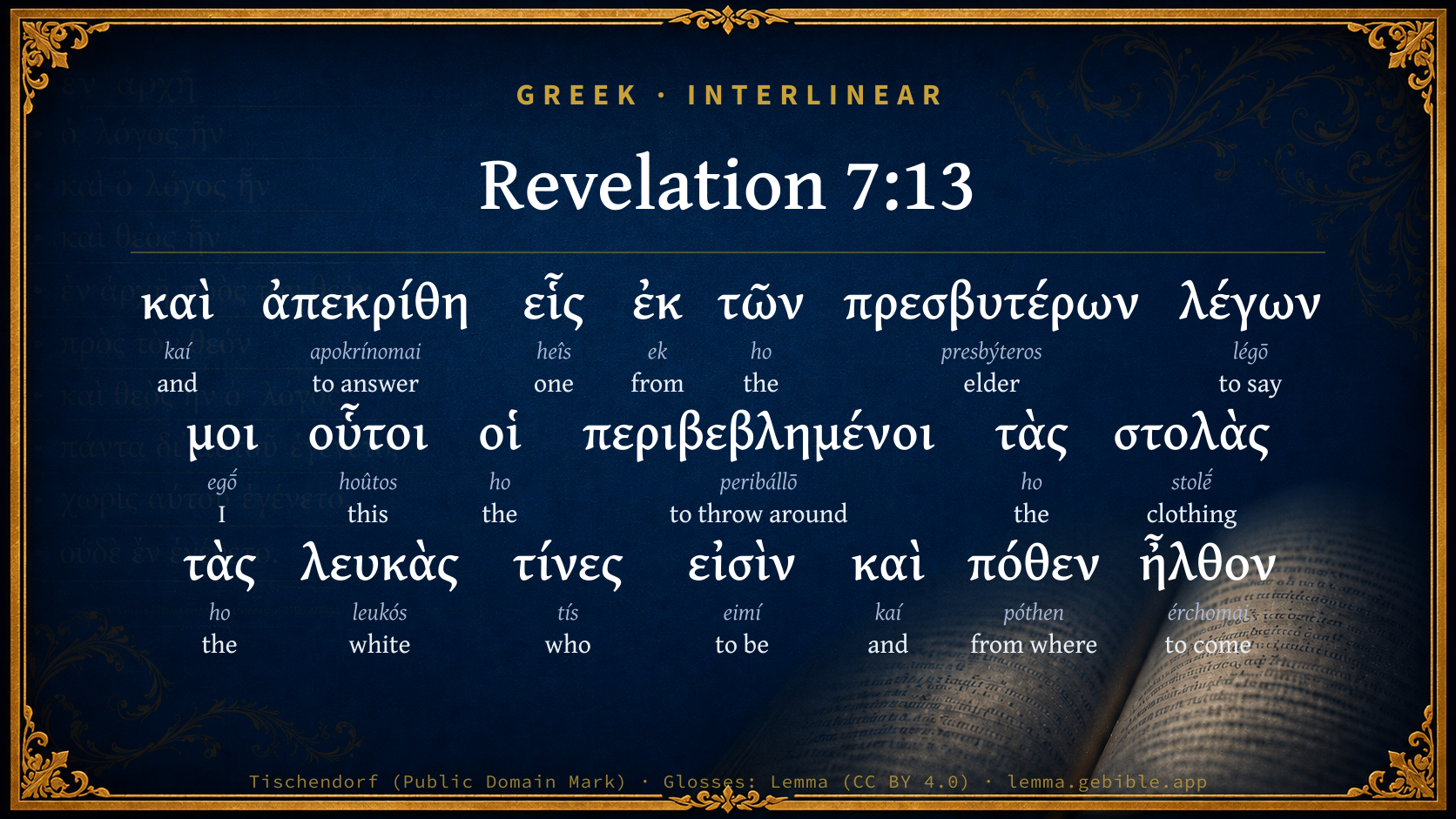
  1. καὶ kaí G2532 “and” Conjunction
  2. ἀπεκρίθη apokrínomai G611 “to answer” Verb, Aorist, Middle deponent, Indicative, 3rd person, Singular
  3. εἷς heîs G1520 “one” Adjective, Nominative, Singular, Masculine
  4. ἐκ ek G1537 “from” Preposition
  5. τῶν ho G3588 “the” Article, Genitive, Plural, Masculine
  6. πρεσβυτέρων presbýteros G4245 “elder” Adjective, Genitive, Plural, Masculine, Comparative
  7. λέγων légō G3004 “to say” Verb, Present, Active, Participle, Nominative, Singular, Masculine
  8. μοι egṓ G1473 “I” Personal pronoun, 1st person, Dative, Singular
  9. οὗτοι hoûtos G3778 “this” Demonstrative pronoun, Nominative, Plural, Masculine
  10. οἱ ho G3588 “the” Article, Nominative, Plural, Masculine
  11. περιβεβλημένοι peribállō G4016 “to throw around” Verb, Perfect, Passive, Participle, Nominative, Plural, Masculine
  12. τὰς ho G3588 “the” Article, Accusative, Plural, Feminine
  13. τὰς ho G3588 “the” Article, Accusative, Plural, Feminine
  14. λευκὰς leukós G3022 “white” Adjective, Accusative, Plural, Feminine
  15. τίνες tís G5101 “who” Interrogative pronoun, Nominative, Plural, Masculine
  16. εἰσὶν eimí G1510 “to be” Verb, Present, Active, Indicative, 3rd person, Plural
  17. καὶ kaí G2532 “and” Conjunction
  18. πόθεν póthen G4159 “from where” Adverb, Interrogative
  19. ἦλθον érchomai G2064 “to come” Verb, Aorist, Active, Indicative, 3rd person, Plural

About this verse

These counts appear in no published source. They are computed here, from the morphology-tagged text and Lemma’s own curated glosses. What Lemma adds →

20
words
16
distinct lemmas
Revelation
section

Notable vocabulary

The rarest word here is στολὰς clothing G4749 — appearing just 9 times in the whole Greek New Testament.

Shared distinctive vocabulary

στολὰς clothing G4749 occurs in 9 verses of the Greek New Testament. Also found in:

Repetition

Words recur within this verse:

Cross-references

7

Topical passages linked to Revelation 7:13 in the Treasury of Scripture Knowledge — connected by theme and wording, ordered by reader-vote popularity; previews shown in the World English Bible.

  • Revelation 7:9 After these things I looked, and behold, a great multitude, which no man could number, out of every nation and of all tribes, peoples, and languages, standing before the throne and before the Lamb, dressed in white robes, with palm branches in their hands.
  • Revelation 4:10 the twenty-four elders fall down before him who sits on the throne, and worship him who lives forever and ever, and throw their crowns before the throne, saying,
  • Revelation 5:5 One of the elders said to me, "Don't weep. Behold, the Lion who is of the tribe of Judah, the Root of David, has overcome; he who opens the book and its seven seals."
  • Revelation 5:11 I saw, and I heard something like a voice of many angels around the throne, the living creatures, and the elders; and the number of them was ten thousands of ten thousands, and thousands of thousands;
  • Judges 13:6 Then the woman came and told her husband, saying, A man of God came to me, and his face was like the face of the angel of God, very awesome; and I didn't ask him whence he was, neither did he tell me his name:
  • John 7:28 Jesus therefore cried out in the temple, teaching and saying, "You both know me, and know where I am from. I have not come of myself, but he who sent me is true, whom you don't know.
  • Revelation 4:4 Around the throne were twenty-four thrones. On the thrones were twenty-four elders sitting, dressed in white garments, with crowns of gold on their heads.

Cross-references courtesy of OpenBible.info (CC BY 4.0).

Commentary

Notes on Revelation 7:13 from classic Christian and Jewish commentators (each source and its license shown beneath its notes). The classic Christian expositions comment on the surrounding passage and are grouped to its opening verse, so a note may address several verses; the Jewish commentaries on the Tanakh (Rashi and others) are per-verse, so they appear only where the commentator wrote on this verse.

Lemma curates 59 commentaries, every one of them public domain or Creative Commons licensed, each selected and text-cleaned for this edition rather than reprinted as found. About our sources →

The Biblical Illustrator

Joseph S. Exell

Rev_7:13-14

What are these which are arrayed in white robes.

What and whence are these?

I. Concerning the bright spirits in heaven--whence came they? These are they which came out of great tribulation.

1. They were then like ourselves, for, in the first place, they were tried like others.

(1) The saints now glorified were not screened from sorrow. I saw to-day a number of lovely flowers; they were as delightful in this month of February as they would have been in the midst of summer; but I did not ask, Whence came they? I know very well that they were the products of the conservatory; they had not been raised amid the frosts of this chill season, else they had not bloomed as yet. But when I look upon Gods flowers blooming in heaven, I understand from the voice of inspiration that they enjoyed no immunity from the chill breath of grief; they were made to bloom by the master hand of the Chief Husbandman, in all their glory, amid the adversities and catastrophes which are common to men.

(2) They were not even screened from temptation. To the child of God, temptation to sin is a greater grievance than the suffering of pain. Storms on any sea are to be dreaded; but a whirlwind raised by Satan on the black sea of corruption is horrible beyond conception. Yet, do not say you cannot enter heaven because you are tempted, for all those snow-white bands attained their glorious standing through much temptation, as well as through much affliction.

(3) They were men who as keenly felt trial and temptation as we do. Good men, because they are good, are not the less sorrowful when their beloved ones are taken from them: gracious men are not by grace petrified so as to despise the chastening of the Lord. Jacob mourned for Rachel, and David for Jonathan. Peter wept bitterly, and Paul had continual heaviness. Tribulations abounded and afflictions were multiplied to the first disciples, and we wrong both themselves and us if we dream that it was easier for them to suffer than for us. I grant you that they possessed a secret something which enabled them to endure, but that something was not homeborn in their nature any more than it is in ours. They were fortified by a secret strength which they found at the throne of God in prayer, a patience which the Holy Ghost wrought in them, and which He is equally ready to work in us.

2. The saints who are now in heaven needed trial like others. To what end do men need tribulation? We reply, they often require it to arouse them; and yonder saints who serve God day and night in His temple, once slept as do others, and needed to be bestirred. They required adversity to educate them into complete manhood, for they, too, were once babes in grace. They needed tribulation, moreover, that they might be made like their Saviour.

3. The children of God who are in heaven in their trials had no other support than that which is still afforded to all the saints.

4. If there was any difference between those saints and ourselves, it lay in their enduring superior tribulations, for these are they that came out of great tribulation.

II. What are these? The reply was, They have washed their robes, etc.

1. All those in heaven were sinners, for they all needed to wash their robes.

2. All who are in heaven needed an atonement, and the same atonement as we rely upon. They have washed their robes and made them white in the blood of the Lamb. Not one of them became white through his tears of repentance, not one through the shedding of the blood of bulls or of goats.

3. The saints in heaven realised the atonement in the same way as we must do. The act which gave them the virtue which lies in the atonement was the act of faith. There is nothing to do, and nothing to feel, and nothing to be, in order to forgiveness; we have but to wash and the filth is gone.

III. Now, what of all this? Why, first of all, we must not draw the conclusion that trouble and temptation are any argument that a man will get to heaven. I add a caution. I would, however, have you learn that no amount of trial which we have to suffer here, if we are believers in Jesus, should lead us to anything like despair, for however trouble may encompass us to-day, those in heaven came through as great a tribulation, and why may not we? (C. H. Spurgeon.)

Whence come the saints?

Whence came they? Heaven, then, itself has a retrospect as well as a fruition. Heaven itself is a sequel and a consequence as well as a fact, and a present. Heaven is an arrival; heaven is a development; heaven is a result, in one aspect, however infinite its capacities of attainments beyond. Whence came they? Then they were somewhere before. These same persons, different as they are, transfigured as they are from anything that we see, yet were once here. We have seen such persons; we have talked with some of them. The dark river was known not to them, and it was no unmaking and remaking of them to us. Whence came they? They came from this earth, and they are perfected. But the question as It is answered in the context has a fuller meaning than this--it pre-supposes this, and passes on. From earth, of course is the answer, but from earth how conditioned and how used? Heaven is a sequel and a consequence--a consequence of what sort of earth? Heaven is a consummation, though never itself to be consummated. Then of what experience is it the consummation? He calls it two things: two only--pain and purification. These are they which came out of great tribulation, and have washed their robes. The simplicity, the brevity of the answer may surprise us? Whence came they? We might have expected in answer, From every possible variety of condition, private or public, humble or conspicuous, adverse or prosperous; wealth and length of days, or else sickness, privation, distress, and woe. Not so. The kind of earth from which they came was one and but one. These are they that came out of great tribulation. Pain, then, is the common feature of the earth, of which the terminus is heaven. It is a thought which has exercised Christian people, and we cannot wonder at it. If those who wear the white robes came out of great tribulation, what prospect is there for me to whom tribulation is an experience unknown? The question ought to press upon us. It is easy to say, You cannot force, you need not invite, and you must not simulate pain. If pain does not come the fault is not yours. Pain may be on its way--you must bear it when it comes. This is true, but it is not all the truth. If life smiles on you personally, if it supplies your abundant needs, if its occupations are pleasant, if its friends are many, if its bereavements are few and far between; if, therefore, you cannot affect not to be happy, it is plain that as regards yourself, the only two questions on this head can be--Are you thankful? and Are you kind? Do you receive your blessings from God, and do you share them generously with men? But much more than this. The compass of pain is not thus limited. If neither bodily pain nor mental is yours, we go on to ask, What of spiritual? Is it no pain to feel myself so sinful, that when I would do good evil is present with me; when I would feel the wonderful love there is no response; when I would mount up into the heaven, which is Gods, I faint, and fall back into the dreamy world where God is not? But while spiritual pain is one kind, one ingredient of the great tribulation, there is another--the purely unselfish pain: the pain which looks upon the animate creation groaning in travail, and travails in pain with it; the pain which looks on this anguished England, with food not enough, and work not enough for its toiling millions; feels, too, with the foolish misled dupes of the so-called sympathy or philosophy which leads them on to quagmires and quicksands unfathomable. Yes, there is an unselfish as well as a spiritual tribulation; and I think some of the white-robed in heaven have come out of it. So, then, pain is one of the two earths out of which heaven is made. Now for the other. We have called it in one word, purification. They washed their robes down here and made them white in the blood of the Lamb. Purification: the being made white; Oh, who shall give me that for this black thing, this spotted, sullied, sordid blackening which is all around me? I feel it, I am ashamed, I am unhappy. Oh, for the whiteness, oh, for purification. Is it a name; is it a dream; or is it a reality? These white-robed ones in heaven, they have it; nay, they had it down here. So then justification, which is in other words the forgiveness of sins, sets in motion sanctification, which is purification, too. But, lastly, we would bid you all ask, are you in process of purification? Who can say, a Scriptural writer asks, Who can say I have made my heart clean? I am pure from my sin? (Dean Vaughan.)

Final blessedness of the saints

I. The previous condition of the persons here presented to Johns notice. One unacquainted with Gods ways, or with the history of our race, would have been, perhaps, ready to conclude that, in their journey hither, their path had been strewed with flowers and gladdened with perpetual sunshine. This we ourselves would be apt to desire. But the ways of God are not as our ways, nor His thoughts as our thoughts. The zeal of saints for the truth of God; their opposition to the sinful practices which abounded around them; their diligence in the cultivation of holy affections; and their zeal in the discharge of private and public duties--all standing forth in marked contrast with the maxims and customs of a world lying in wickedness--have ever exposed them to innumerable trials, to reproaches, and sufferings. In addition to the causes of tribulation which we have now specified as the peculiar lot of the Christian, I mention farther the remains of sin within him.

II. The means by which they have attained their present state.

III. This blessedness of which these saints are represented as partakers. (James Clayson.)

The worshippers in the heavenly temple

I. The temple here spoken of. It is a heavenly temple; a holy place, standing not on this perishable world, but on the everlasting hills of heaven. All other temples have been erected by man, but this temple has been built by Jehovah Himself, to be the eternal dwelling place of His Church, and the seat of His own glorious throne. The most glowing descriptions that language can convey, and the most exalted conceptions to which our imaginations can reach, fall infinitely short of that dazzling splendour which fills the courts of the living God. The world which we inhabit, though defiled by sin and under the curse of God, has yet so much beauty and magnificence in it, that we are often delighted and astonished as we contemplate its scenes. What, then, must be the glory of that world which has never felt the polluting touch of sin, which was prepared before the foundations of the earth were laid? Happy are they who dwell in such a templet Blessed is the man who is but a doorkeeper in such a house!

II. The happy beings who are the worshippers in this splendid temple.

1. The former condition of these worshippers.

(1) It was an earthly condition. They were not, like the angels, always in this house. They were natives of an apostate world.

(2) Their condition, too, was a sinful one. There is not one among them who was not a transgressor while on earth, and who has not to this very hour a remembrance of his guilt.

(3) They were also in an afflicted condition. Many of them came here out of a state of peculiar distress and suffering.

2. Their present condition.

(1) It is a state of peace, a state of freedom from pain and sorrow. The billows of adversity which once filled them with fear still swell and rage, but they are all raging far beneath them, and can never again toss them with their waves.

(2) It is also a state of purity. They have washed their robes, etc. They were indeed continually contracting fresh defilement as long as they remained on earth, and were constrained to wash again and again in the same fountain that cleansed them at first; but if this fountain had left the unpardoned guilt of only one sin upon their souls, that one sin would have disqualified them for the pure services of the habitation of God, and have barred for ever its sacred doors against them. This free and full pardon of sin is not, however, the only blessing which the heavenly worshippers have obtained through the blood of the Lamb. The same fountain that freed them from the guilt of sin, washed away sin itself, and freed them from its power. Not that they were at once brought into this state of perfect purity. Years passed away before some of them were completely sanctified, and made meet to minister among the saints in light; and they were all harassed to their dying hour, in a greater or less degree, with the struggling corruptions of their evil hearts. But sin could not follow them beyond the grave.

(3) The state of these worshippers in the temple of God is one of triumph. They have palms in their hands.

3. The greatness of their number. Satan does not number among his subjects all the inhabitants of our globe. The Redeemer has a people on the earth. Who can tell how many an humble Christian has been travelling to the land of rest, while almost all around him, and even the honoured instrument that first turned his soul to God, have been ignorant of his faith?

Lesson:

1. The gospel of Christ does not promise to its followers any exemption from the calamities of life.

2. How great is the contrast between the present and the future condition of the followers of Jesus!

3. A loud call to self-examination. (C. Bradley, M. A.)

White robes

I. The white robes of innocence. The devil stains our souls. The world, too, stains them. Alas! we stain them by our own folly and fault.

II. The white robes of promise. These are the baptismal robes.

III. The white robes of cleansing. God gives us not one start alone in life; He gives us many. We make our promises, and we break them. But God never bids us give up hope. Try to do better. Lift up your hearts.

IV. The white robes of victory. It will not always be striving here. It will not always be staining our robes and cleansing them anew, and then, alas! staining them once more. If we persevere, we shall win. It is not failing to succeed which is so bad, but failing to try. And all who try, however feeble they may be, however often they may give in to the forces against them, shall at the last stand … clothed with white robes, etc. (J. E. C. Welldon, M. A.)

The human population in heaven

I. Their earthly life was marked by great trial.

1. This should teach us contentment under our trials.

2. This should inspire us with magnanimity under our trials.

II. Their celestial circumstances are pre-eminently glorious.

1. Their appearance.

2. Their employment.

3. Their companionship.

4. Their blessedness.

III. The difference between the earthly and heavenly condition is attributable to Christ.

1. They were originally polluted.

2. The self-sacrifice of Christ has a purifying influence.

3. Their cleansing by this influence had taken place when on earth. (D. Thomas, D. D.)

The sainted in heaven

I. The beings to whom attention is directed. They were not the unfallen, in other words, the natives of that better country: they were redeemed human spirits. They were born of human parentage, and nursed upon a human breast. Their first expression on coming into existence was a wail, and their last, perhaps, a groan. And between those periods they had known their share of human suffering. If they had suffered, they had also sinned. No lingerers on the margin of wrong, no prodigals of a day, they had wandered into a far country, and theirs had been the alienation of years. And, if they had sinned, they had repented under the influence of the Holy Ghost; their hearts had turned in longing towards their Fathers house. Nor had their experience ended here. Young Christians, in the first joy of forgiveness, are apt to think heaven very near to them--that the celestial shores will soon loom upon their view. In passing through a Christian career, there are trials to be endured, Men were they of whom the world was not worthy. Into their labours we have entered. The harvests of their life we reap. They came out of great tribulation. Again, they went to heaven by the way of death.

II. Their position and glorious appearance.

1. They are before the throne of God. The meaning of the throne of God we know not. Heaven is said to be His throne, and earth His footstool. The presence of His infinite nature is diffused throughout all things; but, purged from the grossness of earth, the glorified have a more vivid sense of His presence than is given us. Then notice their glorious appearance: Clothed in white robes

(1) As being typical of their parity. No evil is there lurking within the blessed, and they shrink not beneath the Divine scrutiny.

(2) White robes are significant of triumph.

(3) White robes are significant of rest. The man who has laboured throws aside the garments worn in toil, and puts on others in which to repose. In this world, the condition of the Christian is not that of rest but of labour.

III. The employment of the redeemed. A very natural thought is that contained in the line of the American poet, when, speaking of a departed friend, he says: Day after day we think what she is doing. The rest of heaven is not that of death, but of infinite life. The repose of the redeemed does not consist in cessation from employ, but rather in the constant prosecution of congenial labour. Multiform will be the character of life in heaven.

1. There will be social life. There the golden chain of love will link all souls together, binding them to the throne of God. There a feeling of common love will flow through every heart. All will be at home.

2. There will be an intellectual life. The glory of man is his mind. To cultivate this stands among the highest duties of the present life. The present is the infancy of our being, but there is before us a majestic maturity.

3. The employment of heaven will be religious. In this, more than even his intellectual nature, man is capable of unlimited improvement. Even in this life no bounds can be set to faith, and hope, and love, so will it be in the future. Oh, it overwhelms us to think of the position of unfallen spirits, our brain grows dizzy from the height, our eyes dazzle in the excess of glory. Yet is there no altitude where created being now stands, but what man may attain to in the upward career of his moral progress, and for ever; and for ever will he continue to advance through the infinitudes of his natures possibilities. (S. Clarke.)

The blessed state of the redeemed

I. The condition out of which the redeemed have come.

1. They came out of a state of tribulation. Man is born to trouble as the sparks fly upward.

(1) Disease, perhaps, sows its poisonous seeds in his frame.

(2) Death bereaves him of those who were the desire of his eyes.

(3) Adverse providences involve him in disappointment and indigence; the malice of men, in vexation and disgrace; and his own errors and imprudence in inextricable difficulties.

(4) Existence itself may become a burden through a complication of calamities.

(5) It is generally thought, however, that there is here an allusion to those sorrows which are peculiar to Christians. Like Stephen, they winged their way from martyrdom to the presence of God.

2. They came out of a state of impurity. The earth on which they dwelt is one wide scene of disobedience and rebellion against the Majesty of the universe. The taint of moral pollution adheres to all its intelligent inhabitants, and introduces disorder into its very frame.

II. The means by which the redeemed have been advanced to glory.

1. By washing their robes, and making them white in the blood of the Lamb, they acquired a title to be before the throne.

2. By washing their robes, and making them white in the blood of the Lamb, they acquired a meetness to be before the throne. They are freed from their inability to love and enjoy God; they are blessed with an incipient and growing meetness for heaven.

III. The nature of the felicity to which they are exalted.

1. They are raised to an exalted station. Those before the throne of God witness His glory in its brightest manifestations, and enjoy the most intimate communion with the Father of their spirits. The near sight which they obtain of God gives them more distinct apprehensions of His nature--produces more complete assimilation to His image, and fills with livelier joy. The servants who stood in the presence of Solomon must have caught something of the wisdom of their master; and those who are before the throne of God, cannot fail to advance in everything heavenly and divine.

2. They are engaged in the most exalted employments.

3. They are freed from all the infirmities, imperfections, and sufferings of the present life.

4. They make continual advances in the knowledge and enjoyment of God. (J. Kirkwood, M. A.)

All Saints Day a witness of grace

Putting aside those festivals in the Churchs year which speak to us of the life and death of our Blessed Lord, there is no festival so sublime as that which we keep to-day. We commemorate to-day, not the life of any one servant of God, but the life and example of all; of those whose very names we know not, save that we know that they are written in the Book of Life. There is a threefold lesson which speaks to all of us through this festival.

1. The lesson of faith. Especially is this a festival which tells of faith, inasmuch as, above all others, it bridges over the gulf which separates this world from the world beyond the grave. This life is to the future state what the bud is to the flower, the blade in the ear to the full corn. This is a truth of especial importance to us to-day, when we commemorate the faithful dead, whose warfare is accomplished. For it teaches us that there is a real fellowship between them and us; that their relation to us is not done away by death; that their souls are not sleeping idly; that they are living more truly, and in a nobler sense, than we ourselves. In this world, men of noble birth desire--and a right feeling it surely is--to keep the brightness of their name untarnished, not to disgrace the title which their fathers bore. My ancestors, such an one will say, were brave and pure; they helped to vindicate liberty; I will try to be not less brave, not less upright, not less generous and true, than they. Canst thou remember this, O Christian, and forget of what spiritual lineage thou art come? so noble, so pure, so ancient, that by its side the noblest title of this world is but of yesterday? that thou art of the communion of Gods saints, and they thy fathers and ancestors in the faith? Canst thou remain cowardly, remembering that they were brave?

2. But again, the doctrine of this festival is a witness for Christian endurance. It is difficult not to feel sad when we think what multitudes of our fellow-creatures are living sordid burdened lives, whose earthly course seems little else than a constant round of suffering and care. Yet let us observe, that wherever a ray of light shines in on this mystery of suffering, it is from the blessed thought of a life unseen. Or, take the case of one, whose life is often burdened by a consciousness of sin--who finds himself compassed with infirmity; who is often wearied of this constant struggle against besetting sins, Oh, blessed day, such an one may well say, when this strife shall cease; when God in His pardoning mercy shall make me to become that which I long and pray to be.

3. But again, this blessed festival, inasmuch as it thus throws rays of brightness on the sorrows of earth, teaches us a lesson of final perseverance and spiritual joy. We need to remember that in the dreariest November, the gloomiest days of the decaying year, there still stands out a festival of summer gladness, telling of that meeting beyond the grave, where no parting shall ever mar the unity of perfect love; that gathering on the eternal shore, as when the apostles beheld on the shore of the Lake of Galilee the presence of their risen Lord. (J. S. Bartlett, M. A.)

All Saints Day

We are not the first travellers; we are followers of those who have inherited the promises; and, far as the eye can reach, there is one long line of precursors all looking back to assure us that the proposed path is the right. Shall it then be questioned, that the greatest confirmation for faith is to be obtained from the memories of the worthies who have tried and verified the Christian religion? If there were a flaw in its proofs, it must have been long ago detected: if there were forgery in its documents, it must have been long ago exposed. And now how mighty are the external evidences of Christianity--evidences which the labours and events of centuries have piled up as an impregnable bulwark. It is enough for my private conviction, that Christianity is eighteen hundred years old. But this only applies generally to the truth of Christianity. Suppose me convinced of its truth, then how is my faith strengthened by the memory of those who have gone before me to heaven? We reply at once, that whatever mans theoretical persuasion that Christianity is from God, there will be nothing like a practical exhibition of its energy to prevail on him to put faith in its disclosures. The great object of Christianity is to induce me to throw aside all dependence on my own moral strength, and to trust implicitly to the merits of a surety. If I will, indeed, do this, I shall find myself strengthened for conflict with my own evil nature, and at last made more than a conqueror over sin and the grave. Yet there may be misgiving, and if we were the first to put the promises to the proof, we might almost be pardoned for hesitating ere we dared take them to ourselves. The very greatness of the thing promised, and the smallness of the condition prescribed, might cause us to question whether we had not been deceived in concluding the Bible divine. And, therefore, oh, for the history of men who have made the experiment, and proved by experience that believers in Christ gain all which is promised! Here it is that we are vastly advantaged by being followers instead of forerunners in the Christian course. You cannot show me a promise in the Bible of whose fulfilment I cannot bring you evidence in the registered experience of some believer in Christ. Does the promise refer to support in affliction? Then what is that voice that rolls in upon us from the caves of the earth, where the persecuted have taken refuge--God is a very present help, a most strong tower to all who flee to Him for refuge? Is the promise that of immortality--glorious announcements that entrance shall be ministered abundantly into the everlasting kingdom of our God and Saviour? Indeed, you may tell me that no biography can exhibit the fulfilment of this promise. I cannot track the burning flight of the emancipated spirit delivered from the flesh, and launched into immortality. We own this. But, nevertheless, we can show you that these promises have sustained men in the very hour of dissolution. And though this does not show you that the promises are made good after death, yet proving them accomplished up to the very moment at which our inspection must cease, proving that they die not when everything that has not in it the breath of immortality does die, we call it nothing better than evasion, if you would plead the want of evidence of its fulfilment, because we cannot with our eyes of sense pierce the deep secrets of futurity. Now, hitherto we have spoken only of that confirmation of faith which is derivable from the experience of the righteous whom we this day commemorate; but let us now briefly consider how we may be strengthened also in patience; for those who are clothed in white robes are they who came out of great tribulation. The fact that afflictions have been the portion of the faithful should remove all surprise that we ourselves have to wrestle with sorrow; the fact that God hath not forsaken the faithful, but brought good out of evil, should scatter all fears that we may be left to perish in our distress. And what will they reply if we ask them whether they regret what they suffered for Christ, or whether, if they had to live over again, they would wish to pass through the same painful discipline? Oh! for melodious sounds in which to syllable their answers. The harshness of human speech ill suits the music of their whispers. They tell you with one voice, one peal of grateful acknowledgment, that the sufferings of this present time are not worthy to be compared with the glory revealed in them. (H. Melvill, B. D.)

Saints made from sinners

Professor Hy. Drummond addressing a meeting, said that as he walked through the city that morning, he had noticed a cloud like a pure snow-white bank resting over the slums. Whence came it? The great sun had sent down its beams into the city, and the beams had gone among the puddles, even the nauseous puddles and drawn out of them what they needed, and taken it aloft, and purified it, and there it was, above the city a cloud as white as snow! And God, said the professor, can make His saints, who walk in white, out of material equally unfavourable; He can make a white cloud out of a puddle, He can make saints out of the most depraved. (J. H. Jowett, M. A.)

These are they which came out of great tribulation.--

The ministration of suffering

Let us, in some few points, contrast suffering on earth with its fruits in heaven.

1. Earthly suffering seems to come either as a vengeance or as a calamity upon men. It is still a surprise until we have been long wonted to it. But the heavenly side, as disclosed in the apocalyptic vision, shows that suffering ordinarily comes neither as a vengeance nor as a calamity; for, although we may understand that God sometimes employs suffering for purposes of punishment, yet such an employment of it is special. Suffering is intercalated upon the course of nature, and is part of a universal experience. Storms may be most destroying, overflowing the land, tearing up foundations, sweeping away bridges, and submerging harvests; but this result of storms is exceptional. The fall of rain and the sweep of winds are part of the economy of mercy. It is not for destruction, but for benefit. And so sufferings may, at times, in the hands of God, be punitive, but ordinarily they are not. Suffering is intended to make us let go of things that are lower, and to rise a grade higher. Here it seems as if God were angry; but in heaven it is seen that He was dealing in mercy. Here it seems as if great disaster had overwhelmed us; but there the breaking of the cloud over us appears as the waters of a bath from which we shall emerge purer, cleaner, and more manly.

2. Suffering seems to some contrary to the course of nature; an interruption and violation of natural order; but the revelation of the effects of suffering upon the future state shows that it is in accordance with the course of nature. It would seem rational to suppose that God built the enginery of the human mind for happiness; that the way of growth ought not to be through bafflings; that men should not find their stability by overthrow, and their liberty by restraint. At first view everything apparently tends towards freedom and full development. Men fail to see, however, that while there is one tendency toward liberty, there is another toward restraint. If anything can be shown by the indications and facts of nature, it is that man never grows to a mans full estate without the ministration of suffering; and that suffering is a part of nature, or it could not be universal.

3. The contrast between the earthly appearance of suffering as something that weakens and beats us down, and the glorious light of the heavenly side is very striking; for while on earth suffering seems, in all its immediate tendencies, to take away from man, it is, in point of fact, adding to him. It seems to beat him down; but when we look forward to the full disclosure, we find that it is building him up. While the storm pelts, men shrink. While the thunder sounds, they slink down. While the tempest rages, it is as if they were ruined. But when the violence abates a little, they begin to lift up their head, and to perceive that it was not all dark, that it was not all thunder, that it was not all beating, that there was an element of good in it; and gradually they learn the sweet bounty and benefit that God meant to bestow upon them by afflictions.

4. The seeming cruelty of much of suffering, and the unnaturalness of it, are contrasted with great relief with this vision of the final state of those who have suffered in this world. The fatherliness and benevolence of suffering does not appear in its mere earthly relations. In heaven it is clearly pictured. There we see what it has wrought out. Human nature is very much like some elements of vegetation. In tapioca, one of the most harmless of all articles of food, there is one of the most deadly of all poisons. But the poison is of such a volatile nature, that when it is subjected to heat it escapes, and leaves only the nutriment of the starch. I think that the heart of man originally is full of poison, but that, when it is tried by affliction, little by little the poison, the rancour, the virus exhales, and leaves all the rest wholesome indeed.

5. Earthly suffering seems to weaken, to discourage them, and to destroy them; but the fact is, that it does not really destroy or weaken them. That part in us which suffering weakens is usually that very part which ought to be weakened. The great trouble in turning flax into thread or cloth is caused by that which gives the green plant its very power; for when the flax is growing, it needs two things--one is its ligneous or woody structure, and the other is its gluten. But when it has grown enough, and man wants it to make garments, to furnish the queen in the palace and the peasant in the cottage, he must get rid of these two things. And how is the flax separated from them? It is plucked and thrown into the field, that, under the influence of repeated rains and dews, the wood may rot; then the flax is taken and put through the brakes, until every particle of the stiffness and strength that it had is destroyed, and all but the stringy fibres can be shaken to the winds; then it is subjected to certain chemical processes by which the gluten is taken away; and not till then is it in a proper condition to be carried to the spinning-wheel and the loom, and manufactured into materials for use. So it is with men. There are a great many qualities which they need up to a certain point, but which beyond that are a disadvantage to them. We need a given amount of self-will and independence; but after these qualities have been carried to a certain point, the necessity for them measurably ceases, and there must be superinduced on them opposite qualities. For man is made up of contraries. He is to be as firm as iron, and as yielding as silk; he is to be persevering, and yet most ready to give up; he is to be as steadfast as a mountain, and yet easy to be entreated; he is to abhor evil, and yet to love with an ineffable love; he is to be courageous, and yet to have that fear of the Lord which is the beginning of wisdom. Certain qualities, when they have served their purpose, must give place to opposite qualities. Afflictions, under the supervision of Divine Providence, are working out in those that are exercised thereby beneficent results; so that suffering, while it seems frequently to be wasting and destroying men, is only wasting and destroying that part of them which they are better without than with.

6. Suffering on earth seems to set men apart from their fellows. Sometimes it puts them into obscurity. It is an experience full of solitude, voluntary and yet inevitable. Every heart knows its own bitterness. There is a delicacy in grief often. And though sometimes it is clamorous and vocal, oftener it is silent. But there is a process quietly going on, though it may not be apparent, by which those who seem to be separated in the present shall in the future be gathered together by sorrow. Those that weep apart on earth shall joy together in heaven. Those who in their sorrows are cast out from the sympathies of their fellow-men shall be gathered into the fellowship and sympathy of the heavenly host. This separation and disintegration are only apparent. Really, it is a preparation for fellowship in the world to come. (H. W. Beecher.)

The memory of grief and wrong

Whether a race of finite and imperfect beings could have been trained for any worthy end, or have reached a state of conscious happiness, without the ministry of suffering, we are not competent to say. Whether this be the case or not, it is certain that very many of our happiest experiences, and of our best frames of mind and traits of character, are to be traced, if not to the direct agency, at least to the memory, of grief and wrong. I might remind you, in the first place, that the lowest degradation into which a human being can sink is a state in which there is no retentiveness, nay, hardly a transient consciousness, of painful emotion. Let a child, born in sin, be cast in very infancy upon the bleak world, without shelter, education, or guidance, exposed to the pelting of the elements, spurned and buffeted at every hands turn, that child becomes in his very infancy almost invulnerable to every outward influence, and incapable of feeling neglect or injury, but in this process he grows up an absolute brute. He is incapable of attachment and of gratitude. Gentleness cannot tame him, nor can severity awe him. As the frozen limb must be made sensitive to pain, before it is capable of healthy circulation or free motion, the first step towards making him happy will be to unseal the fountain of sorrow. He must weep before he can enjoy. Take next the ease of one who has fallen into loathsome degradation from a favoured and happy early lot. That fall was not without frequent and severe suffering, probably not without full as much wrong received as committed. But the degraded being has lost his sensibility. Rags, hunger, blows, the alms-house, the prison-cell, have become congenial; and the traces of every new hardship or infliction are like those of the arrow in the air. Nor yet can you excite penitence or remorse by any moral representation, however pungent or attractive, of the evil and misery of guilt or the loveliness of virtue. You must go back to the days of innocence--to the earliest steps in the evil path. You must awaken the remembrance of obsolete wrong and sorrow. You must recall the prodigals first wretched pilgrimage from the fathers house. Let us pass now to experiences that lie more within our own sphere of consciousness, and, first, to domestic happiness. We can hardly be aware how much of the joy, how much of the purity and tenderness, of our home relations springs from the very events which we most dread, or from the shadow or apprehension of them. Two young hearts are plighted to each other in the most fervent love, and enter on their united life under the most prosperous auspices and with the highest hopes. Let everything answer to their anticipations--let their life flow on without grief or fear, and their love is either suddenly exhaled, or gradually frittered away. They grow mutually intolerant of their necessary differences of taste, opinion, and feeling. If they remain without mutual discord or dislike, it is through the negative power of passive good nature, while the heart-ties are all the while growing weaker, so that their dissolution would be more and more slightly and transiently felt. But, with their first weighty cares or solicitudes, they are drawn into an intimacy of feeling closer than they had ever imagined before. A similar view presents itself with regard to our religious characters. Could those of us, who are endeavouring to live in the fear of God and the love of Christ, trace back the growth of the religious life in our hearts, we should find that, while the germ was there before care or sorrow had taken strong hold upon us, yet in many instances its first decided development and rapid increase were in connection with pain, perplexity, or grief. It was the clouding over of earthly prospects, that opened to us a clear and realising view of heaven. It was the failure of fond hopes that sealed our determination to lay up treasures where hope cannot fail. It was the falling away of objects of our most confident dependence, that cast us upon the Most High as our only enduring refuge and support. I have spoken of the sheltered scenes of home, and of the interior life of the soul. In the outward relations of society, we are equally indebted to the ministry of affliction. How many are the pure and virtuous friendships, now sources of unalloyed gladness and improvement, which had their commencement in a common grief, or in a burden of solicitude or sorrow, which one, whom previously we had not known how to prize, hastened to bear with us, or we with him! In old age we can also trace the genial influence of sorrow. As the cloud, that has flashed its angry lightnings and poured its desolating showers, retreats fringed with gold and crimson, and spanned with the glorious bow of Gods unchanging promise, so do the griefs that have been the heaviest and the most cheerless, when they lie in the remote horizon of the past, glow with celestial radiance and Divine beauty. As the aged Christian looks back on the conflicts and sorrows of earlier years, every cloud has its rainbow, every retreating storm dies away in whispers of peace. It is the softened, painless memory of trial and of grief that feeds the spirit of patient, cheerful resignation, reconciles the soul to dissolution as it draws near, and sustains the willingness to depart, the desire to be with Christ. I have spoken chiefly of the sorrows that come to us by the direct appointment of Providence. Are there any of us who can look back on wrong and injury done to us by our fellow-men? Even this, if we were wise, we would not wish to forget. Far more noble is it to remember in full and yet forgive, to retain our sensitiveness unimpaired, and yet to take the offending brother to our hearts as if he had done us no wrong. Thus only can we make the wounds of carelessness, unkindness, envy or malice, permitted, though not wrought by Providence, coincide in their blessed ministry with the griefs that flow from the hand of God. Thus do we turn our enemy into a benefactor, by making him the unconscious instrument of calling out in our hearts traits more elevated, Christlike, Godlike, than without his agency we could have put into exercise. Finally, the connection in which our text stands leads us to extend the benign ministry of sorrow to the world where sorrow is unknown. The frequent trials of the present state, its disappointed hopes, defeated plans, withered joys, may, far along in the heavenly life, supply the term of comparison, reveal the measure of our happiness, quicken the flow of adoring gratitude, and sustain a full consciousness of the felicity in which we are embosomed. (A. P. Peabody.)

Why the heavenly robes are white

I. What did these white robes mean?

1. The white robes show the immaculate purity of their character. White signifies perfection; it is not so much a colour as the harmonious union and blending of all the hues, colours, and beauties of light. In the characters of just men made perfect we have the combination of all virtues, the balancing of all excellences, a display of all the beauties of grace. Are they not like their Lord, and is He not all beauties in one?

2. By white robes we also understand the fitness of their souls for the service to which they are appointed; they were chosen before all worlds to be kings and priests unto God, but a priest might not stand before the Lord to minister until he had put on his appointed linen garments; and therefore the souls which have been taken up to heaven are represented in white robes to show that they are completely fitted for that Divine service to which they were ordained of old, to which the Spirit of God called them while they were here, and in which Jesus Christ leads the way, being a Priest for ever at their head.

3. White robes also signify victory. I should think that in almost every nation white has indicated the joy of triumph. True, the Romans adopted purple as their imperial colour, and well they might, for their victories and their rule were alike bloody and cruel; but the Christ of God sets forth His gentle and holy victories by white: it is on a white cloud that He shall come to judge the world, and His seat of judgment shall be the great white throne.

4. White is also the colour of rest. Well may the redeemed be thus arrayed, for they have finally put off the garments of toil and the armour of battle, and they rest from their labours in the rest of God.

5. Chiefly, white is the colour of joy. Almost all nations have adopted it as most suitable for bridal array, and so therefore these happy spirits have put on their bridal robes, and are ready for the marriage supper of the Lamb.

II. How did they come by those white garments?

1. Those characters were not so pure, or, in other words, those garments were not so white by nature. They are washed, you see, and therefore they must once have been stained. Original sin has stained the character of all the sons of Adam. Do not think of one saint who has gone to his reward above as being in any way different in nature from yourselves; they were all men of like passions with us, men who had within them the same tendencies to sin. But it might be suggested that perhaps they came to their rest by a cleaner way than that which now lies before us. Possibly there was something about their surroundings which helped them to keep their garments white. No, it was not so; they passed along the road of tribulation, and that tribulation was not of a less trying kind than ours. Their road was just as miry as ours, and perhaps even more so. How this ought to assist us to feel that albeit our pathway is one in which we meet with innumerable temptations, yet inasmuch as all the glorified have come up white and clean from it, by virtue of the atoning blood, even so shall we.

2. Their garments came to be white through a miracle of grace, because they came through the great tribulation, where everything tended to defile them. I do not think that the text refers to some one great persecution, but to the great conflict of the ages in which the seed of the serpent perpetually molests and oppresses the seed of the woman. The enmity takes all sorts of shapes, but from the beginning even until now it is in the world. Now the white robed ones had come out of that continuous and general conflict uninjured: like the three holy children who came out of the furnace with not so much as the smell of fire upon them. Some of them had been slandered: men of the world had thrown handfuls of the foulest mud upon them, but they washed their robes and made them white. Others of them had come out of remarkable temptations from men and devils; they were tried by the most defiling of temptations, but they overcame through the blood of the Lamb, and were delivered from every polluting trace of the temptation by the efficacy of the atoning sacrifice. It was by the operation of the blood of Christ, and by nothing else, that the glorified saints were made clean.

3. Some of the trials of the saints are evidently intended, by those who are the instruments of them, to make them sin. Tribulation has a tendency to create, even in good men, new sins: sins into which they have never fallen before. Brother, thou sayest, I shall never repine against God. How knowest thou that? Thou sayest, I have never done so unto this hour. Art thou not in health and strength? Why, then, shouldst thou murmur? But suppose the Lord were to strip thee of all these things, O man, I fear me thou mightest murmur as others have done. In some men tribulation works a very fierce temptation to distrust.

4. So, too, great trials are wonderfully apt to reveal the weakness of our graces and the number of our infirmities. Spiritual storms make a man discover what utter weakness he is, and then he is wise to fly to the blood of the Lamb. Oh, what a sweet restorative is found in the atoning sacrifice!

III. What lesson comes out of this?

1. I would say to you, first, meditate on it. A sight of Christ in His agony is a wondrous sure for our agonies.

2. But the chief thing is this--in all times of tribulation the great matter is to have the blood of Christ actually applied to the soul. (C. H. Spurgeon.)

The sufferings of the redeemed

Gods Word does not conceal, but, on the contrary, rather forewarns, that the road to Heaven is one of trial. Christ prepared His people for the highway thither being hedged with tribulation. Beloved, says St. Peter, think it not strange concerning the fiery trial which is to try you, as though some strange thing happened unto you, but rejoice. These trials are the ladder-steps by which the immortal spirits in this vision attained their bliss. We can almost imagine ourselves listening to their varied testimony. God laid me, would be the experience and retrospect of one, on a bed of sickness. I was living a life of engrossing worldliness. I was taking my health as a thing of course. I had no thought of death. He who gave me the abused talent stretched me on a couch of pain. Year after year I was familiarised with the dim night-lamp--the sleepless vigils--the aching head. But He allured me into the wilderness that He might speak comfortably unto me. I now praise Him for it all. Through the chinks of the battered earthly tabernacle were admitted the first rays of the heavenly glory. In the solitary night-watches my lips were first tuned for the heavenly song. I was reposing in the sunshine of earthly prosperity, would be the testimony of another. The fabled horn of plenty exhausted its ample stores in my lap. Riches increased; ah! I set my heart upon them; my closet, my Bible, my family, were sacrificed in the demon scramble. At an unexpected moment the crash came--the whole fabric of a lifetime (the golden fabric) fell to the ground. Seated amid empty coffers, and dismantled walls, and blighted hopes, I was led to bring the perishable into emphatic contrast with the eternal. I too thank my God for it all. But for that simoom-blast which swept over ms, burying the hoarded treasures of a vain existence, I would have died the fool that I lived. I was an idolater of my family, another would tell. I was leaning too fondly and tenderly on some cherished prop--some gourd in the earth-bower of my happiness. The prop gave way--the gourd withered. But as some gentle spirit (be it that of husband, or wife, or child, or brother, or sister) winged its flight to the realms of glory, It brought me, as I was never before, into near and holy contact with the Unseen. The tie snapped on earth bound ms to the throne of God. These thorns inserted in the earthly nest drove me to the wing, and suffered me not to stay my flight until I had reached the golden eaves of the heavenly home! (J. R. Macduff, D. D.)

The richer flowerings of character caused by trial

It is said that gardeners sometimes, when they would bring a rose to richer flowerings, deprive it for the season of light and moisture. Silent and dark it stands, dropping one faded leaf alter another, and seeming to go down patiently to death. But when every leaf is dropped, and the plant stands stripped to the uttermost, a new life is even then working in the buds, from which shall spring a tender foliage and a brighter wealth of flowers. So, often in celestial gardenings, every leaf of earthly joy must drop before a new and divine bloom visits the soul.

Character formed by tribulation

I saw a beautiful vase, and asked its story. Once it was a lump of common day lying in the darkness. Then it was rudely dug out and crushed and ground in the mill, and then put upon the wheel and shaped, then polished and tinted and put into the furnace and burned. At last, after many processes, it stood upon the table, a gem of graceful beauty. In some way analogous to this every noble character is formed. Common clay at first, it passes through a thousand processes and experiences, many of them hard and painful, until at length it is presented before God, faultless in its beauty, bearing the features of Christ Himself. Spiritual beauty never can be reached without cost. The blessing is always hidden sway in the burden, and can be gotten only by lifting the burden. Michael Angelo used to say, as the chippings flew thick from the marble on the floor of his studio: While the marble wastes the image grows. (J. R. Miller, D. D.)

Tribulation ministers to manhood

You may in the conservatory rear the trailing vine or rear the tropical plant, but put into it hardy English oak, Or the tall Norwegian pine, and they, within the conservatory, would die--their life is exposure. Give them the heaven, the wind of heaven in their branches; give them the dew and the rain of heaven on their leaves: give them the great spacious earth beneath into which they can send their roots in search of moisture, and in search of strength; and they will live, and become things of beauty and joy for ever. So let man in the grace, and by the strength of God, face life; stand in front of it, with all its trouble, with all its tempest, with all its sorrow, with all its suffering! The tribulation will work patience, make the more of a man of him, make him the more able to stand in the presence of God as a servant approved. (A. M. Fairbairn, D. D.)

The Biblical Illustrator, edited by Joseph S. Exell (c. 1880s–1900s) — public domain. Text from a community e-Sword module.

Joseph Benson's Commentary

Rev 7:13-17. And one of the elders, &c. — What is here related, to Rev 7:17, might have immediately followed the tenth verse; but that the praise of the angels, which was given at the same time with that of the great multitude, came in between: answered — That is, he answered St. John’s desire to know, not to any words the apostle spoke. Or, in order to give him a more exact information concerning the persons who were clothed in the white robes of purity, honour, and dignity, one of the elders led him on by a question to ask of him a fuller account of them. What are these which are arrayed in white robes? — And make such a splendid appearance; and whence came, or come, they? And, believing the question to be asked in order to quicken my attention to what he had to tell me concerning them, I said, Sir, thou knowest — Though I do not. And he said, &c. — These persons, whom you behold appearing in their state of honour and happiness, are they which came — Or come, as οι ερχομενοι rather signifies; out of great tribulation — They were very lately in a state of great affliction and suffering, for the sake of their faith and constancy; but, having kept the faith, they have received the blessings which Christ obtained by his blood for his church and faithful people. Yet these could not be all martyrs, for the martyrs could not be such a multitude as no man could number. But as all the angels appear here, so probably did all the souls of the righteous, who had lived from the beginning of the world. All these may be said, more or less, to come out of great tribulation,, of various kinds, wisely and graciously allotted by God to all his children; and have washed their robes — From all guilt; and made them white — In all purity and holiness; in, or by, the blood of the Lamb — Through which alone we obtain remission of sins, and the influences of the sanctifying Spirit, so that they are advanced to the state of glory and happiness in which you see them. Therefore — Because they came out of great affliction, and have washed their robes in Christ’s blood; are they before the throne of God — It seems even nearer than the angels; and serve him, day and night — Speaking after the manner of men; that is, continually; in his temple — In heaven; and he that sitteth on the throve shall dwell among them — Σκηνωσει επ αυτους, shall have his tent over them: shall spread his glory over them as a covering. They shall hunger no more — They shall be no more subject to any of their former infirmities, wants, or afflictions; neither shall the sun light on them, &c. — None of the natural or common evils of the world below shall reach them any more. For the Lamb who is in the midst of the throne shall feed them — With eternal peace and joy, so that they shall hunger no more; and shall lead them unto living fountains of waters — The comforts of the Holy Spirit, so that they shall thirst no more; neither shall they grieve any more, for God shall wipe away all tears from their eyes — Every sorrow, with every cause of sorrow, shall be fully taken away for ever.

Joseph Benson's Commentary on the Old and New Testaments (1811–1818) — public domain. Text from a community e-Sword module.

Whedon's Commentary on the Bible

Daniel D. Whedon

d. ELDER’S explanation, and glorious picture of their HEAVENLY STATE, Rev_7:13-17.

13. One of the elders—It was fitting that one of the representatives of the Church should unfold the mysteries of the Church triumphant. Nor must we puzzle ourselves to know how one of the circle of elders, enveloped in the crowd of the great multitude, and that girt round with the circle of countless angels, could address an outsider, as John, who stands surveying the whole assemblage. Allow the freedom of a celestial vision. The inner circles within the outer circles can transparently be seen with the supernatural eye, for the outer circles are transparent, though visible to its glance. And in the spirit-land distance is no obstacle to utterance and hearing. Celestials (and John was now a pro tem. celestial) can converse without voice, by pure impartation of thought. See our note on 2Co_12:4.

Answered—He answered the unuttered questionings expressed in John’s eyes. So in Act_3:12, Peter answered the “wondering” of the crowd in Solomon’s porch.

What—The angel answers by first stating John’s mental question. The Greek is more elegant than our English. These, the arrayed in robes white, who are they, and whence came they? “In this,” says Bede, “he interrogates that he may teach.” Often the most skilful interrogator is the wisest teacher. Wetstein remarks that these questions occur in both Homer and Virgil as the ordinary queries put by ancient hospitality to strangers. Such was the early habit in America, as foreign travellers often tauntingly reported. Yet one English traveller justly remarked, that such questions had a different sound in our Western wilds from similar ones in the streets of London.

Daniel D. Whedon (gen. ed.), Commentary on the Old and New Testaments (1874–1909) — public domain. Text from a community e-Sword module.

Meyer's Critical & Exegetical Commentary

Heinrich August Wilhelm Meyer

Rev_7:13-17. The second half of the vision contains an express interpretation of the first half, Rev_7:9 sqq.

That it is one of the elders, who gives this interpretation,[2338] corresponds with the idea of these elders as the representatives of the Church,[2339] whose innumerable multitude appears here in glory.[2340]

ἈΠΕΚΡΊΘΗ designates, like עָנָה,[2341] the speech uttered when an occasion is given,[2342] which, however, cannot be limited to a definite question. Here the ἈΠΟΚΡΊΝΕΣΘΑΙ may be referred[2343] to the (unexpressed) desire of John to learn something further concerning the multitude beheld in Rev_7:9; but even without accepting any such unexpressed question of John, the simple reference of the fact of the vision, Rev_7:9 sqq., as the occasion for the declaration of the elders, is sufficient. The form of a dialogue,[2344] with its dramatic vividness, serves to emphasize the point under consideration; for, by asking what he intends to explain,[2345] the elder brings John to the answer which comprises the acknowledgment of his own ignorance, and the expression of the wish for an explanation. Thus, then the explanation, awaited with expectancy, follows in Rev_7:14 sqq.

ΤΊΝΕς ΕἸΣῚΝ ΚΑῚ ΠΌΘΕΝ ἯΛΘΟΝ. The elder presents the two points concerning which one unacquainted would naturally ask first.[2346] Both questions also have their answer in Rev_7:14, of course not in an external sense as though they had to do with names, station, country, etc., but so that the inner nature of the appearance is explained.

The address κύριε μου, which everywhere expresses real homage,even where the ΜΟΥ, which makes the reference still more earnest, is lacking,[2347]has in Johns mouth complete justification, because he stands before a heavenly being, whose superiority he acknowledges in the matter immediately under consideration by the ΣῪ ΟἿΔΑς. By this John does not say, I, indeed, know it too, but you know it better,[2348] but, I do not know it, yet it may be heard from you, as you know it.[2349]

ΟἹ-G0- ἘΡΧΌΜΕΝΟΙ-G0-. Incorrectly, Ew. i.: who have just come hither; Ebrard, etc., those having come. The present is to be retained,[2350] as it alone corresponds to the idea of the entire vision;[2351] for it is not individuals, as possibly martyrs,[2352] who are introduced, but to the seer there is given in anticipation a view of all faithful believers, as they are thus shown to him as those who, after the great tribulation of the last day shall be finished, shall stand before the throne of God and of the Lamb, Rev_7:9 sqq. The explanation of the elder (in which the present ἐρχόμενοι, the aor. ἜΠΛΥΝΑΝ, ἘΛΕΎΚΑΝΑΝ (Rev_7:14), again the present ΕἸΣῚΝ, ΛΑΤΡΕΎΟΥΣΙΝ, and, finally, the future ΣΚΗΝΏΣΕΙ

ἘΞΑΛΕΊΨΕΙ (Rev_7:15-17), must, in like manner, be observed) is intelligible in its form of expression only by regarding the reality as not yet coinciding with what has been beheld. The vision displays that host as they are already before Gods throne, and are serving him (εἰσὶν, λατρεύουσιν, Rev_7:15, pres.); they are those who (in their earthly life) have washed (ἔπλυναν, ἐλεύκαναν, Rev_7:14, aor.) their robes in the blood of the Lamb. From the same standpoint, the pres. ἘΡΧΌΜΕΝΟΙ yields the idea, that they come before the eyes of the gazing prophet, and assemble before the throne of God. For it appears more suitable to one contemplating the standpoint of the vision in all the other points up to Rev_7:15 a (ἐν τ. Ν. ΑὐΤ.), to hold fast, also, to the pres. ἘΡΧΌΜΕΝΟΙ, than[2353] to regard this ἘΡΧΌΜΕΝΟΙ in the sense of a future, and to find the allusion in the fact that that multitude was actually still upon earth, and is only still to come. Particularly opposed to this is the combination with the aor. Κ. ἜΠΛΥΝΑΝ. But from Rev_7:15 b (καὶ ὁ καθήμ., κ.τ.λ.), the elder speaks not from the standpoint of the vision, but of reality. To that entire multitude, which is already presented to John in the vision as in final glory, there yet belongs first, since they are, in reality, still upon earth, the great hope of which the elder speaks: Ὁ ΚΑΘ. ἘΠῚ Τ. ΘΡ. ΣΚΗΝΏΣΕΙ ἘΠʼ ΑὐΤ., Οὐ ΠΕΙΝΆΣΟΥΣΙΝ, Κ.Τ.Λ. It is throughout sufficient that the explanatory address maintains in the beginning the standpoint of the vision, and that it is not until the close that the proper situation of affairs is opened.

ἘΚ Τῆς ΘΛΊΨΕΩς Τῆς ΜΕΓΆΛΗς. Not only because of the definite article, and the discriminating predicate Τ. ΜΕΓΆΛΗς, but also because of the reference of the entire vision from Rev_7:9, it is impossible to understand the great tribulation very generally of all trouble and labor on earth:[2354] on the contrary, the eschatological reference is necessary whereby the ΘΛῚΨΙς, announced by the Lord in Mat_24:21, and also prophesied by John, which is to be expected after Rev_6:17, and therefore in the seventh seal, the immediate preparatory signs of which, also, are described already in Rev_6:12-17, is meant.[2355] The entire vision (ver 9 sqq.) thus places before the eyes the fact, that, like the sealed of Israel (Rev_7:1 sqq.), the innumerable multitude of all believers out of all nations shall nevertheless remain faithful in that great tribulation, and therefore shall attain to heavenly glory.

ΚΑῚ ἜΠΛΥΝΑΝ

ἈΡΝΊΟΝ. Concerning the relation expressed by the aor., see on ΟἹ ἘΡΧΌΜΕΝΟΙ. On the subject itself, Beda remarks, He does not speak of the martyrs alone: they are washed in their own blood. Thus he has already[2356] correctly recognized the idea at once obvious, which elsewhere is marked by the expression Τ. ἈΡΝΊΟΥ,[2357] that the whiteness of the robes has been produced by the (atoning and redeeming) blood of Christ as the Lamb of God.[2358] But the idea recognized, in general, by Beda, of the cleansing power of martyrdom, has been introduced into the text not only by expositors like N. de Lyra, who regards the blood of the Lamb as the blood of martyrs, because it is the blood of his members, but even by Ew. i., manifestly because of his erroneous reference of Rev_7:9 sqq. to martyrs, as he remarks, by the blood of Christ, i.e., the death which they endured because of Christs doctrine, and having followed in this the example of Christ, etc. It is, in other respects, contrary to the nature of the figures, when Hengstenb. tries to distinguish the washing from the making white, and refers the former to the forgiveness of sins, and the latter to sanctification; such a washing, however, is designated whereby the robes are made white. The delicate feature of correct ethics is also here to be noted, which lies in the fact that they who (in their earthly life) have washed their garments white in the blood of the Lamb appear in the future life attired in white clothing.[2359] What follows also Rev_7:15, in its connection with ΔΙᾺ ΤΟῦΤΟ, depends upon the fundamental view which has been explained: those hosts could not stand before Gods throne, beneath the protection of his shadow, if, through the temptation of the great tribulation, they had not carried unsoiled the garments which had been made white in the blood of the Lamb.

Concerning the tenses, the present (ΕἸΣῚΝ, ΛΑΤΡΕΎΟΥΣΙΝ, Rev_7:15 a) and the future (σκηνώσει, κ.τ.λ., Rev_7:15 b17), see on οἱ ἐρχόμενοι (Rev_7:14). To refer the entire discourse (Rev_7:15-17) to earthly circumstances,[2360] is so manifestly contrary to the tenor of the words, that the entire conception of ch. 7, which introduces such absurdities, contradicts itself.

ΕἸΣΙΝ ἘΝΏΠΙΟΝ ΤΟῦ ΘΡΌΝΟΥ Τ. Θ. Already, the fact that they are there is blessedness. Cf. Rev_4:4, Rev_21:3, Rev_22:4; Joh_17:24; 1Jn_3:2; Php_1:23; 1Co_13:12. ΚΙᾺ ΛΑΤΡΕΎΟΥΣΙΝ, Κ.Τ.Λ. Cf. Rev_4:8 sqq., Rev_5:8 sqq., Rev_22:3. It is the glory of the priestly service in heaven; hence, ἘΝ Τῷ ΝΑῷ ΑὐΤΟῦ.[2361]

ἡμέρας καὶ νυκτάς. Speaking after our custom, eternity is nevertheless meant.[2362]

καὶ ὁ καθήμενος

σκηνώσει ἐπʼ αὐτούς. In accord with Lev_26:11, Isa_4:5, Eze_37:27,[2363] here[2364] the eternal, immediate, personal presence of God enthroned in his glory, and the holiness and blessedness of believers perfected therein, are described, viz., the shechinah of God over them, but no more, as in an earthly covering, by pillars of smoke and fire, but in its heavenly immediateness, so that the σκηνοῦν of the enthroned One harmonizes with the εἷναι ἐνώπιον τοῦ θρόνου τ. θ. of the blessed. The further description also of heavenly freedom from pain (Rev_7:16), and eternal refreshment and consolation (Rev_7:17; cf. Rev_21:4), is given with the old prophetic features.[2365]

πᾶν καῦμα, after the special ὁ ἥλιος, is general; no kind of heat, whatever it may be, e.g., that of scorching wind.[2366]

ὅτι τὸ ἀρνίον, κ.τ.λ. Isa_49:10, declares the reason: for[2367] he that hath mercy on them shall lead them,[2368] even by the springs of water shall he guide them.[2369] By writing instead of this,[2370] ΤῸ ἈΡΝΊΟΝ, Κ.Τ.Λ., John designates the mediatorship of Christ, the Lamb, through whose blood especially,[2371] believers have come where they now stand, and who also feeds his own people there,[2372] and leads them unto living fountains of waters. An allusion to the position of the Lamb as mediator lies, besides, in the designation ΤῸ ἈΝᾺ ΜΈΣΟΝ ΤΟῦ ΘΡΌΝΟΥ. This formula is impossible with the entirely synonymous ἘΝ ΜΕΣῷ ΤΟῦ ΘΡΌΝΟΥ, Rev_7:5-6, as De Wette wishes, because there the position of the Lamb is not in the midst of the throne, but in the midst of the throne and of the four beasts, and in the midst of the elders;[2373] but here the position of the Lamb is described entirely apart from the circle of the four beasts and the elders, and alone with reference to the throne. Only the present statement dare not stand in opposition to Rev_5:6. Ewalds explanation: towards the midst of the throne, i.e., near the throne, placed by the Divine throne, is too vague, and ignores the peculiar significance of the ἈΝᾺ ΜΈΣΟΝ; although the translation, towards the midst of the throne, is perfectly correct.[2374] The difficulty of the idea lies in the fact that, while in other places the ἈΝᾺ ΜΈΣΟΝ refers[2375] to a mass,[2376] or at least to two parts, in whose midst something is arranged,[2377] here ἈΝᾺ ΜΈΣΟΝ is attached to the single conception ΤΟῦ ΘΡΌΝΟΥ, so that the simple between, which necessarily corresponds with the ἘΝ ΜΈΣῼ, Rev_5:6, is here entirely inadmissible. But the solution lies in the way indicated by Ewald: the Lamb is so placed as to be turned towards the midst of the throne; it therefore stands directly before the throne,[2378]a statement perfectly harmonizing with the description of Rev_5:6. If, however, the Lamb be beheld directly before the throne of God, or in the midst of the circle of representatives of believers who surround Gods throne, it always has the same position between Him who sits on the throne, and the four beings and twenty-four elders who stand around; i.e., the form of the Lamb in itself, as well as this position, designates Christ as the atoning mediator. Hence it is just as little liable to exception, that there is ascribed here to the Lamb both a ποιμαίνειν and a ὉΔΗΓΕῖΝ,[2379] as comprising the Lambs entire activity.[2380]

ἘΠῚ ΖΩῆς ΠΗΓᾺς ὙΔΆΤΩΝ. The emphatic prefixing of ΖΩῆς is precisely like that of ΣΑΡΚΌς, 1Pe_3:21.[2381] On the subject itself, cf. Rev_22:1.

ΚΑῚ ἘΞΑΛΕΊΨΕΙ, Κ.Τ.Λ. Cf. Rev_21:4; Isa_25:8. It is not without many tears that they come out of great tribulation (Rev_7:14); but when they have overcome, God himself shall dry their tears, and change their weeping into joy.[2382] [See Note LV., p. 258.]

[2338] Cf. Rev_5:4.

[2339] Cf. Rev_4:4.

[2340] Cf. Ebrard.

[2341] Son_2:10. Ew.

[2342] Mat_11:25. Cf., on this, Meyer.

[2343] Beng., Hengstenb.

[2344] De Wette. Cf. Jer_1:11 sqq.; Zec_4:1 sqq.

[2345] He asks in order to teach. Beda, C. a Lap., Aret., etc.

[2346] Cf. Jon_1:8. Virg., Aen., viii. Revelation 14 : Qui genus? unde domo? More examples of the kind in Wetst.

[2347] Zec_1:9; Zec_4:4-5; Zec_4:13; Gen_23:6; Gen_23:11; Gen_31:35; Num_12:11; Joh_12:21; Joh_20:15.

[2348] Ebrard.

[2349] Beng., Ew., De Wette, Hengstenb.

[2350] Beng., Züll., De Wette, Hengstenb.; also Ew. ii.

[2351] Cf. the preliminary remarks on ch. 7.

[2352] Cf. the ἐκ τ. θλίψ. τ. μεγ. and the ἔπλυναν, κ.τ.λ.

[2353] Züll., Hengstenb.

[2354] Gen_5:20; Gen_3:16 sqq. Beng.

[2355] Cf. Ewald, De Wette, Hengstenb., Ebrard.

[2356] Cf. Beng., De Wette, Hengstenb., Ebrard, Bleek; also Ew. ii.

[2357] Cf. Rev_5:6.

[2358] Cf. Rev_1:5; Eph_5:25 sqq.; 1Jn_1:7.

[2359] Cf. Rev_3:4, Rev_19:8.

[2360] Grot., on Rev_7:15 : Here at Pella, God kept them safe from all the very great evils which await the contumacious Jews; on Rev_7:16, They shall have whence they may live.

[2361] Cf. the ἱερεῖς (Rev_1:6, Rev_5:10), which pertains already to the earthly life of believers.

[2362] Beda.

[2363] De Wette, Hengstenb., etc.

[2364] Cf. Rev_21:3.

[2365] Cf. Isa_49:10; Isa_25:8.

[2366] De Wette.

[2367] Incorrectly, LXX.: ἀλλά.

[2368] Incorrectly, LXX.: παρακαλέσει.

[2369] Inaccurately, LXX.: καὶ διὰ πηγῶν ὑδάτων ἅξει αὐτούς.

[2370] Cf. De Wette, Hengstenb., Ebrard.

[2371] Cf. Rev_5:9.

[2372] Cf. Rev_14:1 sqq.

[2373] See on the passage.

[2374] Against Hengstenb., who defends the superficial translation between, in the midst.

[2375] Exo_11:7; Eze_22:16; 1Ki_5:12; Jdg_15:4; LXX.; also 1Co_6:5. Cf., on this, Meyer.

[2376] Mat_13:25; Mar_7:31; Isa_57:5.

[2377] Cf. Winer, p. 372.

[2378] Ew. ii.: an der Mitte des Stuhles.

[2379] It is, nevertheless, the proper person Christ who is understood as the Shepherd of his people. Cf. Psa_23:1; 1Pe_2:12; Joh_10:12.

[2380] Rev_5:7 sq.

[2381] Beng.

[2382] Cf. Psa_126:5 sq.

NOTES BY THE AMERICAN EDITOR

LV. Rev_7:14-17

Gebhardt: The heavenly promises add nothing new to those already available for the earthly Christian life. It is evident that the promise of deliverance from tribulation, rest from labor, cessation from suffering, as well as perpetual joy after trial overcome, belong only to heaven. But, otherwise, the contents of future blessedness are distinguished from those in the promises only in particular symbolic features, and they are still, in nature, the same. The Christian has this blessedness at the moment of his becoming a Christian; but what he possesses and does and is here, in conflict and growth, amidst the discrepancy of his real nature with its manifestation in his life, and still more with the conduct of the world, he possesses and does and is there, in rest and realization.

Meyer — Critical and Exegetical Commentary on the New Testament — English translation by Peter Christie, edited by Frederick Crombie (T&T Clark, 1880) — public domain. Text from a community e-Sword module.

Expositor's Greek Testament

ed. W. Robertson Nicoll

Rev 7:13 . “And one of the elders addressed me, saying”; for similar openings of a dialogue, see Jer 1:11 , Zec 4:2 . Perhaps, like Dante ( Parad. iv. 10 12), John although silent showed desire painted on his face. The form of inquiry resembles Homer’s τίς πόθεν εἶς ἀνδρῶν ; πόθι τοι πόλις or Vergil’s qui genus? unde domo?, more closely still the similar sentences which recur in Hermas. See throughout, Zec 4:1 ; Zec 4:6 , and Asc. Isa. ix. 25, 26 (and I said to the angel “For whom are these robes and thrones and crowns reserved?” And he said to me: “They shall be missed by many who believe the words of him of whom I told thee [ i.e. , Antichrist]”; also 11:40, uos autem uigilate in sancto spiritu ut recipiatis stolam uestram et thronos et coronas gloriae in caelo iacentes). It is the origin and character, not the number, of the company which interests the prophet.

The Expositor's Greek Testament, edited by W. Robertson Nicoll (1897–1910) — public domain. Text from a community e-Sword module.

Geneva Bible (1599)

Geneva Bible translators

A passage over unto the expounding of the vision, of which the Angel inquireth of S. John to stir him up withal, in this verse and John in the form of speech, both acknowledgeth his own ignorance, attributing knowledge unto the Angel, and also in most modest manner requesteth the expounding of the vision.

Geneva Bible (1599) marginal notes — public domain. Text via Bolls.life.

Matthew Henry's Commentary

Here we have a description of the honour and happiness of those who have faithfully served the Lord Jesus Christ, and suffered for him. Observe,

I. A question asked by one of the elders, not for his own information, but for John's instruction: ministers may learn from the people, especially from aged and experienced Christians; the lowest saint in heaven knows more than the greatest apostle in the world. Now the question has two parts: - 1. What are these that are arrayed in white robes? 2. Whence came they? It seems to be spoken by way of admiration, as Sol 3:6, Who is this that cometh out of the wilderness! Faithful Christians deserve our notice and respect; we should mark the upright.

II. The answer returned by the apostle, in which he tacitly acknowledges his own ignorance, and sues to this elder for information: Thou knowest. Those who would gain knowledge must not be ashamed to own their ignorance, nor to desire instruction from any that are able to give it.

III. The account given to the apostle concerning that noble army of martyrs who stood before the throne of God in white robes, with palms of victory in their hands: and notice is taken here of, 1. The low and desolate state they had formerly been in; they had been in great tribulation, persecuted by men, tempted by Satan, sometimes troubled in their own spirits; they had suffered the spoiling of their goods, the imprisonment of their persons, yea, the loss of life itself. The way to heaven lies through many tribulations; but tribulation, how great soever, shall not separate us from the love of God. Tribulation, when gone through well, will make heaven more welcome and more glorious. 2. The means by which they had been prepared for the great honour and happiness they now enjoyed: they had washed their robes, and made them white in the blood of the Lamb, Rev 7:14. It is not the blood of the martyrs themselves, but the blood of the Lamb, that can wash away sin, and make the soul pure and clean in the sight of God. Other blood stains; this is the only blood that makes the robes of the saints white and clean. 3. The blessedness to which they are now advanced, being thus prepared for it. (1.) They are happy in their station, for they are before the throne of God night and day; and he dwells among them; they are in that presence where there is fulness of joy. (2.) They are happy in their employment, for they serve God continually, and that without weakness, drowsiness, or weariness. Heaven is a state of service, though not of suffering; it is a state of rest, but not of sloth; it is a praising delightful rest. (3.) They are happy in their freedom from all the inconveniences of this present life. [1.] From all want and sense of want: They hunger and thirst no more; all their wants are supplied, and all the uneasiness caused thereby is removed. [2.] From all sickness and pain: they shall never be scorched by the heat of the sun any more. (4.) They are happy in the love and guidance of the Lord Jesus: He shall feed them, he shall lead them to living fountains of waters, he shall put them into the possession of every thing that is pleasant and refreshing to their souls, and therefore they shall hunger and thirst no more. (5.) They are happy in being delivered from all sorrow or occasion of it: God shall wipe away all tears from their eyes. They have formerly had their sorrows, and shed many tears, both upon the account of sin and affliction; but God himself, with his own gentle and gracious hand, will wipe those tears away, and they shall return no more for ever; and they would not have been without those tears, when God comes to wipe them away. In this he deals with them as a tender father who finds his beloved child in tears, he comforts him, he wipes his eyes, and turns his sorrow into rejoicing. This should moderate the Christian's sorrow in his present state, and support him under all the troubles of it; for those that sow in tears shall reap in joy; and those that now go forth weeping, bearing precious seed, shall doubtless come again rejoicing, bringing their sheaves with them.

Matthew Henry's Commentary on the Whole Bible (1708–1710) — public domain (CC PDM 1.0). Text via the HelloAO Bible API.

Jamieson, Fausset & Brown

Robert Jamieson, A. R. Fausset & David Brown

answered--namely, to my thoughts; spoke, asking the question which might have been expected to arise in John's mind from what has gone before. One of the twenty-four elders, representing the Old and New Testament ministry, appropriately acts as interpreter of this vision of the glorified Church.

What, &c.--Greek order, "These which are arrayed in white robes, WHO are they?"

Jamieson, Fausset & Brown — Commentary Critical and Explanatory on the Whole Bible (1871) — public domain (CC PDM 1.0). Text via the HelloAO Bible API.

Adam Clarke's Commentary

Verse 13. One of the elders answered] A Hebraism for spoke. The question is here asked, that the proposer may have the opportunity of answering it.

Adam Clarke's Commentary on the Bible (1810–1826) — public domain. Text from a community e-Sword/MySword module.

Ellicott's Commentary for English Readers

(13) And one of the elders answered, saying unto me.—The seer had asked no question, but the elder answers the wondering thoughts and questionings which fill his mind. Perhaps this scene was in Dante’s mind when he described himself in Paradise:

“Silent was I, yet desire

Was painted in my looks; and thus I spake

My wish more earnestly than language could.”

—Paradiso, iv. 10-12.

The elder asks the question which he knows St. John would fain ask. These who are clothed in white robes, who are they, and whence came they? The question brings the white robes into prominence. Is it, as has been suggested, that the wonder of the seer is excited more by the emblem of holiness and innocence than anything else? He recognises the multitudes as men and women out of every nation and tribe of sinful humanity, and he sees them clothed in the garb of holiness. Who are these countless throngs of holy ones?

A Bible Commentary for English Readers, edited by Charles John Ellicott (1878–1897) — public domain. Text from a community e-Sword module.

The Cambridge Bible for Schools and Colleges

gen. ed. J. J. S. Perowne

13. one of the elders] See on Rev_5:5. We have similarly “one (no matter which) of the seven Angels” in Rev_17:1, Rev_21:9.

The Cambridge Bible for Schools and Colleges (gen. ed. J. J. S. Perowne; Cambridge University Press, 1878–1918) — public domain. Text from a community e-Sword module.

John Gill's Exposition

And one of the elders answered, saying unto me,.... This elder was not the Apostle Peter, as some Popish interpreters have thought; and still less Pope Silvester, who lived in the times of Constantine; be is much more likely, according to others, to be Constantine himself, the first of the elders, or the chief magistrate when the church sprung out of its troubles, and enjoyed rest and peace; though some have thought of the prophet Isaiah, since many things said by this elder are to be found in his prophecy; compare Rev 7:14; with Isa 1:18; but it is needless to inquire who the particular person was; it is enough to say, that he was one of the four and twenty elders about the throne, one that belonged to the church, perhaps the same as in Rev 5:5; who, in a visionary way, is represented as accosting John upon the above sight. The word "answered" is a common Hebraism of the New Testament, which is often used when nothing goes before, to which a return is made; and only signifies here, that the elder opened his month, began to speak, and called to John, and said as follows:

what are these which are arrayed in white robes? and whence came they? This he said, not as being ignorant of them, or of the reason of their being clothed in this manner, nor of the place and state from whence they came, as appears by the account afterwards given of them by him; but to stir up John to take more notice of them, as being a body of men that were worthy of observation and contemplation, and were worth his while to consider well who they were, and from whence they came; and also to try him whether he knew them or not, and to bring him to a confession of his ignorance; and that he might have an opportunity of giving him some hints about them, which might be useful to him, and to the churches, and for the explanation of this vision, and other parts of this prophecy.

John Gill's Exposition of the Whole Bible (1746–1763) — public domain (CC PDM 1.0). Text via the HelloAO Bible API.

Trapp's Complete Commentary

John Trapp

13 And one of the elders answered, saying unto me, What are these which are arrayed in white robes? and whence came they?

Ver. 13. And one of the elders] {See Trapp on "Rev 5:5"}

John Trapp, A Commentary or Exposition upon All the Books of the Old and New Testament (1647–1656) — public domain. Text from a community e-Sword module.

Albert Barnes' Notes on the Bible

And one of the elders - See the notes on Rev 4:4. That is, as there understood, one of the representatives of the church before the throne.

Answered - The word “answer,” with us, means “to reply to something which has been said.” In the Bible, however, the word is not infrequently used in the beginning of a speech, where nothing has been said - as if it were a reply to something that might be said on the subject; or to something that is passing through the mind of another; or to something in the case under consideration which suggests an inquiry. Compare Isa 65:24; Dan 2:26; Act 5:8. Thus it is used here. John was looking on the host, and reflecting on the state of things; and to the train of thought passing through his mind the angel answered by an inquiry as to a part of that host. Prof. Stuart renders it accosted me.

What are these which are arrayed in white robes? - Who are these? The object evidently is to bring the case of these persons more particularly into view. The vast host with branches of palm had attracted the attention of John, but it was the object of the speaker to turn his thoughts to a particular part of the host - the martyrs who stood among them. He would seem, therefore, to have turned to a particular portion of the immense multitude of the redeemed, and by an emphasis on the word these - “Who are these” - to have fixed the eye upon them. All those who are before the throne are represented as clothed in white robes Rev 7:9, but the eye might be directed to a particular part of them as grouped together, and as having something special in their position or appearance. There was a propriety in thus directing the mind of John to the martyrs as triumphing in heaven in a time when the churches were suffering persecution, and in view of the vision which he had had of times of darkness and calamity coming upon the world at the opening of the sixth seal. Beyond all the scenes of sorrow and grief, he was permitted to see the martyrs triumphing in heaven.

Arrayed in white robes - See the notes on Rev 7:9.

And whence came they? - The object is to fix the attention more distinctly on what is said of them, that they came up out of great tribulation.

Albert Barnes' Notes on the Bible (1834–1885) — public domain. Text from a community e-Sword/MySword module.

Matthew Poole's English Annotations

Not that he did not know, but to try whether John knew, or rather to set John upon inquiring.

Matthew Poole's English Annotations on the Holy Bible (1683–1685) — public domain. Text from a community e-Sword/MySword module.

The Pulpit Commentary

And one of the elders answered. The elder speaks because he is typical of the Church, concerning which the exposition which he delivers is to be made. (see on Rev_4:4) Where an explanation is made of visions which refer to the Church, the active part is taken by the elders, while angels introduce visions of which the signification is unexplained. (cf. Rev_5:2 Rev_7:1, 2 Re 8 10:1, 3, etc.; and Rev_5:5) Saying unto me, What are these which are arrayed in white robes? and whence came they? The elder questions that he may teach (Bede).

Vers. 13-17. The eternal blessedness.

The vision is yet heightened. A further brightness overspreads the scene, The comfort of hope is yet expanded. Arrested by one of the elders, the seer lowlily refrains from declaring who constitute the triumphant host, and receives the consoling assurance that they are from the fields of earthly suffering, toil, and danger. They are now exalted far above all worldly power. The final blessedness of the righteous is

I BLESSEDNESS FOR WHICH THEY ARE PREPARED BY EARTHLY TRIBULATION. Even the rugged ways of earthly obedience lead to heaven"s gates. But all toil and tribulation are o"er.

II The final blessedness is BASED ON AN ATTAINED SANCTITY. "They have washed their robes, and made them white in the blood of the Lamb.

III This blessedness INCLUDES:

1. Recognition. They are "before the throne of God.

2. Perpetual service. They serve God "day and night in his temple.

3. They enjoy the perfect protection of the Divine presence.

"He that sitteth on the throne shall spread his tabernacle over them.

IV IT SECURES THEM EXEMPTION FROM THE SORROWS OF THE EARTHLY LIFE. "They hunger no more, neither thirst any more," nor shall the sun or any heat strike upon them.

V THE FINAL BLESSEDNESS OF THE RIGHTEOUS HAS ITS FRUITION IN A GRACIOUS ALLIANCE WITH THE ETERNAL The Lamb "shall be their Shepherd," and shall guide them to the perpetual fountains of life and felicity; and God shall himself exempt them from all further sorrow or suffering. He "shall wipe away every tear from their eyes." Thus every trace of the tribulation of earth shall be removed; and blessedness of the highest possible character shall be the final lot of them who now endure for truth"s sake. Thus in the midst of the earthly raging power is the persecuted Church of God assured, in all ages, of a final, a certain, and an ample recompense. R.G.

Vers. 13-17. The human population in heaven (No. 2).

"And one of the elders answered, saying unto me, What are these which are arrayed in white robes? and whence came they?" etc. Here is an illustration of three facts in connection with the human population in heaven.

I THEIR EARTHLY LIFE WAS MARKED BY GREAT TRIAL. "And one of the elders answered, saying unto me, What are these which are arrayed in white robes? these which are arrayed in the white robes, who are they? and whence came they? And I said say unto him, Sir my lord, thou knowest. And he said to me, These are they which came come out of the great tribulation." An elder in those realms struck, it may be, with certain peculiarities in their appearance and worship puts to John the interrogatory what they were, and whence they came, and the reply he receives is that they had come out of "great tribulation." Tribulation is the common lot of humanity, and ever the discipline of the good.

1. This should teach us contentment under our trials. "No temptation hath happened," etc.

2. This should inspire us with magnanimity under our trials. The tribulations are useful. Like the gales of the mariner, they bear us away from scenes on which our heart is set. The darkest thunder cloud terrifies but for an hour; it soon passes away, and leaves the air clearer and the heavens brighter than before.

II THEIR CELESTIAL CIRCUMSTANCES ARE PRE-EMINENTLY GLORIOUS. "Have washed their robes, and made them white in the blood of the Lamb." Look at:

1. Their appearance. In white robes, emblems of purity and conquest.

2. Their position. "They are before the throne." A throne is the emblem of regal authority, and before this throne we are always appearing in this life, but we are not conscious of it. Their employment. "Serve him day and night;" indicating the entire consecration of their time and powers. They serve him in every department of action. Serve him lovingly, wholly, and constantly.

3. Their companionship. "He that sitteth on the throne shall dwell among spread his tabernacle over them." They enjoy intimate communion with the Sovereign of all.

4. Their blessedness. "They shall hunger no more, neither thirst any more; ... and God shall wipe away all tears." They are freed from evil, and brought into the full enjoyment of all blessedness.

III THE DIFFERENCE BETWEEN THE EARTHLY AND HEAVENLY CONDITION IS ATTRIBUTABLE TO CHRIST. "They have washed their robes, and made them white in the blood of the Lamb. Therefore are they before the throne." Three things are implied:

1. That they were originally polluted.

2. That the self-sacrificing love of Christ has a purifying influence.

3. That their cleansing by this influence had taken place when on earth.

CONCLUSION. Mark well the "therefore" of the text. Why are men so different in heaven to what they are on earth in character, circumstances, spirit, different? Not because of the priestly services Of any sect, nor because of their own intellectual attainments, but because they have had their "robes washed in the blood of the Lamb;" it is because of Christ they are in heaven. D.T.

The Pulpit Commentary (1880–1919), ed. H.D.M. Spence-Jones & Joseph S. Exell — public domain. Text from a community e-Sword module.

John Wesley's Explanatory Notes

And one of the elders - What stands, verses 13-17, ver. 13-17 might have immediately followed the tenth verse; but that the praise of the angels, which was at the same time with that of the "great multitude," came in between. Answered - He answered St. John's desire to know, not any words that he spoke.

John Wesley, Explanatory Notes Upon the Whole Bible (1754–1765) — public domain. Text via the GEBible commentary corpus.

Kretzmann's Popular Commentary

Paul E. Kretzmann

The bliss of the saints in white robes:

v. 13. And one of the elders answered, saying unto me, What are these which are arrayed in white robes? And whence came they?

v. 14. And I said unto him, Sir, thou knowest. And he said to me, These are they which came out of great tribulation, and have washed their robes and made them white in the blood of the Lamb.

v. 15. Therefore are they before the throne of God, and serve Him day and night in His temple; and He that sitteth on the throne shall dwell among them.

v. 16. They shall hunger no more, neither thirst anymore; neither shall the sun light on them nor any heat.

v. 17. For the Lamb, which is in the midst of the throne, shall feed them, and shall lead them unto living fountains of waters; and God shall wipe away all tears from their eyes.

An interesting conversation is now reported by John: And there answered one of the elders, saying to me, These that are clothed in white robes, who are they and whence came they? Undoubtedly the elder saw the interest and the curiosity of John depicted on his face, and intended to stimulate this interest and direct it into the right channels. Therefore he pointed to the great multitude of the white-robed saints, asking, not concerning their number, but regarding their origin and character.

John’s answer showed the eagerness of his heart: And I said to him, Sir, thou knowest. It was the respectful address of the inferior to one whom he regarded as his superior. See Eze 37:3. He received the information which he sought: And he said to me, These are they that have come out of the great distress, and washed their robes and made them white in the blood of the Lamb. The great distress was the period of persecution and martyrdom to which reference had been made in chap. 6:11. These people had overcome, they had conquered, they had been faithful unto death, and therefore the Lord had rescued them, had brought them to the haven of eternal safety. There was no merit on their part in this transaction, for all their righteousness were as filthy rags in the sight of God, Isa 64:6. But all the filth of their own garments had been washed away in the blood of Jesus Christ, the Son of God, which cleanses us from all sins, Isa 1:16; 1Jn 1:7. The white robes are the righteousness of Jesus Christ which they received through the means of grace, to which they clung unto the end.

The blessed state of the elect saints is further described: For this reason they are before the throne of God, and they serve Him day and night in His temple, and He that sits upon the throne shall overshadow them. For this reason, not for any merit on their part, but because they accepted the righteousness of Jesus Christ and the white garment of His perfect merit, the perfected saints occupy that place of glory and honor before the throne of God. They are not only new creatures, but they are priests before God, performing the work of their worship before Him in all eternity, without ceasing, since the difference between day and night will then be eliminated. And just as the Shechinah, the cloud of the covenant, hovered over the Tabernacle and over the mercy-seat in the Old Testament with intimate care, thus the presence of God will overshadow the elect in heaven, in order to be united with them in intimate fellowship and to satisfy them with the rich gifts of His house, Psa 36:9; Isa 49:10.

And still more will pertain to the bliss of heaven: They shall no more hunger or thirst, nor shall there strike them the sun or any heat, for the Lamb, which is in the midst of the throne, will be their Shepherd and will direct their way to fountains of living waters; and God shall wipe away every tear from their eyes. These assertions are made with the greatest emphasis. For those that are gathered before the throne of the Lamb hunger and thirst, the time of distress and affliction, are past forever, Isa 49:10. He that has mercy on them shall lead them; even by the springs of water shall He guide them. Never again will the burning rays of the sun, never again will the scorching heat of affliction make their spirits weary. For Jehovah Himself, the Lamb that occupies with the Father the very midst of the heavenly throne, will be the Shepherd that will guide them to the rich pastures of the heavenly blessings; He Himself will lead them beside the still waters of eternal life. He Himself is the bread, the manna, and the water of life, Joh 4:14-15; Joh 6:35; Joh 7:38. He it is that satisfies all hunger and thirst forever. What they have received here on earth in the means of grace, Isa 55:1, they now obtain in richest, endless measure as they see God face to face, as they are partakers of the glory which the Savior gained for them by His redeeming work. Never again will there be a cause for tears in the heavenly home. The last tear that may have remained on their eyelashes, due to the pains of death or martyrdom, will be wiped away, without a trace to show their former misery, Isa 25:8. That is the wonderful, the certain future that awaits the persecuted Church of God when the doors of eternity open. Oh, that this glorious comfort were living in the heart of every believer!

Summary

In the sealing of the servants of God, whose typical number is given, in the scene presenting the countless multitude praising the Lord, in the chorus of the angels, and in the description of the bliss of the saints in heaven the prophet offers the best and most lasting comfort to all believers in all afflictions of this life.

Paul E. Kretzmann, Popular Commentary of the Bible (1921–1924) — public domain. Text from a community e-Sword module.

Burkitt's Expository Notes on the New Testament

William Burkitt

As if John had said, One of the elders, not out of ignorance as to himself, but out of desire to inform me, asked me, Whether, I knew what these were that stood arrayed in white? And I told him I did not know, but desired him to imform me. He replied, They were such as had suffered great tribulation for Christ, and were now accepted of him, and dignified by him; not for their own worthiness, but for the sake of his sufferings.

Note here, 1. The present state and condition of the church of God, and members of Christ in this world, they are in tribulation, yea, in great tribulation here; as long as there is a devil in hell, and wicked men upon earth, all that will live godly in Christ Jesus must suffer tribulation.

Note here, 2. The future state which they shall be advanced to, they shall come out of great tribulation; the saints’ sharp sufferings and persecutions shall have a joyful issue and glorious end.

Yet note, 3. That though the cross was the way to the crown, yet the cross did not merit the crown; their sufferings would not, could not, bring them to heaven, without having their souls washed in the blood of the Lamb, much less could their sufferings merit and purchase heaven; but it pleased God of his free grace thus to reward their sufferings. They were washed in the blood of the Lamb, whose blood paid the price of their salvation.

Note, 4. The description which is here given of heaven; it is called a temple, in allusion to the Jewish temple, in which God dwelt of old; as God by his gracious presence dwelt in his temple in heaven; and accordingly the glorified saints in heaven do temple-service, they worship God continually, and serve him day and night.

In allusion, this is probably spoken to the priests standing in the material temple, and serving in their courses night and day, Psa 134:1.

Heaven is a place of employment and service, as well as of pleasure and joy; and the greatest joy results from the greatest service.

William Burkitt's Expository Notes on the New Testament (1700–1703) — public domain. Text from a community e-Sword module.

Godbey's Commentary on the New Testament

William B. Godbey

13-17. Here we have a clear definition of the qualifications for the bridehood. The Holy Ghost says unequivocally they come out of great tribulations, having washed their robes and made them white in the blood of the Lamb. Hence, entire sanctification is the solitary and inalienable qualification for membership in the bridehood.

William B. Godbey, Commentary on the New Testament (1896–1900) — public domain. Text from a community e-Sword module.

The People's New Testament

B. W. Johnson

13–17. What are these? The questions are asked by the elder that he may teach. “These” refer to the vast multitude described in verse 9.

B. W. Johnson's The People's New Testament with Notes (1889–1891) — public domain. Electronic text from the Christian Classics Ethereal Library (CCEL) ThML edition.

unfoldingWord translationNotes

Door43 World Missions Community

clothed with white robes

These white robes showed that they were righteous.

have come out of the great tribulation

"have survived the great tribulation" or "have lived through the great tribulation"

the great tribulation

"the time of terrible suffering" or "the time when people will suffer terribly"

They have washed their robes and made them white in the blood of the Lamb

Being made righteous by the blood of the Lamb is spoken of as washing their robes in his blood. AT: "They have been made righteous by washing their robes white in his blood" (See: Metaphor)

the blood of the Lamb

The word "blood" is used to refer to the death of Lamb. (See: Metonymy)

translationWords

elder

tribulation

blood

lamb

unfoldingWord translationNotes — © Distant Shores Media and the Door43 World Missions Community, licensed CC BY-SA 4.0. Source: git.door43.org/Door43/en_tn.

Cambridge Greek Testament for Schools and Colleges

13. ἀπεκρίθη. Perhaps because his question is suggested by the wonder of the Seer. Cf. Mat 11:25; Deu 25:9, in both of which passages it is easier to see the force of the word.

Cambridge Greek Testament for Schools and Colleges (Cambridge University Press, 1896; 21 vols, various authors incl. Carr, Maclear, Plummer, Farrar, Lumby, Moule, M. R. James, Simcox) — public domain. Text from a community e-Sword module.

Alford’s Greek Testament

Henry Alford

13-17.] Explanation of the vision. And one of the elders answered (on this use of ἀπεκρίθη, see reff.) saying to me (the elders symbolizing the Church, one of them fitly stands out as the interpreter of this vision in which the glorified Church is represented), These that are clothed in the white robes, who are they, and whence came they (‘ad hoc interrogat, ut doceat,’ The questions are those ordinarily put when we seek for information respecting strangers. Wetst. compares the τίς; πόθεν εἶς ἀνδρῶν; of Homer; and the “Qui genus? unde domo?” of Virgil. Both enquiries are answered in ver. 14)? And I said to him, My Lord (the address is one of deep reverence as to a heavenly being. See the limits of this reverence in ch. 19:10, 22:8, 9), thou knowest (see ref. Ezek., from which the form of expression comes. The σὺ οἶδας must not with Ebrard be forced to mean, “I know well, but thou knowest better:” but must be taken in its simple acceptation, “I know not, but thou dost.” And this again need not mean that the Apostle had no thought on the subject, but that he regarded himself as ignorant in comparison with his heavenly interlocutor). And he said to me, These are they that come (not, as E. V., “that came:” nor again must the present be put prominently forward, that are coming, as if the number in the vision were not yet complete: still less is it to be taken as a quasi-future, “that shall come,” cf. ἔπλυναν and ἐλεύκαναν below;—but as in the expression ὁ ἐρχόμενος, the present is merely one of designation. Their description, generically, is, that “they are they that come,” &c.) out of the great tribulation (the definite art. ought not to be omitted as in E. V. It is most emphatic: “out of the tribulation, the great one.” And in consequence some, e. g. Düsterd., have explained the words of that last great time of trial which is to try the saints before the coming of the Lord. But to limit it to this only, is manifestly out of keeping with the spirit of the vision. I would rather understand it of the whole sum of the trials of the saints of God, viewed by the Elder as now complete, and designated by this emphatic and general name: q. d. “all that tribulation”), and they washed their robes (the aor. is that so often used of the course of this life when looked back upon from its yonder side: they did this in that life on earth which is now (in the vision) past and gone by) and made them white (the reff. are full of interest) in the blood of the Lamb (i. e. by that faith in the atoning blood of Christ of which it is said, τῇ πίστει καθαρίσας τὰς καρδίας αὐτῶν, Act 15:9: and 1Jn 1:7, τὸ αἷμα Ἰησοῦ χριστοῦ.… καθαρίζει ἡμᾶς ἀπὸ πάσης ἁμαρτίας. See also Eph 5:25-27. Several of the ancient Commentators have misunderstood this: e. g. Areth.,—φαμὲν ὡς ἐκ τοῦ αἵματος αὐτῶν ἡ ὑπὲρ χριστοῦ ἔκχυσις πάσης ἀπήλλαξεν αὐτοὺς κηλῖδος. τῷ γὰρ οἰκείῳ αἵματι βαπτισθέντες λευκοὶ ἀπὸ τοῦ τοιούτου λουτροῦ ἀνέβησαν πρὸς τὸν ἑαυτῶν βασιλέα χριστόν: and, though differently, Joachim:—“sed cum sancti martyres in sanguine suo baptizati sint, quomodo sanguini Christi ascribitur quod abluti sunt, et non potius proprio sanguini quem pro Christo fuderunt? sed sciendum est, quod postquam empti sumus sanguine Christi, et ejus sacratissimo cruori communicare concessi, etiam sanguis noster sanguis ejus effectus est.” Similarly Lyra: “merito dicitur sanguis Agni, quia est sanguis membrorum ejus, in quibus dicit se persecutionem pati.” Ansbert ambiguously, “eas in sanguine agni candificant, subaudis, in Christi passionibus habitum mentis exornant.” And Ewald has fallen into the same mistake: “sanguine Christi, i. e. cæde quam ob Christi doctrinam, Christi et in hac re exemplar secuti, passi sunt.” Observe, we must not separate the two acts, washing and making white, as Hengstb., interpreting the former of the forgiveness of sins, the latter of sanctification: the latter is only the result of the former: they washed them, and by so doing made them white. The act was a life-long one,—the continued purification of the man, body, soul, and spirit, by the application of the blood of Christ in its cleansing power). On this account (because they washed their robes white in Christ’s atoning and purifying blood: for nothing that has spot or wrinkle, or any such thing, can stand where they are standing: cf. again Eph 5:27: none will be there who are not thus washed) they are before the throne of God (in the presence of His throne: seeing Him (Mat 5:8; 1Co 13:12) as He sees them), and they serve Him by day (gen. sing.) and by night (“more nostro loquens æternitatem significat,” Bede) in His temple (as His priests, conducting the sweet praises of that heavenly choir, ver. 10, and doing what other high and blessed service He may delight to employ them in): and He that sitteth on the throne shall spread His habitation over them (it is exceedingly difficult to express the sense of these glorious words, in which the fulfilment of the O. T. promises, such as Lev 26:11; Isa 4:5, Isa 4:6; Eze 37:27, is announced. They give the fact of the dwelling of God among them, united with the fact of His protection being over them, and assuring to them the exemptions next to be mentioned. In the word σκηνώσει are contained a multitude of recollections: of the pillar in the wilderness, of the Shechinah in the holy place, of the tabernacle of witness with all its symbolism. These will all now be realized and superseded by the overshadowing presence of God Himself). They shall not hunger any more, nor yet (the repeated οὐδέ is exclusive, and carries a climax in each clause) thirst any more, neither shall the sun ever light upon them, no, nor any (reff.) heat (as, e. g., ὁ καύσων, the sirocco, which word is used in Isa 49:10, from whence this whole sentence is taken): because the Lamb which is in the midst of the throne (the ἀνὰ μέσον is somewhat difficult to express in its strict meaning. In ref. Matt., it has the sense of among: in ref. Mark, that of through the midst of: in ref. Isa., of between. It seems to imply at least two things, between or in the midst of which any thing passes, or is situate. And in order to apply this here, we must remember the text and note at ch. 5:6, where we found reason to believe that ἐν μέσῳ τοῦ θρόνου, κ.τ.λ., imported in the middle point in front of the throne. If so, the two points required for ἀνὰ μέσον would be the two extreme ends of the throne to the right and to the left. See, besides reff., Exo 11:7; Lev 27:12, Lev 27:14; Jdg 15:4; Jdg_3 Kings 5:12; Eze 22:26) shall tend them (as a shepherd his flock), and shall guide them to the fountains of the waters of life (cf. ch. 22:1. ζωῆς is prefixed for emphasis, as σαρκός in 1Pe 3:21, οὐ σαρκὸς ἀπόθεσις ῥύπου. It is not found in the place of Isaiah, which runs thus: ὁ ἐλεῶν αὐτοὺς παρακαλέσει, καὶ διὰ πηγῶν ὑδάτων ἄξει αὐτούς. See Psa 23:2): and God shall wipe away (see reff.) every tear out of their eyes.

All is now ready for the final disclosure by the Lamb of the book of God’s eternal purposes. The coming of the Lord has passed, and the elect are gathered in. Accordingly, the last seal is now opened, which lets loose the roll.

Henry Alford, The Greek Testament (1849–1861) — public domain. Text from a community e-Sword module.

Vincent's Word Studies in the New Testament

Marvin R. Vincent

Answered. In the sense of taking up speech in connection with some given occasion, as Mt 11:25. See also on Joh 2:18.

What are these, etc. The Rev., properly, follows the Greek order, which places first "These which are arrayed in the white robes, who are they?" emphatic and indicating the natural order of the thought as it presents itself to the inquirer. For what, render who, as Rev.

Marvin R. Vincent, Word Studies in the New Testament (1887–1900) — public domain. Text from a community e-Sword/MySword module.

Lesson kit

Teaching starters — assembled from the data on this page, not authored interpretation. Every prompt links to the verse data it draws on. Edit before teaching.

Revelation, in the Revelation, opens this verse with 20 words (16 distinct Greek lemmas). Its most distinctive word is stolḗ (“clothing”). A historical commentator’s framing appears above. Read the whole chapter for the surrounding context.

Discussion questions

  1. How does “clothing” (stolḗ) shape what this verse is saying?
  2. Mark 12:38 shares the word «clothing» with this verse. How do the two illuminate each other?
  3. “the” occurs 4× in this one verse. What is the effect of the repetition?
  4. These translations render this verse differently; the difference is in the English rendering, not the original. What questions does that raise?
  5. Reading how The Biblical Illustrator and Joseph Benson's Commentary read this verse, where do the two commentators agree and where do they part?

Things to notice

Reading settings

Reading text

Shown beneath each verse's original-language words.

Old Testament
Old Testament edition

Read the OT as the Masoretic Hebrew (MT) or the Greek Septuagint (LXX).

English shown for the Greek Septuagint (in the Hebrew ↔ Greek comparison).

Comparing translations? Open the Compare panel on any verse page to stack up to four side by side.