
John 16:31

Greek (Tischendorf 8th ed.) John 16:31 appears in the Greek New Testament. The text above is from the Tischendorf 8th edition. Each word links to its Strong’s number and a concise gloss. Click any word for its full Thayer’s Greek Lexicon entry.
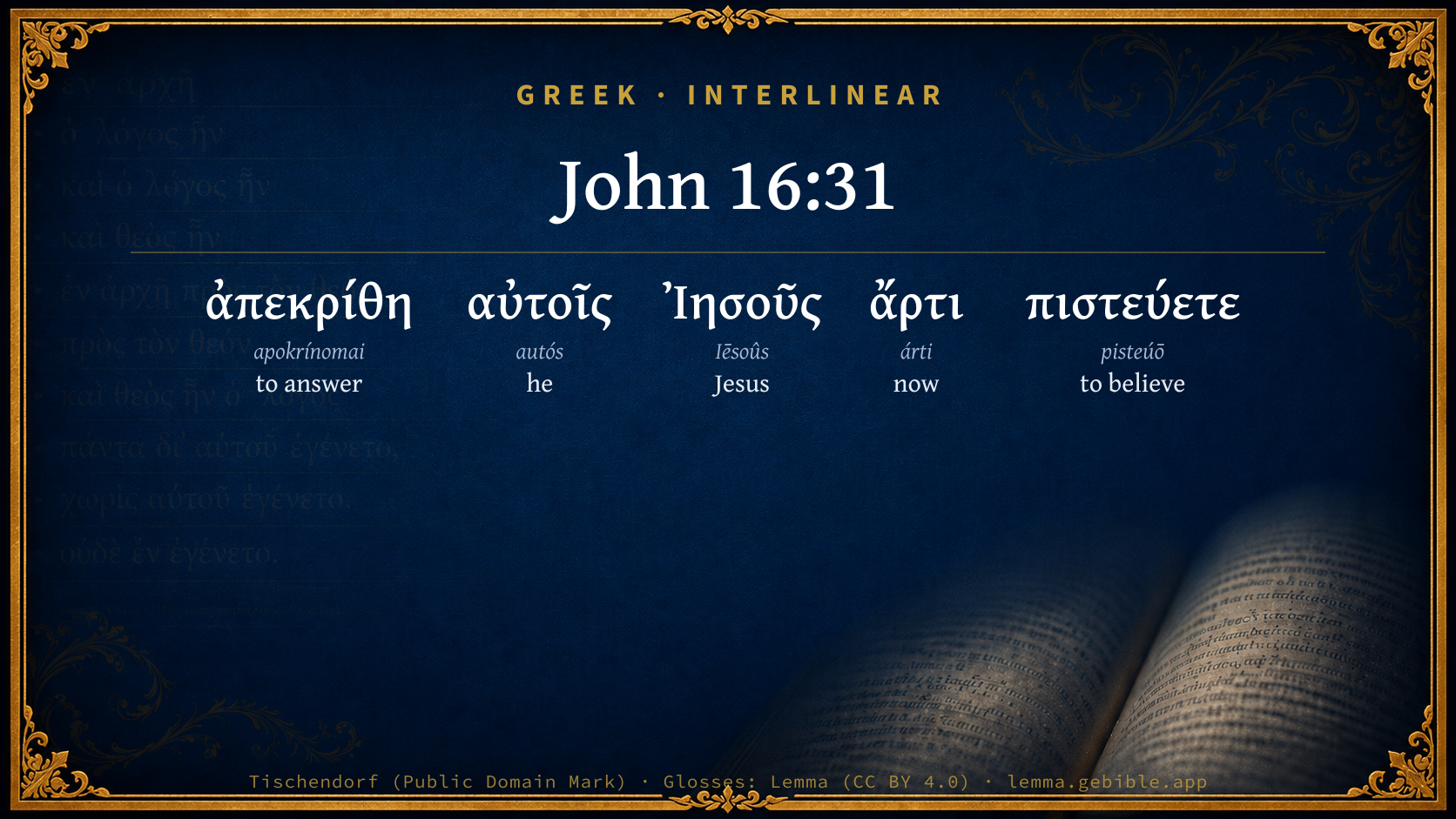
Download image
Cite this verse

John 16:31 (World English Bible). Public Domain. Lemma interlinear Bible study tool, https://lemma.gebible.app/v/john/16/31.

Show BibTeX & RIS
BibTeX
RIS
English Translation
Jesus answered them, "Do you now believe?
World English Bible · Public Domain
Download a study sheet

One document with this verse’s original text, its word-by-word gloss line, the meaning frame, cross-references with their text, attributed commentary, and full source and license credits — printable, and it pastes into notes with its structure intact.

This verse Autodidact and up

Study sheet (.html) Plain text (.txt)

A passage Seminary Student

Up to 50 verses in one chapter. A passage sheet keeps up to 6 commentary sources and 12 cross-references per verse, in the order this page ranks them, and says so on the sheet whenever that leaves anything out. Ask for a single verse and you get the Autodidact verse sheet above.

Everything on this page stays free to read, with no account — the sheet is a download of what is already on screen, not access to it.

Want to remove ads? Support Godless Engineer
Compare translations 3

The same verse in 3 English versions, stacked beneath the original-language interlinear above. Click any original word for its lexicon entry.

Each is an independent rendering of the whole verse — the interlinear is not word-aligned to these translations.

Highlighted words mark where these versions differ — a whole-verse word diff, not a word-by-word alignment.

  • World English Bible Public Domain
    Jesus answered them, "Do you now believe?
  • King James Version Public Domain
    Jesus answered them, Do ye now believe?
  • unfoldingWord Literal Text CC BY-SA 4.0
    Jesus answered them, “Just now do you believe?

unfoldingWord Literal Text — © unfoldingWord, licensed CC BY-SA 4.0. Word-aligned USFM3 via Door43 (git.door43.org/unfoldingWord/en_ult).

Versions to compare (up to 4)

3 of 4 selected

Show all 19 translations

Every available English version of this verse, each an independent rendering of the whole verse.

  • World English Bible Public Domain
    Jesus answered them, "Do you now believe?
  • Berean Standard Bible Public Domain
    “Do you finally believe?” Jesus replied.
  • Majority Standard Bible Public Domain
    “Do you finally believe?” Jesus replied.
  • King James Version Public Domain
    Jesus answered them, Do ye now believe?
  • American Standard Version (1901) Public Domain
    Jesus answered them, Do ye now believe?
  • Revised Version (1885) Public Domain
    Jesus answered them, Do ye now believe?
  • Geneva Bible (1599) Public Domain
    Iesus answered them, Doe you beleeue nowe?
  • Douay-Rheims (1899) Public Domain
    Jesus answered them: Do you now believe
  • Young's Literal Translation Public Domain
    Jesus answered them, `Now do ye believe? lo, there doth come an hour,
  • Literal Standard Version CC BY-SA 4.0
    Jesus answered them, “Now do you believe? Behold, there comes an hour,
  • Unlocked Literal Bible CC BY-SA 4.0
    Jesus answered them, “Do you believe now?
  • unfoldingWord Literal Text CC BY-SA 4.0
    Jesus answered them, “Just now do you believe?
  • Darby Bible Public Domain
    Jesus answered them, Do ye now believe?
  • World Messianic Bible Public Domain
    Yeshua answered them, “Do you now believe?
  • Webster's Bible Public Domain
    Jesus answered them, Do ye now believe?
  • Free Bible Version CC BY-SA 4.0
    “Are you really convinced now?” Jesus asked.
  • Bible in Basic English Public Domain
    Jesus made answer, Have you faith now?
  • Text-Critical English NT CC BY 4.0
    Jesus answered them, “Now do you believe?
  • Tyndale New Testament (1534) Public Domain
    Iesus answered them: Now ye do beleve.

Literal Standard Version (2020), Covenant Press — licensed CC BY-SA 4.0. Text via the HelloAO Bible API (eBible.org). Unlocked Literal Bible (unfoldingWord) — licensed CC BY-SA 4.0. Text via the HelloAO Bible API (eBible.org). unfoldingWord Literal Text — © unfoldingWord, licensed CC BY-SA 4.0. Word-aligned USFM3 via Door43 (git.door43.org/unfoldingWord/en_ult). Free Bible Version, Dr. Jonathan Gallagher — licensed CC BY-SA 4.0. Text via the HelloAO Bible API (eBible.org).

Word by word

More ways to search: Search by grammar → Find every occurrence → Compare this word →

Practice this passage: Drill this verse → Learn its vocabulary →

About this verse

These counts appear in no published source. They are computed here, from the morphology-tagged text and Lemma’s own curated glosses. What Lemma adds →

5
words
5
distinct lemmas
Gospels
section

Shared distinctive vocabulary

ἄρτι now G737 occurs in 32 verses of the Greek New Testament. Also found in:
Cross-references

2

Topical passages linked to John 16:31 in the Treasury of Scripture Knowledge — connected by theme and wording, ordered by reader-vote popularity; previews shown in the World English Bible.

  • Luke 9:44–45 "Let these words sink into your ears, for the Son of Man will be delivered up into the hands of men."
  • John 13:38 Jesus answered him, "Will you lay down your life for me? Most assuredly I tell you, the rooster won't crow until you have denied me three times.

Cross-references courtesy of OpenBible.info (CC BY 4.0).

Commentary

Notes on John 16:31 from classic Christian and Jewish commentators (each source and its license shown beneath its notes). The classic Christian expositions comment on the surrounding passage and are grouped to its opening verse, so a note may address several verses; the Jewish commentaries on the Tanakh (Rashi and others) are per-verse, so they appear only where the commentator wrote on this verse.

Lemma curates 59 commentaries, every one of them public domain or Creative Commons licensed, each selected and text-cleaned for this edition rather than reprinted as found. About our sources →

The Biblical Illustrator

Joseph S. Exell

Joh_16:31

Do ye now believe?

Loves farewell

I. A KIND INQUIRY (Joh_16:31). A question.

1. Authoritative. Put by Him who alone has a right to do so.

2. Necessary. The existence of faith (Joh_9:35; Mar_4:40) the one thing needful (Luk_18:8; Heb_11:6).

3. Urgent. Then the time was short--Christ was on the eve of departure. Now the time is short (1Co_7:29)--The Lord is at hand Php_4:5; Jam_5:8).

4. Personal. The question was addressed to the disciples individually. So must each soul consider and reply for himself.

II. A GENTLE ADMONITION (verse 32). A warning.

1. Startling. Otherwise it would have been worthless.

2. Painful; intimating the fact of their impending desertion: hence suggesting the propriety of examining whether their faith was capable of enduring the coming strain.

3. Softened. Their dispersion would leave Him alone in the hands of His enemies; yet as if to mitigate the blow of this allusion to their apostasy He adds that the Father would be with Him.

III. A CHEERING PREDICTION (verse 33).

1. The blessing. Christ desired that they might have peace. It was His dying legacy (Joh_14:27) and His purpose in all His conversation and labours.

2. The sphere. It could only be secured by vital union with Himself Rom_8:6; Rom_14:17; Eph_2:14; Php_4:7).

IV. A COMFORTING CONSOLATION. Christ had overcome the world

1. For Himself. Hence they need not doubt that He was the Fathers Son and the Saviour of men, or question His ability to support and succour them.

2. For them. If they continued one with Him, in and through Him they would be victorious over all tribulation (Rom_8:37; Rev_7:14).

Lessons:

1. The gentleness of Christ.

2. The weakness of men.

3. The blessedness of faith. (T. Whitelaw, D. D.)

Rebuke and warning

I. THE REBUKE. The words, Do ye now believe? seem to charge the faith, that the disciples had now professed, with a threefold defect

1. That it was late. Why did ye not believe sooner? Have you not had sufficient means of conviction till now?

2. That it was cheap. What does it cost you to believe? What temptation have you to the contrary? Your faith now only lays hold of My promises, and is not at all discouraged by any of your own fears.

3. That it was mistaken. Are you sure that you do believe? Do you not think too indulgently of yourselves? Have you examined your own hearts, and secured the ground of your confidence? A true faith will never be a deserter; but you will by and by desert Me. Perhaps all these three defects were to be found in the present faith of the disciples, at least in some measure: I am sure they are actually and ordinarily found in the faith of common professors.

II. THE WARNING. In the remainder of the text, Behold, the hour cometh, &c., we observe, that, as the disciples crime was the leaving of their Master, so the occasion of that crime was their scattering; and the reason of their scattering was the concern that each of them had for his own. From these two propositions I shall infer

1. That when Christians divide, they leave their Master; and

2. That it is our own things, and not the things of Christ, that make us divide (Rom_16:17-18; Php_2:20-21). (Dean Young.)

The Biblical Illustrator, edited by Joseph S. Exell (c. 1880s–1900s) — public domain. Text from a community e-Sword module.

Bengel's Gnomon

Johann Albrecht Bengel

Joh 16:31. Ἄρτι πιστεύετε, ye now believe)[368] An Epiphonema [Exclamation subjoined after the demonstration of some weighty truth.—Append.] in reference to the whole doctrine of Christ [given utterance to with great gratification of mind.—V. g.] Your faith is ἄρτιος, perfected, suitable or apt. Now I have what I wished (when I said, Believe ye, in ch. Joh 14:1), and still wish, ye believe, Joh 16:30; Joh 16:27; ch. Joh 17:7, “Now (νῦν) they have known that all things whatsoever Thou hast given Me are of Thee;” ch. Joh 20:29, “Blessed are they that have not seen, and yet have believed.” I now proceed forwards. [The Imperative is the prevalent form, wherewith He urges them, from ch. Joh 14:1, until in this passage there results the altogether absolute Indicative.—Not. Crit. As often as aught of the Divine power puts itself forth in a soul, there may be frequently observed a turning point of this kind.—V. g.]

[368] So Lachm. also stops both in the Greek and the Vulgate Latin. The Engl. Vers. and Tisch. less appropriately put an interrogation at πιστεύετε; Do ye now believe?—E. and T.

Bengel's Gnomon of the New Testament — English translation (T&T Clark, Edinburgh, 1860) — public domain. Text from a community e-Sword module.

Meyer's Critical & Exegetical Commentary

Heinrich August Wilhelm Meyer

Joh_16:31-32. Since ἄρτι must bear the emphasis, and since Jesus could not and would not doubt of[184] the faith of the disciples at this moment, ἄρτι πιστ. is not to be taken interrogatively, with Euth. Zigabenus, Calvin, Wetstein, and several others, including Kuinoel, Olshausen, De Wette, B. Crusius, Tischendorf, Hengstenberg, Ewald (according to the analogy of Joh_1:51, Joh_13:38, Joh_20:29), but concessively: Now, just now, ye believe, but how soon will ye become vacillating? οἱ λέγοντες ΠΙΣΤΕΎΕΙΝ ΦΕΎΞΕΣΘΕ ΜΙΚΡῸΝ ὝΣΤΕΡΟΝ, ΚΙΝΗΘΕΊΣΗς ὙΜῶΝ ὙΠῸ ΤΟῦ ΦΌΒΟΥ Τῆς ΠΊΣΤΕΩς, Apollinarius. The faith itself did not pass away (hence there is no contradiction to Joh_16:27, comp. Luk_22:32), but it did not stand the test of self-denial and of heroism. This must first appear in the school of conflict and experience.

ΚΑῚ ἘΛΉΛΥΘΕΝ] so immediately at hand is it.

ἽΝΑ] See on Joh_16:2.

ΕἸς ΤᾺ ἼΔΙΑ] into His own, i.e. His own place of sojourn (Joh_19:27; Plat. Pol. 8, p. 543 B). Opposite of κοινωνία, which is thus rent asunder: ἈΠΌΣΣΥΤΟς ἌΛΛΟς ἈΠʼ ἌΛΛΟΥ, Nonnus, comp. Plat. Gorg. p. 502 E: ἕνεκα τοῦ ἰδίου τοῦ αὑτῶν ὀλιγωροῦντες τοῦ κοινοῦ. On the prediction itself comp. Mat_26:31, and on its fulfilment Mat_26:56.

ΚΑΊ] The emphatic and …, which (with a pause to be supplied in thought) unexpectedly introduces the contrast. See on Joh_7:28.

οὐκ εἰμὶ μόΝΟς, Κ.Τ.Λ.] The calm, clear self-consciousness of the Fathers protection, elevated above all human desertion, comp. Joh_8:29. The momentary feeling which appears in Mat_27:46 is not in conflict with this.

[184] He will not punish them nor discountenance them, as those who are as yet weak and without understanding, but answers them in the most friendly manner, as though He should say: Ye are good pious children, you may probably imagine that you understand and believe, and it is indeed true that you now believe, as you in truth acknowledge from the heart that He went forth from God (which is ever the true faith), but ye know not how it will go, and how weak your faith is, etc., Luther.

Meyer — Critical and Exegetical Commentary on the New Testament — English translation by Peter Christie, edited by Frederick Crombie (T&T Clark, 1880) — public domain. Text from a community e-Sword module.

Expositor's Greek Testament

ed. W. Robertson Nicoll

Joh 16:31 . To this enthusiastic confession Jesus makes the sobering and pathetic reply: Ἄρτι πιστεύετε ; Do ye now believe that I am God’s Representative? Is this your present attitude? ἰδοὺ , ἔρχεται ὥρα καὶ νῦν ἐλήλυθεν , “Behold, the hour is coming and is come,” so imminent is it that the perfect may be used. ἵνα σκορπισθῆτε … ἀφῆτε . Cf. 1Ma 6:54 . ἐσκορπίσθησαν ἔκαστος εἰς τὸν τόπον αὐτοῦ . In Joh 10:12 the wolf σκορπίζει τὰ πρόβατα . Cf. especially Mar 14:27 . εἰς τὰ ἴδια frequently of one’s own house, cf. Joh 19:27 ; Act 21:6 ; Est 5:10 ; Est 6:12 . Here perhaps it is somewhat less definite, “to his own” is better than “to his own house”. It includes “to his own interests,” or “pursuits,” or “familiar surroundings,” or “private affairs,” or all these together. Those whom He had gathered round Him and who believed in Him were yet destined to fail Him in the critical hour, and were to scatter each to his own, for the time abandoning the cause and Person who had held them together, leaving their loved Master (Joh 16:27 ) alone. καὶ οὐκ εἰμὶ μόνος … ἐστι , “and (yet) I am not alone, because the Father is with me”. This presence supplies the lack of all other company. He was destined to lose for a time the consciousness even of this presence, Mat 27:46 .

The Expositor's Greek Testament, edited by W. Robertson Nicoll (1897–1910) — public domain. Text from a community e-Sword module.

Jamieson, Fausset & Brown

Robert Jamieson, A. R. Fausset & David Brown

Jesus answered . . . Do ye now believe?--that is, "It is well ye do, for it is soon to be tested, and in a way ye little expect."

the hour cometh, yea, is now come, that ye shall be scattered, every man to his own, and shall leave me alone; and yet I am not alone--A deep and awful sense of wrong experienced is certainly expressed here, but how lovingly! That He was not to be utterly deserted, that there was One who would not forsake Him, was to Him matter of ineffable support and consolation; but that He should be without all human countenance and cheer, who as Man was exquisitely sensitive to the law of sympathy, would fill themselves with as much shame, when they afterwards recurred to it, as the Redeemer's heart in His hour of need with pungent sorrow. "I looked for some to take pity, but there was none; and for comforters, but I found none" (Psa 69:20).

because the Father is with me--how near, and with what sustaining power, who can express?

Jamieson, Fausset & Brown — Commentary Critical and Explanatory on the Whole Bible (1871) — public domain (CC PDM 1.0). Text via the HelloAO Bible API.

Adam Clarke's Commentary

Verse 31. Do ye now believe?] And will ye continue to believe? Ye are now fully convinced; and will ye in the hour of trial retain your conviction, and prove faithful and steady?

Adam Clarke's Commentary on the Bible (1810–1826) — public domain. Text from a community e-Sword/MySword module.

John Calvin's Commentaries

31. Do you now believe? As the disciples were too highly pleased with themselves, Christ reminds them that, remembering their weakness, they ought rather to confine themselves within their own little capacity. Now, we never are fully aware of what we want, and of our great distance from the fullness of faith, till we come to some serious trial; for then the fact shows how weak our faith was, which we imagined to be full. Christ recalls the attention of the disciples to this matter, and declares that they will ere long forsake him; for persecution is a touchstone to try faith, and when its smallness becomes evident, they who formerly were swelled with pride begin to tremble and to draw back.

The question put by Christ is therefore ironical; as if he had said, “Do you boast as if you were full of faith? But the trial is at hand, which will disclose your emptiness.” In this manner we ought to restrain our foolish confidence, when it indulges itself too freely. But it might be thought, either that the disciples had no faith at all, or that it was extinguished, when they had forsaken Christ, and were scattered in all directions. I reply, though their faith was weakened, and had almost given way, still something was left, from which fresh branches might afterwards shoot forth.

John Calvin's Commentaries (1540-1563) — public domain. Text from the Calvin Translation Society English edition (1840s-50s) via the Christian Classics Ethereal Library (ccel.org). Calvin's coverage is partial (roughly two-thirds of the Bible); uncommented books and verses are honest gaps, never fabricated. The 19th-century editor's footnotes and remarks are omitted so the notes are faithfully Calvin's own voice.

Ellicott's Commentary for English Readers

(31) Jesus answered them, Do ye now believe.—Comp. Note on Joh_1:50. Here, as there, the words do not necessarily ask a question; and, although many expositors prefer to take them interrogatively, a sense more in harmony with the context is got by understanding them as an assertion. Our Lord did not doubt their present faith (Joh_17:8); but He knew that the hour of their full illumination had not yet come, firmly as they believed it had. Their present light was as the flash of the meteor—brilliant, but passing away. The clear and steadfast light of day was in the future, of which He has spoken to them. They think the hour of full knowledge has come. He sees the time when they shall all be scattered and leave Him alone, close at hand. It is this thought which He expresses to them—“Now ye do believe: Behold, the hour cometh . . .”

A Bible Commentary for English Readers, edited by Charles John Ellicott (1878–1897) — public domain. Text from a community e-Sword module.

The Cambridge Bible for Schools and Colleges

gen. ed. J. J. S. Perowne

31. Do ye now believe?] The words are only half a question (comp. Joh_20:29). The belief of which they are conscious is no illusion, but it is not yet as perfect as they in their momentary enthusiasm suppose. ‘Now’ means ‘at this stage of your course;’ it is not the word used by the Apostles (Joh_16:29-30), but another of which S. John makes much use. The one (nûn) regards the present moment only, ‘now’ absolutely; the other (arti) regards the present in relation to the past and future, ‘at this crisis.’ Comp. Joh_16:12, Joh_13:7; Joh_13:19; Joh_13:33; Joh_13:37, &c.

The Cambridge Bible for Schools and Colleges (gen. ed. J. J. S. Perowne; Cambridge University Press, 1878–1918) — public domain. Text from a community e-Sword module.

Trapp's Complete Commentary

John Trapp

31 Jesus answered them, Do ye now believe?

Ver. 31. Do ye now believe?] I know, ere trouble comes, you are jolly fellows. But it is easy to swim in a warm bath: and every bird can sing in a sunshine day. We shall see shortly what you can do. "If ye faint in the day of adversity, your strength is small," Pro 24:10. Hard weather tries what health; hot service, what courage.

John Trapp, A Commentary or Exposition upon All the Books of the Old and New Testament (1647–1656) — public domain. Text from a community e-Sword module.

Albert Barnes' Notes on the Bible

Do ye now believe? - Do you truly and really believe? This question was evidently asked to put them on a full examination of their hearts. Though they supposed that they had unshaken faith - faith that would endure every trial, yet he told them that they were about to go through scenes that would test them, and where they would need all their confidence in God. When we feel strong in the faith we should examine ourselves. It may be that we are deceived; and it may be that God may even then be preparing trials for us that will shake our faith to its foundation. The Syriac and Arabic read this in the indicative as an affirmation - “Ye do now believe.” The sense is not affected by this reading.

Albert Barnes' Notes on the Bible (1834–1885) — public domain. Text from a community e-Sword/MySword module.

Matthew Poole's English Annotations

Some read the words, (not as a question), You do now believe. It is well you believe at last, you had reason enough to have believed before this time.

Matthew Poole's English Annotations on the Holy Bible (1683–1685) — public domain. Text from a community e-Sword/MySword module.

Whedon's Commentary on the Bible

Daniel D. Whedon

31. Do ye now believe?—The best commentators now agree that the words should be rendered not interrogatively but affirmatively—Ye do now believe. Jesus admits their faith.

Daniel D. Whedon (gen. ed.), Commentary on the Old and New Testaments (1874–1909) — public domain. Text from a community e-Sword module.

The Pulpit Commentary

Jesus answered them, Now, at this stage in my self-revelation, do ye believe? It seems as though the whole of Christ"s ministry turns on their acceptance of his claims. If he should pass from the world and return to the Father, and leave behind him none who had discovered and become intensely convinced of his Divine nature, the whole work he had done would be, humanly speaking, a failure. An almost womanlike passion of desire breathes through the inquiry, "Do ye now believe?" or, as some commentators (Gorier and Meyer) translate it indicatively, "Now ye believe." There is truly no essential difference whether it be taken interrogatively or indicatively. Both forms mean, "I have at length brought you to the point of faith. The kingdom of God is now established, and the prince of this world cast out. But a terrible trial awaits the new-born faith." Christ had warned them of the treachery of the absent one, of the approaching denial of the foremost of their number, and he now gives them another warning of the severity of the trial which awaited them all. The power and permanence of their faith may be open to doubt, but not its essential quality. Their faith may not stand firm on that awful night, but it will ultimately prevail, and Christ rejoices in the fact that his words have at last evoked this genuine response. In the prayer which follows (Joh_17:8) he thanks God "that they have known verily that I came forth from thee, and have believed that thou hast sent me.

Vers. 31-33. The faith now acknowledged was destined to be severely tried.

I THE FAITH OF THE DISCIPLES WAS GENUINE, BUT INCOMPLETE. "Now ye believe.

1. Trial is needed to test the existence and strength of faith.

2. It was a mark of our Lords love and wisdom to warn the disciples of coming trial.

3. Their desertion of their Master here foretold must have been incredible to their minds. "Behold, the hour cometh... that ye shall be scattered every man to his own, and shall leave me alone.

(1) The thought must have been painful to our Lord.

(2) The desertion was foretold in Old Testament Scripture. (Zec_13:7)

(3) The prediction almost implies in it the pardon beforehand of their weakness and unfaithfulness.

4. Our Lord had a consolation in prospect of their desertion. "And yet I am not alone, because the Father is with me.

II THE DESIGN OF OUR LORD"S PARTING ADDRESS TO HIS DISCIPLES. "These things have I spoken unto you, that in me ye might have peace.

1. The precious legacy of Christ to his people is peace.

(1) It is peace by the cross. (Col_1:20)

(2) It is peace perfectly consistent with severe trial, sore affliction, and bloody persecution. "In the world ye shall have tribulation.

(3) It is peace in himself.

2. The guarantee of peace. "Be of good cheer; I have overcome the world.

(1) The world is the center of disturbance to the peace of God"s people. It is the sphere of tribulation.

(2) The summons to have "good courage" suggests the faith which is to have overcoming rower. "This is the victory that overcometh the world, even our faith". (1Jn_5:4)

Christ alone, and not alone.

Notice

I CHRIST ALONE. "Shall leave me alone." Through the great tragedy which followed, of which Gethsemane was but a short prelude, and of which the visible was but a small part, Christ, as far as this world was concerned, was alone.

1. He was socially alone. He could really say, "And of the people there was none with me." The world was against him, and even the existing Church was against him, its chief magnates being the ringleaders in his crucifixion. And, more than all, he was alone as to the adherence of his most faithful followers, which he might naturally expect and would so much appreciate. At this very time one of them was in the city betraying him to his most inveterate foes; another was about to deny him in the most determined manner; all were about to leave him in terror. So that from Gethsemane to the cross he was socially alone alone amidst such a vast throng of men.

2. He was mentally alone. He was ever so. Even when his disciples were with him, his mental conceptions towered above them; they could not understand his thoughts, comprehend fully his mission in the world, nor grasp the meaning of his life and death. The Baptist, who hitherto had the highest conception of him when he exclaimed, "Behold the Lamb of God!" was gone, and even the few glimpses which his disciples caught of his scheme were now extinguished. His mind had no associate, and there was no mental reciprocity between him and any human being. He stood in the world of thought the lonely Thinker.

3. He was spiritually alone. He was the only sinless Being in the world, and there was not a single soul in full spiritual harmony with his. His disciples still clung to the idea of a temporal kingdom. Peter manifested his sympathy in a clumsy attempt to fight his foes with a sword, which was to him a greater insult than help. And even the wail of the tender-hearted women at the cross was misapplied, lacked spiritual virtue, and did not rhyme with the agonizing wail of his soul for sin. In the yearnings and. struggles of his holy nature, and the spiritual conceptions and purposes of his heart, he stood the lonely King and Savior.

4. To a great extent he was necessarily alone. In a great portion of his work no one could help. He drank a cup of which no one could drink a drop, and carried a burden of which no one could carry an atom the cup of our curse and the burden of our sin. When making an atonement, satisfying justice and honoring Law, and manifesting Divine love in sacrifice, he was necessarily alone. He fought the powers of darkness, vanquished death and the prince of this world in a single combat. He trod the wine-press alone. No one could help him, and he did not expect it. But he expected the allegiance of his friends. But even this was denied him for a time, not for want of genuine love, but for want of intelligent and courageous faith and self-sacrificing adherence and spiritual discernment. He does not complain of this; still, he keenly felt it, and it pained him. What pain was it?

(1) The pain of perfect and tender sociality at being alone. To be left alone would not affect an unsocial hermit, a cold misanthrope; such would be in their element. But Jesus was the most social of beings; he would associate with the poor, and would appreciate the least kindness. The desertion of friends would specially pain such a nature.

(2) The pain of perfect humanity in the total absence of genuine sympathy in suffering. It is not more natural for the thirsty flower to look to heaven for its dew than for man to look to his friend for sympathy in suffering. But this was denied Jesus. When he cried," I thirst," there was only the rough and unsympathetic hand of a foreigner to give him a sip of drink.

(3) The pain which perfect benevolence feels at ingratitude. He felt this with regard to the nation, and with regard to hundreds in that crowd whom he had personally benefited, and all of whom he had sought to benefit; but especially with regard to his disciples, whom he had loved, and loved to the end. But they deserted him while fighting their battle and the battle of the world.

(4) The pain of an absolutely pure and loving being at the terrible and universal sinfulness and selfishness which his loneliness indicated. He was face to face with this as he was never before. From it there was not so much as a weak disciple to shelter him. "Every man to his own," and he alone for all.

(5) The pain of perfect sympathy with the weakness of friends, lie loved them still. Hence the special pain caused by their desertion. The betrayal of Judas was to him more poignant than the nails of steel, the denial of Peter keener than the spear of the Roman, and the flight of his friends more painful than all the cruel treatment of his foes.

II CHRIST NOT ALONE. "Yet I am not alone, because the Father," etc. Tie had the fellowship of his Father.

1. This fellowship was essential. Being one in nature and essence, nothing could separate him from this. It was one of the special and essential privileges of nature and relationship.

2. This fellowship was deserved, and bestowed upon him as a Divine favor for his perfect obedience. It was not interrupted by his incarnation, but fully enjoyed by him in human nature and under human conditions. It was the reward of his voluntary sacrifice and his perfection as a Mediator and the Author of eternal salvation. He did nothing to forfeit it, but everything to deserve and secure it in the fullest measure.

3. This fellowship was continuous and unbroken. It is not "The Father was," or "will be," but "is with me with me now and always. He was fully conscious of his Father"s cheering and smiling presence in every emotion he felt, every thought he conceived, every word he uttered, every purpose he executed, every act he performed, and in every suffering he bore. His whole life was such a manifestation of his Father"s character and love, such an execution of his will and purposes, that he was ever conscious of his loving and approving fellowship. It is true that at that darkest moment on the cross he exclaimed, "My God, my God," etc. the full meaning of which we probably can never know. When drinking the very dregs of the cup of our curse, he could not describe his experience better than by saying that he felt as if the Father had for a moment hid his face from him. But he was still conscious of his fellowship, addressed him as his God, and soon committed his Spirit unto his loving care.

4. This fellowship was to him now specially sweet and precious. It was ever precious, but specially so now. He could not bear the opposition of foes, and especially the desertion of friends, were it not for the continued fellowship of the Father. And who can render such help and solace in the hour of trial as an able and a kind father? Jesus, the most lonely of human beings, especially now, was yet not alone; deserted by the best human fellowship, he still enjoyed the Divine, and the human desertion made the Divine all the more precious and sweet. This was his support in trial, his light in darkness, and his safety from utter loneliness. He enjoyed the best and Divinest society.

LESSONS.

1. There was one thing which neither friends nor foes could do to Jesus, viz. deprive him of Divine fellowship. From the greatest human loneliness he could say, "I am not alone, because the Father is with me." Neither earth nor hell can interfere with Divine fellowship with regard to Jesus or believers.

2. We should not be disappointed or despair if in the hour of trial we are deserted by the best of friends. Think of Jesus.

3. True fellowship with the Father by faith in Christ can only preserve us from utter loneliness. We can bear every loneliness but that in relation to our Father.

4. When deserted by friends and by all, God comes nearest to us. The least of man the most of God, often; furthest from earth the nearest to heaven.

5. The fellowship of the Father will more than compensate for all the desertions of earth. One day in his courts is better than a thousand. 6..Let us cultivate the fellowship of Christ, especially in his loneliness, then we shall enjoy with him the fellowship of his -Father. Let us prepare for human desertions, for they will certainly come; but let them come upon us in the best society that of the Father. To be left alone by him is the most horrible loneliness, but his fellowship will be sufficient in all circumstances, even in death itself. B.T.

The Pulpit Commentary (1880–1919), ed. H.D.M. Spence-Jones & Joseph S. Exell — public domain. Text from a community e-Sword module.

Burkitt's Expository Notes on the New Testament

William Burkitt

In the foregoing verse, the apostles made a full profession of their faith in Christ’s divinity, and in Christ’s omnipotency: Now are we sure that thou knowest all things, and that thou camest forth from God.

In this verse Christ intimates to them that their faith should be put to a great trial very shortly, namely, when his sufferings came on: and that then they should all forsake him, and take care of themselves: Ye shalt be scattered and leave me alone.

Learn hence, 1. That Christ was forsaken and left alone by his own disciples in the day of his greatest distress and danger.

2. That when the disciples left Christ, they were scattered every one to his own.

3. That when all forsook Christ, and left him alone, he was far from being simply alone, because God was with him: Ye shall leave me alone, and yet I am not alone, because the Father is with me.

God was with Christ, and will be with Christians, in a suffering hour, in his essential presence, in his gracious and supporting presence: He that sent me, says Christ, is with me: the Father hath not left me alone: for I do always those things that please my Father.

William Burkitt's Expository Notes on the New Testament (1700–1703) — public domain. Text from a community e-Sword module.

The People's New Testament

B. W. Johnson

31, 32. Do ye now believe? The disciples had just asserted that they did, because they thought they understood him, but before morning their faith would give way and, instead of clinging to him in the hour of trial, they would leave him alone.

B. W. Johnson's The People's New Testament with Notes (1889–1891) — public domain. Electronic text from the Christian Classics Ethereal Library (CCEL) ThML edition.

Cambridge Greek Testament for Schools and Colleges

31. ἄρτι πιστεύετε; The words are only half a question: comp. Joh 1:51, Joh 20:29. The belief of which they are conscious is no illusion, but it is far more defective than they in their momentary enthusiasm suppose. Ἄρτι means ‘at this stage of your course:’ contrast νῦν (Joh 16:29-30) and see on Joh 2:10.

Cambridge Greek Testament for Schools and Colleges (Cambridge University Press, 1896; 21 vols, various authors incl. Carr, Maclear, Plummer, Farrar, Lumby, Moule, M. R. James, Simcox) — public domain. Text from a community e-Sword module.

Alford’s Greek Testament

Henry Alford

31.] Our Lord does not clear up their misunderstanding, but leaves that for the coming day of the Spirit. He only assures them that their belief, though sincere and loving, was not so deeply grounded in knowledge of Him and His appointed course as they imagined.

ἄρτι πιστ. is not a question: this very belief was by our Lord recognized and commended, see ch. 17:8, also Mat 16:17, Mat 16:18. And as Stier remarks (v. 369, edn. 2), “it was the aim and purpose of the whole prophetic office of Jesus, to prepare some first disciples (not the Apostles alone) for the reception of the Spirit of Truth and the fruits of His Death, by grounding in them firm belief in His Person.” He therefore recognizes their faith; but shews them how weak it as yet was.

Henry Alford, The Greek Testament (1849–1861) — public domain. Text from a community e-Sword module.

International Critical Commentary

31. The form of the reply of Jesus is comparable with that in 13:38, the disciples’ expression of confidence being repeated, and then a warning given. Here, however, the reply does not begin with an interrogative. The stress is on ἄρτι, coming at the beginning of the sentence (cf. Rev 12:10).

ἄρτι πιστεύετε, “at this moment you believe.” He had just before recognised their belief as genuine, so far as it went (v. 27; cf. 17:8), and He does not question it now. But He goes on to warn them that this faith will not keep them faithful in the time of danger which is imminent.

To translate “Do ye now believe?” is inconsistent with what has gone before, and also with the position of ἄρτι in the sentence.

For ἄρτι as compared with νῦν, see on 9:19.

International Critical Commentary — older volumes (1896–1929), various authors — public domain. Text from a community e-Sword module.

Vincent's Word Studies in the New Testament

Marvin R. Vincent

Now [αρτι] . See on 13 33. With reference to the coming time of greater trial.

Marvin R. Vincent, Word Studies in the New Testament (1887–1900) — public domain. Text from a community e-Sword/MySword module.

Godet's Commentaries

Frédéric Louis Godet

Vv. 31-33. “Jesus answered them: Now you believe. 32. Behold, the hour is coming, and is now come, when you shall be scattered every one to his own home, and when you shall leave me alone; but I am not alone, because the Father is with me. 33. I have said these things to you, that in me you may have peace; in the world you shall have tribulation; but be of good courage, I have overcome the world.”

Here is for Jesus a moment of unutterable sweetness; He is recognized and understood—He Jesus—by these eleven Galileans. This is for Him enough; His work is for the moment ended; the Holy Spirit will finish it by glorifying Him in them, and through them in mankind. There remains nothing further for Him but to close the conversation and give thanks. John alone understood the greatness of this moment, and has preserved for us the remembrance of it. The words: Now you believe, must not therefore be understood in an interrogative, and in some sort ironical sense, as if Jesus would call in question the reality of their faith. I do not think even that ἄρτι, now, forms a contrast with the very near want of fidelity to which Jesus is about to allude, as if He would say: “True, you believe now; but in a short time, how will you be acting!” Could Jesus, in ch. 17, give thanks to His Father with such outpouring of heart for a faith which He had just characterized in such a way? Comp. especially Joh 17:8 : “They have known truly (ἀληθῶς) that I came out from thee, and they have believed that thou didst send me,” words in which Jesus certainly alludes to our Joh 16:30. The word now, therefore, seems to me rather to mean here: “Now at last you have reached the point to which I have been laboring to lead you: you have recognized me for what I am, and have received me as such.”

The connection in Joh 16:32 is not a but; it is a simple no doubt; in Joh 16:33 will be found the final but answering to this no doubt. This scarcely formed faith is about to be subjected, it is true, to a severe test; the bond will be broken, at least externally. But the spiritual bond will remain firm and will triumph over this trial and all others.

The νῦν, now, which we have rendered by already, is omitted by the Alexandrian authorities; it may have been rejected because it seemed that the moment indicated was not yet present.

The first aorist passive σκορπισθῆτε, you shall be scattered, is more suited to extenuate than to aggravate the fault of the disciples; it is, as it were, a violent blow which will strike and stun them. These words recall the quotation from Zechariah in the Synoptics: “I will smite the shepherd, and the sheep shall be scattered” (Mat 27:31). It is in the following words: “you will leave me alone,” that the idea of culpable desertion is expressed, but in the tone of sadness rather than of reproach.— ῞Εκαστος εἰς ἴδια, each one to his own; each to his respective abode. Weiss finds in this expression the idea of the breaking off of the communion between them, as a sign of the shaking of their faith in the Messiah. It indicates rather the seeking of a secure shelter, far from the danger which touches their Master.— Καί, evidently in the adversative sense: and yet.

Frédéric Louis Godet — Commentaries on Luke, John, Romans, and 1 Corinthians — English translation (T&T Clark, Edinburgh, 1870s–1890s) — public domain. Text from a community e-Sword module.

Lesson kit

Teaching starters — assembled from the data on this page, not authored interpretation. Every prompt links to the verse data it draws on. Edit before teaching.

John, in the Gospels, opens this verse with 5 words (5 distinct Greek lemmas). Its most distinctive word is árti (“now”). A historical commentator’s framing appears above. Read the whole chapter for the surrounding context.

Discussion questions

  1. How does “now” (árti) shape what this verse is saying?
  2. Matthew 3:15 shares the word «now» with this verse. How do the two illuminate each other?
  3. These translations render this verse differently; the difference is in the English rendering, not the original. What questions does that raise?
  4. Reading how The Biblical Illustrator and Bengel's Gnomon read this verse, where do the two commentators agree and where do they part?

Things to notice

Reading settings

Reading text

Shown beneath each verse's original-language words.

Old Testament
Old Testament edition

Read the OT as the Masoretic Hebrew (MT) or the Greek Septuagint (LXX).

English shown for the Greek Septuagint (in the Hebrew ↔ Greek comparison).

Comparing translations? Open the Compare panel on any verse page to stack up to four side by side.