
Joshua 14:7

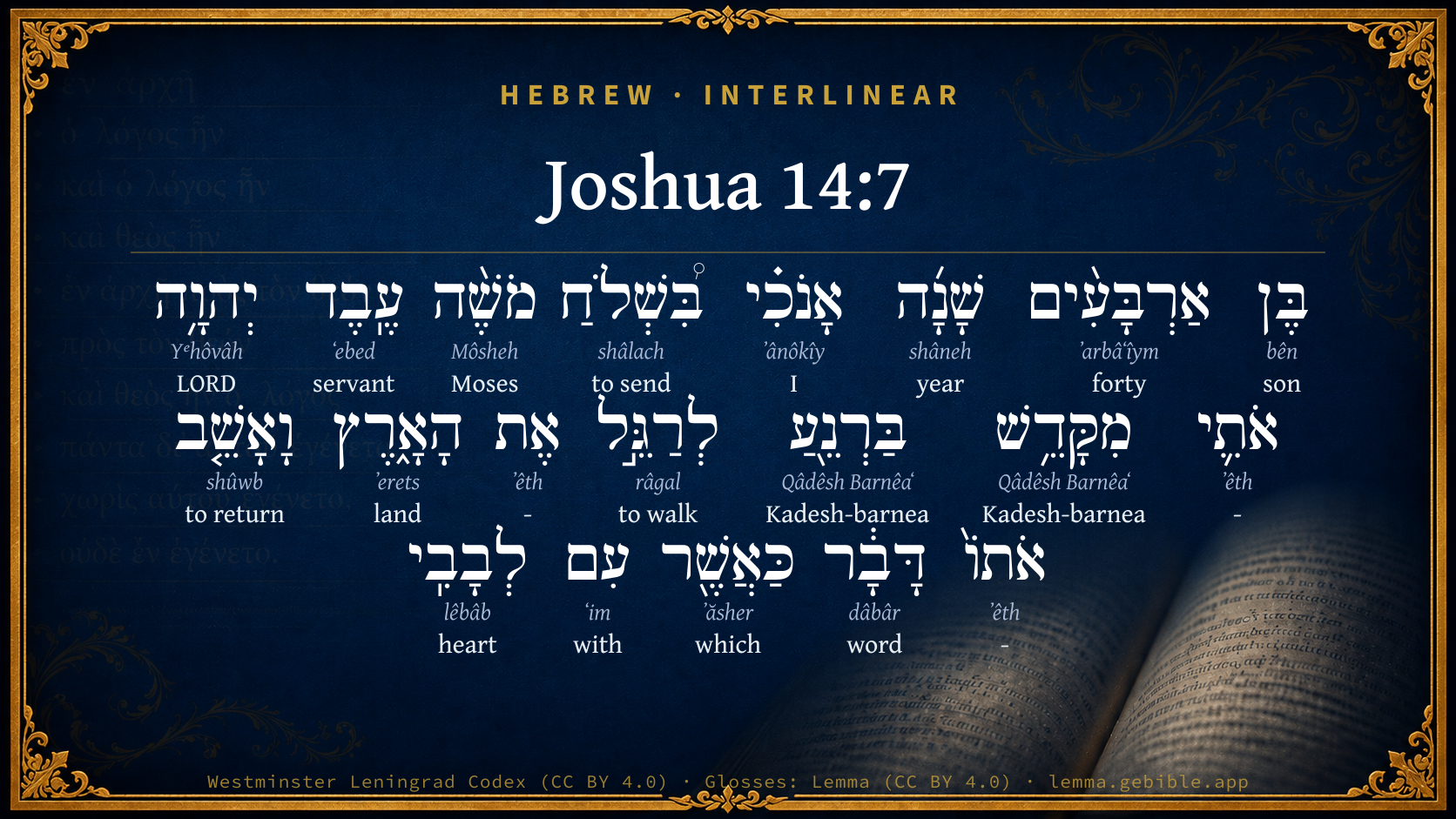
Hebrew (Westminster Leningrad Codex) Joshua 14:7 appears in the Hebrew Old Testament. The text above is from the Westminster Leningrad Codex. Each word links to its Strong’s number, a concise gloss, and parsing drawn from the Open Scriptures Hebrew Bible morphology. Click any word for its full Brown-Driver-Briggs (BDB) entry.
Download image
Cite this verse

Joshua 14:7 (World English Bible). Public Domain. Lemma interlinear Bible study tool, https://lemma.gebible.app/v/joshua/14/7.

Show BibTeX & RIS
BibTeX
RIS
English Translation
Forty years old was I when Moses the servant of Yahweh sent me from Kadesh-barnea to spy out the land; and I brought him word again as it was in my heart.
World English Bible · Public Domain
Download a study sheet

One document with this verse’s original text, its word-by-word gloss line, the meaning frame, cross-references with their text, attributed commentary, and full source and license credits — printable, and it pastes into notes with its structure intact.

This verse Autodidact and up

Study sheet (.html) Plain text (.txt)

A passage Seminary Student

Up to 50 verses in one chapter. A passage sheet keeps up to 6 commentary sources and 12 cross-references per verse, in the order this page ranks them, and says so on the sheet whenever that leaves anything out. Ask for a single verse and you get the Autodidact verse sheet above.

Everything on this page stays free to read, with no account — the sheet is a download of what is already on screen, not access to it.

Want to remove ads? Support Godless Engineer
Compare translations 3

The same verse in 3 English versions, stacked beneath the original-language interlinear above. Click any original word for its lexicon entry.

Each is an independent rendering of the whole verse — the interlinear is not word-aligned to these translations.

Highlighted words mark where these versions differ — a whole-verse word diff, not a word-by-word alignment.

  • World English Bible Public Domain
    Forty years old was I when Moses the servant of Yahweh sent me from Kadesh-barnea to spy out the land; and I brought him word again as it was in my heart.
  • King James Version Public Domain
    Forty years old was I when Moses the servant of the LORD sent me from Kadeshbarnea to espy out the land; and I brought him word again as it was in mine heart.
  • unfoldingWord Literal Text CC BY-SA 4.0
    I a son of 40 years when Moses, the servant of Yahweh, sent me from Kadesh Barnea to spy on the land. And I brought back word to him just as in my heart.

unfoldingWord Literal Text — © unfoldingWord, licensed CC BY-SA 4.0. Word-aligned USFM3 via Door43 (git.door43.org/unfoldingWord/en_ult).

Versions to compare (up to 4)

3 of 4 selected

Show all 18 translations

Every available English version of this verse, each an independent rendering of the whole verse.

  • World English Bible Public Domain
    Forty years old was I when Moses the servant of Yahweh sent me from Kadesh-barnea to spy out the land; and I brought him word again as it was in my heart.
  • Berean Standard Bible Public Domain
    I was forty years old when Moses the servant of the LORD sent me from Kadesh-barnea to spy out the land, and I brought back to him an honest report.
  • Majority Standard Bible Public Domain
    I was forty years old when Moses the servant of the LORD sent me from Kadesh-barnea to spy out the land, and I brought back to him an honest report.
  • King James Version Public Domain
    Forty years old was I when Moses the servant of the LORD sent me from Kadeshbarnea to espy out the land; and I brought him word again as it was in mine heart.
  • American Standard Version (1901) Public Domain
    Forty years old was I when Moses the servant of Jehovah sent me from Kadesh-barnea to spy out the land; and I brought him word again as it was in my heart.
  • Revised Version (1885) Public Domain
    Forty years old was I when Moses the servant of the LORD sent me from Kadesh-barnea to spy out the land; and I brought him word again as it was in mine heart.
  • Geneva Bible (1599) Public Domain
    Fourtie yeere olde was I, when Moses the seruant of the Lord sent me from Kadesh-barnea to espie the land, and I brought him word againe, as I thought in mine heart.
  • Douay-Rheims (1899) Public Domain
    I was forty Bears old when Moses the servant of the Lord sent me m from Cadesbarne, to view the land, and I brought him word again as to me seemed true.
  • Young's Literal Translation Public Domain
    a son of forty years `am' I in Moses, servant of Jehovah, sending me from Kadesh-Barnea, to spy the land, and I bring him back word as with my heart;
  • Literal Standard Version CC BY-SA 4.0
    I [was] a son of forty years in Moses, servant of YHWH, sending me from Kadesh-Barnea, to spy out the land, and I bring him back word as with my heart;
  • Unlocked Literal Bible CC BY-SA 4.0
    I was forty years old when Moses the servant of Yahweh sent me from Kadesh Barnea to spy on the land. I brought him a report again as it was in my heart to make.
  • unfoldingWord Literal Text CC BY-SA 4.0
    I a son of 40 years when Moses, the servant of Yahweh, sent me from Kadesh Barnea to spy on the land. And I brought back word to him just as in my heart.
  • Darby Bible Public Domain
    Forty years old was I when Moses the servant of Jehovah sent me from Kadesh-barnea to search out the land; and I brought him word again as it was in my heart.
  • World Messianic Bible Public Domain
    I was forty years old when Moses the servant of the LORD sent me from Kadesh Barnea to spy out the land. I brought him word again as it was in my heart.
  • Webster's Bible Public Domain
    Forty years old was I when Moses the servant of the LORD sent me from Kadesh-barnea to explore the land; and I brought him word again as it was in my heart.
  • Free Bible Version CC BY-SA 4.0
    I was forty when Moses, the servant of God, sent me from Kadesh-barnea to spy out the land. When I returned I told the truth in my report.
  • Bible in Basic English Public Domain
    I was forty years old when Moses, the servant of the Lord, sent me from Kadesh-barnea to make a search through the land; and the account which I gave him was in keeping with his desire.
  • JPS Tanakh (1917) Public Domain
    Forty years old was I when Moses the servant of the LORD sent me from Kadesh-barnea to spy out the land; and I brought him back word as it was in my heart.

Literal Standard Version (2020), Covenant Press — licensed CC BY-SA 4.0. Text via the HelloAO Bible API (eBible.org). Unlocked Literal Bible (unfoldingWord) — licensed CC BY-SA 4.0. Text via the HelloAO Bible API (eBible.org). unfoldingWord Literal Text — © unfoldingWord, licensed CC BY-SA 4.0. Word-aligned USFM3 via Door43 (git.door43.org/unfoldingWord/en_ult). Free Bible Version, Dr. Jonathan Gallagher — licensed CC BY-SA 4.0. Text via the HelloAO Bible API (eBible.org).

Word by word

More ways to search: Search by grammar → Find every occurrence → Compare this word →

Practice this passage: Drill this verse → Learn its vocabulary →

מִקָּדֵ֥שׁ
Qâdêsh Barnêaʻ
H6947
“from · Kadesh-barnea”
Preposition + Noun, Proper
Part of Speech
Preposition + Noun
Type
Proper
Full BDB Definition

Origin: from the same as H6946 and an otherwise unused word (apparently compounded of a correspondent to H1251 and a derivative of H5128 ) meaning desert of a fugitive

TWOT: None

Kadesh-barnea = "holy" - a city in the extreme south of Judah - same as 'Kedesh' and 'Kadesh'
  1. בֶּן bên H1121 “son of” Noun, Common, Masculine, Singular, Construct
  2. אַרְבָּעִ֨ים ʼarbâʻîym H705 “forty” Adjective, Cardinal number, Both, Plural, Absolute
  3. שָׁנָ֜ה shâneh H8141 “year” Noun, Common, Feminine, Singular, Absolute
  4. אָנֹכִ֗י ʼânôkîy H595 “I” Pronoun, Personal, 1st Person, Common, Singular
  5. בִּ֠שְׁלֹחַ shâlach H7971 “in/at · to send” Preposition + Verb, Qal, Infinitive Construct
  6. מֹשֶׁ֨ה Môsheh H4872 “Moses” Noun, Proper
  7. עֶֽבֶד ʻebed H5650 “servant of” Noun, Common, Masculine, Singular, Construct
  8. יְהוָ֥ה Yᵉhôvâh H3068 “LORD” Noun, Proper
  9. אֹתִ֛י ʼêth H853 “- · me” Particle, Direct Object + Suffix, Personal, 1st Person, Common, Singular
  10. בַּרְנֵ֖עַ Qâdêsh Barnêaʻ H6947 “Kadesh-barnea” Noun, Proper
  11. לְרַגֵּ֣ל râgal H7270 “to walk” Preposition + Verb, Piel, Infinitive Construct
  12. אֶת ʼêth H853 “-” Particle, Direct Object
  13. הָאָ֑רֶץ ʼerets H776 “the · land” Particle, Definite Article + Noun, Common, Both, Singular, Absolute
  14. וָאָשֵׁ֤ב shûwb H7725 “and · to return” Conjunction + Verb, Hiphil, Sequential Imperfect, 1st Person, Common, Singular
  15. אֹתוֹ֙ ʼêth H853 “- · him” Particle, Direct Object + Suffix, Personal, 3rd Person, Masculine, Singular
  16. דָּבָ֔ר dâbâr H1697 “word” Noun, Common, Masculine, Singular, Absolute
  17. כַּאֲשֶׁ֖ר ʼăsher H834 “like/as · which” Preposition + Particle, Relative
  18. עִם ʻim H5973 “with” Preposition
  19. לְבָבִֽי lêbâb H3824 “heart · my” Noun, Common, Masculine, Singular, Construct + Suffix, Personal, 1st Person, Common, Singular

About this verse

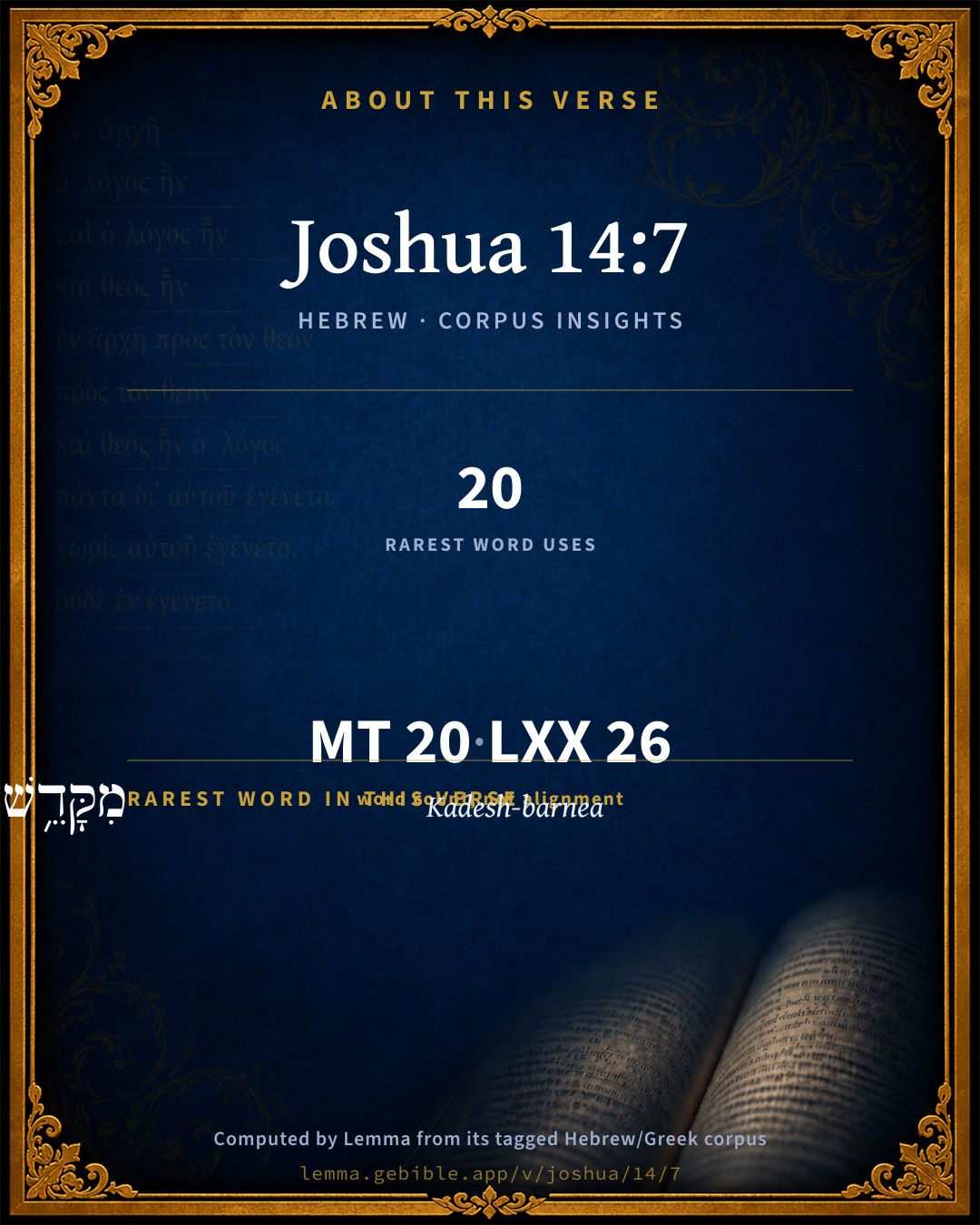
These counts appear in no published source. They are computed here, from the morphology-tagged text and Lemma’s own curated glosses. What Lemma adds →

20
words
17
distinct lemmas
Historical
section

Notable vocabulary

The rarest word here is מִקָּדֵ֥שׁ Kadesh-barnea H6947 — appearing just 20 times in the whole Hebrew Bible.

Shared distinctive vocabulary

מִקָּדֵ֥שׁ Kadesh-barnea H6947 occurs in 10 verses of the Hebrew Bible. Also found in:

Grammatical profile

  • 3 verbs
  • 10 nouns
  • 1 adjective
  • 1 pronoun
  • 1 preposition
  • 4 particles

Verb forms

  • בִּ֠שְׁלֹחַ Qal · Infinitive Construct
  • לְרַגֵּ֣ל Piel · Infinitive Construct
  • וָאָשֵׁ֤ב Hiphil · Sequential Imperfect

Repetition

A word recurs within this verse — often emphatic in Hebrew:

  • מִקָּדֵ֥שׁ Kadesh-barnea H6947 ×2

Hebrew & Septuagint length

In English translation the verse runs 32 words from the Hebrew and 33 from the Septuagint (LXX English) — closely comparable.

A rough comparison of the two English renderings, which tokenize alike — not a word-level alignment.

Word counts can differ between the Hebrew and the Greek without any difference in meaning — e.g. the Hebrew direct-object marker אֵת has no separate Greek word, and Greek often adds the article ὁ.

In the original languages it is 20 Hebrew tokens and 26 Greek tokens — but the two are counted differently (Hebrew bundles its prefixes and suffixes into one token; the Greek is in lemma form), so that isn’t a like-for-like length.

Cross-references

4

Topical passages linked to Joshua 14:7 in the Treasury of Scripture Knowledge — connected by theme and wording, ordered by reader-vote popularity; previews shown in the World English Bible.

  • Numbers 13:6 Of the tribe of Judah, Caleb the son of Jephunneh.
  • Numbers 13:16–20 These are the names of the men who Moses sent to spy out the land. Moses called Hoshea the son of Nun Joshua.
  • Numbers 13:26–33 They went and came to Moses, and to Aaron, and to all the congregation of the children of Israel, to the wilderness of Paran, to Kadesh; and brought back word to them, and to all the congregation, and shown them the fruit of the land.
  • Numbers 14:6–10 Joshua the son of Nun and Caleb the son of Jephunneh, who were of those who spied out the land, tore their clothes:

Cross-references courtesy of OpenBible.info (CC BY 4.0).

Hebrew and Greek witnesses Masoretic Hebrew ↔ Greek Septuagint

The same verse in the two great witnesses to the Old Testament, shown verse-for-verse.

These are two independent witnesses, not word-aligned to each other, and the Septuagint is shown in lemma (dictionary) form.

Hebrew Joshua 14:7 Masoretic · Westminster Leningrad Codex

בֶּן אַרְבָּעִ֨ים שָׁנָ֜ה אָנֹכִ֗י בִּ֠שְׁלֹחַ מֹשֶׁ֨ה עֶֽבֶד יְהוָ֥ה אֹתִ֛י מִקָּדֵ֥שׁ בַּרְנֵ֖עַ לְרַגֵּ֣ל אֶת הָאָ֑רֶץ וָאָשֵׁ֤ב אֹתוֹ֙ דָּבָ֔ר כַּאֲשֶׁ֖ר עִם לְבָבִֽי

Forty years old was I when Moses the servant of Yahweh sent me from Kadesh-barnea to spy out the land; and I brought him word again as it was in my heart.

World English Bible · Public Domain

Greek LXX Joshua 14:7 Septuagint · lemma form

τεσσαράκοντα γάρ ἔτος εἰμί ὅτε ἀποστέλλω ἐγώ μωυσῆς ὁ παῖς ὁ θεός ἐκ καδης βαρνη κατασκοπεύω ὁ γῆ καί ἀποκρίνω αὐτός λόγος κατά ὁ νοῦς αὐτός

For I was forty years old when Moses the servant of God sent me out of Cades Barne to spy out the land; and I returned him an answer according to his mind.

LXX2012 (modern English Septuagint) · Public Domain

On this verse, The Pulpit Commentary discusses the Septuagint’s reading. Read the note in Commentary ↓

Hebrew: Westminster Leningrad Codex (CC BY 4.0). Greek: Septuagint (public domain); English from LXX2012 (modern English Septuagint) (Public Domain). How the Septuagint differs from the Hebrew →

Targum (Aramaic paraphrase)

1

The Targum is the ancient Jewish Aramaic paraphrase of the Hebrew Scriptures — an interpretive translation, not the Hebrew text itself. Onkelos (literal) and Pseudo-Jonathan (expansive) render the Torah, and Jonathan the Prophets. Coverage is partial: where no permissively-licensed English translation exists for a verse, only the Aramaic is shown. This is verse-level text, not a word-by-word alignment to the Hebrew.

  1. Targum Jonathan Prophets (Joshua–Malachi)
    בַּר אַרְבְּעִין שְׁנִין אֲנָא כַּד שְׁלַח מֹשֶׁה עַבְדָא דַייָ יָתִי מֵרְקַם גֵיאָה לַאֲלָלָא יַת אַרְעָא וַאֲתֵיבִית יָתֵיהּ פִתְגָמָא כְּמָא דַהֲוָה עִם לִבִּי:

    (no public-domain English translation for this verse)

    Targum Jonathan — Aramaic: “Mikraot Gedolot” (public domain). English: “Sefaria Community Translation” (CC0 1.0 (public-domain dedication)); “London "Chaldee Paraphrase," 1871” (public domain). Text via Sefaria.

Commentary

Notes on Joshua 14:7 from classic Christian and Jewish commentators (each source and its license shown beneath its notes). The classic Christian expositions comment on the surrounding passage and are grouped to its opening verse, so a note may address several verses; the Jewish commentaries on the Tanakh (Rashi and others) are per-verse, so they appear only where the commentator wrote on this verse.

Lemma curates 59 commentaries, every one of them public domain or Creative Commons licensed, each selected and text-cleaned for this edition rather than reprinted as found. About our sources →

Trapp's Complete Commentary

John Trapp

Jos 14:7 Forty years old [was] I when Moses the servant of the LORD sent me from Kadeshbarnea to espy out the land; and I brought him word again as [it was] in mine heart.

Ver. 7. As it was in my heart.] Sincerely, and without dissimulation; he was all heart, or, as heart, so his name Caleb signifieth, Egregie cordatus homo. One of the disciples was called Lebbaemus, or hearty; and Hooper the martyr was called for like cause Hearty Hooper. His nephew Nabal was none such, but churlish and evil in his doings: yet he was of the house of Caleb, {1Sa 25:3} but as little like him as young Cicero was his worthy father; or as wise Socrates’s children, who took after the mother altogether, as Seneca testifieth.

John Trapp, A Commentary or Exposition upon All the Books of the Old and New Testament (1647–1656) — public domain. Text from a community e-Sword module.

Joseph Benson's Commentary

Jos 14:7-8. I brought him word, as it was in my heart — I spake my opinion sincerely, without flattery and fear, when the other spies were biassed by their own fears, and the dread of the people, to speak otherwise than in their consciences they believed. I wholly followed the Lord my God — The Hebrew, מלאתי אחרי יהוה, milleeti acharei Jehovah, is literally, I filled after the Lord my God, which words, as Dr. Dodd justly observes, “give the idea of a traveller, who, attentive to the following of his guide, so treads in his steps, as to leave hardly any void space between his guide and him, and continually fills up the traces of his feet.” This testimony, God himself had borne to Caleb, and his repeating it here is perfectly consistent with modesty, and was even necessary, as being the ground of his petition and claim.

Joseph Benson's Commentary on the Old and New Testaments (1811–1818) — public domain. Text from a community e-Sword module.

The Pulpit Commentary

Forty years old. The Hebrew expression is "the son of forty years." Compare the expressions "son of man," "sons of Belial," "son of the perverse rebellious woman." As it was in my heart. Literally, according as with my heart, i.e., in agreement with what I saw and felt. The LXX reads "according to his mind," i.e., that of Moses. Houbigant and Le Clerc approve of this reading, but it seems quite out of keeping with the character of Caleb. He did not endeavour to accommodate his report to the wishes of any man, but gave what he himself believed to be a true and faithful account of what he had seen and heard. (see Num_13:30 Num_14:7-9 Deu_1:36)

The Pulpit Commentary (1880–1919), ed. H.D.M. Spence-Jones & Joseph S. Exell — public domain. Text from a community e-Sword module.

Adam Clarke's Commentary

Verse 7. As it was in mine heart.] Neither fear nor favour influenced him on the occasion; he told what he believed to be the truth, the whole truth, and nothing but the truth.

Adam Clarke's Commentary on the Bible (1810–1826) — public domain. Text from a community e-Sword/MySword module.

John Calvin's Commentaries

7. Forty years old was I, etc He seems to talk of his own virtue in rather loftier terms than becomes a pious and modest man. But let us remember that, seeing the thing was in itself invidious and liable to many objections, it stood in need of special commendation as a means of suppressing envy. He therefore mentions that he had acted in good faith in bringing back an account of what he had learned concerning the land. For the expression, “As it was in my heart,” evidently denotes sincerity, the heart being thus opposed to deceitful words. It is a ridiculous fiction to imagine that he had said it in his heart, because from fear of being killed by his companions he had not ventured to mention anything of the kind by the way. Nothing more is meant than simply this, that he acted honestly according to the command given him, without gloss or dissimulation. He enlarges on the merit of his integrity, because though he was opposed by all his colleagues, with the exception of Joshua, he did not yield to their malice, nor was dispirited by their iniquitous conspiracy, but steadfastly pursued his purpose. The words taken in their most literal sense are, I filled or fulfilled to go after thy God; but the obvious meaning is, that he was not seduced from a faithful discharge of his duty by the wicked machination of ten men, however difficult it was to resist them, because he followed God with inflexible perseverance, feeling perfectly assured that God was the author of the expedition, from which those perfidious men were endeavoring to draw off the people.

Let us learn from this passage, first, that unless the last part corresponds to the first, good beginnings vanish away; secondly, that constancy is deserving of praise only when we follow God.

John Calvin's Commentaries (1540-1563) — public domain. Text from the Calvin Translation Society English edition (1840s-50s) via the Christian Classics Ethereal Library (ccel.org). Calvin's coverage is partial (roughly two-thirds of the Bible); uncommented books and verses are honest gaps, never fabricated. The 19th-century editor's footnotes and remarks are omitted so the notes are faithfully Calvin's own voice.

Ellicott's Commentary for English Readers

(7) Forty years old was I . . . and (10) I am this day fourscore and five years old.—In this speech we have the only direct evidence as to the duration of the wars of Canaan under Joshua. The spies were sent from Kadesh-barnea in the second year of the Exodus, about 38½ years before the passage of Jordan (see Deu_2:14). Thus Caleb would be 40+38=78 years old when they crossed the Jordan. He was 85 when they began to divide the country. Therefore the conquest itself must have extended over a period of seven years. It is manifest that the record of the capture of Jericho and Ai, with the two campaigns of Joshua against the southern and northern confederacies, does not give all the details of the war.

A Bible Commentary for English Readers, edited by Charles John Ellicott (1878–1897) — public domain. Text from a community e-Sword module.

The Cambridge Bible for Schools and Colleges

gen. ed. J. J. S. Perowne

7. to espy out the land] “for to behold the loond,” Wyclif. “Espy” (comp. Gen_42:27, “And as one of them opened his sack … he espied his money”) comes from Fr. espier, Sp. espiar, which are modifications of the Latin aspicere. The old form was aspy or aspie. See below the quotation from Wyclif, Jos_14:11, and comp.

“Securely I espy

Virtue with valour couched in thine eye.”

Shakespeare, Richard II. I. 3. 97.

as it was in mine heart] i.e. “according to my thorough conviction,” in the bold confident spirit, which spoke out exactly what it felt. “He had neither courted the favour of any man by his words, nor feared their anger.” He had spoken out what he believed.

The Cambridge Bible for Schools and Colleges (gen. ed. J. J. S. Perowne; Cambridge University Press, 1878–1918) — public domain. Text from a community e-Sword module.

John Gill's Exposition

Forty years old was I when Moses the servant of the Lord sent me from Kadeshbarnea to espy out the land,.... Not he alone, but eleven more with him, one out of every tribe; his age he mentions, and of which, or near it, it is highly probable the rest of the spies were, to show that he and they were in the prime of their days, both as to bodily strength and intellectual capacity, which were requisite for such service as to spy out the land, of what quality that and its inhabitants were; and Moses he calls the servant of the Lord, because it was by the order and appointment of God, signified to Moses, that this was done; and the place from whence they were sent forth is named, which ascertains what that Kadesh was, where Israel was encamped when the spies were sent, Num 13:26,

and I brought him word again, as it was in mine heart; that is, he gave to Moses upon his return a sincere, honest and faithful representation of the land, and its inhabitants, as it appeared to him.

John Gill's Exposition of the Whole Bible (1746–1763) — public domain (CC PDM 1.0). Text via the HelloAO Bible API.

Matthew Poole's English Annotations

Forty years old was I: see Poole "Jos 11:18".

I brought him word again as it was in mine heart; I spake my opinion sincerely, without flattery and fear, when the other spies were biassed by their own fears, and the dread of the people, to speak otherwise than in their consciences they believed, as appears from Num 13:30-32; 14:36.

Matthew Poole's English Annotations on the Holy Bible (1683–1685) — public domain. Text from a community e-Sword/MySword module.

John Wesley's Explanatory Notes

As it was in mine heart - I spake my opinion sincerely, without flattery and fear, when the other spies were biased by their own fears, and the dread of the people, to speak otherwise than in their consciences they believed.

John Wesley, Explanatory Notes Upon the Whole Bible (1754–1765) — public domain. Text via the GEBible commentary corpus.

Rashi

Rabbi Shlomo Yitzchaki (Rashi)

As was in my heart. But not as it was in my mouth, for the spies were united in their scheme and Caleiv was afraid to tell them that he would not say as they would. But when he returned [to Moshe] he contradicted them. This is what is stated there, “Because he possesed in him a different spirit,” for what he said to them by mouth was not what was in his heart.

Rashi on the Tanakh — English translations: “The Judaica Press complete Tanach with Rashi, translated by A. J. Rosenberg” (CC BY 4.0); “Pentateuch with Rashi's commentary by M. Rosenbaum and A.M. Silbermann, 1929-1934” (public domain); “The Metsudah Tanach series, Lakewood, N.J” (CC BY 4.0); and “The Book of Joshua, Metsudah Publications, 1997” (CC BY 4.0). Text via Sefaria.

Lesson kit

Teaching starters — assembled from the data on this page, not authored interpretation. Every prompt links to the verse data it draws on. Edit before teaching.

Joshua, in the Historical, opens this verse with 20 words (17 distinct Hebrew lemmas). Its most distinctive word is Qâdêsh Barnêaʻ (“Kadesh-barnea”). A historical commentator’s framing appears above. Read the whole chapter for the surrounding context.

Discussion questions

  1. The word Qâdêsh Barnêaʻ carries the sense “Kadesh-barnea.” How does it shape the verse?
  2. Numbers 32:8 shares the word «Kadesh-barnea» with this verse. How do the two illuminate each other?
  3. “Kadesh-barnea” occurs 2× in this one verse. What is the effect of the repetition?
  4. The translations on this page render this verse differently — a whole-verse word diff, not a word-by-word alignment. What might account for the different wordings?
  5. The verb «בִּ֠שְׁלֹחַ» is Qal Infinitive Construct. How does its form color the action?
  6. Reading how Trapp's Complete Commentary and Joseph Benson's Commentary read this verse, where do the two commentators agree and where do they part?

Things to notice

Reading settings

Reading text

Shown beneath each verse's original-language words.

Old Testament
Old Testament edition

Read the OT as the Masoretic Hebrew (MT) or the Greek Septuagint (LXX).

English shown for the Greek Septuagint (in the Hebrew ↔ Greek comparison).

Comparing translations? Open the Compare panel on any verse page to stack up to four side by side.