John 6:68

Greek (Tischendorf 8th ed.) John 6:68 appears in the Greek New Testament. The text above is from the Tischendorf 8th edition. Each word links to its Strong’s number and a concise gloss. Click any word for its full Thayer’s Greek Lexicon entry.
Download image
Cite this verse

John 6:68 (World English Bible). Public Domain. Lemma interlinear Bible study tool, https://lemma.gebible.app/v/john/6/68.

Show BibTeX & RIS
BibTeX
RIS
English Translation
Simon Peter answered him, "Lord, to whom would we go? You have the words of eternal life.
World English Bible · Public Domain
Download a study sheet

One document with this verse’s original text, its word-by-word gloss line, the meaning frame, cross-references with their text, attributed commentary, and full source and license credits — printable, and it pastes into notes with its structure intact.

This verse Autodidact and up

Study sheet (.html) Plain text (.txt)

A passage Seminary Student

Up to 50 verses in one chapter. A passage sheet keeps up to 6 commentary sources and 12 cross-references per verse, in the order this page ranks them, and says so on the sheet whenever that leaves anything out. Ask for a single verse and you get the Autodidact verse sheet above.

Everything on this page stays free to read, with no account — the sheet is a download of what is already on screen, not access to it.

Want to remove ads? Support Godless Engineer
Compare translations 3

The same verse in 3 English versions, stacked beneath the original-language interlinear above. Click any original word for its lexicon entry.

Each is an independent rendering of the whole verse — the interlinear is not word-aligned to these translations.

Highlighted words mark where these versions differ — a whole-verse word diff, not a word-by-word alignment.

  • World English Bible Public Domain
    Simon Peter answered him, "Lord, to whom would we go? You have the words of eternal life.
  • King James Version Public Domain
    Then Simon Peter answered him, Lord, to whom shall we go? thou hast the words of eternal life.
  • unfoldingWord Literal Text CC BY-SA 4.0
    Simon Peter answered him, “Lord, to whom will we go? You have words of eternal life,

unfoldingWord Literal Text — © unfoldingWord, licensed CC BY-SA 4.0. Word-aligned USFM3 via Door43 (git.door43.org/unfoldingWord/en_ult).

Versions to compare (up to 4)

3 of 4 selected

Show all 19 translations

Every available English version of this verse, each an independent rendering of the whole verse.

  • World English Bible Public Domain
    Simon Peter answered him, "Lord, to whom would we go? You have the words of eternal life.
  • Berean Standard Bible Public Domain
    Simon Peter replied, “Lord, to whom would we go? You have the words of eternal life.
  • Majority Standard Bible Public Domain
    Simon Peter replied, “Lord, to whom would we go? You have the words of eternal life.
  • King James Version Public Domain
    Then Simon Peter answered him, Lord, to whom shall we go? thou hast the words of eternal life.
  • American Standard Version (1901) Public Domain
    Simon Peter answered him, Lord, to whom shall we go? thou hast the words of eternal life.
  • Revised Version (1885) Public Domain
    Simon Peter answered him, Lord, to whom shall we go? thou hast the words of eternal life.
  • Geneva Bible (1599) Public Domain
    Then Simon Peter answered him, Master, to whome shall we goe? thou hast the wordes of eternall life:
  • Douay-Rheims (1899) Public Domain
    Then Jesus said to the twelve: Will you also go away?
  • Young's Literal Translation Public Domain
    Simon Peter, therefore, answered him, `Sir, unto whom shall we go? thou hast sayings of life age-during;
  • Literal Standard Version CC BY-SA 4.0
    Simon Peter, therefore, answered Him, “Lord, to whom will we go? You have sayings of continuous life;
  • Unlocked Literal Bible CC BY-SA 4.0
    Simon Peter answered him, “Lord, to whom shall we go? You have words of eternal life,
  • unfoldingWord Literal Text CC BY-SA 4.0
    Simon Peter answered him, “Lord, to whom will we go? You have words of eternal life,
  • Darby Bible Public Domain
    Simon Peter answered him, Lord, to whom shall we go? thou hast words of life eternal;
  • World Messianic Bible Public Domain
    Simon Peter answered him, “Lord, to whom would we go? You have the words of eternal life.
  • Webster's Bible Public Domain
    Then Simon Peter answered him, Lord, to whom shall we go? thou hast the words of eternal life.
  • Free Bible Version CC BY-SA 4.0
    Simon Peter answered, “Lord, who would we follow? You're the one who has the words of eternal life.
  • Bible in Basic English Public Domain
    Then Simon Peter gave this answer: Lord, to whom are we to go? you have the words of eternal life;
  • Text-Critical English NT CC BY 4.0
    Simon Peter answered him, “Lord, to whom shall we go? Yoʋ have the words of eternal life.
  • Tyndale New Testament (1534) Public Domain
    Then Simon Peter answered: Master to whom shall we goo? Thou haste the wordes of eternall lyfe,

Literal Standard Version (2020), Covenant Press — licensed CC BY-SA 4.0. Text via the HelloAO Bible API (eBible.org). Unlocked Literal Bible (unfoldingWord) — licensed CC BY-SA 4.0. Text via the HelloAO Bible API (eBible.org). unfoldingWord Literal Text — © unfoldingWord, licensed CC BY-SA 4.0. Word-aligned USFM3 via Door43 (git.door43.org/unfoldingWord/en_ult). Free Bible Version, Dr. Jonathan Gallagher — licensed CC BY-SA 4.0. Text via the HelloAO Bible API (eBible.org).

Word by word

More ways to search: Search by grammar → Find every occurrence → Compare this word →

Practice this passage: Drill this verse → Learn its vocabulary →

ῥήματα
rhēma
G4487
“word”
Noun, Accusative, Plural, Neuter
Part of Speech
Noun
Case
Accusative
Number
Plural
Gender
Neuter
Full Thayer's Definition

Origin: from G4483

TDNT: 05:09,5

1. that which is or has been uttered by the living voice, thing spoken, word a. any sound produced by the voice and having definite meaning b. speech, discourse 1. what one has said c. a series of words joined together into a sentence (a declaration of one's mind made in words) 1. an utterance 2. a saying of any sort as a message, a narrative 1c d. concerning some occurrence 2. subject matter of speech, thing spoken of a. so far forth as it is a matter of narration b. so far as it is a matter of command c. a matter of dispute, case at law
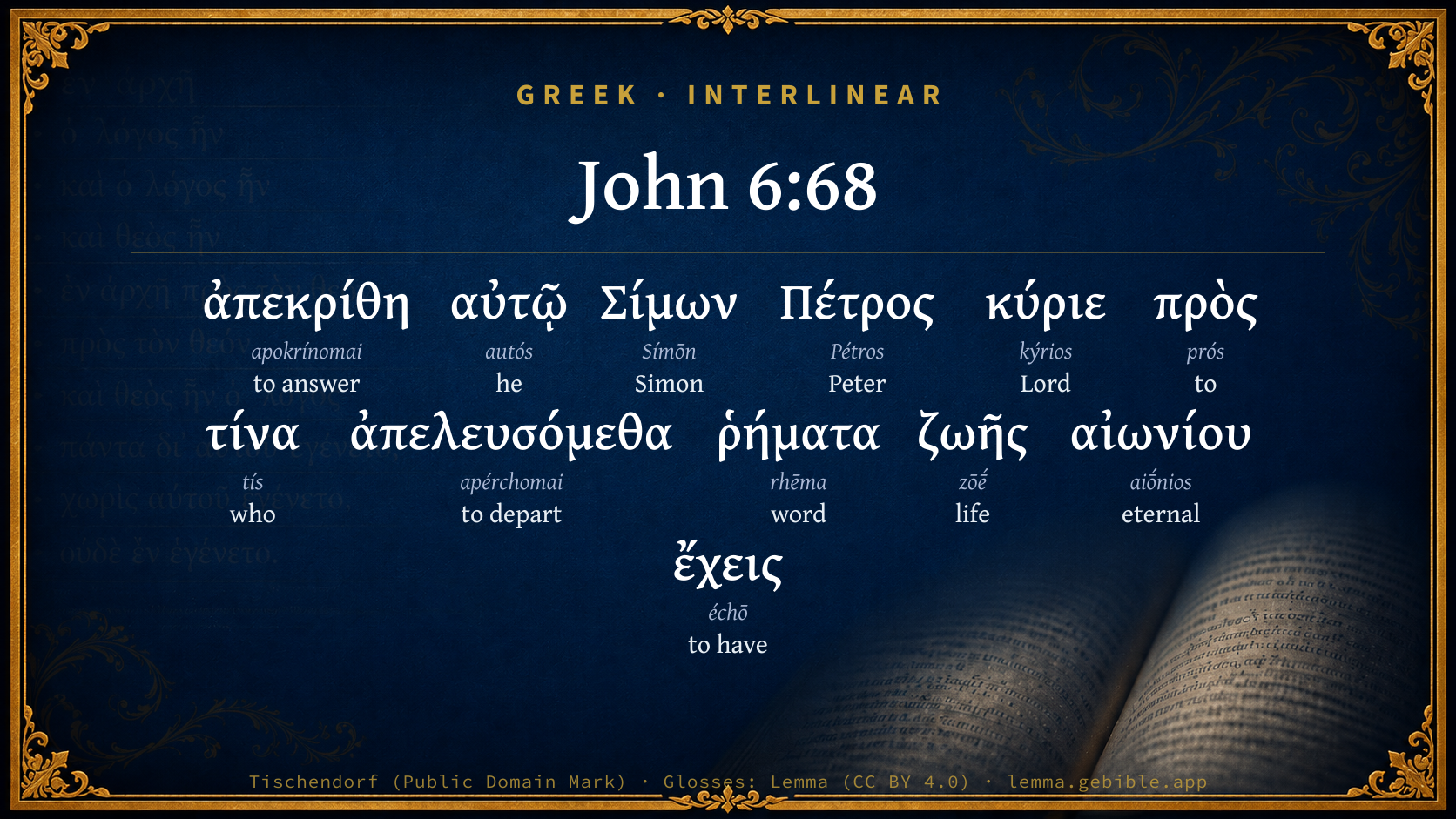
  1. ἀπεκρίθη apokrínomai G611 “to answer” Verb, Aorist, Middle deponent, Indicative, 3rd person, Singular
  2. αὐτῷ autós G846 “he” Personal pronoun, Dative, Singular, Masculine
  3. Σίμων Símōn G4613 “Simon” Noun, Nominative, Singular, Masculine
  4. Πέτρος Pétros G4074 “Peter” Noun, Nominative, Singular, Masculine
  5. κύριε kýrios G2962 “Lord” Noun, Vocative, Singular, Masculine
  6. πρὸς prós G4314 “to” Preposition
  7. τίνα tís G5101 “who” Interrogative pronoun, Accusative, Singular, Masculine
  8. ἀπελευσόμεθα apérchomai G565 “to depart” Verb, Future, Middle deponent, Indicative, 1st person, Plural
  9. ζωῆς zōḗ G2222 “life” Noun, Genitive, Singular, Feminine
  10. αἰωνίου aiṓnios G166 “eternal” Adjective, Genitive, Singular, Feminine
  11. ἔχεις échō G2192 “to have” Verb, Present, Active, Indicative, 2nd person, Singular

About this verse

These counts appear in no published source. They are computed here, from the morphology-tagged text and Lemma’s own curated glosses. What Lemma adds →

12
words
12
distinct lemmas
Gospels
section

Cross-references

11

Topical passages linked to John 6:68 in the Treasury of Scripture Knowledge — connected by theme and wording, ordered by reader-vote popularity; previews shown in the World English Bible.

  • Psalms 73:25 Who do I have in heaven? There is no one on earth who I desire besides you.
  • John 5:24 "Most assuredly I tell you, he who hears my word, and believes him who sent me, has eternal life, and doesn't come into judgment, but has passed out of death into life.
  • 1 John 5:11–13 The testimony is this, that God gave to us eternal life, and this life is in his Son.
  • Acts 4:12 There is salvation in none other, for neither is there any other name under heaven, that is given among men, by which we must be saved!"
  • Acts 5:20 "Go stand and speak in the temple to the people all the words of this life."
  • Matthew 16:16 Simon Peter answered, "You are the Christ, the Son of the living God."
  • John 6:63 It is the spirit who gives life. The flesh profits nothing. The words that I speak to you are spirit, and are life.
  • John 6:40 This is the will of the one who sent me, that everyone who sees the Son, and believes in him, should have eternal life; and I will raise him up at the last day."
  • Acts 7:38 This is he who was in the assembly in the wilderness with the angel that spoke to him on Mount Sinai, and with our fathers, who received living oracles to give to us,
  • John 5:39–40 "You search the Scriptures, because you think that in them you have eternal life; and these are they which testify about me.
  • John 17:8 for the words which you have given me I have given to them, and they received them, and knew for sure that I came forth from you, and they have believed that you sent me.

Cross-references courtesy of OpenBible.info (CC BY 4.0).

Where the printed editions differ

1 variant

Places in this verse where the major printed Greek editions disagree on the wording in a way that affects the translation — a comparison of editions, not a manuscript-by-manuscript collation. The editions are the modern critical texts (Nestlé-Aland 28/27, SBL, Westcott-Hort, Tregelles, Tyndale House) and the traditional texts behind the KJV (the Textus Receptus and the Byzantine/Majority text). It is not a claim about which reading is original.

  1. Extra text
    οὖν

    “therefore”

    In TRByz Not in NA28NA27TynSBLWHTreg

    οὖν (oun) 'therefore' is only in traditional manuscripts (TR+Byz)

Textual data: Translators Amalgamated Greek New Testament (STEPBible TAGNT) · CC BY 4.0.

Commentary

Notes on John 6:68 from classic Christian and Jewish commentators (each source and its license shown beneath its notes). The classic Christian expositions comment on the surrounding passage and are grouped to its opening verse, so a note may address several verses; the Jewish commentaries on the Tanakh (Rashi and others) are per-verse, so they appear only where the commentator wrote on this verse.

Lemma curates 59 commentaries, every one of them public domain or Creative Commons licensed, each selected and text-cleaned for this edition rather than reprinted as found. About our sources →

Tyndale Open Study Notes

Tyndale Open Resources

6:68-69 Simon Peter often served as spokesman for the Twelve (see also Matt 14:28-29; 16:16; 17:4; 18:21; 19:27; 26:33-35).

Tyndale Open Study Notes — © Tyndale Open Resources, licensed CC BY-SA 4.0. Text via the HelloAO Bible API.

Bengel's Gnomon

Johann Albrecht Bengel

Joh 6:68.[153] Ῥήματα, the words) The disciples, even though as yet they do not comprehend the special principles of the discourses of Christ, yet hold the general foundation. A most noble instance of implicit faith, involved in the explicit faith [faith involved in the faith evolved].[154] The whole of the phraseology, the words of eternal life—we have believed—the Son of God, is repeated from Joh 6:63-65.[155] So Martha, ch. Joh 11:27, upholds her faith in Jesus Christ, although she did not as yet perceive the grounds and bearings of the resurrection. [In answer to Jesus, “I am the resurrection and the life,” etc., she replies, “I believe that Thou art the Christ, the Son of God, which should come into the world.”]

[153] πρὸς τίνα, to whom) It is a blessed thing for that man, into whose mind, if even it should see the door open, nothing whatever else glides in.—V. g.

[154] i.e. Universal faith implied in the faith expressed by Peter.

[155] To which therefore Peter alludes, contrasting the Twelve with the unbelievers.—E. and T.

Bengel's Gnomon of the New Testament — English translation (T&T Clark, Edinburgh, 1860) — public domain. Text from a community e-Sword module.

Meyer's Critical & Exegetical Commentary

Heinrich August Wilhelm Meyer

Joh_6:68-69. Peter, according to the position, for which the foundation is already laid in Joh_1:43, makes the confession, and with a resolution how deep and conscious!

ἀπελευσόμεθα] Future, at any time. Da nobis alterum Te, Augustine.

ῥήματα ζωής, κ.τ.λ.] Twofold reason for stedfastness: (1) ῥήματα … ἔχεις, and (2) καὶ ἡμεῖς, κ.τ.λ. Thou hast the words of everlasting life (ζωὴν αἰώνιον προξενοῦντα, Euthymius Zigabenus; more literally: whose specific power it is to secure eternal life); an echo of Joh_6:63. The ῥήματα which proceed from the Teacher are represented as belonging to Him, a possession which He has at His disposal. Comp. 1Co_14:26.

καὶ ἡμεῖς] and we for our part, as contrasted with those who had fallen away.

πεπιστ. κ. ἐγνώκ.] the faith and the knowledge to which we have attained, and which we possess, is that, etc. (Perfect). Conversely, Joh_17:8; 1Jn_4:16. Practical conviction may precede (Php_3:10) and follow (comp. Joh_8:32) the insight which is the product of reason. The former quite corresponds to the immediate and overpowering impressions by which the apostles had been won over to Jesus, chap. 1. Both, therefore, are conformable with experience, and mutually include, and do not exclude, each other.

ὁ ἅγιος τοῦ θεοῦ (see the critical notes): He who is consecrated of God to be the Messiah through the fulness of the Spirit and salvation vouchsafed Him. See on Joh_10:36; 1Jn_2:20; comp. Mar_1:24; Luk_4:34; Act_4:27; Rev_3:7.

The similar confession, Mat_16:16, is so different in its occasion, connection, and circumstances, that the assumption that our passage is only another version of the synoptical account (Weisse and others) is unwarrantable. Who can take exception to the repetition of a confession (of which the apostles hearts were so full) upon every occasion which presented itself? Certainly, according to John (see already Joh_1:42 ff., Joh_2:19), it is untenable to suppose that in our passage, according to the right reading (see the critical notes), we have not yet a complete and unhesitating confession of the Messiah (Ewald); or that the disciples had only now attained a full faith in Him (Weizsäcker). We would have to assume in the earlier passages of chap. 1 a very awkward ὕστερον πρότερον on the part of the evangelist,a view in which even Holtzmann acquiesces (Judenth. u. Christenth. p. 376).

Meyer — Critical and Exegetical Commentary on the New Testament — English translation by Peter Christie, edited by Frederick Crombie (T&T Clark, 1880) — public domain. Text from a community e-Sword module.

Expositor's Greek Testament

ed. W. Robertson Nicoll

Joh 6:68 . Simon Peter answered in name of all, Κύριε … ζῶντος . He gives a threefold reason why they remained faithful while others left. (1) πρὸς τίνα ἀπελευσόμεθα ; “To whom shall we go away?” implying that they must attach themselves to some one as a teacher and mediator in divine things. They cannot imagine that any one should be to them what already Jesus had been. (2) Especially are they bound to Him. because He has words of eternal life, ῥήματα ζωῆς αἰωνίου ἔχεις . They had experienced that His words were spirit and life, Joh 6:63 . In themselves a new life had been quickened by His words, a life they recognised as the true, highest, eternal life. To have received eternal life from Christ makes it impossible to abandon Him. (3) καὶ ἡμεῖς (Joh 6:69 ), “we for our part,” whatever others think, πεπιστεύκαμεν καὶ ἐγνώκαμεν “have believed and know,” cf. 1Jn 4:16 , ἡμεῖς ἐγνώκαμεν καὶ πεπιστεύκαμεν , which shows we cannot press the order [ cf. Augustine’s “credimus ut intelligamus”] but must accept the double expression as a strong asseveration of conviction: we have believed and we know by experience ὅτι σὺ εἶ … ὁ ἅγιος τοῦ Θεοῦ occurs in Mar 1:24 , Luk 6:34 ; cf. Act 3:14 ; Act 4:27 ; Act 4:30 ; Rev 3:7 . The expression is not Johannine; but the idea of the Messiah as consecrated or set apart is found in Joh 10:36 , ὃν ὁ Πατὴρ ἡγίασε . Peter’s confession here is equivalent to his confession at Caesarea Philippi, recorded in the Synoptic Gospels.

The Expositor's Greek Testament, edited by W. Robertson Nicoll (1897–1910) — public domain. Text from a community e-Sword module.

Vincent's Word Studies in the New Testament

Marvin R. Vincent

Simon Peter. Assailants of the authenticity of John's Gospel have asserted that it reveals an effort on the part of the writer to claim for the disciple whom Jesus loved a pre - eminence above Peter. The assertion is effectually contradicted by the narrative itself. See Joh 1:42; Joh 6:68; Joh 13:6; Joh 18:10, 16; Joh 20:2, 7; Joh 21:3, 7, 11, and notes on those passages. Peter's replying for the twelve, in this passage, is a case in point.

The words of eternal life [ρηματα ζωης αιωνιου] . There is no article. Thou hast words. Words of life are words which carry life with them.

Compare the phrases bread of life, light of life, water of life, tree of life.

Marvin R. Vincent, Word Studies in the New Testament (1887–1900) — public domain. Text from a community e-Sword/MySword module.

Jamieson, Fausset & Brown

Robert Jamieson, A. R. Fausset & David Brown

Then Simon Peter--whose forwardness in this case was noble, and to the wounded spirit of His Lord doubtless very grateful.

Lord, to whom, &c.--that is, "We cannot deny that we have been staggered as well as they, and seeing so many go away who, as we thought, might have been retained by teaching a little less hard to take in, our own endurance has been severely tried, nor have we been able to stop short of the question, Shall we follow the rest, and give it up? But when it came to this, our light returned, and our hearts were reassured. For as soon as we thought of going away, there arose upon us that awful question, 'TO WHOM shall we go?' To the lifeless formalism and wretched traditions of the elders? to the gods many and lords many of the heathen around us? or to blank unbelief? Nay, Lord, we are shut up. They have none of that 'ETERNAL LIFE' to offer us whereof Thou hast been discoursing, in words rich and ravishing as well as in words staggering to human wisdom. That life we cannot want; that life we have learnt to crave as a necessity of the deeper nature which Thou hast awakened: 'the words of that eternal life' (the authority to reveal it and the power to confer it). Thou hast: Therefore will we stay with Thee--we must."

Jamieson, Fausset & Brown — Commentary Critical and Explanatory on the Whole Bible (1871) — public domain (CC PDM 1.0). Text via the HelloAO Bible API.

Adam Clarke's Commentary

Verse 68. Simon Peter answered] With his usual zeal and readiness, speaking in behalf of the whole, To whom shall we go? Where shall we find a more gracious master-a more powerful Redeemer - a more suitable Saviour? Thou alone hast the words of eternal life. None can teach the doctrine of salvation but thyself; and none can confer the gift of eternal life but thou alone. Reader, let me ask, whither art thou going? Has the world-the devil-the flesh - the words of eternal life? Art thou turning thy back upon God and Christ? For thy zealous services, what has Satan to give thee? Death! hell! and eternal misery! O stop! Cleave to Jesus; he will give thee that happiness which, in vain, thou seekest in the pleasures of sin.

Adam Clarke's Commentary on the Bible (1810–1826) — public domain. Text from a community e-Sword/MySword module.

John Calvin's Commentaries

68. Simon Peter therefore answered him. Peter replies here in the name of all, as he does on other occasions; because all of them were of the same mind, except that in Judas there was no sincerity. This reply contains two clauses; for Peter first states the reason why he cheerfully adheres to Christ, along with his brethren; namely, because they feel that his doctrine is wholesome and quickening; and, secondly, he acknowledges that to whomsoever they might go, if they left Christ, there remained for them nothing but death.

Thou hast the words of eternal life. When he says the words of life, by the phrase of life, he means quickening, using the genitive case instead of the adjective, which is a very common mode of expression among the Hebrews. It is a remarkable commendation bestowed on the Gospel, that it administers to us eternal life, as Paul testifies, that

it is the power of God for salvation to every one who believeth, (Romans 1:16.)

True, the Law also contains life, but because it denounces against all transgressors the condemnation of eternal death, it can do nothing but kill. Widely different is the manner in which life is offered to us in the Gospel, that is, when God reconciles us to himself through free grace, by not imputing our sins, (2 Corinthians 5:19.) It is no ordinary assertion that Peter makes concerning Christ, when he says that he has the words of eternal life; but he ascribes this to Christ as belonging to him alone. Hence follows the second statement which I glanced at a little ago, that as soon as they have gone away from Christ, there remains for them everywhere nothing but death. Certain destruction, therefore, awaits all who, not satisfied with that Teacher, fly to the inventions of men.

John Calvin's Commentaries (1540-1563) — public domain. Text from the Calvin Translation Society English edition (1840s-50s) via the Christian Classics Ethereal Library (ccel.org). Calvin's coverage is partial (roughly two-thirds of the Bible); uncommented books and verses are honest gaps, never fabricated. The 19th-century editor's footnotes and remarks are omitted so the notes are faithfully Calvin's own voice.

Ellicott's Commentary for English Readers

(68) Then Simon Peter answered.—The look may have been directed to Peter, or here, as elsewhere, his natural character makes him spokesman for the Twelve. And striking is his speech. “Go away? To whom? They had left all to follow Him, and find all in Him. The Baptist is not living, and they know no other teacher. Go away? How could it be, when His words are spirit and eternal life?” (Joh_6:63.)

A Bible Commentary for English Readers, edited by Charles John Ellicott (1878–1897) — public domain. Text from a community e-Sword module.

The Cambridge Bible for Schools and Colleges

gen. ed. J. J. S. Perowne

68. Then Simon Peter] Omit ‘Then.’ S. Peter, as leader, primus inter pares, answers here as elsewhere in the name of the Twelve (see note on Mar_3:17), and answers with characteristic impetuosity. The firmness of His conviction shews the appropriateness of the name given to him Joh_1:42. His answer contains three reasons in logical order why they cannot desert their Master: (1) there is no one else to whom they can go; the Baptist is dead. Even if there were (2) Jesus has all that they need; He has ‘sayings of eternal life.’ And if there be other teachers who have them also, yet (3) there is but one Messiah, and Jesus is He. See on Joh_6:47.

The Cambridge Bible for Schools and Colleges (gen. ed. J. J. S. Perowne; Cambridge University Press, 1878–1918) — public domain. Text from a community e-Sword module.

John Gill's Exposition

Jesus answered them,.... The disciples, taking Peter's answer to his question, as delivered in the name of them all, and as expressing their mind and sense:

have not I chosen you twelve; not to grace and glory, to holiness and happiness; though this was true of eleven of them, but to be apostles:

and one of you is a devil? or like to one, is a deceiver, a liar, and a murderer, as the devil is from the beginning; all which Judas was, and appeared to be, in the betraying of his master. The Syriac, Persic, and Ethiopic versions read, "is Satan"; which name, if given to Peter, as it once was on a certain occasion, Mat 16:23, might very well be given to Judas; who, notwithstanding his profession of faith in Christ, was in the hands and kingdom of Satan, and under his influence and power: and this our Lord said, partly that they might not too much presume upon their faith and love, and steady attachment, and be over confident of their standing; and partly, to prepare them for the apostasy of one from among them.

John Gill's Exposition of the Whole Bible (1746–1763) — public domain (CC PDM 1.0). Text via the HelloAO Bible API.

Trapp's Complete Commentary

John Trapp

68 Then Simon Peter answered him, Lord, to whom shall we go? thou hast the words of eternal life.

Ver. 68. Thou hast the words of eternal life.] In going from thee, therefore, we shall go out of God’s blessing. Nay, we shall go upon our own death, upon hell’s mouth. The Roman law was, Transfugas, ubicunque inventi fuerint, quasi hostes interficere licet. Renagades are sure to die for it; when those that live by those lively oracles of the gospel shall live for ever.

John Trapp, A Commentary or Exposition upon All the Books of the Old and New Testament (1647–1656) — public domain. Text from a community e-Sword module.

Albert Barnes' Notes on the Bible

Simon Peter answered him - With characteristic ardor and promptness. Peter was probably one of the oldest of the apostles, and it was his character to be first and most ardent in his professions.

To whom shall we go - This implied their firm conviction that Jesus was the Messiah, and that he alone was able to save them. It is one of Peter’s noble confessions - the instinctive promptings of a pious heart and of ardent love. There was no one else who could teach them. The Pharisees, the Sadducees, and the scribes were corrupt, and unable to guide them aright; and, though the doctrines of Jesus were mysterious, yet they were the only doctrines that could instruct and save them.

Thou hast ... - The meaning of this is, thou teachest the doctrines which lead to eternal life. And from this we may learn:

1.That we are to expect that some of the doctrines of the Bible will be mysterious.

2.That, though they are difficult to be understood, yet we should not therefore reject them.

3.That nothing would be gained by rejecting them. The atheist, the infidel - nay, the philosopher, believes, or professes to believe, propositions quite as mysterious as any in the Bible.

4.That poor, lost, sinful man has nowhere else to go but to Jesus. He is the way, the truth, and the life, and if the sinner betakes himself to any other way he will wander and die.

We should, therefore, on no account forsake the teachings of the Son of God. The words that he speaks are spirit and are life.

Albert Barnes' Notes on the Bible (1834–1885) — public domain. Text from a community e-Sword/MySword module.

Haydock's Catholic Bible Commentary

Jesus said to the twelve: Will you also go away? He shews them, says St. John Chrysostom, that he stood not in need of them, and so leaves them to their free choice. (Witham) --- Jesus Christ remarking in the previous verse that the apostate disciples had left him, to walk no more with him, turning to the twelve, asks them, Will you also go away? The twelve had heard all that passed; they had seen the Jews strive amongst themselves, and the disciples murmur and leave their Master; they understood what he said in the same literal sense; it could, indeed, bear no other meaning; but when Jesus put the above question to them, leaving them to their free choice, whether to follow him, or to withdraw themselves, Simon Peter answered him: "Lord, to whom shall we go? Thou hast the words of eternal life;" and therefore art able to make good thy words, however hard and difficult they may appear to others. --- We may here admire not only the excellency of their faith, but the plain, yet noble motive of their faith: they believe, because he is Christ, the Son of God, (or, as it is in the Greek, the Son of the living God) who is absolutely incapable of deceiving his creatures, and whose power is perfectly equal to perform the promises he here makes them.

George Leo Haydock (1774–1849), Haydock's Catholic Family Bible and Commentary, 1859 edition — public domain. Excludes Psalms (Douay-Rheims chapter numbering differs from Protestant) and Deuterocanonical books (Catholic canon only).

Matthew Poole's English Annotations

Peter, who is observed in the whole history of the gospel to have discovered the hottest and quickest spirit, and to have been first in answering questions propounded to the twelve, as Mat 16:16, &c., replies,

Lord, to whom shall we go? &c., thereby teaching us under temptations to apostasy, first, to consider what we shall get by it, as the following words teach us, that an abiding with Christ in a steady adherence to the truths of his gospel, is the best choice that we can make.

Matthew Poole's English Annotations on the Holy Bible (1683–1685) — public domain. Text from a community e-Sword/MySword module.

Whedon's Commentary on the Bible

Daniel D. Whedon

68. Peter answered—John was one of these twelve present on this occasion. And although semi-infidels have pretended to find traces of rivalry between him and Peter, yet to Peter he assigns the honour of this memorable confession.

To whom… go—None of the founders of religions, or philosophies, or priesthoods, can fill this place.

Words of eternal life— Peter might have said, Thou alone workest true divine miracles, and doubtless he so believed; and believed that the divinity in the miracles was full proof of the eternal life to be in his words; but it was the words of eternal life of which he truly stood in need.

Daniel D. Whedon (gen. ed.), Commentary on the Old and New Testaments (1874–1909) — public domain. Text from a community e-Sword module.

The Pulpit Commentary

Vers. 68, 69. Simon Peter prominent here, and in Joh_13:6-11, Joh_13:24, 36 18:10 20:2-10 21:7, etc.; just as he is in the synoptic Gospels (see portrait of St. Peter, Introduction VIII 3 (4))then answered him; Lord, to whom shall we go? Perhaps apeleusomeya is even stronger than the upagein ; Hast thou not drawn us to thyself, and supplied a need and craving which thou hadst first of all excited? Is there any teacher to rival thee? Can we look for another while we have thee? "Da nobis alterum te" (Augustine). The second part of this immortal reply points clearly back to ver. 63, where the Lord had declared that the words he had spoken to them were spirit and life. Thou hast words of eternal life. Not "the words," which would savour too much of the dogmatic and technical, but words of life words which minister the Spirit of life; words which convey the Divine power, even the Holy Spirit, to our minds; words which bring those thoughts before us which we can believe, and believing which, we have eternal life. "Thou hast such words". (cf. for use of ecein , 1Co_14:26) The third item of this confession is twofold. We have believed, and have come to know; so that we now do believe and know that, etc. There is a knowledge which precedes belief, and there are some great facts and ideas about Christ which lead to a higher and to a different belief; (see Joh_17:8 1Jn_4:8) but again the fullest knowledge follows belief, a notional and real assent leads to an invincible assent. Faith is the womb of assurance. This richer knowledge is mediated by love. "He that loveth not knoweth not," and the faith that evokes "love" also excites and confirms the "knowledge" that is life eternal. (Joh_17:2) That thou art the Holy One of God. The recognition of the nature of the Lord, which fell short of the great utterance of Peter in Mat_16:16. This was an ascription which the demoniacs, or the devils, by their lips were ready from the first to proclaim prematurely. (Mar_1:24 Luk_4:34) (On the holiness of Christ, on his entire consecration, and on the fact that he was sealed and sent into the world to do the Father"s will, see Joh_10:36 Rev_3:7) "Thou art sent on the highest mission. Thou canst accomplish all that thou hast told us; we have come to believe it, and we do know it. We cannot leave thee. We are not looking for temporal honours or Messianic splendours, but for the food that endureth unto everlasting life."

The Pulpit Commentary (1880–1919), ed. H.D.M. Spence-Jones & Joseph S. Exell — public domain. Text from a community e-Sword module.

John Wesley's Explanatory Notes

Thou hast the words of eternal life - Thou, and thou alone, speakest the words which show the way to life everlasting.

John Wesley, Explanatory Notes Upon the Whole Bible (1754–1765) — public domain. Text via the GEBible commentary corpus.

The People's New Testament

B. W. Johnson

68, 69. To whom shall we go? If we should turn from Christ, to whom should we go? Peter's confession here is of the same purport as that at Cæsarea Philippi.

B. W. Johnson's The People's New Testament with Notes (1889–1891) — public domain. Electronic text from the Christian Classics Ethereal Library (CCEL) ThML edition.

Cambridge Greek Testament for Schools and Colleges

68. Σίμων Πέτρος. see on Joh 1:42. S. Peter, as leader, primus inter pares, answers here as elsewhere in the name of the Twelve (see on Mar 3:17), and with characteristic impetuosity. His answer contains three reasons in logical order why they cannot desert their Master: (1) there is no one else to whom they can go; the Baptist is dead. Even if there were (2) Jesus has all that they need; He has ‘sayings of eternal life.’ And if there be other teachers who have them also, yet (3) there is but one Messiah, and Jesus is He. Contrast his earlier utterance, ‘Depart from me’ (Luk 5:8).

ῥήματα ζ. αἰων. see on Joh 3:34. No article; the expression is quite general, and seems to be an echo of Joh 6:63, the truth of which S. Peter’s experience could already affirm. It may mean either utterances about eternal life, or leading to eternal life. The analogy of the Bread of life, Light of life, Tree of life, and Water of life (Joh 6:35, Joh 8:12; Rev 2:7; Rev 21:6) is strongly in favour of the latter.

Cambridge Greek Testament for Schools and Colleges (Cambridge University Press, 1896; 21 vols, various authors incl. Carr, Maclear, Plummer, Farrar, Lumby, Moule, M. R. James, Simcox) — public domain. Text from a community e-Sword module.

Alford’s Greek Testament

Henry Alford

68.] Peter answers quickly and earnestly for the rest, as in Mat 16:16.

πρὸς τίνα] What they had heard and seen had awakened in them the desire of being led on by some teacher towards eternal life; and to whom else should they go from Him who had, and brought out of His stores for their instruction, the words (see ver. 63) of eternal life?

Henry Alford, The Greek Testament (1849–1861) — public domain. Text from a community e-Sword module.

International Critical Commentary

68. The Confession of Peter here recorded is not to be distinguished from the similar confession narrated by the Synoptists (Mar 8:27f., Mat 16:13f., Luk 9:18f.), although the details are different. The crisis in the Lord’s public ministry which called it forth took place, according to Lk. as well as according to Jn., some time after the Feeding of the Five Thousand (Mk., followed by Mt., places it a little later, after the Feeding of the Four Thousand). Jn. says that the place was Capernaum, while Mk. and Mt. give Cæsarea Philippi, 30 miles to the north; Lk. does not give any indication of place. In all the Synoptists, the Confession of Peter was followed by the first prediction by Jesus of His Passion. There is no indication of this in Jn., who does not assign to any particular crisis the first announcement by Jesus that He was to suffer. Cf. 3:13, 14, 6:53, 8:28, 12:23, 25, 13:31; and see Introd., p. 131. But in Jn., as in the Synoptists, the faithfulness of the apostles, for whom Peter was spokesman, as contrasted with the defection or incredulity of many in the outer circle of the Lord’s followers, is brought out clearly.

Σίμων Πέτρος. This is the only place in Jn. where Peter is represented as speaking on behalf of the rest, although he appears later as foremost to question or to intervene (cf. 13:6, 24, 36, 20:2).

πρὸς τίνα ἀπελευσόμεθα; At an earlier stage, Peter had said, “Depart from me” (Luk 5:8), but that was only a hasty word of humility. The question μὴ καὶ ὑμεῖς θέλετε ὑπάγειν; is answered by another question.

Peter’s Confession is twofold in Jn.’s version. (1) “Thou hast words of eternal life”; this is the acceptance of Jesus as Prophet. (2) “Thou art the Holy One of God”; that is the recognition of Him as the Priest of humanity.

ῥήματα ζωῆς αἰωνίου ἔχεις. The immediate reference is to v. 63, and the teaching of v. 58. “Thou hast words (not the words) of eternal life,” i.e. words which give eternal life, or the knowledge of it; see on v. 35 for the phrase “the Bread of Life.” For ῥήματα, see on v. 63; and cf. Act 5:20 πάντα τὰ π̔ήματα τῆς ζωῆς ταύτης. For ζωὴ αἰώνιος, see on 3:15; and cf. vv. 27, 40. This is a favourite expression of Jn., who puts into his own accustomed phraseology Peter’s confession of trust in Jesus.

International Critical Commentary — older volumes (1896–1929), various authors — public domain. Text from a community e-Sword module.

Lesson kit

Teaching starters — assembled from the data on this page, not authored interpretation. Every prompt links to the verse data it draws on. Edit before teaching.

John, in the Gospels, opens this verse with 12 words (12 distinct Greek lemmas). Its most distinctive word is rhēma (“word”). A historical commentator’s framing appears above. Read the whole chapter for the surrounding context.

Discussion questions

  1. How does “word” (rhēma) shape what this verse is saying?
  2. How does Psalms 73:25, which shares this passage’s theme, read alongside this verse?
  3. These translations render this verse differently; the difference is in the English rendering, not the original. What questions does that raise?
  4. Compare how Tyndale Open Study Notes and Bengel's Gnomon read this verse. Where do they agree or differ?

Things to notice

Reading settings

Reading text

Shown beneath each verse's original-language words.

Old Testament
Old Testament edition

Read the OT as the Masoretic Hebrew (MT) or the Greek Septuagint (LXX).

English shown for the Greek Septuagint (in the Hebrew ↔ Greek comparison).

Comparing translations? Open the Compare panel on any verse page to stack up to four side by side.