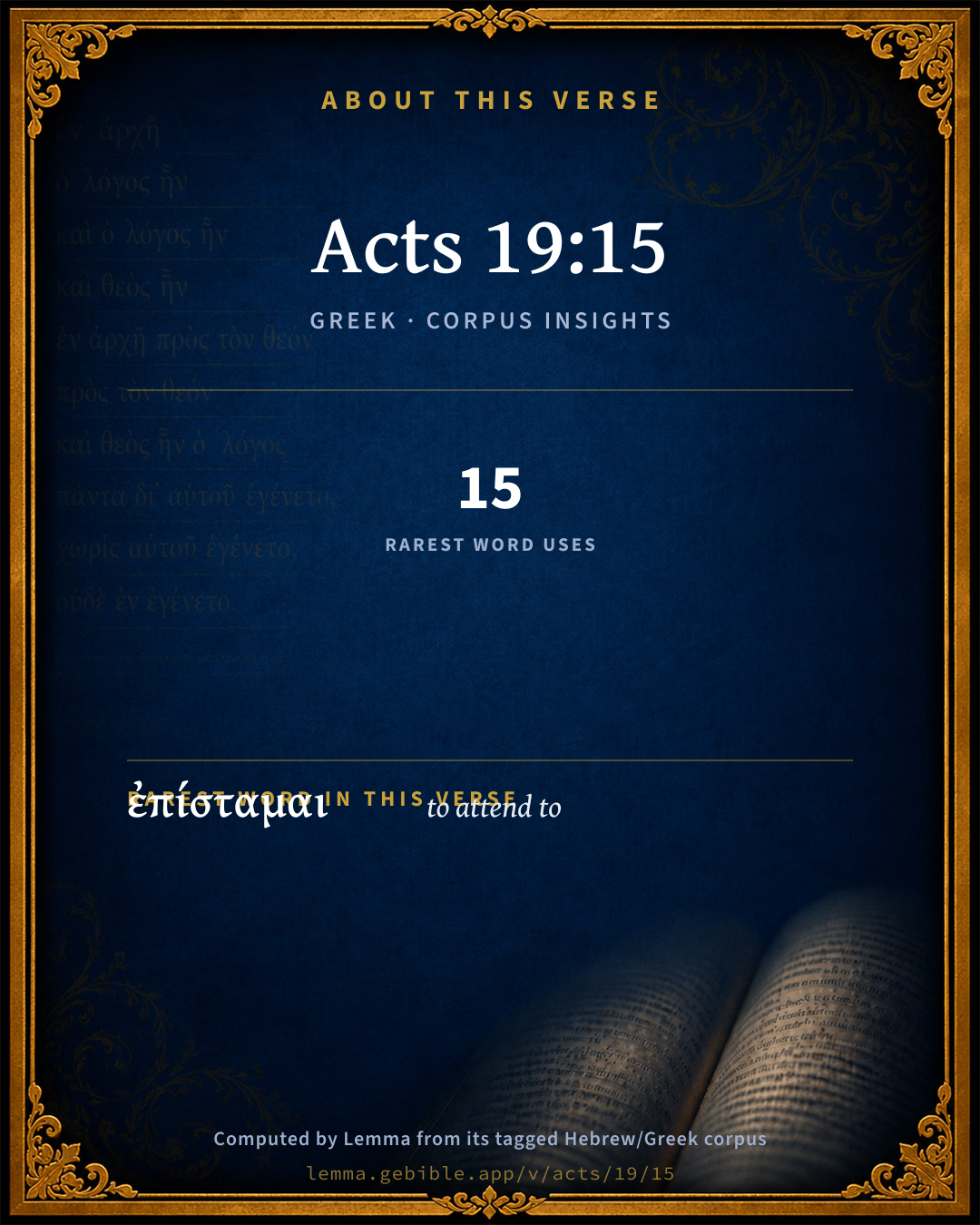
Acts 19:15

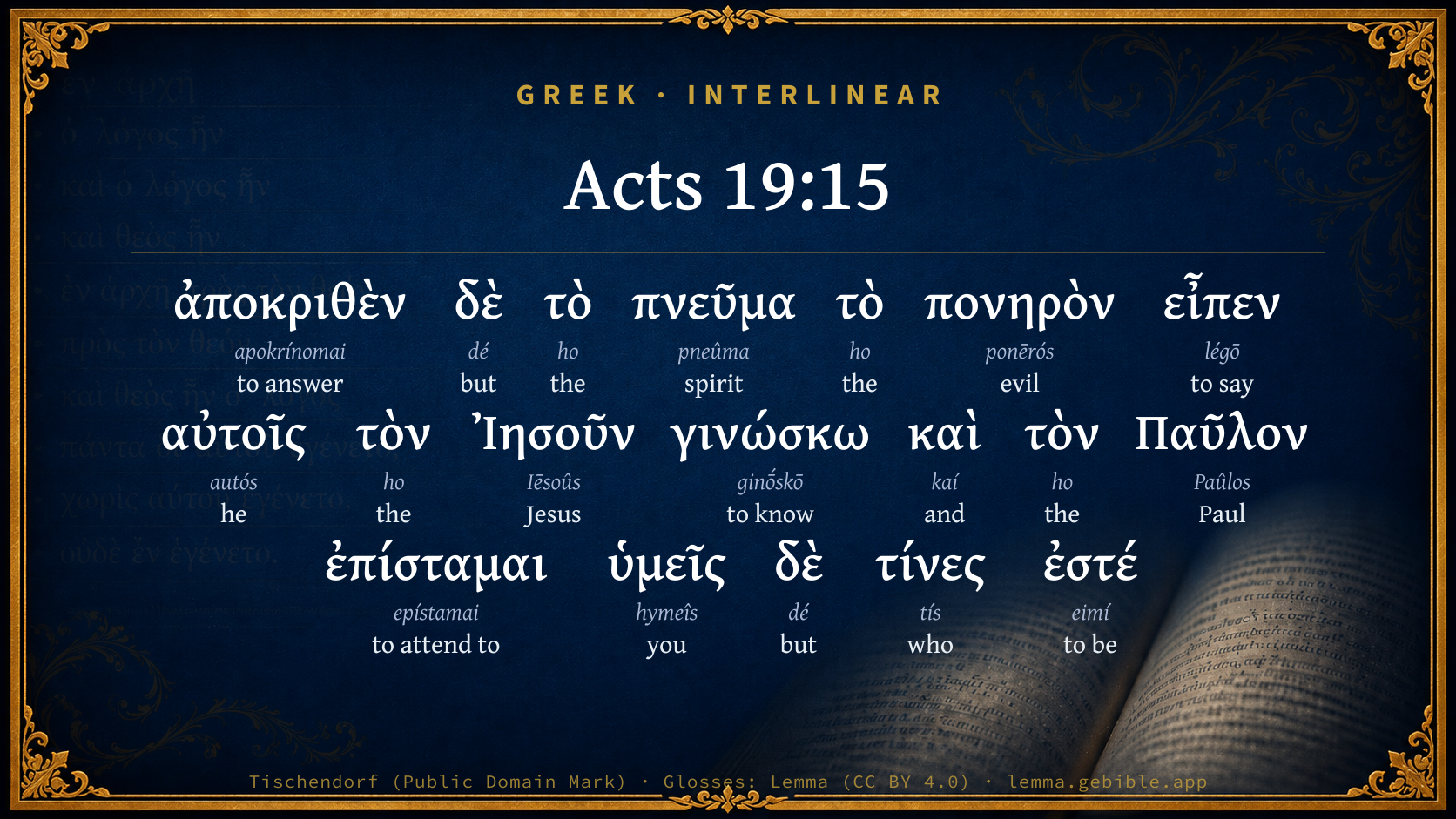
Greek (Tischendorf 8th ed.) Acts 19:15 appears in the Greek New Testament. The text above is from the Tischendorf 8th edition. Each word links to its Strong’s number and a concise gloss. Click any word for its full Thayer’s Greek Lexicon entry.
Download image
Cite this verse

Acts 19:15 (World English Bible). Public Domain. Lemma interlinear Bible study tool, https://lemma.gebible.app/v/acts/19/15.

Show BibTeX & RIS
BibTeX
RIS
English Translation
The evil spirit answered, "Jesus I know, and Paul I know, but who are you?"
World English Bible · Public Domain
Download a study sheet

One document with this verse’s original text, its word-by-word gloss line, the meaning frame, cross-references with their text, attributed commentary, and full source and license credits — printable, and it pastes into notes with its structure intact.

This verse Autodidact and up

Study sheet (.html) Plain text (.txt)

A passage Seminary Student

Up to 50 verses in one chapter. A passage sheet keeps up to 6 commentary sources and 12 cross-references per verse, in the order this page ranks them, and says so on the sheet whenever that leaves anything out. Ask for a single verse and you get the Autodidact verse sheet above.

Everything on this page stays free to read, with no account — the sheet is a download of what is already on screen, not access to it.

Want to remove ads? Support Godless Engineer
Compare translations 3

The same verse in 3 English versions, stacked beneath the original-language interlinear above. Click any original word for its lexicon entry.

Each is an independent rendering of the whole verse — the interlinear is not word-aligned to these translations.

Highlighted words mark where these versions differ — a whole-verse word diff, not a word-by-word alignment.

  • World English Bible Public Domain
    The evil spirit answered, "Jesus I know, and Paul I know, but who are you?"
  • King James Version Public Domain
    And the evil spirit answered and said, Jesus I know, and Paul I know; but who are ye?
  • unfoldingWord Literal Text CC BY-SA 4.0
    But answering, the evil spirit said to them, “Jesus I acknowledge, and Paul I know, but you, who are you?”

unfoldingWord Literal Text — © unfoldingWord, licensed CC BY-SA 4.0. Word-aligned USFM3 via Door43 (git.door43.org/unfoldingWord/en_ult).

Versions to compare (up to 4)

3 of 4 selected

Show all 19 translations

Every available English version of this verse, each an independent rendering of the whole verse.

  • World English Bible Public Domain
    The evil spirit answered, "Jesus I know, and Paul I know, but who are you?"
  • Berean Standard Bible Public Domain
    Eventually, one of the evil spirits answered them, “Jesus I know, and I know about Paul, but who are you?”
  • Majority Standard Bible Public Domain
    But one day the evil spirit responded, “Jesus I know, and I know about Paul, but who are you?”
  • King James Version Public Domain
    And the evil spirit answered and said, Jesus I know, and Paul I know; but who are ye?
  • American Standard Version (1901) Public Domain
    And the evil spirit answered and said unto them, Jesus I know, and Paul I know, but who are ye?
  • Revised Version (1885) Public Domain
    And the evil spirit answered and said unto them, Jesus I know, and Paul I know; but who are ye?
  • Geneva Bible (1599) Public Domain
    And the euil spirit answered, and said, Iesus I acknowledge, and Paul I know: but who are ye?
  • Douay-Rheims (1899) Public Domain
    But the wicked spirit, answering, said to them: Jesus I know, and Paul I know; but who are you?
  • Young's Literal Translation Public Domain
    and the evil spirit, answering, said, `Jesus I know, and Paul I am acquainted with; and ye -- who are ye?'
  • Literal Standard Version CC BY-SA 4.0
    and the evil spirit, answering, said, “I know Jesus, and I am acquainted with Paul; and you—who are you?”
  • Unlocked Literal Bible CC BY-SA 4.0
    An evil spirit answered them, “Jesus I know, and Paul I know; but who are you?”
  • unfoldingWord Literal Text CC BY-SA 4.0
    But answering, the evil spirit said to them, “Jesus I acknowledge, and Paul I know, but you, who are you?”
  • Darby Bible Public Domain
    But the wicked spirit answering said to them, Jesus I know, and Paul I am acquainted with; but *ye*, who are ye?
  • World Messianic Bible Public Domain
    The evil spirit answered, “Yeshua I know, and Paul I know, but who are you?”
  • Webster's Bible Public Domain
    And the evil spirit answered and said, Jesus I know, and Paul I know; but who are ye?
  • Free Bible Version CC BY-SA 4.0
    But one day an evil spirit responded, “I know Jesus, and I know Paul, but who are you?”
  • Bible in Basic English Public Domain
    And the evil spirit, answering, said to them, I have knowledge of Jesus, and of Paul, but who are you?
  • Text-Critical English NT CC BY 4.0
    But one day an evil spirit responded, “I know Jesus, and I am acquainted with Paul, but who are you?”
  • Tyndale New Testament (1534) Public Domain
    And the evyll sprete answered and sayde: Iesus I knowe and Paul I knowe: but who are ye?

Literal Standard Version (2020), Covenant Press — licensed CC BY-SA 4.0. Text via the HelloAO Bible API (eBible.org). Unlocked Literal Bible (unfoldingWord) — licensed CC BY-SA 4.0. Text via the HelloAO Bible API (eBible.org). unfoldingWord Literal Text — © unfoldingWord, licensed CC BY-SA 4.0. Word-aligned USFM3 via Door43 (git.door43.org/unfoldingWord/en_ult). Free Bible Version, Dr. Jonathan Gallagher — licensed CC BY-SA 4.0. Text via the HelloAO Bible API (eBible.org).

Word by word

More ways to search: Search by grammar → Find every occurrence → Compare this word →

Practice this passage: Drill this verse → Learn its vocabulary →

ἐπίσταμαι
epístamai
G1987
“to attend to”
Verb, Present, Middle or Passive deponent, Indicative, 1st person, Singular
Part of Speech
Verb
Tense
Present
Voice
Middle or Passive deponent
Mood
Indicative
Person
1st person
Number
Singular
Full Thayer's Definition

Origin: apparently a middle voice of G2186 (with G3563 implied)

TDNT: None

1. to put one's attention on, fix one's thoughts on, to turn one's self or one's mind to, put one's thought upon a thing a. to be acquainted with, to understand b. to know
  1. ἀποκριθὲν apokrínomai G611 “to answer” Verb, Aorist, Passive deponent, Participle, Nominative, Singular, Neuter
  2. δὲ dé G1161 “but” Conjunction
  3. τὸ ho G3588 “the” Article, Nominative, Singular, Neuter
  4. πνεῦμα pneûma G4151 “spirit” Noun, Nominative, Singular, Neuter
  5. τὸ ho G3588 “the” Article, Nominative, Singular, Neuter
  6. πονηρὸν ponērós G4190 “evil” Adjective, Nominative, Singular, Neuter
  7. εἶπεν légō G3004 “to say” Verb, Aorist, Active, Indicative, 3rd person, Singular
  8. αὐτοῖς autós G846 “he” Personal pronoun, Dative, Plural, Masculine
  9. τὸν ho G3588 “the” Article, Accusative, Singular, Masculine
  10. Ἰησοῦν Iēsoûs G2424 “Jesus” Noun, Accusative, Singular, Masculine
  11. γινώσκω ginṓskō G1097 “to know” Verb, Present, Active, Indicative, 1st person, Singular
  12. καὶ kaí G2532 “and” Conjunction
  13. τὸν ho G3588 “the” Article, Accusative, Singular, Masculine
  14. Παῦλον Paûlos G3972 “Paul” Noun, Accusative, Singular, Masculine
  15. ὑμεῖς hymeîs G5210 “you” Personal pronoun, 2nd person, Nominative, Plural
  16. δὲ dé G1161 “but” Conjunction
  17. τίνες tís G5101 “who” Interrogative pronoun, Nominative, Plural, Masculine
  18. ἐστέ eimí G1510 “to be” Verb, Present, Active, Indicative, 2nd person, Plural

About this verse

These counts appear in no published source. They are computed here, from the morphology-tagged text and Lemma’s own curated glosses. What Lemma adds →

19
words
15
distinct lemmas
Acts
section

Notable vocabulary

The rarest word here is ἐπίσταμαι to attend to G1987 — appearing just 15 times in the whole Greek New Testament.

Shared distinctive vocabulary

ἐπίσταμαι to attend to G1987 occurs in 15 verses of the Greek New Testament. Also found in:

Repetition

Words recur within this verse:

Cross-references

9

Topical passages linked to Acts 19:15 in the Treasury of Scripture Knowledge — connected by theme and wording, ordered by reader-vote popularity; previews shown in the World English Bible.

  • Acts 16:17–18 Following Paul and us, she cried out, "These men are servants of the Most High God, who proclaim to us the way of salvation!"
  • Mark 1:34 He healed many who were sick with various diseases, and cast out many demons. He didn't allow the demons to speak, because they knew him.
  • Mark 5:9–13 He asked him, "What is your name?" He said to him, "My name is Legion, for we are many."
  • Luke 4:33–35 In the synagogue there was a man who had a spirit of an unclean demon, and he cried out with a loud voice,
  • Mark 1:24 saying, "Ha! What do we have to do with you, Jesus, you Nazarene? Have you come to destroy us? I know you who you are: the Holy One of God!"
  • Matthew 8:29–31 Behold, they cried out, saying, "What do we have to do with you, Jesus, Son of God? Have you come here to torment us before the time?"
  • Luke 8:28–32 When he saw Jesus, he cried out, and fell down before him, and with a loud voice said, "What do I have to do with you, Jesus, you Son of the Most High God? I beg you, don't torment me!"
  • Genesis 3:1–5 Now the serpent was more subtle than any animal of the field which Yahweh God had made. He said to the woman, "Yes, has God said, 'You shall not eat of any tree of the garden?'"
  • 1 Kings 22:21–23 There came forth a spirit, and stood before Yahweh, and said, I will entice him.

Cross-references courtesy of OpenBible.info (CC BY 4.0).

Commentary

Notes on Acts 19:15 from classic Christian and Jewish commentators (each source and its license shown beneath its notes). The classic Christian expositions comment on the surrounding passage and are grouped to its opening verse, so a note may address several verses; the Jewish commentaries on the Tanakh (Rashi and others) are per-verse, so they appear only where the commentator wrote on this verse.

Lemma curates 59 commentaries, every one of them public domain or Creative Commons licensed, each selected and text-cleaned for this edition rather than reprinted as found. About our sources →

The Biblical Illustrator

Joseph S. Exell

Act_19:15

And the evil spirit answered and said, Jesus I know, and Paul I know; but who are ye?

A devils estimate of character

I. Christs character is studied by evil spirits. Jesus I know.

1. Their attention would be excited by the prophecies respecting an illustrious One destined to put their forces to the rout.

2. They soon identified Christ as the predicted conqueror.

3. They knew Him by the reverses they suffered through His passion.

II. Virtue is respectable and vice despicable, even in hell. Jesus I know, etc.

III. Artifice cannot charm the devil out of humanity.

1. Satanic power yields only to Omnipotence.

2. Satan scorns exorcists, of whatever arts.

IV. God employs devils to humble the arrogance of wickedness. (J. A. Macdonald.)

A devils confession

The work of these vagabond Jews was apparently sheer imposture. Only God, or those commissioned by Him, could cast out devils; and it is quite evident that the sons of Sceva had no such commission. No doubt, by the use of some occult means, they had been successful in allaying some of the symptoms of demoniacal possession; but that their work was a comparative failure in their own estimation is shown by their desire to imitate the success of Paul. And while they were prosecuting their task, the devil was content to leave them alone, inasmuch as they were doing his work as the deluder of men. But as soon as they seriously attempted to do the real thing by the use of a name which on other lips was potent, and thus to make inroads on the devils kingdom, the devil felt it was time to interfere. Their folly lay in the supposition that they could cast out Satan by Satan, and that he would allow them to do so. The devil, on whom the experiment was made, confessed--

I. Acknowledgment of Christ. Jesus I acknowledge. The word implies the knowledge which produces emotion. What this was it is easy to say.

1. Fear. This was produced--

(1) By what he knew of Christ in the past eternity, when He beheld Satan as lightning fall from heaven.

(2) By what he felt of Christs power in his lifetime, as come to destroy the works of the devil.

(3) By what he anticipated at His hands when the final judgment should arrive (Jam_2:19).

2. Reverence and subjection (Mat_8:29; Mar_1:24; Mar_5:7; Luk_6:41; Luk_8:28). He knew too well the might of that terrible name not to respect it, and not to feel that he was impotent against its spell.

II. Acquaintance with Paul. Paul I am acquainted with. He had full reason to be.

1. Paul was once possessed with a devil himself, and did the devils work well. And past experience of the efforts of so valuable a servant led Satan to strive to enslave him again (2Co_12:7 was written soon after this, and may refer to his Ephesian experience).

2. Paul was the devils most powerful and victorious opponent. It was his success that led to the change of tactics on the part of Satans own emissaries.

III. Contempt for them. Who are ye? This has now passed into a current phrase for expressing the utmost scorn. Who are you? is sufficient to cover a man with confusion. Who are ye that ye should dare to work without our authority and against our dominion, and purely for your own ends. This estimate of hell and its own devotees is not without significance. Conclusion: In view of all this--

1. Let the Christian--

(1) Be encouraged. The devil acknowledges Christ, who is more than equal to Satans efforts in heathenism, worldliness, infidelity, dee.

(2) Be on his guard. The devil is acquainted with him, knows his worth, and will entangle him again in his toils if he can.

(3) Be tranquil. Satans servants may appear very grand and powerful; but what does their own master think of them?

2. Let the impostor learn--

(1) The folly of imposture. It can deceive neither God nor the devil.

(2) The limits of imposture. It may proceed just as far as the devil will permit.

(3) The punishment of imposture. Contempt and punishment at the devils own hands. (J. W. Burn.)

The Biblical Illustrator, edited by Joseph S. Exell (c. 1880s–1900s) — public domain. Text from a community e-Sword module.

MacLaren's Expositions of Holy Scripture

Alexander MacLaren

Acts

WOULD-BE EXORCISTS

Act 19:15.

These exorcists had no personal union with Jesus. To them He was only ‘Jesus whom Paul preached.’ They spoke His name tentatively, as an experiment, and imitatively. To command ‘in the name of Jesus’ was an appeal to Jesus to glorify His name and exert His power, and so when the speaker had no real faith in the name or the power, there was no answer, because there was really no appeal.

I. The only power which can cast out the evil spirits is the name of Jesus.

That is a commonplace of Christian belief. But it is often held in a dangerously narrow way and leads to most unwise pitting of the Gospel against other modes of bettering and elevating men, instead of recognising them as allies. Earnest Christian workers are tempted to forget Jesus’ own word: ‘He that is not against us is for us.’ There is no need to disparage other agencies because we believe that it is the Gospel which is ‘the power of God unto salvation.’ Many of the popular philanthropic movements of the day, many of its curbing and enlightening forces, many of its revolutionary social ideas, are really in their essence and historically in their origin, profoundly Christian, and are the application of the principles inherent in ‘the Name’ to the evils of society. No doubt many of their eager apostles are non-Christian or even anti-Christian, but though some of them have tried violently to pluck up the plant by the root from the soil in which it first flowered, much of that soil still adheres to it, and it will not live long if torn from its native ‘habitat.’

It is not narrowness or hostility to non-Christian efforts to cast out the demons from humanity, but only the declaration of a truth which is taught by the consideration of what is the difference between all other such efforts and Christianity, and is confirmed by experience, if we maintain that, whatever good results may follow from these other influences, it is the powers lodged in the Name of Jesus, and these alone which can, radically and completely, conquer and eject the demons from a single soul, and emancipate society from their tyranny.

For consider that the Gospel which proclaims Jesus as the Saviour is the only thing which deals with the deepest fact in our natures, the fact of sin; gives a personal Deliverer from its power; communicates a new life of which the very essence is righteousness, and which brings with it new motives, new impulses, and new powers.

Contrast with this the inadequate diagnosis of the disease and the consequent imperfection of the remedy which other physicians of the world’s sickness present. Most of them only aim at repressing outward acts. None of them touch more than a part of the whole dreadful circumference of the dark orb of evil. Law restrains actions. Ethics proclaims principles which it has no power to realise. It shows men a shining height, but leaves them lame and grovelling in the mire. Education casts out the demon of ignorance, and makes the demons whom it does not cast out more polite and perilous. It brings its own evils in its train. Every kind of crop has weeds which spring with it. The social and political changes, which are eagerly preached now, will do much; but one thing, which is the all-important thing, they will not do, they will not change the nature of the individuals who make up the community. And till that nature is changed any form of society will produce its own growth of evils. A Christless democracy will be as bad as, if not worse than, a Christless monarchy or aristocracy. If the bricks remain the same, it does not much matter into what shape you build them.

These would-be exorcists but irritated the demons by their vain attempts at ejecting them, and it is sometimes the case that efforts to cure social diseases only result in exacerbating them. If one hole in a Dutch dyke is stopped up, more pressure is thrown on another weak point and a leak will soon appear there. There is but one Name that casts a spell over all the ills that flesh is heir to. There is but one Saviour of society-Jesus who saves from sin through His death, and by participation in His life delivers men from that life of self which is the parent of all the evils from which society vainly strives to be delivered by any power but His.

II. That Name must be spoken by believing men if it is to put forth its full power.

These exorcists had no faith. All that they knew of Jesus was that He was the one ‘whom Paul preached.’ Even the name of Jesus is spoiled and is powerless on the lips of one who repeats it, parrot-like, because he has seen its power when it came flame-like from the fiery lips of some man of earnest convictions.

In all regions, and especially in the matter of art or literature, imitators are poor creatures, and men are quick to detect the difference between the original and the copy. The copyists generally imitate the weak points, and seldom get nearer than the imitation of external and trivial peculiarities. It is more feasible to reproduce the ‘contortions of the Sibyl’ than to catch her ‘inspiration.’

This absence or feebleness of personal faith is the explanation of much failure in so-called Christian work. No doubt there may be other causes for the want of success, but after all allowance is made for these, it still remains true that the chief reason why the Gospel message is often proclaimed without casting out demons is that it is proclaimed with faltering faith, tentatively and without assured confidence in its power, or imitatively, with but little, if any, inward experience of the magic of its spell. The demons have ears quick to discriminate between Paul’s fiery accents and the cold repetition of them. Incomparably the most powerful agency which any man can employ in producing conviction in others is the utterance of his own intense conviction. ‘If you wish me to weep, your own tears must flow,’ said the Roman poet. Other factors may powerfully aid the exorcising power of the word spoken by faith, and no wise man will disparage these, but they are powerless without faith and it is powerful without them.

Consider the effect of that personal faith on the speaker-in bringing all his force to bear on his words; in endowing him for a time with many of the subsidiary qualities which make our words winged and weighty; in lifting to a height of self-oblivion, which itself is magnetic.

Consider its effect on the hearers-how it bows hearts as trees are bent before a rushing wind.

Consider its effect in bringing into action God’s own power. Of the man, all aflame with Christian convictions and speaking them with the confidence and urgency which become them and him, it may truly be said, ‘It is not ye that speak, but the Spirit of your Father that speaketh in you.’

Here then we have laid bare the secret of success and a cause of failure, in Christian enterprise. Here we see, as in a concrete example, the truth exemplified, which all who long for the emancipation of demon-ridden humanity would be wise to lay to heart, and thereby to be saved from much eager travelling on a road that leads nowhither, and much futile expenditure of effort and sympathy, and many disappointments. It is as true to-day as it was long ago in Ephesus, that the evil spirits ‘feel the Infant’s hand from far Judea’s land,’ and are forced to confess, ‘Jesus we know and Paul we know’; but to other would-be exorcists their answer is, ‘Who are ye?’ ‘When a strong man armed keepeth his house, his goods are in peace.’ There is but ‘One stronger than he who can come upon him, and having overcome him, can take from him all his armour wherein he trusted and divide the spoils,’ and that is the Christ, at whose name, faithfully spoken, ‘the devils fear and fly.’

Alexander MacLaren, Expositions of Holy Scripture (1904–1910) — public domain. Text from a community e-Sword module.

Bengel's Gnomon

Johann Albrecht Bengel

Act 19:15. Τίνες, who) This indicates contempt. [What has it profited thee, if thou knowest so as to be able to relate many things concerning Jesus, or even concerning His true members, if thou thyself art notwithstanding destitute of (saving) power? Who art thou?—V. g.]

Bengel's Gnomon of the New Testament — English translation (T&T Clark, Edinburgh, 1860) — public domain. Text from a community e-Sword module.

Meyer's Critical & Exegetical Commentary

Heinrich August Wilhelm Meyer

Act_19:15. But how entirely did that ἐπεχείρησαν fail of success in the very first instance of its application! Bengel well remarks on Act_19:13 : Si semel successisset, saepius ausuri fuerant.

τὸ πνεῦμα] the demon, who had taken possession of the individual consciousness in the man.

By τὸν ʼΙησοῦν … ἐπίσταμαι he recognises the power of Jesus and of the apostle over him; by ὑμεῖς δὲ τίνες (what sort of men!) ἐστέ he shows his contempt for the presumption of his powerless (not empowered by Jesus and Paul) opponents. ὑμεῖς is with depreciating emphasis placed first.

Meyer — Critical and Exegetical Commentary on the New Testament — English translation by Peter Christie, edited by Frederick Crombie (T&T Clark, 1880) — public domain. Text from a community e-Sword module.

Expositor's Greek Testament

ed. W. Robertson Nicoll

Act 19:15 . γινώσκω … ἐπίσταμαι : “I know,” R.V. for both verbs, but for the former “I recognise,” margin, as a distinction is drawn between Paul and Jesus in the formula of adjuration, it is natural to expect a distinction in the reply; γιν . probably denotes a more personal knowledge, ἐπίστ ., I know as of a fact. “Jesus I know and about Paul I know,” Rendall; Lightfoot would render “Jesus I acknowledge and Paul I know”: On a Fresh Revision of N. T. , p. 60. Wordsworth also, in loco , holds that ἐπίστ . denotes knowledge of a lower degree such as acquaintance with a fact , and compares the distinction between the two verbs in Jud 1:10 . ἐπίστ . is only once used in the Gospels, Mar 14:68 . But see also Page, in loco , as to the difficulty in making any precise distinction. ὑμεῖς placed first here in a depreciatory sense, τίνες indicating contempt.

The Expositor's Greek Testament, edited by W. Robertson Nicoll (1897–1910) — public domain. Text from a community e-Sword module.

Jamieson, Fausset & Brown

Robert Jamieson, A. R. Fausset & David Brown

the evil spirit answered, Jesus I know--"recognize."

and Paul I know--"know intimately," in contrast to them, whom he altogether disowns.

but who are ye?

Jamieson, Fausset & Brown — Commentary Critical and Explanatory on the Whole Bible (1871) — public domain (CC PDM 1.0). Text via the HelloAO Bible API.

Adam Clarke's Commentary

Verse 15. Jesus I know, and Paul I know] In the answer of the demoniac, the verb in varied: τον Ιησουν γινωσκω, και τον Παυλον επιϚαμαι· ὑμεις δε τινες (τινος) εϚε. I acknowledge Jesus, and am acquainted with Paul; but of whom are ye? Ye belong to neither; ye have no authority. And he soon gave them full proof of this. This distinction is observed in my old MS. Bible: I have knowe Jesu, and I wote Poule; forsothe who ben yee.

Adam Clarke's Commentary on the Bible (1810–1826) — public domain. Text from a community e-Sword/MySword module.

Ellicott's Commentary for English Readers

(15) Jesus I know, and Paul I know . . .—Better, Jesus I acknowledge. The two verbs are different in the Greek, the one implying recognition of authority, the latter, as colloquially used, though originally it had a stronger meaning, a more familiar acquaintance. The possessed man, identifying himself, as the Gadarene did, with the demon, stood in awe of the Name of Jesus, when uttered by a man like St. Paul; but who were these seven pretenders, that they should usurp authority over him?

A Bible Commentary for English Readers, edited by Charles John Ellicott (1878–1897) — public domain. Text from a community e-Sword module.

The Cambridge Bible for Schools and Colleges

gen. ed. J. J. S. Perowne

15. And the evil spirit answered and said] The most ancient texts add unto them. They had taken upon them to use the name of Jesus, but the result was far contrary to their wishes and intentions. “Evil spirit” is used for the man in whom the spirit was. Cp. Mar_3:11.

Jesus I know, and Paul I know] The verbs are not the same, though it is hardly possible in a translation to mark the difference. In the first there seems to be intended a recognition and admission of power, in the other a recognition of an appointed ministry thereof. The spirit speaking through the man would intimate: I recognise that Jesus has power over evil spirits, and I know that Paul is a true servant of Jesus, through whom Jesus manifests His power.

but who are ye?] Who are not followers of Jesus, and so are mere pretenders in the use of His name.

The Cambridge Bible for Schools and Colleges (gen. ed. J. J. S. Perowne; Cambridge University Press, 1878–1918) — public domain. Text from a community e-Sword module.

John Gill's Exposition

And this was known to all the Jews,.... These men being Jews: and Greeks also dwelling at Ephesus: for though it was done in a private house, yet there might be many spectators and witnesses, both Jews and Greeks, who spread this fact about the city, and who, were to be depended upon:

and fear fell on them all; on the enemies of Christ and his Gospel, so that others were deterred from making such an attempt for the future:

and the name of the Lord Jesus was magnified; which had such power over evil spirits, and whose power they themselves acknowledged: this was done by them that believed in Christ, who thought and spake the more highly of him; and who more strongly believed in him, and so magnified him, and gave more glory to him; Christ is great in himself, and he is magnified and made great, when he is declared to be so, and is treated as such.

John Gill's Exposition of the Whole Bible (1746–1763) — public domain (CC PDM 1.0). Text via the HelloAO Bible API.

Trapp's Complete Commentary

John Trapp

15 And the evil spirit answered and said, Jesus I know, and Paul I know; but who are ye?

Ver. 15. Jesus I know, and Paul] Jesus had destroyed his works, and Paul had felt his fingers, 2Co 12:7, and yet thrown him out of his trenches, 2Co 10:4.

John Trapp, A Commentary or Exposition upon All the Books of the Old and New Testament (1647–1656) — public domain. Text from a community e-Sword module.

Albert Barnes' Notes on the Bible

Jesus I know - His power to cast out devils I know. Compare Mat 8:29.

Paul I know - Paul’s power to cast out devils, Acts . Act 19:12.

But who are ye? - What power have you over evil spirits? By what right do you attempt to expel them? The meaning is, “You belong neither to Jesus nor Paul, and you have no right or authority to at tempt to work miracles in the name of either.”

Albert Barnes' Notes on the Bible (1834–1885) — public domain. Text from a community e-Sword/MySword module.

Matthew Poole's English Annotations

I acknowledge that Jesus hath power to command me to go hence; and I know that Paul, as his minister, hath authority over me; but what pretensions have ye to command me now? Though the devil is a liar, and the father of lies, yet none lie to their own disadvantage, but rather to their advantage, as they take it; and Satan may therefore be believed in what he here says, because it is to his disgrace, that, will he, nill he, he is under the command of God, though but signified to him by the least of his ministers or servants.

Matthew Poole's English Annotations on the Holy Bible (1683–1685) — public domain. Text from a community e-Sword/MySword module.

Whedon's Commentary on the Bible

Daniel D. Whedon

15. Evil spirit answered—Speaking from within the man and using his organs. (See note on Mar_5:1.)

Who are ye?—The divine purpose is to enable Ephesus to realize that Jesus is divine, and supreme even over the great goddess. To this end: 1. Her jugglers are reduced to use his name as having been proved by Paul’s miracles to be mightier than any spell of their own. 2. The demon is compelled, in disobedience to the sorcerers, audibly to declare the supremacy of Jesus. 3. The Divine Power uses him as an instrument in punishing the sorcerers for their presumption in appropriating the name of Jesus. 4. In so doing the demon so reveals the utter hellishness of his own nature as to till the minds of the spectators with horror. (See notes on Mar_1:24; Mar_5:7.)

Daniel D. Whedon (gen. ed.), Commentary on the Old and New Testaments (1874–1909) — public domain. Text from a community e-Sword module.

The Pulpit Commentary

Said unto them for said, A.V. and T.R.

The Pulpit Commentary (1880–1919), ed. H.D.M. Spence-Jones & Joseph S. Exell — public domain. Text from a community e-Sword module.

Godbey's Commentary on the New Testament

William B. Godbey

15. “The evil spirit responding said to them: Jesus I know and I am acquainted with Paul; but who are you?

William B. Godbey, Commentary on the New Testament (1896–1900) — public domain. Text from a community e-Sword module.

McGarvey & Pendleton's Commentaries

J. W. McGarvey

See notes on verse 13

J. W. McGarvey (with Philip Y. Pendleton), Commentaries on the New Testament (The Fourfold Gospel, 1914; Acts; and the epistles) — public domain. Text from a community e-Sword/MySword module.

The People's New Testament

B. W. Johnson

15, 16. And the evil spirit answered. The evil spirit spoke and acted by means of the man possessed. It is possible that in this instance the spirit was overruled so as to magnify the gospel preached by Paul. On this question of demoniacal possession, See notes on Matt. 8:29.

B. W. Johnson's The People's New Testament with Notes (1889–1891) — public domain. Electronic text from the Christian Classics Ethereal Library (CCEL) ThML edition.

unfoldingWord translationNotes

Door43 World Missions Community

Jesus I know, and Paul I know

"I know Jesus and Paul" or "I know Jesus, and I know Paul"

but who are you?

The spirit asked this question to emphasize that the exorcists had no authority over evil spirits. AT: "but I do not know you!" or "but you have no authority over me!" (See: Rhetorical Question)

The evil spirit in the man leaped

This means that the evil spirit caused the man whom it was controlling to leap on the exorcists.

exorcists

This refers to people who send evil spirits from people or places. See how you translated this in Acts 19:13.

they fled ... naked

The exorcists fled with their clothes ripped off them.

the name of the Lord Jesus was honored

This can be stated in active form. AT: "they honored the name of the Lord Jesus" or "they considered the name of the Lord Jesus to be great" (See: Active or Passive)

the name

This stands for the power and authority of Jesus. (See: Metonymy)

translationWords

Greek

Ephesus

fear

lord

honor

unfoldingWord translationNotes — © Distant Shores Media and the Door43 World Missions Community, licensed CC BY-SA 4.0. Source: git.door43.org/Door43/en_tn.

Cambridge Greek Testament for Schools and Colleges

15. αὐτοίς added after εἶπεν with אABD. Vulg. has ‘eis.’

15. ἀποκριθὲν δὲ τὸ πνεῦμα τὸ πονηρὸν εἶπεν αὐτοῖς, and the evil spirit answered and said to them. They had taken upon them to use the name of Jesus, but the result was far contrary to their wishes and intentions. ‘Evil spirit’ is used for the man in whom the spirit was. Cf. Mar 3:11.

τὸν Ἰησοῦν γινώσκω καὶ τὸν Παῦλον ἐπίσταμαι, Jesus I know and Paul I know. It is hardly possible in a translation to mark the difference of the two verbs. In γινώσκω there seems to be intended a recognition and admission of power, in ἐπίσταμαι a recognition of an appointed ministry thereof. The spirit speaking through the man would intimate: I recognise that Jesus has power over evil spirits, and I know that Paul is a true servant of Jesus, through whom Jesus manifests His power. The LXX. has the two verbs in the same sentence (Isa 48:8) οὔτε ἔγνως, οὔτε ἠπίστω.

ὑμεῖς δὲ τίνες ἐστέ; but who are ye? Ye are not like Paul, devoted servants of Jesus. Ye are mere pretenders coming in His name.

Cambridge Greek Testament for Schools and Colleges (Cambridge University Press, 1896; 21 vols, various authors incl. Carr, Maclear, Plummer, Farrar, Lumby, Moule, M. R. James, Simcox) — public domain. Text from a community e-Sword module.

Alford’s Greek Testament

Henry Alford

15.] The narrative, from describing the nature of the attempt, passes to a single case in which it was tried, and in which (see below) two only of the brothers were apparently concerned.

No difference between γινώσκω and ἐπίσταμαι must be pressed:—the two verbs are apparently used as separating Jesus and Paul, so that they do not stand together in the same category:—as in E. V., Jesus I know, and Paul I know: the One being God in heaven, the other man on earth.

Henry Alford, The Greek Testament (1849–1861) — public domain. Text from a community e-Sword module.

Vincent's Word Studies in the New Testament

Marvin R. Vincent

I know - I know [γινωσκω - επισταμαι] . There is a purpose in using two different words to denote the demon 's recognition of the Divine Master and of the human agent, though it is not easy to convey the difference in a translation. It is the difference between an instinctive perception or recognition of a supreme power and the more intimate knowledge of a human agent. A divine mystery would invest Jesus, which the demon would feel, though he could not penetrate it. His knowledge of a man would be greater, in his own estimation at least. The difference may be given roughly, thus : "Jesus I recognize, and Paul I am acquainted with."

Overcame them [κατακυριευσας] . The best texts read both of them, which would imply that only two of the seven were concerned in the exorcism. Rev, better, mastered, thus giving the force of kuriov, master, in the composition of the verb.

Marvin R. Vincent, Word Studies in the New Testament (1887–1900) — public domain. Text from a community e-Sword/MySword module.

Lesson kit

Teaching starters — assembled from the data on this page, not authored interpretation. Every prompt links to the verse data it draws on. Edit before teaching.

Acts, in the Acts, opens this verse with 19 words (15 distinct Greek lemmas). Its most distinctive word is epístamai (“to attend to”). A historical commentator’s framing appears above. Read the whole chapter for the surrounding context.

Discussion questions

  1. How does “to attend to” (epístamai) shape what this verse is saying?
  2. How does Mark 14:68, which shares the word «to attend to», read alongside this verse?
  3. What does the repetition of “the” (4× in this one verse) do in this verse?
  4. These translations render this verse differently; the difference is in the English rendering, not the original. What questions does that raise?
  5. Compare how The Biblical Illustrator and MacLaren's Expositions of Holy Scripture read this verse. Where do they agree or differ?

Things to notice

Reading settings

Reading text

Shown beneath each verse's original-language words.

Old Testament
Old Testament edition

Read the OT as the Masoretic Hebrew (MT) or the Greek Septuagint (LXX).

English shown for the Greek Septuagint (in the Hebrew ↔ Greek comparison).

Comparing translations? Open the Compare panel on any verse page to stack up to four side by side.