
Numbers 13:26

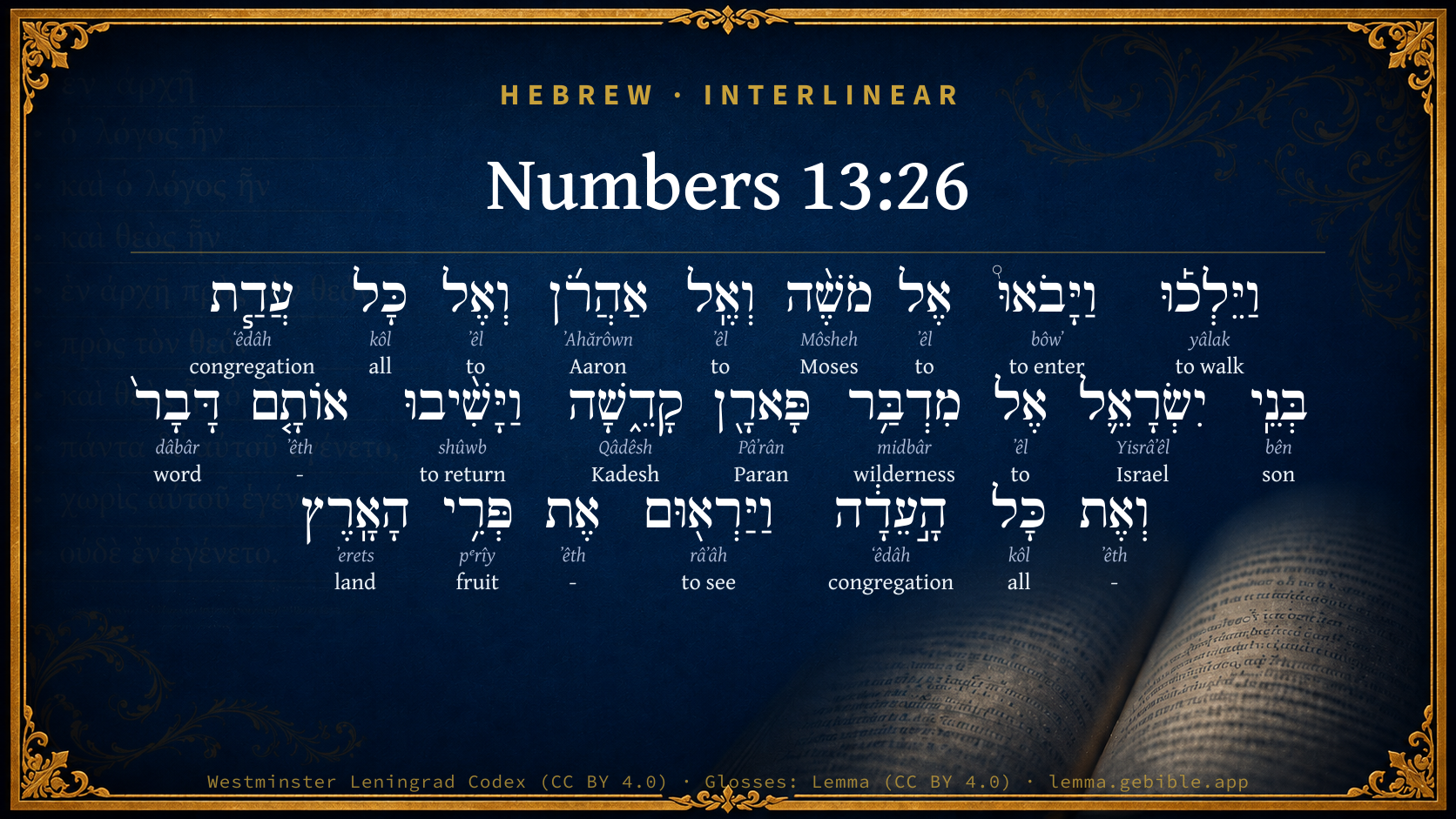
Hebrew (Westminster Leningrad Codex) Numbers 13:26 appears in the Hebrew Old Testament. The text above is from the Westminster Leningrad Codex. Each word links to its Strong’s number, a concise gloss, and parsing drawn from the Open Scriptures Hebrew Bible morphology. Click any word for its full Brown-Driver-Briggs (BDB) entry.
Download image
Cite this verse

Numbers 13:26 (World English Bible). Public Domain. Lemma interlinear Bible study tool, https://lemma.gebible.app/v/numbers/13/26.

Show BibTeX & RIS
BibTeX
RIS
English Translation
They went and came to Moses, and to Aaron, and to all the congregation of the children of Israel, to the wilderness of Paran, to Kadesh; and brought back word to them, and to all the congregation, and shown them the fruit of the land.
World English Bible · Public Domain
Download a study sheet

One document with this verse’s original text, its word-by-word gloss line, the meaning frame, cross-references with their text, attributed commentary, and full source and license credits — printable, and it pastes into notes with its structure intact.

This verse Autodidact and up

Study sheet (.html) Plain text (.txt)

A passage Seminary Student

Up to 50 verses in one chapter. A passage sheet keeps up to 6 commentary sources and 12 cross-references per verse, in the order this page ranks them, and says so on the sheet whenever that leaves anything out. Ask for a single verse and you get the Autodidact verse sheet above.

Everything on this page stays free to read, with no account — the sheet is a download of what is already on screen, not access to it.

Want to remove ads? Support Godless Engineer
Compare translations 3

The same verse in 3 English versions, stacked beneath the original-language interlinear above. Click any original word for its lexicon entry.

Each is an independent rendering of the whole verse — the interlinear is not word-aligned to these translations.

Highlighted words mark where these versions differ — a whole-verse word diff, not a word-by-word alignment.

  • World English Bible Public Domain
    They went and came to Moses, and to Aaron, and to all the congregation of the children of Israel, to the wilderness of Paran, to Kadesh; and brought back word to them, and to all the congregation, and shown them the fruit of the land.
  • King James Version Public Domain
    And they went and came to Moses, and to Aaron, and to all the congregation of the children of Israel, unto the wilderness of Paran, to Kadesh; and brought back word unto them, and unto all the congregation, and showed them the fruit of the land.
  • unfoldingWord Literal Text CC BY-SA 4.0
    and they went and they came to Moses and to Aaron and to all the congregation of the sons of Israel, to the wilderness of Paran at Kadesh. And they returned them and all the congregation a word, and they showed them the fruit of the land,

unfoldingWord Literal Text — © unfoldingWord, licensed CC BY-SA 4.0. Word-aligned USFM3 via Door43 (git.door43.org/unfoldingWord/en_ult).

Versions to compare (up to 4)

3 of 4 selected

Show all 18 translations

Every available English version of this verse, each an independent rendering of the whole verse.

  • World English Bible Public Domain
    They went and came to Moses, and to Aaron, and to all the congregation of the children of Israel, to the wilderness of Paran, to Kadesh; and brought back word to them, and to all the congregation, and shown them the fruit of the land.
  • Berean Standard Bible Public Domain
    and they went back to Moses, Aaron, and the whole congregation of Israel in the Wilderness of Paran at Kadesh. They brought back a report for the whole congregation and showed them the fruit of the land.
  • Majority Standard Bible Public Domain
    and they went back to Moses, Aaron, and the whole congregation of Israel in the Wilderness of Paran at Kadesh. They brought back a report for the whole congregation and showed them the fruit of the land.
  • King James Version Public Domain
    And they went and came to Moses, and to Aaron, and to all the congregation of the children of Israel, unto the wilderness of Paran, to Kadesh; and brought back word unto them, and unto all the congregation, and showed them the fruit of the land.
  • American Standard Version (1901) Public Domain
    And they went and came to Moses, and to Aaron, and to all the congregation of the children of Israel, unto the wilderness of Paran, to Kadesh; and brought back word unto them, and unto all the congregation, and showed them the fruit of the land.
  • Revised Version (1885) Public Domain
    And they went and came to Moses, and to Aaron, and to all the congregation of the children of Israel, unto the wilderness of Paran, to Kadesh; and brought back word unto them, and unto all the congregation, and shewed them the fruit of the land.
  • Geneva Bible (1599) Public Domain
    Then after fourtie dayes, they turned againe from searching of the land.
  • Douay-Rheims (1899) Public Domain
    And they that went to spy out the land returned after forty days, having gone round all the country,
  • Young's Literal Translation Public Domain
    And they go and come in unto Moses, and unto Aaron, and unto all the company of the sons of Israel, unto the wilderness of Paran, to Kadesh; and they bring them and all the company back word, and shew them the fruit of the land.
  • Literal Standard Version CC BY-SA 4.0
    And they go and come to Moses, and to Aaron, and to all the congregation of the sons of Israel, to the wilderness of Paran, to Kadesh; and they bring them and all the congregation back word, and show them the fruit of the land.
  • Unlocked Literal Bible CC BY-SA 4.0
    They came back to Moses, Aaron, and all the community of the people of Israel in the wilderness of Paran, at Kadesh. They brought back word to them and to all the community, and showed them the produce from the land.
  • unfoldingWord Literal Text CC BY-SA 4.0
    and they went and they came to Moses and to Aaron and to all the congregation of the sons of Israel, to the wilderness of Paran at Kadesh. And they returned them and all the congregation a word, and they showed them the fruit of the land,
  • Darby Bible Public Domain
    And they came, and went to Moses and to Aaron, and to the whole assembly of the children of Israel, to the wilderness of Paran, to Kadesh; and brought back word to them, and to the whole assembly; and shewed them the fruit of the land.
  • World Messianic Bible Public Domain
    They went and came to Moses, to Aaron, and to all the congregation of the children of Israel, to the wilderness of Paran, to Kadesh; and brought back word to them and to all the congregation. They showed them the fruit of the land.
  • Webster's Bible Public Domain
    And they went and came to Moses, and to Aaron, and to all the congregation of the children of Israel, to the wilderness of Paran, to Kadesh; and brought back word to them, and to all the congregation, and showed them the fruit of the land.
  • Free Bible Version CC BY-SA 4.0
    They went to see Moses and Aaron, and all the Israelites gathered there at their camp in Kadesh in the Desert of Paran. They gave a report before everyone and showed them the fruit they had brought back from the country.
  • Bible in Basic English Public Domain
    And they came back to Moses and Aaron and all the children of Israel, to Kadesh in the waste land of Paran; and gave an account to them and to all the people and let them see the produce of the land.
  • JPS Tanakh (1917) Public Domain
    And they went and came to Moses, and to Aaron, and to all the congregation of the children of Israel, unto the wilderness of Paran, to Kadesh; and brought back word unto them, and unto all the congregation, and showed them the fruit of the land.

Literal Standard Version (2020), Covenant Press — licensed CC BY-SA 4.0. Text via the HelloAO Bible API (eBible.org). Unlocked Literal Bible (unfoldingWord) — licensed CC BY-SA 4.0. Text via the HelloAO Bible API (eBible.org). unfoldingWord Literal Text — © unfoldingWord, licensed CC BY-SA 4.0. Word-aligned USFM3 via Door43 (git.door43.org/unfoldingWord/en_ult). Free Bible Version, Dr. Jonathan Gallagher — licensed CC BY-SA 4.0. Text via the HelloAO Bible API (eBible.org).

Word by word

More ways to search: Search by grammar → Find every occurrence → Compare this word →

Practice this passage: Drill this verse → Learn its vocabulary →

פָּארָ֖ן
Pâʼrân
H6290
“Paran”
Noun, Proper
Part of Speech
Noun
Type
Proper
Full BDB Definition

Origin: from H6286

TWOT: 1728

Paran = "place of caverns" - wilderness area bounded on the north by Palestine, on the west by the wilderness of Etham, on the south by the desert of Sinai, and on the east by the valley of Arabah; the exodus was through this area and probably all 18 stops were in this area
  1. וַיֵּלְכ֡וּ yâlak H3212 “and · to walk” Conjunction + Verb, Qal, Sequential Imperfect, 3rd Person, Masculine, Plural
  2. וַיָּבֹאוּ֩ bôwʼ H935 “and · to enter” Conjunction + Verb, Qal, Sequential Imperfect, 3rd Person, Masculine, Plural
  3. אֶל ʼêl H413 “to” Preposition
  4. מֹשֶׁ֨ה Môsheh H4872 “Moses” Noun, Proper
  5. וְאֶֽל ʼêl H413 “and · to” Conjunction + Preposition
  6. אַהֲרֹ֜ן ʼAhărôwn H175 “Aaron” Noun, Proper
  7. וְאֶל ʼêl H413 “and · to” Conjunction + Preposition
  8. כָּל kôl H3605 “all of” Noun, Common, Masculine, Singular, Construct
  9. עֲדַ֧ת ʻêdâh H5712 “congregation of” Noun, Common, Feminine, Singular, Construct
  10. בְּנֵֽי bên H1121 “sons of” Noun, Common, Masculine, Plural, Construct
  11. יִשְׂרָאֵ֛ל Yisrâʼêl H3478 “Israel” Noun, Proper
  12. אֶל ʼêl H413 “to” Preposition
  13. מִדְבַּ֥ר midbâr H4057 “wilderness of” Noun, Common, Masculine, Singular, Construct
  14. קָדֵ֑שָׁה Qâdêsh H6946 “Kadesh · toward” Noun, Proper + Suffix, Demonstrative
  15. וַיָּשִׁ֨יבוּ shûwb H7725 “and · to return” Conjunction + Verb, Hiphil, Sequential Imperfect, 3rd Person, Masculine, Plural
  16. אוֹתָ֤ם ʼêth H853 “- · them” Particle, Direct Object + Suffix, Personal, 3rd Person, Masculine, Plural
  17. דָּבָר֙ dâbâr H1697 “word” Noun, Common, Masculine, Singular, Absolute
  18. וְאֶת ʼêth H853 “and · -” Conjunction + Particle, Direct Object
  19. כָּל kôl H3605 “all of” Noun, Common, Masculine, Singular, Construct
  20. הָ֣עֵדָ֔ה ʻêdâh H5712 “the · congregation” Particle, Definite Article + Noun, Common, Feminine, Singular, Absolute
  21. וַיַּרְא֖וּם râʼâh H7200 “and · to see · them” Conjunction + Verb, Hiphil, Sequential Imperfect, 3rd Person, Masculine, Plural + Suffix, Personal, 3rd Person, Masculine, Plural
  22. אֶת ʼêth H853 “-” Particle, Direct Object
  23. פְּרִ֥י pᵉrîy H6529 “fruit of” Noun, Common, Masculine, Singular, Construct
  24. הָאָֽרֶץ ʼerets H776 “the · land” Particle, Definite Article + Noun, Common, Both, Singular, Absolute

About this verse

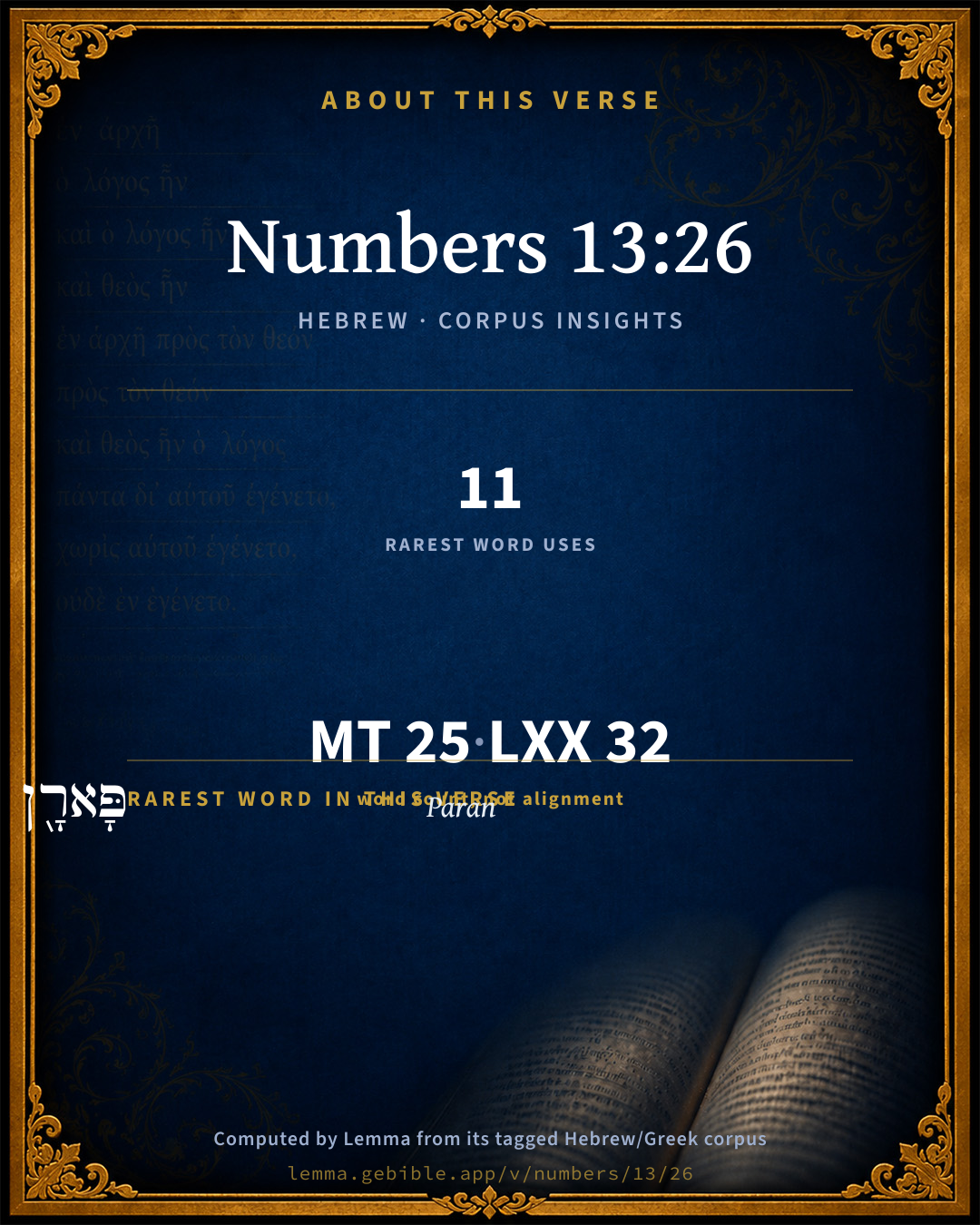
These counts appear in no published source. They are computed here, from the morphology-tagged text and Lemma’s own curated glosses. What Lemma adds →

25
words
18
distinct lemmas
Pentateuch
section

Notable vocabulary

The rarest word here is פָּארָ֖ן Paran H6290 — appearing just 11 times in the whole Hebrew Bible.

Shared distinctive vocabulary

פָּארָ֖ן Paran H6290 occurs in 10 verses of the Hebrew Bible. Also found in:

Grammatical profile

  • 4 verbs
  • 14 nouns
  • 4 prepositions
  • 3 particles

Verb forms

  • וַיֵּלְכ֡וּ Qal · Sequential Imperfect
  • וַיָּבֹאוּ֩ Qal · Sequential Imperfect
  • וַיָּשִׁ֨יבוּ Hiphil · Sequential Imperfect
  • וַיַּרְא֖וּם Hiphil · Sequential Imperfect

Repetition

Words recur within this verse — often emphatic in Hebrew:

  • כָּל all H3605 ×2
  • עֲדַ֧ת congregation H5712 ×2
  • אֶל to H413 ×4

Hebrew & Septuagint length

In English translation the verse runs 45 words from the Hebrew and 12 from the Septuagint (LXX English) — the Septuagint runs noticeably shorter here. See the side-by-side →

A rough comparison of the two English renderings, which tokenize alike — not a word-level alignment.

Word counts can differ between the Hebrew and the Greek without any difference in meaning — e.g. the Hebrew direct-object marker אֵת has no separate Greek word, and Greek often adds the article ὁ.

In the original languages it is 25 Hebrew tokens and 32 Greek tokens — but the two are counted differently (Hebrew bundles its prefixes and suffixes into one token; the Greek is in lemma form), so that isn’t a like-for-like length.

Cross-references

6

Topical passages linked to Numbers 13:26 in the Treasury of Scripture Knowledge — connected by theme and wording, ordered by reader-vote popularity; previews shown in the World English Bible.

  • Numbers 32:8 Thus did your fathers, when I sent them from Kadesh-barnea to see the land.
  • Numbers 20:1 The children of Israel, even the whole congregation, came into the wilderness of Zin in the first month: and the people abode in Kadesh; and Miriam died there, and was buried there.
  • Numbers 20:16 and when we cried to Yahweh, he heard our voice, and sent an angel, and brought us forth out of Egypt: and, behold, we are in Kadesh, a city in the uttermost of your border.
  • Numbers 33:36 They traveled from Ezion Geber, and encamped in the wilderness of Zin (the same is Kadesh).
  • Deuteronomy 1:19 We traveled from Horeb, and went through all that great and terrible wilderness which you saw, by the way to the hill-country of the Amorites, as Yahweh our God commanded us; and we came to Kadesh-barnea.
  • Joshua 14:6 Then the children of Judah drew near to Joshua in Gilgal: and Caleb the son of Jephunneh the Kenizzite said to him, You know the thing that Yahweh spoke to Moses the man of God concerning me and concerning you in Kadesh-barnea.

Cross-references courtesy of OpenBible.info (CC BY 4.0).

Hebrew and Greek witnesses Masoretic Hebrew ↔ Greek Septuagint

The same verse in the two great witnesses to the Old Testament, shown verse-for-verse.

Here the Septuagint runs noticeably shorter than the Hebrew — LXX2012 (modern English Septuagint) 12 words vs World English Bible 45. A rough length comparison of the two English translations, not a word-level alignment — read both below.

These are two independent witnesses, not word-aligned to each other, and the Septuagint is shown in lemma (dictionary) form.

Hebrew Numbers 13:26 Masoretic · Westminster Leningrad Codex

וַיֵּלְכ֡וּ וַיָּבֹאוּ֩ אֶל מֹשֶׁ֨ה וְאֶֽל אַהֲרֹ֜ן וְאֶל כָּל עֲדַ֧ת בְּנֵֽי יִשְׂרָאֵ֛ל אֶל מִדְבַּ֥ר פָּארָ֖ן קָדֵ֑שָׁה וַיָּשִׁ֨יבוּ אוֹתָ֤ם דָּבָר֙ וְאֶת כָּל הָ֣עֵדָ֔ה וַיַּרְא֖וּם אֶת פְּרִ֥י הָאָֽרֶץ

They went and came to Moses, and to Aaron, and to all the congregation of the children of Israel, to the wilderness of Paran, to Kadesh; and brought back word to them, and to all the congregation, and shown them the fruit of the land.

World English Bible · Public Domain

Greek LXX Numbers 13:26 Septuagint · lemma form

καί πορεύομαι ἔρχομαι πρός μωυσῆς καί ἀαρών καί πρός πᾶς συναγωγή υἱός ἰσραήλ εἰς ὁ ἔρημος φαραν καδης καί ἀποκρίνω αὐτός ῥῆμα καί πᾶς ὁ συναγωγή καί δεικνύω ὁ καρπός ὁ γῆ

And they returned from thence, having surveyed the land, after forty days.

LXX2012 (modern English Septuagint) · Public Domain

Hebrew: Westminster Leningrad Codex (CC BY 4.0). Greek: Septuagint (public domain); English from LXX2012 (modern English Septuagint) (Public Domain). How the Septuagint differs from the Hebrew →

Targum (Aramaic paraphrase)

2

The Targum is the ancient Jewish Aramaic paraphrase of the Hebrew Scriptures — an interpretive translation, not the Hebrew text itself. Onkelos (literal) and Pseudo-Jonathan (expansive) render the Torah, and Jonathan the Prophets. Coverage is partial: where no permissively-licensed English translation exists for a verse, only the Aramaic is shown. This is verse-level text, not a word-by-word alignment to the Hebrew.

  1. Targum Onkelos Torah (Genesis–Deuteronomy)
    וַאֲזָלוּ וְאָתוּ לְוַת משֶׁה וּלְוַת אַהֲרֹן וּלְוַת כָּל כְּנִשְׁתָּא דִבְנֵי יִשְׂרָאֵל לְמַדְבְּרָא דְפָארָן לִרְקָם וַאֲתִיבוּ יָתְהוֹן פִּתְגָמָא וְיָת כָּל כְּנִשְׁתָּא וְאַחֲזֵיאֻנוּן יָת אִבָּא דְאַרְעָא

    (no public-domain English translation for this verse)

    Targum Onkelos — Aramaic: “Onkelos Genesis” (public domain); “Onkelos Exodus” (public domain); “Onkelos Leviticus” (public domain); “Onkelos Numbers” (public domain); “Onkelos Deuteronomy” (public domain). English: “Sefaria Community Translation” (CC0 1.0 (public-domain dedication)); “J.W. Etheridge. The Targums of Onkelos and Jonathan Ben Uzziel on the Pentateuch. London: Longmans, Green, 1862” (public domain). Text via Sefaria.

  2. Targum Pseudo-Jonathan Torah (Genesis–Deuteronomy)
    וַאֲזָלוּ וְאָתוּ לְוַת משֶׁה וּלְוַת אַהֲרן וּלְוַת כָּל כְּנִישְׁתָּא דְיִשְרָאֵל לְמַדְבְּרָא דְפָּארָן לִרְקַם וְאָתִיבוּ לְהוֹן פִּתְגָמָא וּלְוַת כָּל כְּנִישְׁתָּא וְחָמִיאוֹנוּן יַת אִבָּא דְאַרְעָא

    And they came to Mosheh and Aharon, and all the congregation of the children of Israel in the wilderness of Pharan, at Rekem, and returned them word, to them and the whole congregation, and showed them the fruit of the land.

    Targum Pseudo-Jonathan — Aramaic: “Targum Jonathan on Genesis” (public domain); “Targum Jonathan on Exodus” (public domain); “Targum Jonathan on Leviticus” (public domain); “Targum Jonathan on Numbers” (public domain); “Targum Jonathan on Deuteronomy” (public domain). English: “The Targum of Jonathan ben Uzziel, trans. J. W. Etheridge, London, 1862” (public domain). Text via Sefaria.

Commentary

Notes on Numbers 13:26 from classic Christian and Jewish commentators (each source and its license shown beneath its notes). The classic Christian expositions comment on the surrounding passage and are grouped to its opening verse, so a note may address several verses; the Jewish commentaries on the Tanakh (Rashi and others) are per-verse, so they appear only where the commentator wrote on this verse.

Lemma curates 59 commentaries, every one of them public domain or Creative Commons licensed, each selected and text-cleaned for this edition rather than reprinted as found. About our sources →

Tyndale Open Study Notes

Tyndale Open Resources

13:26 Kadesh is often identified with ‘Ain el-Qudeirat, a spring at the northern border of Sinai and the southern edge of Canaan. There is no evidence of a Hebrew camp at this site during the period of the Exodus or the wilderness wanderings, so some scholars have suggested that ancient Kadesh was located elsewhere.

Tyndale Open Study Notes — © Tyndale Open Resources, licensed CC BY-SA 4.0. Text via the HelloAO Bible API.

Matthew Henry's Commentary

It is a wonder how the people of Israel had patience to stay forty days for the return of their spies, when they were just ready to enter Canaan, under all the assurances of success they could have from the divine power, and a constant series of miracles that had hitherto attended them; but they distrusted God's power and promise, and were willing to be held in suspense by their own counsels, rather than be brought to a certainty by God's covenant. How much do we stand in our own light by our unbelief! Well, at length the messengers return, but they agree not in their report.

I. The major part discourage the people from going forward to Canaan; and justly are the Israelites left to this temptation, for putting so much confidence in the judgment of men, when they had the word of God to trust to. It is a righteous thing with God to give those up to strong delusions who will not receive his truth in the love of it.

1. Observe their report. (1.) They could not deny but that the land of Canaan was a very fruitful land; the bunch of grapes they brought with them was an ocular demonstration of it, Num 13:27. God had promised them a land flowing with milk and honey, and the evil spies themselves own that it is such a land. Thus even out of the mouth of adversaries will God be glorified and the truth of his promise attested. And yet afterwards they contradict themselves, when they say (Num 13:32), It is a land that eateth up the inhabitants thereof; as if, though it had milk, and honey, and grapes, yet it wanted other necessary provision; some think that there was a great plague in the country at the time they surveyed it, which they ought to have imputed to the wisdom of the divine Providence, which thus lessened the numbers of their enemies, to facilitate their conquests; but they invidiously imputed it to the unwholesomeness of the air, and thence took occasion to disparage the country. For this unreasonable fear of a plague in Canaan, they were justly cut off immediately by a plague in the wilderness, Num 14:37. But, (2.) They represented the conquest of it as altogether impracticable, and that it was to no purpose to attempt it. The people are strong (Num 13:28), men of a great stature (Num 13:32), stronger than we, Num 13:31. The cities are represented as impregnable fortresses: they are walled and very great, Num 13:28. But nothing served their ill purpose more than a description of the giants, on whom they lay a great stress: We saw the children of Anak there (Num 13:28), and again, we saw the giants, those men of a prodigious size, the sons of Anak, who come of the giants, Num 13:33. They spoke as if they were ready to tremble at the mention of them, as they had done at the sight of them. "O these tremendous giants! when we were near them, we were in our own sight as grasshoppers, not only little and weak, but trembling and daunted." Compare Job 39:20, Canst thou make him afraid as a grasshopper? "Nay, and so we were in their sight; they looked upon us with as much scorn and disdain as we did upon them with fear and trembling." So that upon the whole matter they gave it in as their judgment, We are not able to go up against them (Num 13:31), and therefore must think of taking some other course.

2. Now, even if they had been to judge only by human probabilities, they could not have been excused from the imputation of cowardice. Were not the hosts of Israel very numerous? 600,000 effective men, well marshalled and modelled, closely embodied, and entirely united in interest and affection, constituted as formidable an army as perhaps was ever brought into the field; many a less has done more than perhaps the conquering of Canaan was, witness Alexander's army. Moses, their commander-in-chief, was wise and brave; and if the people had put on resolution, and behaved themselves valiantly, what could have stood before them? It is true the Canaanites were strong, but they were dispersed (Num 13:29): Some dwell in the south and others in the mountains; so that by reason of their distance they could not soon get together, and by reason of their divided interests they could not long keep together, to oppose Israel. The country being plentiful would subsist an army, and, though the cities were walled, if they could beat them in the field the strong-holds would fall of course into their hands. And, lastly, as for the giants, their overgrown stature would but make them the better mark, and the bulkiest men have not always the best mettle.

3. But, though they deserved to be posted for cowards, this was not the worst, the scripture brands them for unbelievers. It was not any human probabilities they were required to depend upon, but, (1.) They had the manifest and sensible tokens of God's presence with them, and the engagement of his power for them. The Canaanites were stronger than Israel; suppose they were, but were they stronger than the God of Israel? We are not able to deal with them, but is not God Almighty able? Have we not him in the midst of us? Does not he go before us? And is any thing too hard for him? Were we as grasshoppers before the giants, and are not they less than grasshoppers before God? Their cities are walled against us, but can they be walled against heaven? Besides this, (2.) They had had very great experience of the length and strength of God's arm, lifted up and made bare on their behalf. Were not the Egyptians as much stronger than they as the Canaanites were? And yet, without a sword drawn by Israel or a stroke struck, the chariots and horsemen of Egypt were quite routed and ruined; the Amalekites took them at great disadvantages, and yet they were discomfited. Miracles were at this time their daily bread; were there nothing else, an army so well victualled as theirs was, so constantly, so plentifully, and all on free cost, would have a might advantage against any other force. Nay, (3.) They had particular promises made them of victory and success in their wars against the Canaanites. God had given Abraham all possible assurances that he would put his seed into possession of that land, Gen 15:18; Gen 17:8. He had expressly promised them by Moses that he would drive out the Canaanites from before them (Exo 33:2), and that he would do it by little and little, Exo 23:30. And, after all this, for them to say, We are not able to go up against them, was in effect to say, "God himself is not able to make his words good." It was in effect to give him the lie, and to tell him he had undertaken more than he could perform. We have a short account of their sin, with which they infected the whole congregation, Psa 106:24. They despised the land, they believed not his word. Though, upon search, they had found it as good as he had said, a land flowing with milk and honey, yet they would not believe it as sure as he had said, but despaired of having it, though eternal truth itself had engaged it to them. And now this is the representation of the evil spies.

II. Caleb encouraged them to go forward, though he was seconded by Joshua only (Num 13:30): Caleb stilled the people, whom he saw already put into a ferment even before Moses himself, whose shining face could not daunt them, when they began to grow unruly. Caleb signifies all heart, and he answered his name, was hearty himself, and would have made the people so if they would have hearkened to him. If Joshua had begun to stem the tide, he would have been suspected of partiality to Moses, whose minister he was; and therefore he prudently left it to Caleb's management at first, who was of the tribe of Judah, the leading tribe, and therefore the fittest to be heard. Caleb had seen and observed the strength of the inhabitants as much as his fellows, and upon the whole matter, 1. He speaks very confidently of success: We are well able to overcome them, as strong as they are. 2. He animates the people to go on, and, his lot lying in the van, he speaks as one resolved to lead them on with bravery: "Let us go up at once, one bold step, one bold stroke more, will do our business; it is all our own if we have but courage to make it so: Let us go up and possess it." He does not say, "Let us go up and conquer it;" he looks upon that to be as good as done already; but, "Let us go up and possess it; there is nothing to be done but to enter, and take the possession which God our great Lord is ready to give us." Note, The righteous are bold as a lion. Difficulties that lie in the way of salvation dwindle and vanish before a lively active faith in the power and promise of God. All things are possible, if they be but promised, to him that believes.

Matthew Henry's Commentary on the Whole Bible (1708–1710) — public domain (CC PDM 1.0). Text via the HelloAO Bible API.

Jamieson, Fausset & Brown

Robert Jamieson, A. R. Fausset & David Brown

they came . . . to Kadesh--an important encampment of the Israelites. But its exact situation is not definitely known, nor is it determined whether it is the same or a different place from Kadesh-barnea. It is supposed to be identical with Ain-el-Weibeh, a famous spring on the eastern side of the desert [ROBINSON], or also with Petra [STANLEY].

Jamieson, Fausset & Brown — Commentary Critical and Explanatory on the Whole Bible (1871) — public domain (CC PDM 1.0). Text via the HelloAO Bible API.

Ellicott's Commentary for English Readers

(26) To Kadesh.—Robinson and others identify Kadeeh with Ain-el-Weibeh, which is in the Arabah, about ten miles north of the place in which Mount Hor abuts on that valley. On the other hand, Mr. Wilton, in The Negeb (pp. 79, 80), and Mr. Palmer in the Desert of the Exodus (Numbers 25), maintain the identity of Kadesh with el-Ain, which is about sixty miles west of Mount Hor, and about fifty miles west of Ain-el-Weibeh. The former of these views is maintained in a very elaborate note on this verse in The Bible Commentary.

A Bible Commentary for English Readers, edited by Charles John Ellicott (1878–1897) — public domain. Text from a community e-Sword module.

John Gill's Exposition

And they brought up an evil report of the land which they had searched unto the children of Israel,.... Before, they gave a good report of the land itself, as a very fruitful one, answering to their expectations and wishes; but now they change their language, and give a different account of it; which shows their want of integrity, and to what length an opposition carried them, to say things contrary to their real sentiments, and to what they themselves had said before:

saying, the land through which we have gone to search it, is a land that eateth up the inhabitants thereof; the meaning seems to be, that it was so barren and unfruitful that it did not produce food sufficient for the inhabitants of it, who were ready to starve, and many did starve through want, and so was the reverse of what they had before said; for which reason, Gussetius (o) thinks the sense is, that the land was the food and nourishment of its inhabitants, and that there was such plenty in it that it wanted not any foreign assistance in any respect whatever. Some think that it was continually embroiled in civil wars, in which they destroyed one another; but then this was no argument against, but for their going up against them, since through the divisions among themselves they might reasonably hope the better to succeed; or it ate them up with diseases, as the Targum of Jonathan adds, and so they would represent it, though a fruitful land, yet a very unhealthful one, in which the natives could not live, and much less strangers; and so Aben Ezra and Ben Gersom interpret it of the badness of the air of the country, as being very unwholesome and pernicious. Jarchi represents them as saying, that wherever they came they saw them burying their dead, as if there was a plague among them; and be it so that there was, which is not unlikely, since the Lord promised to send hornets before them, which some interpret of diseases sent, Exo 23:28; and which was in their favour, since hereby the number of their enemies would be lessened, and they would be weakened, and in a bad condition to oppose them:

and all the people that we saw in it are men of a great stature; or men of measures (p), of a large measure, above the common measure of men; but it may be justly questioned whether they spoke truth; for though they might see some that exceeded in height men in common, yet it is not credible that all they saw were of such a size; since they were not only at Hebron and saw the giants there who were such, but they went through the land, as in the preceding clause, and all they met with cannot be supposed to be of such a measure.

(o) Ebr. Comment. p. 40. (p) "viri mensurarum", Montanus, Vatablus, Drusius.

John Gill's Exposition of the Whole Bible (1746–1763) — public domain (CC PDM 1.0). Text via the HelloAO Bible API.

Albert Barnes' Notes on the Bible

Kadesh is usually identified with Ain-el-Weibeh, which lies in the Arabah, about 10 miles north of the place in which Mount Hor abuts on that valley, (or with Ain-Gadis in Jebel Magrah).

Albert Barnes' Notes on the Bible (1834–1885) — public domain. Text from a community e-Sword/MySword module.

Matthew Poole's English Annotations

Kadesh; so called by way of abbreviation, which is frequent in Hebrew names, for Kadesh-barnea, Deu 1:19, which some rashly confound with Kadesh in the wilderness of Zin, Num 20:1; 27:14; 33:36; into which they came not till the fortieth year after their coming out of Egypt, as appears from Num 33:37,38 whereas they were in this Kadesh in the second year, and before they received the sentence of their forty years’ abode in the wilderness.

Matthew Poole's English Annotations on the Holy Bible (1683–1685) — public domain. Text from a community e-Sword/MySword module.

Whedon's Commentary on the Bible

Daniel D. Whedon

26. Paran — See Num_10:12; Num_12:16, notes.

Kadesh — Num_20:16; Num_33:36, notes.

Showed them the fruit — In confirmation of their report of the excellence of the land.

Daniel D. Whedon (gen. ed.), Commentary on the Old and New Testaments (1874–1909) — public domain. Text from a community e-Sword module.

The Pulpit Commentary

To Kadesh. (see note at the end of Nu 14)

The Pulpit Commentary (1880–1919), ed. H.D.M. Spence-Jones & Joseph S. Exell — public domain. Text from a community e-Sword module.

John Wesley's Explanatory Notes

Kadesh - Kadesh-barnea, which some confound with Kadesh in the wilderness of Sin, into which they came not 'till the fortieth year after their coming out of Egypt, as appears from chap. xxxiii, 37, 38, whereas they were in this Kadesh in the second year, and before they received the sentence of their forty years abode in the wilderness.

John Wesley, Explanatory Notes Upon the Whole Bible (1754–1765) — public domain. Text via the GEBible commentary corpus.

Rashi

Rabbi Shlomo Yitzchaki (Rashi)

וילכו ויבאו AND THEY WENT AND CAME [TO MOSES] — What is the force of “they went” (we have been informed that they had returned; why afterwards make any reference to their going on the journey)? It is intended to compare their “going” with their “coming" to Moses! How was their coming to Moses? With an evil plan! So, too, was their “going” on the journey with an evil plan (i.e. that when they were travelling they had already resolved to bring back an evil report)! (Sotah 35a).

וישיבו אתם דבר AND THEY BROUGHT BACK WORD UNTO THEM — unto Moses and Aaron (for the Congregation is mentioned separately).

Rashi on the Tanakh — English translations: “The Judaica Press complete Tanach with Rashi, translated by A. J. Rosenberg” (CC BY 4.0); “Pentateuch with Rashi's commentary by M. Rosenbaum and A.M. Silbermann, 1929-1934” (public domain); “The Metsudah Tanach series, Lakewood, N.J” (CC BY 4.0); and “The Book of Joshua, Metsudah Publications, 1997” (CC BY 4.0). Text via Sefaria.

Ibn Ezra

Rabbi Abraham ibn Ezra

They went. This teaches that they did not go to their tents in the camp, rather, they immediately went

and they brought word back to them — to Moshe and Aharon.

Ibn Ezra on the Tanakh — English translations: “Sefaria Community Translation” (CC0 1.0 (public-domain dedication)); “Yalkut, Sifsei Chachomim Chumash, Metsudah Publications, 2009” (CC BY 4.0); and “Commentary of Ibn Ezra on Isaiah - trans. by M. Friedlander, 1873” (public domain). Text via Sefaria.

Lesson kit

Teaching starters — assembled from the data on this page, not authored interpretation. Every prompt links to the verse data it draws on. Edit before teaching.

Numbers, in the Pentateuch, opens this verse with 25 words (18 distinct Hebrew lemmas). Its most distinctive word is Pâʼrân (“Paran”). The Greek Septuagint runs shorter here. A historical commentator’s framing appears above. Read the whole chapter for the surrounding context.

Discussion questions

  1. What does “Paran” (Pâʼrân) contribute to the verse as a whole?
  2. Genesis 21:21 shares the word «Paran» with this verse. How do the two illuminate each other?
  3. “all” occurs 2× in this one verse. What is the effect of the repetition?
  4. Compared with the Hebrew, the Septuagint runs shorter here. What questions does that raise?
  5. The translations on this page render this verse differently — a whole-verse word diff, not a word-by-word alignment. What might account for the different wordings?
  6. The verb «וַיֵּלְכ֡וּ» is Qal Sequential Imperfect. How does its form color the action?
  7. Reading how Tyndale Open Study Notes and Matthew Henry's Commentary read this verse, where do the two commentators agree and where do they part?

Things to notice

Reading settings

Reading text

Shown beneath each verse's original-language words.

Old Testament
Old Testament edition

Read the OT as the Masoretic Hebrew (MT) or the Greek Septuagint (LXX).

English shown for the Greek Septuagint (in the Hebrew ↔ Greek comparison).

Comparing translations? Open the Compare panel on any verse page to stack up to four side by side.