
John 9:27

Greek (Tischendorf 8th ed.) John 9:27 appears in the Greek New Testament. The text above is from the Tischendorf 8th edition. Each word links to its Strong’s number and a concise gloss. Click any word for its full Thayer’s Greek Lexicon entry.
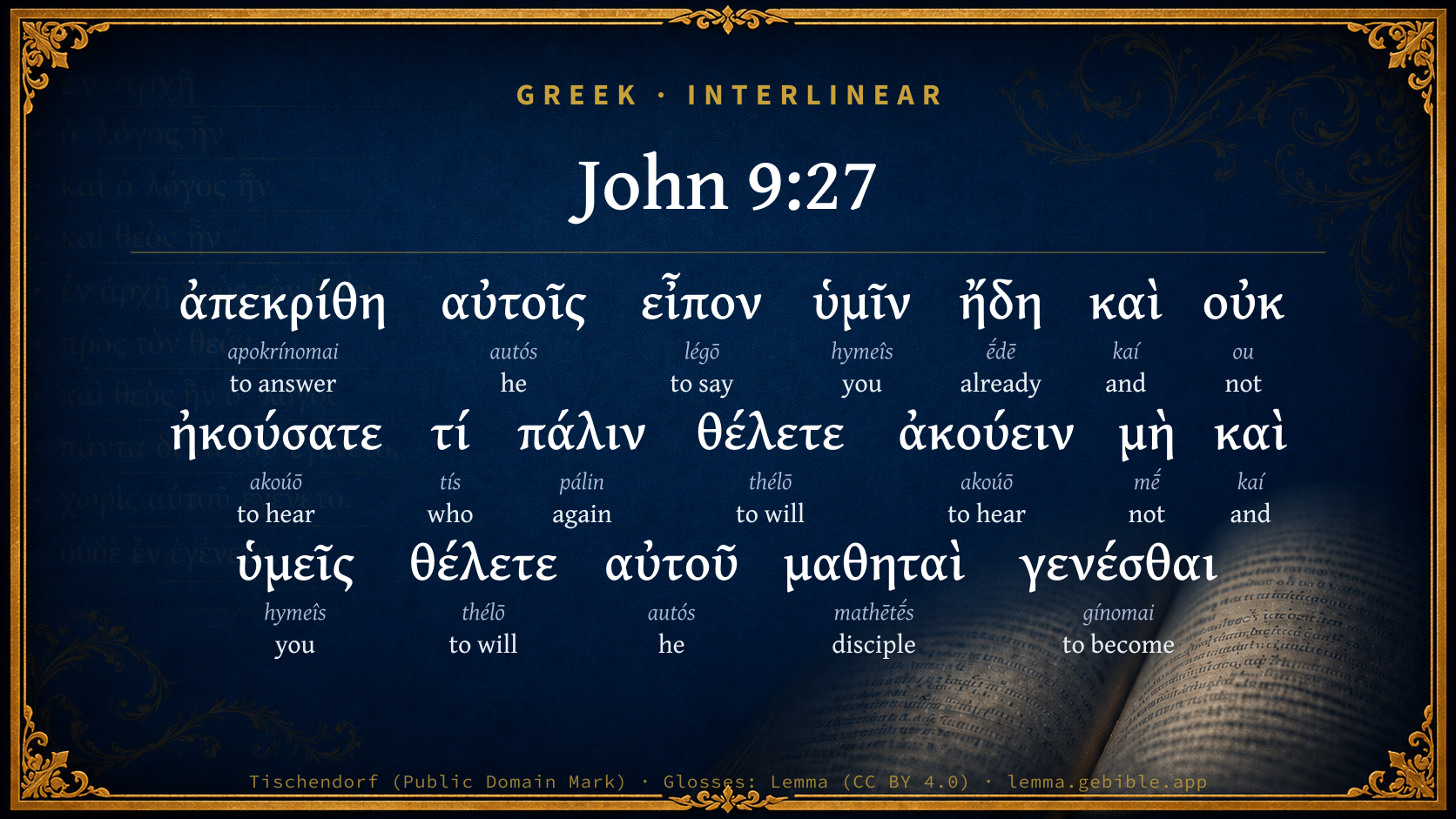
Download image
Cite this verse

John 9:27 (World English Bible). Public Domain. Lemma interlinear Bible study tool, https://lemma.gebible.app/v/john/9/27.

Show BibTeX & RIS
BibTeX
RIS
English Translation
He answered them, "I told you already, and you didn't listen. Why do you want to hear it again? You don't also want to become his disciples, do you?"
World English Bible · Public Domain
Download a study sheet

One document with this verse’s original text, its word-by-word gloss line, the meaning frame, cross-references with their text, attributed commentary, and full source and license credits — printable, and it pastes into notes with its structure intact.

This verse Autodidact and up

Study sheet (.html) Plain text (.txt)

A passage Seminary Student

Up to 50 verses in one chapter. A passage sheet keeps up to 6 commentary sources and 12 cross-references per verse, in the order this page ranks them, and says so on the sheet whenever that leaves anything out. Ask for a single verse and you get the Autodidact verse sheet above.

Everything on this page stays free to read, with no account — the sheet is a download of what is already on screen, not access to it.

Want to remove ads? Support Godless Engineer
Compare translations 3

The same verse in 3 English versions, stacked beneath the original-language interlinear above. Click any original word for its lexicon entry.

Each is an independent rendering of the whole verse — the interlinear is not word-aligned to these translations.

Highlighted words mark where these versions differ — a whole-verse word diff, not a word-by-word alignment.

  • World English Bible Public Domain
    He answered them, "I told you already, and you didn't listen. Why do you want to hear it again? You don't also want to become his disciples, do you?"
  • King James Version Public Domain
    He answered them, I have told you already, and ye did not hear: wherefore would ye hear it again? will ye also be his disciples?
  • unfoldingWord Literal Text CC BY-SA 4.0
    He answered them, “I have told you already, and you did not listen! Why do you want to listen again? You do not want to become his disciples also, do you?”

unfoldingWord Literal Text — © unfoldingWord, licensed CC BY-SA 4.0. Word-aligned USFM3 via Door43 (git.door43.org/unfoldingWord/en_ult).

Versions to compare (up to 4)

3 of 4 selected

Show all 19 translations

Every available English version of this verse, each an independent rendering of the whole verse.

  • World English Bible Public Domain
    He answered them, "I told you already, and you didn't listen. Why do you want to hear it again? You don't also want to become his disciples, do you?"
  • Berean Standard Bible Public Domain
    He replied, “I already told you, and you did not listen. Why do you want to hear it again? Do you also want to become His disciples?”
  • Majority Standard Bible Public Domain
    He replied, “I already told you, and you did not listen. Why do you want to hear it again? Do you also want to become His disciples?”
  • King James Version Public Domain
    He answered them, I have told you already, and ye did not hear: wherefore would ye hear it again? will ye also be his disciples?
  • American Standard Version (1901) Public Domain
    He answered them, I told you even now, and ye did not hear; wherefore would ye hear it again? would ye also become his disciples?
  • Revised Version (1885) Public Domain
    He answered them, I told you even now, and ye did not hear: wherefore would ye hear it again? would ye also become his disciples?
  • Geneva Bible (1599) Public Domain
    Hee answered them, I haue tolde you already, and yee haue not heard it: wherefore would yee heare it againe? will yee also be his disciples?
  • Douay-Rheims (1899) Public Domain
    He answered them: I have told you already, and you have heard: why would you hear it again? will you also become his disciples?
  • Young's Literal Translation Public Domain
    He answered them, `I told you already, and ye did not hear; why again do ye wish to hear? do ye also wish to become his disciples?'
  • Literal Standard Version CC BY-SA 4.0
    He answered them, “I told you already, and you did not hear; why do you wish to hear [it] again? Do you also wish to become His disciples?”
  • Unlocked Literal Bible CC BY-SA 4.0
    He answered, “I have told you already, and you did not listen! Why do you want to hear it again? You do not want to become his disciples too, do you?
  • unfoldingWord Literal Text CC BY-SA 4.0
    He answered them, “I have told you already, and you did not listen! Why do you want to listen again? You do not want to become his disciples also, do you?”
  • Darby Bible Public Domain
    He answered them, I told you already and ye did not hear: why do ye desire to hear again? do ye also wish to become his disciples?
  • World Messianic Bible Public Domain
    He answered them, “I told you already, and you didn’t listen. Why do you want to hear it again? You don’t also want to become his disciples, do you?”
  • Webster's Bible Public Domain
    He answered them, I have told you already, and ye did not hear: Why would ye hear it again? will ye also be his disciples?
  • Free Bible Version CC BY-SA 4.0
    The man replied, “I already told you. Weren't you listening? Why do you want to hear it again? You don't want to become his disciples too, do you?”
  • Bible in Basic English Public Domain
    His answer was: I have said it before, but your ears were shut: why would you have me say it again? is it your desire to become his disciples?
  • Text-Critical English NT CC BY 4.0
    He answered them, “I told you already, and you did not listen. Why do you want to hear it again? Do you also want to become his disciples?”
  • Tyndale New Testament (1534) Public Domain
    He answered them I tolde you yerwhyle and the dyd not heare. Wherfore wolde ye heare it agayne? Will ye also be his disciples?

Literal Standard Version (2020), Covenant Press — licensed CC BY-SA 4.0. Text via the HelloAO Bible API (eBible.org). Unlocked Literal Bible (unfoldingWord) — licensed CC BY-SA 4.0. Text via the HelloAO Bible API (eBible.org). unfoldingWord Literal Text — © unfoldingWord, licensed CC BY-SA 4.0. Word-aligned USFM3 via Door43 (git.door43.org/unfoldingWord/en_ult). Free Bible Version, Dr. Jonathan Gallagher — licensed CC BY-SA 4.0. Text via the HelloAO Bible API (eBible.org).

Word by word

More ways to search: Search by grammar → Find every occurrence → Compare this word →

Practice this passage: Drill this verse → Learn its vocabulary →

ἤδη
ḗdē
G2235
“already”
Adverb
Part of Speech
Adverb
Full Thayer's Definition

Origin: apparently from G2228 (or possibly G2229 ) and G1211

TDNT: None

1. now, already
  1. ἀπεκρίθη apokrínomai G611 “to answer” Verb, Aorist, Middle deponent, Indicative, 3rd person, Singular
  2. αὐτοῖς autós G846 “he” Personal pronoun, Dative, Plural, Masculine
  3. εἶπον légō G3004 “to say” Verb, Aorist, Active, Indicative, 1st person, Singular
  4. ὑμῖν hymeîs G5210 “you” Personal pronoun, 2nd person, Dative, Plural
  5. καὶ kaí G2532 “and” Conjunction
  6. οὐκ ou G3756 “not” Particle, Negative
  7. ἠκούσατε akoúō G191 “to hear” Verb, Aorist, Active, Indicative, 2nd person, Plural
  8. τί tís G5101 “who” Interrogative pronoun, Accusative, Singular, Neuter
  9. πάλιν pálin G3825 “again” Adverb
  10. θέλετε thélō G2309 “to will” Verb, Present, Active, Indicative, 2nd person, Plural
  11. ἀκούειν akoúō G191 “to hear” Verb, Present, Active, Infinitive
  12. μὴ mḗ G3361 “not” Particle, Negative
  13. καὶ kaí G2532 “and” Conjunction
  14. ὑμεῖς hymeîs G5210 “you” Personal pronoun, 2nd person, Nominative, Plural
  15. θέλετε thélō G2309 “to will” Verb, Present, Active, Indicative, 2nd person, Plural
  16. αὐτοῦ autós G846 “he” Personal pronoun, Genitive, Singular, Masculine
  17. μαθηταὶ mathētḗs G3101 “disciple” Noun, Nominative, Plural, Masculine
  18. γενέσθαι gínomai G1096 “to become” Verb, Aorist, Middle deponent, Infinitive

About this verse

These counts appear in no published source. They are computed here, from the morphology-tagged text and Lemma’s own curated glosses. What Lemma adds →

19
words
14
distinct lemmas
Gospels
section

Shared distinctive vocabulary

ἤδη already G2235 occurs in 53 verses of the Greek New Testament. Also found in:
Repetition

Words recur within this verse:

  • ἠκούσατε to hear G191 ×2
  • θέλετε to will G2309 ×2
  • αὐτοῖς he G846 ×2
  • ὑμῖν you G5210 ×2
  • καὶ and G2532 ×2

Cross-references

1

Topical passages linked to John 9:27 in the Treasury of Scripture Knowledge — connected by theme and wording, ordered by reader-vote popularity; previews shown in the World English Bible.

  • Luke 22:67 "If you are the Christ, tell us." But he said to them, "If I tell you, you won't believe,

Cross-references courtesy of OpenBible.info (CC BY 4.0).

Commentary

Notes on John 9:27 from classic Christian and Jewish commentators (each source and its license shown beneath its notes). The classic Christian expositions comment on the surrounding passage and are grouped to its opening verse, so a note may address several verses; the Jewish commentaries on the Tanakh (Rashi and others) are per-verse, so they appear only where the commentator wrote on this verse.

Lemma curates 59 commentaries, every one of them public domain or Creative Commons licensed, each selected and text-cleaned for this edition rather than reprinted as found. About our sources →

Bengel's Gnomon

Johann Albrecht Bengel

Joh 9:27. Τί, why) wherefore?—και ὑμεῖς ye also) He confesses that he wishes to become a disciple of Jesus.—θέλετε, do ye wish) A sweet and becoming irony. [And indeed it is right, that he, who wishes to become a disciple of Christ, should resort to anxious investigation. The truth does not shrink from it.—V. g.]

Bengel's Gnomon of the New Testament — English translation (T&T Clark, Edinburgh, 1860) — public domain. Text from a community e-Sword module.

Jamieson, Fausset & Brown

Robert Jamieson, A. R. Fausset & David Brown

I have told you already . . . will ye also be his disciples?--In a vein of keen irony he treats their questions as those of anxious inquirers, almost ready for discipleship! Stung by this, they retort upon him as the disciple (and here they plainly were not wrong); for themselves, they fall back upon Moses; about him there could be no doubt; but who knew about this upstart?

Jamieson, Fausset & Brown — Commentary Critical and Explanatory on the Whole Bible (1871) — public domain (CC PDM 1.0). Text via the HelloAO Bible API.

Adam Clarke's Commentary

Verse 27. I have told you already] So he did, Joh 9:15. And did ye not hear? Ye certainly did. Why then do you wish to hear it again? Is it because ye wish to become his disciples? The poor man continued steady in his testimony; and, by putting this question to them, he knew he should soon put an end to the debate.

Adam Clarke's Commentary on the Bible (1810–1826) — public domain. Text from a community e-Sword/MySword module.

Ellicott's Commentary for English Readers

(27) I have told you already, and ye did not hear.—The man becomes weary of this cross-questioning, the purpose of which is sufficiently clear to him. His first answer was in the fewest possible words (Joh_9:15, compared with Joh_9:7), and even these he will not repeat. There is some difficulty about the meaning of the word “hear” in the two clauses of this verse. When the man says “Ye did not hear,” we naturally understand “did not heed;” but when he goes on to say, “Wherefore would ye hear it again? the word clearly has its ordinary sense of hearing. The same word occurs in the two clauses in the Greek, just as it does in the English, and we are scarcely justified in giving it two distinct meanings. If we were to read both clauses as questions, we should avoid this difficulty, and get a sense which would suit the evident feeling of the man. He is impatient, and expresses this in a series of rapid questions. “I have told you already, and did ye not hear? wherefore would ye hear it again? will ye also be His disciples?”

Will ye also be his disciples?—The words refer, probably, to some who are His disciples, not to the man himself as being, or being ready to become, a disciple. This is a further stage of his spiritual education which is to follow, but has not yet arrived (Joh_9:35-38). The man must have known of the existence of a band of disciples, who indeed in his presence had questioned their Master concerning him (Joh_9:2), and it is not unlikely that while the parents were being questioned, the son may have learnt more concerning the work of Christ. The question puts the irony in the severest form, “Surely ye also do not wish to become His disciples?” It may have been designed, or may only have been as an arrow drawn at a venture; but there must have been among those of whom it was asked, men who tried in vain to encase themselves in the armour of authority, which would repel his shaft and silence him. It must have gone through the joints of the harness and pierced to the hearts of men like Nicodemus, who were half-disciples without the “courage of their convictions.” Here was the blind beggar making an open avowal of that which the Pharisees and rulers dared only to confess by night (Joh_3:2).

A Bible Commentary for English Readers, edited by Charles John Ellicott (1878–1897) — public domain. Text from a community e-Sword module.

The Cambridge Bible for Schools and Colleges

gen. ed. J. J. S. Perowne

27. I have told you] Rather, I told you.

and ye did not hear] Or possibly, and did ye not hear? This avoids taking ‘hear’ in two different senses; (1) ‘pay attention,’ (2) ‘hear.’ The man loses all patience, and will not go through it again.

wherefore would ye hear] Or, wherefore do ye wish to hear.

will ye also, &c.] Or, Surely ye also do not wish to become His disciples. The form of the question is similar to that in Joh_6:67 and Joh_7:52 (comp. Joh_4:29, Joh_7:35). Moreover, it is not the future tense, but the verb ‘to will’ or ‘wish’ (comp. Joh_5:40, Joh_6:67, Joh_7:17, Joh_8:44). Lastly, the difference between ‘be’ and ‘become’ is easily preserved here, and is worth preserving (comp. Joh_8:58). The meaning of ‘also’ has been misunderstood. It can scarcely mean ‘as well as I:’ the man has not advanced so far in faith as to count himself a disciple of Jesus; and if he had, he would not avow the fact to the Jews. ‘Also’ means ‘as well as His well-known disciples.’ That Christ had a band of followers was notorious.

The Cambridge Bible for Schools and Colleges (gen. ed. J. J. S. Perowne; Cambridge University Press, 1878–1918) — public domain. Text from a community e-Sword module.

John Gill's Exposition

Then they reviled him,.... Called him an impertinent, saucy, impudent fellow, for talking in this pert manner to them, the great sanhedrim of the nation; or, as the Vulgate Latin version reads, they cursed him; they thundered out their anathemas against him, and pronounced him an execrable and an accursed fellow:

and said, thou art his disciple; for they looked upon it a reproach and scandal to be called a disciple of Jesus of Nazareth; though there is nothing more honourable than to be a follower of him the Lamb whithersoever he goes: wherefore these Jews threw off what they thought a term of reproach from themselves to the blind man; and perhaps they might say this to ensnare him, hoping that he would own himself to be a disciple of Jesus, and profess him to be the Christ, that they might, according to their own act, excommunicate him. The Vulgate Latin, Persic, and Ethiopic versions read, "be thou his disciple"; if thou wilt, we despise the character; far be it from us that we should be followers of him:

but we are Moses's disciples. Thus they preferred Moses to Christ, and chose to be the disciples of Moses the servant, rather than of Christ the Son; though indeed they were not the genuine disciples of Moses; for if they had, they would have been the disciples of Christ, and believers in him, since Moses wrote and testified of him: they might indeed be so far the disciples of Moses, or of his law, since they sought for righteousness and justification by obedience to his law. This was a phrase in use among the Jews: so the Targumist (i) on Num 3:2 says,

"these are the names of they sons of Aaron the priests, , "the disciples of Moses", the master of the Israelites;''

particularly the Pharisees, as here, claimed this title to themselves: for it is said (k),

"all the seven days (before the day of atonement) they delivered to him (the high priest) two of the disciples of the wise men, to instruct him in the service (of that day), who were, , "of the disciples of Moses", in opposition to the Sadducees:''

from whence it appears, that these disciples of Moses were of the sect of the Pharisees, who assumed this character as peculiar to themselves; sometimes they call themselves the disciples of Abraham, though the description they give of such, by no means belongs to them; See Gill on Joh 8:39. They say (l),

"whoever has three things in him, is , "of the disciples of Abraham" our father, and who has three other things is of the disciples of Balaam the wicked: he that has a good eye, (beneficence, or temperance, or contentment,) a lowly spirit, and an humble soul, he is of "the disciples of Abraham" our father; but he that has evil eye, and a proud spirit, and a large soul (lustful or covetous), is of the disciples of Balaam.''

This last character best agrees with those very persons, who would be thought to be the disciples of Abraham and of Moses.

(i) Jonathan ben Uzziel in ib. (k) T. Bab. Yoma, fol. 4. 1. (l) Pirke Abot, c. 5. sect. 19.

John Gill's Exposition of the Whole Bible (1746–1763) — public domain (CC PDM 1.0). Text via the HelloAO Bible API.

Trapp's Complete Commentary

John Trapp

27 He answered them, I have told you already, and ye did not hear: wherefore would ye hear it again? will ye also be his disciples?

Ver. 27. Will ye also be his disciples?] A bold speech of so mean a man, so little enlightened, to the chief priests and Pharisees. Such was that of Dirick Carver, martyr, to Bonner, Your doctrine is poison and sorcery. If Christ were here, you would put him to a worse death than he was put to before. You say you can make God; you can make a pudding as soon, &c. And that of Henry Lawrence, who being to subscribe the bill of his examination, wrote, Ye are all antichrist, and him ye follow, &c. And that of Anthony Parsons: Thou callest us thieves, said the bishop of Salisbury. I say, quoth Anthony, ye are not only thieves, but murderers, ye are rather bitesheeps than true bishops. (Acts and Mon.)

John Trapp, A Commentary or Exposition upon All the Books of the Old and New Testament (1647–1656) — public domain. Text from a community e-Sword module.

Haydock's Catholic Bible Commentary

I have told you already, and you have heard. In almost all Greek manuscripts we now read, and you have not heard. Beza, with good reason, here prefers the Latin Vulgate, as more correct than the Greek. (Witham)

George Leo Haydock (1774–1849), Haydock's Catholic Family Bible and Commentary, 1859 edition — public domain. Excludes Psalms (Douay-Rheims chapter numbering differs from Protestant) and Deuterocanonical books (Catholic canon only).

Matthew Poole's English Annotations

It is wonderful to see how the boldness and confidence of the poor man increased; God giving him that wisdom and courage which they were not able to resist. He refuseth to repeat the story to them, telling them he had once already told it them, but they would not give credit to him; and to what purpose was it for him to say it over again, unless they were inclined to be his disciples? Some think the form of speech implies a hearty wishing and desiring that they would be so: but others think he speaks ironically, as if he had said, I know my repeating again the story will not induce you to be his disciples, you are resolved against that, and therefore why do you put me upon a needless trouble? And this seemeth to have been his sense by what followeth in the Pharisees reply, full of indignation.

Matthew Poole's English Annotations on the Holy Bible (1683–1685) — public domain. Text from a community e-Sword/MySword module.

Whedon's Commentary on the Bible

Daniel D. Whedon

27. Be his disciples—Was the irony in his question justifiable? Elijah used irony in 1Ki_18:27, and Jesus in Mat_23:32. And yet, if this were truly a legal court, it may be doubted whether the man did not commit a faulty disrespect for which the want of self-respect in the court furnishes no full excuse. Yet when we consider that he was a poor, uncultivated mendicant, we can excuse this single error, and still wonder at his martyr-like constancy.

Daniel D. Whedon (gen. ed.), Commentary on the Old and New Testaments (1874–1909) — public domain. Text from a community e-Sword module.

The Pulpit Commentary

He answered them, I told you already, and ye did not hear (the Italic Versions and the Vulgate here omit the negation, which De Wette says would be caster of comprehension; but as it stands, the sentence is equivalent to "you had no ears, you took no heed, if you had already listened to the simple facts"): wherefore would ye hear it again? You will pay no more heed now than then; or do ye want to transform it into a charge? There is another alternative, stated in either humble pleading or ironical retort, according as we interpret the kai . The next question is either,

(1) (Lutbardt) Would you also be his disciples, like the many multitudes who are shouting his praise? is that your bent? surely not! or

(2) it may mean, Is it possible that it is in your mind, not only to find out all about the how of this great miracle, but also to become his disciples? Neither of these interpretations is perfectly consistent with his taunt, "ye did not hear." Therefore

(3) (Bengel) the most natural meaning is, Would ye also, as well as myself, the poor beggar, become his disciples? (so Westcott, Moulton, and Lange). The poor man was roused, ironical, and ready, notwithstanding the threat of the great excommunication hanging over him, to announce his own discipleship to any extent and at any risk.

An appeal for disciples.

Admirable, indeed, were the bearing and the language of this poor man when in the presence either of Jesus or of the Pharisees. When confronted by the Lord"s enemies, he was not worsted in the discussion, and he was silenced only by violence. If there was a shade of irony in this appeal, still there was justice in it. The language is such as may well be addressed, by those who have benefited by Christ and have attached themselves to Christ, to all whom their influence may reach.

I THE CHARACTER OF THIS DISCIPLESHIP. There was reason in the designation "disciple," as applied to all who attached themselves to the Lord Jesus. Observe:

1. The Master and his lesson. Christ is supremely able to teach. There may be learned

a. wisdom from his lips;

b. holiness from his life;

c. love and pardon from his cross;

d. obedience from his throne.

2. The scholar and his spirit. On the part of him who would be Christ"s true pupil, there must be

a. reverence for the Master"s authority;

b. diligence in the study of his character, his words, and his life;

c. subjection to all commands, however this submission may involve self-denial;

d. perseverance in application to Divine lessons.

II THE HINDRANCES TO THIS DISCIPLESHIP. There may be observed, as militating against such pupilage:

1. Pride, which flatters men that they need no teaching, that they are a sufficient lesson and law to themselves.

2. Irreligion, which assures men that other masters are as good as Christ, that there is no special faculty to instruct and to govern residing in him rather than in others who claim obedience.

3. Unspirituality, which too readily suggests that Christ"s teaching is too holy, that his standard of goodness is too high, for human attainment. By these several formidable obstacles multitudes are kept from resorting to Jesus in that reverent, lowly, and teachable temper of mind which alone can secure their enlightenment and salvation.

III THE MOTIVES TO THIS DISCIPLESHIP.

1. It is our nature and our need to learn.

2. None is so able to instruct us as is the great Teacher, the Divine Master.

3. To stand aloof from his teaching is to remain ignorant of what it most concerns us to know.

4. Christ is willing to receive and to welcome us into his school. There is no need, in order to become his disciples and to learn of him, to abandon lawful avocations; no need to dispense with human teachers who are not rivals to Jesus. The door of the school is open, and the great Master is waiting and ready.

APPLICATION.

1. A question to answer for yourselves. "Will ye also be his disciples?" It is not the first time this question has been put to the hearers of the gospel; it is urged once again. It is not too early for any to begin discipleship. And it is not too late for any who may have delayed hitherto, now to respond to the summons.

2. A question to propose to others. This is the invitation which the Church is bound to address to the world. If one who had been a poor blind beggar could urge it upon his superiors; if he could speak for Jesus, though persecuted for his boldness; why should any Christian be deterred from witnessing and appealing to his fellow-men, either by the sense of his own unworthiness and insufficiency, or by the seeming unsuitableness and insensibility of those to whom the appeal is made? T.

The Pulpit Commentary (1880–1919), ed. H.D.M. Spence-Jones & Joseph S. Exell — public domain. Text from a community e-Sword module.

John Wesley's Explanatory Notes

Are ye also - As well as I, at length convinced and willing to be his disciples?

John Wesley, Explanatory Notes Upon the Whole Bible (1754–1765) — public domain. Text via the GEBible commentary corpus.

Cambridge Greek Testament for Schools and Colleges

27. καὶ οὐκ ἠκούσατε. Possibly interrogative, Did ye not hear? This avoids taking ἀκούειν in two senses; (1) ‘hearken,’ (2) ‘hear.’ The man loses all patience, and will not go through it again.

μὴ καὶ ὑμεῖς. Surely ye also do not wish to become: comp. Joh 4:29, Joh 6:67, Joh 7:35; Joh 7:52. For θέλειν comp. Joh 5:40, Joh 6:67, Joh 7:17, Joh 8:44. For γένεσθαι comp. Joh 1:6, Joh 8:58, Joh 10:19. The meaning of ‘also’ has been misunderstood. It can scarcely mean ‘as well as I:’ the man has not advanced so far in faith as to count himself a disciple of Jesus; and if he had, he would not avow the fact to the Jews. ‘Also’ means ‘as well as His well-known disciples.’ That Christ had a band of followers was notorious.

Cambridge Greek Testament for Schools and Colleges (Cambridge University Press, 1896; 21 vols, various authors incl. Carr, Maclear, Plummer, Farrar, Lumby, Moule, M. R. James, Simcox) — public domain. Text from a community e-Sword module.

Alford’s Greek Testament

Henry Alford

27.] οὐκ ἠκούσατε must be in its special meaning of ‘did not heed it.’ The latter clause is of course ironical: ‘you seem so anxious to hear particulars about Him, that you must surely be intending to become His disciples.’

Henry Alford, The Greek Testament (1849–1861) — public domain. Text from a community e-Sword module.

International Critical Commentary

27. The man who has recovered his sight now becomes irritable, and turns on his questioners: εἶπον ὑμῖν ἤδη καὶ οὐκ ἠκούσατε, “I told you already (v. 15), and you did not hear,” i.e. you did not heed. Fam. 13 have ἐπιστεύσατε for ἠκούσατε, and the O.L. r has creditis, an attempt to interpret ἠκούσατε.

μὴ καὶ ὑμεῖς θέλετε αὐτοῦ μαθηταὶ γενέσθαι; “Surely you do not wish to become disciples of His?” He could not refrain from this ironical gibe, which he must have known would irritate the Pharisees. καί before ὑμεῖς, “you also,” suggests that it was known that Jesus had made some disciples already, and that the Pharisees were aware of it.

International Critical Commentary — older volumes (1896–1929), various authors — public domain. Text from a community e-Sword module.

Lesson kit

Teaching starters — assembled from the data on this page, not authored interpretation. Every prompt links to the verse data it draws on. Edit before teaching.

John, in the Gospels, opens this verse with 19 words (14 distinct Greek lemmas). Its most distinctive word is ḗdē (“already”). A historical commentator’s framing appears above. Read the whole chapter for the surrounding context.

Discussion questions

  1. How does “already” (ḗdē) shape what this verse is saying?
  2. How does Matthew 3:10, which shares the word «already», read alongside this verse?
  3. What does the repetition of “to hear” (2× in this one verse) do in this verse?
  4. The translations on this page render this verse differently — a whole-verse word diff, not a word-by-word alignment. What might account for the different wordings?
  5. Compare how Bengel's Gnomon and Jamieson, Fausset & Brown read this verse. Where do they agree or differ?

Things to notice

Reading settings

Reading text

Shown beneath each verse's original-language words.

Old Testament
Old Testament edition

Read the OT as the Masoretic Hebrew (MT) or the Greek Septuagint (LXX).

English shown for the Greek Septuagint (in the Hebrew ↔ Greek comparison).

Comparing translations? Open the Compare panel on any verse page to stack up to four side by side.