
Luke 7:40

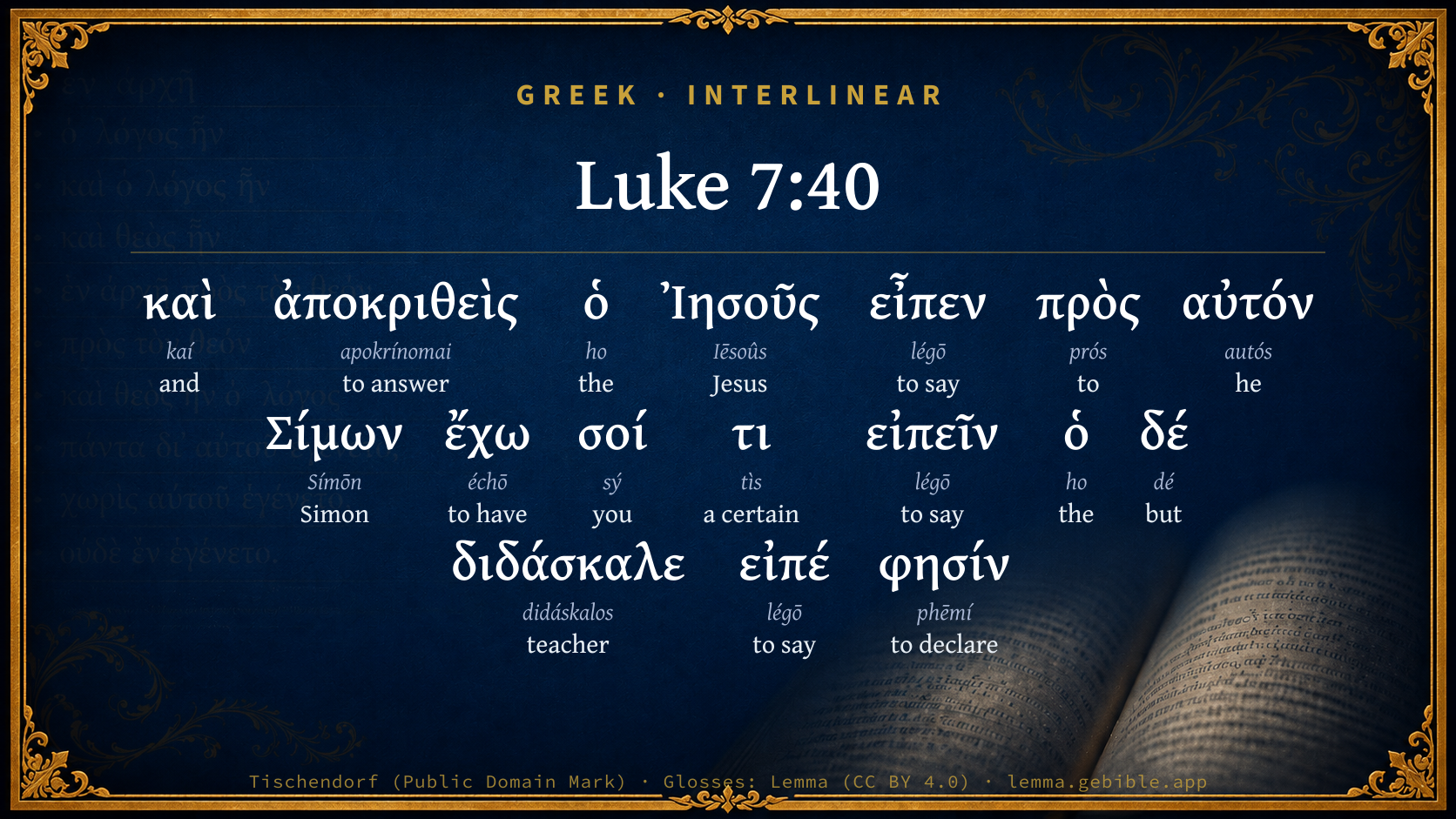
Greek (Tischendorf 8th ed.) Luke 7:40 appears in the Greek New Testament. The text above is from the Tischendorf 8th edition. Each word links to its Strong’s number and a concise gloss. Click any word for its full Thayer’s Greek Lexicon entry.
Download image
Cite this verse

Luke 7:40 (World English Bible). Public Domain. Lemma interlinear Bible study tool, https://lemma.gebible.app/v/luke/7/40.

Show BibTeX & RIS
BibTeX
RIS
English Translation
Jesus answered him, "Simon, I have something to tell you." He said, "Teacher, say on."
World English Bible · Public Domain
Download a study sheet

One document with this verse’s original text, its word-by-word gloss line, the meaning frame, cross-references with their text, attributed commentary, and full source and license credits — printable, and it pastes into notes with its structure intact.

This verse Autodidact and up

Study sheet (.html) Plain text (.txt)

A passage Seminary Student

Up to 50 verses in one chapter. A passage sheet keeps up to 6 commentary sources and 12 cross-references per verse, in the order this page ranks them, and says so on the sheet whenever that leaves anything out. Ask for a single verse and you get the Autodidact verse sheet above.

Everything on this page stays free to read, with no account — the sheet is a download of what is already on screen, not access to it.

Want to remove ads? Support Godless Engineer
Compare translations 3

The same verse in 3 English versions, stacked beneath the original-language interlinear above. Click any original word for its lexicon entry.

Each is an independent rendering of the whole verse — the interlinear is not word-aligned to these translations.

Highlighted words mark where these versions differ — a whole-verse word diff, not a word-by-word alignment.

  • World English Bible Public Domain
    Jesus answered him, "Simon, I have something to tell you." He said, "Teacher, say on."
  • King James Version Public Domain
    And Jesus answering said unto him, Simon, I have somewhat to say unto thee. And he saith, Master, say on.
  • unfoldingWord Literal Text CC BY-SA 4.0
    And answering, Jesus said to him, “Simon, I have something to say to you.” And he says, “Say it, Teacher!”

unfoldingWord Literal Text — © unfoldingWord, licensed CC BY-SA 4.0. Word-aligned USFM3 via Door43 (git.door43.org/unfoldingWord/en_ult).

Versions to compare (up to 4)

3 of 4 selected

Show all 19 translations

Every available English version of this verse, each an independent rendering of the whole verse.

  • World English Bible Public Domain
    Jesus answered him, "Simon, I have something to tell you." He said, "Teacher, say on."
  • Berean Standard Bible Public Domain
    But Jesus answered him, “Simon, I have something to tell you.” “Tell me, Teacher,” he said.
  • Majority Standard Bible Public Domain
    But Jesus answered him, “Simon, I have something to tell you.” “Tell me, Teacher,” he said.
  • King James Version Public Domain
    And Jesus answering said unto him, Simon, I have somewhat to say unto thee. And he saith, Master, say on.
  • American Standard Version (1901) Public Domain
    And Jesus answering said unto him, Simon, I have somewhat to say unto thee. And he saith, Teacher, say on.
  • Revised Version (1885) Public Domain
    And Jesus answering said unto him, Simon, I have somewhat to say unto thee. And he saith, Master, say on.
  • Geneva Bible (1599) Public Domain
    And Iesus answered, and saide vnto him, Simon, I haue somewhat to say vnto thee. And he said, Master, say on.
  • Douay-Rheims (1899) Public Domain
    And Jesus answering, said to him: Simon, I have somewhat to say to thee. But he said: Master, say it.
  • Young's Literal Translation Public Domain
    And Jesus answering said unto him, `Simon, I have something to say to thee;' and he saith, `Teacher, say on.'
  • Literal Standard Version CC BY-SA 4.0
    And Jesus answering said to him, “Simon, I have something to say to you”; and he says, “Teacher, say on.”
  • Unlocked Literal Bible CC BY-SA 4.0
    Jesus responded and said to him, “Simon, I have something to say to you.” He said, “Say it, Teacher!”
  • unfoldingWord Literal Text CC BY-SA 4.0
    And answering, Jesus said to him, “Simon, I have something to say to you.” And he says, “Say it, Teacher!”
  • Darby Bible Public Domain
    And Jesus answering said to him, Simon, I have somewhat to say to thee. And he says, Teacher, say [it].
  • World Messianic Bible Public Domain
    Yeshua answered him, “Simon, I have something to tell you.” He said, “Rabbi, say on.”
  • Webster's Bible Public Domain
    And Jesus answering, said to him, Simon, I have somewhat to say to thee. And he saith, Master, speak.
  • Free Bible Version CC BY-SA 4.0
    Jesus spoke up and said, “Simon, I have something to tell you.” “Tell me, Teacher,” he responded.
  • Bible in Basic English Public Domain
    And Jesus, answering, said, Simon, I have something to say to you. And he said, Master, say on.
  • Text-Critical English NT CC BY 4.0
    Jesus said to him in response, “Simon, I have something to say to yoʋ.” So he said, “Say it, Teacher.”
  • Tyndale New Testament (1534) Public Domain
    And Iesus answered and sayde vnto him: Simon I have some what to saye vnto the. And he sayd master saye on.

Literal Standard Version (2020), Covenant Press — licensed CC BY-SA 4.0. Text via the HelloAO Bible API (eBible.org). Unlocked Literal Bible (unfoldingWord) — licensed CC BY-SA 4.0. Text via the HelloAO Bible API (eBible.org). unfoldingWord Literal Text — © unfoldingWord, licensed CC BY-SA 4.0. Word-aligned USFM3 via Door43 (git.door43.org/unfoldingWord/en_ult). Free Bible Version, Dr. Jonathan Gallagher — licensed CC BY-SA 4.0. Text via the HelloAO Bible API (eBible.org).

Word by word

More ways to search: Search by grammar → Find every occurrence → Compare this word →

Practice this passage: Drill this verse → Learn its vocabulary →

διδάσκαλε
didáskalos
G1320
“teacher”
Noun, Vocative, Singular, Masculine
Part of Speech
Noun
Case
Vocative
Number
Singular
Gender
Masculine
Full Thayer's Definition

Origin: from G1321

TDNT: 04:28,2

1. a teacher 2. in the NT one who teaches concerning the things of God, and the duties of man a. one who is fitted to teach, or thinks himself so b. the teachers of the Jewish religion c. of those who by their great power as teachers draw crowds around them i.e. John the Baptist, Jesus d. by preeminence used of Jesus by himself, as one who showed men the way of salvation e. of the apostles, and of Paul f. of those who in the religious assemblies of the Christians, undertook the work of teaching, with the special assistance of the Holy Spirit g. of false teachers among Christians
  1. καὶ kaí G2532 “and” Conjunction
  2. ἀποκριθεὶς apokrínomai G611 “to answer” Verb, Aorist, Passive deponent, Participle, Nominative, Singular, Masculine
  3. ὁ ho G3588 “the” Article, Nominative, Singular, Masculine
  4. Ἰησοῦς Iēsoûs G2424 “Jesus” Noun, Nominative, Singular, Masculine
  5. εἶπεν légō G3004 “to say” Verb, Aorist, Active, Indicative, 3rd person, Singular
  6. πρὸς prós G4314 “to” Preposition
  7. αὐτόν autós G846 “he” Personal pronoun, Accusative, Singular, Masculine
  8. Σίμων Símōn G4613 “Simon” Noun, Vocative, Singular, Masculine
  9. ἔχω échō G2192 “to have” Verb, Present, Active, Indicative, 1st person, Singular
  10. σοί sý G4771 “you” Personal pronoun, 2nd person, Dative, Singular
  11. τι tìs G5100 “a certain” Indefinite pronoun, Accusative, Singular, Neuter
  12. εἰπεῖν légō G3004 “to say” Verb, Aorist, Active, Infinitive
  13. ὁ ho G3588 “the” Article, Nominative, Singular, Masculine
  14. δέ dé G1161 “but” Conjunction
  15. εἰπέ légō G3004 “to say” Verb, Aorist, Active, Imperative, 2nd person, Singular
  16. φησίν phēmí G5346 “to declare” Verb, Present, Active, Indicative, 3rd person, Singular

About this verse

These counts appear in no published source. They are computed here, from the morphology-tagged text and Lemma’s own curated glosses. What Lemma adds →

17
words
14
distinct lemmas
Gospels
section

Shared distinctive vocabulary

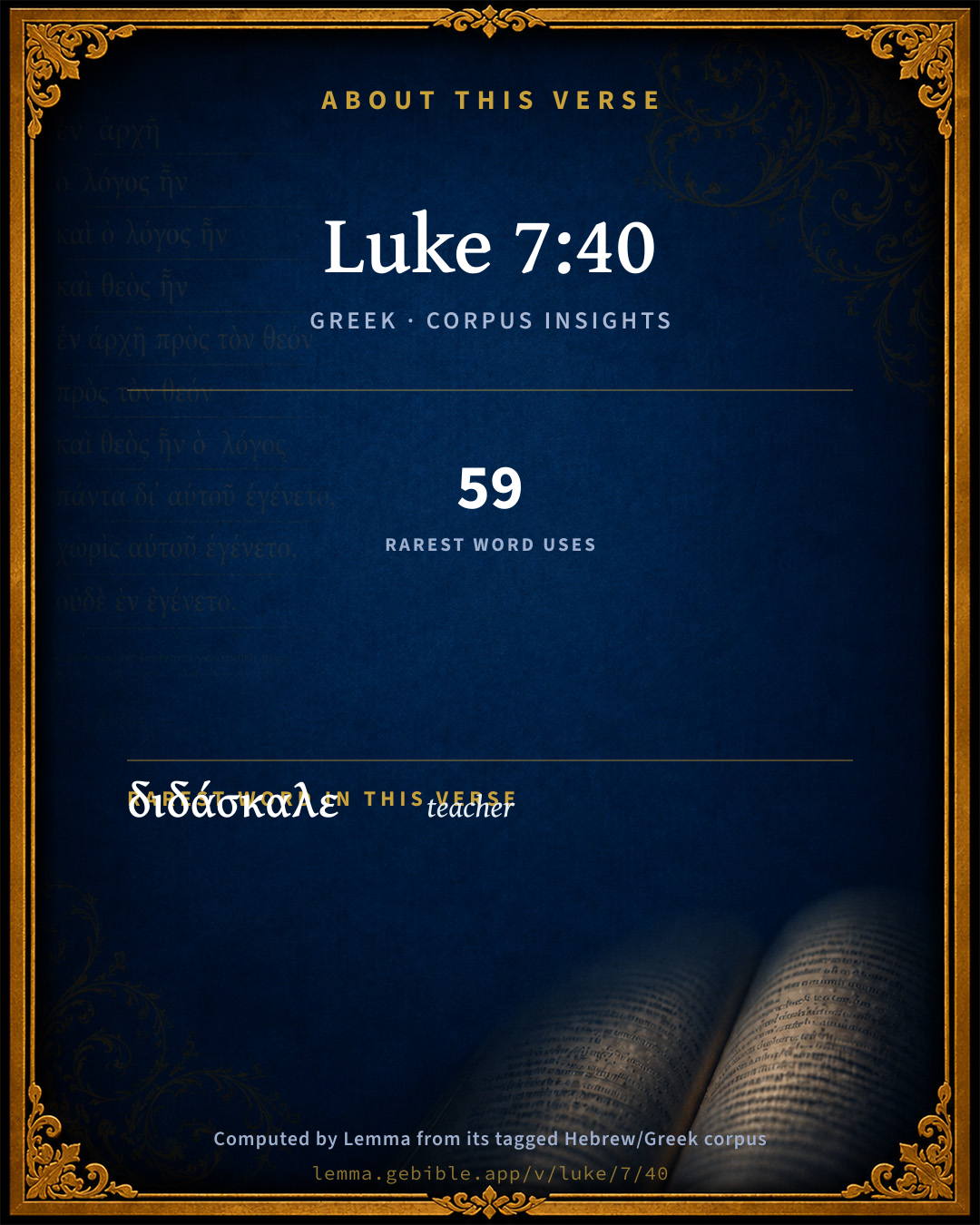
διδάσκαλε teacher G1320 occurs in 58 verses of the Greek New Testament. Also found in:
Repetition

Words recur within this verse:

Cross-references

13

Topical passages linked to Luke 7:40 in the Treasury of Scripture Knowledge — connected by theme and wording, ordered by reader-vote popularity; previews shown in the World English Bible.

  • Ezekiel 33:31 They come to you as the people comes, and they sit before you as my people, and they hear your words, but don't do them; for with their mouth they show much love, but their heart goes after their gain.
  • Matthew 7:22 Many will tell me in that day, 'Lord, Lord, didn't we prophesy in your name, in your name cast out demons, and in your name do many mighty works?'
  • Luke 5:22 But Jesus, perceiving their thoughts, answered them, "Why are you reasoning so in your hearts?
  • Luke 5:31 Jesus answered them, "Those who are healthy have no need for a physician, but those who are sick do.
  • Luke 6:8 But he knew their thoughts; and he said to the man who had the withered hand, "Rise up, and stand in the middle." He arose and stood.
  • Luke 18:18 A certain ruler asked him, saying, "Good Teacher, what shall I do to inherit eternal life?"
  • Luke 20:20–21 They watched him, and sent out spies, who pretended to be righteous, that they might trap him in something he said, so as to deliver him up to the power and authority of the governor.
  • John 3:2 The same came to him by night, and said to him, "Rabbi, we know that you are a teacher come from God, for no one can do these signs that you do, unless God is with him."
  • John 13:13 You call me, 'Teacher' and 'Lord.' You say so correctly, for so I am.
  • John 16:19 Therefore Jesus perceived that they wanted to ask him, and he said to them, "Do you inquire among yourselves concerning this, that I said, 'A little while, and you won't see me, and again a little while, and you will see me?'
  • John 16:30 Now we know that you know all things, and don't need for anyone to question you. By this we believe that you came forth from God."
  • Malachi 1:6 "A son honors his father, and a servant his master. If I am a father, then where is my honor? And if I am a master, where is the respect due me? Says Yahweh of Hosts to you, priests, who despise my name. You say, 'How have we despised your name?'
  • Matthew 26:49 Immediately he came to Jesus, and said, "Hail, Rabbi!" and kissed him.

Cross-references courtesy of OpenBible.info (CC BY 4.0).

Commentary

Notes on Luke 7:40 from classic Christian and Jewish commentators (each source and its license shown beneath its notes). The classic Christian expositions comment on the surrounding passage and are grouped to its opening verse, so a note may address several verses; the Jewish commentaries on the Tanakh (Rashi and others) are per-verse, so they appear only where the commentator wrote on this verse.

Lemma curates 59 commentaries, every one of them public domain or Creative Commons licensed, each selected and text-cleaned for this edition rather than reprinted as found. About our sources →

The Biblical Illustrator

Joseph S. Exell

Luk_7:40

Simon, I have somewhat to say unto thee

On administering reproof

1.

To say somewhat to our brother when we see him run into an error. In such a case we may not be silent. Thou shalt in any wise rebuke thy neighbour, and not suffer sin upon him (Lev_19:17). Observe--

2. Courteous usage should not keep us from telling men of their faults, and discovering their failings to them. (N. Rogers.)

Rebuke in parable

It is none of the worst observations we meet withal in Oleaster; that the holy prophets in dealing with great ones have spoken most an end in parables, as our Saviour did here to Simon. Let reproof be as good and wholesome diet as a partridge, yet it would not be served in to a great mans table raw, or with the feathers on, but cooked and seasoned. Reproof of them must be well wrapped up (as we do a pill in sugar), that it may the more easily be swallowed, and work before they think on it. But it may not be wholly withheld from any man whatever, be he our dearest friend. In so doing we should deal unkindly with them who deal friendly with us. Unhappy is that friendship, saith Carthusianus, which favouring our brothers cares doth break his neck. Such friendship David putteth in his Litany, and desireth God to keep him from. (N. Rogers.)

On receiving reproof

The word Christ speaks ought to be received with all readiness of spirit. Thus Simon received it, so ought we. Eli desired Samuel to tell him all (1Sa_3:17). Such should be the desire of all Gods people, that Gods ministers would deal faithfully with them in delivering the whole counsel of God unto them--as well one part as another. Wantons, you know, come into a garden to pick only flowers; here they pick a gay, and there another; but the good housewife comes to gather herbs: so should we come into Gods house to hear His Word. (N. Rogers.)

The ear the door to the soul

The devil s study is to keep this door shut, that Christ may not enter. Like a gaoler, he will sometimes be content to let his prisoner have hands and feet free, provided the prison doors and gates be fast locked and barred. His captives shall sometimes give an alms, or do

some other outward work of mercy, come to church to satisfy the law, &c. But he cannot endure the doors should stand open, for fear of an escape. Act_7:57; Psa_58:45.) Search the Scriptures, and you shall find that none was cured with greater difficulty than he that had a deaf and dumb spirit. (N. Rogers.)

The Biblical Illustrator, edited by Joseph S. Exell (c. 1880s–1900s) — public domain. Text from a community e-Sword module.

Joseph Benson's Commentary

Luk 7:40-43. Jesus answering — What Simon spake within himself; said, Simon, I have somewhat to say to thee — Though he was kindly entertained at his table, yet even there he judged it proper to reprove him for what he saw amiss in him, and not to suffer sin upon him. This he does, however, in a most tender and courteous manner. And he saith, Master, διδασκαλε, teacher, say on — Though Simon would not believe him to be a prophet, because he suffered so great a sinner to touch him, yet he could compliment him with the title of teacher, like those that say to him, Lord, Lord, but do not the things which he enjoins. Then Jesus immediately delivered the following parable as a just, yet mild reproof of his host. A certain creditor had two debtors — That were both insolvent; the one owed five hundred pence — Greek, δηναρια, Roman pence, in value about seven pence halfpenny sterling, so that five hundred of them were nearly equivalent to fifteen guineas sterling, and fifty to one guinea and a half. There is no reason to believe that there was any mystery intended in Christ’s fixing on these sums, rather than any others that had as great a difference between them. And when they had nothing to pay — Could neither of them discharge any part of this debt; he frankly forgave them both — The whole of what they respectively owed: Tell me, therefore — Since it may be reasonably expected that both would have some sense of, and gratitude for his goodness; which of them would love him most — In return for this his great kindness and generosity? Observe, reader, neither of them would love him at all before he had forgiven him. An insolvent debtor, till he is forgiven, does not love, but shun his creditor. Simon answered, He to whom he forgave most — He surely was under the greatest obligations, and must reasonably be supposed to feel the greatest affection for his merciful and generous creditor: And he said, Thou hast rightly judged — And the reflection is evidently suited to the case that we have before us.

Joseph Benson's Commentary on the Old and New Testaments (1811–1818) — public domain. Text from a community e-Sword module.

Tyndale Open Study Notes

Tyndale Open Resources

7:40 Then Jesus answered his thoughts: See study note on 5:22.

Tyndale Open Study Notes — © Tyndale Open Resources, licensed CC BY-SA 4.0. Text via the HelloAO Bible API.

Bengel's Gnomon

Johann Albrecht Bengel

Luk 7:40. Ἔχω, I have) A courteous preface. He does not call this Pharisee a hypocrite.—Διδάσκαλε, Master) Simon had some degree of respectful modesty.

Bengel's Gnomon of the New Testament — English translation (T&T Clark, Edinburgh, 1860) — public domain. Text from a community e-Sword module.

Expositor's Greek Testament

ed. W. Robertson Nicoll

Luk 7:40-50 . Host and guest . ἀποκριθεὶς , answering, to his thought written on his face. Σίμων : the Pharisee now is called by his own name as in friendly intercourse. The whole dialogue on Christ’s part presents an exquisite combination of outspoken criticism with courtesy. ἔχω σοί τι εἰπεῖν : comis praefatio , Bengel. Διδάσκαλε : Simon’s reply equally frank and pleasant.

The Expositor's Greek Testament, edited by W. Robertson Nicoll (1897–1910) — public domain. Text from a community e-Sword module.

Geneva Bible (1599)

Geneva Bible translators

To love Christ, is a sure and perpetual witness of remission of sins.

Geneva Bible (1599) marginal notes — public domain. Text via Bolls.life.

Jamieson, Fausset & Brown

Robert Jamieson, A. R. Fausset & David Brown

Like Nathan with David, our Lord conceals His home thrust under the veil of a parable, and makes His host himself pronounce upon the case. The two debtors are the woman and Simon; the criminality of the one was ten times that of the other (in the proportion of "five hundred" to "fifty"); but both being equally insolvent, both are with equal frankness forgiven; and Simon is made to own that the greatest debtor to forgiving mercy will cling to her Divine Benefactor with the deepest gratitude. Does our Lord then admit that Simon was a forgiving man? Let us see.

Jamieson, Fausset & Brown — Commentary Critical and Explanatory on the Whole Bible (1871) — public domain (CC PDM 1.0). Text via the HelloAO Bible API.

Ellicott's Commentary for English Readers

(40) And Jesus answering said . . .—The answer was, as the context shows, to the unspoken thoughts of the Pharisee.

Simon, I have somewhat to say unto thee.—The name of the Pharisee is thus given to us, but it was too common to suggest any identification. It is a somewhat singular coincidence that the two anointings should have happened (comp. Mat_26:6) each of them in the house of a Simon, but it cannot be looked on as more than accidental.

Master, say on.—The term used is ‘one which implied recognition of our Lord’s character as a teacher or Rabbi.

A Bible Commentary for English Readers, edited by Charles John Ellicott (1878–1897) — public domain. Text from a community e-Sword module.

The Cambridge Bible for Schools and Colleges

gen. ed. J. J. S. Perowne

40. answering] “He heard the Pharisee thinking.” S. Aug. unto thee] The emphasis is on these words, You have been thinking evil of me: I have something to say to thee.

Master] Rather, Teacher, or Rabbi.

The Cambridge Bible for Schools and Colleges (gen. ed. J. J. S. Perowne; Cambridge University Press, 1878–1918) — public domain. Text from a community e-Sword module.

John Gill's Exposition

And he turned to the woman,.... That stood behind him at his feet,

and said to Simon, seest thou this woman? and what she has done? pointing to her, and comparing him, and her, and their actions together, whereby he might judge of the preceding parable, and how fitly it might be applied to the present case:

I entered into thine house; not of his own accord, but by the invitation of Simon, and therefore might have expected the usual civilities:

thou gavest me no water for my feet: to wash them with, no, not so much as water; a civility very common in those hot countries, where walking without stockings, and only with sandals, they needed often washing; and which was very refreshing, and was not only used to travellers and strangers, but to guests, and was usually done by the servants of the house; See Gill on Luk 7:38.

but she hath washed my feet with tears. The Persic version reads, "with the tears of her eyes"; which made a bath for his feet;

and wiped them with the hairs of her head. The Vulgate Latin, Syriac, Persic, and Ethiopic versions read only, "with her hair", which she used instead of a towel, when Simon neither gave him water to wash with, nor a towel to wipe with.

John Gill's Exposition of the Whole Bible (1746–1763) — public domain (CC PDM 1.0). Text via the HelloAO Bible API.

Trapp's Complete Commentary

John Trapp

40 And Jesus answering said unto him, Simon, I have somewhat to say unto thee. And he saith, Master, say on.

Ver. 40. I have somewhat to say to thee] He that receives a courtesy, we say, sells his liberty. But so did not Christ at Simon’s, at Martha’s, &c., table. His mouth was not stopped with good cheer. He entertains the Pharisees with as many menaces as they do him with messes of meat.

John Trapp, A Commentary or Exposition upon All the Books of the Old and New Testament (1647–1656) — public domain. Text from a community e-Sword module.

Matthew Poole's English Annotations

Our Saviour treats his host civilly, but yet letteth him know, that he both knew his heart, and the heart of this poor woman, whom he had so uncharitably reflected upon.

Simon spake within himself, Luk 7:39. Christ lets him know that he knew the thoughts of his heart.

I have (saith he) somewhat to say unto thee. So he civilly obtaineth leave of him to speak.

Simon saith, Master, say on. Our Saviour tells him: There was a certain creditor, & c. It is obvious by our Saviour’s application of this parable, Luk 7:44-47, that he whom Christ here intends under the notion of a creditor is God; that one of the debtors that did owe five hundred pence (that is, a great sum) was this woman: whether Simon were intended by the other, or no, is not easily determined; but admit the other was ο δεινα, any one that was a sinner, but not so notorious a sinner, God forgives freely both the one and the other. Christ asks which would love most. Simon tells him, that debtor to whom most was forgiven. Christ tells him that he had judged rightly. Whence observe:

1. That as all sins, so all sinners, are not equal in the sight of God; all are guilty, but there are degrees in guilt.

2. That be men’s sins less or greater, fewer or more, those who have least will stand in need of pardoning mercy and forgiveness.

3. That God is free in the forgiveness of all sins, be they few or more; he frankly forgave them both.

4. That Christ first speaketh of these two debtors as being forgiven, then of their loving much, and of their being forgiven as the cause of their loving much.

5. That much love will follow a great forgiveness; a great sinner (one, I mean, who hath been so) will hardly ever be able to satisfy himself that his much is forgiven, if he doth not find his heart very warm with love to God.

6. A true love to God and Christ will be seen in all acts, which may be demonstrative or declarative of it. Christ turns to the woman, and saith to Simon, &c. Kissing, washing of feet, anointing with oil, were usual compliments of those countries, by which men showed their respects and kindness to strangers and friends.

For washing of feet, see Gen 18:4; 19:2; Jdg 19:21; 1Sa 25:41; 1Ti 5:10. For anointing with oil, see Psa 23:5; 45:7. This woman had exceeded the usual kindness and civility of the country toward Christ: they were wont to bring their friends water to wash their feet, and possibly a piece of linen to wipe them; she washes his feet with her tears, and drieth them with her hair. They used to anoint the head of their friends with oil, she anoints his feet. They used to kiss one another’s cheeks or lips, she kisses his feet. They kissed their friends once, she ceased not to kiss his feet. Upon this Christ, who before had forgiven her, declareth her to be forgiven, first in the hearing of Simon, then he doubles his words unto her. He had told Simon before that the creditor had frankly forgiven them both; his adding here, Her sins, which are many, sufficiently evidences that it was she whom he intended by the debtor who owed much. Hence we may judge how little ground the papists have to urge this place to prove, that remission of sins is procured by our own merits and satisfactions. Love here is not mentioned as the cause, but as the effect of the remission of sins; and that which our Saviour here designed to instruct Simon in, was,

1. That whatsoever this woman had been, she was not now such a notorious sinner as he fancied; her sins were forgiven.

2. That God having thus favoured her with the grace of remission, had also kindled in her heart a love towards him.

3. That this love wrought in her heart in some proportion to that love which God had magnified upon her, therefore she loved much.

4. That men and women’s love to God and Christ, will and ought to be according to that love which they have received from Christ.

5. That much love to God will bring a great sense of God’s love to the soul, Joh 14:21.

The particle οτι, which we translate because, doth not always in Scripture signify the cause, but may be translated therefore, or, for what cause: see Joh 14:17, Ye know him; for he dwelleth in you: the Spirit’s abiding in believers is not the cause of their knowing of him, but the effect of it, so that for, in that place, is as much as therefore. So in Mar 9:28, οτι is as much as for what cause, or, for what reason? We translate it, Why could not we cast him out? So here, her sins, which are many, are forgiven, for which cause, or reason, she loveth much.

Matthew Poole's English Annotations on the Holy Bible (1683–1685) — public domain. Text from a community e-Sword/MySword module.

The Pulpit Commentary

And Jesus answering said unto him, Simon, I have somewhat to say unto thee. And he saith, Master, say on. How accurately did the Master read Simon"s heart. Not a real Prophet because he was in ignorance of the character and life of the woman whom he suffered without rebuke to pour the fragrant ointment over him! We almost see the half-sad smile flickering on the Teacher"s lips as he turned and spoke to his host. Such a parable-story as Jesus was about to give utterance to was no uncommon form of teaching on such an occasion when a well-known Rabbi like Jesus was Guest at a festal gathering.

Christ and Simon: the correcting word.

There were some good points about Simon.

1. He was an eminently respectable man; he was so in the true sense of the word, for as a virtuous man he could respect himself, and his neighbours could rightly respect him; he conformed his conduct to a high standard of morality.

2. He was an open-handed, hospitable man.

3. He was an open-minded man. It was not every Pharisee that would have invited Jesus Christ to supper, or would have given him such freedom to speak his mind without resentment. But he was a much-mistaken man. He was quite wrong in three important points.

I HIS ESTIMATE OF JESUS CHRIST. When he found that Jesus did not resent the attention of "this woman," he came to the conclusion that he could not be a prophet, or he would have known that she was a sinner, and, knowing that, he would have repelled her. Here he was wrong in his conclusion; and he was also wrong in his reasoning. His argument was this: a man as holy as a prophet would be certain to repel such guilt as is present here; when the Holy Prophet comes, the Messiah, ha will be more scrupulously separate from sin and from sinners than any other has been. Here he was completely mistaken. The Holy One came to be the Merciful One; to say to guilty men and women, "Your fellows may despair of you and abandon you. I despair of none, I abandon nobody. I see in all the possibilities of recovery; I summon you all to repentance and to life. Touch me, if you will, with the hand of your faith; I will lay my hand of help and healing upon you.

II HIS VIEW OF THAT WOMAN.. A sinner she had been; but she was more, and indeed other than a sinner now. That word did not faithfully describe her state before God. She was a penitent. And what is a penitent? A penitent soul is one who hates the sin that had been cherished, who has cast out the evil spirit from him, in whom is the living germ of righteousness, who is on the upward line that leads to heavenly wisdom and Divine worth, on whom God is looking down with tender grace and deep satisfaction, in whom Jesus Christ beholds a servant, a friend, an heir of his holy kingdom. This is not one to turn away from in scorn, but to draw nigh unto in kindness and encouragement.

III HIS ESTIMATE OF HIMSELF.

1. He thought himself a very long way on in the kingdom of God as compared with that poor woman; he did not know that, she being poor in spirit and he being proud in spirit, she was much nearer to its entrance-gates than he.

2. He thought himself in a position to patronize Jesus Christ, and consequently withheld some of the usual courtesies from his Guest; he did not know that it was on himself the distinction was conferred.

3. He supposed himself to be possessed of all the cardinal virtues: he did not know that he lacked that which is the crowning excellence of all love, the love that can pity, that can stoop to save.

We draw two main lessons.

1. That Christ makes much of love. Dwelling on the various manifestations of this woman"s feeling, he declares they are the signs of her love, and he then traces her love to her deep sense of forgiven sin. God wants our love, as we want the love of our children and of our friends, and cannot accept anything, however valuable, in its stead: so Christ wants the pure, deep, lasting affection of our souls. No ceremonies, or services, or even sacrifices, will compensate for its absence. (see 1Co 13) And the measure of our love will depend on the depth of our sense of God"s forgiving love toward us. Hence it is of the first importance that we

(1) should understand how much God has forgiven us, how great and serious our guilt has been (see preceding homily);

(2) should recognize how great and full is the Divine forgiveness, how much it includes how much in the sense of overlooking the past, and in the way of granting us present favour and of promising us future blessedness. Our wisdom and our duty, therefore, is to dwell on the greatness of God"s mercy to us in Jesus Christ, to rejoice much in it, to let our souls bathe in the thought of it, be filled continually with a sense of it. For they who are (consciously) forgiven much will love much; and they who love much will be much beloved of God. (Joh_14:23)

2. That we should be ready to receive Christs correcting word. Simon was wholly wrong in his estimate of men and of things; but he was not unwilling to hear Christ"s correcting word. "Master, say on," he replied, when the great Teacher said, "I have somewhat to say unto thee." Let us see to it that this is our attitude. Our Lord may have something very serious to say to us, as he had to those seven Churches in Asia Minor, which he addressed from his heavenly throne. (Rev 2:, Rev_2:3) When, through his Word, his ministry, his providence, he does thus correct us, calling us to a renewed humility, faith, love, zeal, consecration, are we ready to receive his message, to bow our head, to open our heart, and say, "Speak, Lord; thy servants hear! Master, say on"? C.

The Pulpit Commentary (1880–1919), ed. H.D.M. Spence-Jones & Joseph S. Exell — public domain. Text from a community e-Sword module.

John Wesley's Explanatory Notes

And Jesus said, Simon, I have somewhat to say to thee - So tender and courteous an address does our Lord use even to a proud, censorious Pharisee!

John Wesley, Explanatory Notes Upon the Whole Bible (1754–1765) — public domain. Text via the GEBible commentary corpus.

The People's New Testament

B. W. Johnson

40–43. Jesus answering. To the unspoken thought.

Five hundred pence. About seventy dollars. Fifty pence. About seven dollars.

Had nothing to pay. The small debtor was as helpless as the other. We are all insolvent.

Forgave. Forgiveness is the only hope of sinners. To whom he forgave most. There is a peculiar gratitude which the restored wanderer realizes, to which the one who has grown up in rectitude must be a stranger. Both may love with all the heart, yet their love will not possess precisely the same characteristics.

B. W. Johnson's The People's New Testament with Notes (1889–1891) — public domain. Electronic text from the Christian Classics Ethereal Library (CCEL) ThML edition.

Cambridge Greek Testament for Schools and Colleges

40. ἀποκριθείς. “He heard the Pharisee thinking.” St Aug.

σοί. The emphasis is on these words, You have been thinking evil of me: ‘I have something to say to thee.’

Διδάσκαλε. ‘Teacher,’ or ‘Rabbi.’

Cambridge Greek Testament for Schools and Colleges (Cambridge University Press, 1896; 21 vols, various authors incl. Carr, Maclear, Plummer, Farrar, Lumby, Moule, M. R. James, Simcox) — public domain. Text from a community e-Sword module.

Alford’s Greek Testament

Henry Alford

40.] ἀποκριθείς—perhaps to the disgust manifested in the Pharisee’s countenance; for that must have been the ground on which the narrative relates ver. 39. We must not however forget that in similar cases ἰδὼν ὁ Ἰησ. τὰς ἐνθυμήσεις αὐτῶν is inserted (Mat 9:4), and doubtless might also have been here.

There is an inner personal appeal in the words addressing the Pharisee. The calling by name—the especial ἔχω σοί τι εἰπεῖν, refer to the inner thoughts of the heart, and at once bring the answer διδάσ., εἰπέ, so different from οὗτος εἰ ἦν προφήτης.

Henry Alford, The Greek Testament (1849–1861) — public domain. Text from a community e-Sword module.

International Critical Commentary

40. ἀποκριθεὶς ὁ Ἰησοῦς. Audivit Pharisaeum cogitantem (Aug. Serm. xcix.). Jesus not only answered but confuted his doubts. Simon questioned the mission of Jesus because He seemed to be unable to read the woman’s character. Jesus shows Simon that He can read his inmost thoughts: He knows τίς καὶ ποταπός ἐστι. For ἔχω σοί τι εἰπεῖν see on 12:4. Christ asks permission of His host to speak. As Godet remarks, there is a tone of Socratic irony in the address. The historic present (φησίν) is very rare in Lk

International Critical Commentary — older volumes (1896–1929), various authors — public domain. Text from a community e-Sword module.

Godet's Commentaries

Frédéric Louis Godet

Vers. 40-43. The Parable.

If this man wanted a proof of the prophetic gift of Jesus, he received it instantly in the following parable, which so exactly meets his thoughts and secret questions. The form of the following conversation is kindly, familiar, and even slightly humorous. It is just the tone of the Socratic irony. The denarius was equivalent to about three farthings; the larger of the two sums amounted, therefore, to about £16, the smaller to 32s. The former represents the enormous amount of sins to which this sinful woman pleaded guilty, and which Jesus had pardoned; the latter, the few infractions of the law for which the Pharisee reproached himself, and from the burden of which Jesus had also released him.—᾿Ορθῶς ἔκρινας: “thou hast rightly judged; and in judging so rightly, thou hast condemned thyself.” It is the πάνυ ὀρθῶς of Socrates, when he had caught his interlocutor in his net. But that which establishes such an immeasurable distance between Jesus and the Greek sage, is the way in which Jesus identifies Himself, both here and in what follows, with the offended God who pardons and who becomes the object of the sinner’s grateful love.

Frédéric Louis Godet — Commentaries on Luke, John, Romans, and 1 Corinthians — English translation (T&T Clark, Edinburgh, 1870s–1890s) — public domain. Text from a community e-Sword module.

Lesson kit

Teaching starters — assembled from the data on this page, not authored interpretation. Every prompt links to the verse data it draws on. Edit before teaching.

Luke, in the Gospels, opens this verse with 17 words (14 distinct Greek lemmas). Its most distinctive word is didáskalos (“teacher”). A historical commentator’s framing appears above. Read the whole chapter for the surrounding context.

Discussion questions

  1. The word didáskalos carries the sense “teacher.” How does it shape the verse?
  2. Matthew 8:19 shares the word «teacher» with this verse. How do the two illuminate each other?
  3. “to say” occurs 3× in this one verse. What is the effect of the repetition?
  4. These translations render this verse differently. What is at stake in choosing one wording over another?
  5. Reading how The Biblical Illustrator and Joseph Benson's Commentary read this verse, where do the two commentators agree and where do they part?

Things to notice

  • These translations choose different wording for 9 words in this verse.
  • “to say” occurs 3× in this single verse.
  • 14 distinct Greek lemmas span 17 words in this verse.

Reading settings

Reading text

Shown beneath each verse's original-language words.

Old Testament
Old Testament edition

Read the OT as the Masoretic Hebrew (MT) or the Greek Septuagint (LXX).

English shown for the Greek Septuagint (in the Hebrew ↔ Greek comparison).

Comparing translations? Open the Compare panel on any verse page to stack up to four side by side.