
Numbers 22:8

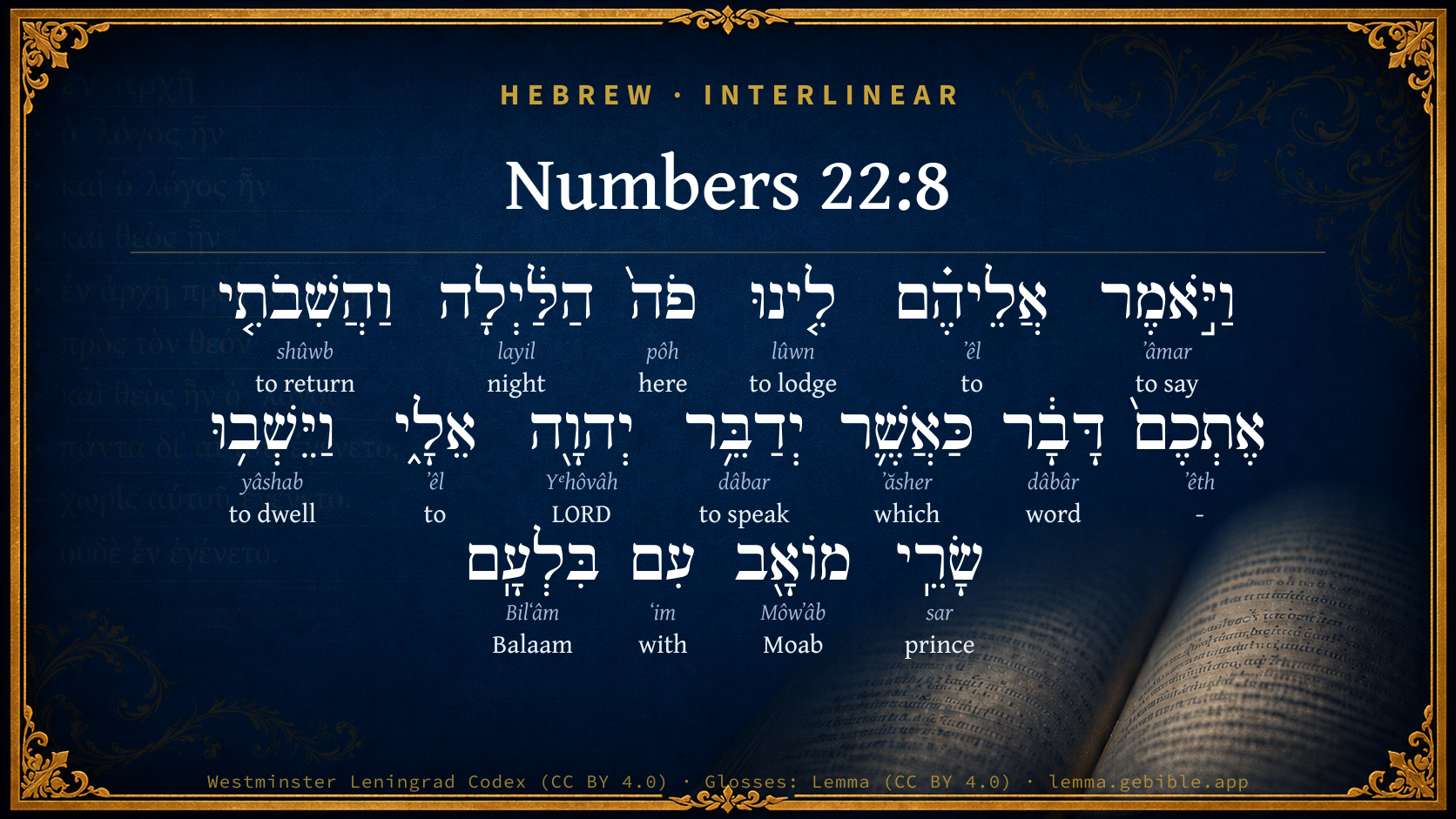
Hebrew (Westminster Leningrad Codex) Numbers 22:8 appears in the Hebrew Old Testament. The text above is from the Westminster Leningrad Codex. Each word links to its Strong’s number, a concise gloss, and parsing drawn from the Open Scriptures Hebrew Bible morphology. Click any word for its full Brown-Driver-Briggs (BDB) entry.
Download image
Cite this verse

Numbers 22:8 (World English Bible). Public Domain. Lemma interlinear Bible study tool, https://lemma.gebible.app/v/numbers/22/8.

Show BibTeX & RIS
BibTeX
RIS
English Translation
He said to them, Lodge here this night, and I will bring you word again, as Yahweh shall speak to me: and the princes of Moab abode with Balaam.
World English Bible · Public Domain
Download a study sheet

One document with this verse’s original text, its word-by-word gloss line, the meaning frame, cross-references with their text, attributed commentary, and full source and license credits — printable, and it pastes into notes with its structure intact.

This verse Autodidact and up

Study sheet (.html) Plain text (.txt)

A passage Seminary Student

Up to 50 verses in one chapter. A passage sheet keeps up to 6 commentary sources and 12 cross-references per verse, in the order this page ranks them, and says so on the sheet whenever that leaves anything out. Ask for a single verse and you get the Autodidact verse sheet above.

Everything on this page stays free to read, with no account — the sheet is a download of what is already on screen, not access to it.

Want to remove ads? Support Godless Engineer
Compare translations 3

The same verse in 3 English versions, stacked beneath the original-language interlinear above. Click any original word for its lexicon entry.

Each is an independent rendering of the whole verse — the interlinear is not word-aligned to these translations.

Highlighted words mark where these versions differ — a whole-verse word diff, not a word-by-word alignment.

  • World English Bible Public Domain
    He said to them, Lodge here this night, and I will bring you word again, as Yahweh shall speak to me: and the princes of Moab abode with Balaam.
  • King James Version Public Domain
    And he said unto them, Lodge here this night, and I will bring you word again, as the LORD shall speak unto me: and the princes of Moab abode with Balaam.
  • unfoldingWord Literal Text CC BY-SA 4.0
    And he said to them, “Lodge here tonight, and I will bring back to you a word, just as Yahweh speaks to me.” And the princes of Moab stayed with Balaam.

unfoldingWord Literal Text — © unfoldingWord, licensed CC BY-SA 4.0. Word-aligned USFM3 via Door43 (git.door43.org/unfoldingWord/en_ult).

Versions to compare (up to 4)

3 of 4 selected

Show all 18 translations

Every available English version of this verse, each an independent rendering of the whole verse.

  • World English Bible Public Domain
    He said to them, Lodge here this night, and I will bring you word again, as Yahweh shall speak to me: and the princes of Moab abode with Balaam.
  • Berean Standard Bible Public Domain
    “Spend the night here,” Balaam replied, “and I will give you the answer that the LORD speaks to me.” So the princes of Moab stayed with Balaam.
  • Majority Standard Bible Public Domain
    “Spend the night here,” Balaam replied, “and I will give you the answer that the LORD speaks to me.” So the princes of Moab stayed with Balaam.
  • King James Version Public Domain
    And he said unto them, Lodge here this night, and I will bring you word again, as the LORD shall speak unto me: and the princes of Moab abode with Balaam.
  • American Standard Version (1901) Public Domain
    And he said unto them, Lodge here this night, and I will bring you word again, as Jehovah shall speak unto me: and the princes of Moab abode with Balaam.
  • Revised Version (1885) Public Domain
    And he said unto them, Lodge here this night, and I will bring you word again, as the LORD shall speak unto me: and the princes of Moab abode with Balaam.
  • Geneva Bible (1599) Public Domain
    Who answered them, Tary here this night, and I will giue you an answere, as the Lord shall say vnto mee. So the princes of Moab abode with Balaam.
  • Douay-Rheims (1899) Public Domain
    He answered: Tarry here this night, and I will answer whatsoever the Lord shall say to me. And while they stayed with Balaam, God came and said to him:
  • Young's Literal Translation Public Domain
    and he saith unto them, `Lodge here to-night, and I have brought you back word, as Jehovah speaketh unto me;' and the princes of Moab abide with Balaam.
  • Literal Standard Version CC BY-SA 4.0
    and he says to them, “Lodge here tonight, and I have brought you back word, as YHWH speaks to me”; and the princes of Moab abide with Balaam.
  • Unlocked Literal Bible CC BY-SA 4.0
    Balaam said to them, “Stay here tonight. I will bring you what Yahweh says to me.” So the leaders of Moab stayed with Balaam that night.
  • unfoldingWord Literal Text CC BY-SA 4.0
    And he said to them, “Lodge here tonight, and I will bring back to you a word, just as Yahweh speaks to me.” And the princes of Moab stayed with Balaam.
  • Darby Bible Public Domain
    And he said to them, Lodge here this night, and I will bring you word again, according as Jehovah shall speak unto me. And the princes of Moab abode with Balaam.
  • World Messianic Bible Public Domain
    He said to them, “Lodge here this night, and I will bring you word again, as the LORD shall speak to me.” The princes of Moab stayed with Balaam.
  • Webster's Bible Public Domain
    And he said to them, Lodge here this night, and I will bring you word again, as the LORD shall speak to me: and the princes of Moab abode with Balaam.
  • Free Bible Version CC BY-SA 4.0
    “Stay the night and I'll let you know the answer the Lord gives me,” Balaam told them. So the Moabite leaders stayed there with Balaam.
  • Bible in Basic English Public Domain
    And he said to them, Take your rest here tonight, and I will give you an answer after hearing what the Lord says; so the chiefs of Moab kept there with Balaam that night.
  • JPS Tanakh (1917) Public Domain
    And he said unto them: 'Lodge here this night, and I will bring you back word, as the LORD may speak unto me'; and the princes of Moab abode with Balaam.

Literal Standard Version (2020), Covenant Press — licensed CC BY-SA 4.0. Text via the HelloAO Bible API (eBible.org). Unlocked Literal Bible (unfoldingWord) — licensed CC BY-SA 4.0. Text via the HelloAO Bible API (eBible.org). unfoldingWord Literal Text — © unfoldingWord, licensed CC BY-SA 4.0. Word-aligned USFM3 via Door43 (git.door43.org/unfoldingWord/en_ult). Free Bible Version, Dr. Jonathan Gallagher — licensed CC BY-SA 4.0. Text via the HelloAO Bible API (eBible.org).

Word by word

More ways to search: Search by grammar → Find every occurrence → Compare this word →

Practice this passage: Drill this verse → Learn its vocabulary →

בִּלְעָֽם
Bilʻâm
H1109
“Balaam”
Noun, Proper
Part of Speech
Noun
Type
Proper
Full BDB Definition

Origin: probably from H1077 and H5971

TWOT: 251b

Balaam = "not of the people" - the son of Beor, a man endowed with the gift of prophecy (noun proper masculine) - a town in Manasseh (noun proper locative)
  1. וַיֹּ֣אמֶר ʼâmar H559 “and · to say” Conjunction + Verb, Qal, Sequential Imperfect, 3rd Person, Masculine, Singular
  2. אֲלֵיהֶ֗ם ʼêl H413 “to · them” Preposition + Suffix, Personal, 3rd Person, Masculine, Plural
  3. לִ֤ינוּ lûwn H3885 “lodge” Verb, Qal, Imperative, 2nd Person, Masculine, Plural
  4. פֹה֙ pôh H6311 “here” Adverb
  5. הַלַּ֔יְלָה layil H3915 “the · night” Particle, Definite Article + Noun, Common, Masculine, Singular, Absolute
  6. וַהֲשִׁבֹתִ֤י shûwb H7725 “and · to return” Conjunction + Verb, Hiphil, Sequential Perfect, 1st Person, Common, Singular
  7. אֶתְכֶם֙ ʼêth H853 “- · you” Particle, Direct Object + Suffix, Personal, 2nd Person, Masculine, Plural
  8. דָּבָ֔ר dâbâr H1697 “word” Noun, Common, Masculine, Singular, Absolute
  9. כַּאֲשֶׁ֛ר ʼăsher H834 “like/as · which” Preposition + Particle, Relative
  10. יְדַבֵּ֥ר dâbar H1696 “to speak” Verb, Piel, Imperfect, 3rd Person, Masculine, Singular
  11. יְהוָ֖ה Yᵉhôvâh H3068 “LORD” Noun, Proper
  12. אֵלָ֑י ʼêl H413 “to · me” Preposition + Suffix, Personal, 1st Person, Common, Singular
  13. וַיֵּשְׁב֥וּ yâshab H3427 “and · to dwell” Conjunction + Verb, Qal, Sequential Imperfect, 3rd Person, Masculine, Plural
  14. שָׂרֵֽי sar H8269 “princes of” Noun, Common, Masculine, Plural, Construct
  15. מוֹאָ֖ב Môwʼâb H4124 “Moab” Noun, Proper
  16. עִם ʻim H5973 “with” Preposition

About this verse

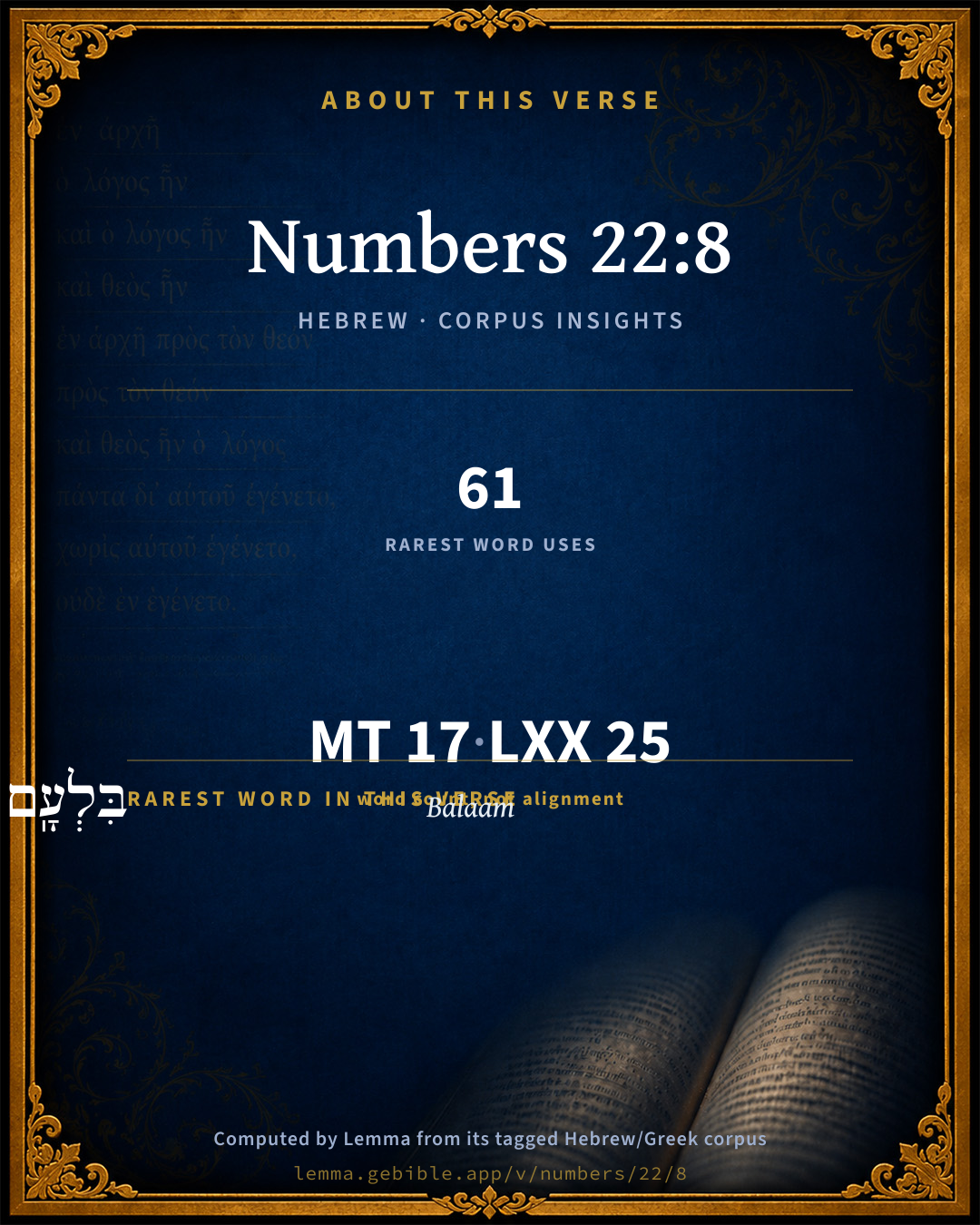
These counts appear in no published source. They are computed here, from the morphology-tagged text and Lemma’s own curated glosses. What Lemma adds →

17
words
16
distinct lemmas
Pentateuch
section

Grammatical profile

  • 5 verbs
  • 6 nouns
  • 3 prepositions
  • 1 adverb
  • 2 particles

Verb forms

  • וַיֹּ֣אמֶר Qal · Sequential Imperfect
  • לִ֤ינוּ Qal · Imperative
  • וַהֲשִׁבֹתִ֤י Hiphil · Sequential Perfect
  • יְדַבֵּ֥ר Piel · Imperfect
  • וַיֵּשְׁב֥וּ Qal · Sequential Imperfect

Repetition

A word recurs within this verse — often emphatic in Hebrew:

  • אֲלֵיהֶ֗ם to H413 ×2

Hebrew & Septuagint length

In English translation the verse runs 29 words from the Hebrew and 31 from the Septuagint (LXX English) — closely comparable.

A rough comparison of the two English renderings, which tokenize alike — not a word-level alignment.

Word counts can differ between the Hebrew and the Greek without any difference in meaning — e.g. the Hebrew direct-object marker אֵת has no separate Greek word, and Greek often adds the article ὁ.

In the original languages it is 17 Hebrew tokens and 25 Greek tokens — but the two are counted differently (Hebrew bundles its prefixes and suffixes into one token; the Greek is in lemma form), so that isn’t a like-for-like length.

Cross-references

5

Topical passages linked to Numbers 22:8 in the Treasury of Scripture Knowledge — connected by theme and wording, ordered by reader-vote popularity; previews shown in the World English Bible.

  • Numbers 12:6 He said, Hear now my words: if there be a prophet among you, I Yahweh will make myself known to him in a vision, I will speak with him in a dream.
  • Numbers 22:19–20 Now therefore, please wait also here this night, that I may know what Yahweh will speak to me more.
  • Numbers 23:12 He answered and said, Must I not take heed to speak that which Yahweh puts in my mouth?
  • Jeremiah 12:2 You have planted them, yes, they have taken root; they grow, yes, they bring forth fruit: you are near in their mouth, and far from their heart.
  • Ezekiel 33:31 They come to you as the people comes, and they sit before you as my people, and they hear your words, but don't do them; for with their mouth they show much love, but their heart goes after their gain.

Cross-references courtesy of OpenBible.info (CC BY 4.0).

Hebrew and Greek witnesses Masoretic Hebrew ↔ Greek Septuagint

The same verse in the two great witnesses to the Old Testament, shown verse-for-verse.

These are two independent witnesses, not word-aligned to each other, and the Septuagint is shown in lemma (dictionary) form.

Hebrew Numbers 22:8 Masoretic · Westminster Leningrad Codex

וַיֹּ֣אמֶר אֲלֵיהֶ֗ם לִ֤ינוּ פֹה֙ הַלַּ֔יְלָה וַהֲשִׁבֹתִ֤י אֶתְכֶם֙ דָּבָ֔ר כַּאֲשֶׁ֛ר יְדַבֵּ֥ר יְהוָ֖ה אֵלָ֑י וַיֵּשְׁב֥וּ שָׂרֵֽי מוֹאָ֖ב עִם בִּלְעָֽם

He said to them, Lodge here this night, and I will bring you word again, as Yahweh shall speak to me: and the princes of Moab abode with Balaam.

World English Bible · Public Domain

Greek LXX Numbers 22:8 Septuagint · lemma form

καί εἶπον πρός αὐτός καταλύω αὐτοῦ ὁ νύξ καί ἀποκρίνω σύ πρᾶγμα ὅς ἐάν λαλέω κύριος πρός ἐγώ καί καταμένω ὁ ἄρχων μωαβ παρά βαλααμ

And he said to them, Tarry here the night, and I will answer you the things which the Lord shall say to me; and the princes of Moab stayed with Balaam.

LXX2012 (modern English Septuagint) · Public Domain

Hebrew: Westminster Leningrad Codex (CC BY 4.0). Greek: Septuagint (public domain); English from LXX2012 (modern English Septuagint) (Public Domain). How the Septuagint differs from the Hebrew →

Targum (Aramaic paraphrase)

2

The Targum is the ancient Jewish Aramaic paraphrase of the Hebrew Scriptures — an interpretive translation, not the Hebrew text itself. Onkelos (literal) and Pseudo-Jonathan (expansive) render the Torah, and Jonathan the Prophets. Coverage is partial: where no permissively-licensed English translation exists for a verse, only the Aramaic is shown. This is verse-level text, not a word-by-word alignment to the Hebrew.

  1. Targum Onkelos Torah (Genesis–Deuteronomy)
    וַאֲמַר לְהוֹן בִּיתוּ הָכָא בְּלֵילְיָא וְאָתֵב יַתְכוֹן פִּתְגָמָא כְּמָא דִי יְמַלֵיל יְיָ עִמִי וְאוֹרִיכוּ רַבְרְבֵי מוֹאָב עִם בִּלְעָם

    (no public-domain English translation for this verse)

    Targum Onkelos — Aramaic: “Onkelos Genesis” (public domain); “Onkelos Exodus” (public domain); “Onkelos Leviticus” (public domain); “Onkelos Numbers” (public domain); “Onkelos Deuteronomy” (public domain). English: “Sefaria Community Translation” (CC0 1.0 (public-domain dedication)); “J.W. Etheridge. The Targums of Onkelos and Jonathan Ben Uzziel on the Pentateuch. London: Longmans, Green, 1862” (public domain). Text via Sefaria.

  2. Targum Pseudo-Jonathan Torah (Genesis–Deuteronomy)
    וַאֲמַר לְהוֹן בִּיתוּ הָכָא בְלֵילְיָא וְאָתִיב יַתְכוֹן פִּתְגָמָא הֵיכְמָא דִי יְמַלֵיל יְיָ עִמִי וְאַסְחָרוּ רַבְרְבֵי מוֹאָב עִם בִּלְעָם

    And he said to them, Abide here tonight, and I will return you word as the Lord shall speak with me. And the princes of Moab stayed with Bileam.

    Targum Pseudo-Jonathan — Aramaic: “Targum Jonathan on Genesis” (public domain); “Targum Jonathan on Exodus” (public domain); “Targum Jonathan on Leviticus” (public domain); “Targum Jonathan on Numbers” (public domain); “Targum Jonathan on Deuteronomy” (public domain). English: “The Targum of Jonathan ben Uzziel, trans. J. W. Etheridge, London, 1862” (public domain). Text via Sefaria.

Commentary

Notes on Numbers 22:8 from classic Christian and Jewish commentators (each source and its license shown beneath its notes). The classic Christian expositions comment on the surrounding passage and are grouped to its opening verse, so a note may address several verses; the Jewish commentaries on the Tanakh (Rashi and others) are per-verse, so they appear only where the commentator wrote on this verse.

Lemma curates 59 commentaries, every one of them public domain or Creative Commons licensed, each selected and text-cleaned for this edition rather than reprinted as found. About our sources →

Trapp's Complete Commentary

John Trapp

Num 22:8 And he said unto them, Lodge here this night, and I will bring you word again, as the LORD shall speak unto me: and the princes of Moab abode with Balaam.

Ver. 8. As the Lord shall speak unto me.] Good words and wishes may be found in hell’s mouth; as wholesome sugar may be found in a poisoned cane, and a stone of great virtue in the head of a toad. The French have a berry which they name Uve de spine, the grape of a thorn.

John Trapp, A Commentary or Exposition upon All the Books of the Old and New Testament (1647–1656) — public domain. Text from a community e-Sword module.

Joseph Benson's Commentary

Num 22:8. This night — The night was the time when God used to reveal his mind by dreams. As the Lord shall speak unto me — Hebrew, Jehovah, the true God. Though he was mercenary and addicted to superstitious rites, he might still have some revelations from the true God, even as Laban had, though he used teraphim, or idol gods, Gen 36:24-30. Thus, though termed a soothsayer, he here acknowledges the true God, by his incommunicable name Jehovah, and yet with that profession he both loved the wages of unrighteousness, 2Pe 2:15, and joined in offering sacrifices on the high places of Baal, Num 22:41, and Num 23:2. Some think that he mentioned Jehovah either for his own greater reputation, as if he consulted not with inferior spirits, but with the Supreme God; or rather, because Jehovah was Israel’s God, and the only possible way of ruining them was by engaging their God against them. Thus the Romans and other heathens, when they went to besiege any city, used enchantments, to call forth that god under whose peculiar protection it was supposed to be.

Joseph Benson's Commentary on the Old and New Testaments (1811–1818) — public domain. Text from a community e-Sword module.

Tyndale Open Study Notes

Tyndale Open Resources

22:8 Stay here overnight: Balaam expected to receive a message from God at night (22:9, 19-20; cp. Job 4:12-16; Zech 1:8). • the Lord (Hebrew Yahweh): Balaam knew about Yahweh, the God of Israel, and expected a message from him as to what he could or could not do.

Tyndale Open Study Notes — © Tyndale Open Resources, licensed CC BY-SA 4.0. Text via the HelloAO Bible API.

Geneva Bible (1599)

Geneva Bible translators

Whom before he called Elders: meaning the governors, and after calleth them servants: that is, subjects to their king.

Geneva Bible (1599) marginal notes — public domain. Text via Bolls.life.

Jamieson, Fausset & Brown

Robert Jamieson, A. R. Fausset & David Brown

Lodge here this night, and I will bring you word again, as the Lord shall speak unto me, &c.--God usually revealed His will in visions and dreams; and Balaam's birth and residence in Mesopotamia, where the remains of patriarchal religion still lingered, account for his knowledge of the true God. His real character has long been a subject of discussion. Some, judging from his language, have thought him a saint; others, looking to his conduct, have described him as an irreligious charlatan; and a third class consider him a novice in the faith, who had a fear of God, but who had not acquired power over his passions [HENGSTENBERG].

Jamieson, Fausset & Brown — Commentary Critical and Explanatory on the Whole Bible (1871) — public domain (CC PDM 1.0). Text via the HelloAO Bible API.

Adam Clarke's Commentary

Verse 8. I will bring you word again, as the Lord shall speak] So it appears he knew the true God, and had been in the habit of consulting him, and receiving oracles from his mouth.

Adam Clarke's Commentary on the Bible (1810–1826) — public domain. Text from a community e-Sword/MySword module.

Ellicott's Commentary for English Readers

(8) Lodge here this night.—These words indicate the true character of Balaam. As a prophet of the Lord, he must have known that in seeking to curse the Israelites he was sinning against the Lord, who had chosen them for His own people.

As the Lord shall speak unto me.—It appears from this verse, as from Num_22:18-19, that the name of Jehovah was known to Balaam.

A Bible Commentary for English Readers, edited by Charles John Ellicott (1878–1897) — public domain. Text from a community e-Sword module.

The Cambridge Bible for Schools and Colleges

gen. ed. J. J. S. Perowne

8. the princes of Moab] The verse appears to be from E . In Num_22:7 J describes them as the ‘elders of Moab.’

The Cambridge Bible for Schools and Colleges (gen. ed. J. J. S. Perowne; Cambridge University Press, 1878–1918) — public domain. Text from a community e-Sword module.

John Gill's Exposition

And God came unto Balaam,.... In a dream very probably, as he did to Abimelech and Laban, Gen 20:3,

and said, what men are these with thee? who lodged with him that night. This he said, not as ignorant who they were, or from whence they came, or what they came about; but in order to lead on to a discourse with Balaam, and to have from him the account of the men, and their business, and to try his fidelity in relating the affair.

John Gill's Exposition of the Whole Bible (1746–1763) — public domain (CC PDM 1.0). Text via the HelloAO Bible API.

Albert Barnes' Notes on the Bible

Balaam must surely have known that God’s blessing was on the people with whose marvelous march forth from Egypt he was acquainted Exo 15:14; Exo 18:1; Jos 2:9, and from whom he had himself probably learned much (compare the language of Num 23:12 with Gen 13:6, and that of Num 24:9 with Gen 49:9). But his reply to the messengers next morning Num 22:13, betrays the desire to venture to the utmost of that which God would not forbid rather than to carry out God’s will in hearty sincerity.

Albert Barnes' Notes on the Bible (1834–1885) — public domain. Text from a community e-Sword/MySword module.

Haydock's Catholic Bible Commentary

Night. He was accustomed to exercising his art by night; loving darkness, for his works were evil, John iii. 19. (Haydock)

George Leo Haydock (1774–1849), Haydock's Catholic Family Bible and Commentary, 1859 edition — public domain. Excludes Psalms (Douay-Rheims chapter numbering differs from Protestant) and Deuterocanonical books (Catholic canon only).

Matthew Poole's English Annotations

The night was the time when God used to reveal his mind by dreams. Here is the first discovery of his wickedness, that he hakes time to consider, and doth his endeavour to effect that wicked notion of cursing the Israelites, which he should have rejected and abhorred at the first mention of it.

As the Lord shall speak, Heb. Jehovah, the true God, whom he here mentions, either for his own greater reputation, as if he consulted not with inferior spirits, as other soothsayers did, but with the supreme God; or rather because this was Israel’s God, and the only possible way of ruining them was by engaging their God against them; as the known way of the Romans and other heathens, when they went to besiege any city, they used enchantments to call forth that god under whose peculiar protection they were.

The princes of Moab, and of Midian too, as is manifest from Num 22:7, which was needless to repeat here.

Matthew Poole's English Annotations on the Holy Bible (1683–1685) — public domain. Text from a community e-Sword/MySword module.

Whedon's Commentary on the Bible

Daniel D. Whedon

8. Lodge here this night — The night, when the external senses, in consequence of silence and darkness, were in a measure closed, was especially appropriate for a vision, the probable mode of the divine communication.

As the Lord shall speak — Balaam, in using the name Jehovah, the special and memorial name of Israel’s God, indicates that he is not a mere pagan juggler. He speaks like a Moses or a Paul. Yet some locate Balaam’s primal error at this point, that, knowing that Israel was the peculiar people of Jehovah, he did not promptly refuse to entertain the proposition of Balak and forthwith dismiss the messengers. But it is not certain that he had this knowledge of Israel’s relation to God.

Daniel D. Whedon (gen. ed.), Commentary on the Old and New Testaments (1874–1909) — public domain. Text from a community e-Sword module.

The Pulpit Commentary

Lodge here this night. It was therefore in the night, in a dream or in a vision, (cf. Gen_20:3 Num_12:6 Job_4:15, Job_4:16) that Balaam expected to receive some communication from God. If he had received none he would no doubt have felt himself free to go.

The Pulpit Commentary (1880–1919), ed. H.D.M. Spence-Jones & Joseph S. Exell — public domain. Text from a community e-Sword module.

John Wesley's Explanatory Notes

This night - The night was the time when God used to reveal his mind by dreams. The Lord - Hebrew. Jehovah, the true God, whom he here mentions, either for his own greater reputation, as if he consulted not with inferior spirits, but with the supreme God; or rather because this was Israel's God, and the only possible way of ruining them was by engaging their God against them: as the Roman and other Heathens, when they went to besiege any city, used enchantments to call forth that God under whose peculiar protection they were. Of Moab - And of Midian too.

John Wesley, Explanatory Notes Upon the Whole Bible (1754–1765) — public domain. Text via the GEBible commentary corpus.

Rashi

Rabbi Shlomo Yitzchaki (Rashi)

לינו פה הלילה LODGE HERE THIS NIGHT — The Holy Spirit rested upon him only at night time, and similarly in the case of all the prophets of the heathen peoples, and similarly He revealed Himself to Laban in a dream at night, as it is said, (Genesis 31:24) “And God came to Laban in a dream of the night” — as a man who comes to his concubine furtively (cf. Leviticus Rabbah 1 13; Rashi on Job 12:4).

כאשר ידבר ה' אלי [AND I WILL GIVE YOU AN ANSWER] AS THE LORD SHALL SPEAK TO ME — If He advises me to go with people such as you I will go with you; but perhaps it is not compatible with His dignity to permit me to go except with princes greater than you.

וישבו — this is an expression for “remaining”, (they remained with Balaam).

Rashi on the Tanakh — English translations: “The Judaica Press complete Tanach with Rashi, translated by A. J. Rosenberg” (CC BY 4.0); “Pentateuch with Rashi's commentary by M. Rosenbaum and A.M. Silbermann, 1929-1934” (public domain); “The Metsudah Tanach series, Lakewood, N.J” (CC BY 4.0); and “The Book of Joshua, Metsudah Publications, 1997” (CC BY 4.0). Text via Sefaria.

Lesson kit

Teaching starters — assembled from the data on this page, not authored interpretation. Every prompt links to the verse data it draws on. Edit before teaching.

Numbers, in the Pentateuch, opens this verse with 17 words (16 distinct Hebrew lemmas). Its most distinctive word is Bilʻâm (“Balaam”). A historical commentator’s framing appears above. Read the whole chapter for the surrounding context.

Discussion questions

  1. How does “Balaam” (Bilʻâm) shape what this verse is saying?
  2. Numbers 12:6 shares this passage’s theme. How do the two illuminate each other?
  3. “to” occurs 2× in this one verse. What is the effect of the repetition?
  4. These translations render this verse differently; the difference is in the English rendering, not the original. What questions does that raise?
  5. The verb «וַיֹּ֣אמֶר» is Qal Sequential Imperfect. How does its form color the action?
  6. Reading how Trapp's Complete Commentary and Joseph Benson's Commentary read this verse, where do the two commentators agree and where do they part?

Things to notice

Reading settings

Reading text

Shown beneath each verse's original-language words.

Old Testament
Old Testament edition

Read the OT as the Masoretic Hebrew (MT) or the Greek Septuagint (LXX).

English shown for the Greek Septuagint (in the Hebrew ↔ Greek comparison).

Comparing translations? Open the Compare panel on any verse page to stack up to four side by side.