John 7:21

Greek (Tischendorf 8th ed.) John 7:21 appears in the Greek New Testament. The text above is from the Tischendorf 8th edition. Each word links to its Strong’s number and a concise gloss. Click any word for its full Thayer’s Greek Lexicon entry.
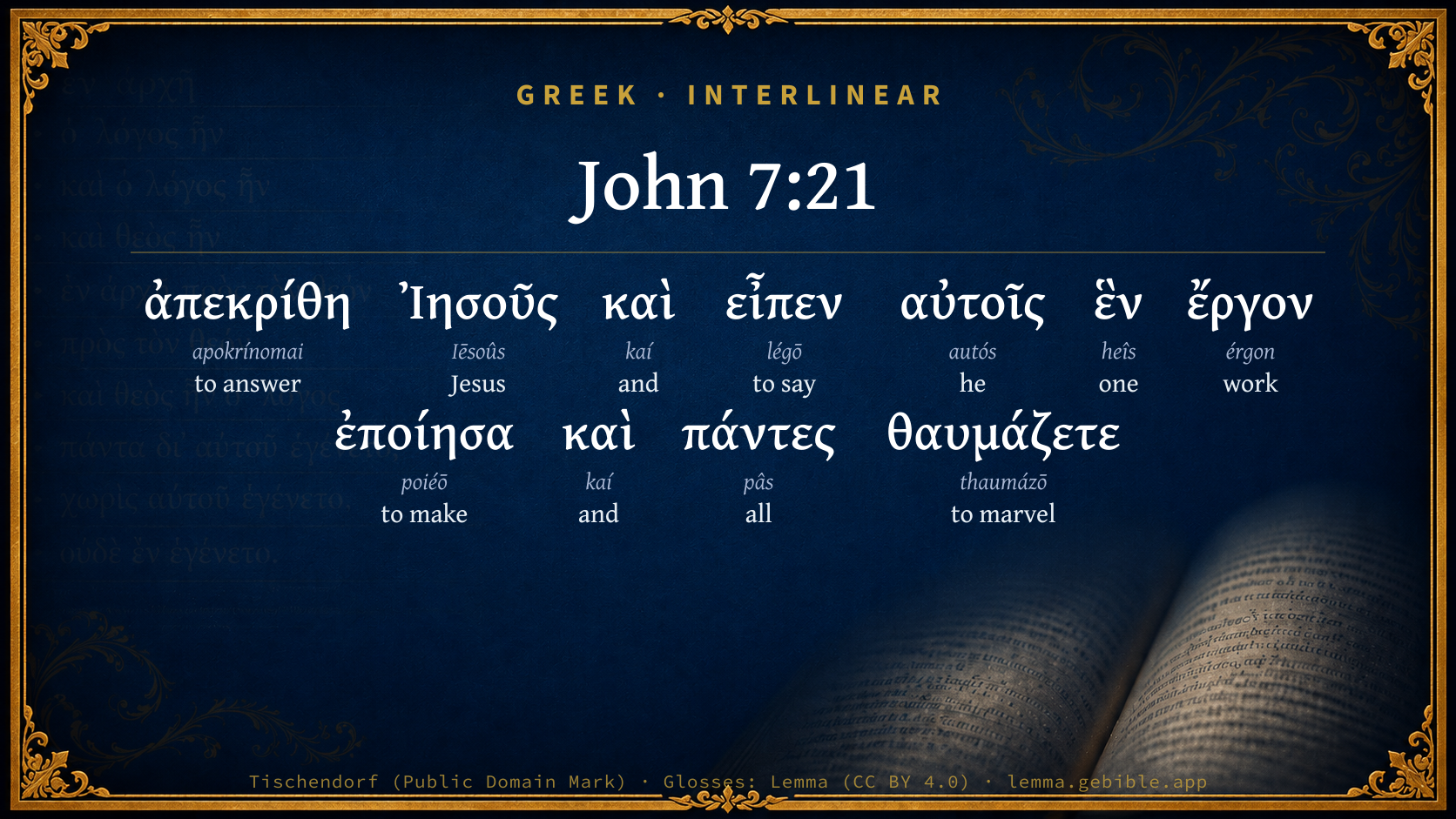
Download image
Cite this verse

John 7:21 (World English Bible). Public Domain. Lemma interlinear Bible study tool, https://lemma.gebible.app/v/john/7/21.

Show BibTeX & RIS
BibTeX
RIS
English Translation
Jesus answered them, "I did one work, and you all marvel because of it.
World English Bible · Public Domain
Download a study sheet

One document with this verse’s original text, its word-by-word gloss line, the meaning frame, cross-references with their text, attributed commentary, and full source and license credits — printable, and it pastes into notes with its structure intact.

This verse Autodidact and up

Study sheet (.html) Plain text (.txt)

A passage Seminary Student

Up to 50 verses in one chapter. A passage sheet keeps up to 6 commentary sources and 12 cross-references per verse, in the order this page ranks them, and says so on the sheet whenever that leaves anything out. Ask for a single verse and you get the Autodidact verse sheet above.

Everything on this page stays free to read, with no account — the sheet is a download of what is already on screen, not access to it.

Want to remove ads? Support Godless Engineer
Compare translations 3

The same verse in 3 English versions, stacked beneath the original-language interlinear above. Click any original word for its lexicon entry.

Each is an independent rendering of the whole verse — the interlinear is not word-aligned to these translations.

Highlighted words mark where these versions differ — a whole-verse word diff, not a word-by-word alignment.

  • World English Bible Public Domain
    Jesus answered them, "I did one work, and you all marvel because of it.
  • King James Version Public Domain
    Jesus answered and said unto them, I have done one work, and ye all marvel.
  • unfoldingWord Literal Text CC BY-SA 4.0
    Jesus answered and said to them, “I did one work, and you all marvel.

unfoldingWord Literal Text — © unfoldingWord, licensed CC BY-SA 4.0. Word-aligned USFM3 via Door43 (git.door43.org/unfoldingWord/en_ult).

Versions to compare (up to 4)

3 of 4 selected

Show all 19 translations

Every available English version of this verse, each an independent rendering of the whole verse.

  • World English Bible Public Domain
    Jesus answered them, "I did one work, and you all marvel because of it.
  • Berean Standard Bible Public Domain
    Jesus answered them, “I did one miracle, and you are all amazed.
  • Majority Standard Bible Public Domain
    Jesus answered them, “I did one miracle, and you are all amazed.
  • King James Version Public Domain
    Jesus answered and said unto them, I have done one work, and ye all marvel.
  • American Standard Version (1901) Public Domain
    Jesus answered and said unto them, I did one work, and ye all marvel because thereof.
  • Revised Version (1885) Public Domain
    Jesus answered and said unto them, I did one work, and ye all marvel.
  • Geneva Bible (1599) Public Domain
    Iesus answered, and saide to them, I haue done one worke, and ye all maruaile.
  • Douay-Rheims (1899) Public Domain
    Jesus answered, and said to them: One work I have done; and you all wonder:
  • Young's Literal Translation Public Domain
    Jesus answered and said to them, `One work I did, and ye all wonder,
  • Literal Standard Version CC BY-SA 4.0
    Jesus answered and said to them, “I did one work, and you all wonder,
  • Unlocked Literal Bible CC BY-SA 4.0
    Jesus answered and said to them, “I did one work, and you all marvel because of it.
  • unfoldingWord Literal Text CC BY-SA 4.0
    Jesus answered and said to them, “I did one work, and you all marvel.
  • Darby Bible Public Domain
    Jesus answered and said to them, I have done one work, and ye all wonder.
  • World Messianic Bible Public Domain
    Yeshua answered them, “I did one work and you all marvel because of it.
  • Webster's Bible Public Domain
    Jesus answered and said to them, I have done one work, and ye all marvel.
  • Free Bible Version CC BY-SA 4.0
    “I did one miracle and you're all shocked by it,” Jesus replied.
  • Bible in Basic English Public Domain
    This was the answer of Jesus: I have done one work and you are all surprised at it.
  • Text-Critical English NT CC BY 4.0
    Jesus answered them, “I performed one miracle, and you are all amazed.
  • Tyndale New Testament (1534) Public Domain
    Iesus answered and sayde to them: I have done one worke and ye all marvayle.

Literal Standard Version (2020), Covenant Press — licensed CC BY-SA 4.0. Text via the HelloAO Bible API (eBible.org). Unlocked Literal Bible (unfoldingWord) — licensed CC BY-SA 4.0. Text via the HelloAO Bible API (eBible.org). unfoldingWord Literal Text — © unfoldingWord, licensed CC BY-SA 4.0. Word-aligned USFM3 via Door43 (git.door43.org/unfoldingWord/en_ult). Free Bible Version, Dr. Jonathan Gallagher — licensed CC BY-SA 4.0. Text via the HelloAO Bible API (eBible.org).

Word by word

More ways to search: Search by grammar → Find every occurrence → Compare this word →

Practice this passage: Drill this verse → Learn its vocabulary →

About this verse

These counts appear in no published source. They are computed here, from the morphology-tagged text and Lemma’s own curated glosses. What Lemma adds →

11
words
10
distinct lemmas
Gospels
section

Shared distinctive vocabulary

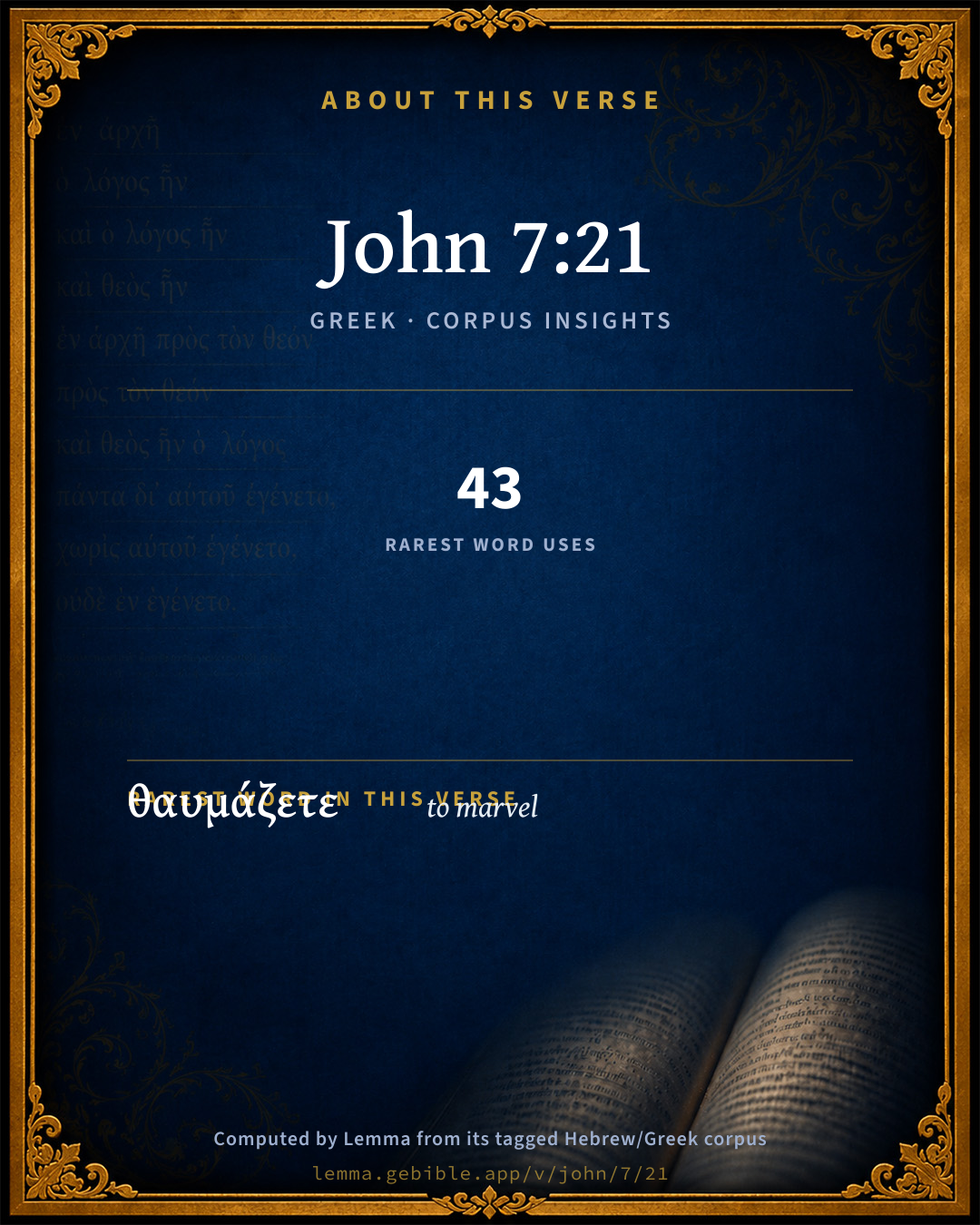
θαυμάζετε to marvel G2296 occurs in 43 verses of the Greek New Testament. Also found in:

Repetition

A word recurs within this verse:

Cross-references

2

Topical passages linked to John 7:21 in the Treasury of Scripture Knowledge — connected by theme and wording, ordered by reader-vote popularity; previews shown in the World English Bible.

  • John 5:2–11 Now in Jerusalem by the sheep gate, there is a pool, which is called in Hebrew, "Bethesda," having five porches.
  • John 7:23 If a boy receives circumcision on the Sabbath, that the law of Moses may not be broken, are you angry with me, because I made a man every bit whole on the Sabbath?

Cross-references courtesy of OpenBible.info (CC BY 4.0).

Commentary

Notes on John 7:21 from classic Christian and Jewish commentators (each source and its license shown beneath its notes). The classic Christian expositions comment on the surrounding passage and are grouped to its opening verse, so a note may address several verses; the Jewish commentaries on the Tanakh (Rashi and others) are per-verse, so they appear only where the commentator wrote on this verse.

Lemma curates 59 commentaries, every one of them public domain or Creative Commons licensed, each selected and text-cleaned for this edition rather than reprinted as found. About our sources →

Joseph Benson's Commentary

Joh 7:21-24. Jesus answered, I have done one good work, and ye all marvel — I have done a miracle of an extraordinary kind on the sabbath day, an action which ye think inconsistent with the character of a good man, and therefore ye wonder that I should have performed it. But I can easily vindicate my character, by an argument which it is not in your power to gainsay. Moses therefore gave you circumcision — That is, the law of circumcision. Dr. Campbell joins the words δαι τουτο, here rendered therefore, to the end of the former verse, following Theophylact, and some whom he terms “our best authors,” observing, that “nothing can be more incongruously connected than the words are in the English, and most other modern translations; where our Lord’s performing a miracle is represented as the cause why Moses gave them circumcision.” Thus also Doddridge, Wesley, Wynne, and Worsley, who translate the last clause of the preceding verse, I have done one work, and ye all marvel at it, or, on account of it. If we retain the common pointing, as all the versions do, the interpretation of this verse (Joh 7:22) must be, Because that Moses gave you the precept concerning circumcision, ye even circumcise a man on the sabbath day. But the correction just now proposed makes the sense more clear and elegant, thus: Moses gave you the law of circumcision, (though indeed it was far more ancient than he, being a precept enjoined to and observed by, the patriarchs,) and on the sabbath day ye circumcise a man. If a man receive circumcision on the sabbath day, that the law of Moses may not be broken — The precept of circumcision required, that every male should be circumcised the eighth day from his birth. Though the eighth day happened on the sabbath, this ceremony was not deferred: and the law of circumcision vacated the law of the sabbath. Are ye angry at me, because I have made a man every whit whole — Or, have made a whole man sound; on the sabbath day? — Since you think yourselves bound to dispense with the strict observation of the sabbath for the sake of another precept, which is only of a ceremonial nature, how can ye be angry with me, because, in pursuance of the great end of all the divine laws, I have cured a man who was infirm in all his members, and that with far less bodily labour than that with which you perform the ceremony of circumcision, and cure the wound that is made by it? Judge not according to the appearance, &c. — Consider the nature of the things, and judge impartially, without regard to your own prejudices, or the superstition of your teachers. Dr. Campbell renders the clause, Judge not from personal regards, thinking that translation gives more exactly the sense of the original expression, μη κρινετε κατ’ οψιν. “There can be no question,” says he, “that this precept is of the same import with those which enjoin strict impartiality between the parties, or to have no respect of persons in judgment. The application of it is obvious on this occasion. If the Jews had been strictly impartial and equitable, they would have seen that they could not vindicate Moses for enjoining such a violation of the sabbatical rest as was occasioned by circumcising, while they condemned Jesus for his miraculous cures, which required less labour, and were not less evidently calculated for promoting a good end. Nay, they could not excuse themselves for the one practice, if Jesus was blameable for the other.”

Joseph Benson's Commentary on the Old and New Testaments (1811–1818) — public domain. Text from a community e-Sword module.

Bengel's Gnomon

Johann Albrecht Bengel

Joh 7:21. Ἕν, one) out of countless works, which ye know not [viz. the miracle in the case of the man at the pool of Bethesda.—V. g.]—ἐποίησα, I have done) on the Sabbath, Joh 7:23.—καὶ, and) Involves a relative force; I have done one work, which ye all wonder at. Since in the case of none other work of Mine ye perceive anything to censure; ye ought to have formed a favourable opinion of this one work also.—θαυμάζετε, ye marvel) accompanied with doubt. Such a marvelling, as in Act 2:7; Act 2:12, “They were all amazed and marvelled, saying—Behold, are not all these which speak Galilæans? And—they were in doubt.”

Bengel's Gnomon of the New Testament — English translation (T&T Clark, Edinburgh, 1860) — public domain. Text from a community e-Sword module.

Meyer's Critical & Exegetical Commentary

Heinrich August Wilhelm Meyer

Joh_7:21-22. Ἀπεκρίθη] The reply of Jesus, not to the Ἰουδαῖοι (Ebrard), but to the ὄχλος (for it is really addressed to them, not in appearance merely, and through an inaccurate account of the matter on Johns part, as Tholuck unnecessarily assumes), contains, indeed, no direct answer to the question put, but is intended to make the people feel that all had a guilty part in the murderous designs against Him, and that none of them are excepted, because that one work which He had done among them was unacceptable to them all, and had excited their unjustifiable wrath. Thus He deprives the people of that assurance of their own innocence which had prompted them to put the question to Him; ostendit se profundius eos nôsse et hoc radio eos penetrat, Bengel.

ἓν ἔργον] i.e. the healing on the Sabbath, Joh_5:2 ff., the only miraculous work which He had done in Jerusalem (against Weisse[262]) (not, indeed, the only work at all, see Joh_2:23, comp. also Joh_10:32, but the only one during the last visit), for the remembrance of which the fact of its being so striking an instance of Sabbath-breaking would suffice.

καὶ πάντες θαυμάζετε] πάντες is correlative with ἕν, and ye all wonder (Act_3:12), i.e. how I could have done it as a Sabbath work (Joh_5:16); it is the object of your universal astonishment! An exclamation; taken as a question (Ewald), the expression of disapprobation which it contains would be less emphatic. To put into θαυμάζετε the idea of alarm (Chrysostom), of blame (Nonnus), of displeasure (Grotius), or the like, would be to anticipate; the bitterness of tone does not appear till Joh_7:23.

διὰ τοῦτο] connected with θαυμάζετε by Theophylact, and most moderns (even Lücke, Tholuck, Olshausen, De Wette, B. Crusius, Maier, Lange, Lachmann, Hengstenberg, Ewald, Baeumlein, Ebrard, Godet; among earlier expositors, Beza, Casaubon, Homberg, Maldonatus, Wolf, Mill, Kypke, etc.; see on Mar_6:6); but Syr. Goth. Codd. It., Cyril, Chrysostom, Nonnus, Euthymius Zigabenus, Luther, Castalio, Erasmus, Aretius, Grotius, Cornelius a Lapide, Jansen, Bengel, Wetstein, and several others, also Luthardt, and already most of the Codices, with true perception, place the words at the beginning of Joh_7:22 (so also Elzevir); for, joined with θαυμάζετε, they are cumbrous and superfluous,[263] and contrary to Johns method elsewhere of beginning, not ending, with διὰ τοῦτο (Joh_5:16; Joh_5:18, Joh_6:65, Joh_8:47, Joh_10:17, al.; see Schulz on Griesbach, p. 543). Only we must not take them either as superfluous (Euthymius Zigabenus) or as elliptical: therefore hear, or know (Grotius, Jansen, even Winer, p. 58 [E. T. p. 68]); the former is inadmissible, the latter is neither Johannean nor in keeping with what follows, which does not contain a declaration, but a deduction of a logical kind. We ought rather, with Bengel (propterea, hoc mox declaratur per ΟὐΧ ὍΤΙ, nempe non quia) and Luthardt, following Cyril, to regard them as standing in connection with the following οὐχ ὅτι. With this anticipatory διὰ τοῦτο, Jesus begins to diminish the astonishment which His healing on the Sabbath had awakened, showing it to be unreasonable, and this by the analogy of circumcision, which is performed also on the Sabbath. Instead of simply saying, because it comes from the fathers, He puts the main statement, already introduced by ΔΙᾺ ΤΟῦΤΟ, and so important in the argument, both negatively and positively, and says, Therefore Moses gave you circumcision, not because it originated with Moses, but (because it originated) with the fathers, and so ye circumcise (ΚΑῚ consecutive), etc.; that is, this ΟὐΧ ὍΤΙ, on to ΠΑΤΈΡΩΝ, serves to show that circumcision, though divinely commanded by Moses in the law, and thus given to the Jews as a ritualistic observance, was not Mosaic in its origin, but was an old patriarchal institution dating back even from Abraham. The basis of its historic claim to validity lies in the fact that the law of circumcision precedes the law of the Sabbath, and consequently the enjoined rest of the Sabbath must give way to circumcision.[264] Even the Rabbins had this axiom: Circumcisio pellit sabbatum, and based it upon the fact that it was traditio partum. See Wetstein on Joh_7:23. The anger of the people on account of the healing on the Sabbath rested on a false estimate of the Sabbath; comp. Mat_12:5. From this explanation it is at the same time clear that οὐχ ὅτι … πατέρων is not of the nature of a parenthesis (so usually, even Lachmann). Of those who so regard it, some rightly recognise in the words the authority of circumcision as outweighing that of the Sabbath; while others, against the context, infer from them its lesser sanctity as being a traditional institution (Paulus, B. Crusius, Ewald, Godet). Others, again, take them as an (objectless) correction (De Wette, Baeumlein), or as an historical observation (equally superfluous) of Jesus (Tholuck, Hengstenberg, and earlier expositors) or of John (Lücke, cf. Ebrard). Above all, it would have been very strange and paltry to suppose (with Hengstenberg) that Jesus by this remark was endeavouring, with reference to Joh_7:15, to do away with the appearance of ignorance.

Μωϋσῆς] Lev_12:3.

οὐχ ὅτι] not as in Joh_6:46, but as in Joh_12:6.

ἐκ τοῦ Μωϋσέως] Instead of saying ἐξ αὐτοῦ, Jesus repeats the name, thus giving more emphasis to the thought. See Kühner, ad Xen. Mem. i. 6. 1, ad Anab. i. 6. 11.

ἐκ τῶν πατέρων] Gen_17:10; Gen_21:4; Act_7:8; Rom_4:11.

ἐν Σαββ.] if it be the eighth day. Comp. the Rabbinical quotations in Lightfoot. Being emphatic, it takes the lead.

[262] How does he make out the ἓν ἔργον? It is the one miracle which Christ came to accomplish (Mat_12:38; Mat_16:1 sqq.; Luk_11:29 ff.), described by Him metaphorically as a Sabbath healing; this the evangelist has taken for a single miraculous act. See Evangelienfr. p. 249.

[263] This accounts for the omission of διὰ τοῦτο in א Tisch. deletes it, and with א* reads ὁ Μωϋσ. (with the article).

[264] The patriarchal period wag indeed that of promise, but this is not made prominent here, and we cannot therefore say with Luthardt: Jesus puts the law and the promise over-against one another, like Paul in Gal_3:17. There is no hint of this in the text. Judging from the text, there rather lies in οὐχ ὅτι, κ.τ.λ., the proof that, in the case of a collision between the two laws, that of circumcision and that of the Sabbath, the former must have the precedence, because, though enjoined by Moses, it already had a patriarchal origin, and on account of this older sanctity it must suffer no infringement through the law of the Sabbath. Nonnus well describes the argumentation by the words ἀρχεγόνῳ τινὶ θεσμῷ.

Meyer — Critical and Exegetical Commentary on the New Testament — English translation by Peter Christie, edited by Frederick Crombie (T&T Clark, 1880) — public domain. Text from a community e-Sword module.

Expositor's Greek Testament

ed. W. Robertson Nicoll

Joh 7:21 . Jesus prefers to expose the unjustifiable character of the hostility which pursued Him (Joh 7:16 ). Referring to the miracle wrought at Bethesda, and which gave occasion to this hostility, He says ἕν ἔργον … σαββάτω . One single work I did and ye all marvel [are horrified or scandalised]; for this same object, of imparting health, Moses gave you circumcision, an ordinance that continues through all the generations and regularly sets aside the Sabbath law. If circumcision is performed, lest the law of Moses be broken, are ye angry at me for making a man every whit whole [or rather, for making an entire or whole man healthy] on the Sabbath day? The argument is obvious; and its force is brought out by the antithetical form of the sentence: the ἕν ἔργον of the healing of the impotent man is contrasted with the continuous ordinance of circumcision, and so the aorist is used of the one, the perfect of the other. In Joh 7:23 περιτομὴν λαμβάνει is contrasted with ὅλον ἄνθρωπον ὑγιῆ , the partial and symbolic with the complete and actual soundness. The argument is all the more telling because a “vis medicatrix,” as well as a ceremonial purity (but vide Meyer), was ascribed to circumcision [“praeputium est vitium in corpore”]. Wetstein quotes from a Rabbi a singularly analogous argument: “Si circumcisio, quae fit in uno membrorum 248 hominis, pellit Sabbatum, quanto magis verum est, conservationem vitae Sabbatum pellere?” The parenthesis in Joh 7:22 , οὐχ ὅτι … πατέρων , is apparently thrown in for accuracy’s sake, lest some captious persons should divert attention from the argument by objecting to the statement that Moses had “given” them circumcision. The reference of διὰ τοῦτο in the same verse is obscure. Some editors join these words with θαυμάζετε ; but although in Mar 6:6 διά follows θαυμάζειν , this construction does not occur in John. Besides, John frequently begins his sentences with διὰ τοῦτο ; and if Joh 7:22 begins with Μωσῆς , such a commencement is certainly abrupt. Retaining διὰ τοῦτο as part of Joh 7:22 , the words might be understood thus: “I have done one work and ye all marvel: therefore (be it known unto you) Moses has given you,” etc., i.e. , “I will remove your astonishment: you yourselves perform circumcision,” etc. See Winer, p. 68. So Holtzmann, and Weizsäcker, who renders: “Darum: Moses hat euch,” etc. This gives a good sense, but surely the ellipsis is too severe. Holtzmann’s reference to Joh 6:65 tells rather against it, for there εἴρηκα is added. May διὰ τοῦτο not mean, “on this account,” i.e. , for the same reason as I had in healing the impotent man, did Moses give you circumcision? I did one work of healing and ye marvel. But with a similar object Moses gave you circumcision. This seems best to suit the words and the context. He adds to His argument the comprehensive advice of Joh 7:24 . μὴ κρίνετε κατʼ ὄψιν … κρίνατε . “Judge not according to appearance:” κατʼ ὄψιν , according to what presents itself to the eye; the Pharisaic vice. In appearance the healing of the impotent man was a breach of the Sabbath-law. No righteous judgment can be come to if appearances decide. For κρίσιν κρίνειν , cf. Plato Rep. , 360 E; and cf. οἰκίαν οἰκεῖν , βαδίζειν ὁδόν , πεσεῖν πτώματα , etc.

The Expositor's Greek Testament, edited by W. Robertson Nicoll (1897–1910) — public domain. Text from a community e-Sword module.

Geneva Bible (1599)

Geneva Bible translators

The Sabbath day (which is here set before us for a rule of all ceremonies) was not appointed to hinder but to further and practice God’s works: amongst which the love of our neighbor is the chiefest.

Geneva Bible (1599) marginal notes — public domain. Text via Bolls.life.

Jamieson, Fausset & Brown

Robert Jamieson, A. R. Fausset & David Brown

I have done one work, &c.--Taking no notice of the popular appeal, as there were those there who knew well enough what He meant, He recalls His cure of the impotent man, and the murderous rage it had kindled (Joh 5:9, Joh 5:16, Joh 5:18). It may seem strange that He should refer to an event a year and a half old, as if but newly done. But their present attempt "to kill Him" brought up the past scene vividly, not only to Him, but without doubt to them, too, if indeed they had ever forgotten it; and by this fearless reference to it, exposing their hypocrisy and dark designs, He gave His position great moral strength.

Jamieson, Fausset & Brown — Commentary Critical and Explanatory on the Whole Bible (1871) — public domain (CC PDM 1.0). Text via the HelloAO Bible API.

Adam Clarke's Commentary

Verse 21. I have done one work] That of curing the impotent man, already referred to. See Joh 5:9.

And ye all marvel.] or, ye all marvel because of this. Some have δια τουτο, in connection with θαυμαζετε, which the common pointing makes the beginning of the next verse, and which, in our common version, is translated therefore; but this word conveys no meaning at all, in the connection in which it is thus placed. Proof of this construction Kypke gives from Themistius, Strabo, and AElian. All the eminent critics are on the side of this arrangement of the words.

Adam Clarke's Commentary on the Bible (1810–1826) — public domain. Text from a community e-Sword/MySword module.

John Calvin's Commentaries

21. I have done one work. Now, leaving their persons, he begins to speak of the fact; for he proves that the miracle which he performed is not inconsistent with the Law of God. When he says that he has done one work, the meaning is, that it is only of a single crime that he is held guilty, or that it is only for a single work that he is blamed, which is, that he cured a man on the day of Rest; but that they, on every day of Rest, do many works of the same, or a similar description, and do not reckon them criminal; for not a day of Rest passed on which there were not many infants circumcised in Judea. By this example he defends his action, although he does not merely argue from what is similar, but draws a comparison between the greater and the less. There was this similarity between circumcision and the cure of the paralytic, that both were works of God; but Christ maintains that the latter is more excellent, because the benefit of it extends to the whole man. Now if he had merely cured the man of bodily disease, the comparison would not have been applicable; for circumcision would have greater excellence as to the cure of the soul. Christ, therefore, connects the spiritual advantage of the miracle with the outward benefit granted to the body; and on this account he justly prefers to circumcision the entire cure of a man.

There might also be another reason for the comparison, namely, that the sacraments are not always attended by power and efficacy, while Christ wrought efficaciously in curing the paralytic. But I prefer the former exposition, that the Jews maliciously and slanderously blame a work, in which the grace of God shines more illustriously than in circumcision, on which they bestow so much honor that they think the Sabbath is not violated by it. And you all wonder The wonder, of which he speaks, means that what Christ had done caused this murmur, because they thought that he had ventured to do more than was lawful.

John Calvin's Commentaries (1540-1563) — public domain. Text from the Calvin Translation Society English edition (1840s-50s) via the Christian Classics Ethereal Library (ccel.org). Calvin's coverage is partial (roughly two-thirds of the Bible); uncommented books and verses are honest gaps, never fabricated. The 19th-century editor's footnotes and remarks are omitted so the notes are faithfully Calvin's own voice.

Ellicott's Commentary for English Readers

(21) I have done one work—i.e., the one conspicuous work of healing the infirm man on the Sabbath day, which He did at His last visit to Jerusalem. We have already had a reference to other works in Joh_2:23, and He Himself refers to His many good works in Joh_10:32.

Ye all marvel.—This answer is addressed to the multitude who said “Thou hast a devil,” when He spoke of the intention to kill Him. This work on the Sabbath day, which provoked the deadly hostility of the hierarchy (Joh_5:16; Joh_5:18), was cause of wonder to them all. They, too, though not in the same degree, were led by it to take a hostile position.

A Bible Commentary for English Readers, edited by Charles John Ellicott (1878–1897) — public domain. Text from a community e-Sword module.

The Cambridge Bible for Schools and Colleges

gen. ed. J. J. S. Perowne

21. I have done] Better, I did. Comp. Joh_7:23.

one work] The healing of the impotent man at Bethesda: it excited the astonishment of all as being wrought on the Sabbath. Christ reminds them that on that occasion all, and not the rulers only, were offended.

Most modern editors add to this verse the words translated ‘therefore’ in Joh_7:22 [it is not S. John’s favourite particle (see on Joh_7:15), but a preposition with a pronoun = for this cause, on account of this]; ‘and ye all marvel on account of this.’ But this is cumbrous, and unlike S. John, who begins sentences with this phrase (Joh_6:16; Joh_6:18, Joh_8:47, Joh_10:17, Joh_12:39; mistranslated ‘therefore’ in all cases) rather than ends them with it. The old arrangement is best.

The Cambridge Bible for Schools and Colleges (gen. ed. J. J. S. Perowne; Cambridge University Press, 1878–1918) — public domain. Text from a community e-Sword module.

John Gill's Exposition

Moses therefore gave unto you circumcision,.... The command of circumcision, which he renewed and established, Lev 12:3;

(not because, or that it is of Moses; originally, or that he was the first giver of it, for it was enjoined before his time; this is a correction of what is before said, giving a more accurate account of the rise of circumcision:

but of the fathers); Abraham, Isaac, and Jacob, to whom it was enjoined by God, and who practised it before the times of Moses; so that this command was in force before him, and obligatory upon the descendants of Abraham, before he delivered it; and would have been, if he had never mentioned it; though the Jews say (r),

"we do not circumcise because Abraham our father, on whom be peace, circumcised himself and his household, but because the holy blessed God commanded us by Moses, that we should be circumcised, as Abraham our father was circumcised.''

But no doubt it would have been binding on them, if Moses had said nothing about it; the command to Abraham is so express, for the circumcision of his male offspring, Gen 17:10; however, it being both of Moses and of the fathers, laid a very great obligation on the Jews to observe it:

and ye on the sabbath day, circumcise a man; a male child, as they did, when the eighth day fell on a sabbath day; for the law of circumcision was before the law of the sabbath, and therefore was not to be made void by it, nor was it made void by it; and so much is intimated by our Lord's observing, that it was not of Moses, but of the fathers; and this is the reason which the Karaite Jews give for circumcision on the sabbath day: for (s).

"say they, because it is a former command, from the time of Abraham our father, on whom be peace, before the giving of the law of the sabbath, , "they circumcise on the sabbath day", and when the command of the sabbath afterwards took place, it was not possible it should disannul circumcision on the sabbath day; and for the same reason, they also allow the sacrifice of the passover to be done on the sabbath day, because it is a command which went before the command of the sabbath.''

And this was also the sense and practice of the other Jews: thus citing the law of Moses in Lev 12:3. "And in the eighth day, the flesh of his foreskin shall be circumcised", by way of gloss upon it add, , "and even on the sabbath day" (t); and on the same text another writer observes (u), that by Gematry, every day is fit for circumcision. R. Jose says (w),

"they do all things necessary to circumcision, on the sabbath day.''

R. Abika says (x),

"all work that can be done on the evening of the sabbath, does not drive away the sabbath; but circumcision, which cannot be done on the evening of the sabbath, drives away the sabbath: they do all things necessary to circumcision; they circumcise, and make bare, and suck, and put (on the wound) a plaster and cummin; and which, if not bruised on the evening of the sabbath, they may chew with their teeth.''

Also it is allowed of (y), to

"wash the infant on the third day of circumcision, which happens to be on the sabbath.''

Moreover, a case is put after this manner (z);

"if a man has two infants, one to be circumcised after the sabbath, and the other to be "circumcised on the sabbath", and forgets, and circumcises that, that was to be after the sabbath, on the sabbath, he is guilty of sin; if one is to be circumcised in the evening of the sabbath, and the other on the sabbath, and he forgets, and circumcises that which should be on the evening of the sabbath, on the sabbath, R. Eliezer pronounces him guilty, but R, Joshua absolves him.''

And we have an instance (a) of

"R. Sheshana, the son of R. Samuel bar Abdimo, that when he was to be circumcised, it was the sabbath day, and they forgot the razor; and they inquired of R. Meni and R. Isaac ben Eleazar, and it was drove off to another day.''

From all which it appears, that circumcision on the sabbath day, was a common practice, and which confirms the assertion of Christ.

(r) Maimon. in Misn. Cholin, c. 7. sect. 6. (s) R. Eliaha in Adderet apud Trigland. de Sect. Karaeorum, c. 9. p. 134. (t) T. Bab. Sabbat, fol. 132. 1. Mitzvot Tora, pr. Affirm. 28. (u) Baal Hatturim in Lev. xii. 3. (w) Misna Sabbat, c. 18. sect. 3. (x) Misna Sabbat, c. 19. sect. 1, 2. T. Bab. Pesachim, fol. 69. 2. Maimon. Hilchot Milah, c. 2. sect. 6, 7. (y) Ib. sect. 3. Bereshit Rabba, sect. 8. fol. 70. 3. Maimon. ib. sect. 6. (z) Ib. sect. 4. T. Bab. Ceritot, fol. 19. 2. (a) Juchasin, fol. 105. 2.

John Gill's Exposition of the Whole Bible (1746–1763) — public domain (CC PDM 1.0). Text via the HelloAO Bible API.

Trapp's Complete Commentary

John Trapp

21 Jesus answered and said unto them, I have done one work, and ye all marvel.

Ver. 21. And ye all marvel] i.e. ye all murmur: but he speaks the best of them, as not willing to enrage them.

John Trapp, A Commentary or Exposition upon All the Books of the Old and New Testament (1647–1656) — public domain. Text from a community e-Sword module.

Albert Barnes' Notes on the Bible

One work - The healing of the man on the Sabbath, John 5.

Ye all marvel - You all wonder or are amazed, and particularly that it was done on the Sabbath. This was the particular ground of astonishment, that he should dare to do what they esteemed a violation of the Sabbath.

Albert Barnes' Notes on the Bible (1834–1885) — public domain. Text from a community e-Sword/MySword module.

Haydock's Catholic Bible Commentary

One work I have done. He means by healing the man at the pond, who had been ill thirty-eight years. (Witham) --- Jesus here speaks of the cure that he had performed on the paralytic, eighteen months before, and which had scandalized the Jews. See Chap. v, ver. 9. et dein. of this gospel. (Bible de Vence)

George Leo Haydock (1774–1849), Haydock's Catholic Family Bible and Commentary, 1859 edition — public domain. Excludes Psalms (Douay-Rheims chapter numbering differs from Protestant) and Deuterocanonical books (Catholic canon only).

Matthew Poole's English Annotations

By the one miracle it is plain, by what followeth, that he meaneth healing the man who lay at the pool of Bethesda; at this, he saith, they marvelled, by which is to be understood offended, for so it is expounded by χολατε, Joh 7:23; and to this sense is our Saviour’s subsequent discourse.

Matthew Poole's English Annotations on the Holy Bible (1683–1685) — public domain. Text from a community e-Sword/MySword module.

Whedon's Commentary on the Bible

Daniel D. Whedon

21. Jesus answered—He disregards the interruption, and prosecutes his argument to show how they break the law of Moses while he does the will of God, (21-24.) In his miracle at Bethesda, he argues, he as truly did the will of God by healing on the Sabbath day as they observe the law of Moses in circumcising on the Sabbath day. The law of the Sabbath is truly broken in neither case. For both were religious and holy acts on the Sabbath day, in accordance with God’s will and law.

Daniel D. Whedon (gen. ed.), Commentary on the Old and New Testaments (1874–1909) — public domain. Text from a community e-Sword module.

The Pulpit Commentary

Jesus answered and said to them; i.e. to the multitude wire had so coarsely treated him, and to the "Jews" who were present, who were all marvelling together at the line he was taking. The very interruption was a proof both of the extent and consequence of their wonderment. One work I did, and ye are all marvelling. This one work was a very small fraction of his mighty signs, but it was one which, from its manner of operation, and from the fact that it was immediately brought before the religious authorities as an unlawful act (Joh 5), and which, moreover, became the occasion for one of the greatest of his discourses, and for his solemn claim to be the Son of God and the Arbiter of life and death, of resurrection and judgment, made the profoundest impression on the Sanhedrin, compelled them to think that he was a Man who must be sooner or later arrested, and who deserved condign punishment. He must be either submitted to, confined as a madman, or killed as a blasphemer.

The Pulpit Commentary (1880–1919), ed. H.D.M. Spence-Jones & Joseph S. Exell — public domain. Text from a community e-Sword module.

John Wesley's Explanatory Notes

I did - At the pool of Bethesda: one work - Out of many: and ye all marvelled at it - Are amazed, because I did it on the Sabbath day.

John Wesley, Explanatory Notes Upon the Whole Bible (1754–1765) — public domain. Text via the GEBible commentary corpus.

The People's New Testament

B. W. Johnson

21. I have done one work. He goes back to the cause of the enmity of the rulers, the healing of the impotent man at the pool of Bethesda on the Sabbath day, about eighteen months before (see chap. 5).

B. W. Johnson's The People's New Testament with Notes (1889–1891) — public domain. Electronic text from the Christian Classics Ethereal Library (CCEL) ThML edition.

unfoldingWord translationNotes

Door43 World Missions Community

one work

"one miracle" or "one sign"

you all marvel

"you all are shocked"

not that it is from Moses, but from the ancestors

Here John provides additional information about circumcision. (See: Background Information)

on the Sabbath you circumcise a man

Jesus implies that the act of circumcision also involves work. AT: "you circumcise a male baby on the Sabbath. That is working too" (See: Assumed Knowledge and Implicit Information)

on the Sabbath

"on the Jewish Day of Rest"

translationWords

amazed

circumcise

Sabbath

unfoldingWord translationNotes — © Distant Shores Media and the Door43 World Missions Community, licensed CC BY-SA 4.0. Source: git.door43.org/Door43/en_tn.

Cambridge Greek Testament for Schools and Colleges

21. ἓν ἔρ. ἐπ. I did one work; the healing at Bethesda, which (He reminds them) excited the astonishment and indignation of all, not of the rulers only, as being wrought on the Sabbath. Ἕν, a single work, in contrast to frequent circumcisions on the Sabbath, or possibly to the many works which excited comparatively little attention: ἕν balances πάντες, one act sets all in amazement.

Many modern editors add διὰ τοῦτο from Joh 7:22 to this verse; ‘and ye all marvel on account of this.’ But this is cumbrous, and unlike S. John, who begins sentences with διὰ τοῦτο (Joh 5:16; Joh 5:18, Joh 6:65, Joh 8:47, Joh 10:17, Joh 12:18; Joh 12:39) rather than ends them with it.

Cambridge Greek Testament for Schools and Colleges (Cambridge University Press, 1896; 21 vols, various authors incl. Carr, Maclear, Plummer, Farrar, Lumby, Moule, M. R. James, Simcox) — public domain. Text from a community e-Sword module.

Alford’s Greek Testament

Henry Alford

21.] The one work was the sabbath-healing in ch. 5.

Henry Alford, The Greek Testament (1849–1861) — public domain. Text from a community e-Sword module.

International Critical Commentary

21. Jesus does not answer the insulting suggestion that He is out of His mind. He goes back to His statement that no Jew keeps the Sabbatical law after a fashion which admits of no exception.

ἓν ἔργον ἐποίησα καὶ πάντες θαυμάζετε. This has generally been interpreted as meaning, “I did one miracle, and you all marvel.” But such a pronouncement is not in harmony with the context. Nothing has been said throughout 5:1-47 or 7:15-24 to indicate that the observers, whether the simple folk or the Jewish leaders, had seen anything extraordinary in the cure of the impotent man, or had expressed any wonder. Indeed, 5:20 suggests that “greater works” would be necessary, if their wonder was to be aroused. Nor, again, would an appeal made by Jesus at this point to the miraculous nature of what He had done be apposite to the argument which He is developing. That argument has to do with one point only, sc. His alleged breach of the Sabbath; and it would be no answer to the charge of breaking the Sabbath to tell His critics that what He had done had been miraculous, and to remind them that they had been astonished.

We have seen above (5:20) that Jn. frequently speaks of the wonderful works of Jesus as His ἔργα; but there is no instance of a specific miracle being referred to as ἔργον in the singular (as σημεῖον is used, 4:54), unless 10:32 be regarded as an exception: πολλὰ καλὰ ἔργα ἔδειξα ὑμῖν … διὰ ποῖον αὐτῶν ἔργον λιθάζετέ με; ἔργον in the sing. occurs again in Jn. only at 4:34, 17:4 (of the work which the Father prescribes to the Son) and at 6:29 (of the work which God desires of man).

Furthermore, stress is laid here on the singularity of the “work” that has been “done” by Jesus. “I did one work.” But in the course of the preceding argument He had appealed to the “works,” in the plural, which bore witness to His claims (5:36, where see note). There would be no point in now singling out one ἔργον only, as having excited wonder because of its extraordinary character; and it would be surprising if that one were singled out, of which it is not recorded that it caused any astonishment.

Accordingly we render ἓν ἔργον ἐποίησα, “I did one work,” sc. of labour, and interpret it as having reference to the matter originally in dispute, sc. that He had broken the Sabbath.1 The law was, πᾶς ὃς ποιήσει ἔργον τῇ ἡμέρᾳ τῇ ἐβδόμῃ, θανατωθήσεται (Exo 31:15, Exo 35:2). Jesus admits, in terms, that He has broken this law on the particular occasion to which His critics refer. ἓν ἔργον ἐποίησα κτλ., “I did one work,” sc. on the Sabbath, “and you are all astonished,” θαυμάζειν indicating that they were puzzled, as at 3:7, 4:27. Their astonishment was not caused by the extraordinary nature of the cure, but by the circumstance that Jesus had ventured to cure the man on a Sabbath day.

We take θαυμάζετε with διὰ τοῦτο which follows: “you are all astonished by this.” Cf. ἐθαύμασεν διὰ τὴν ἀπιστίαν αὐτῶν (Mar 6:6), where the reason of astonishment is indicated by διά with the acc., as here. διὰ τοῦτο is often used by Jn. in relation to what follows (see on 5:16); while the more common usage, in accordance with which it relates to what has gone before, is also adopted several times in the Gospel (see on 9:23), although there is no other instance in Jn. Of διὰ τοῦτο coming at the end of a sentence.

The tendency of the versions is to take διὰ τοῦτο as beginning the next sentence: “Therefore Moses, etc.” But, in that case, διὰ τοῦτο is difficult to interpret, and involves a very elliptical construction. It would mean “For this very cause, Moses gave you the ordinance of circumcision, knowing that it would conflict with the strict law of the Sabbath; sc. in order that he might teach you that the Sabbatical precepts admit of exceptions and are not always to be enforced literally.” This would give a tolerable sense, but it strains the force of διὰ τοῦτο too far, and introduces a very subtle reason (not suggested elsewhere) for the rule that circumcision must always be on the eighth day after birth. It is simpler to take πάντες θαυμάζετε διὰ τοῦτο as one sentence, “You are all astonished at this act of mine.”

א* Omits διὰ τοῦτο, thus cutting the knot of the difficulty by treating the words as a later gloss.

International Critical Commentary — older volumes (1896–1929), various authors — public domain. Text from a community e-Sword module.

Vincent's Word Studies in the New Testament

Marvin R. Vincent

One work [εν εργον] . The healing on the Sabbath (v. 1 - 8).

Marvin R. Vincent, Word Studies in the New Testament (1887–1900) — public domain. Text from a community e-Sword/MySword module.

Lesson kit

Teaching starters — assembled from the data on this page, not authored interpretation. Every prompt links to the verse data it draws on. Edit before teaching.

John, in the Gospels, opens this verse with 11 words (10 distinct Greek lemmas). Its most distinctive word is thaumázō (“to marvel”). A historical commentator’s framing appears above. Read the whole chapter for the surrounding context.

Discussion questions

  1. The word thaumázō carries the sense “to marvel.” How does it shape the verse?
  2. How does Matthew 8:10, which shares the word «to marvel», read alongside this verse?
  3. What does the repetition of “and” (2× in this one verse) do in this verse?
  4. The translations on this page render this verse differently — a whole-verse word diff, not a word-by-word alignment. What might account for the different wordings?
  5. Compare how Joseph Benson's Commentary and Bengel's Gnomon read this verse. Where do they agree or differ?

Things to notice

Reading settings

Reading text

Shown beneath each verse's original-language words.

Old Testament
Old Testament edition

Read the OT as the Masoretic Hebrew (MT) or the Greek Septuagint (LXX).

English shown for the Greek Septuagint (in the Hebrew ↔ Greek comparison).

Comparing translations? Open the Compare panel on any verse page to stack up to four side by side.