

John 9:34
Greek (Tischendorf 8th ed.) John 9:34 appears in the Greek New Testament. The text above is from the Tischendorf 8th edition. Each word links to its Strong’s number and a concise gloss. Click any word for its full Thayer’s Greek Lexicon entry.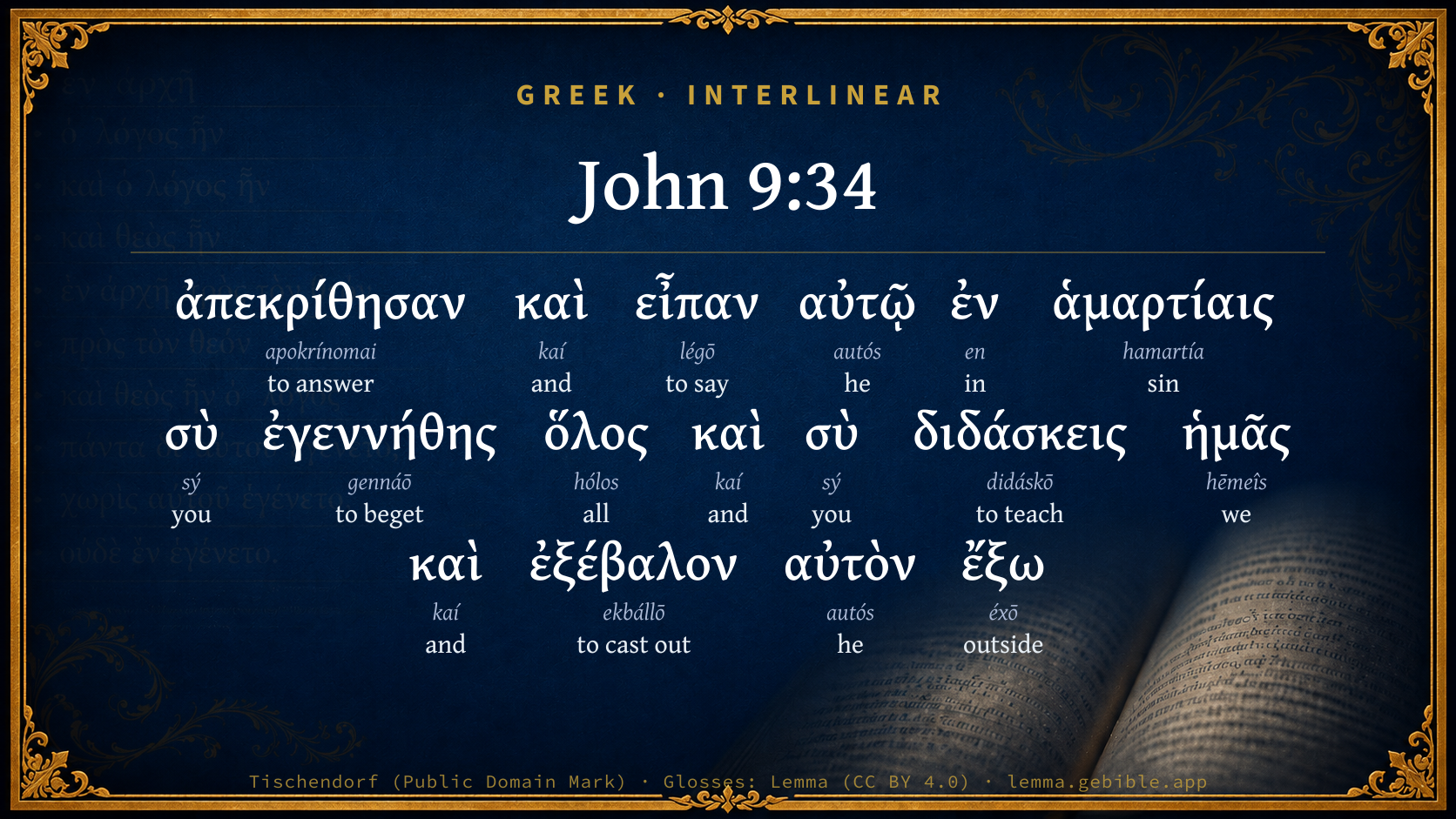
They answered him, "You were altogether born in sins, and do you teach us?" They threw him out.
Download a study sheet
One document with this verse’s original text, its word-by-word gloss line, the meaning frame, cross-references with their text, attributed commentary, and full source and license credits — printable, and it pastes into notes with its structure intact.
This verse Autodidact and up
A passage Seminary Student
Up to 50 verses in one chapter. A passage sheet keeps up to 6 commentary sources and 12 cross-references per verse, in the order this page ranks them, and says so on the sheet whenever that leaves anything out. Ask for a single verse and you get the Autodidact verse sheet above.
Everything on this page stays free to read, with no account — the sheet is a download of what is already on screen, not access to it.
Compare translations 3
The same verse in 3 English versions, stacked beneath the original-language interlinear above. Click any original word for its lexicon entry.
Each is an independent rendering of the whole verse — the interlinear is not word-aligned to these translations.
Highlighted words mark where these versions differ — a whole-verse word diff, not a word-by-word alignment.
-
World English Bible Public Domain
They answered him, "You were altogether born in sins, and do you teach us?" They threw him out.
-
King James Version Public Domain
They answered and said unto him, Thou wast altogether born in sins, and dost thou teach us? And they cast him out.
-
unfoldingWord Literal Text CC BY-SA 4.0
They answered and said to him, “You were completely born in sins, and you are teaching us?” And they put him out.
unfoldingWord Literal Text — © unfoldingWord, licensed CC BY-SA 4.0. Word-aligned USFM3 via Door43 (git.door43.org/unfoldingWord/en_ult).
Show all 19 translations
Every available English version of this verse, each an independent rendering of the whole verse.
-
World English Bible Public Domain
They answered him, "You were altogether born in sins, and do you teach us?" They threw him out.
-
Berean Standard Bible Public Domain
They replied, “You were born in utter sin, and you are instructing us?” And they threw him out.
-
Majority Standard Bible Public Domain
They replied, “You were born in utter sin, and you are instructing us?” And they threw him out.
-
King James Version Public Domain
They answered and said unto him, Thou wast altogether born in sins, and dost thou teach us? And they cast him out.
-
American Standard Version (1901) Public Domain
They answered and said unto him, Thou wast altogether born in sins, and dost thou teach us? And they cast him out.
-
Revised Version (1885) Public Domain
They answered and said unto him, Thou wast altogether born in sins, and dost thou teach us? And they cast him out.
-
Geneva Bible (1599) Public Domain
They answered, and sayd vnto him, Thou art altogether borne in sinnes, and doest thou teach vs? so they cast him out.
-
Douay-Rheims (1899) Public Domain
They answered, and said to him: Thou wast wholly born in sins, and dost thou teach us? And they cast him out.
-
Young's Literal Translation Public Domain
They answered and said to him, `In sins thou wast born altogether, and thou dost teach us!' and they cast him forth without.
-
Literal Standard Version CC BY-SA 4.0
They answered and said to him, “In sins you were born altogether, and you teach us?” And they cast him forth outside.
-
Unlocked Literal Bible CC BY-SA 4.0
They answered and said to him, “You were completely born in sins, and you are teaching us?” Then they threw him out.
-
unfoldingWord Literal Text CC BY-SA 4.0
They answered and said to him, “You were completely born in sins, and you are teaching us?” And they put him out.
-
Darby Bible Public Domain
They answered and said to him, Thou hast been wholly born in sins, and thou teachest us? And they cast him out.
-
World Messianic Bible Public Domain
They answered him, “You were altogether born in sins, and do you teach us?” Then they threw him out.
-
Webster's Bible Public Domain
They answered and said to him, Thou wast altogether born in sins, and dost thou teach us? and they cast him out.
-
Free Bible Version CC BY-SA 4.0
“You were born totally sinful, and yet you're trying to lecture us,” they replied. And they threw him out of the synagogue.
-
Bible in Basic English Public Domain
Their answer was: You came to birth through sin; do you make yourself our teacher? And they put him out of the Synagogue.
-
Text-Critical English NT CC BY 4.0
They answered him, “Yoʋ were born entirely in sin, and yet yoʋ are trying to teach us?” And they threw him out.
-
Tyndale New Testament (1534) Public Domain
They answered and sayd vnto him: thou arte altogeder borne in synne: and dost thou teache vs? And they cast him out.
Literal Standard Version (2020), Covenant Press — licensed CC BY-SA 4.0. Text via the HelloAO Bible API (eBible.org). Unlocked Literal Bible (unfoldingWord) — licensed CC BY-SA 4.0. Text via the HelloAO Bible API (eBible.org). unfoldingWord Literal Text — © unfoldingWord, licensed CC BY-SA 4.0. Word-aligned USFM3 via Door43 (git.door43.org/unfoldingWord/en_ult). Free Bible Version, Dr. Jonathan Gallagher — licensed CC BY-SA 4.0. Text via the HelloAO Bible API (eBible.org).
Word by word
More ways to search: Search by grammar → Find every occurrence → Compare this word →
Practice this passage: Drill this verse → Learn its vocabulary →
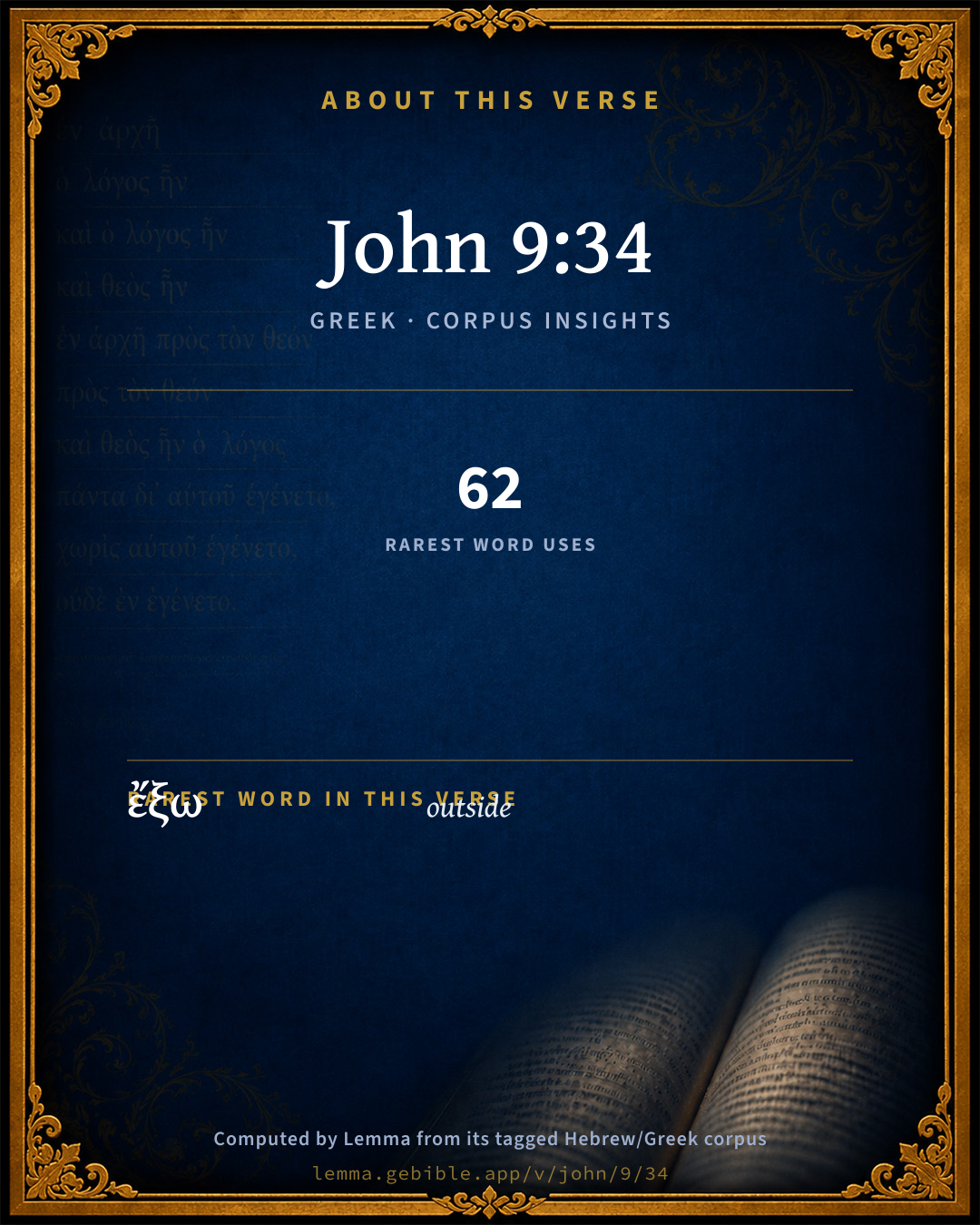
- Appears 62× in the Greek New Testament
- First appears at Matthew 5:13
- Part of Speech
- Adverb
Full Thayer's Definition
- ἀπεκρίθησαν apokrínomai G611 “to answer” Verb, Aorist, Middle deponent, Indicative, 3rd person, Plural
- καὶ kaí G2532 “and” Conjunction
- εἶπαν légō G3004 “to say” Verb, Aorist, Active, Indicative, 3rd person, Plural
- αὐτῷ autós G846 “he” Personal pronoun, Dative, Singular, Masculine
- ἐν en G1722 “in” Preposition
- ἁμαρτίαις hamartía G266 “sin” Noun, Dative, Plural, Feminine
- σὺ sý G4771 “you” Personal pronoun, 2nd person, Nominative, Singular
- ἐγεννήθης gennáō G1080 “to beget” Verb, Aorist, Passive, Indicative, 2nd person, Singular
- ὅλος hólos G3650 “all” Adjective, Nominative, Singular, Masculine
- καὶ kaí G2532 “and” Conjunction
- σὺ sý G4771 “you” Personal pronoun, 2nd person, Nominative, Singular
- διδάσκεις didáskō G1321 “to teach” Verb, Present, Active, Indicative, 2nd person, Singular
- ἡμᾶς hēmeîs G2249 “we” Personal pronoun, 1st person, Accusative, Plural
- καὶ kaí G2532 “and” Conjunction
- ἐξέβαλον ekbállō G1544 “to cast out” Verb, Aorist, Active, Indicative, 3rd person, Plural
- αὐτὸν autós G846 “he” Personal pronoun, Accusative, Singular, Masculine
- ἔξω éxō G1854 “outside” Adverb
About this verse
These counts appear in no published source. They are computed here, from the morphology-tagged text and Lemma’s own curated glosses. What Lemma adds →
- 17
- words
- 13
- distinct lemmas
- Gospels
- section
Cross-references
33Topical passages linked to John 9:34 in the Treasury of Scripture Knowledge — connected by theme and wording, ordered by reader-vote popularity; previews shown in the World English Bible.
- John 9:2 His disciples asked him, "Rabbi, who sinned, this man or his parents, that he was born blind?"
- John 9:22 His parents said these things because they feared the Jews; for the Jews had already agreed that if any man would confess him as Christ, he would be put out of the synagogue.
- Isaiah 66:5 Hear the word of Yahweh, you who tremble at his word: Your brothers who hate you, who cast you out for my name's sake, have said, Let Yahweh be glorified, that we may see your joy; but it is those who shall be disappointed.
- Genesis 19:9 They said, "Stand back!" They said, "This one fellow came in to live as a foreigner, and he appoints himself a judge. Now will we deal worse with you, than with them!" They pressed hard on the man, even Lot, and drew near to break the door.
- Job 25:4 How then can man be just with God? Or how can he who is born of a woman be clean?
- Psalms 51:5 Behold, I was brought forth in iniquity. In sin my mother conceived me.
- Luke 18:17 Most assuredly, I tell you, whoever doesn't receive the Kingdom of God like a little child, he will in no way enter into it."
- Exodus 2:14 He said, "Who made you a prince and a judge over us? Do you plan to kill me, as you killed the Egyptian?" Moses was afraid, and said, "Surely this thing is known."
- 2 Chronicles 25:16 It happened, as he talked with him, that [the king] said to him, Have we made you of the king's counsel? Stop! Why should you be struck down? Then the prophet stopped, and said, I know that God has determined to destroy you, because you have done this, and have not listened to my counsel.
- Job 14:4 Who can bring a clean thing out of an unclean? Not one.
- Job 15:14–16 What is man, that he should be clean? He who is born of a woman, that he should be righteous?
- Proverbs 9:7–8 He who corrects a mocker invites insult. He who reproves a wicked man invites abuse.
- Proverbs 22:10 Drive out the mocker, and strife will go out; Yes, quarrels and insults will stop.
- Proverbs 26:12 Do you see a man wise in his own eyes? There is more hope for a fool than for him.
- Proverbs 29:1 He who is often rebuked and stiffens his neck Will be destroyed suddenly, with no remedy.
- Isaiah 65:5 who say, Stand by yourself, don't come near to me, for I am holier than you. These are a smoke in my nose, a fire that burns all the day.
- Matthew 18:17–18 If he refuses to listen to them, tell it to the assembly. If he refuses to hear the assembly also, let him be to you as a Gentile or a tax collector.
- Luke 6:22 Blessed are you when men shall hate you, and when they shall exclude and mock you, and throw out your name as evil, for the Son of Man's sake.
- Luke 11:45 One of the lawyers answered him, "Teacher, in saying this you insult us also."
- Luke 14:11 For everyone who exalts himself will be humbled, and whoever humbles himself will be exalted."
- Luke 18:10–14 "Two men went up into the temple to pray; one was a Pharisee, and the other was a tax collector.
- John 6:37 All those who the Father gives me will come to me. Him who comes to me I will in no way throw out.
- John 7:48–49 Have any of the rulers believed in him, or of the Pharisees?
- John 8:41 You do the works of your father." They said to him, "We were not born of sexual immorality. We have one Father, God."
- John 9:35 Jesus heard that they had thrown him out, and finding him, he said, "Do you believe in the Son of God?"
- John 9:40 Those of the Pharisees who were with him heard these things, and said to him, "Are we also blind?"
- 1 Corinthians 5:4–5 In the name of our Lord Jesus Christ, you being gathered together, and my spirit, with the power of our Lord Jesus Christ,
- 1 Corinthians 5:13 But those who are outside, God judges. "Put away the wicked man from among yourselves."
- Galatians 2:15 "We, being Jews by nature, and not Gentile sinners,
- Ephesians 2:3 among whom we also all once lived in the lust of our flesh, doing the desires of the flesh and of the mind, and were by nature children of wrath, even as the rest.
- 1 Peter 5:5 Likewise, you younger ones, be subject to the elder. Yes, all of you gird yourselves with humility, to subject yourselves to one another; for "God resists the proud, but gives grace to the humble."
- 3 John 1:9 I wrote to the assembly, but Diotrephes, who loves to be first among them, doesn't accept what we say.
- Revelation 13:17 and that no one would be able to buy or to sell, unless he has that mark, the name of the beast or the number of his name.
Cross-references courtesy of OpenBible.info (CC BY 4.0).
Lesson kit
Teaching starters — assembled from the data on this page, not authored interpretation. Every prompt links to the verse data it draws on. Edit before teaching.
John, in the Gospels, opens this verse with 17 words (13 distinct Greek lemmas). Its most distinctive word is éxō (“outside”). A historical commentator’s framing appears above. Read the whole chapter for the surrounding context.
Discussion questions
- What does “outside” (éxō) contribute to the verse as a whole?
- How does John 9:2, which shares this passage’s theme, read alongside this verse?
- What does the repetition of “and” (3× in this one verse) do in this verse?
- The translations on this page render this verse differently — a whole-verse word diff, not a word-by-word alignment. What might account for the different wordings?
- Compare how Tyndale Open Study Notes and Bengel's Gnomon read this verse. Where do they agree or differ?
Things to notice
- These translations choose different wording for 10 words in this verse.
- “and” occurs 3× in this single verse.
- 13 distinct Greek lemmas span 17 words in this verse.
Commentary
Notes on John 9:34 from classic Christian and Jewish commentators (each source and its license shown beneath its notes). The classic Christian expositions comment on the surrounding passage and are grouped to its opening verse, so a note may address several verses; the Jewish commentaries on the Tanakh (Rashi and others) are per-verse, so they appear only where the commentator wrote on this verse.
Lemma curates 59 commentaries, every one of them public domain or Creative Commons licensed, each selected and text-cleaned for this edition rather than reprinted as found. About our sources →
Tyndale Open Study Notes
Tyndale Open Resources
Tyndale Open Study Notes — © Tyndale Open Resources, licensed CC BY-SA 4.0. Text via the HelloAO Bible API.
Bengel's Gnomon
Johann Albrecht Bengel
Bengel's Gnomon of the New Testament — English translation (T&T Clark, Edinburgh, 1860) — public domain. Text from a community e-Sword module.
Meyer's Critical & Exegetical Commentary
Heinrich August Wilhelm Meyer
Meyer — Critical and Exegetical Commentary on the New Testament — English translation by Peter Christie, edited by Frederick Crombie (T&T Clark, 1880) — public domain. Text from a community e-Sword module.
Expositor's Greek Testament
ed. W. Robertson Nicoll
The Expositor's Greek Testament, edited by W. Robertson Nicoll (1897–1910) — public domain. Text from a community e-Sword module.
Geneva Bible (1599)
Geneva Bible translators
Geneva Bible (1599) marginal notes — public domain. Text via Bolls.life.
Adam Clarke's Commentary
Adam Clarke's Commentary on the Bible (1810–1826) — public domain. Text from a community e-Sword/MySword module.
John Calvin's Commentaries
John Calvin's Commentaries (1540-1563) — public domain. Text from the Calvin Translation Society English edition (1840s-50s) via the Christian Classics Ethereal Library (ccel.org). Calvin's coverage is partial (roughly two-thirds of the Bible); uncommented books and verses are honest gaps, never fabricated. The 19th-century editor's footnotes and remarks are omitted so the notes are faithfully Calvin's own voice.
Ellicott's Commentary for English Readers
A Bible Commentary for English Readers, edited by Charles John Ellicott (1878–1897) — public domain. Text from a community e-Sword module.
The Cambridge Bible for Schools and Colleges
gen. ed. J. J. S. Perowne
The Cambridge Bible for Schools and Colleges (gen. ed. J. J. S. Perowne; Cambridge University Press, 1878–1918) — public domain. Text from a community e-Sword module.
John Gill's Exposition
John Gill's Exposition of the Whole Bible (1746–1763) — public domain (CC PDM 1.0). Text via the HelloAO Bible API.
Trapp's Complete Commentary
John Trapp
John Trapp, A Commentary or Exposition upon All the Books of the Old and New Testament (1647–1656) — public domain. Text from a community e-Sword module.
Albert Barnes' Notes on the Bible
Albert Barnes' Notes on the Bible (1834–1885) — public domain. Text from a community e-Sword/MySword module.
Matthew Poole's English Annotations
Matthew Poole's English Annotations on the Holy Bible (1683–1685) — public domain. Text from a community e-Sword/MySword module.
Whedon's Commentary on the Bible
Daniel D. Whedon
Daniel D. Whedon (gen. ed.), Commentary on the Old and New Testaments (1874–1909) — public domain. Text from a community e-Sword module.
The Pulpit Commentary
The Pulpit Commentary (1880–1919), ed. H.D.M. Spence-Jones & Joseph S. Exell — public domain. Text from a community e-Sword module.
John Wesley's Explanatory Notes
John Wesley, Explanatory Notes Upon the Whole Bible (1754–1765) — public domain. Text via the GEBible commentary corpus.
Kretzmann's Popular Commentary
Paul E. Kretzmann
Paul E. Kretzmann, Popular Commentary of the Bible (1921–1924) — public domain. Text from a community e-Sword module.
Burkitt's Expository Notes on the New Testament
William Burkitt
William Burkitt's Expository Notes on the New Testament (1700–1703) — public domain. Text from a community e-Sword module.
The People's New Testament
B. W. Johnson
B. W. Johnson's The People's New Testament with Notes (1889–1891) — public domain. Electronic text from the Christian Classics Ethereal Library (CCEL) ThML edition.
Cambridge Greek Testament for Schools and Colleges
Cambridge Greek Testament for Schools and Colleges (Cambridge University Press, 1896; 21 vols, various authors incl. Carr, Maclear, Plummer, Farrar, Lumby, Moule, M. R. James, Simcox) — public domain. Text from a community e-Sword module.
Alford’s Greek Testament
Henry Alford
Henry Alford, The Greek Testament (1849–1861) — public domain. Text from a community e-Sword module.
International Critical Commentary
International Critical Commentary — older volumes (1896–1929), various authors — public domain. Text from a community e-Sword module.
Vincent's Word Studies in the New Testament
Marvin R. Vincent
Marvin R. Vincent, Word Studies in the New Testament (1887–1900) — public domain. Text from a community e-Sword/MySword module.