
Luke 13:15

Greek (Tischendorf 8th ed.) Luke 13:15 appears in the Greek New Testament. The text above is from the Tischendorf 8th edition. Each word links to its Strong’s number and a concise gloss. Click any word for its full Thayer’s Greek Lexicon entry.
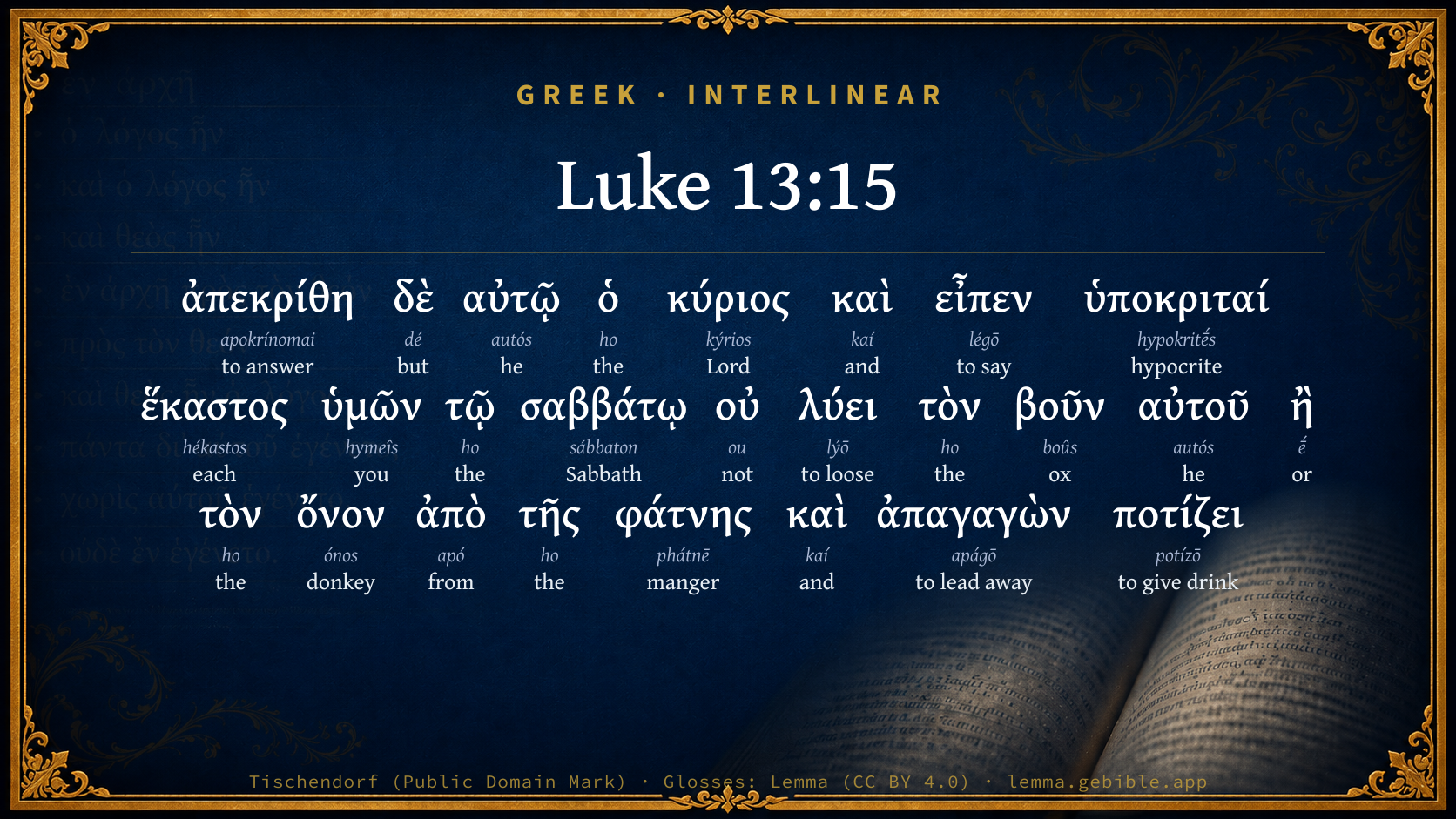
Download image
Cite this verse

Luke 13:15 (World English Bible). Public Domain. Lemma interlinear Bible study tool, https://lemma.gebible.app/v/luke/13/15.

Show BibTeX & RIS
BibTeX
RIS
English Translation
Therefore the Lord answered him, "You hypocrites! Doesn't each one of you free his ox or his donkey from the stall on the Sabbath, and lead him away to water?
World English Bible · Public Domain
Highlights
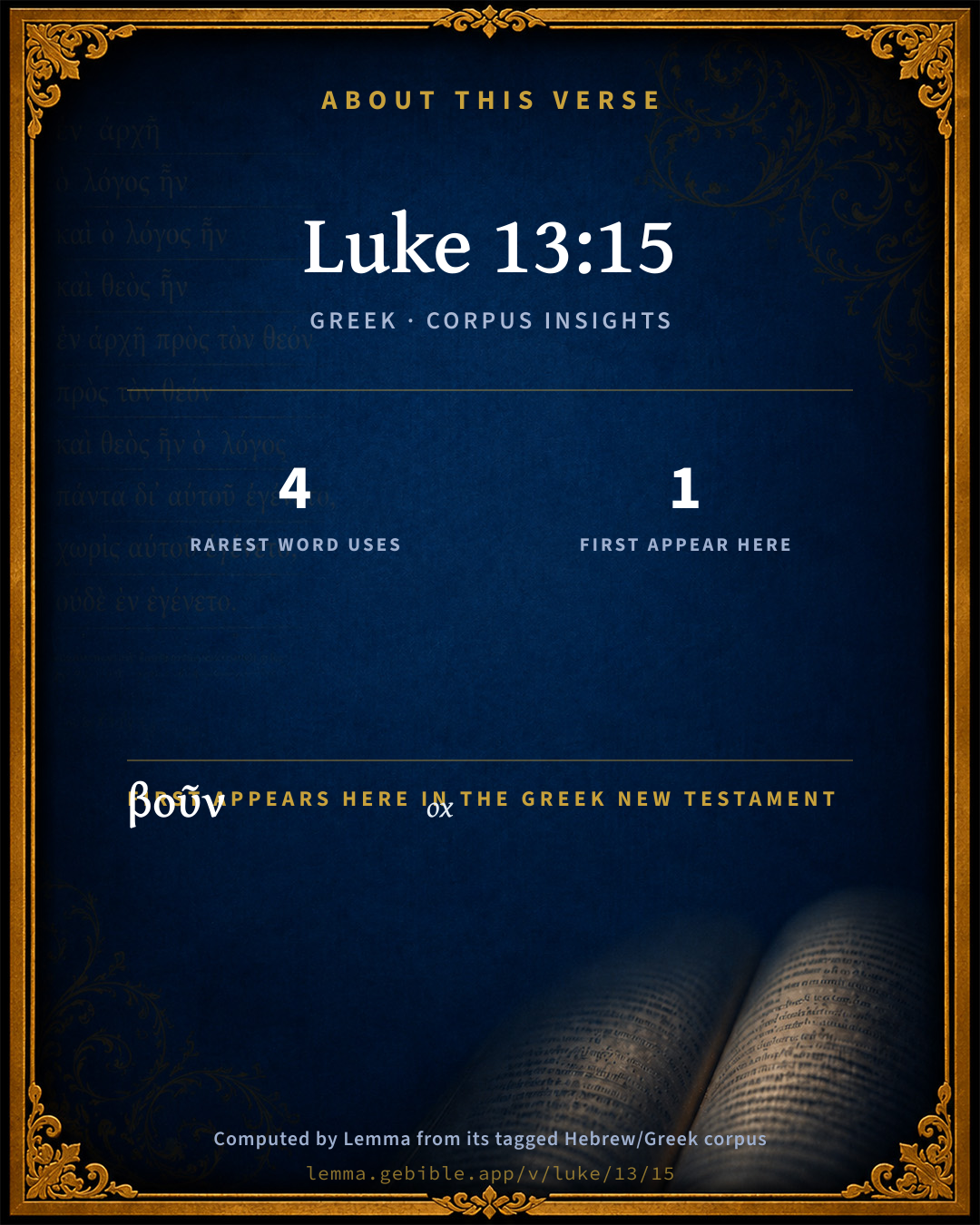
  • 1 first appearance in the Greek New Testament
Full analysis ↓
Download a study sheet

One document with this verse’s original text, its word-by-word gloss line, the meaning frame, cross-references with their text, attributed commentary, and full source and license credits — printable, and it pastes into notes with its structure intact.

This verse Autodidact and up

Study sheet (.html) Plain text (.txt)

A passage Seminary Student

Up to 50 verses in one chapter. A passage sheet keeps up to 6 commentary sources and 12 cross-references per verse, in the order this page ranks them, and says so on the sheet whenever that leaves anything out. Ask for a single verse and you get the Autodidact verse sheet above.

Everything on this page stays free to read, with no account — the sheet is a download of what is already on screen, not access to it.

Want to remove ads? Support Godless Engineer
Compare translations 3

The same verse in 3 English versions, stacked beneath the original-language interlinear above. Click any original word for its lexicon entry.

Each is an independent rendering of the whole verse — the interlinear is not word-aligned to these translations.

Highlighted words mark where these versions differ — a whole-verse word diff, not a word-by-word alignment.

  • World English Bible Public Domain
    Therefore the Lord answered him, "You hypocrites! Doesn't each one of you free his ox or his donkey from the stall on the Sabbath, and lead him away to water?
  • King James Version Public Domain
    The Lord then answered him, and said, Thou hypocrite, doth not each one of you on the sabbath loose his ox or his ass from the stall, and lead him away to watering?
  • unfoldingWord Literal Text CC BY-SA 4.0
    But the Lord answered him and said, “Hypocrites! Does not each of you on the Sabbath untie his ox or donkey from the stall and lead it away to drink?

unfoldingWord Literal Text — © unfoldingWord, licensed CC BY-SA 4.0. Word-aligned USFM3 via Door43 (git.door43.org/unfoldingWord/en_ult).

Versions to compare (up to 4)

3 of 4 selected

Show all 19 translations

Every available English version of this verse, each an independent rendering of the whole verse.

  • World English Bible Public Domain
    Therefore the Lord answered him, "You hypocrites! Doesn't each one of you free his ox or his donkey from the stall on the Sabbath, and lead him away to water?
  • Berean Standard Bible Public Domain
    “You hypocrites!” the Lord replied. “Does not each of you on the Sabbath untie his ox or donkey from the stall and lead it to water?
  • Majority Standard Bible Public Domain
    “You hypocrites!” the Lord replied. “Does not each of you on the Sabbath untie his ox or donkey from the stall and lead it to water?
  • King James Version Public Domain
    The Lord then answered him, and said, Thou hypocrite, doth not each one of you on the sabbath loose his ox or his ass from the stall, and lead him away to watering?
  • American Standard Version (1901) Public Domain
    But the Lord answered him, and said, Ye hypocrites, doth not each one of you on the sabbath loose his ox or his ass from the stall, and lead him away to watering?
  • Revised Version (1885) Public Domain
    But the Lord answered him, and said, Ye hypocrites, doth not each one of you on the sabbath loose his ox or his ass from the stall, and lead him away to watering?
  • Geneva Bible (1599) Public Domain
    Then answered him the Lord, and said, Hypocrite, doth not eche one of you on the Sabbath day loose his oxe or his asse from the stall, and leade him away to the water?
  • Douay-Rheims (1899) Public Domain
    And the Lord answering him, said: Ye hypocrites, doth not every one of you, on the sabbath day, loose his ox or his ass from the manger, and lead them to water
  • Young's Literal Translation Public Domain
    Then the Lord answered him and said, `Hypocrite, doth not each of you on the sabbath loose his ox or ass from the stall, and having led away, doth water `it'?
  • Literal Standard Version CC BY-SA 4.0
    Then the LORD answered him and said, “Hypocrite, do not each of you loose his ox or donkey from the stall on the Sabbath, and having led [it] away, water [it]?
  • Unlocked Literal Bible CC BY-SA 4.0
    The Lord answered him and said, “Hypocrites! Does not each of you untie his ox or his donkey from the stall and lead it to drink on the Sabbath?
  • unfoldingWord Literal Text CC BY-SA 4.0
    But the Lord answered him and said, “Hypocrites! Does not each of you on the Sabbath untie his ox or donkey from the stall and lead it away to drink?
  • Darby Bible Public Domain
    The Lord therefore answered him and said, Hypocrites! does not each one of you on the sabbath loose his ox or his ass from the manger and leading [it] away, water [it]?
  • World Messianic Bible Public Domain
    Therefore the Lord answered him, “You hypocrites! Doesn’t each one of you free his ox or his donkey from the stall on the Sabbath and lead him away to water?
  • Webster's Bible Public Domain
    The Lord then answered him, and said, Thou hypocrite, doth not each one of you on the sabbath loose his ox or his ass from the stall, and lead him away to watering?
  • Free Bible Version CC BY-SA 4.0
    But the Lord answered him, “You hypocrites! Doesn't every one of you untie your ox or donkey from the stall and take it to drink?
  • Bible in Basic English Public Domain
    But the Lord gave him an answer and said, O you false men! do you not, every one of you, on the Sabbath, let loose his ox and his ass and take it to the water?
  • Text-Critical English NT CC BY 4.0
    Then the Lord said to him in response, “ Hypocrites! Do not each of you on the Sabbath untie yoʋr ox or donkey from the manger, lead it away, and give it water?
  • Tyndale New Testament (1534) Public Domain
    Then answered him the Lorde and sayd: Ypocrite doth not eache one of you on the saboth daye lowse his oxe or his asse from the stall and leade him to the water?

Literal Standard Version (2020), Covenant Press — licensed CC BY-SA 4.0. Text via the HelloAO Bible API (eBible.org). Unlocked Literal Bible (unfoldingWord) — licensed CC BY-SA 4.0. Text via the HelloAO Bible API (eBible.org). unfoldingWord Literal Text — © unfoldingWord, licensed CC BY-SA 4.0. Word-aligned USFM3 via Door43 (git.door43.org/unfoldingWord/en_ult). Free Bible Version, Dr. Jonathan Gallagher — licensed CC BY-SA 4.0. Text via the HelloAO Bible API (eBible.org).

Word by word

More ways to search: Search by grammar → Find every occurrence → Compare this word →

Practice this passage: Drill this verse → Learn its vocabulary →

φάτνης
phátnē
G5336
“manger”
Noun, Genitive, Singular, Feminine
Part of Speech
Noun
Case
Genitive
Number
Singular
Gender
Feminine
Full Thayer's Definition

Origin: from pateomai (to eat)

TDNT: 09:49,1

1. a crib, a manger
  1. ἀπεκρίθη apokrínomai G611 “to answer” Verb, Aorist, Middle deponent, Indicative, 3rd person, Singular
  2. δὲ dé G1161 “but” Conjunction
  3. αὐτῷ autós G846 “he” Personal pronoun, Dative, Singular, Masculine
  4. ὁ ho G3588 “the” Article, Nominative, Singular, Masculine
  5. κύριος kýrios G2962 “Lord” Noun, Nominative, Singular, Masculine
  6. καὶ kaí G2532 “and” Conjunction
  7. εἶπεν légō G3004 “to say” Verb, Aorist, Active, Indicative, 3rd person, Singular
  8. ὑποκριταί hypokritḗs G5273 “hypocrite” Noun, Vocative, Plural, Masculine
  9. ἕκαστος hékastos G1538 “each” Adjective, Nominative, Singular, Masculine
  10. ὑμῶν hymeîs G5210 “you” Personal pronoun, 2nd person, Genitive, Plural
  11. τῷ ho G3588 “the” Article, Dative, Singular, Neuter
  12. σαββάτῳ sábbaton G4521 “Sabbath” Noun, Dative, Singular, Neuter
  13. οὐ ou G3756 “not” Particle, Negative
  14. λύει lýō G3089 “to loose” Verb, Present, Active, Indicative, 3rd person, Singular
  15. τὸν ho G3588 “the” Article, Accusative, Singular, Masculine
  16. βοῦν boûs G1016 “ox” Noun, Accusative, Singular, Masculine
  17. αὐτοῦ autós G846 “he” Personal pronoun, Genitive, Singular, Masculine
  18. ἢ ḗ G2228 “or” Particle
  19. τὸν ho G3588 “the” Article, Accusative, Singular, Masculine
  20. ὄνον ónos G3688 “donkey” Noun, Accusative, Singular, Masculine
  21. ἀπὸ apó G575 “from” Preposition
  22. τῆς ho G3588 “the” Article, Genitive, Singular, Feminine
  23. καὶ kaí G2532 “and” Conjunction
  24. ἀπαγαγὼν apágō G520 “to lead away” Verb, Present, Active, Participle, Nominative, Singular, Masculine
  25. ποτίζει potízō G4222 “to give drink” Verb, Present, Active, Indicative, 3rd person, Singular

About this verse

These counts appear in no published source. They are computed here, from the morphology-tagged text and Lemma’s own curated glosses. What Lemma adds →

26
words
20
distinct lemmas
Gospels
section

Notable vocabulary

The rarest word here is φάτνης manger G5336 — appearing just 4 times in the whole Greek New Testament.

First appearance in Scripture

This word makes its first canonical appearance in the Greek New Testament here:

Shared distinctive vocabulary

φάτνης manger G5336 occurs in 4 verses of the Greek New Testament. Also found in:
Repetition

Words recur within this verse:

Cross-references

14

Topical passages linked to Luke 13:15 in the Treasury of Scripture Knowledge — connected by theme and wording, ordered by reader-vote popularity; previews shown in the World English Bible.

  • Luke 14:5 He answered them, "Which of you, if your son or an ox fell into a well, wouldn't immediately pull him out on a Sabbath day?"
  • John 7:21–24 Jesus answered them, "I did one work, and you all marvel because of it.
  • Luke 6:42 Or how can you tell your brother, 'Brother, let me remove the speck of chaff that is in your eye,' when you yourself don't see the beam that is in your own eye? You hypocrite! First remove the beam from your own eye, and then you can see clearly to remove the speck of chaff that is in your brother's eye.
  • Acts 13:9–10 But Saul, who is also called Paul, filled with the Holy Spirit, fastened his eyes on him,
  • Job 34:30 That the godless man may not reign, That there be no one to ensnare the people.
  • Isaiah 29:20 For the terrible one is brought to nothing, and the scoffer ceases, and all those who watch for iniquity are cut off;
  • Matthew 7:5 You hypocrite! First remove the beam out of your own eye, and then you can see clearly to remove the speck out of your brother's eye.
  • Matthew 15:7 You hypocrites! Well did Isaiah prophesy of you, saying,
  • Matthew 15:14 Leave them alone. They are blind guides of the blind. If the blind guide the blind, both will fall into a pit."
  • Matthew 23:13 "Woe to you, scribes and Pharisees, hypocrites! For you devour widows' houses, and as a pretense you make long prayers. Therefore you will receive greater condemnation.
  • Matthew 23:28 Even so you also outwardly appear righteous to men, but inwardly you are full of hypocrisy and iniquity.
  • Luke 12:1 Meanwhile, when a multitude of many thousands had gathered together, so much so that they trampled on each other, he began to tell his disciples first of all, "Beware of the yeast of the Pharisees, which is hypocrisy.
  • Acts 8:20–23 But Peter said to him, "May your silver perish with you, because you thought you could obtain the gift of God with money!
  • Proverbs 11:9 With his mouth the godless man destroys his neighbor, But the righteous will be delivered through knowledge.

Cross-references courtesy of OpenBible.info (CC BY 4.0).

Commentary

Notes on Luke 13:15 from classic Christian and Jewish commentators (each source and its license shown beneath its notes). The classic Christian expositions comment on the surrounding passage and are grouped to its opening verse, so a note may address several verses; the Jewish commentaries on the Tanakh (Rashi and others) are per-verse, so they appear only where the commentator wrote on this verse.

Lemma curates 59 commentaries, every one of them public domain or Creative Commons licensed, each selected and text-cleaned for this edition rather than reprinted as found. About our sources →

Tyndale Open Study Notes

Tyndale Open Resources

13:15-16 You hypocrites! The religious leaders would take care of their own animals on the Sabbath (to protect their investment) but then refuse to meet the needs of a fellow human being. In an ironic wordplay, the same word is translated untie (13:15) and released (13:16). The religious leaders would free their animals but not a daughter of Abraham—one of God’s chosen people and a recipient of his favor. • in bondage by Satan: Jesus’ exorcisms and healings manifested the Kingdom of God and the defeat of Satan (see 11:20).

Tyndale Open Study Notes — © Tyndale Open Resources, licensed CC BY-SA 4.0. Text via the HelloAO Bible API.

Bengel's Gnomon

Johann Albrecht Bengel

Luk 13:15. Ὑποκριταὶ, ye hypocrites) The plural is used, including more persons, but addressed to one person; comp. Luk 13:17 [where all His adversaries are included]: as also in Luk 11:46, compared with Luk 11:45. There was some degree of reverence felt on the part of the ruler of the synagogue towards Jesus; and it was not owing to any peculiar prejudice of his own, but owing to the common error of the Jews on the subject, that he was led to oppose the Saviour.[130]—λύει, doth loose) A most apt illustration. Comp. λυθῆναι, to be loosed, applied to the woman in Luk 13:16.—ἀπαγαγὼν, having led away) Words are heaped together in order to show the amount of work [comp. ἐργάζεσθαι, Luk 13:14, in the complaint of the ruler] done on the Sabbath in such a case.

[130] However the Vers. Germ., following the margin of the 2d Ed., prefers the singular number in this passage.—E. B. Ὑποκριταὶ is the reading of ABabc Vulg. Iren. 236. Ὑποκριτὰ of the Rec. Text is only supported by D of the primary authorities.—ED. and TRANSL.

Bengel's Gnomon of the New Testament — English translation (T&T Clark, Edinburgh, 1860) — public domain. Text from a community e-Sword module.

Expositor's Greek Testament

ed. W. Robertson Nicoll

Luk 13:15 . ὑποκριταί : plural less personal than the singular (T.R.), yet severe enough, though directed against the class. The case put was doubtless according to the prevailing custom, and so stated as to make the work done prominent ( λύει , looses, that one bit of work: ἀπάγων , leading the animal loosed to the water, that another, vide Bengel). ποτίζει , gives him drink, at least to the extent of drawing water from the well, if not of carrying it to the animal’s mouth (the former allowed, the latter disallowed in the Talmud, vide Lightfoot and Wünsche).

The Expositor's Greek Testament, edited by W. Robertson Nicoll (1897–1910) — public domain. Text from a community e-Sword module.

Jamieson, Fausset & Brown

Robert Jamieson, A. R. Fausset & David Brown

the Lord--(See on Luk 10:1).

hypocrite!--How "the faithful and true Witness" tears off the masks which men wear!

his ox, &c.--(See on Mat 12:9-13; and Luk 6:9).

Jamieson, Fausset & Brown — Commentary Critical and Explanatory on the Whole Bible (1871) — public domain (CC PDM 1.0). Text via the HelloAO Bible API.

Ellicott's Commentary for English Readers

(15, 16) Doth not each one of you . . .?—The principle is the same as that in Mat_12:11 (where see Note), but the case is put in even a stronger form. There the illustration is drawn from what might seem an exceptional act for an exceptional emergency; here from the regular practice of men, where their own interests were concerned. If they pleaded that it was not for their own interests, but those of humanity to the brutes committed to their charge, the answer was obvious that the daughter of Abraham was “better” than the ox or ass.

A Bible Commentary for English Readers, edited by Charles John Ellicott (1878–1897) — public domain. Text from a community e-Sword module.

The Cambridge Bible for Schools and Colleges

gen. ed. J. J. S. Perowne

15. Thou hypocrite] Rather (with the best uncials), Hypocrites!

(א, A, B), classing the man with the whole sect to which he belonged, and whose shibboleths he used. They were hypocrites (i.e. they were acting a part) because they were disguising secret enmity under a pretence of sabbatical zeal.

on the sabbath loose his ox] Our Lord varied from time to time the arguments with which He abolished the fanatical formalism of the Pharisees respecting the Sabbath. Sometimes He appealed to His own inherent authority (Joh_5:17-47); sometimes to Scripture precedents (Luk_6:3-5); or to common sense and eternal principles (Luk_6:9). Here, as in Luk_14:5, He uses an argumentum ad hominem, refuting their traditional rules by the selfish insincerity with which they applied them. They allowed men to unloose and lead to water their cattle on the sabbath, and thus to break their own Sabbatic rules to save themselves the trouble of providing water overnight, or, at the best, to abridge a few hours’ thirst; was then this suffering woman not to be touched, not to be spoken to, to end 18 years of suffering?

The Cambridge Bible for Schools and Colleges (gen. ed. J. J. S. Perowne; Cambridge University Press, 1878–1918) — public domain. Text from a community e-Sword module.

John Gill's Exposition

The Lord then answered him and said,.... Though he did not direct his speech to him, he knew that he struck at him, and suggested that he was a violator of the sabbath, as well as the people: and therefore in defence of himself, and of what he had done, and to expose the hypocrisy of this man, made answer as follows,

thou hypocrite; the Vulgate Latin, Arabic, and Ethiopic versions read in the plural, "hypocrites"; as do the Complutensian edition, and four ancient copies of Beza's, and the Alexandrian copy; but the Syriac and Persic versions read in the singular, "hypocrite"; as this man was, who covered his malice and envy at Christ, with a show of zeal for the sabbath day; and yet did that upon it, which must be allowed by themselves, and others, to be a much greater violation of the sabbath, than this cure could ever be thought to be:

doth not each one of you, on the sabbath day, loose his ox, or his ass, from the stall, or rack, where he is fastened with a rope;

and lead him away to watering? to some place of water, where he may drink, after having filled himself at the rack: and that this was agreeably to their own canons and practice, that beasts may be led out on a sabbath day, is certain; for they deliver various rules concerning leading them out, with what they might, and with what they might not be brought out; and particularly, among others, mention asses and heifers (q); and they speak (r) of leading them to water, not only to drink of it, but to wash their chains in it, which, it seems, received pollution, and needed washing, and might be done on a sabbath day; yea, they allow, that not only a beast may be led out to watering, but a man might fill a vessel of water, and pour it out into a trough for it, provided he did not directly set it before it: the rule is this (s).

"a man may not fill water (a vessel of it), and put it on a sabbath day before his beast, but he may fill it, and pour it out, and it may drink of it.''

And particularly on a feast day, their rule is (t), that

"they do not water nor slay beasts of the desert, but they water and slay domestic ones. Domestic ones are such as lie in the city (i.e. as Maimonides says (u), within the sabbatical border, 2000 cubits from the city), and those of the desert are such as lie in pastures.''

And therefore very justly does our Lord observe to the ruler of the synagogue their own practices towards a beast, in defence of his works of mercy to men.

(q) Misn. Sahbat, c. 5. sect. 1, 2, 3, 4. & 18. 2. T. Bab. Sabbat, fol. 51. 2. & Piske Tosephot in ib. art. 226, 227, 228, 233. (r) Bartenora in Misn. Sabbat, c. 5. sect. 1. (s) T. Bab. Erubin, fol. 20. 2. (t) Misn. Betza, c. 5. sect. 7. (u) In ib.

John Gill's Exposition of the Whole Bible (1746–1763) — public domain (CC PDM 1.0). Text via the HelloAO Bible API.

Trapp's Complete Commentary

John Trapp

15 The Lord then answered him, and said, Thou hypocrite, doth not each one of you on the sabbath loose his ox or his ass from the stall, and lead him away to watering?

Ver. 15. Thou hypocrite] The Syriac rendereth it Assumens vultum, thou that settest a good face upon it, thou that impersonate a better man than thou art; thou picture of piety, &c.

John Trapp, A Commentary or Exposition upon All the Books of the Old and New Testament (1647–1656) — public domain. Text from a community e-Sword module.

Albert Barnes' Notes on the Bible

Thou hypocrite! - You condemn “me” for an action, and yet you perform one exactly similar. You condemn “me” for doing to a woman what you do to a beast. To her I have done good on the Sabbath; you provide for your cattle, and yet blame me for working a miracle to relieve a sufferer on that day.

Stall - A place where cattle are kept to be fed, and sheltered from the weather.

Albert Barnes' Notes on the Bible (1834–1885) — public domain. Text from a community e-Sword/MySword module.

Matthew Poole's English Annotations

Our Saviour here calleth this ruler of the synagogue hypocrite, for his impudence in so severe a reflection on him for doing on the sabbath day a work of that nature which he himself did, and thought himself blameless in the doing of, and his friends ordinarily did, upon whom for so working he did not reflect, thereby teaching us one note of a hypocrite, viz. to reflect upon others for things which we do ourselves. This ruler of the synagogue aud his party indeed did not heal on the sabbath day. But what kind of work was healing? Was it not a work of mercy? What servile labour was there in it? It is only said Christ called this poor creature, and she came, not she was brought to him. What did Christ do? He only laid his hands upon her, and pronounced her loosed from her infirmity. Now the Jews would ordinarily upon the sabbath day loose a beast from the stall to go and drink at a pit, or lead it thither; was not this a greater labour? How came this to be lawful, and not that act of mercy which Christ did show to this poor creature? Their act was capable of no other excuse, than that it was an act of mercy, and a good man will show mercy to his beast: it could be no act of piety, nor of necessity; for a beast may live one day without water, or at least might have had water set by it the night before. Nay, our Lord’s work of mercy was much more noble. Theirs was to a beast; his to one of mankind, to a woman, and she a Jewish woman, a daughter of Abraham, a father upon whom they much valued themselves, and their whole nation, Mat 3:9; Joh 8:39. Their beast might not be sick; she was under an infirmity, and that no ordinary infirmity, she was in the hands of the enemy of mankind, bound by Satan; nor was her affliction of a few days’ continuance, she had been so bound eighteen years.

Matthew Poole's English Annotations on the Holy Bible (1683–1685) — public domain. Text from a community e-Sword/MySword module.

Whedon's Commentary on the Bible

Daniel D. Whedon

15. Hypocrite—He belongs to that class whom Jesus has stamped with that terrible name. This man might well have withered, had he known and felt the awfulness of that epithet, pronounced from such lips. It is applied to this man as his share of the name, as applied by our Lord to the whole class of his teachers and masters. Early in his ministry our Lord gave out that there was such a standing class. See Mat_6:2; Mat_6:5; Mat_6:16. Later he began to tell who and which they generally were, (Luk_15:7; Luk_16:3; Luk_22:18.) Later to denounce woes upon them, (Luk_23:14-15,) and finally to assign them their portion, (Luk_24:51.) This cavilling at healing on the Sabbath day was one of the stereotype tests of the hypocrite. See note on Mat_12:1-9.

Daniel D. Whedon (gen. ed.), Commentary on the Old and New Testaments (1874–1909) — public domain. Text from a community e-Sword module.

The Pulpit Commentary

The Lord then answered him, and said, Thou hypocrite, doth not each one of you on the sabbath loose his ox or his ass from the stall, and lead him away to watering? The older authorities here read "hypocrites," and thus join the cavilling synagogue ruler with the whole sect of men who taught an elaborate ritual in place of a high, pure life. The Lord, in a few master-touches, exposes the hollowness of such sabbath-keeping. Every possible indulgence was to be shown in cases where their own interests were involved; no mercy or indulgence was to be thought of, though, where the sick poor only were concerned. He vividly draws a contrast between the animal and the human being. The ox and the ass, though, were personal property; the afflicted daughter of Abraham was but a woman, friendless and poor.

The Pulpit Commentary (1880–1919), ed. H.D.M. Spence-Jones & Joseph S. Exell — public domain. Text from a community e-Sword module.

John Wesley's Explanatory Notes

Thou hypocrite - For the real motive of his speaking was envy, not (as he pretended) pure zeal for the glory of God.

John Wesley, Explanatory Notes Upon the Whole Bible (1754–1765) — public domain. Text via the GEBible commentary corpus.

unfoldingWord translationNotes

Door43 World Missions Community

The Lord answered him

"The Lord responded to the synagogue ruler"

Hypocrites

Jesus speaks directly to the synagogue ruler, but the plural form includes the other religious rulers also. This can be stated explicitly. AT: "You and your fellow religious leaders are hypocrites" (See: Assumed Knowledge and Implicit Information)

Does not each of you untie his ox or his donkey from the stall and lead it to drink on the Sabbath?

Jesus uses a question to get them to think about something they already knew. AT: "Every one of you unties his ox or his donkey from the stall and leads it to drink on the Sabbath." (See: Rhetorical Question)

ox ... donkey

These are animals that people care for by giving them water.

on the Sabbath

"on a Sabbath." Some languages would say "a Sabbath" because we do not know which particular Sabbath day it was.

daughter of Abraham

This is an idiom that means, "descendant of Abraham" (See: Idiom)

whom Satan bound

Jesus compares people tying animals to the way Satan restricted the woman with this disease. AT: "whom Satan kept crippled by her illness" or "whom Satan bound with this disease" (See: Metaphor)

eighteen long years

"18 long years." The word "long" here emphasizes that eighteen years was a very long time for the woman to suffer. Other languages may have other ways of emphasizing this. (See: Numbers)

should her bonds not be untied ... day?

Jesus uses a question to tell the synagogue rulers that they are wrong. Jesus speaks about the women's disease as if it were ropes that bound her. This can be translated as an active statement. AT: "it is right to release her from the bonds of this illness ... day." (See: Rhetorical Question and Active or Passive)

translationWords

lord

hypocrite

donkey

cow

Sabbath

Abraham

Satan

bind

unfoldingWord translationNotes — © Distant Shores Media and the Door43 World Missions Community, licensed CC BY-SA 4.0. Source: git.door43.org/Door43/en_tn.

Cambridge Greek Testament for Schools and Colleges

15. ὑποκριταί. The address is in the plural, not only to the ruler of the synagogue but to all his class.

15. ὑποκριταί. ‘Hypocrites!’ (אAB), classing the man with the whole sect to which he belonged, and whose shibboleths he used. They were hypocrites (i.e. they were acting a part) because they were disguising secret enmity under a pretence of sabbatical zeal.

τῷ σαββάτῳ … λύει τὸν βοῦν. Our Lord varied from time to time the arguments with which He abolished the fanatical formalism of the Pharisees respecting the Sabbath. Sometimes He appealed to His own inherent authority (Joh 5:17-47); sometimes to Scripture precedents (Luk 6:3-5); or to common sense and eternal principles (Luk 6:9). Here, as in Luk 14:5, He uses an argumentum ad hominem, refuting their traditional rules by the selfish insincerity with which they applied them. They allowed men to unloose and lead to water their cattle on the sabbath, and thus to break their own Sabbatic rules, in order to save themselves the trouble of providing water overnight, or, at the best, to abridge a few hours’ thirst; was then this suffering woman not to be touched, not to be spoken to, even in order to end 18 years of suffering?

ἀπὸ τῆς φάτνης. ‘From the manger,’ Luk 2:7.

ἀπαγαγών. The pictorial participle—“ad opus demonstrandum.” Bengel.

Cambridge Greek Testament for Schools and Colleges (Cambridge University Press, 1896; 21 vols, various authors incl. Carr, Maclear, Plummer, Farrar, Lumby, Moule, M. R. James, Simcox) — public domain. Text from a community e-Sword module.

Alford’s Greek Testament

Henry Alford

15. ὑποκριταί] The Lord saw the real thoughts of his heart, that they were false, and inconsistent with his pretended zeal, and addressed the multitude as represented by him, their leader. A man hardly could give forth a doctrine so at variance with common sense and common practice, without some by-end, with which he covered his violation of truth. That by-end here was enmity to and jealousy of Jesus.

The instance chosen exactly fits the circumstances. A beast tied to the manger is confined down as this poor woman was.

Henry Alford, The Greek Testament (1849–1861) — public domain. Text from a community e-Sword module.

International Critical Commentary

15. Ὑποκριται. All who sympathize with this faultfinder are addressed, especially of οἱ ἀντικείμενοι αὐτῷ (ver. 17). There was hypocrisy in pretending to rebuke the people, when he was really censuring Jesus; and in professing to have a zeal for the Law, when his motive was animus against the Healer. There was no evidence that people had come in order to be healed. And, if they had done so, would they have broken the Law? Cyril has a very animated attack on this man, whom he addresses as βασκαίας ἀνοδράποδον, rebuking him for not seeing that Jesus had not broken even the letter of the Law in keeping its spirit (Migne, vol. lxxii.770; Payne Smith, p. 454). See also Iren. iv. 8, 2. For ὁ Κύριος see on 5:17 and 7:13.

The sing. ὑποκριτά (D U X and some Versions) is an obvious correction. All English Versions prior to RV., even Wic. and Rhem., have the sing., in spite of hypocritæ in Vulg.

λύει τὸν βοῦν αὐτοῦ. Christ appeals from his perverted interpretation of the law to a traditional and reasonable interpretation. But here the Talmud makes the characteristic reservation that, although water may be drawn for the animal, it must not be carried to the animal in a vessel (Edersh. L. & T. 2.Rev_17). For other arguments used by Christ respecting the Sabbath, see 6:3, 5, 9; Mar 2:27, Mar 2:28; Joh 5:17. We may place them in an ascending scale. Jewish tradition; charity and common sense; the Sabbath is a blessing, not a burden; the Son of Man is Lord of it; Sabbaths have never hindered the Father’s work, and must not hinder the Son’s. Such appeals would be varied to suit the occasion and the audience.

International Critical Commentary — older volumes (1896–1929), various authors — public domain. Text from a community e-Sword module.

Vincent's Word Studies in the New Testament

Marvin R. Vincent

Loose [λυει] . Compare thou art loosed, ver. 12.

Stall. See on ch. Luk 2:7.

Marvin R. Vincent, Word Studies in the New Testament (1887–1900) — public domain. Text from a community e-Sword/MySword module.

Lesson kit

Teaching starters — assembled from the data on this page, not authored interpretation. Every prompt links to the verse data it draws on. Edit before teaching.

Luke, in the Gospels, opens this verse with 26 words (20 distinct Greek lemmas). Its most distinctive word is phátnē (“manger”). A historical commentator’s framing appears above. Read the whole chapter for the surrounding context.

Discussion questions

  1. How does “manger” (phátnē) shape what this verse is saying?
  2. This is the first place “ox” appears in Scripture (first appears here). What does its debut here establish?
  3. How does Luke 2:7, which shares the word «manger», read alongside this verse?
  4. What does the repetition of “the” (5× in this one verse) do in this verse?
  5. These translations render this verse differently. What is at stake in choosing one wording over another?
  6. Compare how Tyndale Open Study Notes and Bengel's Gnomon read this verse. Where do they agree or differ?

Things to notice

  • 1 word makes its first canonical appearance in Scripture here.
  • These translations choose different wording for 15 words in this verse.
  • “the” occurs 5× in this single verse.
  • 20 distinct Greek lemmas span 26 words in this verse.

Reading settings

Reading text

Shown beneath each verse's original-language words.

Old Testament
Old Testament edition

Read the OT as the Masoretic Hebrew (MT) or the Greek Septuagint (LXX).

English shown for the Greek Septuagint (in the Hebrew ↔ Greek comparison).

Comparing translations? Open the Compare panel on any verse page to stack up to four side by side.