John 13:8

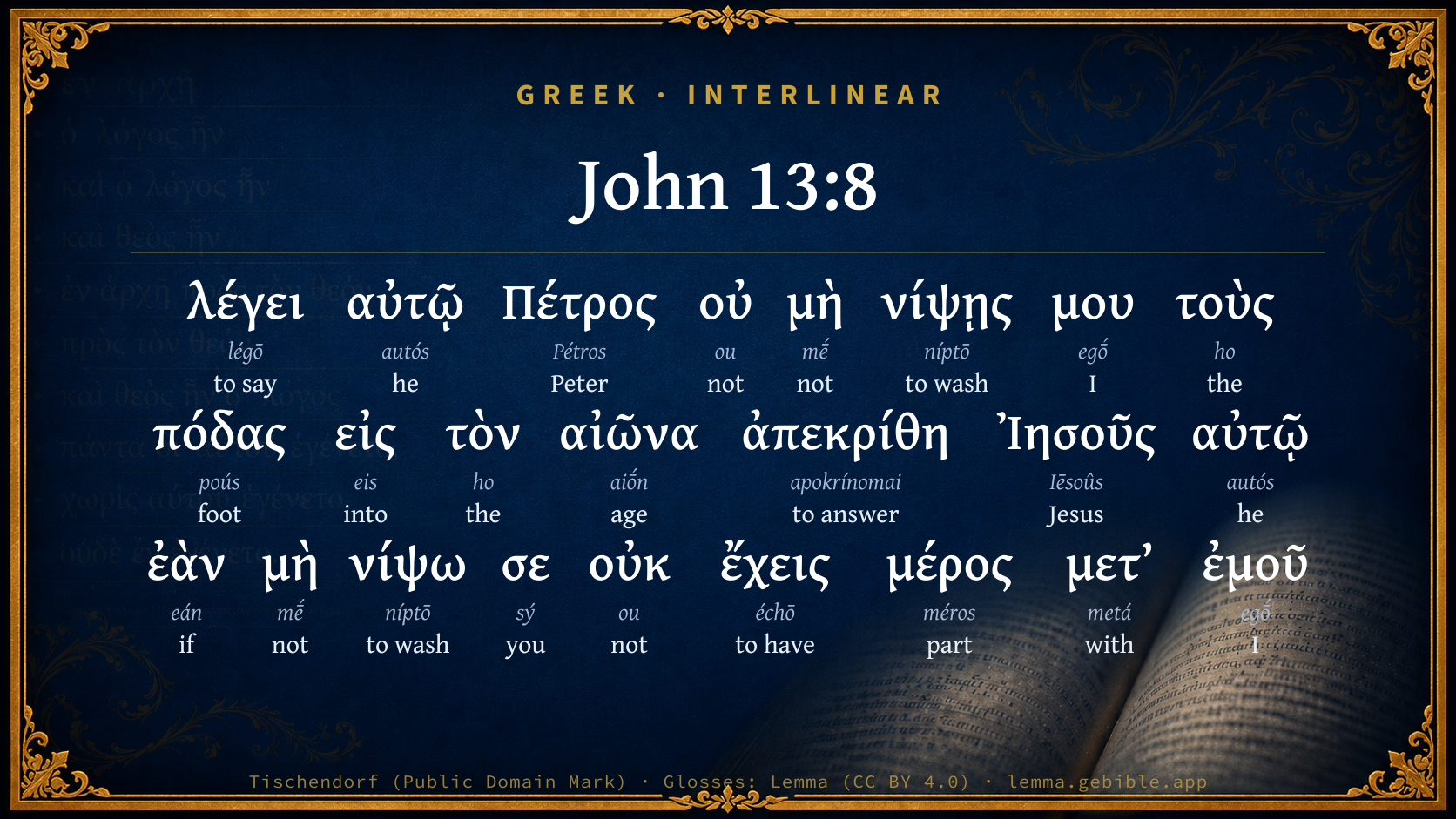
Greek (Tischendorf 8th ed.) John 13:8 appears in the Greek New Testament. The text above is from the Tischendorf 8th edition. Each word links to its Strong’s number and a concise gloss. Click any word for its full Thayer’s Greek Lexicon entry.
Download image
Cite this verse

John 13:8 (World English Bible). Public Domain. Lemma interlinear Bible study tool, https://lemma.gebible.app/v/john/13/8.

Show BibTeX & RIS
BibTeX
RIS
English Translation
Peter said to him, "You will never wash my feet!" Jesus answered him, "If I don't wash you, you have no part with me."
World English Bible · Public Domain
Download a study sheet

One document with this verse’s original text, its word-by-word gloss line, the meaning frame, cross-references with their text, attributed commentary, and full source and license credits — printable, and it pastes into notes with its structure intact.

This verse Autodidact and up

Study sheet (.html) Plain text (.txt)

A passage Seminary Student

Up to 50 verses in one chapter. A passage sheet keeps up to 6 commentary sources and 12 cross-references per verse, in the order this page ranks them, and says so on the sheet whenever that leaves anything out. Ask for a single verse and you get the Autodidact verse sheet above.

Everything on this page stays free to read, with no account — the sheet is a download of what is already on screen, not access to it.

Want to remove ads? Support Godless Engineer
Compare translations 3

The same verse in 3 English versions, stacked beneath the original-language interlinear above. Click any original word for its lexicon entry.

Each is an independent rendering of the whole verse — the interlinear is not word-aligned to these translations.

Highlighted words mark where these versions differ — a whole-verse word diff, not a word-by-word alignment.

  • World English Bible Public Domain
    Peter said to him, "You will never wash my feet!" Jesus answered him, "If I don't wash you, you have no part with me."
  • King James Version Public Domain
    Peter saith unto him, Thou shalt never wash my feet. Jesus answered him, If I wash thee not, thou hast no part with me.
  • unfoldingWord Literal Text CC BY-SA 4.0
    Peter says to him, “You may certainly not wash my feet into eternity.” Jesus answered him, “If I do not wash you, you have no share with me.”

unfoldingWord Literal Text — © unfoldingWord, licensed CC BY-SA 4.0. Word-aligned USFM3 via Door43 (git.door43.org/unfoldingWord/en_ult).

Versions to compare (up to 4)

3 of 4 selected

Show all 19 translations

Every available English version of this verse, each an independent rendering of the whole verse.

  • World English Bible Public Domain
    Peter said to him, "You will never wash my feet!" Jesus answered him, "If I don't wash you, you have no part with me."
  • Berean Standard Bible Public Domain
    “Never shall You wash my feet!” Peter told Him. Jesus answered, “Unless I wash you, you have no part with Me.”
  • Majority Standard Bible Public Domain
    “Never shall You wash my feet!” Peter told Him. Jesus answered, “Unless I wash you, you have no part with Me.”
  • King James Version Public Domain
    Peter saith unto him, Thou shalt never wash my feet. Jesus answered him, If I wash thee not, thou hast no part with me.
  • American Standard Version (1901) Public Domain
    Peter saith unto him, Thou shalt never wash my feet. Jesus answered him, If I wash thee not, thou hast no part with me.
  • Revised Version (1885) Public Domain
    Peter saith unto him, Thou shalt never wash my feet. Jesus answered him, If I wash thee not, thou hast no part with me.
  • Geneva Bible (1599) Public Domain
    Peter said vnto him, Thou shalt neuer wash my feete. Iesus answered him, If I wash thee not, thou shalt haue no part with me.
  • Douay-Rheims (1899) Public Domain
    Peter saith to him: Thou shalt never wash my feet. Jesus answered him: If I wash thee not, thou shalt have no part with me.
  • Young's Literal Translation Public Domain
    Peter saith to him, `Thou mayest not wash my feet -- to the age.' Jesus answered him, `If I may not wash thee, thou hast no part with me;'
  • Literal Standard Version CC BY-SA 4.0
    Peter says to Him, “You may not wash my feet—throughout the age.” Jesus answered him, “If I may not wash you, you have no part with Me”;
  • Unlocked Literal Bible CC BY-SA 4.0
    Peter said to him, “You will never wash my feet.” Jesus answered him, “If I do not wash you, you have no share with me.”
  • unfoldingWord Literal Text CC BY-SA 4.0
    Peter says to him, “You may certainly not wash my feet into eternity.” Jesus answered him, “If I do not wash you, you have no share with me.”
  • Darby Bible Public Domain
    Peter says to him, Thou shalt never wash my feet. Jesus answered him, Unless I wash thee, thou hast not part with me.
  • World Messianic Bible Public Domain
    Peter said to him, “You will never wash my feet!” Yeshua answered him, “If I don’t wash you, you have no part with me.”
  • Webster's Bible Public Domain
    Peter saith to him, Thou shalt never wash my feet. Jesus answered him, If I wash thee not, thou hast no part with me.
  • Free Bible Version CC BY-SA 4.0
    “No!” Peter protested. “You'll never wash my feet!” Jesus replied, “If I don't wash you, you have no part with me.”
  • Bible in Basic English Public Domain
    Peter said, I will never let my feet be washed by you, never. Jesus said in answer, If I do not make you clean you have no part with me.
  • Text-Critical English NT CC BY 4.0
    Peter said to him, “Yoʋ shall never wash my feet.” Jesus answered him, “If I do not wash yoʋ, yoʋ have no part with me.”
  • Tyndale New Testament (1534) Public Domain
    Peter sayd vnto him: thou shalt not wesshe my fete whill the worlde stondeth. Iesus answered him: yf I wasshe the not thou shalt have no part with me.

Literal Standard Version (2020), Covenant Press — licensed CC BY-SA 4.0. Text via the HelloAO Bible API (eBible.org). Unlocked Literal Bible (unfoldingWord) — licensed CC BY-SA 4.0. Text via the HelloAO Bible API (eBible.org). unfoldingWord Literal Text — © unfoldingWord, licensed CC BY-SA 4.0. Word-aligned USFM3 via Door43 (git.door43.org/unfoldingWord/en_ult). Free Bible Version, Dr. Jonathan Gallagher — licensed CC BY-SA 4.0. Text via the HelloAO Bible API (eBible.org).

Word by word

More ways to search: Search by grammar → Find every occurrence → Compare this word →

Practice this passage: Drill this verse → Learn its vocabulary →

νίψῃς
níptō
G3538
“to wash”
Verb, Aorist, Active, Subjunctive, 2nd person, Singular
Part of Speech
Verb
Tense
Aorist
Voice
Active
Mood
Subjunctive
Person
2nd person
Number
Singular
Full Thayer's Definition

Origin: to cleanse (especially the hands or the feet or the face)

TDNT: 19:46,6

1. to wash 2. to wash one's self
  1. λέγει légō G3004 “to say” Verb, Present, Active, Indicative, 3rd person, Singular
  2. αὐτῷ autós G846 “he” Personal pronoun, Dative, Singular, Masculine
  3. Πέτρος Pétros G4074 “Peter” Noun, Nominative, Singular, Masculine
  4. οὐ ou G3756 “not” Particle, Negative
  5. μὴ mḗ G3361 “not” Particle, Negative
  6. μου egṓ G1473 “I” Personal pronoun, 1st person, Genitive, Singular
  7. τοὺς ho G3588 “the” Article, Accusative, Plural, Masculine
  8. πόδας poús G4228 “foot” Noun, Accusative, Plural, Masculine
  9. εἰς eis G1519 “into” Preposition
  10. τὸν ho G3588 “the” Article, Accusative, Singular, Masculine
  11. αἰῶνα aiṓn G165 “age” Noun, Accusative, Singular, Masculine
  12. ἀπεκρίθη apokrínomai G611 “to answer” Verb, Aorist, Middle deponent, Indicative, 3rd person, Singular
  13. Ἰησοῦς Iēsoûs G2424 “Jesus” Noun, Nominative, Singular, Masculine
  14. αὐτῷ autós G846 “he” Personal pronoun, Dative, Singular, Masculine
  15. ἐὰν eán G1437 “if” Conditional
  16. μὴ mḗ G3361 “not” Particle, Negative
  17. νίψω níptō G3538 “to wash” Verb, Aorist, Active, Subjunctive, 1st person, Singular
  18. σε sý G4771 “you” Personal pronoun, 2nd person, Accusative, Singular
  19. οὐκ ou G3756 “not” Particle, Negative
  20. ἔχεις échō G2192 “to have” Verb, Present, Active, Indicative, 2nd person, Singular
  21. μέρος méros G3313 “part” Noun, Accusative, Singular, Neuter
  22. μετ’ metá G3326 “with” Preposition
  23. ἐμοῦ egṓ G1473 “I” Personal pronoun, 1st person, Genitive, Singular

About this verse

These counts appear in no published source. They are computed here, from the morphology-tagged text and Lemma’s own curated glosses. What Lemma adds →

24
words
18
distinct lemmas
Gospels
section

Notable vocabulary

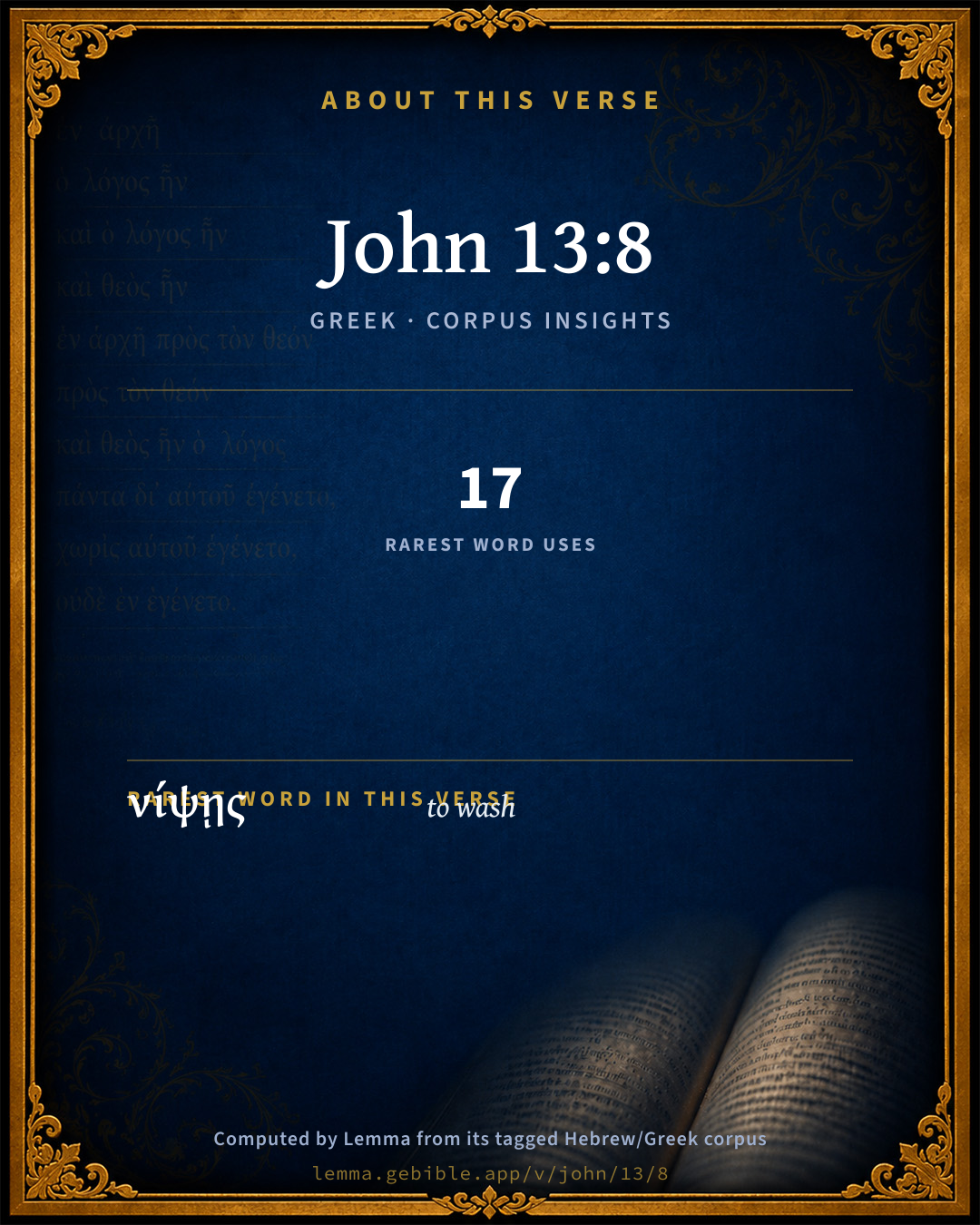
The rarest word here is νίψῃς to wash G3538 — appearing just 17 times in the whole Greek New Testament.

Shared distinctive vocabulary

νίψῃς to wash G3538 occurs in 13 verses of the Greek New Testament. Also found in:

Repetition

Words recur within this verse:

Cross-references

22

Topical passages linked to John 13:8 in the Treasury of Scripture Knowledge — connected by theme and wording, ordered by reader-vote popularity; previews shown in the World English Bible.

  • Ezekiel 36:25 I will sprinkle clean water on you, and you shall be clean: from all your filthiness, and from all your idols, will I cleanse you.
  • Acts 22:16 Now why do you wait? Arise, be baptized, and wash away your sins, calling on the name of the Lord.'
  • Titus 3:5 not by works of righteousness, which we did ourselves, but according to his mercy, he saved us, through the washing of regeneration and renewing by the Holy Spirit,
  • Ephesians 5:26 that he might sanctify it, having cleansed it by the washing of water with the word,
  • Hebrews 10:22 let's draw near with a true heart in fullness of faith, having our hearts sprinkled from an evil conscience, and having our body washed with pure water,
  • 1 Corinthians 6:11 Such were some of you, but you were washed. But you were sanctified. But you were justified in the name of the Lord Jesus, and in the Spirit of our God.
  • Revelation 7:14 I told him, "My lord, you know." He said to me, "These are those who came out of the great tribulation. They washed their robes, and made them white in the Lamb's blood.
  • Zechariah 13:1 "In that day there will be a spring opened to the house of David and to the inhabitants of Jerusalem, for sin and for uncleanness.
  • Matthew 21:29 He answered, 'I will not,' but afterward he changed his mind, and went.
  • Matthew 26:33 But Peter answered him, "Even if all will be made to stumble because of you, I will never be made to stumble."
  • John 3:5 Jesus answered, "Most assuredly I tell you, unless one is born of water and spirit, he can't enter into the Kingdom of God!
  • Colossians 2:18 Let no one rob you of your prize by a voluntary humility and worshipping of the angels, dwelling in the things which he has not seen, vainly puffed up by his fleshly mind,
  • Colossians 2:23 Which things indeed appear like wisdom in self-imposed worship, and humility, and severity to the body; but aren't of any value against the indulgence of the flesh.
  • Hebrews 9:22–23 According to the law, nearly everything is cleansed with blood, and apart from shedding of blood there is no remission.
  • Revelation 1:5 and from Jesus Christ, the faithful witness, the firstborn of the dead, and the ruler of the kings of the earth. To him who loves us, and washed us from our sins by his blood;
  • Isaiah 4:4 when the Lord shall have washed away the filth of the daughters of Zion, and shall have purged the blood of Jerusalem from its midst, by the spirit of justice, and by the spirit of burning.
  • Ezekiel 16:4–9 As for your birth, in the day you were born your navel was not cut, neither were you washed in water to cleanse you; you weren't salted at all, nor swaddled at all.
  • Matthew 16:22 Peter took him aside, and began to rebuke him, saying, "Far be it from you, Lord! This will never be done to you."
  • Matthew 26:35 Peter said to him, "Even if I must die with you, I will not deny you." All of the disciples also said likewise.
  • Hebrews 10:4–10 For it is impossible that the blood of bulls and goats should take away sins.
  • Genesis 42:38 He said, "My son shall not go down with you; for his brother is dead, and he only is left. If harm happens to him by the way in which you go, then you will bring down my gray hairs with sorrow to Sheol."
  • John 13:6 Then he came to Simon Peter. He said to him, "Lord, do you wash my feet?"

Cross-references courtesy of OpenBible.info (CC BY 4.0).

Commentary

Notes on John 13:8 from classic Christian and Jewish commentators (each source and its license shown beneath its notes). The classic Christian expositions comment on the surrounding passage and are grouped to its opening verse, so a note may address several verses; the Jewish commentaries on the Tanakh (Rashi and others) are per-verse, so they appear only where the commentator wrote on this verse.

Lemma curates 59 commentaries, every one of them public domain or Creative Commons licensed, each selected and text-cleaned for this edition rather than reprinted as found. About our sources →

Tyndale Open Study Notes

Tyndale Open Resources

13:8 Based on the depth of his devotion to Jesus, it is understandable that Peter protested. But Jesus was not simply giving Peter a model of service; this was a symbolic pre-enactment of his greater act of sacrifice on the cross (13:7). Receiving Jesus’ spiritual cleansing is a condition for discipleship, so if Peter could not accept this act, he could not be Jesus’ disciple at all.

Tyndale Open Study Notes — © Tyndale Open Resources, licensed CC BY-SA 4.0. Text via the HelloAO Bible API.

Bengel's Gnomon

Johann Albrecht Bengel

Joh 13:8. Λέγει, saith) A second protestation against it need not to have been added.—εἰς τὸν αἰῶνα, ever at any time) Peter opposes this to the μετὰ ταῦτα, hereafter, Joh 13:7. An emphatic form of denying: 1Co 8:13, “I will eat no flesh εἰς τὸν αἰῶνα, while the world standeth.”—ἐάν, if) We ought to yield to the will of the Lord.—σέ) thee, saith He, not thy feet. This brevity of expression is strictly accurate; for he who has not his feet washed, is accounted as wholly unwashed.—οὐκ ἔχεις, thou hast not) The necessity for that grace [humility] was shown to them through the washing of their feet. There is no doubt but that the wonderful humility of the Lord very much changed and melted the souls of the disciples. Peter especially was in need of it.—μετʼ ἐμοῦ, with Me) Jesus therefore [notwithstanding this act of humiliation] still remains their Lord.

Bengel's Gnomon of the New Testament — English translation (T&T Clark, Edinburgh, 1860) — public domain. Text from a community e-Sword module.

Expositor's Greek Testament

ed. W. Robertson Nicoll

Joh 13:8 . Peter, however, cannot accept the disciple’s attitude, but persists, Οὐ μὴ νίψῃς μου τοὺς πόδας εἰς τὸν αἰῶνα , “never shalt Thou wash my feet”. The εἰς τὸν αἰῶνα was prompted by the μετὰ ταῦτα . No future explanation can make this possible. Peter’s humility is true enough to allow him to see the incongruity of Jesus washing his feet: not deep enough to make him conscious of the incongruity of his thus opposing and dictating to his Master. To this characteristic utterance Jesus, waiting with the basin, replies, ἐὰν μὴ νίψω σε … ἐμοῦ . Superficially these words might mean that unless Peter allowed Jesus to wash him, he could not sit at table with Him. But evidently Peter found in them a deeper significance, and understood them as meaning: Unless I wash you, you are outcast from my fellowship and cease to share in my kingdom and destiny. Here the symbolic significance of the eating together and of the washing begins dimly to appear. That Peter saw that this deeper meaning was intended appears from the eagerness of his answer.

The Expositor's Greek Testament, edited by W. Robertson Nicoll (1897–1910) — public domain. Text from a community e-Sword module.

Geneva Bible (1599)

Geneva Bible translators

Unless thou suffer me to wash thee, thou shalt have no part in the kingdom of heaven.

Geneva Bible (1599) marginal notes — public domain. Text via Bolls.life.

Jamieson, Fausset & Brown

Robert Jamieson, A. R. Fausset & David Brown

Peter saith unto him, Thou shalt never wash, &c.--more emphatically, "Never shalt Thou wash my feet": that is, "That is an incongruity to which I can never submit." How like the man!

If I wash thee not, thou hast no part with me--What Peter could not submit to was, that the Master should serve His servant. But the whole saving work of Christ was one continued series of such services, ending with and consummated by the most self-sacrificing and transcendent of all services: THE SON OF MAN CAME not to be ministered unto, but TO MINISTER, AND TO GIVE HIS LIFE A RANSOM FOR MANY. (See on Mar 10:45). If Peter then could not submit to let his Master go down so low as to wash his feet, how should he suffer himself to be served by Him at all? This is couched under the one pregnant word "wash," which though applicable to the lower operation which Peter resisted, is the familiar scriptural symbol of that higher cleansing, which Peter little thought he was at the same time virtually putting from him. It is not humility to refuse what the Lord deigns to do for us, or to deny what He has done, but it is self-willed presumption--not rare, however, in those inner circles of lofty religious profession and traditional spirituality, which are found wherever Christian truth has enjoyed long and undisturbed possession. The truest humility is to receive reverentially, and thankfully to own, the gifts of grace.

Jamieson, Fausset & Brown — Commentary Critical and Explanatory on the Whole Bible (1871) — public domain (CC PDM 1.0). Text via the HelloAO Bible API.

Adam Clarke's Commentary

Verse 8. If I wash thee not, thou hast no part with me.] Thou canst not be my disciple unless I wash thee. It is certain Christ did not mean to exclude him from the apostolic office, if he should persist, through the deepest reverence for his Master, to refuse to let him wash his feet: this act of his was emblematical of something spiritual; of something that concerned the salvation of Peter; and without which washing he could neither be an apostle or be finally saved; therefore our Lord said, If I wash thee not, thou hast no part with me. There is a mystical washing by the blood of Christ, 1Jo 1:7; and by his Spirit, 1Co 6:11; Tit 3:5-6. It was the common custom of our Lord to pass from sensible and temporal things to those which were spiritual and eternal; and to take occasion from every thing that presented itself, to instruct his disciples, and to raise their souls to God. If the discourse was of bread, water, leaven, father, mother, riches, c., he immediately changed the literal sense, and under the figure of these things, spoke of matters altogether spiritual and Divine. I have met with many good persons who have attempted to imitate our blessed Lord in this, but I never knew one to succeed in it. The reason is, it requires not only very deep piety, but sound sense, together with an accurate knowledge of the nature and properties of the subjects which, in this way, the person wishes to illustrate and very few can be found who have such deep, philosophical knowledge as such cases require. The large folio which a good-intentioned man printed on the metaphors is, alas! a standing proof how little mere piety can do in matters of this kind, where the sciences, and especially practical philosophy, are totally wanting. Jesus Christ was a consummate philosopher: every subject appears grand and noble in his hands. See an ample proof in the preceding chapter, Joh 12:24.

Adam Clarke's Commentary on the Bible (1810–1826) — public domain. Text from a community e-Sword/MySword module.

John Calvin's Commentaries

8. Thou shalt never wash my feet. Hitherto Peter’s modesty was excusable, though it was not free from blame; but now he errs more grievously, when he has been corrected, and yet does not yield. And, indeed, it is a common fault, that ignorance is closely followed by obstinacy. It is a plausible excuse, no doubt, that the refusal springs from reverence for Christ; but since he does not absolutely obey the injunction, the very desire of showing his respect for Christ loses all its gracefulness. The true wisdom of faith, therefore, is to approve and embrace with reverence whatever proceeds from God, as done with propriety and in good order; nor is there any other way, indeed, in which his name can be sanctified by us; for if we do not believe that whatever he does is done for a very good reason: our flesh, being naturally stubborn, will continually murmur, and will not render to God the honor due to him, unless by constraint. In short, until a man renounce the liberty of judging as to the works of God, whatever exertions he may make to honor God, still pride will always lurk under the garb of humility.

If I wash thee not. This reply of Christ does not yet explain the reason why he resolved to wash the feet of his disciples; only by a comparison drawn from the soul to the body, he shows that, in washing the feet of his disciples, he does nothing that is unusual or inconsistent with his rank. Meanwhile, the reply points out the folly of Peter’s wisdom. The same thing will always happen to us, whenever the Lord begins to contend with us. So long as he remains silent, men imagine that they have a good right to differ from him: but nothing is easier far him than to refute, by a single word, all the plausible arguments which they employ. As Christ is Lord and Master, Peter thinks it inconsistent that Christ should wash his feet. But the evil is, that, in refusing such a service, he rejects the principal part of his own salvation. There is also a general doctrine contained in this statement, that we are all filthy and abominable in the sight of God, until Christ wash away our stains. Now, since he claims for himself the exclusive right of washing, let every man present himself, o be cleansed from his pollution, that he may obtain a place among the children of God.

But before proceeding farther, we must understand what is the meaning of the word wash. Some refer it to the free pardon of sins; others, to newness of life; while a third class extends it to. both, and this last view I cheerfully admit. For Christ washes us when he removes the guilt of our sins by his atoning sacrifice, that they may not come into judgment before God; and, on the other hand, he washes us when he takes away, by his Spirit, the wicked and sinful desires of the flesh. But as it will shortly afterwards be evident from what follows, that he speaks of the grace of regeneration, I do not absolutely maintain the opinion that he included here the washing of pardon.

John Calvin's Commentaries (1540-1563) — public domain. Text from the Calvin Translation Society English edition (1840s-50s) via the Christian Classics Ethereal Library (ccel.org). Calvin's coverage is partial (roughly two-thirds of the Bible); uncommented books and verses are honest gaps, never fabricated. The 19th-century editor's footnotes and remarks are omitted so the notes are faithfully Calvin's own voice.

Ellicott's Commentary for English Readers

(8) Thou shalt never wash my feet.—For the word “never,” comp. Note on Joh_8:51. The incidental touches of character where individual apostles are named in this Gospel are in striking agreement with the more fully-drawn character of the other evangelists, and the value of their evidence for the authorship cannot be over-estimated. They are perfectly artless, but are beyond the most consummate art. We feel that it is the loving, impulsive, but self-confident Peter of the earlier Gospels who is speaking here. He does not wait for that after-knowledge which our Lord promises him. He sees no ground on which our Lord’s act can possibly be one which he can permit. Note that the emphasis is on the negative. The pronoun “my” is again not to be emphasised, nor is “Thou” in this passage. “Thou shalt never wash my feet.”

If I wash thee not, thou hast no part with me.—Our Lord has already intimated (Joh_13:7) that His deed was symbolic, and He now refers to the truth underlying the outer act. The key to His meaning is to be found in His own words in Joh_13:13-17. By the act of washing their feet, He, their Lord, taught the spirit of self-sacrifice and love in opposition to the spirit of self-seeking and pride which ruled even in the Apostles’ hearts. That lesson every servant and apostle of Jesus Christ must learn, for the servant is. not greater than the Lord, nor the Apostle than the Sender. That lesson Peter was refusing to learn in the pride of his own impulsive will, which seemed to be humility. But unless he learns to accept the love of Christ’s humiliation, and is so cleansed by its power that he yields his human will wholly to the divine, and learns in self-sacrifice what the spirit of Christ really is, he can have no part in Him. The lesson is a hard one, but it is necessary; the sacrifice of will may be harder than that of life; but the strong man must become as the little child before he can enter into the Kingdom of Heaven.

For the phrase, “Thou hast no part with me,” which is again a Hebrew thought in Greek dress, comp. Mat_24:51, and Luk_12:46. It is frequent in the Old Testament. See, e.g., Deu_12:12, “He hath no part nor inheritance with you.”

A Bible Commentary for English Readers, edited by Charles John Ellicott (1878–1897) — public domain. Text from a community e-Sword module.

The Cambridge Bible for Schools and Colleges

gen. ed. J. J. S. Perowne

8. Thou shalt never wash my feet] The negative is the strongest form possible; ‘thou shalt certainly not wash my feet for ever.’ See on Joh_8:51, and comp. Mat_16:22.

no part with me] The Greek is the same as in Mat_24:51 and Luk_12:46. The expression is of Hebrew origin; comp. Deu_10:9; Deu_12:12; Deu_14:27. To reject Christ’s self-humiliating love, because it humiliates Him (a well-meaning but false principle), is to cut oneself off from Him. It requires much more humility to accept a benefit which is a serious loss to the giver than one which costs him nothing. In this also the surrender of self is necessary.

The Cambridge Bible for Schools and Colleges (gen. ed. J. J. S. Perowne; Cambridge University Press, 1878–1918) — public domain. Text from a community e-Sword module.

John Gill's Exposition

Peter saith unto him, thou shall never wash my feet,.... Before he had behaved with modesty, but now with obstinacy and perverseness; and though these expressions might arise from great reverence to Christ, yet they were wrong and rashly spoken. Peter ought to have been satisfied with Christ's reply, and have submitted, since though he then did not know the reason of such surprising conduct, he should hereafter. In order therefore to bring him to a compliance,

Jesus answered him, if I wash thee not, thou hast no part with me; he does not say, if I wash not thy feet, but thee, meaning not with water, but with his blood, and by his Spirit; for Christ uses the word wash here, not literally, but in a mystical and figurative sense, and takes an occasion, as he sometimes does, from things natural, to discourse of things spiritual: moreover, he does not say, thou hast no part "in" me, but thou hast no part "with" me, that is, no fellowship and communion with me; see Co2 6:14; and it is as if he should say, Peter, if I had not washed thee with the washing of regeneration by my Spirit, and if I should not shed my blood for thee, and wash thee in it from thy sins, sad would be thy case; thou couldest have no communion with me in this world, nor any part and portion with me in the heavenly inheritance hereafter. Hence it may be observed, that unless a man is washed by Christ, he can have no part with him in this, or the other world. God's elect have a part, an interest in Christ through eternal, electing, and covenant grace, and in consequence of this are washed by Christ both with his blood, and with the washing of regeneration: and this is done in order that they may have a part with Christ, spiritual fellowship with him now, and possess with him the undefiled inheritance, when time shall be no more.

John Gill's Exposition of the Whole Bible (1746–1763) — public domain (CC PDM 1.0). Text via the HelloAO Bible API.

Trapp's Complete Commentary

John Trapp

8 Peter saith unto him, Thou shalt never wash my feet. Jesus answered him, If I wash thee not, thou hast no part with me.

Ver. 8. Thou shalt never wash my feet] This was an immoderate modesty, a proud humility; so is it in them that refuse gospel comforts, because they are unworthy, Domine, non sum dignus, at sum indigens, said Pomeran. Tibi adest ninia humilitas, Thou hast too much humility, said Luther to Staupicius. So the Baptist was as much to blame in refusing to baptize Christ {Mat 3:14} as Peter here to be washed by him. Luther said of Melancthon’s self-denying humility, Soli Deo omnia deberi tam obstinate asserit, ut mihi plane videatur in hoc saltem errare, quod Christum ipse fingat longius abesse cordi sue quam sit revera: Certe nimis nullus in hoc est Philippus. Philip is worse conceited of himself than is fit.

John Trapp, A Commentary or Exposition upon All the Books of the Old and New Testament (1647–1656) — public domain. Text from a community e-Sword module.

Albert Barnes' Notes on the Bible

Thou shalt never wash my feet - This was a decided and firm expression of his reverence for his Master, and yet it was improper. Jesus had just declared that it had a meaning, and that he ought to submit to it. We should yield to all the plain and positive requirements of God, even if we cannot now see how obedience would promote his glory.

If I wash thee not - This had immediate reference to the act of washing his feet; and it denotes that if Peter had not so much confidence in him as to believe that an act which he performed was proper, though he could not see its propriety - if he was not willing to submit his will to that of Christ and implicitly obey him, he had no evidence of piety. As Christ, however, was accustomed to pass from temporal and sensible objects to those which were spiritual, and to draw instruction from whatever was before him, some have supposed that he here took occasion to state to Peter that if his soul was not made pure by him he could not be his follower. Washing is often thus put as an emblem of moral purification, 1Co 6:11; Tit 3:5-6. This is the meaning, also, of baptism. If this was the sense in which Jesus used these words, it denotes that unless Christ should purify Peter, he could have no evidence that he was his disciple. “Unless by my doctrine and spirit I shall purify you, and remove your pride Mat 26:33, your lack of constant watchfulness Mat 26:40, your anger Mat 26:51, your timidity and fear Mat 26:70, Mat 26:74, you can have no part in me” (Grotius).

Hast no part with me - Nothing in common with me. No evidence of possessing my spirit, of being interested in my work, and no participation in my glory.

Albert Barnes' Notes on the Bible (1834–1885) — public domain. Text from a community e-Sword/MySword module.

Haydock's Catholic Bible Commentary

If I wash thee not, thou shalt have no part with me. At this, Peter, as one thunderstruck, replied: Lord, not my feet only, but my head; whatever my Lord pleaseth. (Witham)

George Leo Haydock (1774–1849), Haydock's Catholic Family Bible and Commentary, 1859 edition — public domain. Excludes Psalms (Douay-Rheims chapter numbering differs from Protestant) and Deuterocanonical books (Catholic canon only).

Matthew Poole's English Annotations

Peter rashly replies, Thou shalt never wash my feet. Here was a seeming reverence for his Master, but (like the Jewish zeal mentioned by Paul, Rom 10:2) not according to knowledge. Christ tells him, that except he washed him, he had no part with him; that is, he should never be saved. But will some say, Was not this too severe, for our Saviour to threaten Peter with an exclusion from a co-inheritance with him in heaven, for modestly refusing to suffer him to wash his feet?

Answer.

1. The least disobedience not repented of, is enough to exclude a soul from the kingdom of heaven.

2. But Christ seems to take an advantage here, from this ceremony of his washing their feet, to discourse to him the necessity of his washing his soul with his blood, from the filth of sin and corruption; and of this washing it undoubtedly is that Christ here speaketh, the necessity of which is very often inculcated in holy writ.

Matthew Poole's English Annotations on the Holy Bible (1683–1685) — public domain. Text from a community e-Sword/MySword module.

Whedon's Commentary on the Bible

Daniel D. Whedon

8. Peter saith—It were wise for Peter, at least now, to be silent and submissive. He has a chance to exercise that profound humility which trusts in God amid the mysteries of life, saying, we know not now but shall know

hereafter. Never wash my feet—Peter at last, in his presumptuous humility, is utterly disobedient. He is imperative upon his Lord and Master. He imposes a never, a prohibition to last for ever. Hence now the stern rebuke of Jesus, If I wash thee not, thou hast no part with me. If the reality which requires this symbol be not performed, as thy disobedience will secure that it shall not, thou and I are separate forever. The same pride which in self-deception repels this washing service of thy Lord, rejects the washing of his atonement. Thou wilt not be washed with water in body, and thou canst not be washed with blood in soul; and thy impure nature can have no part with me.

Daniel D. Whedon (gen. ed.), Commentary on the Old and New Testaments (1874–1909) — public domain. Text from a community e-Sword module.

John Wesley's Explanatory Notes

If I wash thee not - If thou dost not submit to my will, thou hast no part with me - Thou art not my disciple. In a more general sense it may mean, If I do not wash thee in my blood, and purify thee by my Spirit, thou canst have no communion with me, nor any share in the blessings of my kingdom.

John Wesley, Explanatory Notes Upon the Whole Bible (1754–1765) — public domain. Text via the GEBible commentary corpus.

The People's New Testament

B. W. Johnson

8. If I wash thee not, thou hast no part with me. Washing, with the Jews, was a symbolical act, signifying purification from uncleanliness. That Christ referred to more than a washing with water was understood by Peter as is evident from his reply. Christ could only wash with blood the obedient.

B. W. Johnson's The People's New Testament with Notes (1889–1891) — public domain. Electronic text from the Christian Classics Ethereal Library (CCEL) ThML edition.

Cambridge Greek Testament for Schools and Colleges

8. οὐ μὴ νίψῃς. Strong negative; Thou shalt certainly never wash my feet. see on Joh 8:51, and comp. οὐ μὴ ἔσται σοι τοῦτο (Mat 16:22). In both utterances S. Peter resents the idea of his Master being humiliated.

οὐκ ἔχεις μέρος. Comp. ὁ ἔχων μέρος (Rev 20:6). The phrase occurs nowhere else in N.T. See on ὄψις, Joh 11:44. Comp. οὐκ ἔστι σοι μερὶς οὐδὲ κλῆρος (Act 8:21; Deu 10:9; Deu 12:12; Deu 14:27, &c.), and τὸ μέρος αὐτοῦ μετὰ τ. ὑποκριτῶν θήσει (Mat 24:51). The expression is of Hebrew origin. To reject Christ’s self-humiliating love, because it humiliates Him (a well-meaning but false principle), is to cut oneself off from Him. It requires much more humility to accent a benefit which is a serious loss to the giver than one which costs him nothing. In this also the surrender of self is necessary.

Cambridge Greek Testament for Schools and Colleges (Cambridge University Press, 1896; 21 vols, various authors incl. Carr, Maclear, Plummer, Farrar, Lumby, Moule, M. R. James, Simcox) — public domain. Text from a community e-Sword module.

Alford’s Greek Testament

Henry Alford

8.] The rash and self-opinionated Apostle opposes to μετὰ ταῦτα his οὐ μὴ … εἰς τ. αἰῶνα. In interpreting our Lord’s answer, we must remember, that He replies more to the spirit of Peter’s objection, than to his words. The same well-meaning but false humility would prevent him (and does prevent many) from stooping to receive at the hands of the Lord that spiritual washing which is absolutely necessary in order to have any part in Him, Rom 8:9, ‘If I wash thee not, thou hast no part in Me;’ but the affirmative proposition is not equally true; witness the example of Judas, who was washed, but yet had no part in Jesus. In the spiritual sense of washing, this is not so. Whoever is washed by Jesus, has part in Him. We are here in the realm of another and deeper logic: the act being no longer symbolic, but veritable.

Henry Alford, The Greek Testament (1849–1861) — public domain. Text from a community e-Sword module.

International Critical Commentary

8. Judas goes out at once (Joh 13:30; not in Mk., Mt., Lk.).

8. οὐ μὴ νίψῃς μου τοὺς πόδας, “Thou shalt assuredly never (εἰς τὸν αἰῶνα; see on 4:14) wash my feet,” μου being emphatic because of its position in the sentence (acc. to BCL; but the rec. text, with אAΓΘ, puts it after πόδας).

The answer of Jesus, “If I wash thee not, thou hast no part with me,” is very severe. “To have part with another,” or to be his partner, is to share in his work, and ultimately in his reward. Thus the unfaithful slave is condemned to have his part (τὸ μέρος αὐτοῦ) with the hypocrites (Mat 24:51; cf. Psa 50:18). The Levites had no part in the inheritance of Israel, their work being different from that of the other tribes (Deu 10:9, Deu 12:12); Simon Magus had no part in the apostolic endowments of the Spirit, being animated by ideals wholly different from those of the apostles (Act 8:21); a Christian has no part with an unbelieving heathen (2Co 6:15). So to decline the call of ministry, to which every disciple is called, is to have no part with Christ, to be no partner of His, for His work was pre-eminently a work of ministry (see on 12:26). Peter’s refusal to allow his Master to minister to him was really to reject that principle of the dignity of ministry and service which was behind the work of Jesus.

It was not said affirmatively that he whom Jesus washed was thereby recognised as His partner; for the feet of Judas were washed by Him, and He knew Judas for a traitor.

International Critical Commentary — older volumes (1896–1929), various authors — public domain. Text from a community e-Sword module.

Vincent's Word Studies in the New Testament

Marvin R. Vincent

Never [ου μη - εις τον αιωνα] . A very strong expression. Literally, thou shalt by no means wash my feet as long as the world stands.

Marvin R. Vincent, Word Studies in the New Testament (1887–1900) — public domain. Text from a community e-Sword/MySword module.

Lesson kit

Teaching starters — assembled from the data on this page, not authored interpretation. Every prompt links to the verse data it draws on. Edit before teaching.

John, in the Gospels, opens this verse with 24 words (18 distinct Greek lemmas). Its most distinctive word is níptō (“to wash”). A historical commentator’s framing appears above. Read the whole chapter for the surrounding context.

Discussion questions

  1. What does “to wash” (níptō) contribute to the verse as a whole?
  2. How does Matthew 6:17, which shares the word «to wash», read alongside this verse?
  3. What does the repetition of “to wash” (2× in this one verse) do in this verse?
  4. These translations render this verse differently. What is at stake in choosing one wording over another?
  5. Compare how Tyndale Open Study Notes and Bengel's Gnomon read this verse. Where do they agree or differ?

Things to notice

Reading settings

Reading text

Shown beneath each verse's original-language words.

Old Testament
Old Testament edition

Read the OT as the Masoretic Hebrew (MT) or the Greek Septuagint (LXX).

English shown for the Greek Septuagint (in the Hebrew ↔ Greek comparison).

Comparing translations? Open the Compare panel on any verse page to stack up to four side by side.