
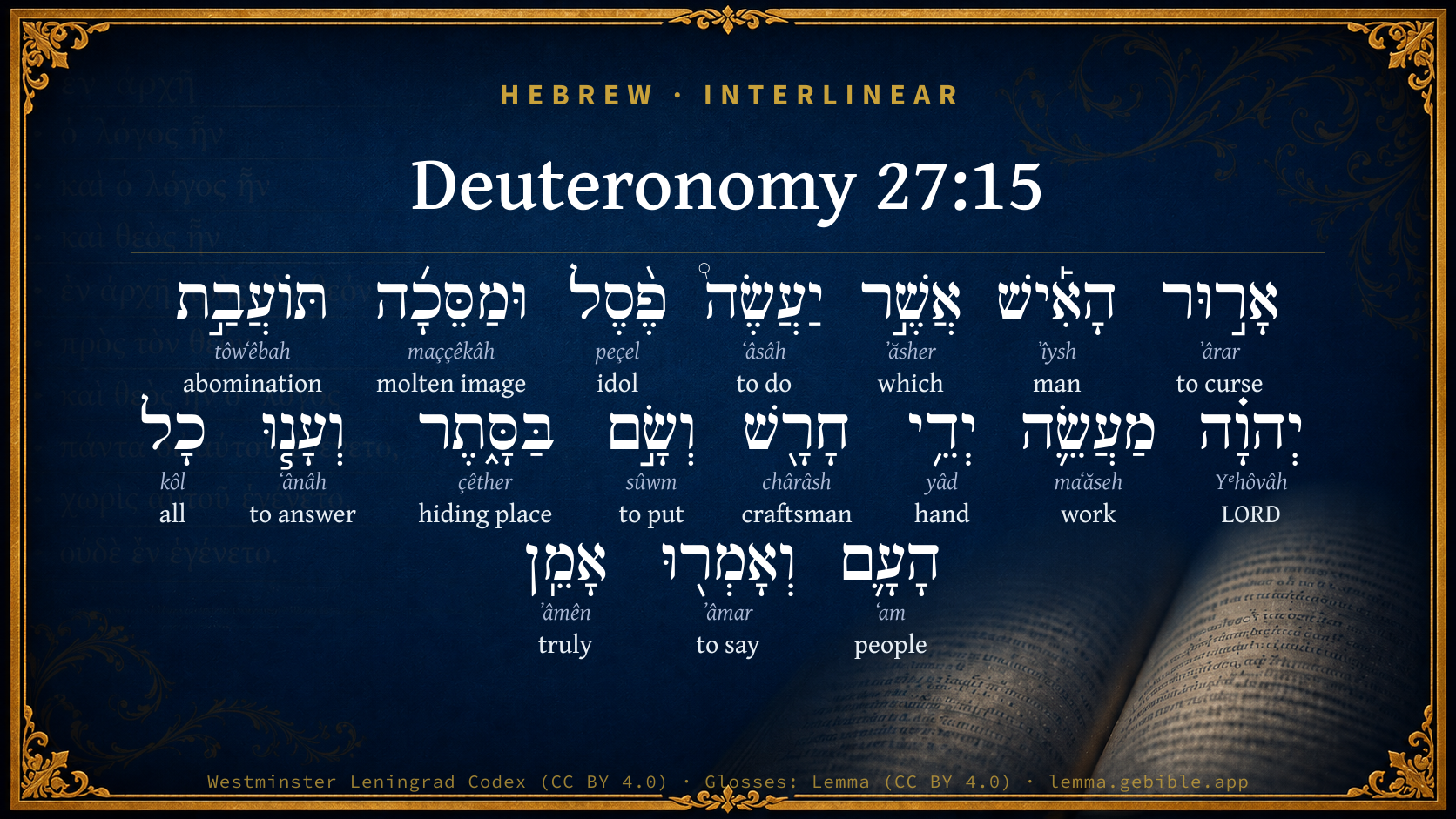
Deuteronomy 27:15

Hebrew (Westminster Leningrad Codex) Deuteronomy 27:15 appears in the Hebrew Old Testament. The text above is from the Westminster Leningrad Codex. Each word links to its Strong’s number, a concise gloss, and parsing drawn from the Open Scriptures Hebrew Bible morphology. Click any word for its full Brown-Driver-Briggs (BDB) entry.
Download image
Cite this verse

Deuteronomy 27:15 (World English Bible). Public Domain. Lemma interlinear Bible study tool, https://lemma.gebible.app/v/deuteronomy/27/15.

Show BibTeX & RIS
BibTeX
RIS
English Translation
Cursed be the man who makes an engraved or molten image, an abomination to Yahweh, the work of the hands of the craftsman, and sets it up in secret. All the people shall answer and say, Amen.
World English Bible · Public Domain
Download a study sheet

One document with this verse’s original text, its word-by-word gloss line, the meaning frame, cross-references with their text, attributed commentary, and full source and license credits — printable, and it pastes into notes with its structure intact.

This verse Autodidact and up

Study sheet (.html) Plain text (.txt)

A passage Seminary Student

Up to 50 verses in one chapter. A passage sheet keeps up to 6 commentary sources and 12 cross-references per verse, in the order this page ranks them, and says so on the sheet whenever that leaves anything out. Ask for a single verse and you get the Autodidact verse sheet above.

Everything on this page stays free to read, with no account — the sheet is a download of what is already on screen, not access to it.

Want to remove ads? Support Godless Engineer
Compare translations 3

The same verse in 3 English versions, stacked beneath the original-language interlinear above. Click any original word for its lexicon entry.

Each is an independent rendering of the whole verse — the interlinear is not word-aligned to these translations.

Highlighted words mark where these versions differ — a whole-verse word diff, not a word-by-word alignment.

  • World English Bible Public Domain
    Cursed be the man who makes an engraved or molten image, an abomination to Yahweh, the work of the hands of the craftsman, and sets it up in secret. All the people shall answer and say, Amen.
  • King James Version Public Domain
    Cursed be the man that maketh any graven or molten image, an abomination unto the LORD, the work of the hands of the craftsman, and putteth it in a secret place. And all the people shall answer and say, Amen.
  • unfoldingWord Literal Text CC BY-SA 4.0
    ‘Cursed is the man who makes a carved image or cast figure, an abomination Yahweh, the work of the hands of a craftsman, and sets up secretly.’ And all the people shall answer and say, ‘Amen.’

unfoldingWord Literal Text — © unfoldingWord, licensed CC BY-SA 4.0. Word-aligned USFM3 via Door43 (git.door43.org/unfoldingWord/en_ult).

Versions to compare (up to 4)

3 of 4 selected

Show all 18 translations

Every available English version of this verse, each an independent rendering of the whole verse.

  • World English Bible Public Domain
    Cursed be the man who makes an engraved or molten image, an abomination to Yahweh, the work of the hands of the craftsman, and sets it up in secret. All the people shall answer and say, Amen.
  • Berean Standard Bible Public Domain
    ‘Cursed is the man who makes a carved idol or molten image—an abomination to the LORD, the work of the hands of a craftsman—and sets it up in secret.’ And let all the people say, ‘Amen!’
  • Majority Standard Bible Public Domain
    ‘Cursed is the man who makes a carved idol or molten image—an abomination to the LORD, the work of the hands of a craftsman—and sets it up in secret.’ And let all the people say, ‘Amen!’
  • King James Version Public Domain
    Cursed be the man that maketh any graven or molten image, an abomination unto the LORD, the work of the hands of the craftsman, and putteth it in a secret place. And all the people shall answer and say, Amen.
  • American Standard Version (1901) Public Domain
    Cursed be the man that maketh a graven or molten image, an abomination unto Jehovah, the work of the hands of the craftsman, and setteth it up in secret. And all the people shall answer and say, Amen.
  • Revised Version (1885) Public Domain
    Cursed be the man that maketh a graven or molten image, an abomination unto the LORD, the work of the hands of the craftsman, and setteth it up in secret. And all the people shall answer and say, Amen.
  • Geneva Bible (1599) Public Domain
    Cursed be the man that shall make any carued or molten image, which is an abomination vnto the Lord, the worke of the hands of the craftesman, and putteth it in a secrete place: And all the people shall answere, and say: So be it.
  • Douay-Rheims (1899) Public Domain
    Cursed be the man that maketh a graven and molten thing, the abomination of the Lord, the work of the hands of artificers, and shall put it in a secret place: and all the people shall answer and say: Amen.
  • Young's Literal Translation Public Domain
    `Cursed `is' the man who maketh a graven and molten image, the abomination of Jehovah, work of the hands of an artificer, and hath put `it' in a secret place, -- and all the people have answered and said, Amen.
  • Literal Standard Version CC BY-SA 4.0
    “Cursed [is] the man who makes a carved and molten image, an abomination [to] YHWH, work of the hands of a craftsman, and has put [it] in a secret place.” And all the people have answered and said, “Amen.”
  • Unlocked Literal Bible CC BY-SA 4.0
    'May the man be cursed who makes a carved or cast figure, an abomination to Yahweh, the work of the hands of a craftsman, and who sets it up in secret.' Then all the people must answer and say, 'Amen.'
  • unfoldingWord Literal Text CC BY-SA 4.0
    ‘Cursed is the man who makes a carved image or cast figure, an abomination Yahweh, the work of the hands of a craftsman, and sets up secretly.’ And all the people shall answer and say, ‘Amen.’
  • Darby Bible Public Domain
    Cursed be the man that maketh a graven or molten image, an abomination to Jehovah, a work of the craftsman's hand, and putteth it up secretly! And all the people shall answer and say, Amen.
  • World Messianic Bible Public Domain
    ‘Cursed is the man who makes an engraved or molten image, an abomination to the LORD, the work of the hands of the craftsman, and sets it up in secret.’ All the people shall answer and say, ‘Amen.’
  • Webster's Bible Public Domain
    Cursed be the man that maketh any graven or molten image, an abomination to the LORD, the work of the hands of the artificer, and putteth it in a secret place: and all the people shall answer, and say Amen.
  • Free Bible Version CC BY-SA 4.0
    “A curse on anyone who makes a carved image or a metal idol and worships it in secret. It's only an object that someone made, and it's offensive to the Lord!” Everyone says “Amen!”
  • Bible in Basic English Public Domain
    Cursed is the man who makes any image of wood or stone or metal, disgusting to the Lord, the work of man's hands, and puts it up in secret. And let all the people say, So be it.
  • JPS Tanakh (1917) Public Domain
    Cursed be the man that maketh a graven or molten image, an abomination unto the LORD, the work of the hands of the craftsman, and setteth it up in secret. And all the people shall answer and say: Amen.

Literal Standard Version (2020), Covenant Press — licensed CC BY-SA 4.0. Text via the HelloAO Bible API (eBible.org). Unlocked Literal Bible (unfoldingWord) — licensed CC BY-SA 4.0. Text via the HelloAO Bible API (eBible.org). unfoldingWord Literal Text — © unfoldingWord, licensed CC BY-SA 4.0. Word-aligned USFM3 via Door43 (git.door43.org/unfoldingWord/en_ult). Free Bible Version, Dr. Jonathan Gallagher — licensed CC BY-SA 4.0. Text via the HelloAO Bible API (eBible.org).

Word by word

More ways to search: Search by grammar → Find every occurrence → Compare this word →

Practice this passage: Drill this verse → Learn its vocabulary →

וּמַסֵּכָ֜ה
maççêkâh
H4541
“and · molten image”
Conjunction + Noun, Common, Feminine, Singular, Absolute
Part of Speech
Conjunction + Noun
Type
Common
Gender
Feminine
Number
Singular
State
Absolute
Full BDB Definition

Origin: from H5258

TWOT: 1375c , 1376a

a pouring, libation, molten metal, cast image, drink offering - libation (with covenant sacrifice) - molten metal, molten image, molten gods - web, covering, veil, woven stuff
  1. אָר֣וּר ʼârar H779 “cursed” Verb, Qal, Participle Passive, Masculine, Singular, Absolute
  2. הָאִ֡ישׁ ʼîysh H376 “the · man” Particle, Definite Article + Noun, Common, Masculine, Singular, Absolute
  3. אֲשֶׁ֣ר ʼăsher H834 “which” Particle, Relative
  4. יַעֲשֶׂה֩ ʻâsâh H6213 “to do” Verb, Qal, Imperfect, 3rd Person, Masculine, Singular
  5. פֶ֨סֶל peçel H6459 “idol” Noun, Common, Masculine, Singular, Absolute
  6. תּוֹעֲבַ֣ת tôwʻêbah H8441 “abomination of” Noun, Common, Feminine, Singular, Construct
  7. יְהוָ֗ה Yᵉhôvâh H3068 “LORD” Noun, Proper
  8. מַעֲשֵׂ֛ה maʻăseh H4639 “work of” Noun, Common, Masculine, Singular, Construct
  9. יְדֵ֥י yâd H3027 “hands of” Noun, Common, Both, Dual, Construct
  10. חָרָ֖שׁ chârâsh H2796 “craftsman” Noun, Common, Masculine, Singular, Absolute
  11. וְשָׂ֣ם sûwm H7760 “and · to put” Conjunction + Verb, Qal, Sequential Perfect, 3rd Person, Masculine, Singular
  12. בַּסָּ֑תֶר çêther H5643 “in/at the · hiding place” Preposition, Determined + Noun, Common, Masculine, Singular, Absolute
  13. וְעָנ֧וּ ʻânâh H6030 “and · to answer” Conjunction + Verb, Qal, Sequential Perfect, 3rd Person, Common, Plural
  14. כָל kôl H3605 “all of” Noun, Common, Masculine, Singular, Construct
  15. הָעָ֛ם ʻam H5971 “the · people” Particle, Definite Article + Noun, Common, Masculine, Singular, Absolute
  16. וְאָמְר֖וּ ʼâmar H559 “and · to say” Conjunction + Verb, Qal, Sequential Perfect, 3rd Person, Common, Plural
  17. אָמֵֽן ʼâmên H543 “truly” Adverb

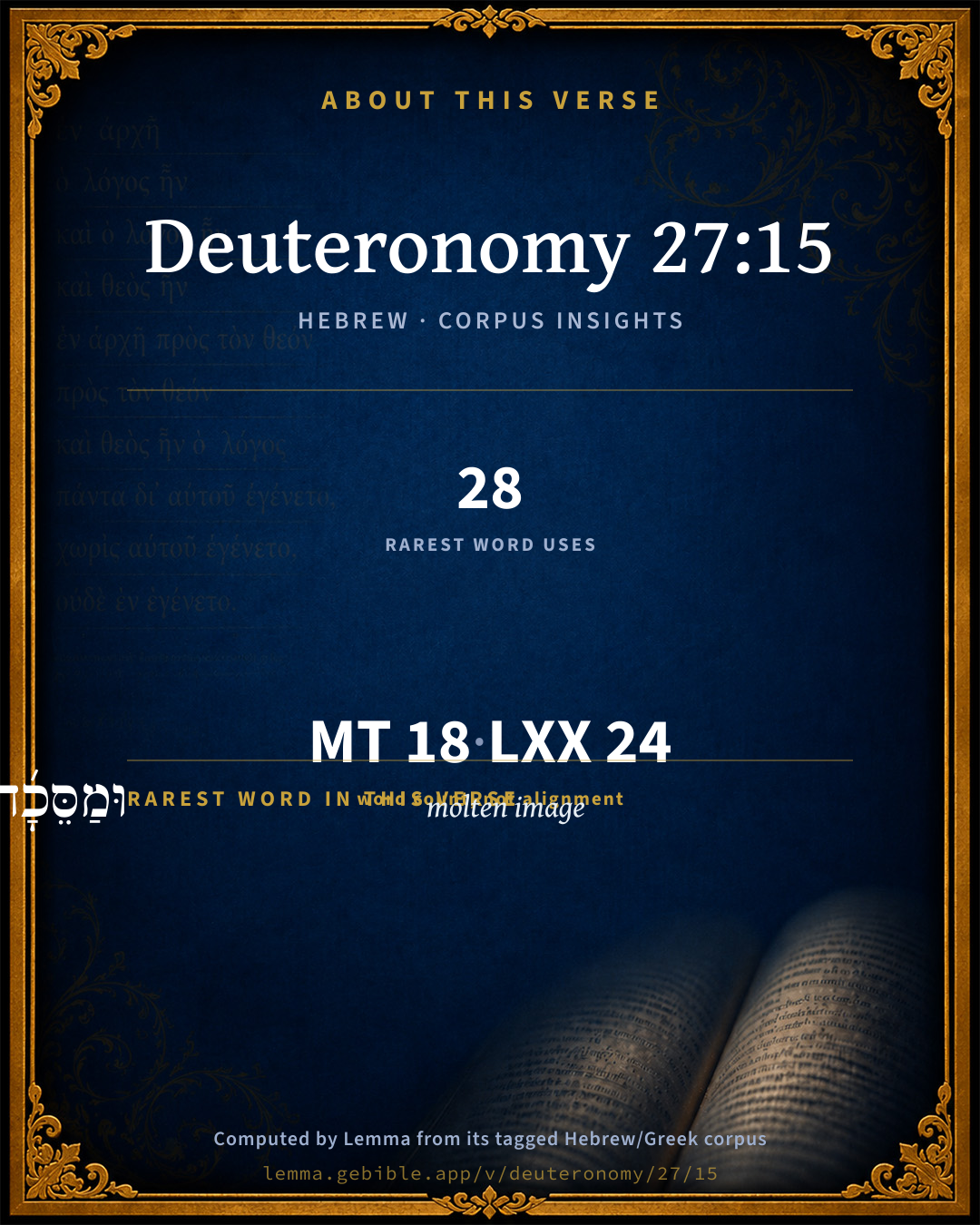
About this verse

These counts appear in no published source. They are computed here, from the morphology-tagged text and Lemma’s own curated glosses. What Lemma adds →

18
words
18
distinct lemmas
Pentateuch
section

Shared distinctive vocabulary

וּמַסֵּכָ֜ה molten image H4541 occurs in 28 verses of the Hebrew Bible. Also found in:

Grammatical profile

  • 5 verbs
  • 11 nouns
  • 1 adverb
  • 1 particle

Verb forms

  • אָר֣וּר Qal · Participle Passive
  • יַעֲשֶׂה֩ Qal · Imperfect
  • וְשָׂ֣ם Qal · Sequential Perfect
  • וְעָנ֧וּ Qal · Sequential Perfect
  • וְאָמְר֖וּ Qal · Sequential Perfect

Hebrew & Septuagint length

In English translation the verse runs 37 words from the Hebrew and 43 from the Septuagint (LXX English) — closely comparable.

A rough comparison of the two English renderings, which tokenize alike — not a word-level alignment.

Word counts can differ between the Hebrew and the Greek without any difference in meaning — e.g. the Hebrew direct-object marker אֵת has no separate Greek word, and Greek often adds the article ὁ.

In the original languages it is 18 Hebrew tokens and 24 Greek tokens — but the two are counted differently (Hebrew bundles its prefixes and suffixes into one token; the Greek is in lemma form), so that isn’t a like-for-like length.

Cross-references

36

Topical passages linked to Deuteronomy 27:15 in the Treasury of Scripture Knowledge — connected by theme and wording, ordered by reader-vote popularity; previews shown in the World English Bible.

  • Exodus 34:17 You shall make no cast idols for yourselves.
  • Exodus 20:4 "You shall not make for yourselves an idol, nor any image of anything that is in the heavens above, or that is in the earth beneath, or that is in the water under the earth:
  • Leviticus 19:4 "'Don't turn to idols, nor make molten gods for yourselves. I am Yahweh your God.
  • Leviticus 26:1 "'You shall make for yourselves no idols, neither shall you raise up an engraved image or a pillar, neither shall you place any figured stone in your land, to bow down to it: for I am Yahweh your God.
  • Deuteronomy 5:8 "You shall not make an engraved image for yourself, [nor] any likeness [of anything] that is in heaven above, or that is in the earth beneath, or that is in the water under the earth:
  • Exodus 20:23 You shall most certainly not make alongside of me gods of silver, or gods of gold for yourselves.
  • Deuteronomy 4:16–23 Lest you corrupt yourselves, and make yourself an engraved image in the form of any figure, the likeness of male or female,
  • Hosea 13:2–3 Now they sin more and more, And have made themselves molten images of their silver, Even idols according to their own understanding, All of them the work of the craftsmen. They say of them, "They offer human sacrifice and kiss the calves."
  • 1 Corinthians 14:16 Otherwise if you bless with the spirit, how will he who fills the place of the unlearned say the "Amen" at your giving of thanks, seeing he doesn't know what you say?
  • Genesis 9:25 He said, "Cursed be Canaan; A servant of servants will he be to his brothers."
  • Genesis 31:19 Now Laban had gone to shear his sheep: and Rachel stole the teraphim that were her father's.
  • Genesis 31:34 Now Rachel had taken the teraphim, put them in the camel's saddle, and sat on them. Laban felt about all the tent, but didn't find them.
  • Exodus 32:1–4 When the people saw that Moses delayed to come down from the mountain, the people gathered themselves together to Aaron, and said to him, "Come, make us gods, which shall go before us; for as for this Moses, the man who brought us up out of the land of Egypt, we don't know what has become of him."
  • Numbers 5:22 and this water that brings a curse will go into your bowels, and make your body swell, and your thigh fall away.' The woman shall say, 'Amen, Amen.'
  • Deuteronomy 28:16–19 Cursed shall you be in the city, and cursed shall you be in the field.
  • Deuteronomy 29:17 and you have seen their abominations, and their idols, wood and stone, silver and gold, which were among them);
  • 1 Samuel 26:19 Now therefore, please let my lord the king hear the words of his servant. If it be Yahweh that has stirred you up against me, let him accept an offering: but if it be the children of men, cursed be they before Yahweh: for they have driven me out this day that I shouldn't cling to Yahweh's inheritance, saying, Go, serve other gods.
  • 1 Kings 11:5–7 For Solomon went after Ashtoreth the goddess of the Sidonians, and after Milcom the abomination of the Ammonites.
  • 2 Kings 17:19 Also Judah didn't keep the commandments of Yahweh their God, but walked in the statutes of Israel which they made.
  • 2 Kings 23:13 The high places that were before Jerusalem, which were on the right hand of the mountain of corruption, which Solomon the king of Israel had built for Ashtoreth the abomination of the Sidonians, and for Chemosh the abomination of Moab, and for Milcom the abomination of the children of Ammon, did the king defile.
  • 2 Chronicles 33:2 He did that which was evil in the sight of Yahweh, after the abominations of the nations whom Yahweh cast out before the children of Israel.
  • Psalms 44:20–21 If we have forgotten the name of our God, Or spread forth our hands to a strange god;
  • Isaiah 44:9–10 Those who fashion an engraved image are all of them vanity; and the things that they delight in shall not profit; and their own witnesses don't see, nor know: that they may be disappointed.
  • Isaiah 44:17 The residue of it he makes a god, even his engraved image; he falls down to it and worships, and prays to it, and says, Deliver me; for you are my god.
  • Isaiah 44:19 None calls to mind, neither is there knowledge nor understanding to say, I have burned part of it in the fire; yes, also I have baked bread on the coals of it; I have roasted flesh and eaten it: and shall I make the residue of it an abomination? shall I fall down to the stock of a tree?
  • Jeremiah 11:3 and say you to them, Thus says Yahweh, the God of Israel: Cursed be the man who doesn't hear the words of this covenant,
  • Jeremiah 11:5 that I may establish the oath which I swore to your fathers, to give them a land flowing with milk and honey, as at this day. Then answered I, and said, Amen, Yahweh.
  • Jeremiah 23:24 Can any hide himself in secret places so that I shall not see him? says Yahweh. Don't I fill heaven and earth? says Yahweh.
  • Jeremiah 28:6 even the prophet Jeremiah said, Amen: Yahweh do so; Yahweh perform your words which you have prophesied, to bring again the vessels of Yahweh's house, and all them of the captivity, from Babylon to this place.
  • Ezekiel 7:20 As for the beauty of his ornament, he set it in majesty; but they made the images of their abominations [and] their detestable things therein: therefore have I made it to them as an unclean thing.
  • Ezekiel 8:7–12 He brought me to the door of the court; and when I looked, behold, a hole in the wall.
  • Ezekiel 14:4 Therefore speak to them, and tell them, Thus says the Lord Yahweh: Every man of the house of Israel who takes his idols into his heart, and puts the stumbling block of his iniquity before his face, and comes to the prophet; I Yahweh will answer him therein according to the multitude of his idols;
  • Daniel 11:31 Forces shall stand on his part, and they shall profane the sanctuary, even the fortress, and shall take away the continual [burnt offering], and they shall set up the abomination that makes desolate.
  • Matthew 6:13 Bring us not into temptation, but deliver us from the evil one. For yours is the Kingdom, the power, and the glory forever. Amen.'
  • Matthew 24:15 "When, therefore, you see the abomination of desolation, which was spoken of through Daniel the prophet, standing in the holy place (let the reader understand),
  • Revelation 17:4–5 The woman was dressed in purple and scarlet, and decked with gold and precious stones and pearls, having in her hand a golden cup full of abominations and the impurities of the sexual immorality of the earth.

Cross-references courtesy of OpenBible.info (CC BY 4.0).

Hebrew and Greek witnesses Masoretic Hebrew ↔ Greek Septuagint

The same verse in the two great witnesses to the Old Testament, shown verse-for-verse.

These are two independent witnesses, not word-aligned to each other, and the Septuagint is shown in lemma (dictionary) form.

Hebrew Deuteronomy 27:15 Masoretic · Westminster Leningrad Codex

אָר֣וּר הָאִ֡ישׁ אֲשֶׁ֣ר יַעֲשֶׂה֩ פֶ֨סֶל וּמַסֵּכָ֜ה תּוֹעֲבַ֣ת יְהוָ֗ה מַעֲשֵׂ֛ה יְדֵ֥י חָרָ֖שׁ וְשָׂ֣ם בַּסָּ֑תֶר וְעָנ֧וּ כָל הָעָ֛ם וְאָמְר֖וּ אָמֵֽן

Cursed be the man who makes an engraved or molten image, an abomination to Yahweh, the work of the hands of the craftsman, and sets it up in secret. All the people shall answer and say, Amen.

World English Bible · Public Domain

Greek LXX Deuteronomy 27:15 Septuagint · lemma form

ἐπικατάρατος ἄνθρωπος ὅστις ποιέω γλυπτός καί χωνευτός βδέλυγμα κύριος ἔργον χείρ τεχνίτης καί τίθημι αὐτός ἐν ἀπόκρυφος καί ἀποκρίνω πᾶς ὁ λαός εἶπον γίγνομαι

Cursed is the man whoever shall make a graven or molten image, an abomination to the Lord, the work of the hands of craftsmen, and shall put it in a secret place: and all the people shall answer and say, So be it.

LXX2012 (modern English Septuagint) · Public Domain

Hebrew: Westminster Leningrad Codex (CC BY 4.0). Greek: Septuagint (public domain); English from LXX2012 (modern English Septuagint) (Public Domain). How the Septuagint differs from the Hebrew →

Targum (Aramaic paraphrase)

2

The Targum is the ancient Jewish Aramaic paraphrase of the Hebrew Scriptures — an interpretive translation, not the Hebrew text itself. Onkelos (literal) and Pseudo-Jonathan (expansive) render the Torah, and Jonathan the Prophets. Coverage is partial: where no permissively-licensed English translation exists for a verse, only the Aramaic is shown. This is verse-level text, not a word-by-word alignment to the Hebrew.

  1. Targum Onkelos Torah (Genesis–Deuteronomy)
    לִיט גַבְרָא דִי יַעְבֵּד צֶלֶם וּמַתְּכָא מְרָחָקָא קֳדָם יְיָ עֹבַד יְדֵי אֳמָן וְשַׁוִי בְסִתְרָא וִיתִיבוּן כָּל עַמָא וְיֵימְרוּן אָמֵן

    (no public-domain English translation for this verse)

    Targum Onkelos — Aramaic: “Onkelos Genesis” (public domain); “Onkelos Exodus” (public domain); “Onkelos Leviticus” (public domain); “Onkelos Numbers” (public domain); “Onkelos Deuteronomy” (public domain). English: “Sefaria Community Translation” (CC0 1.0 (public-domain dedication)); “J.W. Etheridge. The Targums of Onkelos and Jonathan Ben Uzziel on the Pentateuch. London: Longmans, Green, 1862” (public domain). Text via Sefaria.

  2. Targum Pseudo-Jonathan Torah (Genesis–Deuteronomy)
    שִׁיתָּא שִׁבְטִין קָמוּ עַל טַוְורָא דִגְרִיזִים וְשִׁיתָּא עַל טַוְורָא דְעֵיבָל וַאֲרוֹנָא וְכַהֲנַיָא וְלֵיוָאֵי בִּמְצִיעָא מְבָרְכַיָא הֲווֹן הָפְכִין אַפֵּיהוֹן כֻּלוֹ קֳבֵיל טַוְורָא דִגְרִיזִים וְאָמְרִין בְּרִיךְ יֶהֱוֵי גַבְרָא דְלָא יֶעֱבַד צְלַם וְצוּרָה וְכָל דְמוּ מַה דִמְרַחֵק קֳדָם יְיָ עוֹבַד יְדֵי אוּמַן וְלָא יְשַׁוֵי בְטוּמְרָא מְלַטְטַיָא הֲווֹן הָפְכִין אַפֵּיהוֹן כֻּלוֹ קֳבֵיל טַוְורָא דְעֵיבָל וְאָמְרִין לִיט יֶהֱוֵי גַבְרָא דְיַעֲבֵיד צְלַם וְצוּרָה וְכָל דְמוּ מַה דִמְרַחֵק קֳדָם יְיָ עוֹבַד יְדֵי אוּמַן וְשַׁוֵי בְטוּמְרָא הֲווֹן עַנְיַין כּוּלְהוֹן כַּחֲדָא וְאָמְרִין אָמֵן

    Six tribes shall stand on Mount Gerezim, and six on Mount Ebal; and the ark, the priests, and Levites in the midst. In blessing they shall turn their faces towards Mount Gerezim, and say: Blessed shall be the man who maketh not an image or form, or any similitude which is an abomination before the Lord, the work of the craftsman’s hand, and who placeth not such in concealment. In cursing, they shall turn their faces toward Mount Ebal, and say: Accursed be the man who maketh an image, figure, or any similitude which is an abomination before the Lord, the work of the craftsman’s hand, or who placeth such in concealment. And all of them shall respond together, and say, Amen.

    Targum Pseudo-Jonathan — Aramaic: “Targum Jonathan on Genesis” (public domain); “Targum Jonathan on Exodus” (public domain); “Targum Jonathan on Leviticus” (public domain); “Targum Jonathan on Numbers” (public domain); “Targum Jonathan on Deuteronomy” (public domain). English: “The Targum of Jonathan ben Uzziel, trans. J. W. Etheridge, London, 1862” (public domain). Text via Sefaria.

Commentary

Notes on Deuteronomy 27:15 from classic Christian and Jewish commentators (each source and its license shown beneath its notes). The classic Christian expositions comment on the surrounding passage and are grouped to its opening verse, so a note may address several verses; the Jewish commentaries on the Tanakh (Rashi and others) are per-verse, so they appear only where the commentator wrote on this verse.

Lemma curates 59 commentaries, every one of them public domain or Creative Commons licensed, each selected and text-cleaned for this edition rather than reprinted as found. About our sources →

Trapp's Complete Commentary

John Trapp

Deu 27:15 Cursed [be] the man that maketh [any] graven or molten image, an abomination unto the LORD, the work of the hands of the craftsman, and putteth [it] in [a] secret [place]. And all the people shall answer and say, Amen.

Ver. 15. Cursed be he, &c.] The blessings are not mentioned by Moses; that we might learn to look for them by the Messiah only. {Act 3:26}

John Trapp, A Commentary or Exposition upon All the Books of the Old and New Testament (1647–1656) — public domain. Text from a community e-Sword module.

The Biblical Illustrator

Joseph S. Exell

Deu_27:15-26

Cursed be he that removeth his neighbours landmark.

The landmarks of faith

The landmarks of faith are just the truth which God has revealed to men, and the duty which He requires of them. Among the sins, the criminality of which it was the will of God should be deeply impressed on the minds of the children of Israel, that of removing the ancient landmarks was one. The reference manifestly is to landmarks that were set up, when the land of Canaan was divided among the tribes and families of Israel; to determine the boundaries of the portion belonging to each individual family, or tribe. This is a kind of crime which is spoken of and pointedly prohibited in other parts of Scripture as well as that quoted above. (Pro_22:28.) God saw meet to employ men of high character in the division made of the land, and that division He so sanctioned that it was His will that it should be maintained throughout the successive generations of Israel. But however great a crime it was to remove any of these landmarks, the criminality of the removal of such landmarks and its evil consequences were exceedingly small compared with the guilt that has been and is being contracted by the removal of the landmarks of faith. The dishonour done to God, and the injury to society by the one form of wickedness, is as nothing compared with the other. Of this there is ample illustration and confirmation furnished in the past history of our fallen world. The landmarks of faith were set up progressively by God Himself in the special revelation which He was pleased to give to men regarding His own character and will in relation to doctrine and practice; to the truth to be believed and the duty to be performed to Him and to one another. In most cases, though not in all, the removal of those Divinely erected landmarks has been a gradual process. Of Abraham God said, I know him, that he will command his children and his household after him, and they shall keep the way of the Lord, to do justice and judgment (Gen_18:19). By this patriarch we can have no doubt the landmarks of faith as to truth and duty were faithfully set up in his household, both by precept and instruction, commended by the best example. But except in the line of Jacob, how speedily did these come to be removed among all the other branches of his posterity. His son Ishmael, and his children by Keturah, as well as Isaac, were no doubt highly favoured in their early years with the advantages of earnest paternal counsel. Reminiscences of this behoved to follow them to their respective places of sojourn and location. But the light which might thus shine for a time became gradually more and mole obscure, till at length there was scarcely anything left to distinguish them from the other branches of Noahs descendants, who had at an earlier date sunk into that state of moral debasement which is inseparable from idolatry. How brief the time during which these landmarks stood up erect in the days of David and the first years of the reign of his son Solomon! In the history of Judah we see the same issues realised so far as a similar course was pursued in that kingdom; and in the conduct of the Jews after their restoration from the Babylonish captivity, when the landmarks of faith were set up anew among them--by such notable instruments as Ezra and Nehemiah--and to which they bound themselves to adhere by solemn covenant. How soon did they also fall back and become hardened in unbelief. Again, at the era of the glorious Reformation from Popery, God graciously interposed for a blissful restoration of the widely obliterated landmarks of faith in a number of the nations of Europe. Distinguished instruments were simultaneously raised up in different countries, by whom these were anew set up in a remarkable degree of conformity to the Divine pattern. These, alas, have been, to a very lamentable extent, practically removed in all the Reformed Churches on the Continent--in France, Switzerland, Holland, and Germany. (Original Secession Magazine.)

Amen.

Amen

I. A lesson of acquiescence in the Divine law. Amen is understood to denote truth or certainty. Such, without doubt, was its signification here. The leading principles of the moral law were then being enunciated, in the hearing of all the people, and in token that these met with their acquiescence, they were to superadd the emphatic Amen. Now, every believer knows that the God in whom we live and move, is a God of infinite holiness, and that the Scripture is filled with precepts which every responsible creature is bound to carry into hourly practice. Be ye holy, for I am holy--Cursed is everyone that continueth not in all things written in the book of the law to do them--Except your righteousness shall exceed--such are precepts whose import may not be misunderstood, leaving it as one of the dearest and most intelligible of Gospel maxims that to Gods moral law the Christian is called upon to append his sanction--his solemn Amen.

1. The Christian Church is not placed under the law, as a covenant of works. An acquiescence, therefore, in the moral law, or of our saying Amen to every one of its precepts, does not imply that we have elevated these to be the conditions of our salvation, or the grounds of an acceptance before God.

2. This does not stand in the way of an acknowledging the surpassing excellency of every such precept. The law may in itself be good and holy, although we cannot keep it--just as the light of the suns meridian splendour may be pure and glorious, although there are eyes too weak to bear it. And this we affirm.

3. We must consider the law as still the rule of our life. Our inability to realise the lofty standard of holiness indicated in the Decalogue, no more releases us from our obligation to perform it, than the mere declaration of bankruptcy cancels a debt, discharges the conscience from the duty of paying it, should there be ability to do so at any future time, or authorises a man to contract fresh obligations with the secret purpose of getting quit of them by a similar process.

4. As Christians, we are necessarily anticipating a restoration to that moral perfection which the law requires.

II. A lesson of conformity to the Divine method of salvation. Momentous, of course, are the effects which ensue upon the acceptance or rejection, but everyone who listens to the overtures of the Gospel does so in the attitude of an independent and rational being. There is no restraint, no compulsion. My son, give Me thine heart, is, indeed, the impressive demand; but we ought to know, that if we choose to risk the fearful consequences of embracing the alternative, there is no constraining influence compelling us to believe against our will. The thing, indeed, is impossible. Faith is a voluntary, act; and this is the most important principle suggested by the text, that to Gods method of salvation, our heart, in the hour of regeneration, must respond with an unreserved and cordial Amen.

III. A lesson of submission to Gods providential dispensations. It is obvious to even the natural judgment of man, that, of all methods of meeting the calamities which flesh is heir to, the worst is to murmur and oppose. Not only does this involve the turpitude of virtual rebellion against the authority of heaven; it positively adds to and renders more poignant the distresses we are called upon to endure. It were folly to imagine, for a single instant, that affliction can be thereby either mitigated or removed. The dying soldier may cherish the fiercest resentment against the enemy who has smitten him, but that resentment will not heal the deadly wound. The chances are that death will be thereby precipitated. So is it with our calamities. Whether we will or no, these will descend upon us; and our spiritual enemies can desire no greater victory over us than that these should crush and drive us to despair. Submission, then, is the lesson inculcated upon us by the afflictive dispensations of God. Whatever these may be, let the tendency of the Christians heart be to acknowledge them with a cordial Amen. Peace will be his in the present. He will experimentally know the meaning of that apostolic paradox, Sorrowful, yet always rejoicing; in the worlds chastisements realise a pledge of his heavenly Fathers love; and anticipate with gladness unspeakable the approval of that blissful era when God the Lord shall wipe away, etc.

IV. A lesson of confidence in the Divine promises and of assurance regarding the execution of the Divine purposes. (James Cochrane, M. A.)

That maketh the blind to wander out of the way.--

Against imposing on the ignorant

In this chapter, curses are pronounced against several heinous crimes, such as idolatry, contempt of parents, murder, rapine, and the like; and amongst these crimes is mentioned this, of causing the blind to go out of their way; a wickedness of a singular nature, and which one would not expect to find in this list of vicious actions. It is a crime which is seldom committed; there are few opportunities for it; there is little temptation to it: it is doing mischief for mischiefs sake, an enormity to which few can easily bring themselves. We may therefore reasonably suppose that more is intended than barely to condemn those who should lead a blind man out of his way. And what that may be, it is not difficult to discover. Blindness in all languages is put for error and ignorance; and, in the style of the Scriptures, ways and paths, and walking, running, going, wandering astray, stumbling, falling, mean the actions and the behaviour of men. These obvious observations will lead us to the moral, mystical, spiritual, and enlarged sense of the law, or commination; and it is this: Cursed is he who imposeth upon the simple, the credulous, the unwary, the ignorant, and the helpless; and either hurts, or defrauds, or deceives, or seduces, or misinforms, or misleads, or perverts, or corrupts and spoils them.

1. As to the ministers of the Gospel, they may be said to mislead the blind when, instead of endeavouring to instruct and amend their hearers, they deal in false opinions, or unintelligible doctrines, or unprofitable disputes, or uncharitable reproofs, or personal reflections, or flattery, or in any subjects foreign from religion and void of edification; much more when they teach things of an evil tendency, and which may have a bad influence on the minds and manners of the people.

2. In all our worldly affairs and intercourse with others, as we ought to act fairly, justly towards every person, so more especially ought we to behave towards those whom we might injure with impunity, that is, without danger of being called to account for it in this life.

3. As nations subsist by trade, so trade subsists by integrity. In commerce upright dealing is an indispensable duty, and defrauding is a vice. But if it be a fault to make unreasonable advances in our dealings even with those who are skilful as ourselves, it is far worse to impose upon the ignorant and the necessitous, and to wrong those who have a good opinion of us, and place an entire confidence in us.

4. Of the same bad nature is giving wrong counsel and hurtful advice, knowingly and wilfully, to those who have an opinion of our superior skill, and apply to us for direction. As likewise all dishonesty in offices of trust and confidence.

5. To take bad courses, to keep bad company, to be vicious amongst the vicious, dissolute amongst the dissolute--this is confessedly a great fault. But yet there is a greater, which is, to seek out the weak, the young, the ignorant, the unsteadfast, to instill bad principles into them, to entice them to sin, to spoil an honest disposition, to seduce an innocent mind, to rob an unspotted person of virtue, of honour and reputation, of peace of mind, of a quiet conscience, and perhaps of all happiness present and future. This is not an ordinary offence; it is to be agents and assisters to the devil, and to do his work and imitate his example. It is a crime attended with this terrible circumstance, that even repentance itself can be attended with no suitable reparation to the injured person. (J. Jortin, D. D.)

.

The Biblical Illustrator, edited by Joseph S. Exell (c. 1880s–1900s) — public domain. Text from a community e-Sword module.

Joseph Benson's Commentary

Deu 27:15. Cursed — The curses are expressed, but not the blessings. For as many as were under the law, were under the curse. But it was an honour reserved for Christ to bless us; to do that which the law could not do. So in his sermon on the mount, the true mount Gerizim, we have blessings only. The man that maketh any graven image — Under this particular he understands all the gross violations of the first table, as under the following branches he comprehends all other sins against the second table. Amen — It is easy to understand the meaning of amen to the blessings. But how could they say it to the curses? It was both a profession of their faith in the truth of these curses, and an acknowledgment of the equity of them. So that when they said amen, they did, in effect, say, not only, it is certain it shall be so, but, it is just it should be so.

Joseph Benson's Commentary on the Old and New Testaments (1811–1818) — public domain. Text from a community e-Sword module.

Keil & Delitzsch

C. F. Keil & F. Delitzsch

In Deu 27:15-26 there follow twelve curses, answering to the number of the tribes of Israel. The first is directed against those who make graven or molten images of Jehovah, and set them up in secret, that is to say, against secret breaches of the second commandment (Exo 20:4); the second against contempt of, or want of reverence towards, parents (Exo 21:17); the third against those who remove boundaries (Deu 19:14); the fourth against the man who leads the blind astray (Lev 19:14); the fifth against those who pervert the right of orphans and widows (Deu 24:17); the sixth against incest with a mother (Deu 23:1; Deu 18:8); the seventh against unnatural vices (Lev 18:23); the eighth and ninth against incest with a sister or a mother-in-law (Lev 18:9 and Lev 18:17); the tenth against secret murder (Exo 20:13; Num 35:16.); the eleventh against judicial murder ("he that taketh reward to slay a soul, namely, innocent blood:" Exo 23:7-8); the twelfth against the man who does not set up the words of this law to do them, who does not make the laws the model and standard of his life and conduct. From this last curse, which applied to every breach of the law, it evidently follows, that the different sins and transgressions already mentioned were only selected by way of example, and for the most part were such as could easily be concealed from the judicial authorities. At the same time, "the office of the law is shown in this last utterance, the summing up of all the rest, to have been pre-eminently to proclaim condemnation. Every conscious act of transgression subjects the sinner to the curse of God, from which none but He who has become a curse for us can possibly deliver us" (Gal 3:10, Gal 3:13. O. v. Gerlach). - On the reason why the blessings are not given, see the remarks on Deu 27:4. As the curses against particular transgressions of the law simply mention some peculiarly grievous sins by way of example, it would be easy to single out corresponding blessings from the general contents of the law: e.g., "Blessed be he who faithfully follows the Lord his God, or loves Him with the heart, who honours his father and his mother," etc.; and lastly, all the blessings of the law could be summed up in the words, "Blessed be he who setteth up the words of this law, to do them."

Keil & Delitzsch — Biblical Commentary on the Old Testament (1861–1891) — public domain (CC PDM 1.0). Text via the HelloAO Bible API. (Old Testament only.)

Tyndale Open Study Notes

Tyndale Open Resources

27:15 carves or casts an idol: Such behavior would strike at the very heart of the covenant ideal by violating the second commandment (see 5:7-10).

Tyndale Open Study Notes — © Tyndale Open Resources, licensed CC BY-SA 4.0. Text via the HelloAO Bible API.

Geneva Bible (1599)

Geneva Bible translators

Under this he containeth all the corruptions of God’s service, and the transgression of the first Table.

Geneva Bible (1599) marginal notes — public domain. Text via Bolls.life.

Adam Clarke's Commentary

Verse 15. Cursed be the man, c.] Other laws, previously made, had prohibited all these things and penal sanctions were necessarily understood; but here God more openly declares that he who breaks them is cursed - falls under the wrath and indignation of his Maker and Judge. See Clarke on Ex 20:4.

Adam Clarke's Commentary on the Bible (1810–1826) — public domain. Text from a community e-Sword/MySword module.

The Cambridge Bible for Schools and Colleges

gen. ed. J. J. S. Perowne

15. Amen] The Heb. ’amen (lit. firm or assured) when used as an exclamation means true, truly, or be it assured. All the instances of ’Amen which are parallel to this are post-exilic.

Cp. Deu_4:16; Deu_4:23; Deu_4:25, Deu_5:8 (Deu_7:5; Deu_7:25), Deu_9:12; Deu_9:16; Deu_9:21 (Deu_12:3); E, Exo_20:23; J, Exo_34:17; H, Lev_19:4; Lev_26:1. Graven image (Heb. pesel), Deu_4:16; molten, Deu_9:12; Deu_9:16; the work of the hands of the craftsman, so Jer_10:3, cp. Hos_8:6; Hos_13:2, Isa_40:19 f., Isa_41:7, Isa_44:11-17, Isa_45:16; in secret, Isa_13:6 (7), cp. Job_31:27.

15–26. Cursed be] The Heb. for this is simply the passive part. of the vb. ‘to curse’ (the original sense of which may have been ‘to bind’), and may be rendered either cursed be or cursed is.

The Cambridge Bible for Schools and Colleges (gen. ed. J. J. S. Perowne; Cambridge University Press, 1878–1918) — public domain. Text from a community e-Sword module.

John Gill's Exposition

Cursed be the man that maketh any graven or molten image,.... The blessings and the form of them are not recorded, because they were not to be had from the law, and through obedience to it; and therefore there is a profound silence about them, to put men upon seeking for them elsewhere, and which are only to be had in Christ, especially spiritual ones; but we may suppose they were delivered in the same form, and respecting the same things as the curses, only just the reverse of them; as, "blessed is the man that maketh not any graven image", &c. The order of both is given in the Targums of Jonathan and Jerusalem; See Gill on Deu 11:29. This curse respects the breach of the first table of the law, and everything included in it relating to the nature and being of God, the worship of him, and the honour of his name; to do anything contrary to which, particularly to make an image, whether graven or molten, to worship, is

an abomination to the Lord; and therefore subjects a man to the curse of his law, it being

the work of the hands of the craftsman; and therefore it must be a most stupid thing to ascribe deity to it, and worship it as such:

and putteth it in a secret place; though it is not set in a place of public worship, or the house, so as to be seen by everyone; but in some retired place, in a secret chamber, and there worshipped, or kept to look at with pleasure; which would be a temptation, and lead on to idolatry, and therefore is forbidden, and to be guarded against: now one that committed idolatry, or anything like it, in the most secret manner, was liable to this curse; for the omniscient God, the legislator, knows what is done in the most private manner, and will resent and revenge every affront and injury to his honour and glory. And Aben Ezra observes, that all that follow respect things done in a secret way, and which were not cognizable by the civil magistrate, and therefore to deter persons from them these curses were pronounced:

and all the people shall answer and say Amen; even those on the one mountain as on the other, thereby approving of, and assenting to, the justice of the sentence pronounced.

John Gill's Exposition of the Whole Bible (1746–1763) — public domain (CC PDM 1.0). Text via the HelloAO Bible API.

Haydock's Catholic Bible Commentary

Thing. Protestant, any....image. They insert the word any, and translate image, as they almost constantly do where idols are meant, to make the ignorant believe, that all images are to be rejected with the utmost abhorrence, as cursed things. Why then do they not observe the injunction themselves? (Chap. xvi. 22.) (Haydock) --- Secret. The magistrates had to punish all acts of public idolatry with the utmost severity. But God will not suffer those to escape who do such things even in the most private manner. --- Amen, truly; (Calmet) so be it.

George Leo Haydock (1774–1849), Haydock's Catholic Family Bible and Commentary, 1859 edition — public domain. Excludes Psalms (Douay-Rheims chapter numbering differs from Protestant) and Deuterocanonical books (Catholic canon only).

Matthew Poole's English Annotations

Under this particular he understands all the gross violations of the first table, as under the following branches he comprehends all other sins against the second table, as is manifest from hence, that there are other sins, not here mentioned, which are as sinful as these, and will as certainly expose a man to the curse as any of the rest.

And putteth it, or although, as that particle sometimes signifies,

In a secret place; he takes special notice of such partly to show the folly of those men who think to hide their sins by this means; and partly to deter men from such practices, which men could not see nor punish, by making them their own condemners and executioners.

Amen, i.e. So let it be: I wish this curse may befall me, if I be guilty of this crime See Num 5:22; Jer 11:5.

Matthew Poole's English Annotations on the Holy Bible (1683–1685) — public domain. Text from a community e-Sword/MySword module.

The Pulpit Commentary

Vers. 15-26. The curses to be pronounced were twelve in number, probably to correspond with the number of the tribes. The blessings are not here recorded; but when the injunction here given was fulfilled by Joshua, the blessing as well as the curse was pronounced. (Jos_8:34) And probably, as the Jews report, each, the blessing and the curse, was pronounced alternately (Talmud Bab., "Sotah," p. 7; Targum Hieros., in loc.; Surcnhus., "Mishna," 3:262). It has sometimes been doubted whether any human voice could be audible over so wide a stretch as that between these two mountains; but this need be no longer matter of doubt, for the experiment has been repeatedly tried in recent times with success (Tristram, "Land of Israel," p. 150; Bonar, p. 371; Stanley, "Syr. and Pal.," p. 13). In the clear atmosphere of the East sounds travel far. It is to be borne in mind also that it was not a single voice that had to make itself heard across the valley on this occasion, but a chorus of voices pro-seeding from a body of priests stationed apparently in the midst between the two companies, (cf. Jos_8:33) and chanting in unison the words of each blessing or curse.

Vers. 15-26. Each of the first eleven curses is directed against some particular sin already denounced in the Law. The twelfth curse is directed generally against all breaches of the Law, against those who fail or refuse to set up the whole Law and follow it as the rule of life and conduct. This shows that the sins specially denounced are selected by way of specimen, and also, perhaps, because they are such as could for the most part be easily concealed from judicial inspection.

cf. Exo_20:4; Lev_26:1.

The Pulpit Commentary (1880–1919), ed. H.D.M. Spence-Jones & Joseph S. Exell — public domain. Text from a community e-Sword module.

John Wesley's Explanatory Notes

Cursed - The curses are expressed, but not the blessings. For as many as were under the law, were under the curse. But it was an honour reserved for Christ to bless us; to do that which the law could not do. So in his sermon on the mount, the true mount Gerizzim, we have blessings only. The man - Under this particular he understands all the gross violations of the first table, as under the following branches he comprehends all other sins against the second table. Amen - 'Tis easy to understand the meaning of Amen to the blessings. But how could they say it to the curses? It was both a profession of their faith in the truth of it, and an acknowledgment of the equity of these curses. So that when they said Amen, they did in effect Say, not only, it is certain it shall be so, but it is just it should be so.

John Wesley, Explanatory Notes Upon the Whole Bible (1754–1765) — public domain. Text via the GEBible commentary corpus.

unfoldingWord translationNotes

Door43 World Missions Community

May the man be cursed ... sets it up in secret

This is the statement the Levites must shout to all the people of Israel. It may be stated in active form. AT: "May Yahweh curse the person ... sets it up in secret" (See: Active or Passive)

the work of the hands of a craftsman

This is an idiom. AT: "something a man has made" (See: Idiom)

craftsman

a man who knows how to make things well

translationWords

image

hand

people of God

amen

unfoldingWord translationNotes — © Distant Shores Media and the Door43 World Missions Community, licensed CC BY-SA 4.0. Source: git.door43.org/Door43/en_tn.

Lesson kit

Teaching starters — assembled from the data on this page, not authored interpretation. Every prompt links to the verse data it draws on. Edit before teaching.

Deuteronomy, in the Pentateuch, opens this verse with 18 words (18 distinct Hebrew lemmas). Its most distinctive word is maççêkâh (“molten image”). A historical commentator’s framing appears above. Read the whole chapter for the surrounding context.

Discussion questions

  1. What does “molten image” (maççêkâh) contribute to the verse as a whole?
  2. Exodus 32:4 shares the word «molten image» with this verse. How do the two illuminate each other?
  3. These translations render this verse differently. What is at stake in choosing one wording over another?
  4. The verb «אָר֣וּר» is Qal Participle Passive. How does its form color the action?
  5. Reading how Trapp's Complete Commentary and The Biblical Illustrator read this verse, where do the two commentators agree and where do they part?

Things to notice

Reading settings

Reading text

Shown beneath each verse's original-language words.

Old Testament
Old Testament edition

Read the OT as the Masoretic Hebrew (MT) or the Greek Septuagint (LXX).

English shown for the Greek Septuagint (in the Hebrew ↔ Greek comparison).

Comparing translations? Open the Compare panel on any verse page to stack up to four side by side.