Numbers 32:31

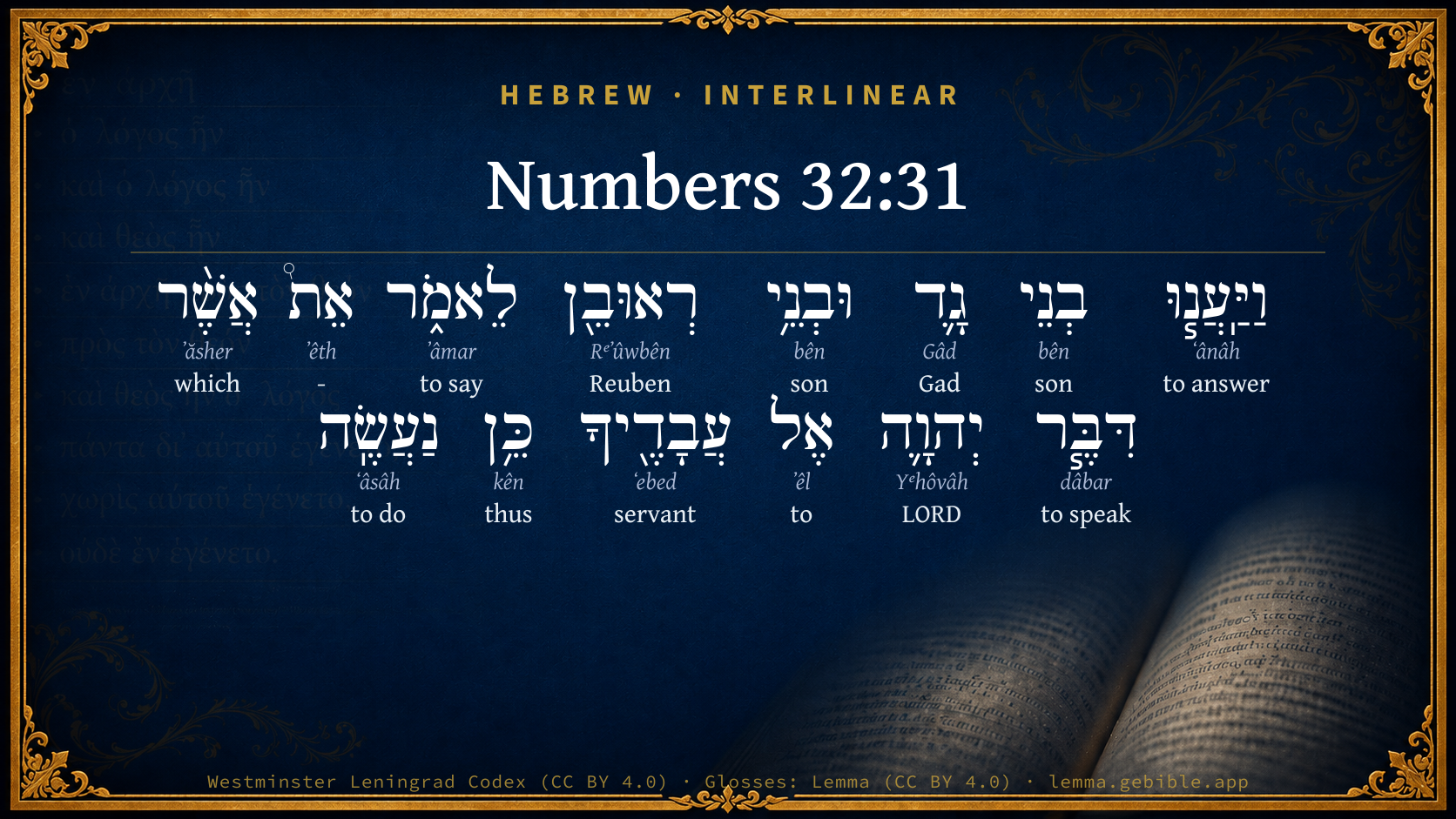
Hebrew (Westminster Leningrad Codex) Numbers 32:31 appears in the Hebrew Old Testament. The text above is from the Westminster Leningrad Codex. Each word links to its Strong’s number, a concise gloss, and parsing drawn from the Open Scriptures Hebrew Bible morphology. Click any word for its full Brown-Driver-Briggs (BDB) entry.
Download image
Cite this verse

Numbers 32:31 (World English Bible). Public Domain. Lemma interlinear Bible study tool, https://lemma.gebible.app/v/numbers/32/31.

Show BibTeX & RIS
BibTeX
RIS
English Translation
The children of Gad and the children of Reuben answered, saying, As Yahweh has said to your servants, so will we do.
World English Bible · Public Domain
Download a study sheet

One document with this verse’s original text, its word-by-word gloss line, the meaning frame, cross-references with their text, attributed commentary, and full source and license credits — printable, and it pastes into notes with its structure intact.

This verse Autodidact and up

Study sheet (.html) Plain text (.txt)

A passage Seminary Student

Up to 50 verses in one chapter. A passage sheet keeps up to 6 commentary sources and 12 cross-references per verse, in the order this page ranks them, and says so on the sheet whenever that leaves anything out. Ask for a single verse and you get the Autodidact verse sheet above.

Everything on this page stays free to read, with no account — the sheet is a download of what is already on screen, not access to it.

Want to remove ads? Support Godless Engineer
Compare translations 3

The same verse in 3 English versions, stacked beneath the original-language interlinear above. Click any original word for its lexicon entry.

Each is an independent rendering of the whole verse — the interlinear is not word-aligned to these translations.

Highlighted words mark where these versions differ — a whole-verse word diff, not a word-by-word alignment.

  • World English Bible Public Domain
    The children of Gad and the children of Reuben answered, saying, As Yahweh has said to your servants, so will we do.
  • King James Version Public Domain
    And the children of Gad and the children of Reuben answered, saying, As the LORD hath said unto thy servants, so will we do.
  • unfoldingWord Literal Text CC BY-SA 4.0
    And the sons of Gad and the sons of Reuben answered, saying, “What Yahweh has spoken to your servants, so we will do.

unfoldingWord Literal Text — © unfoldingWord, licensed CC BY-SA 4.0. Word-aligned USFM3 via Door43 (git.door43.org/unfoldingWord/en_ult).

Versions to compare (up to 4)

3 of 4 selected

Show all 18 translations

Every available English version of this verse, each an independent rendering of the whole verse.

  • World English Bible Public Domain
    The children of Gad and the children of Reuben answered, saying, As Yahweh has said to your servants, so will we do.
  • Berean Standard Bible Public Domain
    The Gadites and Reubenites replied, “As the LORD has spoken to your servants, so we will do.
  • Majority Standard Bible Public Domain
    The Gadites and Reubenites replied, “As the LORD has spoken to your servants, so we will do.
  • King James Version Public Domain
    And the children of Gad and the children of Reuben answered, saying, As the LORD hath said unto thy servants, so will we do.
  • American Standard Version (1901) Public Domain
    And the children of Gad and the children of Reuben answered, saying, As Jehovah hath said unto thy servants, so will we do.
  • Revised Version (1885) Public Domain
    And the children of Gad and the children of Reuben answered, saying, As the LORD hath said unto thy servants, so will we do.
  • Geneva Bible (1599) Public Domain
    And the children of Gad, and the children of Reuben answered, saying, As the Lord hath said vnto thy seruants, so will we doe.
  • Douay-Rheims (1899) Public Domain
    And the children of Gad, and the children of Ruben answered: As the Lord hath spoken to his servants, so will we do:
  • Young's Literal Translation Public Domain
    And the sons of Gad and the sons of Reuben answer, saying, `That which Jehovah hath spoken unto thy servants -- so we do;
  • Literal Standard Version CC BY-SA 4.0
    And the sons of Gad and the sons of Reuben answer, saying, “That which YHWH has spoken to your servants, so we do;
  • Unlocked Literal Bible CC BY-SA 4.0
    So the descendants of Gad and Reuben answered and said, “As Yahweh has said to us, your servants, this is what we will do.
  • unfoldingWord Literal Text CC BY-SA 4.0
    And the sons of Gad and the sons of Reuben answered, saying, “What Yahweh has spoken to your servants, so we will do.
  • Darby Bible Public Domain
    And the children of Gad and the children of Reuben answered, saying, As Jehovah has said to thy servants, so will we do.
  • World Messianic Bible Public Domain
    The children of Gad and the children of Reuben answered, saying, “As the LORD has said to your servants, so will we do.
  • Webster's Bible Public Domain
    And the children of Gad and the children of Reuben answered, saying, As the LORD hath said to thy servants, so will we do.
  • Free Bible Version CC BY-SA 4.0
    The tribes of Gad and Reuben responded, “We will do just as the Lord has told us, your servants.
  • Bible in Basic English Public Domain
    Then the children of Gad and the children of Reuben said, As the Lord has said to your servants, so will we do.
  • JPS Tanakh (1917) Public Domain
    And the children of Gad and the children of Reuben answered, saying: 'As the LORD hath said unto thy servants, so will we do.

Literal Standard Version (2020), Covenant Press — licensed CC BY-SA 4.0. Text via the HelloAO Bible API (eBible.org). Unlocked Literal Bible (unfoldingWord) — licensed CC BY-SA 4.0. Text via the HelloAO Bible API (eBible.org). unfoldingWord Literal Text — © unfoldingWord, licensed CC BY-SA 4.0. Word-aligned USFM3 via Door43 (git.door43.org/unfoldingWord/en_ult). Free Bible Version, Dr. Jonathan Gallagher — licensed CC BY-SA 4.0. Text via the HelloAO Bible API (eBible.org).

Word by word

More ways to search: Search by grammar → Find every occurrence → Compare this word →

Practice this passage: Drill this verse → Learn its vocabulary →

גָ֛ד
Gâd
H1410
“Gad”
Noun, Proper
Part of Speech
Noun
Type
Proper
Full BDB Definition

Origin: from H1464

TWOT: None

Gad = "troop" - seventh son of Jacob by Zilpah, Leah's handmaid, and full brother of Asher. - the tribe descended from Gad - a prophet during the time of David; appears to have joined David when in the hold; reappears in connection with the punishment for taking a census; also assisted in the arrangements for the musical service of the " house of God"
  1. וַיַּֽעֲנ֧וּ ʻânâh H6030 “and · to answer” Conjunction + Verb, Qal, Sequential Imperfect, 3rd Person, Masculine, Plural
  2. בְנֵי bên H1121 “sons of” Noun, Common, Masculine, Plural, Construct
  3. וּבְנֵ֥י bên H1121 “and · sons of” Conjunction + Noun, Common, Masculine, Plural, Construct
  4. רְאוּבֵ֖ן Rᵉʼûwbên H7205 “Reuben” Noun, Proper
  5. לֵאמֹ֑ר ʼâmar H559 “to say” Preposition + Verb, Qal, Infinitive Construct
  6. אֵת֩ ʼêth H853 “-” Particle, Direct Object
  7. אֲשֶׁ֨ר ʼăsher H834 “which” Particle, Relative
  8. דִּבֶּ֧ר dâbar H1696 “to speak” Verb, Piel, Perfect, 3rd Person, Masculine, Singular
  9. יְהוָ֛ה Yᵉhôvâh H3068 “LORD” Noun, Proper
  10. אֶל ʼêl H413 “to” Preposition
  11. עֲבָדֶ֖יךָ ʻebed H5650 “servants · your” Noun, Common, Masculine, Plural, Construct + Suffix, Personal, 2nd Person, Masculine, Singular
  12. כֵּ֥ן kên H3651 “thus” Particle, Demonstrative
  13. נַעֲשֶֽׂה ʻâsâh H6213 “to do” Verb, Qal, Imperfect, 1st Person, Common, Plural

About this verse

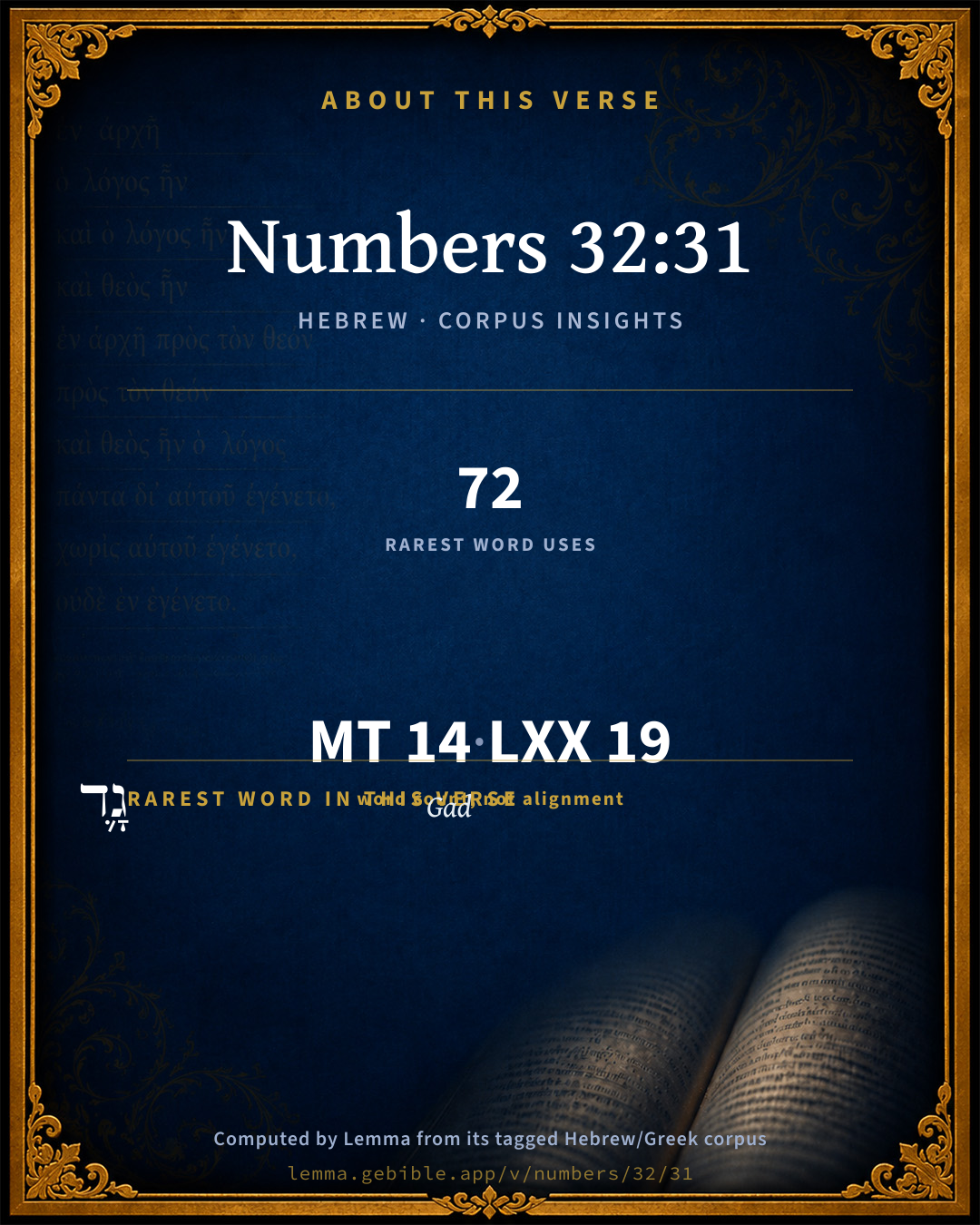
These counts appear in no published source. They are computed here, from the morphology-tagged text and Lemma’s own curated glosses. What Lemma adds →

14
words
13
distinct lemmas
Pentateuch
section

Grammatical profile

  • 4 verbs
  • 6 nouns
  • 1 preposition
  • 3 particles

Verb forms

  • וַיַּֽעֲנ֧וּ Qal · Sequential Imperfect
  • לֵאמֹ֑ר Qal · Infinitive Construct
  • דִּבֶּ֧ר Piel · Perfect
  • נַעֲשֶֽׂה Qal · Imperfect

Repetition

A word recurs within this verse — often emphatic in Hebrew:

  • בְנֵי son H1121 ×2

Hebrew & Septuagint length

In English translation the verse runs 22 words from the Hebrew and 23 from the Septuagint (LXX English) — closely comparable.

A rough comparison of the two English renderings, which tokenize alike — not a word-level alignment.

Word counts can differ between the Hebrew and the Greek without any difference in meaning — e.g. the Hebrew direct-object marker אֵת has no separate Greek word, and Greek often adds the article ὁ.

In the original languages it is 14 Hebrew tokens and 19 Greek tokens — but the two are counted differently (Hebrew bundles its prefixes and suffixes into one token; the Greek is in lemma form), so that isn’t a like-for-like length.

Hebrew and Greek witnesses Masoretic Hebrew ↔ Greek Septuagint

The same verse in the two great witnesses to the Old Testament, shown verse-for-verse.

These are two independent witnesses, not word-aligned to each other, and the Septuagint is shown in lemma (dictionary) form.

Hebrew Numbers 32:31 Masoretic · Westminster Leningrad Codex

וַיַּֽעֲנ֧וּ בְנֵי גָ֛ד וּבְנֵ֥י רְאוּבֵ֖ן לֵאמֹ֑ר אֵת֩ אֲשֶׁ֨ר דִּבֶּ֧ר יְהוָ֛ה אֶל עֲבָדֶ֖יךָ כֵּ֥ן נַעֲשֶֽׂה

The children of Gad and the children of Reuben answered, saying, As Yahweh has said to your servants, so will we do.

World English Bible · Public Domain

Greek LXX Numbers 32:31 Septuagint · lemma form

καί ἀποκρίνω ὁ υἱός ρουβην καί ὁ υἱός γαδ λέγω ὅσος ὁ κύριος λέγω ὁ θεράπων αὐτός οὕτως ποιέω

And the sons of Ruben and the sons of Gad answered, saying, Whatsoever the Lord says to his servants, that will we do.

LXX2012 (modern English Septuagint) · Public Domain

Hebrew: Westminster Leningrad Codex (CC BY 4.0). Greek: Septuagint (public domain); English from LXX2012 (modern English Septuagint) (Public Domain). How the Septuagint differs from the Hebrew →

Targum (Aramaic paraphrase)

2

The Targum is the ancient Jewish Aramaic paraphrase of the Hebrew Scriptures — an interpretive translation, not the Hebrew text itself. Onkelos (literal) and Pseudo-Jonathan (expansive) render the Torah, and Jonathan the Prophets. Coverage is partial: where no permissively-licensed English translation exists for a verse, only the Aramaic is shown. This is verse-level text, not a word-by-word alignment to the Hebrew.

  1. Targum Onkelos Torah (Genesis–Deuteronomy)
    וְאָתִיבוּ בְנֵי גָד וּבְנֵי רְאוּבֵן לְמֵימָר יָת דִי מַלִיל יְיָ לְעַבְדָךְ כֵּן נַעְבֵּד

    (no public-domain English translation for this verse)

    Targum Onkelos — Aramaic: “Onkelos Genesis” (public domain); “Onkelos Exodus” (public domain); “Onkelos Leviticus” (public domain); “Onkelos Numbers” (public domain); “Onkelos Deuteronomy” (public domain). English: “Sefaria Community Translation” (CC0 1.0 (public-domain dedication)); “J.W. Etheridge. The Targums of Onkelos and Jonathan Ben Uzziel on the Pentateuch. London: Longmans, Green, 1862” (public domain). Text via Sefaria.

  2. Targum Pseudo-Jonathan Torah (Genesis–Deuteronomy)
    וְאָתִיבוּ בְנֵי גָד וּבְנֵי רְאוּבֵן וַאֲמָרוּ יַת כָּל דְמַלֵיל יְיָ לְעַבְדָךְ הֵיכְדֵין נַעֲבֵיד

    But the sons of Gad and Reuben answered and said: Whatsoever the Lord hath spoken to thy servants so will we do.

    Targum Pseudo-Jonathan — Aramaic: “Targum Jonathan on Genesis” (public domain); “Targum Jonathan on Exodus” (public domain); “Targum Jonathan on Leviticus” (public domain); “Targum Jonathan on Numbers” (public domain); “Targum Jonathan on Deuteronomy” (public domain). English: “The Targum of Jonathan ben Uzziel, trans. J. W. Etheridge, London, 1862” (public domain). Text via Sefaria.

Commentary

Notes on Numbers 32:31 from classic Christian and Jewish commentators (each source and its license shown beneath its notes). The classic Christian expositions comment on the surrounding passage and are grouped to its opening verse, so a note may address several verses; the Jewish commentaries on the Tanakh (Rashi and others) are per-verse, so they appear only where the commentator wrote on this verse.

Lemma curates 59 commentaries, every one of them public domain or Creative Commons licensed, each selected and text-cleaned for this edition rather than reprinted as found. About our sources →

Tyndale Open Study Notes

Tyndale Open Resources

32:31-32 Gad and Reuben reaffirmed their pledge before all of Israel’s leaders.

Tyndale Open Study Notes — © Tyndale Open Resources, licensed CC BY-SA 4.0. Text via the HelloAO Bible API.

Geneva Bible (1599)

Geneva Bible translators

This is attributed to the Lord, which his messenger speaketh.

Geneva Bible (1599) marginal notes — public domain. Text via Bolls.life.

John Gill's Exposition

And the children of Gad and the children of Reuben answered,...., The word is in the singular number, and shows their unanimity, that they agreed to what Moses said, and replied all of them as one man, as Jarchi expresses it; and it may be there was one that was the mouth of them all, and answered for them:

saying, as the Lord hath said unto thy servants, so will we do; here they make use of the word Jehovah, taking what Moses had said unto them as from the Lord, and therefore should strictly and punctually observe it, as if they heard the Lord himself speak it.

John Gill's Exposition of the Whole Bible (1746–1763) — public domain (CC PDM 1.0). Text via the HelloAO Bible API.

Matthew Poole's English Annotations

As the Lord hath said; either at this time by thy mouth; or formerly, where he commandeth us as well as our brethren to go into Canaan and possess it.

Matthew Poole's English Annotations on the Holy Bible (1683–1685) — public domain. Text from a community e-Sword/MySword module.

John Wesley's Explanatory Notes

As the Lord hath said - Either at this time by thy mouth: or formerly, where he commanded us, as well as our brethren to go into Canaan and possess it.

John Wesley, Explanatory Notes Upon the Whole Bible (1754–1765) — public domain. Text via the GEBible commentary corpus.

Keil & Delitzsch

C. F. Keil & F. Delitzsch

The Gadites and Reubenites repeated their promise once more (Num 32:25), and added still further (Num 32:32): "We will pass over armed before Jehovah into the land of Canaan, and let our inheritance be with us (i.e., remain to us) beyond the Jordan."

Keil & Delitzsch — Biblical Commentary on the Old Testament (1861–1891) — public domain (CC PDM 1.0). Text via the HelloAO Bible API. (Old Testament only.)

unfoldingWord translationNotes

Door43 World Missions Community

We will cross over armed

You can make it clear that they will cross the Jordan. AT: "We will cross over the Jordan ready to fight" (See: Assumed Knowledge and Implicit Information)

our possessed inheritance

The land that the people were to receive as a permanent possession is spoken of as if it were an inheritance that they were to obtain. AT: "the portion of land that we will possess" (See: Metaphor)

will remain with us

This idiom refers to ownership. AT: "will be ours" (See: Idiom)

translationWords

Gad

Reuben

Yahweh

servant

Canaan

inherit

unfoldingWord translationNotes — © Distant Shores Media and the Door43 World Missions Community, licensed CC BY-SA 4.0. Source: git.door43.org/Door43/en_tn.

Ramban (Nachmanides)

Rabbi Moshe ben Nachman (Ramban / Nachmanides)

AND THE CHILDREN OF GAD AND THE CHILDREN OF REUBEN ANSWERED, SAYING: [AS THE ETERNAL HATH SAID UNTO THY SERVANTS, SO WILL WE DO]. 32. WE WILL PASS OVER ARMED. They said to Moses: “Our lord need not command us with a double condition (Verses 29-30). [to cross over the Jordan]. Far be it from your servants to transgress that which my lord commands! For they [i.e., your words] are the words of G-d, and we will not transgress His commandment!” And this is the meaning of the expression, as the Eternal hath said, for at the beginning [i.e., before Moses had made the double condition] they had [already] said that they would do as my lord commanded [hence we must say that here in Verse 31 they were telling Moses there was no need for the double condition, for the reason explained above].

Ramban (Nachmanides) on the Tanakh — English translation: “Commentary on the Torah by Ramban (Nachmanides). Translated and annotated by Charles B. Chavel. New York, Shilo Pub. House, 1971-1976” (CC BY 4.0). Text via Sefaria.

Lesson kit

Teaching starters — assembled from the data on this page, not authored interpretation. Every prompt links to the verse data it draws on. Edit before teaching.

Numbers, in the Pentateuch, opens this verse with 14 words (13 distinct Hebrew lemmas). Its most distinctive word is Gâd (“Gad”). A historical commentator’s framing appears above. Read the whole chapter for the surrounding context.

Discussion questions

  1. The word Gâd carries the sense “Gad.” How does it shape the verse?
  2. What does the repetition of “son” (2× in this one verse) do in this verse?
  3. These translations render this verse differently. What is at stake in choosing one wording over another?
  4. «וַיַּֽעֲנ֧וּ» is a Qal Sequential Imperfect verb. How does that grammatical form shape the action described?
  5. Compare how Tyndale Open Study Notes and Geneva Bible (1599) read this verse. Where do they agree or differ?

Things to notice

Reading settings

Reading text

Shown beneath each verse's original-language words.

Old Testament
Old Testament edition

Read the OT as the Masoretic Hebrew (MT) or the Greek Septuagint (LXX).

English shown for the Greek Septuagint (in the Hebrew ↔ Greek comparison).

Comparing translations? Open the Compare panel on any verse page to stack up to four side by side.