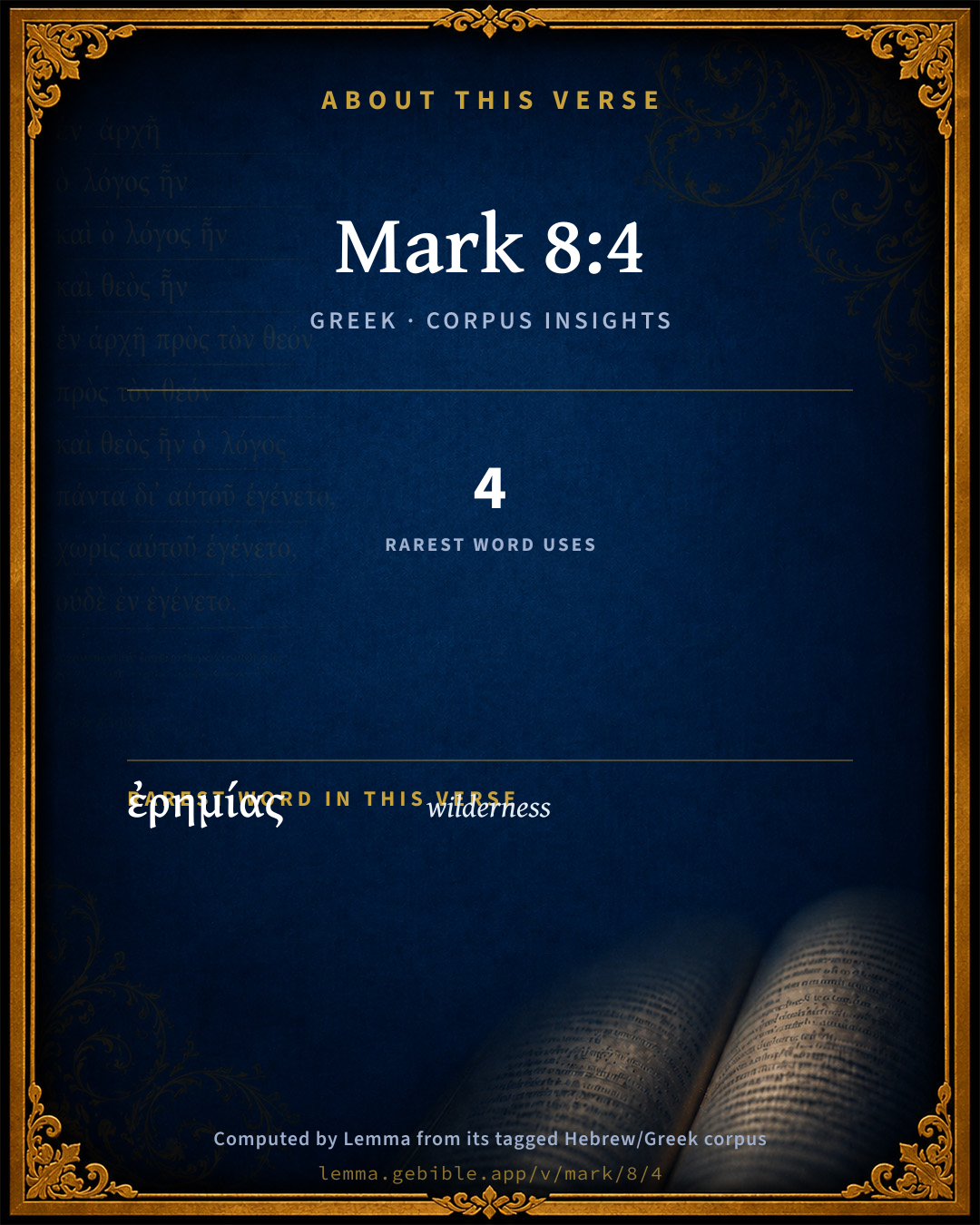
Mark 8:4

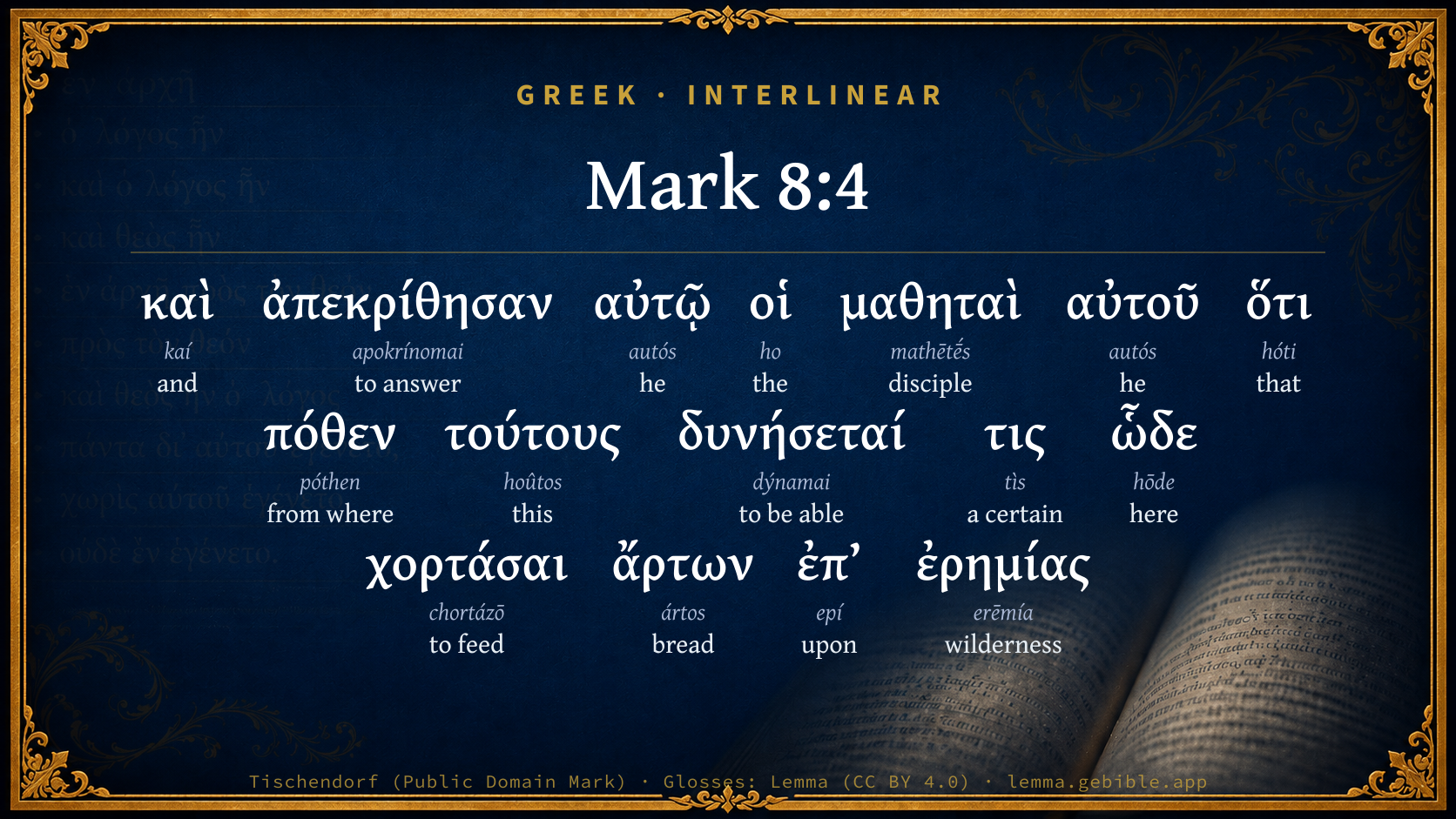
Greek (Tischendorf 8th ed.) Mark 8:4 appears in the Greek New Testament. The text above is from the Tischendorf 8th edition. Each word links to its Strong’s number and a concise gloss. Click any word for its full Thayer’s Greek Lexicon entry.
Download image
Cite this verse

Mark 8:4 (World English Bible). Public Domain. Lemma interlinear Bible study tool, https://lemma.gebible.app/v/mark/8/4.

Show BibTeX & RIS
BibTeX
RIS
English Translation
His disciples answered him, "From where could one satisfy these people with bread here in a deserted place?"
World English Bible · Public Domain
Download a study sheet

One document with this verse’s original text, its word-by-word gloss line, the meaning frame, cross-references with their text, attributed commentary, and full source and license credits — printable, and it pastes into notes with its structure intact.

This verse Autodidact and up

Study sheet (.html) Plain text (.txt)

A passage Seminary Student

Up to 50 verses in one chapter. A passage sheet keeps up to 6 commentary sources and 12 cross-references per verse, in the order this page ranks them, and says so on the sheet whenever that leaves anything out. Ask for a single verse and you get the Autodidact verse sheet above.

Everything on this page stays free to read, with no account — the sheet is a download of what is already on screen, not access to it.

Want to remove ads? Support Godless Engineer
Compare translations 3

The same verse in 3 English versions, stacked beneath the original-language interlinear above. Click any original word for its lexicon entry.

Each is an independent rendering of the whole verse — the interlinear is not word-aligned to these translations.

Highlighted words mark where these versions differ — a whole-verse word diff, not a word-by-word alignment.

  • World English Bible Public Domain
    His disciples answered him, "From where could one satisfy these people with bread here in a deserted place?"
  • King James Version Public Domain
    And his disciples answered him, From whence can a man satisfy these men with bread here in the wilderness?
  • unfoldingWord Literal Text CC BY-SA 4.0
    And his disciples answered him, “From where will anyone be able to satisfy these with loaves here in a desolate place?”

unfoldingWord Literal Text — © unfoldingWord, licensed CC BY-SA 4.0. Word-aligned USFM3 via Door43 (git.door43.org/unfoldingWord/en_ult).

Versions to compare (up to 4)

3 of 4 selected

Show all 19 translations

Every available English version of this verse, each an independent rendering of the whole verse.

  • World English Bible Public Domain
    His disciples answered him, "From where could one satisfy these people with bread here in a deserted place?"
  • Berean Standard Bible Public Domain
    His disciples replied, “Where in this desolate place could anyone find enough bread to feed all these people?”
  • Majority Standard Bible Public Domain
    His disciples replied, “Where in this desolate place could anyone find enough bread to feed all these people?”
  • King James Version Public Domain
    And his disciples answered him, From whence can a man satisfy these men with bread here in the wilderness?
  • American Standard Version (1901) Public Domain
    And his disciples answered him, Whence shall one be able to fill these men with bread here in a desert place?
  • Revised Version (1885) Public Domain
    And his disciples answered him, Whence shall one be able to fill these men with bread here in a desert place?
  • Geneva Bible (1599) Public Domain
    Then his disciples answered him, Whence can a man satisfie these with bread here in the wildernes?
  • Douay-Rheims (1899) Public Domain
    And his disciples answered him: From whence can any one fill them here with bread in the wilderness?
  • Young's Literal Translation Public Domain
    And his disciples answered him, `Whence shall any one be able these here to feed with bread in a wilderness?'
  • Literal Standard Version CC BY-SA 4.0
    And His disciples answered Him, “From where will anyone be able to feed these here in a wilderness with bread?”
  • Unlocked Literal Bible CC BY-SA 4.0
    His disciples answered him, “Where can we get enough loaves of bread in such a deserted place to satisfy these people?”
  • unfoldingWord Literal Text CC BY-SA 4.0
    And his disciples answered him, “From where will anyone be able to satisfy these with loaves here in a desolate place?”
  • Darby Bible Public Domain
    And his disciples answered him, Whence shall one be able to satisfy these with bread here in a desert place?
  • World Messianic Bible Public Domain
    His disciples answered him, “From where could one satisfy these people with bread here in a deserted place?”
  • Webster's Bible Public Domain
    And his disciples answered him, From whence can a man satisfy these men with bread here in the wilderness?
  • Free Bible Version CC BY-SA 4.0
    “Where could anybody find enough bread to feed them here in this wilderness?” answered his disciples.
  • Bible in Basic English Public Domain
    And his disciples said in answer, How will it be possible to get enough bread for these men here in a waste place?
  • Text-Critical English NT CC BY 4.0
    His disciples answered him, “How can anyone feed these people with bread here in the wilderness?”
  • Tyndale New Testament (1534) Public Domain
    And his disciples answered him: where shuld a man have breade here in the wildernes to satisfie these?

Literal Standard Version (2020), Covenant Press — licensed CC BY-SA 4.0. Text via the HelloAO Bible API (eBible.org). Unlocked Literal Bible (unfoldingWord) — licensed CC BY-SA 4.0. Text via the HelloAO Bible API (eBible.org). unfoldingWord Literal Text — © unfoldingWord, licensed CC BY-SA 4.0. Word-aligned USFM3 via Door43 (git.door43.org/unfoldingWord/en_ult). Free Bible Version, Dr. Jonathan Gallagher — licensed CC BY-SA 4.0. Text via the HelloAO Bible API (eBible.org).

Word by word

More ways to search: Search by grammar → Find every occurrence → Compare this word →

Practice this passage: Drill this verse → Learn its vocabulary →

ἐρημίας
erēmía
G2047
“wilderness”
Noun, Genitive, Singular, Feminine
Part of Speech
Noun
Case
Genitive
Number
Singular
Gender
Feminine
Full Thayer's Definition

Origin: from G2048

TDNT: 12:57,3

1. a solitude, an uninhabited region, a waste
  1. καὶ kaí G2532 “and” Conjunction
  2. ἀπεκρίθησαν apokrínomai G611 “to answer” Verb, Aorist, Middle deponent, Indicative, 3rd person, Plural
  3. αὐτῷ autós G846 “he” Personal pronoun, Dative, Singular, Masculine
  4. οἱ ho G3588 “the” Article, Nominative, Plural, Masculine
  5. μαθηταὶ mathētḗs G3101 “disciple” Noun, Nominative, Plural, Masculine
  6. αὐτοῦ autós G846 “he” Personal pronoun, Genitive, Singular, Masculine
  7. ὅτι hóti G3754 “that” Conjunction
  8. πόθεν póthen G4159 “from where” Adverb, Interrogative
  9. τούτους hoûtos G3778 “this” Demonstrative pronoun, Accusative, Plural, Masculine
  10. δυνήσεταί dýnamai G1410 “to be able” Verb, Future, Middle deponent, Indicative, 3rd person, Singular
  11. τις tìs G5100 “a certain” Indefinite pronoun, Nominative, Singular, Masculine
  12. ὧδε hōde G5602 “here” Adverb
  13. χορτάσαι chortázō G5526 “to feed” Verb, Aorist, Active, Infinitive
  14. ἄρτων ártos G740 “bread” Noun, Genitive, Plural, Masculine
  15. ἐπ’ epí G1909 “upon” Preposition

About this verse

These counts appear in no published source. They are computed here, from the morphology-tagged text and Lemma’s own curated glosses. What Lemma adds →

16
words
15
distinct lemmas
Gospels
section

Notable vocabulary

The rarest word here is ἐρημίας wilderness G2047 — appearing just 4 times in the whole Greek New Testament.

Shared distinctive vocabulary

ἐρημίας wilderness G2047 occurs in 4 verses of the Greek New Testament. Also found in:

Repetition

A word recurs within this verse:

  • αὐτῷ he G846 ×2

Cross-references

8

Topical passages linked to Mark 8:4 in the Treasury of Scripture Knowledge — connected by theme and wording, ordered by reader-vote popularity; previews shown in the World English Bible.

  • Matthew 15:33 The disciples said to him, "Where should we get so many loaves in a deserted place as to satisfy so great a multitude?"
  • Mark 6:52 for they hadn't understood about the loaves, but their hearts were hardened.
  • Psalms 78:19–20 Yes, they spoke against God. They said, "Can God prepare a table in the wilderness?
  • Mark 6:36–37 Send them away, that they may go into the surrounding country and villages, and buy themselves bread, for they have nothing to eat."
  • Numbers 11:21–23 Moses said, The people, among whom I am, are six hundred thousand footmen; and you have said, I will give them flesh, that they may eat a whole month.
  • 2 Kings 7:2 Then the captain on whose hand the king leaned answered the man of God, and said, Behold, if Yahweh should make windows in heaven, might this thing be? He said, Behold, you shall see it with your eyes, but shall not eat of it.
  • John 6:7–9 Philip answered him, "Two hundred denarii worth of bread is not sufficient for them, that everyone of them may receive a little."
  • 2 Kings 4:42–44 There came a man from Baal Shalishah, and brought the man of God bread of the first fruits, twenty loaves of barley, and fresh ears of grain in his sack. He said, Give to the people, that they may eat.

Cross-references courtesy of OpenBible.info (CC BY 4.0).

Commentary

Notes on Mark 8:4 from classic Christian and Jewish commentators (each source and its license shown beneath its notes). The classic Christian expositions comment on the surrounding passage and are grouped to its opening verse, so a note may address several verses; the Jewish commentaries on the Tanakh (Rashi and others) are per-verse, so they appear only where the commentator wrote on this verse.

Lemma curates 59 commentaries, every one of them public domain or Creative Commons licensed, each selected and text-cleaned for this edition rather than reprinted as found. About our sources →

Tyndale Open Study Notes

Tyndale Open Resources

8:4 The disciples’ frustration at the situation reveals their dullness. They knew how God provided manna in the wilderness for his people in Moses’ time (Exod 16). They were now in the presence of one far greater than Moses (see Mark 9:5-7) and had recently seen him feed a greater number of people in a similar situation (6:30-44). However, they still did not understand (cp. 6:52). Even so, Jesus worked through them to bring physical and spiritual food to the hungry (8:6-8). What they could not do by themselves, the mighty Son of God would do through them.

Tyndale Open Study Notes — © Tyndale Open Resources, licensed CC BY-SA 4.0. Text via the HelloAO Bible API.

Expositor's Greek Testament

ed. W. Robertson Nicoll

Mar 8:4 . πόθεν , whence? This adverb was used by the Greeks, in speaking of food, in reference to the source of supply πόθεν φάγητε = “unde cibum petituri sitis”. Examples in Kypke, Raphel, Palairet. ἐπʼ ἐρημίας , in a desert. The scene of the first feeding is a desert place also (chap. Mar 6:32 ). But in that case food was purchasable within a reasonable distance; not so here.

The Expositor's Greek Testament, edited by W. Robertson Nicoll (1897–1910) — public domain. Text from a community e-Sword module.

Adam Clarke's Commentary

Verse 4. c.] See on Mt 14:14; Mt 15:35.

Adam Clarke's Commentary on the Bible (1810–1826) — public domain. Text from a community e-Sword/MySword module.

Ellicott's Commentary for English Readers

(4) Satisfy.—The verb is the same as the “filled” of Mar_7:27.

Here in the wilderness.—The word here, as in Mat_15:33, is not the one usually employed, and is abstract, not concrete, in its form, suggesting the idea, i.e., of “loneliness;” and through that, of a lonely place. It is used in a like sense in 2Co_11:26; Heb_11:38. Like many other abstract words, it seems to have tended to a concrete meaning; but there is always an appreciable shade of difference.

A Bible Commentary for English Readers, edited by Charles John Ellicott (1878–1897) — public domain. Text from a community e-Sword module.

The Cambridge Bible for Schools and Colleges

gen. ed. J. J. S. Perowne

4. And his disciples answered him] Though the Apostles are the writers, they do not conceal from us their own shortcomings, or the fact that they had so soon forgotten so great a miracle.

From whence can a man satisfy] It has been suggested that “it is evermore thus in times of difficulty and distress. All former deliverances are in danger of being forgotten; the mighty interpositions of God’s hand in former passages of men’s lives fall out of their memories. Each new difficulty appears insurmountable; as one from which there is no extrication; at each recurring necessity it seems as though the wonders of God’s grace are exhausted and had come to an end.” Comp. (a) Exo_17:1-7, and (b) Exo_16:13 with Num_11:21; Num_11:23. Trench on the Miracles, p. 356. Still it has also been well observed that “many and many a time had the Apostles been with multitudes before, and yet on one occasion only had He fed them. Further, to suggest to Him a repetition of the feeding of the Five Thousand would be a presumption which their ever-deepening reverence forbade, and forbade more than ever as they recalled how persistently He had refused to work a sign, such as this was, at the bidding of others.” Farrar’s Life of Christ, i. p. 480.

The Cambridge Bible for Schools and Colleges (gen. ed. J. J. S. Perowne; Cambridge University Press, 1878–1918) — public domain. Text from a community e-Sword module.

John Gill's Exposition

And his disciples answered him,.... The Syriac version renders it, "say unto him"; and the Persic and Ethiopic, "said unto him"; forgetting the late miracle of feeding five thousand with five loaves and two fishes, when they had now a less number, and more provisions:

from whence can a man satisfy these men with bread here in the wilderness? from what place, and by what ways and means can it be thought, that such a quantity of bread can be got at any rate in a desert, as to satisfy so large a number of hungry men? See Gill on Mat 15:33.

John Gill's Exposition of the Whole Bible (1746–1763) — public domain (CC PDM 1.0). Text via the HelloAO Bible API.

Trapp's Complete Commentary

John Trapp

4 And his disciples answered him, From whence can a man satisfy these men with bread here in the wilderness?

Ver. 4. With bread] That is, with the coarsest fare. Horatius opponit panem libis et placentis, lib. i. eph 10. Bread is used for homely provision.

John Trapp, A Commentary or Exposition upon All the Books of the Old and New Testament (1647–1656) — public domain. Text from a community e-Sword module.

The Pulpit Commentary

Whence shall one be able to fill these men with bread here in a desert place? St. Matthew (Mat_15:33) gives the question thus: "Whence should we have so many loaves in a desert place, as to fill so great a multitude?" The disciples, measuring the difficulty by human reason, thought that it was impossible to find so many loaves in the desert. But Christ in this necessity, when human resources fail, supplies Divine; and meanwhile the disciples" estimate of the impossibility illustrates the grandeur of the miracle.

Whence shall man"s soul be fed?

God"s creatures are altogether and for ever dependent upon him. It is not now and then only that our Creator and Lord interposes upon our behalf, to supply our wants and to relieve our distresses. There are times when we specially recognize, and occasions when we specially feel, his care. But his bounty and watchfulness are, in fact, unceasing. "In him we live, and move, and have our being;" "He openeth his hand, and satisfieth the desires of every living thing." Bread for the body, and bread for the soul, alike are "from him. Our daily bread is his daily gift, and our daily remembrancer of him the Giver. In most cases the provision is so regular, by reason of fruitful seasons, by which he fills us with joy and gladness, that men take the gifts of his providence as a matter of course, and are (in instances) only now and then reminded of their dependence when he withholds his bounties. Our souls equally wait upon him, and to them he also giveth "their portion in due season." The sinless beings above doubtless receive from him abundant spiritual good, in an unceasing stream. If our human spirits are not constantly and of course enriched by his Spirit, it is not that his loving-kindness is little or intermittent; it is because our sin prevents us from receiving what is, to believing, lowly, and obedient natures, ever accessible. There is, accordingly, something altogether special in the supply provided for the deep and everlasting needs of human spirits. The unfallen angels, by reason of their purity, have constant fellowship with God, and doubtless are daily fed from his presence, and drink of the stream of his life. But we poor, sinful children of men need to be dealt with in a way Divine wisdom alone can devise, to suit the emergency of our position. The plenty of the Divine granary must be brought to our perishing souls by a heavenly interposition and grace. It is in Christ Jesus, the Son of the Eternal Father, that the bread of God becomes the bread of man. Needy, and therefore longing for spiritual food; sinful, and therefore unable to obtain and partake of such food, except in the way Infinite wisdom and grace may open up to us, we are in a pitiable case until the beneficent Father sends unto us a heavenly and all-sufficient supply. No fellow-creature can give what our circumstances demand and our nature craves; no fellow-creature can satisfy the necessities of one suppliant, far less those of the unnumbered race of humanity. "From whence can a man satisfy these men with bread here in the wilderness?

I This language suggests THE CRY OF THeE SPIRITUALLY HUNGRY FOR BREAD, Man cannot "live by bread alone." Unless he change his nature, or blunt its urgencies, and stifle its voice, it calls aloud for God. "Far and wide, though all unknowing, Pants for thee each mortal breast; Human tears for thee are flowing, Human hearts in thee would rest.

Oftentimes do men try to misinterpret this utterance, to persuade themselves that it is not God they want; that they are as the brutes, to which due fodder and litter and shelter suffice for satisfaction and enjoyment. When one looks upon the vain endeavours of misguided, self-deluded men, one cannot help crying aloud, in the memorable language of the Hebrew prophet, "Wherefore do ye spend money for that which is not bread, and your labour for that which satisfieth not?" There is a deep-seated longing, a recurring appetite, which prompts all men in whom is any spiritual vitality at all to look for more than earth, than man, can give. We ask for truth, for without truth and especially truth concerning God is no satisfaction possible to the created soul. "Oh that I knew where I might find him! him, my Maker, Lord, and Judge; that I might know why he has made me, why he has stationed me here on earth, what is the purpose of his wisdom concerning me! Mock me not with dust and stones, but give me bread indeed, even the true knowledge of God! And as conscience assures each child of man that, if this God whom he fain would know take any interest in him, he cannot but remark his disobedience and his errors, the heart within calls aloud for the favor and acceptance of the great King. "How shall a man be just with God?" "Wherewithal shall I come into his presence? Will he "lift the light of his countenance" upon me, and be gracious to me? Must my sins be a barrier between me and my God; or can he, will he, overturn and cast them away, and admit me to his grace and fellowship and peace? Turning his regard inward upon himself, and perceiving his own helplessness in the struggle which is not to be avoided, the poor and feeble child of man asks for strength. How shall I gain strength for duty in times of weakness and temptation? How realize the intention of the Creator concerning me, that I shall enter into the conflict, sustain its toils, brave its dangers, and come forth victorious? And when the day of suffering and the night of sorrow come, can the human soul find comfort in the lessons of human philosophy, in the balm of human sympathy? Alas! these cannot suffice. Nor can aught truly soothe and effectually succor the weak and weary, the sad and lonely, the bereaved and dying, save the hand which fashioned the soul and made it susceptible to anguish the heart that, by a Divine sympathy and consolation, heals the wounds that it permits. And when "heart and flesh fail," who but the Creator and Saviour can prove "the Strength of the heart, and its Portion for evermore"? No human plummet can fathom the river all must cross, no human hand uphold the feeble, trembling feet amidst the dark, cold waters. Be sure of this: as long as man retains a nature higher than that of brutes that perish, so long as his heart is subject to grief, his life is surrounded by trouble, his nature prone to sin; so long he will ever and anon cry out for supernatural succor and comfort, and call upon his God. Spiritual hunger is no fancy of the sentimental, no artificial demand of the leisurely and cultivated. It is a fact a fact which (however it may be regarded) is not to be denied, and without considering which, our view of our human nature and our knowledge of ourselves must needs be incomplete and delusive. Bread for his soul man will ask for, and, unless he have it, he will hunger, pine, and perish!

II This language suggests THE SILENCE OF THE WILDERNESS TO THIS APPEAL. Out beyond the Lake of Tiberius, away from towns and villages, in the solitudes of the green hillsides, how was the want of the multitude to be supplied? Blades of grass were not ears of corn, stones were not bread. "Here in the wilderness" was no answer to the demand of the hungering none! The wilderness could only leave those to perish who trusted to its tender mercies. An emblem of the world"s powerlessness to meet the case of our spiritually dependent and hungering race! The world is the scene of our trial and proving, the occasion of our manifold temptations. Of what use is it to look to it for sympathy, succor, strength, and salvation? It cannot satisfy you, search and prove it how you may. Is that rich and luscious fruit that hangs from yonder bough? Alas! it is the apple of the Dead Sea, dust and ashes between the teeth. Is that a lake of sweet, pellucid waters which gleams in the glowing sun in yonder hollow? Alas! it is the mirage of the desert, which mocks the thirsty travelers, offering them sand for water. So with the pretences of the world to satisfy the hungering soul. These pretences are vanity and delusion. Equally vain to help, though more honest, is the world, when its response is otherwise. It sometimes acknowledges its utter powerlessness: none to help, none to pity, none to deliver and to save I Whilst some who reject and despise the message of religion abandon themselves to selfish and worldly aims, and seek to still the voice of conscience and to repress the aspirations of the soul in the pursuits of pleasure, pelf, or power, there are others in whose breasts is no peace and no hope. They cry aloud in the wilderness; but no answer comes to them, save the mocking echoes from the hard, dead rock. No truth, no law, no grace, no hope, no heaven, no God! Such is their interpretation of the echoes of the desert. And we cannot wonder that, incredulous of every higher, better message, they abandon themselves to doubt, despondency, despair. From this cheerless and desolate prospect, let us turn to facts fitted to gladden every depressed and anxious heart.

III The language suggests to us THE DIVINE PROVISION OF THE BREAD OF LIFE. When the disciples of Jesus asked him this question, "Whence shall one be able to satisfy these men with bread here in the wilderness?" they must have been thinking of their own inability. For they could not have forgotten how, not far from this very spot and not long since, their Master had fed five thousand men with five loaves and two fishes. If they had been there without him, they might have been as helpless as they were when the father of the lunatic boy brought his son into their presence, and entreated their compassion and aid. But the Lord Jesus was himself the answer to this inquiry. He had but to bless the bread, and distribute it by the hands of the disciples, and, for even so vast a multitude, there was "bread enough and to spare." Thousands were fed when Jesus was the Master of the feast. No miracles were more evidently and decisively than these of feeding the thousands, parables concerning Christ himself. St. John has recorded the discourse which our Saviour uttered in Capernaum, in which Jesus asserted his own mission and office and power. "My Father," said he, "giveth you the true Bread from heaven. For the Bread of God is he which cometh down from heaven, and giveth life unto the world.... I am the Bread of life: he that cometh to me shall never hunger; and he that believeth on me shall never thirst." In this language our Divine Lord evidently referred to that marvellous incident in the history of Israel when the wants of the people were supplied by daily provision of manna in the wilderness. More especially he brought before the minds of his hearers the great fact that the supply of human wants is due to the grace and interposition of God himself. Bread does not come to us from the wilderness, but it comes to us in the wilderness; and it is the Father above who sends it none but he! Obviously, the figurative language in which Christ describes himself appeals to our best, purest, most sacred feelings. God is the Father, who will not leave his children without bread. He cares for his spiritual family, considers their wants, hears their cry, and in his wisdom and love secures for them all that he sees to be for their good. Our Lord Jesus Christ is himself the Divine provision for the needs of men. "He that eateth the flesh, and drinketh the blood of Christ, has life eternal." For it must be borne in mind that the heavenly Father who has given us his Son, has in him virtually given us all the resources of his boundless compassion and grace. "He who spared not his own Son, but delivered him up for us all, how shall he not with him also freely give us all things?" Do our hearts cry aloud for spiritual truth? God gives us this in Christ, who is himself the Truth the revelation of the Father"s mind and will. The heart that finds "Immanuel God with us," finds God himself for Christ is "the brightness of the Father"s glory reads the writing of God"s own hand, hears the utterances of Truth Divine. "He that hath seen me," says Christ, "hath seen the Father." Is our heart restless until assured of the forgiveness and the favor of our God? Hungry for the smile of Heaven, does it turn heavenward a wistful gaze? God in Christ gives us this first great necessity of the sinful soul. Jesus came to call sinners to repentance, but he came at the same time to assure the penitent of pardon the purchase of his precious blood. What bread is to the hungry, that is pardon to the contrite, humbled, suppliant transgressor. And this is the gift of Christ, who came with "power on earth to forgive sins." Do we feet an inner craving for a strength which we do not find within ourselves for a power which shall uphold us in the labour and the conflict of this earthly life? Not only to know the will of God but to do it this is the want of man"s soul. Power to do this is bread to his hungering nature. Do you not, indeed, when you best know yourselves, feel that truly to live you must have strength to live to God? And who but God himself can impart this strength? It is given in Jesus. Eat of this bread, and labour shall be sweet and work welcome. His meat and drink was to do the will of him who sent him, and to finish his work. And in his people is "the mind of Christ." Does not the sorrowful i and tempted soul the soul oppressed by the infirmities of the flesh and the ills of life hunger for a consolation not to be found from the wilderness? Who of us has not felt this, in seasons of grief and anxiety? Surely, God knows the heart which he has fashioned; he reads its laments, he witnesses its struggles, he comprehends its fears. It was to allay our anxiety, to assuage our griefs, that Jesus dwelt on earth, wept our tears, tasted the bitterness of our death; that he might be a "High Priest touched with the feeling of our infirmities." As long as "man is born to sorrow," so long shall the "Man of sorrows, acquainted with grief," be the dearest Friend the heart can know. Jesus is a "brother born for adversity." "But what to those who find? Ah! this Nor tongue nor pen can show; The love of Jesus, what it is None but his loved ones know,

IV This language suggests THE SATISFACTION FOUND BY THOSE WHO PARTAKE OF THIS SPIRITUAL FOOD. We read in the Gospel that, when the great Lord of nature and of men miraculously supplied the wants of the hungering crowds," they did all eat, and were filled." In this they prefigured all who, in every land and age, should feed by faith upon the Son of God. Of him it may truly be said, "He filleth the hungry soul with goodness." Three remarks may be made upon the power of the Lord Jesus to appease the spiritual hunger and to supply the spiritual wants of men. He is sufficient for each, sufficient for all, sufficient for evermore. Each soul, however drawn or driven to Christ driven by the desperation of want, or drawn by the excellence and abundance of the Divine supply finds in him all that he himself has promised. To believe, to trust, to love, to follow Christ, this is to appropriate him, to prove and learn his Divine sufficiency. "He that cometh to me," says Jesus," shall never hunger; and he that believeth on me shall never thirst." The same faith which first reveals Christ to the soul, and stays its hunger, is the means of attaching the soul to Christ and the means by which the soul finds in him all the fullness of God. For he of God is made unto his people "wisdom and righteousness, sanctification and redemption." The bounty of the Lord Jesus is unrestricted. As the vast multitude of his auditors were fed by his beneficence as men, women, and children all ate and had enough, so that basketsful of fragments were taken up so throughout this wide world its teeming and varied populations are all destined to find in him the Saviour of mankind. "I," said he, "if I be lifted up from the earth, will draw all men unto me." Untold myriads have feasted at the table of Christ, and none have risen hungry and dissatisfied. Still have the ministers of his grace the privilege of announcing to the starving children of men, there is room." Come ye in, that the guests may be many and the tables filled. "Eat ye that which is good, and let your soul delight itself in fatness. Still further to enhance the conception of the preciousness of the great salvation, let it be remembered that it is an unfailing, an everlasting, an imperishable satisfaction which is to be found in Jesus Christ. He that eats of earthly bread and drinks of earthly streams hungers and thirsts again; but he who, by Divine mercy, feeds on heavenly food and drinks of the living water hungers and thirsts no more. For him is provided a perpetual feast, an immortal satisfaction and content. Generation succeeds generation, and age follows age. The experience of humanity is prolonged from century to century. Opportunity is given to every system, to every creed, to every philosophy, to deal with the deep and spiritual necessities of mankind. As one attempt of human wisdom succeeds another, and as each fails in its turn, we hear in our soul within us the cry arise, suggested by human effort and by human powerlessness, "From whence can a man satisfy these men with bread here in the wilderness?" There is no answer. None has been given; none can be given. Happy are we who hear a voice, Divine alike in sweetness and authority, rising above the plaint of the hungry, or breaking the silence of the baffled and the helpless, and uttering forth the welcome declaration of pity and of love, "I am the Bread of life"! And happier still if, convinced of the sincerity and the power of this Divine and compassionate Benefactor, prompted by our human need, and guided by the Spirit of God, we respond, in faith and gratitude and poise, "Lord, evermore give us this Bread"!

The Pulpit Commentary (1880–1919), ed. H.D.M. Spence-Jones & Joseph S. Exell — public domain. Text from a community e-Sword module.

Kretzmann's Popular Commentary

Paul E. Kretzmann

The miracle:

v. 4. And His disciples answered Him, From whence can a man satisfy these men with bread here in the wilderness?

v. 5. And He asked them, How many loaves have ye? And they said, Seven.

v. 6. And He commanded the people to sit down on the ground; and He took the seven loaves, and gave thanks, and brake, and gave to His disciples to set before them; and they did set them before the people.

v. 7. And they had a few small fishes; and He blessed, and commanded to set them also before them.

v. 8. So they did eat and were filled; and they took up of the broken meat that was left seven baskets.

v. 9. And they that had eaten were about four thousand; and He sent them away.

The disciples again failed in the test proposed to them by the Lord, whether from diffidence or from hardness of heart cannot be determined. Instead of reminding Him in joyful faith of the former feeding at a place only a few miles away, they begin to cast about for a solution of the difficulty, in utter helplessness: Whence will anyone find it possible, here in the wilderness, to supply all these men with bread? There were, in this case, not even villages or towns within easy reach where supplies might be gotten. It is a question which has been repeated in countless variations since that time. "The apostles also worry, but in a far different way than Christ; they say: Whence can we obtain bread here in the wilderness to satisfy them? That is worrying; but this worrying does not help the matter. But, on the other hand, when Christ takes up the matter of the people and plans about getting them something to eat, though there are only seven loaves there and a: little fish, it still proves sufficient for four thousand men, and seven baskets of fragments remain... How is it, then, that we, who are all Christians or want to be considered such, do not follow this example, neither comfort ourselves with our fullness and surplus, but are terrorized on account of want, and begin to worry on its account? For if we adhere to the Word of God diligently and faithfully, there will be no want; Christ will take care of us, and it must follow that we shall have enough to eat. For it does not depend upon how much or how little we have, but upon His blessing. If He adds that to the small store that thou hast, this will not only not dissolve, but on account of His blessing there will be added to it and be more there than in the beginning. "

In this case the disciples had a supply of seven loaves, very likely the bread for their own use. Jesus now took charge of the banquet which He wanted to prepare for the multitude. He bade them all cast themselves down on the ground. The inviting grass of the former miracle seems to have been absent in this case. He then proceeded as before. Taking the seven. loaves and having spoken a blessing over them, He broke them and gave them to His disciples to distribute among the people. Note: Christ never began a meal without remembering the thanks due to the Giver of all good gifts and asking His blessing upon the food. "Here He teaches first that we should use what God gives us, no matter how little it is, and accept it with thanksgiving, and know that Christ also wants to bless it that it may prosper and suffice, yea, even grow under our hands; for that is well-pleasing to Him when His gifts are acknowledged and thanks returned for them, and He adds His blessing that this prospers better and reaches farther than great riches and superfluous goods of the unbelievers, as also the Scripture says, Psa 37:16; Pro 10:22; 1Ti 6:6. For, what have they that possess many and great goods without faith and Christ, and what do they gain? They only deprive themselves of God and of His blessing, are idolaters, the captives of mammon, that dare not make use of their own goods nor let others use it, or they do not use it with a good conscience, neither are they happy over the bite that they eat on account of their avarice and bad conscience, in which they have only one thought, to scrape together more and more with all manner of bad deals and schemes, and yet must always be worrying and in danger that they will have no peace before God and the people, must hear and see much and experience things that make their heart sick, in their great possessions and in their own children; and thus they have thrown themselves into the bonds of the devil and pierced themselves through with many sorrows, as the apostle says, from which they cannot escape. "

As Jesus was breaking the bread and dividing the little fish that had been found among the supplies, the food grew under His hand. As often as the disciples returned for more, so often could He offer it to them, and they, in turn, passed it to the people. So they all partook of the meal, and they all had their fill to eat; not one was obliged to remain hungry, though there were four thousand men that had enjoyed Christ’s hospitality. And again the Lord, in the spirit of food conservation which is advocated throughout Scriptures, had the multitude gather up the remainders of the broken pieces, which could well be used for food, and they filled seven large baskets of the kind that were used in that country for carrying large loads on the back. It is not stated whether the people knew the manner in which they were fed on this occasion, nor what effect the knowledge had upon them, if they knew. And even the disciples remained comparatively callous, as the Lord soon had occasion to find out. If people let the constant repetition of the great miracles of Christ in the means of grace deaden their sensibilities, they are working great harm to themselves; the compassion, the mercy, the faithfulness of the Lord is new every morning.

Paul E. Kretzmann, Popular Commentary of the Bible (1921–1924) — public domain. Text from a community e-Sword module.

Cambridge Greek Testament for Schools and Colleges

4. As in Mar 4:21, ὅτι is omitted in most authorities, but is probably original ([1596][1597][1598]).

[1596] Codex Vaticanus. 4th cent., but perhaps a little later than א. In the Vatican Library almost since its foundation by Pope Nicolas V., and one of its greatest treasures. The whole Gospel, ending at Mar 16:8. Photographic facsimile, 1889.

[1597] Codex Regius. 8th cent. An important witness. At Paris. Contains Mar 1:1 to Mar 10:15; Mar 10:30 to Mar 15:1; Mar 15:20 to Mar 16:20, but the shorter ending is inserted between Mar 16:8 and Mar 16:9, showing that the scribe preferred it to the longer one.

[1598] Codex Sangallensis. 9th or 10th cent. Contains the Gospels nearly complete, with an interlinear Latin translation. The text of Mark is specially good, agreeing often with CL. At St Gall.

4. ὅτι Πόθεν. The ὅτι is recitative; see crit. note. Syr-Sin. has “Whence art Thou able?” The disciples’ question is urged as an argument for regarding this miracle as a doublet of Mar 6:34-44. Could the disciples, who had seen how the 5000 were fed, have made such a reply? They would have said, “Thou canst feed them.” Their question diffidently suggests this; they confess their own powerlessness and leave the solution to Him. Note the emphatic ἡμῖν in Mt. “How can we have enough food?” Moreover, Christ does not rebuke them. They were still dull of apprehension (Mar 8:16), and were sometimes afraid to ask questions (Mar 9:32).

Χορτάσαι ἄρτων. Cf. τοὺς πτωχοὺς αὐτῆς χορτάσω ἄρτων (Psa 132:15). The gen. after verbs of filling is freq. (Mar 15:36). Blass, § 36. 4.

ἐρημίας. Cf. 2Co 11:26; Heb 11:38. The more usual term is ἡ ἔρημος or ἔρημος τόπος.

Cambridge Greek Testament for Schools and Colleges (Cambridge University Press, 1896; 21 vols, various authors incl. Carr, Maclear, Plummer, Farrar, Lumby, Moule, M. R. James, Simcox) — public domain. Text from a community e-Sword module.

International Critical Commentary

4. Ὅτι πόθεν τούτους δυνήσεταί τις ὥδε χορτάσαι ἄρτων ἐπʼ ἐρημίας;—Whence will any one be able to feed these with bread here in the wilderness? This failure of the disciples to recall the previous miracle is one of the really strong reasons for doubting the repetition of the miracle. The objection is valid; the stupid repetition of the question is psychologically impossible. But this does not disprove the repetition of the miracle, only this incident in it. All things considered, it is very much more probable that the accounts got mixed in this particular, than that one miracle should be multiplied into two. So Meyer. χορτάσαι5 ἐπʼ ἐρημίας—literally, on a desert place; i.e. an uninhabited place, where there are no supplies to be bought.

International Critical Commentary — older volumes (1896–1929), various authors — public domain. Text from a community e-Sword module.

Lesson kit

Teaching starters — assembled from the data on this page, not authored interpretation. Every prompt links to the verse data it draws on. Edit before teaching.

Mark, in the Gospels, opens this verse with 16 words (15 distinct Greek lemmas). Its most distinctive word is erēmía (“wilderness”). A historical commentator’s framing appears above. Read the whole chapter for the surrounding context.

Discussion questions

  1. How does “wilderness” (erēmía) shape what this verse is saying?
  2. How does Matthew 15:33, which shares the word «wilderness», read alongside this verse?
  3. What does the repetition of “he” (2× in this one verse) do in this verse?
  4. These translations render this verse differently. What is at stake in choosing one wording over another?
  5. Compare how Tyndale Open Study Notes and Expositor's Greek Testament read this verse. Where do they agree or differ?

Things to notice

Reading settings

Reading text

Shown beneath each verse's original-language words.

Old Testament
Old Testament edition

Read the OT as the Masoretic Hebrew (MT) or the Greek Septuagint (LXX).

English shown for the Greek Septuagint (in the Hebrew ↔ Greek comparison).

Comparing translations? Open the Compare panel on any verse page to stack up to four side by side.