Luke 9:49

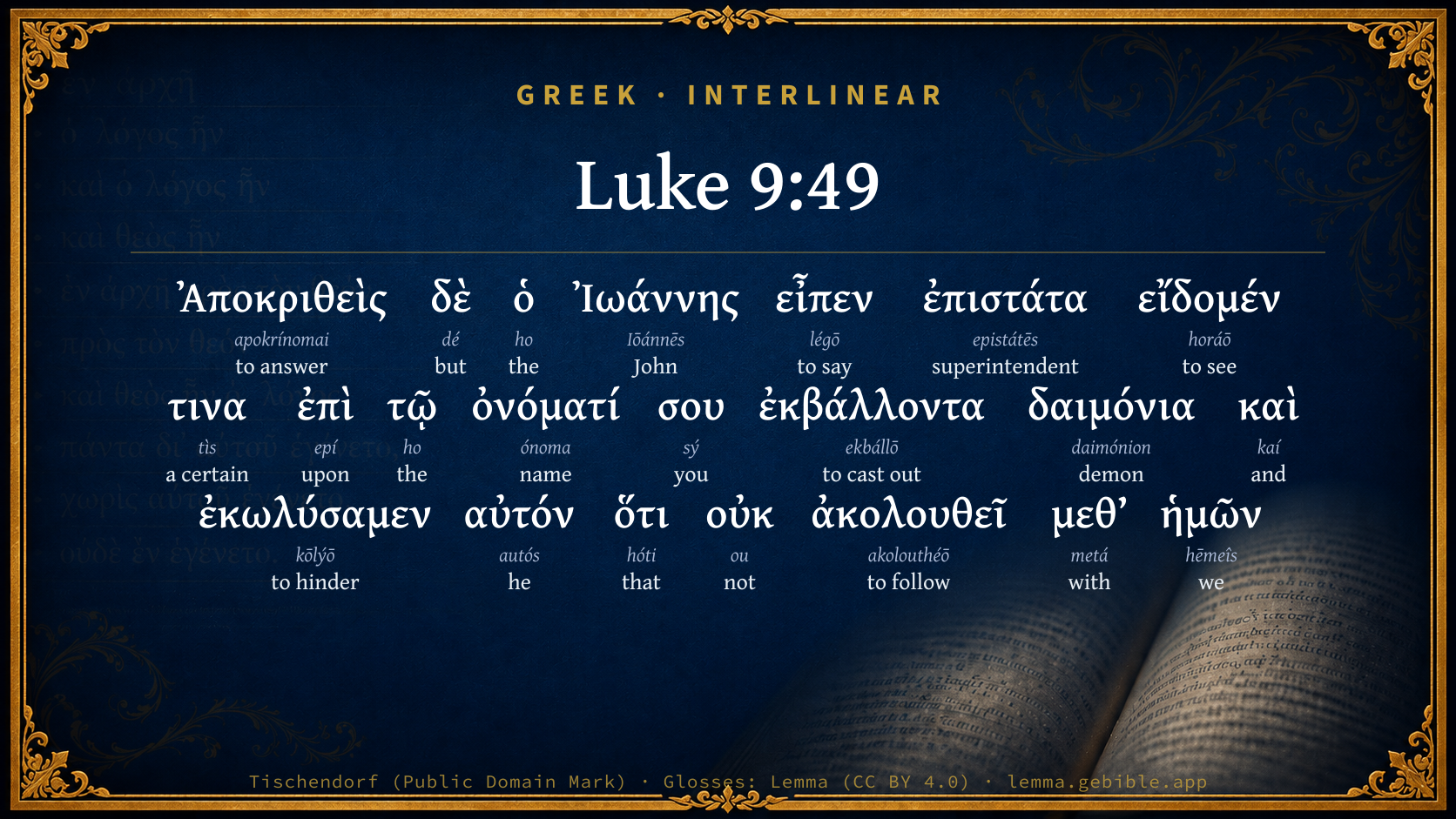
Greek (Tischendorf 8th ed.) Luke 9:49 appears in the Greek New Testament. The text above is from the Tischendorf 8th edition. Each word links to its Strong’s number and a concise gloss. Click any word for its full Thayer’s Greek Lexicon entry.
Download image
Cite this verse

Luke 9:49 (World English Bible). Public Domain. Lemma interlinear Bible study tool, https://lemma.gebible.app/v/luke/9/49.

Show BibTeX & RIS
BibTeX
RIS
English Translation
John answered, "Master, we saw someone casting out demons in your name, and we forbade him, because he doesn't follow with us."
World English Bible · Public Domain
Download a study sheet

One document with this verse’s original text, its word-by-word gloss line, the meaning frame, cross-references with their text, attributed commentary, and full source and license credits — printable, and it pastes into notes with its structure intact.

This verse Autodidact and up

Study sheet (.html) Plain text (.txt)

A passage Seminary Student

Up to 50 verses in one chapter. A passage sheet keeps up to 6 commentary sources and 12 cross-references per verse, in the order this page ranks them, and says so on the sheet whenever that leaves anything out. Ask for a single verse and you get the Autodidact verse sheet above.

Everything on this page stays free to read, with no account — the sheet is a download of what is already on screen, not access to it.

Want to remove ads? Support Godless Engineer
Compare translations 3

The same verse in 3 English versions, stacked beneath the original-language interlinear above. Click any original word for its lexicon entry.

Each is an independent rendering of the whole verse — the interlinear is not word-aligned to these translations.

Highlighted words mark where these versions differ — a whole-verse word diff, not a word-by-word alignment.

  • World English Bible Public Domain
    John answered, "Master, we saw someone casting out demons in your name, and we forbade him, because he doesn't follow with us."
  • King James Version Public Domain
    And John answered and said, Master, we saw one casting out devils in thy name; and we forbad him, because he followeth not with us.
  • unfoldingWord Literal Text CC BY-SA 4.0
    Then answering, John said, “Master, we saw someone casting out demons in your name and we were preventing him, because he does not follow with us.”

unfoldingWord Literal Text — © unfoldingWord, licensed CC BY-SA 4.0. Word-aligned USFM3 via Door43 (git.door43.org/unfoldingWord/en_ult).

Versions to compare (up to 4)

3 of 4 selected

Show all 19 translations

Every available English version of this verse, each an independent rendering of the whole verse.

  • World English Bible Public Domain
    John answered, "Master, we saw someone casting out demons in your name, and we forbade him, because he doesn't follow with us."
  • Berean Standard Bible Public Domain
    “Master,” said John, “we saw someone driving out demons in Your name, and we tried to stop him, because he does not accompany us.”
  • Majority Standard Bible Public Domain
    “Master,” said John, “we saw someone driving out demons in Your name, and we tried to stop him, because he does not accompany us.”
  • King James Version Public Domain
    And John answered and said, Master, we saw one casting out devils in thy name; and we forbad him, because he followeth not with us.
  • American Standard Version (1901) Public Domain
    And John answered and said, Master, we saw one casting out demons in thy name; and we forbade him, because he followeth not with us.
  • Revised Version (1885) Public Domain
    And John answered and said, Master, we saw one casting out devils in thy name; and we forbade him, because he followeth not with us.
  • Geneva Bible (1599) Public Domain
    And Iohn answered and saide, Master, we sawe one casting out deuils in thy Name, and we forbad him, because he followeth thee not with vs.
  • Douay-Rheims (1899) Public Domain
    And John, answering, said: Master, we saw a certain man casting out devils in thy name, and we forbade him, because he followeth not with us.
  • Young's Literal Translation Public Domain
    And John answering said, `Master, we saw a certain one in thy name casting forth the demons, and we forbade him, because he doth not follow with us;'
  • Literal Standard Version CC BY-SA 4.0
    And John answering said, “Master, we saw a certain one casting forth the demons in Your Name, and we forbade him, because he does not follow with us”;
  • Unlocked Literal Bible CC BY-SA 4.0
    John answered, “Master, we saw someone forcing out demons in your name and we prevented him, because he does not follow along with us.”
  • unfoldingWord Literal Text CC BY-SA 4.0
    Then answering, John said, “Master, we saw someone casting out demons in your name and we were preventing him, because he does not follow with us.”
  • Darby Bible Public Domain
    And John answering said, Master, we saw some one casting out demons in thy name, and we forbad him, because he follows not with us.
  • World Messianic Bible Public Domain
    Yochanan answered, “Master, we saw someone casting out demons in your name, and we forbade him, because he doesn’t follow with us.”
  • Webster's Bible Public Domain
    And John answered and said, Master, we saw one casting out demons in thy name; and we forbad him, because he followeth not with us.
  • Free Bible Version CC BY-SA 4.0
    John spoke up, saying, “Master, we saw someone driving out demons in your name and we tried to stop him because he wasn't one of us.”
  • Bible in Basic English Public Domain
    And John, answering, said, Master, we saw a man driving out evil spirits in your name, and we did not let him do it, because he was not one of us.
  • Text-Critical English NT CC BY 4.0
    John responded, “Master, we saw someone casting out demons in yoʋr name, and we told him to stop because he does not follow us.”
  • Tyndale New Testament (1534) Public Domain
    And Iohn answered and sayde: Master we sawe one castinge out devyls in thy name and we forbade him because he foloweth not with vs.

Literal Standard Version (2020), Covenant Press — licensed CC BY-SA 4.0. Text via the HelloAO Bible API (eBible.org). Unlocked Literal Bible (unfoldingWord) — licensed CC BY-SA 4.0. Text via the HelloAO Bible API (eBible.org). unfoldingWord Literal Text — © unfoldingWord, licensed CC BY-SA 4.0. Word-aligned USFM3 via Door43 (git.door43.org/unfoldingWord/en_ult). Free Bible Version, Dr. Jonathan Gallagher — licensed CC BY-SA 4.0. Text via the HelloAO Bible API (eBible.org).

Word by word

More ways to search: Search by grammar → Find every occurrence → Compare this word →

Practice this passage: Drill this verse → Learn its vocabulary →

ἐπιστάτα
epistátēs
G1988
“superintendent”
Noun, Vocative, Singular, Masculine
Part of Speech
Noun
Case
Vocative
Number
Singular
Gender
Masculine
Full Thayer's Definition

Origin: from G1909 and a presumed derivative of G2476

TDNT: 12:22,2

1. any sort of superintendent or overseer
  1. Ἀποκριθεὶς apokrínomai G611 “to answer” Verb, Aorist, Passive deponent, Participle, Nominative, Singular, Masculine
  2. δὲ dé G1161 “but” Conjunction
  3. ὁ ho G3588 “the” Article, Nominative, Singular, Masculine
  4. Ἰωάννης Iōánnēs G2491 “John” Noun, Nominative, Singular, Masculine
  5. εἶπεν légō G3004 “to say” Verb, Aorist, Active, Indicative, 3rd person, Singular
  6. εἴδομέν horáō G3708 “to see” Verb, Aorist, Active, Indicative, 1st person, Plural
  7. τινα tìs G5100 “a certain” Indefinite pronoun, Accusative, Singular, Masculine
  8. ἐπὶ epí G1909 “upon” Preposition
  9. τῷ ho G3588 “the” Article, Dative, Singular, Neuter
  10. ὀνόματί ónoma G3686 “name” Noun, Dative, Singular, Neuter
  11. σου sý G4771 “you” Personal pronoun, 2nd person, Genitive, Singular
  12. ἐκβάλλοντα ekbállō G1544 “to cast out” Verb, Present, Active, Participle, Accusative, Singular, Masculine
  13. δαιμόνια daimónion G1140 “demon” Noun, Accusative, Plural, Neuter
  14. καὶ kaí G2532 “and” Conjunction
  15. ἐκωλύσαμεν kōlýō G2967 “to hinder” Verb, Aorist, Active, Indicative, 3rd person, Plural
  16. αὐτόν autós G846 “he” Personal pronoun, Accusative, Singular, Masculine
  17. ὅτι hóti G3754 “that” Conjunction
  18. οὐκ ou G3756 “not” Particle, Negative
  19. ἀκολουθεῖ akolouthéō G190 “to follow” Verb, Present, Active, Indicative, 3rd person, Singular
  20. μεθ’ metá G3326 “with” Preposition
  21. ἡμῶν hēmeîs G2249 “we” Personal pronoun, 1st person, Genitive, Plural

About this verse

These counts appear in no published source. They are computed here, from the morphology-tagged text and Lemma’s own curated glosses. What Lemma adds →

22
words
21
distinct lemmas
Gospels
section

Notable vocabulary

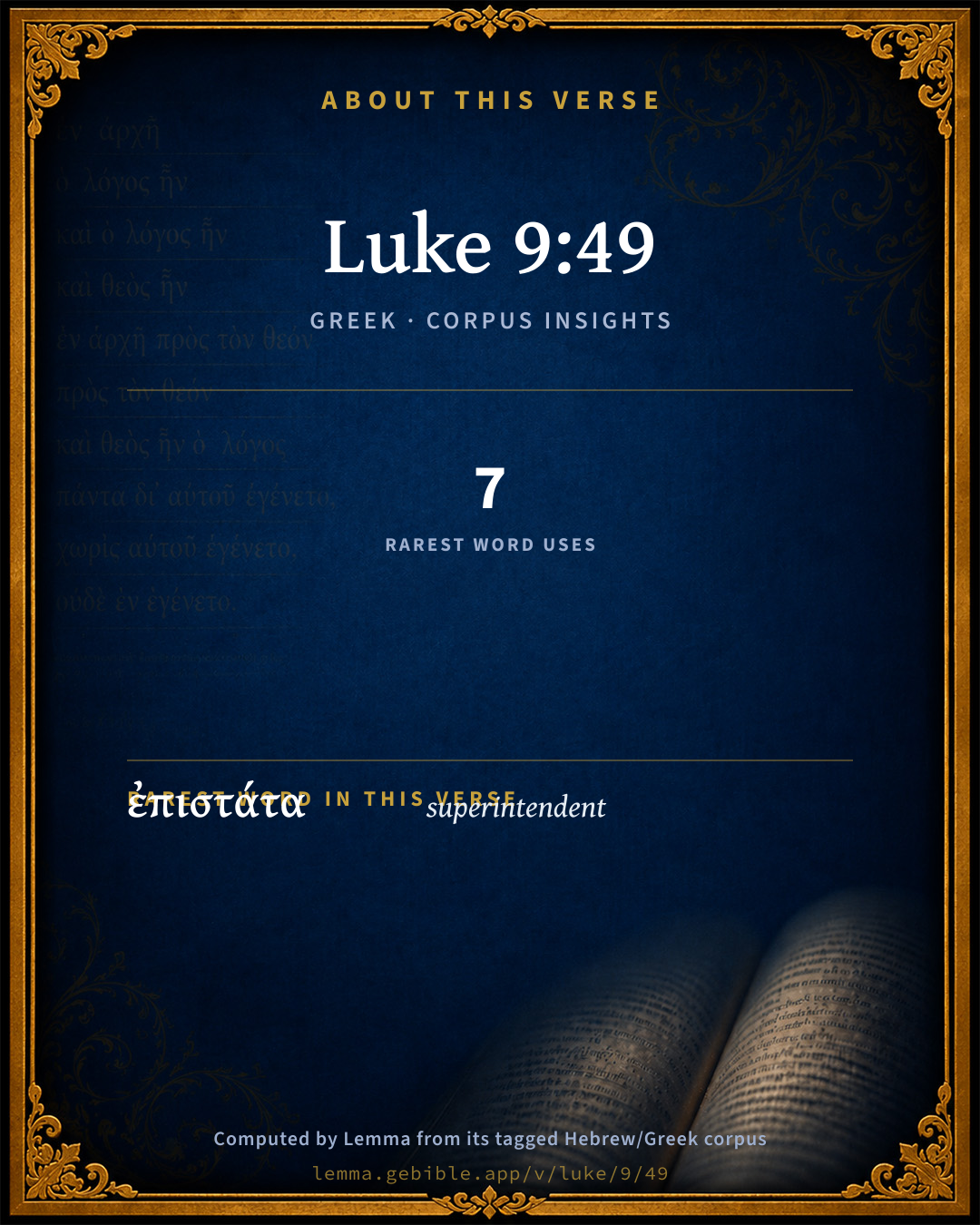
The rarest word here is ἐπιστάτα superintendent G1988 — appearing just 7 times in the whole Greek New Testament.

Shared distinctive vocabulary

ἐπιστάτα superintendent G1988 occurs in 6 verses of the Greek New Testament. Also found in:

Repetition

A word recurs within this verse:

Cross-references

3

Topical passages linked to Luke 9:49 in the Treasury of Scripture Knowledge — connected by theme and wording, ordered by reader-vote popularity; previews shown in the World English Bible.

  • Mark 9:38–40 John said to him, "Teacher, we saw someone who doesn't follow us casting out demons in your name; and we forbade him, because he doesn't follow us."
  • Numbers 11:27–29 There ran a young man, and told Moses, and said, Eldad and Medad do prophesy in the camp.
  • Mark 10:13–14 They were bringing to him little children, that he should touch them, but the disciples rebuked those who were bringing them.

Cross-references courtesy of OpenBible.info (CC BY 4.0).

Commentary

Notes on Luke 9:49 from classic Christian and Jewish commentators (each source and its license shown beneath its notes). The classic Christian expositions comment on the surrounding passage and are grouped to its opening verse, so a note may address several verses; the Jewish commentaries on the Tanakh (Rashi and others) are per-verse, so they appear only where the commentator wrote on this verse.

Lemma curates 59 commentaries, every one of them public domain or Creative Commons licensed, each selected and text-cleaned for this edition rather than reprinted as found. About our sources →

The Biblical Illustrator

Joseph S. Exell

Luk_9:49-50

Forbid him not

Casting out devils

This, one of the shortest of the recorded conversations of Jesus, contains but a single remark made in response to a single statement of the disciples.

I. JESUS WAS HERE DEALING WITH THAT HARDEST CONDITION IN WHICH WRONG AND RIGHT ARE MIXED TOGETHER. There was good in the jealousy of the disciples for Jesus, even though it misled them. There was evil in the narrowness into which it led them. There were four people involved:

1. The man out of whom the devil was being cast. To him the interference of the disciples must have seemed a cruel thing.

2. The man who was casting out the evil spirit. We can understand his bewilderment. Shall I refrain from doing this thing which it is so evident that I have power to do?

3. The disciples. No doubt they were men who rejoiced to see any good work done in the world, and yet they bade this man to cease the work he was doing.

4. Behind all, Jesus Himself, looking upon the whole transaction, and declaring at once, without any hesitation, forbid him not.

II. IS THIS A STORY OF THE CENTURIES AGO, OR IS IT NOT THE STORY OF WHAT IS ALWAYS TAKING PLACE? Wherever Christian men, in very virtue of their loyalty to Christ, incline to limit the operations of His power in the world, there are these four.

III. EVERYTHING THAT IS GOING ON IN THE WORLD MUST BE PLACED EITHER UPON ONE SIDE OR THE OTHER SIDE. Everything that is making the world better is on the side of Christ. Everything that is degrading humanity is against Christ. How clear this principle is! How Jesus is always pointing us to the great test of results.

IV. THIS TEST APPLIED--

1. To our personal lives.

2. To our fellowship with Churches around us. There is only one way in which we shall enter into such sympathy with Jesus that we can have His large spirit, and that is by catching that which was in His mind, His soul, the intense value He set upon the end. He rejoices so in the driving out of the devil that any one who would drive out the devil should have His commendation and His praise, His permission to do it, and His thanksgiving that it had been done. (Phillips Brooks, D. D.)

Need for toleration

Seeing a tree grow somewhat irregular in a very neat orchard, says Mr. Flavel, I told the owner it was a pity that that tree should stand there, and that if it were mine I would root it up, and thereby reduce the orchard to an exact uniformity. He replied, that he rather regarded the fruit than the form, and that this slight inconvenience was abundantly preponderated by a more considerable advantage. This tree, which you would root up, hath yielded me more fruit than many of those trees which have nothing else to recommend them but their regular situation. I could not, adds Mr. Flavel, but yield to the reason of this answer, and could wish it had been spoken so loud that all our conformity men had heard it, who would not stick to root up many hundreds of the best learners in the Lords orchard because they stand not in exact order with other more conformable but less beneficial trees, who destroy the fruit to preserve the form. Such, alas, is the prejudice of our minds, that we are too prone to condemn those who do not view things exactly as we do. We lay down plans and rules for ourselves, and then blame others if they do not follow them. Too often also are we mistaken in our opinions of others, and imagine that they are only cumberers of the ground, when probably they bring forth the fruits of righteousness in greater abundance than ourselves. (W. Buck.)

The Biblical Illustrator, edited by Joseph S. Exell (c. 1880s–1900s) — public domain. Text from a community e-Sword module.

Godbey's Commentary on the New Testament

William B. Godbey

BIGOTRY OF THE APOSTLE JOHN

Luk 9:49-50; Mar 9:38-41. “And John responded to Him, saying, Teacher we saw a certain one casting out devils in Thy name who does not follow us, and we forbade him, because he does not follow us. And Jesus said, Prevent him not. For there is no one who shall work a miracle in My name who will be able quickly to speak evil of Me [as he will have to backslide first]. For whosoever is not against us, is on our side. And whosoever may give you a cup of water in the name of Christ, because you are His, truly, I say unto you, He shall not lose his reward.” There is no doubt but John was the first disciple of our Lord, and during His entire ministry honored, with Peter and James, on the Mount of Transfiguration the resurrection of Jairus’s daughter, and in Gethsemane. Besides, he was even epitheted the “loving disciple,” habitually sitting close by His side, and even leaning on His bosom. That he was characteristic of pre-eminent spirituality from the beginning, growing on him through his long and useful life, till his writings are swelling rivers of love, sweeping down from heaven, the source of his inspiration, can not be doubted. Though he is the speaker on this occasion, making his own confession, you see he includes his comrades, authenticating the conclusion that those apostles actually did forbid that man to cast out demons in the name of Jesus, because he did not follow them. That man deserved their prayers and their encouragement, as well as their cooperation. He was no bogus worker, but was actually casting out the demons. Now, what is the conclusion? They most imperatively needed the fiery baptism of Pentecost, to burn up their bigotry and sectarian prejudice. Read John’s Gospel, Epistles, and Apocalypse, all of which are swelling rivers of love, and you can not find a solitary vestige of sectarian bigotry or ecclesiastical ostracism.

William B. Godbey, Commentary on the New Testament (1896–1900) — public domain. Text from a community e-Sword module.

Bengel's Gnomon

Johann Albrecht Bengel

Luk 9:49. Ὁ Ἰωάννης, John) Comp. concerning this Luk 9:54, [where, along with his brother James, he likewise evinced extraordinary zeal after the glorification on the mount.—V. g.]

Bengel's Gnomon of the New Testament — English translation (T&T Clark, Edinburgh, 1860) — public domain. Text from a community e-Sword module.

Expositor's Greek Testament

ed. W. Robertson Nicoll

Luk 9:49 . ἐκωλύσαμεν (T. R.), aorist, instead of Mk.’s imperfect; the former implies successful repression, the latter an attempt at it. Vide notes on Mk., ad loc. μεθʼ ἡμῶν : Phrynichus objects to this construction after ἀκολουθεῖν , and says it should be followed by the dative. But Lobeck gives examples of the former construction from good authors ( vide p. 353).

Chapter 9, as Farrar remarks (C. G. T.), should have ended here, as with Luk 9:51 begins an entirely distinct, large, and very important division of Lk.’s Gospel.

The Expositor's Greek Testament, edited by W. Robertson Nicoll (1897–1910) — public domain. Text from a community e-Sword module.

Godet's Commentaries

Frédéric Louis Godet

3 d. The Dissenting Disciple: Luk 9:49-50.

Only in some very rare cases does John play an active part in the Gospel history. But he appears to have been at this time in a state of great excitement; comp. the incident which immediately follows (Luk 9:54 et seq.), and another a little later (Mat 20:20 et seq.). He had no doubt been one of the principal actors in the incident related here by himself, and which might very easily have had some connection with the dispute which had just been going on. The link of connection is more simple than criticism imagines. The importance which Jesus had just attributed to His name in the preceding answer, makes John fear that he has violated by his rashness the majesty of this august name. When once in the way of confession, he feels that he must make a clean breast of it. This connection is indicated by the terms ἀποκριθείς (Luke) and ἀπεκρίθη (Mark). This incident, placed here in close connection with the preceding, helps us to understand some parts of the lengthened discourse, Matthew 18, which certainly belongs to this period. These little ones, whom care must be taken not to offend (Luk 9:6), whom the good Shepherd seeks to save (Luk 9:11-13), and of whom not one by God’s will shall perish (Luk 9:14), are doubtless beginners in the faith, such as he was towards whom the apostles had shown such intolerance. Thus it very often happens, that by bringing together separate stones scattered about in our three narratives, we succeed in reconstructing large portions of the edifice, and then, by joining it to the Gospel of John, the entire building.

The fact here mentioned is particularly interesting. “We see,” as Meyer says, “that even outside the circle of the permanent disciples of Jesus there were men in whom His word and His works had called forth a higher and miraculous power; these sparks, which fell beyond the circle of His disciples, had made flames burst forth here and there away from the central fire.” Was it desirable to extinguish these fires? It was a delicate question. Such men, though they had never lived in the society of Jesus, acquired a certain authority, and might use it to disseminate error. With this legitimate fear on the part of the Twelve there was no doubt mingled a reprehensible feeling of jealousy. They no longer had the monopoly of the work of Christ. Jesus instantly discerned this taint of evil in the conduct which they had just pursued.

In Luke, as in Mark, instead of the aor. ἐκωλύσαμεν, we forbade him, some MSS. read the imperf. ἐκωλύομεν: “We were forbidding him, and thought we were doing right; were we deceived?” Their opposition was only tentative, inasmuch as Jesus had not sanctioned it. This is the preferable reading.

The answer of Jesus is full of broad and exalted feeling. The divine powers which emanate from Him could not be completely contained in any visible society, not even in that of the Twelve. The fact of spiritual union with Him takes precedence of social communion with the other disciples. So far from treating a man who makes use of His name as an adversary, he must rather be regarded, even in his isolated position, as a useful auxiliary.

Of the three readings offered by the MSS. in Luk 9:50, and which are also found in Mark (against you—for you; against you—for us; against us—for us), it appears to me that we must prefer the first: “He who is not against you, is for you.” The authority of the Alex. MSS., which read in this way, is confirmed by that of the ancient versions, the Italic and the Peschito, and still more by the context. The person of Jesus is not in fact involved in this conflict,—is it not in His name that the man acts? As a matter of fact, it is the Twelve who are concerned: “he followeth not with us;” this is the grievance (Luk 9:49). It is quite different in the similar and apparently contradictory saying (Luk 11:23; Mat 12:30): “He who is not with me, is against me.” The difference between these two declarations consists in this; in the second case, it is the personal honour of Jesus which is at stake. He opposes the expulsions of demons, which He effects, to those of the Jewish exorcists. These latter appear to be labouring with Him against a common enemy, but really they are strengthening the enemy. In the application which we might make of these maxims at the present day, the former would apply to brethren who, while separated from us ecclesiastically, are fighting with us for the cause of Christ; whilst the latter would apply to men who, although belonging to the same religious society as ourselves, are sapping the foundations of the gospel. We should have the sense to regard the first as allies, although found in a different camp; the others as enemies, although found in our own camp.

Mark introduces between the two parts of this reply a remarkable saying, the import of which is, that no one need fear that a man who does such works in the name of Jesus will readily pass over to the ranks of those who speak evil of Him, that is to say, of those who accuse Him of casting out devils by Beelzebub. After having invoked the name of Jesus in working a cure, to bring such an accusation against Jesus would be to accuse himself.

Nowhere, perhaps, is the fitting of the Syn. one into the other, albeit quite undesigned, more remarkable. In Matthew the words, without the occasion of them (the dispute between the disciples); in Luke the incident, with a brief saying having reference to it; in Mark the incident, with some very graphic and much more circumstantial details than in Luke, and a discourse which resembles in part that in Matthew, but differs from both by omissions and additions which are equally important. Is not the mutual independence of the three traditional narratives palpably proved?

Frédéric Louis Godet — Commentaries on Luke, John, Romans, and 1 Corinthians — English translation (T&T Clark, Edinburgh, 1870s–1890s) — public domain. Text from a community e-Sword module.

Geneva Bible (1599)

Geneva Bible translators

Extraordinary things are neither rashly to be allowed, nor condemned.

Geneva Bible (1599) marginal notes — public domain. Text via Bolls.life.

Jamieson, Fausset & Brown

Robert Jamieson, A. R. Fausset & David Brown

John answered, &c.--The link of connection here with the foregoing context lies in the words "in My name" (Luk 9:48). "Oh, as to that," said John, young, warm, but not sufficiently apprehending Christ's teaching in these things, "we saw one casting out devils in Thy name, and we forbade him: Were we wrong?" "Ye were wrong." "But we did because he followeth not us,'" "No matter. For (1) There is no man which shall do a miracle in My name that can lightly [soon] speak evil of Me' [Mar 9:39]. And (2) If such a person cannot be supposed to be 'against us,' you are to consider him 'for us.'" Two principles of immense importance. Christ does not say this man should not have followed "with them," but simply teaches how he was to be regarded though he did not--as a reverer of His name and a promoter of His cause. Surely this condemns not only those horrible attempts by force to shut up all within one visible pale of discipleship, which have deluged Christendom with blood in Christ's name, but the same spirit in its milder form of proud ecclesiastic scowl upon all who "after the form which they call a sect (as the word signifies, Act 24:14), do so worship the God of their fathers." Visible unity in Christ's Church is devoutly to be sought, but this is not the way to it. See the noble spirit of Moses (Num 11:24-29).

Jamieson, Fausset & Brown — Commentary Critical and Explanatory on the Whole Bible (1871) — public domain (CC PDM 1.0). Text via the HelloAO Bible API.

Adam Clarke's Commentary

Verse 49. We forbade him] See this subject considered on Mr 9:38, &c.

Adam Clarke's Commentary on the Bible (1810–1826) — public domain. Text from a community e-Sword/MySword module.

Ellicott's Commentary for English Readers

(49) And John answered and said.—See Notes on Mar_9:38-41, the narrative being common to these two Gospels only.

Master.—The same word as in Luk_5:5; Luk_8:24.

A Bible Commentary for English Readers, edited by Charles John Ellicott (1878–1897) — public domain. Text from a community e-Sword module.

The Cambridge Bible for Schools and Colleges

gen. ed. J. J. S. Perowne

49, 50. The Tolerance of Jesus.

49. And John answered and said] Mar_9:38-41. This sudden question seems to have been suggested by the words “in my name” which Jesus had just used.

casting out devils in thy name] It was common among the Jews to attempt exorcism by many different methods; see on Luk_4:35; Luk_4:41; Luk_8:32. This unknown person—like the sons of Sceva in Act_19:13-14, but evidently in a more faithful spirit—had found that the name of Jesus was more powerful. Specimens of Jewish exorcisms are given inthe Jewish Book of Jubilees, and in Shabbath,67; Pesachim, f. 112 a, b; see too Tob_6:16-17; Jos. B. J. vii. 6, § 3.

we forbad him] Compare the jealous zeal of Joshua against Eldad and Medad, and the truly noble answer of Moses, Num_11:27-29.

because he followeth not with us] This touch of intolerant zeal is quite in accordance with the natural disposition which shews itself in the incident of Luk_9:54, and with the story that St John rushed out of a bath in which he saw the heretic Cerinthus. It was this burning temperament that made him a “Son of Thunder.”

The Cambridge Bible for Schools and Colleges (gen. ed. J. J. S. Perowne; Cambridge University Press, 1878–1918) — public domain. Text from a community e-Sword module.

John Gill's Exposition

And sent messengers before his face,.... Who very likely were his two disciples, James and John, since they so highly resented the ill treatment their master met with from the Samaritans:

and they went; before him:

and entered into a village of the Samaritans; or "city", as the Vulgate Latin, Persic, and Ethiopic versions read, and so one of Stephens's copies; which lay in the way from Galilee to Judea, where the disciples had been forbid to enter, that is, in order to preach, Mat 10:5

To make ready for him; to prepare a lodging, and proper food for him and his disciples, as they passed on in their journey, for his intention was not to make any stay there.

John Gill's Exposition of the Whole Bible (1746–1763) — public domain (CC PDM 1.0). Text via the HelloAO Bible API.

Trapp's Complete Commentary

John Trapp

47 And Jesus, perceiving the thought of their heart, took a child, and set him by him,

48 And said unto them, Whosoever shall receive this child in my name receiveth me: and whosoever shall receive me receiveth him that sent me: for he that is least among you all, the same shall be great.

49 And John answered and said, Master, we saw one casting out devils in thy name; and we forbad him, because he followeth not with us.

Ver. 49. See Mar 9:38.

John Trapp, A Commentary or Exposition upon All the Books of the Old and New Testament (1647–1656) — public domain. Text from a community e-Sword module.

Haydock's Catholic Bible Commentary

We forbade him. St. John having the most love for his Lord, and being particularly beloved by him, thought all were to be excluded from these gifts, who were not obedient to his divine Master. (St. Augustine) --- But we must remember, that not the minister is the author of these miracles, but the grace which is in him, who performs these wonders by virtue of the power of Christ. (St. Cyril) --- How wonderful is the power of Christ, who by his grace works miracles in the persons of the unworthy, and those that are not disciples; as men are sanctified by the priest, though the priest should not be in the state of grace! (Theophylactus)

George Leo Haydock (1774–1849), Haydock's Catholic Family Bible and Commentary, 1859 edition — public domain. Excludes Psalms (Douay-Rheims chapter numbering differs from Protestant) and Deuterocanonical books (Catholic canon only).

Matthew Poole's English Annotations

Mark saith further, that Christ added, for there is no man, which shall do a miracle in my name, that can lightly speak evil of me: See Poole on "Mar 9:38", See Poole on "Mar 9:39".

Matthew Poole's English Annotations on the Holy Bible (1683–1685) — public domain. Text from a community e-Sword/MySword module.

The Pulpit Commentary

Vers. 49, 50. A question put by John.

And John answered and said, Master, we saw one casting out devils in thy Name; and we forbad him, because he followeth not with us. The character of John is a strangely interesting one. With the exception of his forming one of the chosen three who were in a peculiar manner received into their Master"s confidence, John seldom appears, during the public ministry of Christ, to have played a prominent part. Many years had to elapse before he attained that unique position of influence in the early Church which no one seems to have disputed. In the mean time, his character was slowly forming. Fiery and impetuous, although reserved and retiring, it seemed in these first days scarcely probable that such a nature would ever deepen or ripen into that John who became the world-teacher of his Master"s love. St. Luke here records two circumstances which suggested some of the Master"s important teaching, in both of which John plays the prominent part. The question of John was evidently suggested by Jesus" words spoken in connection with his teaching respecting little ones. "Whosoever," said the Master, "shall receive this child in my Name. " But John and others had just been sternly rebuking some one not of their company, who had been using, to some effect evidently, that same Master"s Name, which possessed, as John saw, wondrous power. Had he and his friends been doing right in rebuking the comparative stranger for using a Name which Jesus, in his words just spoken, seemed to regard as the common property of kindly devout men? Meyer remarks here that outside the company of disciples of Jesus there were, even then, men in whose hearts, his teaching and acts had evoked a higher and even a supernatural power. Certain sparks which had fallen here and there beyond the little circle of his own, kindled flames occasionally away from the central fire." Those who were ever close to the Master seemed to dread lest, if these were allowed unchecked to teach and to work in the Name, grave error might be disseminated. Some natural jealousy of these outsiders no doubt influenced men like John in their wish to confine the work in the limits of their own circle.

Vers. 49, 50. Exclusiveness and neutrality the forbidden and the impossible thing.

We do well to take together this passage and that of Luk_11:23. For one is the complement of the other. "He that is not against us is for us;" "He that is not with me is against me; and he that gathereth not with me scattereth." There is not the slightest inconsistency between these two declarations of our Lord. One states one truth, and the other a different one. They teach successively

I THAT WE ARE IN DANGER OF COUNTING AMONG OUR OPPONENTS THOSE WHOM WE SHOULD RECKON AS ALLIES. It did not seem to be a service of any particular account that a man should use the name of Jesus to exorcise demons, even though he may have had a measure of success in his attempts. But Christ said he was not to be "forbidden" as an outsider, but rather hailed as a friend and as an ally. What, then, would he not say now of those who go so far towards the fullest declaration of his truth as many thousands do, but who remain outside the particular Church with which we may be connected? Would he have us blame and brand these because they "follow not with us"? The spirit of persecution is cruel, foolish, and emphatically unchristian. Rather let us rejoice that there are found so many who, while not feeling it right to connect themselves with our organization, are yet loving the same Lord and serving the same cause. These are not our enemies; they are our allies.

II THAT WE CANNOT WITHHOLD OUR EARNEST THOUGHT AND DELIBERATE CHOICE FROM CHRIST without being counted by him as his enemies. "He that is not with me is against me," etc. There is no neutrality in the great campaign now being fought out between sin and righteousness. In great European wars it is customary for generals and correspondents from other countries, not involved in the strife, to attend the movements and watch the operations of the armies; they, of course, are strictly neutral. But in this great spiritual campaign we cannot be mere spectators; we must be soldiers fighting on one side or on the other. For we are all deeply involved; we are implicated in what is past; we are interested in the issue; we have great responsibilities resting on us; we have great things at stake. God is addressing himself to every one of us, and it is not open to any of us to refuse to take up a decisive attitude in regard to the subjects of his address.

1. He speaks to us of himself. He makes himself known to us as our Creator, our Preserver, our generous Benefactor; he makes his appeal to us as our Divine Father, who earnestly desires our return to his home that he may bless us with his parental love. Can we possibly remain unaffected by this? Is not our very silence a most grievous offence and injury? Not to respond to him is to sin grievously against him.

2. He comes to us in the Person of his Son Jesus Christ. And he offers himself to us as the Redeemer who at the greatest possible price has wrought out our redemption, as the Divine Friend in the shelter of whose love and power we may spend our days, as the Source of our eternal life. Can we possibly take up a position toward him in which we are neither one thing nor another neither enemy nor subject? Can we do other than either accept him or reject him?

3. He summons us to his service, and to the service of our kind. We are to be "living epistles," making known his truth, revealing to men the goodness of God, the grace of Christ, the excellency of his service. We are to bear witness unto him. Either our life is witnessing for him and for his truth, or our influence is thrown into the other scale. Those who know us are either being attracted toward Christ through all they see and know about us, or they are being repelled. We cannot be cyphers, try how we may. Our lives are telling on one side or on the other. Either we gather with Christ or we scatter abroad. We must make our choice. C.

The Pulpit Commentary (1880–1919), ed. H.D.M. Spence-Jones & Joseph S. Exell — public domain. Text from a community e-Sword module.

John Wesley's Explanatory Notes

Mark ix, 38.

John Wesley, Explanatory Notes Upon the Whole Bible (1754–1765) — public domain. Text via the GEBible commentary corpus.

Kretzmann's Popular Commentary

Paul E. Kretzmann

An interruption by John:

v. 49. And John answered and said, Master, we saw one casting out devils in Thy name; and we forbade him because he followeth not with us.

v. 50. And Jesus said unto him, Forbid him not; for he that is not against us is for us.

The claim has been made that this is an unnatural transition, and that this incident is in the false place. But it fits very nicely. The present subject was by no means a pleasant one, and John thought by introducing this story he would change the subject and also earn some commendation. John tells the Lord that either on their missionary journey or more recently, some of them, probably he and James, had seen a man casting out devils in the name of Jesus. They had promptly resented and forbidden this as an interference with their rights and as an insult to their Master. But Jesus instructs them differently. It was far better for the exorcists to be using His name than to be relying upon incantations of devils. The chances were that this man Believed in Jesus as the Messiah, but he had not yet gained the understanding that he ought to join the disciples of Jesus and follow after Him, thus confessing his faith before men. Just the same, he did not hinder, but furthered, so far as he was concerned, the work of Jesus. This judgment of Christ contains an instruction for all of us to have patience with our weak brethren and sisters. They have faith in their hearts and confess the name of Jesus, but are not yet so far advanced as to be on a level with established Christians. But the Lord will give them further enlightenment, and it is not for us to set limits too arbitrarily.

Paul E. Kretzmann, Popular Commentary of the Bible (1921–1924) — public domain. Text from a community e-Sword module.

Burkitt's Expository Notes on the New Testament

William Burkitt

Observe here, 1. St. John’s relation of a matter of fact to our Saviour; namely, his forbidding one to cast out devils in Christ’s name, that did not follow Christ as they did; for though only the disciples which followed Christ had a commission to work miracles, yet were there others, no enemies to Christ, who, in imitation of his disciples, did attempt to do the like; and God was pleased, for the honor of his Son, in whose name they cast out devils, to give them sometimes success.

Observe, 2. The action of the disciples towards this person: We forbade him, because he followed not with us.

Where is observable, their rashness in forbidding him of their own heads, before they had consulted Christ about it; and their envy, and emulation, in that they were grieved and discontented that good was done, because they did not do it. It is as hard a matter to look upon the gifts of others without envy, as it is to look upon our own without pride.

Observe, 3. Our Saviour’s reply: Forbid him not. Because our Saviour knew, that this action of casting out devils in his name would some ways redound to his glory, although he undertook the matter without direction from Christ. We ought not to censure and condemn those, who do that which is good in itself, though they fail in the manner of their doing it.

William Burkitt's Expository Notes on the New Testament (1700–1703) — public domain. Text from a community e-Sword module.

unfoldingWord translationNotes

Door43 World Missions Community

John answered

"In reply, John said" or "John replied to Jesus." John was responding to what Jesus had said about being the greatest. He was not answering a question.

we saw

John speaks of himself but not Jesus, so "we" here is exclusive. (See: Exclusive and Inclusive "We")

in your name

This means the person was speaking with the power and authority of Jesus. (See: Metonymy)

Do not stop him

This can be stated positively. AT: "Allow him to continue"

whoever is not against you is for you

Some modern languages have sayings that mean the same thing. AT: "if a person does not keep you from working, it is as if he were helping you" or "if someone is not working against you, he is working with you"

translationWords

John (the apostle)

lord

demon

Jesus

unfoldingWord translationNotes — © Distant Shores Media and the Door43 World Missions Community, licensed CC BY-SA 4.0. Source: git.door43.org/Door43/en_tn.

Cambridge Greek Testament for Schools and Colleges

49–50. THE TOLERANCE OF JESUS

49. ἀποκριθεὶς δὲ ὁ Ἰωάννης εἶπεν. Mar 9:38-41. This sudden question seems to have been suggested by the words ‘in my name,’ which Jesus had just used.

ἐπὶ τῷ ὀνόματί σου ἐκβάλλοντα δαιμόνια. It was common among the Jews to attempt exorcism by many different methods; see on Luk 4:35; Luk 4:41; Luk 8:32. This unknown person—like the sons of Sceva in Act 19:13-14, but evidently in a more faithful spirit—had found that the name of Jesus was more powerful. Specimens of Jewish exorcisms are given in the Jewish Book of Jubilees, and in Shabbath, 67; Pesachim, f. 112 a, b; see too Tob 6:16-17; Jos. B. J. VII. 6, § 3.

ἐκωλύσαμεν αὐτόν. The other reading ἐκωλύομεν might mean ‘we tried to prevent him.’ Compare the jealous zeal of Joshua against Eldad and Medad, and the truly noble answer of Moses, Num 11:27-29.

ὅτι οὐκ ἀκολουθεῖ μεθ’ ἡμῶν. This touch of intolerant zeal is quite in accordance with the natural disposition which shews itself in the incident of Luk 9:54; and with the legend that St John rushed out of a bath in which he saw the heretic Cerinthus. It was this burning temperament that made him a “Son of Thunder.” The μετὰ is redundant, but like σὺν is often used even in classic writers with verbs of following, just as in Latin we find comitari cum in inscriptions. Every synthetic language tends to become analytic, as the delicacy of its inflexions is obliterated by use. Ἀκολουθεῖν ὀπίσω is a Hebraism. Mat 10:38.

Cambridge Greek Testament for Schools and Colleges (Cambridge University Press, 1896; 21 vols, various authors incl. Carr, Maclear, Plummer, Farrar, Lumby, Moule, M. R. James, Simcox) — public domain. Text from a community e-Sword module.

International Critical Commentary

49, 50. A Second Lesson in Humility, the Humility of Toleration. Mar 9:38-40. The ἀποκριθείς in ver. 49 shows, that there is connexion with what precedes, but the precise link is not certain. The common explanation, that Christ’s ἐπὶ τῷ ὀνόματί μου suggests to John’s mind the case of the stranger who cast out demons ἐν τῷ ὀνόματι, is possible. But it is perhaps more likely that Christ’s declaration about the blessedness of giving a welcome to the humblest of His followers has aroused misgivings in John’s mind. His words are those of one who defends his conduct, or at least excuses it, and might be paraphrased, “But the principle just laid down must have limits, and would not apply to the case which I mention”; or, “But one who remains outside our body is not really a follower of Thee, and therefore ought not to receive a welcome.” John does not mean that the man was not an Apostle, but that he was not a professed disciple. Jealousy for the credit of their Master, not jealousy for their own prerogatives, prompted the Apostles1 to forbid this man from making use of the Name.

The reading ἐν τῷ ὀνόματί σου (א B L X D Ξ 1 33 69) is to be preferred to ἐπὶ τ. ὀν. (A C D), and is not to be discarded because it is also found in Mar 9:38. On the expression see Deissmann, Bible Studies, p. 147.

49. Ἐπιστάτα, εἴδαμέν τινα. See on 5:5 and 26. Mk. has Διδάσκαλε. The exorcist was not pretending to be a disciple of Jesus when he was not one. But, in however faulty a way, he believed in the power of the name of Jesus, and tried to make use of it for good (Act 3:6, Act 16:18). Contrast the mere jugglery of the Jewish exorcists who tried to use the formula Ὁρκιζω ὑμᾶς τὸν Ἰησοῦν ὅν Παῦλος κηρύσσει as a charm (Act 19:13-16). Here the context shows that the exorcist was successful, and therefore sincere. The ἐκωλύομεν may mean either “we tried to forbid” or “we repeatedly forbade.” The pres. ἀκολουθεῖ implies persistence in such conduct. For ἀκολουθεῖν μετά τίος comp. Rev 6:8, Rev 14:13: the constr. is classical.

International Critical Commentary — older volumes (1896–1929), various authors — public domain. Text from a community e-Sword module.

Lesson kit

Teaching starters — assembled from the data on this page, not authored interpretation. Every prompt links to the verse data it draws on. Edit before teaching.

Luke, in the Gospels, opens this verse with 22 words (21 distinct Greek lemmas). Its most distinctive word is epistátēs (“superintendent”). A historical commentator’s framing appears above. Read the whole chapter for the surrounding context.

Discussion questions

  1. How does “superintendent” (epistátēs) shape what this verse is saying?
  2. How does Luke 5:5, which shares the word «superintendent», read alongside this verse?
  3. What does the repetition of “the” (2× in this one verse) do in this verse?
  4. These translations render this verse differently; the difference is in the English rendering, not the original. What questions does that raise?
  5. Compare how The Biblical Illustrator and Godbey's Commentary on the New Testament read this verse. Where do they agree or differ?

Things to notice

Reading settings

Reading text

Shown beneath each verse's original-language words.

Old Testament
Old Testament edition

Read the OT as the Masoretic Hebrew (MT) or the Greek Septuagint (LXX).

English shown for the Greek Septuagint (in the Hebrew ↔ Greek comparison).

Comparing translations? Open the Compare panel on any verse page to stack up to four side by side.