

Mark 10:24
Greek (Tischendorf 8th ed.) Mark 10:24 appears in the Greek New Testament. The text above is from the Tischendorf 8th edition. Each word links to its Strong’s number and a concise gloss. Click any word for its full Thayer’s Greek Lexicon entry.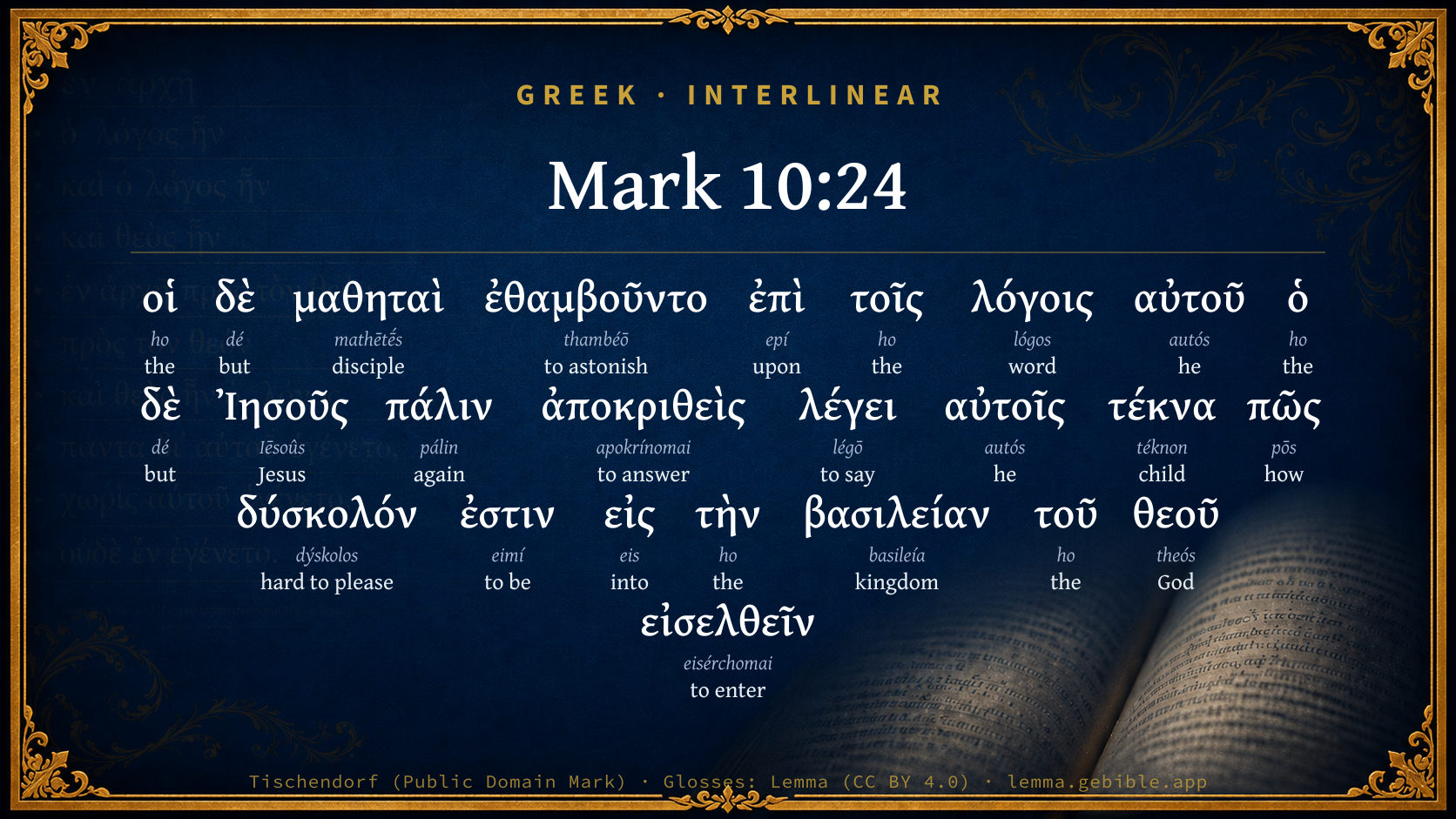
The disciples were amazed at his words. But Jesus answered again, "Children, how hard is it for those who trust in riches to enter into the Kingdom of God!
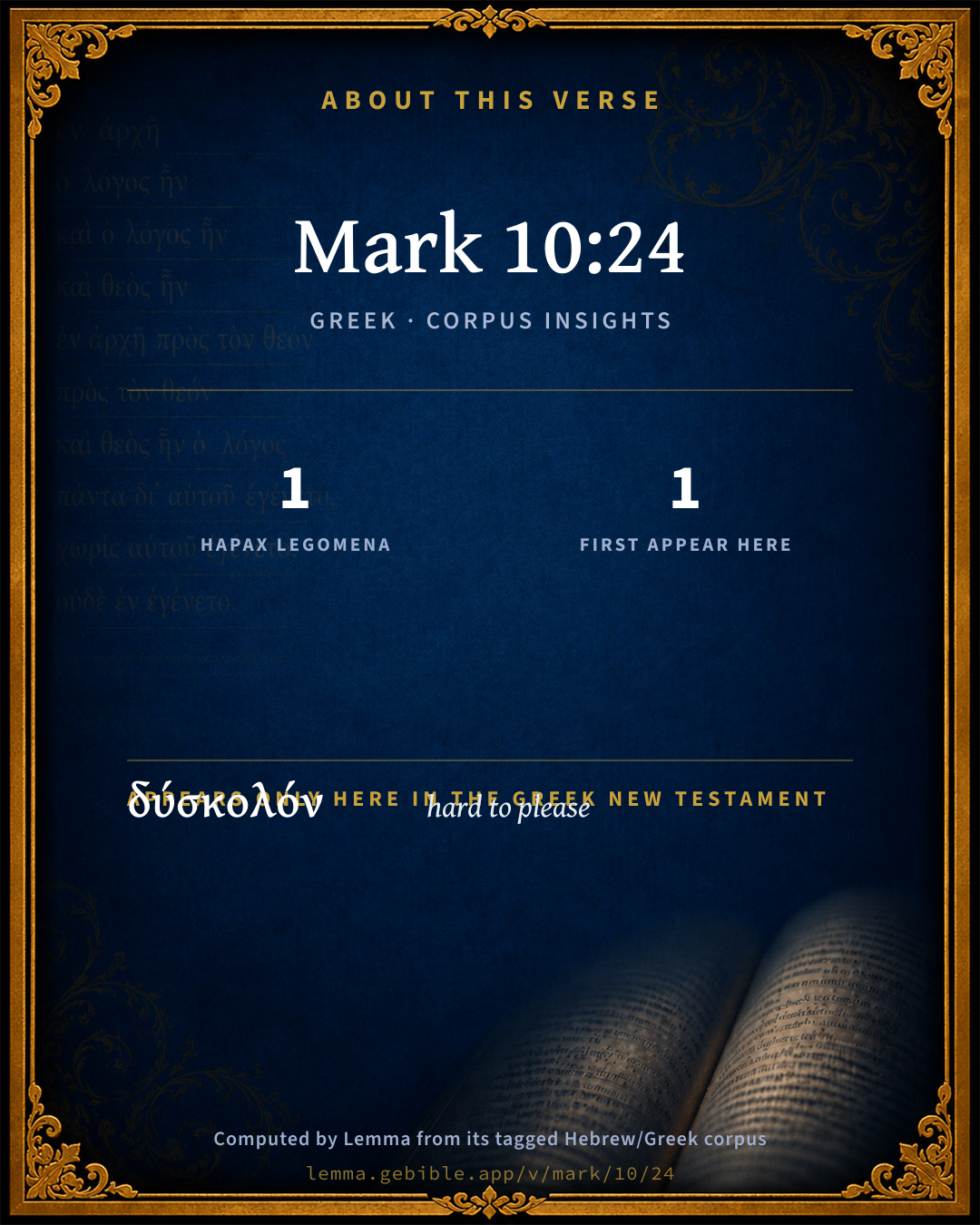
- 1 hapax legomenon — only here in the Greek New Testament
- 1 first appearance in the Greek New Testament
Download a study sheet
One document with this verse’s original text, its word-by-word gloss line, the meaning frame, cross-references with their text, attributed commentary, and full source and license credits — printable, and it pastes into notes with its structure intact.
This verse Autodidact and up
A passage Seminary Student
Up to 50 verses in one chapter. A passage sheet keeps up to 6 commentary sources and 12 cross-references per verse, in the order this page ranks them, and says so on the sheet whenever that leaves anything out. Ask for a single verse and you get the Autodidact verse sheet above.
Everything on this page stays free to read, with no account — the sheet is a download of what is already on screen, not access to it.
Compare translations 3
The same verse in 3 English versions, stacked beneath the original-language interlinear above. Click any original word for its lexicon entry.
Each is an independent rendering of the whole verse — the interlinear is not word-aligned to these translations.
Highlighted words mark where these versions differ — a whole-verse word diff, not a word-by-word alignment.
-
World English Bible Public Domain
The disciples were amazed at his words. But Jesus answered again, "Children, how hard is it for those who trust in riches to enter into the Kingdom of God!
-
King James Version Public Domain
And the disciples were astonished at his words. But Jesus answereth again, and saith unto them, Children, how hard is it for them that trust in riches to enter into the kingdom of God!
-
unfoldingWord Literal Text CC BY-SA 4.0
And the disciples were astonished at his words, but again answering, Jesus says to them, “Children, how hard it is to enter into the kingdom of God!
unfoldingWord Literal Text — © unfoldingWord, licensed CC BY-SA 4.0. Word-aligned USFM3 via Door43 (git.door43.org/unfoldingWord/en_ult).
Show all 19 translations
Every available English version of this verse, each an independent rendering of the whole verse.
-
World English Bible Public Domain
The disciples were amazed at his words. But Jesus answered again, "Children, how hard is it for those who trust in riches to enter into the Kingdom of God!
-
Berean Standard Bible Public Domain
And the disciples were amazed at His words. But Jesus said to them again, “Children, how hard it is to enter the kingdom of God!
-
Majority Standard Bible Public Domain
And the disciples were amazed at His words. But Jesus said to them again, “Children, how hard it is for those who trust in riches to enter the kingdom of God!
-
King James Version Public Domain
And the disciples were astonished at his words. But Jesus answereth again, and saith unto them, Children, how hard is it for them that trust in riches to enter into the kingdom of God!
-
American Standard Version (1901) Public Domain
And the disciples were amazed at his words. But Jesus answereth again, and saith unto them, Children, how hard is it for them that trust in riches to enter into the kingdom of God!
-
Revised Version (1885) Public Domain
And the disciples were amazed at his words. But Jesus answereth again, and saith unto them, Children, how hard is it for them that trust in riches to enter into the kingdom of God!
-
Geneva Bible (1599) Public Domain
And his disciples were afraide at his words. But Iesus answered againe, and sayd vnto them, Children, how hard is it for them that trust in riches, to enter into the kingdome of God!
-
Douay-Rheims (1899) Public Domain
And the disciples were astonished at his words. But Jesus again answering, saith to them: Children, how hard is it for them that trust in riches, to enter into the kingdom of God
-
Young's Literal Translation Public Domain
And the disciples were astonished at his words, and Jesus again answering saith to them, `Children, how hard is it to those trusting on the riches to enter into the reign of God!
-
Literal Standard Version CC BY-SA 4.0
And the disciples were astonished at His words, and Jesus again answering says to them, “Children, how hard it is to those trusting on riches to enter into the Kingdom of God!
-
Unlocked Literal Bible CC BY-SA 4.0
The disciples were astonished at his words. But Jesus said to them again, “Children, how hard it is to enter into the kingdom of God!
-
unfoldingWord Literal Text CC BY-SA 4.0
And the disciples were astonished at his words, but again answering, Jesus says to them, “Children, how hard it is to enter into the kingdom of God!
-
Darby Bible Public Domain
And the disciples were amazed at his words. And Jesus again answering says to them, Children, how difficult it is that those who trust in riches should enter into the kingdom of God!
-
World Messianic Bible Public Domain
The disciples were amazed at his words. But Yeshua answered again, “Children, how hard it is for those who trust in riches to enter into God’s Kingdom!
-
Webster's Bible Public Domain
And the disciples were astonished at his words. But Jesus answereth again, and saith to them, Children, how hard is it for them that trust in riches to enter into the kingdom of God!
-
Free Bible Version CC BY-SA 4.0
The disciples were shocked at this. But Jesus went on, “My friends, it is difficult to enter God's kingdom.
-
Bible in Basic English Public Domain
And the disciples were full of wonder at his words. But Jesus said to them again, Children, how hard it is for those who put faith in wealth to come into the kingdom of God!
-
Text-Critical English NT CC BY 4.0
The disciples were amazed at his words. But Jesus said to them again, “Children, how difficult it is for those who trust in riches to enter the kingdom of God!
-
Tyndale New Testament (1534) Public Domain
And his disciples were astonneyd at his wordes. But Iesus answered agayne and sayde vnto them: chyldre how harde is it for them that trust in riches to entre in to the kyngdome of God.
Literal Standard Version (2020), Covenant Press — licensed CC BY-SA 4.0. Text via the HelloAO Bible API (eBible.org). Unlocked Literal Bible (unfoldingWord) — licensed CC BY-SA 4.0. Text via the HelloAO Bible API (eBible.org). unfoldingWord Literal Text — © unfoldingWord, licensed CC BY-SA 4.0. Word-aligned USFM3 via Door43 (git.door43.org/unfoldingWord/en_ult). Free Bible Version, Dr. Jonathan Gallagher — licensed CC BY-SA 4.0. Text via the HelloAO Bible API (eBible.org).
Word by word
More ways to search: Search by grammar → Find every occurrence → Compare this word →
Practice this passage: Drill this verse → Learn its vocabulary →
- Appears 1× in the Greek New Testament
- First appears here
- Part of Speech
- Adjective
- Case
- Nominative
- Number
- Singular
- Gender
- Neuter
Full Thayer's Definition
- οἱ ho G3588 “the” Article, Nominative, Plural, Masculine
- δὲ dé G1161 “but” Conjunction
- μαθηταὶ mathētḗs G3101 “disciple” Noun, Nominative, Plural, Masculine
- ἐθαμβοῦντο thambéō G2284 “to astonish” Verb, Imperfect, Passive, Indicative, 3rd person, Plural
- ἐπὶ epí G1909 “upon” Preposition
- τοῖς ho G3588 “the” Article, Dative, Plural, Masculine
- λόγοις lógos G3056 “word” Noun, Dative, Plural, Masculine
- αὐτοῦ autós G846 “he” Personal pronoun, Genitive, Singular, Masculine
- ὁ ho G3588 “the” Article, Nominative, Singular, Masculine
- δὲ dé G1161 “but” Conjunction
- Ἰησοῦς Iēsoûs G2424 “Jesus” Noun, Nominative, Singular, Masculine
- πάλιν pálin G3825 “again” Adverb
- ἀποκριθεὶς apokrínomai G611 “to answer” Verb, Aorist, Passive deponent, Participle, Nominative, Singular, Masculine
- λέγει légō G3004 “to say” Verb, Present, Active, Indicative, 3rd person, Singular
- αὐτοῖς autós G846 “he” Personal pronoun, Dative, Plural, Masculine
- τέκνα téknon G5043 “child” Noun, Vocative, Plural, Neuter
- πῶς pōs G4459 “how” Adverb
- δύσκολόν dýskolos G1422 “hard to please” Adjective, Nominative, Singular, Neuter
- ἐστιν eimí G1510 “to be” Verb, Present, Active, Indicative, 3rd person, Singular
- εἰς eis G1519 “into” Preposition
- τὴν ho G3588 “the” Article, Accusative, Singular, Feminine
- βασιλείαν basileía G932 “kingdom” Noun, Accusative, Singular, Feminine
- τοῦ ho G3588 “the” Article, Genitive, Singular, Masculine
- θεοῦ theós G2316 “God” Noun, Genitive, Singular, Masculine
- εἰσελθεῖν eisérchomai G1525 “to enter” Verb, Aorist, Active, Infinitive
About this verse
These counts appear in no published source. They are computed here, from the morphology-tagged text and Lemma’s own curated glosses. What Lemma adds →
- 25
- words
- 19
- distinct lemmas
- Gospels
- section
Notable vocabulary
1 hapax legomenon — a word that appears only here in the entire Greek New Testament:
- δύσκολόν hard to please G1422
First appearance in Scripture
This word makes its first canonical appearance in the Greek New Testament here:
- δύσκολόν hard to please G1422
Shared distinctive vocabulary
ἐθαμβοῦντο to astonish G2284 occurs in 3 verses of the Greek New Testament. Also found in:
Cross-references
26Topical passages linked to Mark 10:24 in the Treasury of Scripture Knowledge — connected by theme and wording, ordered by reader-vote popularity; previews shown in the World English Bible.
- James 5:1–3 Come now, you rich, weep and howl for your miseries that are coming on you.
- Proverbs 11:28 He who trusts in his riches will fall, But the righteous shall flourish as the green leaf.
- Psalms 52:7 "Behold, this is the man who didn't make God his strength, But trusted in the abundance of his riches, And strengthened himself in his wickedness."
- 1 Timothy 6:17 Charge those who are rich in this present world that they not be haughty, nor have their hope set on the uncertainty of riches, but on the living God, who richly provides us with everything to enjoy;
- Revelation 3:17 Because you say, 'I am rich, and have gotten riches, and have need of nothing;' and don't know that you are the wretched one, miserable, poor, blind, and naked;
- Psalms 62:10 Don't trust in oppression. Don't become vain in robbery. If riches increase, Don't set your heart on them.
- Proverbs 18:11 The rich man's wealth is his strong city, Like an unscalable wall in his own imagination.
- Luke 12:16–21 He spoke a parable to them, saying, "The ground of a certain rich man brought forth abundantly.
- Luke 16:14 The Pharisees, who were lovers of money, also heard all these things, and they scoffed at him.
- Job 31:24–25 "If I have made gold my hope, And have said to the fine gold, 'You are my confidence;'
- Psalms 17:14 From men by your hand, Yahweh, From men of the world, whose portion is in this life. You fill the belly of your cherished ones. Your sons have plenty, And they store up wealth for their children.
- Psalms 49:6–7 Those who trust in their wealth, And boast in the multitude of their riches--
- Proverbs 23:5 Why do you set your eyes on that which is not? For it certainly sprouts wings like an eagle and flies in the sky.
- Jeremiah 9:23 Thus says Yahweh, Don't let the wise man glory in his wisdom, neither let the mighty man glory in his might, don't let the rich man glory in his riches;
- Ezekiel 28:4–5 by your wisdom and by your understanding you have gotten you riches, and have gotten gold and silver into your treasures;
- Habakkuk 2:9 Woe to him who gets an evil gain for his house, that he may set his nest on high, that he may be delivered from the hand of evil!
- Zephaniah 1:18 Neither their silver nor their gold will be able to deliver them in the day of Yahweh's wrath, but the whole land will be devoured by the fire of his jealousy; for he will make an end, yes, a terrible end, of all those who dwell in the land.
- Luke 18:26–27 Those who heard it said, "Then who can be saved?"
- 1 John 2:1 My little children, I write these things to you so that you may not sin. If anyone sins, we have a Counselor with the Father, Jesus Christ, the righteous.
- Matthew 19:25 When the disciples heard it, they were exceedingly astonished, saying, "Who then can be saved?"
- John 6:60 Therefore many of his disciples, when they heard this, said, "This is a hard saying! Who can listen to it?"
- John 13:33 Little children, I will be with you a little while longer. You will seek me, and as I said to the Jews, 'Where I am going, you can't come,' so now I tell you.
- John 21:5 Jesus therefore said to them, "Children, have you anything to eat?" They answered him, "No."
- Galatians 4:19 My little children, of whom I am again in travail until Christ is formed in you--
- 1 John 4:4 You are of God, little children, and have overcome them; because greater is he who is in you than he who is in the world.
- 1 John 5:21 Little children, keep yourselves from idols.
Cross-references courtesy of OpenBible.info (CC BY 4.0).
Where the printed editions differ
3 variantsPlaces in this verse where the major printed Greek editions disagree on the wording in a way that affects the translation — a comparison of editions, not a manuscript-by-manuscript collation. The editions are the modern critical texts (Nestlé-Aland 28/27, SBL, Westcott-Hort, Tregelles, Tyndale House) and the traditional texts behind the KJV (the Textus Receptus and the Byzantine/Majority text). It is not a claim about which reading is original.
-
Extra text
τοὺς πεποιθότας ἐπὶ
“<the> having trusted upon”
In TregTRByz Not in NA28NA27TynSBLWH -
Extra text
τοῖς
“<the>”
In TR Not in NA28NA27TynSBLWHTregByz -
Extra text
χρήμασιν
“riches”
In TregTRByz Not in NA28NA27TynSBLWHτοὺς πεποιθότας ἐπὶ τοῖς χρήμασιν (tous pepoithotas epi tois chrēmasin) ' having trusted upon riches' is only in traditional manuscripts (Treg+TR+Byz)
Textual data: Translators Amalgamated Greek New Testament (STEPBible TAGNT) · CC BY 4.0.
Lesson kit
Teaching starters — assembled from the data on this page, not authored interpretation. Every prompt links to the verse data it draws on. Edit before teaching.
Mark, in the Gospels, opens this verse with 25 words (19 distinct Greek lemmas). Its most distinctive word is dýskolos (“hard to please”). A historical commentator’s framing appears above. Read the whole chapter for the surrounding context.
Discussion questions
- What does “hard to please” (dýskolos) contribute to the verse as a whole?
- This verse holds 1 word here found nowhere else in the Greek New Testament. What might the rare word draw attention to?
- The word “hard to please” first appears here in Scripture. What is being introduced at this debut?
- Mark 1:27 shares the word «to astonish» with this verse. How do the two illuminate each other?
- “the” occurs 5× in this one verse. What is the effect of the repetition?
- These translations render this verse differently. What is at stake in choosing one wording over another?
- Reading how Tyndale Open Study Notes and Bengel's Gnomon read this verse, where do the two commentators agree and where do they part?
Things to notice
- 1 word in this verse appears nowhere else in the Greek New Testament.
- 1 word makes its first canonical appearance in Scripture here.
- These translations choose different wording for 9 words in this verse.
- “the” occurs 5× in this single verse.
- 19 distinct Greek lemmas span 25 words in this verse.
Commentary
Notes on Mark 10:24 from classic Christian and Jewish commentators (each source and its license shown beneath its notes). The classic Christian expositions comment on the surrounding passage and are grouped to its opening verse, so a note may address several verses; the Jewish commentaries on the Tanakh (Rashi and others) are per-verse, so they appear only where the commentator wrote on this verse.
Lemma curates 59 commentaries, every one of them public domain or Creative Commons licensed, each selected and text-cleaned for this edition rather than reprinted as found. About our sources →
Tyndale Open Study Notes
Tyndale Open Resources
Tyndale Open Study Notes — © Tyndale Open Resources, licensed CC BY-SA 4.0. Text via the HelloAO Bible API.
Bengel's Gnomon
Johann Albrecht Bengel
Bengel's Gnomon of the New Testament — English translation (T&T Clark, Edinburgh, 1860) — public domain. Text from a community e-Sword module.
Expositor's Greek Testament
ed. W. Robertson Nicoll
The Expositor's Greek Testament, edited by W. Robertson Nicoll (1897–1910) — public domain. Text from a community e-Sword module.
Ellicott's Commentary for English Readers
A Bible Commentary for English Readers, edited by Charles John Ellicott (1878–1897) — public domain. Text from a community e-Sword module.
The Cambridge Bible for Schools and Colleges
gen. ed. J. J. S. Perowne
The Cambridge Bible for Schools and Colleges (gen. ed. J. J. S. Perowne; Cambridge University Press, 1878–1918) — public domain. Text from a community e-Sword module.
John Gill's Exposition
John Gill's Exposition of the Whole Bible (1746–1763) — public domain (CC PDM 1.0). Text via the HelloAO Bible API.
Trapp's Complete Commentary
John Trapp
John Trapp, A Commentary or Exposition upon All the Books of the Old and New Testament (1647–1656) — public domain. Text from a community e-Sword module.
The Pulpit Commentary
The Pulpit Commentary (1880–1919), ed. H.D.M. Spence-Jones & Joseph S. Exell — public domain. Text from a community e-Sword module.
John Wesley's Explanatory Notes
John Wesley, Explanatory Notes Upon the Whole Bible (1754–1765) — public domain. Text via the GEBible commentary corpus.
Scofield Reference Notes
C. I. Scofield
The Scofield Reference Bible (1917 edition), notes by C. I. Scofield — public domain. Text from a community e-Sword module.
Cambridge Greek Testament for Schools and Colleges
Cambridge Greek Testament for Schools and Colleges (Cambridge University Press, 1896; 21 vols, various authors incl. Carr, Maclear, Plummer, Farrar, Lumby, Moule, M. R. James, Simcox) — public domain. Text from a community e-Sword module.
Alford’s Greek Testament
Henry Alford
Henry Alford, The Greek Testament (1849–1861) — public domain. Text from a community e-Sword module.
International Critical Commentary
International Critical Commentary — older volumes (1896–1929), various authors — public domain. Text from a community e-Sword module.